Structuring Operative Notes using Active Learning
Kirk Roberts∗ National Library of Medicine
National Institutes of Health Bethesda, MD 20894 [email protected]
Sanda M. Harabagiu
Human Language Technology Research Institute University of Texas at Dallas
Richardson, TX 75080 [email protected]
Michael A. Skinner
University of Texas Southwestern Medical Center Children’s Medical Center of Dallas
Dallas, TX 75235
Abstract
We present an active learning method for placing the event mentions in an operative note into a pre-specified event structure. Event mentions are first classified into ac-tion, peripheral acac-tion, observaac-tion, and report events. The actions are further clas-sified into their appropriate location within the event structure. We examine how uti-lizing active learning significantly reduces the time needed to completely annotate a corpus of 2,820 appendectomy notes.
1 Introduction
Operative reports are written or dictated after ev-ery surgical procedure. They describe the course of the operation as well as any abnormal find-ings in the surgical process. Template-based and structured methods exist for recording the opera-tive note (DeOrio, 2002), and in many cases have been shown to increase the completeness of sur-gical information (Park et al., 2010; Gur et al., 2011; Donahoe et al., 2012). The use of natural language, however, is still preferred for its expres-sive power. This unstructured information is typi-cally the only vehicle for conveying important de-tails of the procedure, including the surgical in-struments, incision techniques, and laparoscopic methods employed.
The ability to represent and extract the infor-mation found within operative notes would enable ∗Most of this work was performed while KR was at the
University of Texas at Dallas.
powerful post-hoc reasoning methods about surgi-cal procedures. First, the completeness problem may be alleviated by indicating gaps in the sur-gical narrative. Second, deep semantic similarity methods could be used to discover comparable op-erations across surgeons and institutions. Third, given information on the typical course and find-ings of a procedure, abnormal aspects of an oper-ation could be identified and investigated. Finally, other secondary use applications would be enabled to study the most effective instruments and tech-niques across large amounts of surgical data.
In this paper, we present an initial method for aligning the event mentions within an operative note to the overall event structure for a procedure. A surgeon with experience in a particular proce-dure first describes the overall event structure. A supervised method enhanced by active learning is then employed to rapidly build an information ex-traction model to classify event mentions into the event structure. This active learning paradigm al-lows for rapid prototyping while also taking ad-vantage of the sub-language characteristics of op-erative notes and the common structure of opera-tive notes reporting the same type of procedure. A further goal of this method is to aid in the eval-uation of unsupervised techniques that can auto-matically discover the event structure solely from the narratives. This would enable all the objectives outlined above for leveraging the unstructured in-formation within operative notes.
This paper presents a first attempt at this ac-tive learning paradigm for structuring appendec-tomy reports. We intentionally chose a well-understood and relatively simple procedure to
sure a straight-forward, largely linear event struc-ture where a large amount of data would be eas-ily available. Section 3 describes a generic frame-work for surgical event structures and the particu-lar structure chosen for appendectomies. Section 4 details the data used in this study. Section 5 de-scribes the active learning experiment for filling in this event structure for operative notes. Section 6 reports the results of this experiment. Section 7 analyzes the method and proposes avenues for fur-ther research. First, however, we outline the small amount of previous work in natural language pro-cessing on operative notes.
2 Previous Work
An early tool for processing operative notes was proposed by Lamiell et al. (1993). They develop an auditing tool to help enforce completeness in operative notes. A syntactic parser converts sen-tences in an operative note into a graph structure that can be queried to ensure the necessary surgical elements are present in the narrative. For appen-dectomies, they could determine whether answers were specified for questions such as “What was the appendix abnormality?” and “Was cautery or drains used?”. Unlike what we propose, they did not attempt to understand the narrative structure of the operative note, only ensure that a small num-ber of important elements were present. Unfortu-nately, they only tested their rule-based system on four notes, so it is difficult to evaluate the robust-ness and generalizability of their method.
More recently, Wang et al. (2014) proposed a machine learning (ML) method to extract patient-specific values from operative notes written in Chinese. They specifically extract tumor-related information from patients with hepatic carcinoma, such as the size/location of the tumor, and whether the tumor boundary is clear. In many ways this is similar in purpose to Lamiell et al. (1993) in the sense that there are operation-specific attributes to extract. However, while the auditing function pri-marily requires knowing whether particular items were stated, their method extracts the particular values for these items. Furthermore, they em-ploy an ML-based conditional random field (CRF) trained and tested on 114 operative notes. The pri-mary difference between the purpose of these two methods and the purpose of our method lies in the attempt to model all the events that characterize a surgery. Both the work of Lamiell et al. (1993)
and Wang et al. (2014) can be used for complete-ness testing, and Wang et al. (2014) can be used to find similar patients. The lack of understand-ing of the event structure, however, prevents these methods from identifying similar surgical methods or unexpected surgical techniques, or from accom-plishing many other secondary use objectives.
In a more similar vein to our own approach, Wang et al. (2012) studies actions (a subset of event mentions) within an operative note. They note that various lexico-syntactic constructions can be used to specify an action (e.g.,incised,the incision was carried,made an incision). Like our approach, they observed sentences can be catego-rized into actions, perceptions/reports, and other (though we make this distinction at the event men-tion level). They adapted the Stanford Parser (Klein and Manning, 2003) with the Specialist Lexicon (Browne et al., 1993) similar to Huang et al. (2005). They do not, however, propose any automatic system for recognizing and categoriz-ing actions. Instead, they concentrate on evalu-ating existing resources. They find that many re-sources, such as UMLS (Lindberg et al., 1993) and FrameNet (Baker et al., 1998) have poor coverage of surgical actions, while Specialist and WordNet (Fellbaum, 1998) have good coverage.
A notable limitation of their work is that they only studied actions at the sentence level, look-ing at the main verb of the independent clause. We have found in our study that multiple actions can occur within a sentence, and we thus study ac-tions at the event mention level. Wang et al. (2012) noted this shortcoming and provide the following illustrative examples:
• The patient wastakento the operating room where general anesthesia wasadministered.
• After the successfulinductionof spinal anes-thesia, she wasplacedsupine on the operat-ing table.
PropBank (Palmer et al., 2005) style predicate-argument structures on thirty common surgical ac-tions.
3 Event Structures in Operative Notes Since operations are considered to be one of the riskier forms of clinical treatment, surgeons fol-low strict procedures that are highly structured and require significant training and oversight. Thus, a surgeon’s description of a particular operation should be highly similar with a different descrip-tion of the same type of operadescrip-tion, even if writ-ten by a different surgeon at a different hospital. For instance, the two examples below were writ-ten by two different surgeons to describe the event of controlling the blood supply to the appendix:
• The 35 mm vascular Endo stapler device was firedacross the mesoappendix...
• The meso appendix wasdividedwith electro-cautery...
In these two examples, the surgeons use different lexical forms (fired vs. divided), syntactic forms (mesoappendix to the right or left of the EVENT),
different semantic predicate-argument structures (INSTRUMENT-EVENT-ANATOMICALOBJECT
vs. ANATOMICALOBJECT-EVENT-METHOD),
and even different surgical techniques (stapling or cautery). Still, these examples describe the same step in the operation and thus can be mapped to the same location in the event structure.
In order to recognize the event structure in op-erative notes, we start by specifying an event structure to a particular operation (e.g., mastec-tomy, appendecmastec-tomy, heart transplant) and create a ground-truth structure based on expert knowl-edge. Our goal is then to normalize the event men-tions within a operative note to the specific surgi-cal actions in the event structure. While the lex-ical, syntactic, and predicate-argument structures vary greatly across the surgeons in our data, many event descriptions are highly consistent within notes written by the same surgeon. This is es-pecially true of events with little linguistic vari-ability, typically largely procedural but necessary events that are not the focus of the surgeon’s de-scription of the operation. An example of low-variability is the event of placing the patient on the operating table, as opposed to the event of ma-nipulating the appendix to prepare it for removal. Additionally, while there is considerable lexical variation in how an event is mentioned, the
ter-minology for event mentions is fairly limited, re-sulting in reasonable similarity between surgeons (e.g., the verbal description used for the dividing of the mesoappendix is typically one of the fol-lowing mentions: fire,staple,divide,separate, re-move).
3.1 Event Structure Representation
Operative notes contain event mentions of many different event classes. Some classes correspond to actions performed by the surgeon, while oth-ers describe findings, provide reasonings, or dis-cuss interactions with patients or assistants. These distinctions are necessary to recognizing the event structure of an operation, in which we are primar-ily concerned with surgical actions. We consider the following event types:
• ACTION: the primary types of events in an
operation. These typically involve physi-cal actions taken by the surgeon (e.g., cre-ating/closing an incision, dividing tissue), or procedural events (e.g., anesthesia, transfer to recovery). With limited exceptions, AC -TIONs occur in a strict order and theith AC -TION can be interpreted as enabling the(i+
1)th ACTION.
• P ACTION: the peripheral actions that are
optional, do not occur within a specific place in the chain of ACTIONs, and are not
consid-ered integral to the event structure. Examples include stopping unexpected bleeding and re-moving benign cysts un-connected with the operation.
• OBSERVATION: an event that denotes the
act of observing a given state. OBSERVA -TIONs may lead to ACTION (e.g., the
ap-pendix is perforated and therefore needs to be removed) or P ACTIONs (e.g., a cyst is
found). They may also be elaborations to pro-vide more details about the surgical method being used.
• REPORT: an event that denotes a verbal
in-teraction between the surgeon and a patient, guardian, or assistant (such as obtaining con-sent for an operation).
The primary class of events that we are interested in here are ACTIONs. Abstractly, one can view a
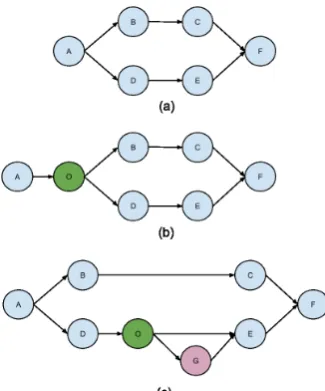
Figure 1: Graphical representation of a surgical procedure with ACTIONs A,B,C,D,E, andF,
OBSERVATION O, and P ACTION G. (a) strict
surgical graph (only actions), (b) surgical graph with an observation invoking an action, (c) surgi-cal graph with an observation invoking a periph-eral action.
path between the start and end nodes.
In its simplest form, a surgical graph is com-posed entirely of ACTIONnodes (see Figure 1(a)).
It is possible to add expected OBSERVATIONs
that might trigger a different ACTION path
(Fig-ure 1(b)). Finally, P ACTIONs can be represented
as optional nodes in the surgical graph, which may or may not be triggered by OBSERVATIONs
(Fig-ure 1(c)). This graphical model is simply a con-ceptual aid to help design the action types. The model currently plays no role in the automatic classification. For the remainder of this section we focus on a relatively limited surgical proce-dure that can be interpreted as a linear chain of ACTIONs.
3.2 Appendectomy Representation
Acute appendicitis is a common condition requir-ing surgical management, and is typically treated by removing the appendix, either laparoscopically or by using an open technique. Appendectomies are the most commonly performed urgent surgi-cal procedure in the United States. The procedure is relatively straight-forward, and the steps of the procedure exhibit little variation between differ-ent surgeons. The third author (MS), a surgeon with more than 20 years of experience in pedi-atric surgery, provided the following primary AC -TIONs:
• APP01: transfer patient to operating room
• APP02: place patient on table
• APP03: anesthesia
• APP04: prep
• APP05: drape
• APP06: umbilical incision
• APP07: insert camera/telescope
• APP08: insert other working ports
• APP09: identify appendix
• APP10: dissect appendix away from other
structures
• APP11: divide blood supply
• APP12: divide appendix from cecum
• APP13: place appendix in a bag
• APP14: remove bag from body
• APP15: close incisions
• APP16: wake up patient
• APP17: transfer patient to post-anesthesia
care unit
In the laparoscopic setting, each of these actions is a necessary part of the operation, and most should be recorded in the operative note. Additionally, any number of P ACTION, OBSERVATION, and
REPORTevents may be interspersed.
4 Data
In accordance with generally accepted medical practice and to comply with requirements of The Joint Commission, a detailed report of any surgical procedure is placed in the medical record within 24 hours of the procedure. These notes include the preoperative diagnosis, the post-operative diagno-sis, the procedure name, names of surgeon(s) and assistants, anesthetic method, operative findings, complications (if any), estimated blood loss, and a detailed report of the conduct of the procedure. To ensure accuracy and completeness, such notes are typically dictated and transcribed shortly after the procedure by the operating surgeon or one of the assistants.
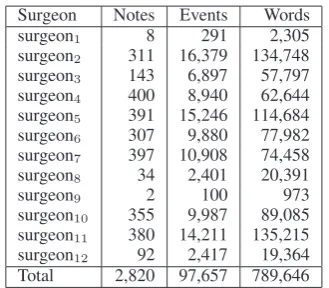
Surgeon Notes Events Words surgeon1 8 291 2,305 surgeon2 311 16,379 134,748 surgeon3 143 6,897 57,797 surgeon4 400 8,940 62,644 surgeon5 391 15,246 114,684 surgeon6 307 9,880 77,982 surgeon7 397 10,908 74,458 surgeon8 34 2,401 20,391
surgeon9 2 100 973
[image:5.595.98.263.60.204.2]surgeon10 355 9,987 89,085 surgeon11 380 14,211 135,215 surgeon12 92 2,417 19,364 Total 2,820 97,657 789,646
Table 1: Overview of corpus by surgeon.
laparoscopic appendectomies and 63 open proce-dures. The records were then processed automat-ically to remove any identifying information such as names, hospital record numbers, and dates. For the purposes of this investigation, only the sur-geon’s name and the detailed procedure note were collected for further study. Owing to the complete anonymity of the records, the study received an ex-emption from the University of Texas Southwest-ern Medical Center and CMC Institutional Review Boards. Table 1 contains statistics about the distri-bution of notes by surgeon in our dataset.
5 Active Learning Framework
Active learning is becoming a more and more popular framework for natural language annota-tion in the biomedical domain (Hahn et al., 2012; Figueroa et al., 2012; Chen et al., 2013a; Chen et al., 2013b). In an active learning setting, instead of performing manual annotation separate from auto-matic system development, an existing ML classi-fier is employed to help choose which examples to annotate. Thus, human annotators can focus on examples that would prove difficult for a classifier, which can dramatically reduce overall annotation time. However, active learning is not without pit-falls, notably sampling bias (Dasgupta and Hsu, 2008), re-usability (Tomanek et al., 2007), and class imbalance (Tomanek and Hahn, 2009). In our work, the purpose of utilizing an active learn-ing framework is to produce a fully-annotated cor-pus of labeled event mentions in as small a period of time as possible. To some extent, the goal of full-annotation alleviates some of the active learn-ing issues discussed above (re-usability and class imbalance), but sampling bias could still lead to significantly longer annotation time.
Our goal is to (1) distinguish event mentions in one of the four classes introduced in Section 3.1
(event type annotation), and (2) further classify ac-tions into their appropriate location in the event structure (on this data, appendectomy type anno-tation). While most active learning methods are used with the intention of only manually labeling a sub-set of the data, our goal is to annotate every event mention so that we may ultimately evaluate unsupervised techniques on this data. Our active learning experiment thus proceeds in two paral-lel tracks: (i) a traditional active learning process where the highest-utility unlabeled event mentions are classified by a human annotator, and (ii) a batch annotation process where extremely simi-lar, “easy” examples are annotated in large groups. Due to small intra-surgeon language variation, and relatively small inter-surgeon variation due to the limited terminology, this second process allows us to annotate large numbers of unlabeled examples at a time. The batch labeling largely annotates un-labeled examples that would not be selected by the primary active learning module because they are too similar to the already-labeled examples. After a sufficient amount of time being spent in tradi-tional active learning, the batch labeling is used to annotate until the batches produced are insuf-ficiently similar and/or wrong classifications are made. After a sufficent number of annotations are made with the active learning method, the choice of when to use the active learning or batch tation method is left to the discretion of the anno-tator. This back-and-forth is then repeated itera-tively until all the examples are annotated.
For both the active learning and batch labeling processes, we use a multi-class support vector ma-chine (SVM) using a simple set of features:
F1. Event mention’s lexical form (e.g.,identified) F2. Event mention’s lemma (identify)
F3. Previous words (3-the,2-appendix,1-was) F4. Next words (1-and, 2-found, 3-to, 4-be,
5-ruptured)
F5. Whether the event is a gerund (false)
Features F3 and F4 were constrained to only return words within the sentence.
To sample event mentions for the active learner, we combine several sampling techniques to ensure a diversity of samples to label. This meta-sampler chooses from 4 different samplers with differing probabilityp:
1. UNIFORM: Choose (uniformly) an unlabeled
set of manually labeled instances. Then, the probability of selecting an eventeiis:
PU(ei)∝δ(ei ∈ L/ )
Whereδ(x)is the delta function that returns 1 if the condition xis true, and 0 otherwise. Thus, an unlabeled event has an equal prob-ability of being selected as every other unla-beled event.
2. JACCARD: Choose an unlabeled instance
bi-ased toward those whose word context is least similar to the labeled instances using Jac-card similarity (p = 0.2). This sampler pro-motes diversity to help prevent sampling bias. LetWi be the words in ei’s sentence. Then
the probability of selecting an event with the JACCARDsampler is:
PJ(ei)∝δ(ei ∈ L/ ) min ej∈L
1−WWi∩Wj i∪Wj
α
Here,αis a parameter to give more weight to dissimilar sentences (we setα= 2).
3. CLASSIFIER: Choose an unlabeled instance
biased toward those the SVM assigned low confidence values (p = 0.65). Formally, let
fc(ei)be the confidence assigned by the
clas-sifier to eventei. Then, the probability of
se-lecting an event with the CLASSIFIER
sam-pler is:
PC(ei)∝δ(ei ∈ L/ )(1−fc(ei))
The SVM we use provides confidence values largely in the range (-1, 1), but for some very confident examples this value can be larger. We therefore constrain the raw confidence valuefr(ei)and place it within the range [0,
1] to achieve the modified confidencefc(ei)
above:
fc(ei) =max(min(fr(e2i),1),−1) + 1
In this way, fc(ei) can be guaranteed to be
within [0, 1] and can thus be interpreted as a probability.
4. MISCLASSIFIED: Choose (uniformly) a la-beled instance that the SVM mis-classifies during cross-validation (p= 0.05). Letf(ei)
be the classifier’s guess and L(ei) be the
manual label for event ei. Then the
proba-bility of selecting an event is:
PM(ei)∝δ(ei ∈ L)δ(f(ei)6=L(ei))
Event Type Precision Recall F1
ACTION 0.79 0.90 0.84
NOTEVENT 0.75 0.82 0.79
OBSERVATION 0.71 0.57 0.63
P ACTION 0.66 0.40 0.50
REPORT 1.00 0.58 0.73
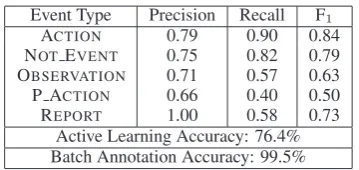
[image:6.595.326.506.60.145.2]Active Learning Accuracy: 76.4% Batch Annotation Accuracy: 99.5%
Table 2: Classification results for event types. Ex-cept when specified, results are for data annotated using the active learning method, while the batch annotation results include all data.
The first annotation was made using the UNIFORM
sampler. For every new annotation, the meta-sampler chooses one of the above sampling meth-ods according to the abovepvalues, and that sam-pler selects an example to annotate. For each se-lected sample, it is first assigned an event type. If it is assigned as an ACTION, the annotator further
as-signs its appropriate action type. The CLASSIFIER
and MISCLASSIFIED samplers alternate between
the event type and action type classifiers. These four samplers were chosen to balance the tra-ditional active learning approach (CLASSIFIER),
while trying to prevent classifier bias (UNIFORM
and JACCARD), while also allowing mis-labeled
data to be corrected (MISCLASSIFIED). An
eval-uation of the utility of the individual samplers is beyond the scope of this work.
6 Results
For event type annotation, two annotators single-annotated 1,014 events with one of five event types (ACTION, P ACTION, OBSERVATION, REPORT,
and NOT EVENT). The classifier’s accuracy on
this data was 75.9% (see Table 2 for a breakdown by event type). However, the examples were cho-sen because they were very different from the cur-rent labeled set, and thus we would expect them to be more difficult than a random sampling. When one includes the examples annotated using batch labeling, the overall accuracy is 99.5%.
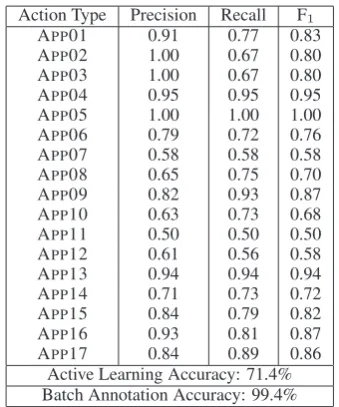
For action type annotation, the same two anno-tators labeled 626 ACTIONs with one of the 17
ac-tion types (APP01–APP17). The classifier’s
Action Type Precision Recall F1 APP01 0.91 0.77 0.83
APP02 1.00 0.67 0.80
APP03 1.00 0.67 0.80
APP04 0.95 0.95 0.95 APP05 1.00 1.00 1.00 APP06 0.79 0.72 0.76 APP07 0.58 0.58 0.58 APP08 0.65 0.75 0.70 APP09 0.82 0.93 0.87 APP10 0.63 0.73 0.68 APP11 0.50 0.50 0.50
APP12 0.61 0.56 0.58
APP13 0.94 0.94 0.94
APP14 0.71 0.73 0.72
APP15 0.84 0.79 0.82
APP16 0.93 0.81 0.87
APP17 0.84 0.89 0.86
[image:7.595.95.265.60.264.2]Active Learning Accuracy: 71.4% Batch Annotation Accuracy: 99.4%
Table 3: Classification results for action types. 7 Discussion
The total time allotted for annotation was approxi-mately 12 hours, split between two annotators (the first author and a computer science graduate stu-dent). Prior to annotation, both annotators were given a detailed description of an appendectomy, including a video of a procedure to help asso-ciate the actual surgical actions with the narrative description. After annotation, 1,042 event types were annotated using the active learning method, 90,335 event types were annotated using the batch method, and 6,279 remained un-annotated. Sim-ilarly, 658 action types were annotated using the active learning method, 35,799 action types were annotated using the batch method, and 21,151 re-mained un-annotated. A greater proportion of ac-tions remained un-annotated due to the lower clas-sifier confidence associated with the task. Event and action types were annotated in unison, but we estimate during the active learning process it took about 25 seconds to annotate each event (both the event type and the action type if classified as an ACTION). The batch process enabled the
annota-tion of an average of 3 event menannota-tions per second. This rapid annotation was made possible by the repetitive nature of operative notes, especially within an individual surgeon’s notes. For exam-ple, the following statements were repeated over 100 times in our corpus:
• General anesthesia wasinduced.
• A Foley catheter was placed under sterile conditions.
• The appendix was identified and seemed to be acutelyinflamed.
The first example was used by an individual sur-geon in 95% of his/her notes, and only used three times by a different surgeon. In the second exam-ple, the sentence is used in 77% of the surgeon’s notes while only used once by another surgeon. The phrase “Foley catheter was placed”, however, was used 133 times by other surgeons. In the con-text of an appendectomy, this action is unambigu-ous, and so only a few annotations are needed to recognize the hundreds of actual occurrences in the data. Similarly, with the third example, the phrase “the appendix was identified” was used in over 600 operative notes by 10 of the 12 surgeons. After a few manual annotations to achieve suffi-cient classification confidence, the batch process can identify duplicate or near-duplicate events that can be annotated at once, greatly reducing the time needed to achieve full annotation.
Unfortunately, the most predictable parts of a surgeon’s language are typically the least inter-esting from the perspective of understanding the critical points in the narrative. As shown in the examples above, the highest levels of redundancy are found in the most routine aspects of the op-eration. The batch annotation, therefore, is quite biased and the 99% accuracies it achieves cannot be expected to hold up once the data is fully an-notated. Conversely, the active learning process specifically chooses examples that are different from the current labeled set and thus are more dif-ficult to classify. Active learning is more likely to sample from the “long tail” than the most frequent events and actions, so the performance on the cho-sen sample is certainly a lower bound on the per-formance of a completely annotated data set. If one assumes the remaining un-annotated data will be of similar difficulty to the data sampled by the active learner, one could project an overall event type accuracy of 97% and an overall action type accuracy of 89%. This furthermore assumes no improvements are made to the machine learning method based on this completed data.
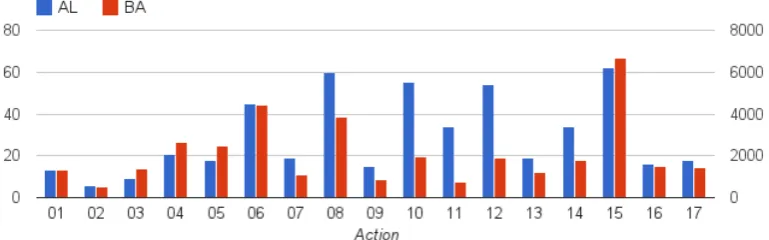
One way to estimate the potential bias in batch annotation is by observing the differences in the distributions of the two data sets. Figure 2 shows the total numbers of action types for both the active learning and batch annotation portions of the data. For the most part, the distributions are similar. APP08 (insert other working ports),
APP10 (dissect appendix away from other
(di-Figure 2: Frequencies of action types in the active learning (AL) portion of the data set (left vertical axis) and the batch annotation (BA) portion of the data set (right vertical axis).
vide appendix from cecum), and APP14 (remove
bag from body) are the most under-represented in the batch annotation data. This confirms our hy-pothesis that some of the most interesting events have the greatest diversity in expression.
In Section 2 we noted that a limitation of the an-notation method of Wang et al. (2012) was that a sentence could only have one action. We largely overcame this problem by associating a single sur-gical action with an event mention. This has one notable limitation, however, as occasionally a sin-gle event mention corresponds to more than one action. In our data, APP11 and APP12 are
com-monly expressed together:
• Next, the mesoappendix and appendix is stapledAPP11/APP12 and then the appendix is
placedAPP13in an endobag.
Here, a coordination (“mesoappendix and ap-pendix”) is used to associate two events (the sta-pling of the mesoappendix and the stasta-pling of the appendix) with the same event mention. In the event extraction literature, this is a well-understood occurrence, as for instance TimeML (Pustejovsky et al., 2003) can represent more than one event with a single event mention. In practice, however, few automatic TimeML systems handle such phenomena. Despite this, for our purpose the annotation structure should likely be amended so that we can account for all the important actions in the operative note. This way, gaps in our event structure will correspond to actual gaps in the nar-rative (e.g., dividing the blood supply is a critical step in an appendectomy and therefore needs to fit within the event structure).
Finally, the data in our experiment comes from a relatively simple procedure (an appendectomy). It is unclear how well this method would general-ize to more complex operations. Most likely, the
difficulty will lie in actions that are highly ambigu-ous, such as if more than one incision is made. In this case, richer semantic information will be necessary, such as the spatial argument that indi-cates where a particular event occurs (Roberts et al., 2012).
8 Conclusion
With the increasing availability of electronic oper-ative notes, there is a corresponding need for deep analysis methods to understand the note’s narra-tive structure to enable applications for improving patient care. In this paper, we have presented a method for recognizing how event mentions in an operative note fit into the event structure of the ac-tual operation. We have proposed a generic frame-work for event structures in surgical notes with a specific event structure for appendectomy tions. We have described a corpus of 2,820 opera-tive notes of appendectomies performed by 12 sur-geons at a single institution. With the ultimate goal of fully annotating this data set, which contains al-most 100,000 event mentions, we have shown how an active learning method combined with a batch annotation process can quickly annotate the ma-jority of the corpus. The method is not without its weaknesses, however, and further annotation is likely necessary.
[image:8.595.111.496.74.194.2]Acknowledgments
The authors would like to thank Sanya Peshwani for her help in annotating the data.
References
Collin F. Baker, Charles J. Fillmore, and John B. Lowe. 1998. The Berkeley FrameNet project. In Proceed-ings of ACL/COLING.
Allen C. Browne, Alexa T. McCray, and Suresh Srini-vasan. 1993. The SPECIALIST Lexicon. Tech-nical Report NLM-LHC-93-01, National Library of Medicine.
Yukun Chen, Hongxin Cao, Qiaozhu Mei, Kai Zheng, and Hua Xu. 2013a. Applying active learning to su-pervised word sense disambiguation in MEDLINE.
J Am Med Inform Assoc, 20:1001–1006.
Yukun Chen, Robert Carroll, Eugenia R. McPeek Hinz, Anushi Shah, Anne E. Eyler, Joshua C. Denny, , and Hua Xu. 2013b. Applying active learning to high-throughput phenotyping algorithms for elec-tronic health records data. J Am Med Inform Assoc, 20:e253–e259.
Sanjoy Dasgupta and Daniel Hsu. 2008. Hierarchical Sampling for Active Learning. InProceedings of the International Conference on Maching Learning. J.K. DeOrio. 2002. Surgical templates for orthopedic
operative reports.Orthopedics, 25(6):639–642. Laura Donahoe, Sean Bennett, Walley Temple, Andrea
Hilchie-Pye, Kelly Dabbs, Ethel MacIntosh, and Ge-off Porter. 2012. Completeness of dictated oper-ative reports in breast cancer–the case for synoptic reporting.J Surg Oncol, 106(1):79–83.
Christiane Fellbaum. 1998. WordNet: An Electronic Lexical Database. MIT Press.
Rosa L. Figueroa, Qing Zeng-Treitler, Long H. Ngo, Sergey Goryachev, and Eduardo P. Wiechmann. 2012. Active learning for clinical text classification: is it better than random sampling? J Am Med Inform Assoc, 19:809–816.
I. Gur, D. Gur, and J.A. Recabaren. 2011. The com-puterized synoptic operative report: A novel tool in surgical residency education. Arch Surg, pages 71– 74.
Udo Hahn, Elena Beisswanger, Ekaterina Buyko, and Erik Faessler. 2012. Active Learning-Based Corpus Annotation – The PATHOJENExperience. In Pro-ceedings of the AMIA Symposium, pages 301–310. Yang Huang, Henry J Lowe, Dan Klein, and
Rus-sell J Cucina. 2005. Improved Identification of Noun Phrases in Clinical Radiology Reports Using a High-Performance Statistical Natural Language Parser Augmented with the UMLS Specialist Lex-icon.J Am Med Inform Assoc, 12:275–285.
Dan Klein and Christopher D. Manning. 2003. Accu-rate Unlexicalized Parsing. InProceedings of ACL, pages 423–430.
James M Lamiell, Zbigniew M Wojcik, and John Isaacks. 1993. Computer Auditing of Surgical Op-erative Reports Written in English. InProc Annu Symp Comput Appl Med Care, pages 269–273. Donald A.B. Lindberg, Betsy L. Humphreys, and
Alexa T. McCray. 1993. The Unified Medical Lan-guage System.Methods of Information in Medicine, 32(4):281–291.
Martha Palmer, Paul Kingsbury, and Daniel Gildea. 2005. The Proposition Bank: An Annotated Cor-pus of Semantic Roles. Computational Linguistics, 31(1):71–106.
Jason Park, Venu G. Pillarisetty, Murray F. Brennan, andet al. 2010. Electronic Synoptic Operative Re-porting: Assessing the Reliability and Completeness of Synoptic Reports for Pancreatic Resection. J Am Coll Surgeons, 211(3):308–315.
James Pustejovsky, Jos´e Castano, Robert Ingria, Roser Saur´ı, Robert Gaizauskas, Andrea Setzer, Graham Katz, and Dragomir Radev. 2003. TimeML: Ro-bust Specification of Event and Temporal Expres-sions in Text. InProceedings of the Fifth Interna-tional Workshop on ComputaInterna-tional Semantics. Kirk Roberts, Bryan Rink, Sanda M. Harabagiu,
Richard H. Scheuermann, Seth Toomay, Travis Browning, Teresa Bosler, and Ronald Peshock. 2012. A Machine Learning Approach for Identi-fying Anatomical Locations of Actionable Findings in Radiology Reports. InProceedings of the AMIA Symposium.
Katrin Tomanek and Udo Hahn. 2009. Reducing Class Imbalance during Active Learning for Named Entity Annotation. InProceedings of KCAP.
Katrin Tomanek, Joachim Wermter, and Udo Hahn. 2007. An Approach to Text Corpus Construc-tion which Cuts AnnotaConstruc-tion Costs and Maintains Reusability of Annotated Data. InProceedings of EMNLP/CoNLL, pages 486–495.
Yan Wang, Serguei Pakhomov, Nora E. Burkart, James O. Ryan, and Genevieve B. Melton. 2012. A Study of Actions in Operative Notes. In Proceed-ings of the AMIA Symposium, pages 1431–1440. Yan Wang, Serguei Pakhomov, and Genevieve B
Melton. 2013. Predicate Argument Structure Frames for Modeling Information in Operative Notes. InStudies in Health Technology and Infor-matics (MEDINFO), pages 783–787.