A Multilingual Entity Linker Using PageRank and Semantic Graphs
Anton S¨odergren
Department of computer science Lund University, Lund [email protected]
Pierre Nugues
Department of computer science Lund University, Lund [email protected]
Abstract
This paper describes HERD, a multilin-gual named entity recognizer and linker. HERD is based on the links in Wikipedia to resolve mappings between the entities and their different names, and Wikidata as a language-agnostic reference of entity identifiers.
HERD extracts the mentions from text us-ing a strus-ing matchus-ing engine and links them to entities with a combination of rules, PageRank, and feature vectors based on the Wikipedia categories. We evalu-ated HERD with the evaluation protocol of ERD’14 (Carmel et al., 2014) and we reached the competitive F1-score of 0.746 on the development set. HERD is de-signed to be multilingual and has versions in English, French, and Swedish.
1 Introduction
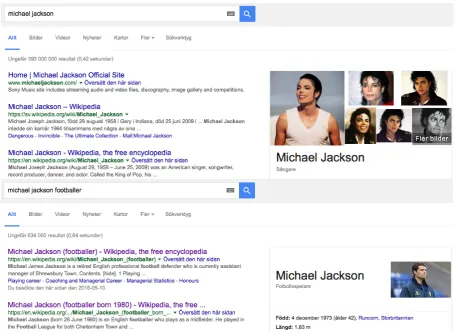
Named entity recognition (NER) refers to the pro-cess of finding mentions of persons, locations, and organizations in text, while entity linking (or disambiguation) associates these mentions with unique identifiers. Figure 1 shows an example of entity linking with the mentionMichael Jackson, an ambiguous name that may refer to thousands of people and where 21 are famous enough to have a Wikipedia page (Wikipedia, 2016). In Fig. 1, the search engine selected the most popular entity (top) and used the cue wordfootballer(bottom) to link the phraseMichael Jackson footballerto the English defender born in 1973.
Entity recognition and linking has become a crucial component to many language process-ing applications: Search engines (Sprocess-inghal, 2012), question answering (Ferrucci, 2012), or dialogue agents. This importance is reflected by a growing number of available systems; see TAC-KBP2015
(Ji et al., 2015), for instance, with 10 participating teams.
Although many applications include entity link-ers, the diversity of the input texts, which can in-clude tweets, search queries, news wires, or en-cyclopedic articles, makes their evaluation prob-lematic. While some evaluations consider entity linking in isolation and mark the mentions in the input, end-to-end pipelines, where the input con-sists of raw text, need to combine entity recogni-tion and linking. The ERD’14 challenge (Carmel et al., 2014) is an example of the latter.
2 Previous Work
Entity linking has spurred a considerable amount of work over the last 10 years. Bunescu and Pasca (2006), Mihalcea and Csomai (2007), and Cucerzan (2007) used Wikipedia as a knowledge source and its articles to define the entities, its hy-perlinks to find the mentions, and semantic knowl-edge from redirect pages and categories, to carry out disambiguation. Milne and Witten (2008) used the likelihood of an entity given a mention M,
P(E|M), and a relatedness metric between two entities computed from the links to their corre-sponding pages to improve both recall and pre-cision. Ferragina and Scaiella (2010) addressed shorter pieces of text with the idea to use a collec-tive agreement between all the entities.
The Entity Recognition and Disambiguation Challenge (ERD’14) (Carmel et al., 2014) is a re-cent evaluation, where competitors were given a set of entities to recognize and link in a corpus of unlabelled text. This setting is closer to real world application than TAC (Ji et al., 2015), where par-ticipants have to link already bracketed mentions. The evaluation included two tracks: one with long documents of an average size of 600 words and a short track consisting of search query.
Finally, the CoNLL-2003 shared task (Tjong Kim Sang and De Meulder, 2003) is an
Figure 1: Search results for the queriesMichael Jackson andMichael Jackson footballer. The engine returns the most popular entity (top) and uses the minimal context given in the query, footballer, to propose a less popular entity (bottom)
tial evaluation of language independent named en-tity recognition, with a focus on German and En-glish. Hoffart et al. (2011) linked the names in the English corpus to Wikipedia pages making this dataset a useful corpus for entity linking.
In this paper, we used the ERD’14 development set as well as the CoNLL-2003 dataset with Wiki-data links.
3 Building the Entity Knowledge Base
3.1 Mention-Entity Pairs
Following Mihalcea and Csomai (2007) and Bunescu and Pasca (2006), we collected the mention-entity pairs from the Wikipedia links (wikilinks). We built the entity base from the from three versions of Wikipedia: English, French, and Swedish, and the frequency of the wikilinks in each version. Figure 2 shows an example of a pair with the mentionSwedish Parliament. This gives suggestions of how an entity is commonly referred to: i.e. its name or aliases.
Figure 2: The structure of wikilinks in Wikipedia.
3.2 Entity Nomenclature
As nomenclature for the entities, we used Wiki-data, the linked database of Wikimedia. Wikidata connects the different language versions of each article in Wikipedia with a unique identifier called the Q-number. In addition to being a cross-lingual repository, Wikidata also links a large number of entities to structured information such as the dates of birth and death for persons.
[image:2.595.312.522.467.521.2]algo-rithm must recreate the address from the titles. We could reach a coverage of about 90%. The re-maining 10% corresponds to redirect pages that act as alternative names or to cover common mis-spellings. We used the Wikipedia dump to identify these redirects and we improved the coverage rate to 99.1%.
3.3 Annotating the Mentions
We annotated the mention-entity pairs in our knowledge base with a set of features that we used in the subsequent processing:
1. TheFrequency of the mention-entity pairs.
Table 1 shows an example for the city of Hon-olulu.
2. We used dictionaries of common nouns, verb, and adjectives for each language. If a men-tion only consists of words in the dicmen-tionary, we mark it asonly-dictionary. An
exam-ple of this is the artistPrincein English and French.
3. We computed a list of the most frequent words (stop words) from Wikipedia for each language. They includethe,in,and, anda, in English. If all the words in a mention are stop words, we mark it asonly-stop-words.
4. The system marks the mentions with a high number of links as highly-ambiguous,
such asJohnordetailswith almost 5,000 dif-ferent entities linked to each.
5. Mentions without uppercase letters are marked aslower-case.
6. Family names and surnames. If the most common mention of a person has more than two words, we mark each mention of one word asgeneric, such as the mention Bush
referring to the former president George W. Bush.
7. We also annotate the entities with their fre-quency (total-frequency). It corresponds
to the sum of all their mentions frequencies.
3.4 Pruning the Knowledge Base
Although Wikipedia is reviewed by scores of vol-unteers, there are plenty of misleading mentions in the collected knowledge base. We removed a part of them using the following rules:
1. The mention is marked as lower-case
and either only-dictionary or only-stop-words
2. Thefrequency of the entity-mention is
ex-actly 1, while thetotal-frequencyof that
entity is above a threshold parameter that was empirically obtained.
3. The mention consists of two or more words, and starts with a lower-case stop word, that is not a definite article. This will filter out anchors of the typea city in Sweden.
We also clustered the mentions with a normal-ized Levenshtein distance (Levenshtein, 1966). If the distance was less than 0.2 to any element, they were considered to be in the same group. We ap-plied the clustering to all the surface forms and we discarded the mentions without a group.
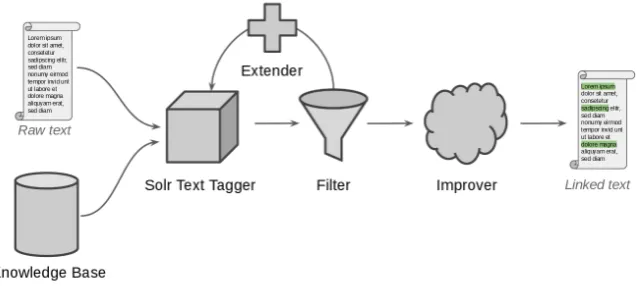
4 System Components and Pipeline The system consists of three main components: a spotter that identifies the mentions, a set of rules that prunes the results, and an improver that uses contextual clues for entity recognition (Fig. 3).
The spotter outputs a match for every conceiv-able mention of an entity, leaving us with a doc-ument where almost every word is tagged as an entity. This output has a very high recall, but a very low precision.
The filtering that comes after that tries to re-move the most unlikely of the alternatives from the spotter and raises the precision to a modest level while trying to have a minimal impact on the re-call. If the input data to the next step is completely unfiltered the Contextual Improver is unable to af-fect the results in a positive way.
The Contextual Improver is the final step and uses contextual clues, such as which categories the entities belong to and which entities are commonly seen together, to improve the result.
4.1 Mention Spotting
Mention Entity Frequency Mention Entity Frequency
Honolulu Q18094 5117 Hawaii Q18094 11
Honolulu, Hawaii Q18094 2281 Honolulu, HI MSA Q18094 7
Honolulu, HI Q18094 600 HONOLULU Q18094 7
Honolulu, Hawaii, USA Q18094 67 city of Honolulu Q18094 7
Honolulu, Hawai’i Q18094 47 honolulu Q18094 5
Honolulu, Hawai’i Q18094 21 Honululu Q18094 5
[image:4.595.87.511.61.173.2]Honolulu CPD Q18094 21
Table 1: An example of the mention-entity counts for the entity Q18094, most commonly called Hon-olulu
Figure 3: The system architecture, where the knowledge base contains the mention-entity pairs
Lucene open-source software and its implementa-tion of finite-state transducers.
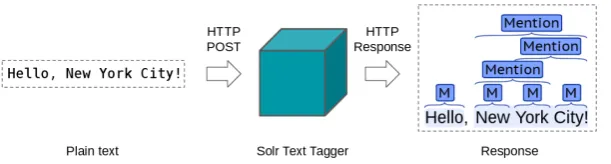
As a preprocessing step, Solr Text Tagger com-piles all the mentions in the knowledge base, where the input labels are the letters and symbols of mentions and the output labels are the entity identifiers. Then, given an untagged text, the tag-ger marks all the occurrences, possibly overlap-ping, of all the names in the database. See Fig. 4.
4.2 Filtering and Expansion
The output of the Spotter is usually very noisy as most words can match some mention in the knowledge base. Examples include It, a novel by Stephen King, or Is This It, an album by The Strokes. The result is a high mention recall, but a low precision. We applied filters to remove some matches and improve the precision while preserv-ing the recall.
The system uses a set of manually-written rules and empirically obtained hyper parameters to im-prove precision with a minimal effect on recall. We describe them in the sections below. The com-plete list of parameter values is provided in the
HERD source code available from GitHub1.
4.2.1 Mention Probability
We computed the probability for a term or a phrase to be a link over the whole Wikipedia (Eckhardt et al., 2014) using the formula: Mention probability= f reqlink((mentionmention)). This gives a hint at whether a word sequence is more com-monly used as a mention of entities or just as words.
Medical Center, for example, is linked 1.0% of the times used, whileMedical Center of Central Georgiahas a mention probability of 73.7%.
Any candidate that had less than 0.5% mention probability was immediately pruned.
4.2.2 Filters to Improve Precision
Filters are rules based on syntactical clues and the flags defined in Sect. 3.3. Each matching rule re-turns a suspicion score and we compute the sum of the scores. The most significant rules are:
[image:4.595.142.461.229.372.2]dramatically. We improved it with a func-tion that takes into considerafunc-tion the number of capital letters, whether the mention is the start of a new sentence and whether the men-tion has the only-dictionary tag.
Head-lines also use capitalized words. We recog-nize fully capitalized sentences with regular expressions. Mentions in headlines with the
only-dictionary, or only-stop-words
tags, generate suspicion.
2. Generic names: We apply a two-pass analy-sis forgenericmentions. We remove them
from the first pass. In a second pass, the generic names are restored if a mention of the same entity that is not generic shows in the text i.e. theBushmention is kept only when there is a full mention ofGeorge W. Bushin the text. This is to avoid the tagging of the mention Bush with every entity having this name as a generic name.
3. Colliding names: If two tags are immediate neighbors, with the exception of a space, they generate suspicion. The system considers all the candidate entities for a surface form, and only triggers suspicion if at least one of the entities is a generic name. This is a method to detect and avoid tagging a multiword name which does not exist in our knowledge base with multiple other candidates.
4.2.3 Extender to Improve Recall
We extended the detected mentions following the work of Eckhardt et al. (2014). Once we recog-nize a mention consisting of two words or more that passed the filter, we create new mentions with acronyms and generic version of the item by split-ting it into multiple parts.
Given the texta division of First Citizens Banc-Shares Inc. of Raleigh, N.C., where the system recognizes the mentionFirst Citizens BancShares Inc, the extender creates possible acronyms, such asFCBIandF.C.B.I. It also looks for parentheses, immediately following a mention, giving a sug-gestion of how it is meant to be abbreviated.
The extender also splits the mention into parts of 1, 2, and 3 words. The mention above generates
First, Citizens, BankShares and Inc., as well as
First Citizens, Citizens BankShares, BankShares Inc, and so forth. We associate the generated tions with the set of entities of the original
men-tion. The tagged extensions are filtered in the same manner as all the other tags.
4.3 Contextual Improver
For each document, the Improver uses PageR-ank to determine which candidates commonly oc-cur together, and prunes the unseen combinations. This produces a result with a very high precision. We use this high precision output as the modelled context of the document. A weighted category graph is calculated for this modelled context. The named entity recognition is then widened by con-sidering the similarity of all the candidates to the modelled context.
Once the improver has been applied, we carry out a final clean-up step, where we eliminate all the overlap and rank the remaining candidates for each mention.
4.3.1 PageRank
We apply a modified version of PageRank (Brin and Page, 1998) to the tagged mentions. Follow-ing Eckhardt et al. (2014), we create a node for ev-ery mention-entity pair that is detected in the text, and run three iterations of PageRank. We analyze the internal links of Wikipedia to determine which entities appear in the same context. Two entities are considered linked if the article of EntityAlinks to the article of EntityBor a link to both the article of EntityAand the article of EntityBoccurs in the same paragraph.
The links calculated on Wikipedia are trans-ferred to the tagged document and produce a graph of linked entities. Unlike the work of Eckhardt et al. (2014), we initialize each node with the stan-dard value 1/N, and the ratio between the initial value and the final value is used to modify the sus-picion for a candidate.
After applying PageRank, some entities will be higher ranked than others which we take as an in-put to another round of filtering. The candidates with high suspicion are removed. This produces a high precision output, with a slight drop of the recall.
4.3.2 Weighted Category Graph
as-Figure 4: The Solr Text Tagger processing scheme, where the operations are carried out through POST requests.
signed the maximum weight of 1.0. The weight is then decreased as a linear function of the number of languages. The categories need to be weighted to avoid rare or incorrect categories assigned to ar-ticles.
Wikipedia categories are themselves catego-rized into parent categories. The category of Swe-denhas a parent category ofCountries in Europe
for example. A tree of categories is derived from each article by getting the topkcategories of an ar-ticle, and expanding those categories with the top
k parents for each category. This process is re-peatedd times. This generalizes the categories of the article, which makes them easier to compare to adjacent articles.
The valuekis set to 5, and the valuedis set to 3, as proposed by Lipczak et al. (2014).
Table 2 shows an example of the categories we obtain from the article aboutSweden.
The weighted category graph is used in the fol-lowing way:
1. We input a set of core entities with high pre-cision. The improver calculates a weighted category vector for each entity and creates a
topic centroidas the linear combination
of these vectors. This is meant to function as the general topic of the analyzed document.
2. We improve the precision of the core entities by comparing each of the high-precision en-tities to the topic centroid with a cosine sim-ilarity. If the score of an entity is under a threshold value of 0.6, it is removed. Finally, the topic centroid is recalculated.
3. We then compare each entity in the unfiltered output of Solr Text Tagger to the topic cen-troid with a cosine similarity. We keep the entities that are above a threshold value of 0.2.
Category Ratio
Sweden 1.00
Countries in Europe 0.38
Member states of the European Union 0.30 Constitutional monarchies 0.20
[image:6.595.148.454.65.147.2]Scandinavia 0.20
Table 2: Top 5 categories for Sweden, Q34
This procedure widens the scope of the en-tity selection and improves the recall in a context aware manner. Since the output of the weighted category graphs is similar to the input constraints of PageRank, and the output of PageRank is simi-lar to the input requirements of the weighted cate-gory graph, we have set them into an iteration cy-cle in order to achieve higher results.
4.3.3 Clean-up
As a final step, we eliminate overlapping men-tions: When two mentions overlap, we keep the longest. If the mentions are of equal length, we keep the rightmost.
The remaining candidates for each mention are then ranked by their wikilink frequency, and the most frequent candidate is selected as the correct disambiguation.
5 Experimental Setup and Results
We evaluated the system with two different data sets for English: ERD-51 and AIDA/YAGO and we used the evaluation metrics of ERD’14 Carmel et al. (2014). We did not have access to evaluation sets for the other languages.
[image:6.595.307.523.207.291.2]the problem of defining what a named entity ac-tually is was avoided. We filtered our knowledge base to only contain mentions of entities from the given set.
AIDA/YAGO is derived from the CoNLL-2003 shared task (Tjong Kim Sang and De Meulder, 2003). It is a collection of 1393 news articles with 34,587 human-annotated names. 27,632 of those names have been disambiguated with a link to the corresponding Wikipedia site using a dump from 2010-08-17 (Hoffart et al., 2011).
Tables 4 and 3 show the results evolving over different versions of the system. The execution time is normalized to the time spent to process 5,000 characters. It should not be considered an absolute value, but can be used to compare the dif-ferent algorithms.
Lipczak et al. (2014) and Eckhardt et al. (2014), respectively second and third of ERD’14, reported results of 0.735 and 0.72 on the test set. Our re-sults are not exactly comparable as we used the development set. Nonetheless we believe our sys-tem competitive. The highest scoring participant (Cucerzan, 2014) with a score of 0.76 was one of the organizers and was not part of the competition. The reason for the difference in recognition score between the ERD-51 and the AIDA/YAGO dataset lies in the text genres. AIDA/YAGO is collected from well written news wires, mainly written by professionals with proper punctuation and capi-talization, while ERD-51 is a collection of more poorly written texts collected from a wider vari-ety of sources, spanning from blogs to eBay sales sites.
For the score of the linked systems, the results are the opposite. ERD-51 has been annotated and linked by humans from a predefined set of 2 mil-lion entities, while the linking in AIDA/YAGO has been done from an older dump of Wikipedia. The dump contains around 3 million different sites, un-like the dump we used that has around 5 million entities. Both the mismatch in the entities that are possible to use and the larger size of the knowl-edge base lead to a larger gap between recognition and linking.
With a latency of around 200 ms per 5,000 char-acters, the system should be able to tag the en-tire of the English Wikipedia under a day with a heavy duty computer. We estimate that the average length of a Wikipedia article is around 2,000 char-acters, that there are 5 million articles, 24 available
cores and 100% run time.
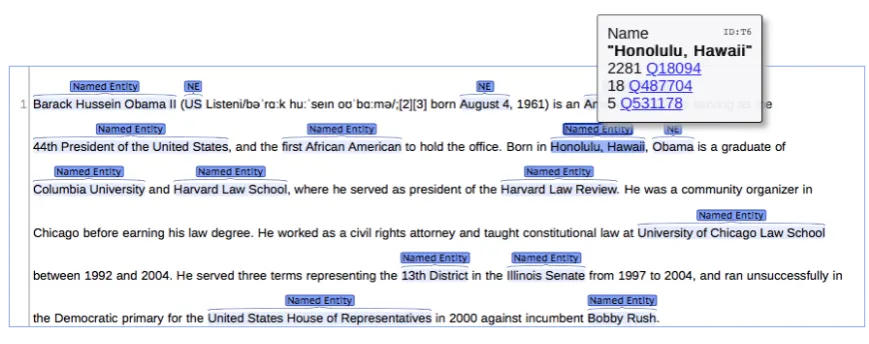
We implemented the entity linker as an interac-tive demonstration. The user can paste a text and visualize the results in the form of a text annotated with entity labels. Once the user hovers over the label, the ranked candidates are displayed with a link to the Wikidata page for that entity. Figure 5 shows an output of the system.
6 Conclusions and Future Work
We explored different methods to carry out language-independent entity linking from raw text and we presented evaluations on English. The ver-sion of the system that had the highest score used a 4-step pipeline, ending with an iteration cycle between a personalized version of PageRank and the usage of weighted category graphs. The sys-tem reached a weighted F1-score of 0.746 on the ERD-51 dataset.
The paper takes an unusual approach to named entity recognition and disambiguation as it does not separate the tasks, but treats every candidate to every mention as a separate possibility. The iteration between two context-aware algorithms with different precision/recall characteristics im-proved the results dramatically and is, to the best of our knowledge, a novel, language-independent approach to entity recognition and disambigua-tion. We also exposed a way of pruning unsatis-fying links in a collected knowledge base by clus-tering.
The system and its approach can be improved in a number of ways. Firstly, the usage of manually written rules is suboptimal, as the rules may be de-pendent on the language. A method that only uses Wikipedia, or some other multilingual resource, and avoids syntactical clues altogether, would be a better solution. An approach like that would be more robust to the differences between languages. We have also introduced a number of threshold values in different parts of the system, such as the suspicion cutoff in the manual rules and the simi-larity threshold in the WCG. These are difficult to optimize without an automated method. We think HERD would benefit from finding an alternative approach that avoids cutoff values or automates their optimization.
Exec. Recognition Linking
Version (ms) Precision Recall F Precision Recall F
v0.1 Baseline - 0.745 0.686 0.714 0.551 0.521 0.535
v0.2 With extender - 0.673 0.762 0.715 0.520 0.581 0.549 v0.3 Remove colliding
men-tions - 0.698 0.730 0.714 0.536 0.572 0.554
v0.4 Simplified filtering - 0.723 0.720 0.721 0.613 0.610 0.611 v0.5 Relaxed filtering - 0.642 0.859 0.734 0.522 0.720 0.605 v0.6 Part of headline - 0.691 0.796 0.740 0.593 0.684 0.635 v0.7 Filter out candidates
with low frequency
250 0.718 0.785 0.750 0.612 0.672 0.640
[image:8.595.77.521.61.239.2]v0.8 PageRank 246 0.865 0.765 0.812 0.747 0.661 0.701 v1.0 PageRank & WCG 608 0.843 0.848 0.845 0.744 0.749 0.746
Table 3: Results on the ERD51 dataset
Exec. Recognition Linking
Version (ms) Precision Recall F Precision Recall F
v0.1 Baseline - 0.940 0.630 0.755
v0.2 With extender - 0.889 0.684 0.773 v0.3 Remove colliding nodes - 0.923 0.678 0.782 v0.4 Simplified filtering - 0.934 0.705 0.803 v0.5 Relaxed filtering - 0.912 0.769 0.835 v0.7 Filtered out candidates
with low frequency 1088 0.888 0.789 0.835
[image:8.595.79.524.273.428.2]v0.8 PageRank 3325 0.935 0.819 0.873 0.732 0.631 0.678 v1.0 PageRank & WCG 4415 0.932 0.827 0.876 0.740 0.647 0.690
Table 4: Results on the AIDA/YAGO dataset
Figure 5: Visualizer
The HERD source code is available from GitHub at this repository: https://github. com/AAAton/herd. A demonstration of HERD as
part of the Langforia processing pipelines (Klang and Nugues, 2016) is available at this location:
http://vilde.cs.lth.se:9000.
Acknowledgements
[image:8.595.80.515.464.636.2]References
Kurt Bollacker, Colin Evans, Praveen Paritosh, Tim Sturge, and Jamie Taylor. 2008. Freebase: A collaboratively created graph database for structur-ing human knowledge. InProceedings of the 2008 ACM SIGMOD International Conference on Man-agement of Data, SIGMOD ’08, pages 1247–1250, New York, NY, USA. ACM.
Sergey Brin and Lawrence Page. 1998. The anatomy of a large-scale hypertextual web search engine. Computer Networks and ISDN Systems, 30(1-7):107–117, April.
Razvan C Bunescu and Marius Pasca. 2006. Using en-cyclopedic knowledge for named entity disambigua-tion. In European Chapter of the Association for Computational Linguistics, volume 6, pages 9–16.
David Carmel, Ming-Wei Chang, Evgeniy Gabrilovich, Bo-June Paul Hsu, and Kuansan Wang. 2014. ERD’14: Entity recognition and disambiguation challenge. InACM SIGIR Forum, volume 48, pages 63–77. ACM.
Silviu Cucerzan. 2007. Large-scale named entity dis-ambiguation based on wikipedia data. InEmpirical Methods in Natural Language Processing and Com-putational Natural Language Learning, volume 7, pages 708–716.
Silviu Cucerzan. 2014. Name Entities Made Obvi-ous: The Participation in the ERD 2014 Evaluation. In Proceedings of the First International Workshop on Entity Recognition & Disambiguation, ERD ’14, pages 95–100, New York, NY, USA. ACM.
Alan Eckhardt, Juraj Hreˇsko, Jan Proch´azka, and Otakar Smri;. 2014. Entity linking based on the co-occurrence graph and entity probability. In Pro-ceedings of the First International Workshop on En-tity Recognition & Disambiguation, ERD ’14, pages 37–44, New York, NY, USA. ACM.
Paolo Ferragina and Ugo Scaiella. 2010. Tagme: On-the-fly annotation of short text fragments (by wikipedia entities). In Proceedings of the 19th ACM International Conference on Information and Knowledge Management, CIKM ’10, pages 1625– 1628, New York, NY, USA. ACM.
David Angelo Ferrucci. 2012. Introduction to “This is Watson”. IBM Journal of Research and Develop-ment, 56(3.4):1:1 –1:15, May-June.
Johannes Hoffart, Mohamed Amir Yosef, Ilaria Bor-dino, Hagen F¨urstenau, Manfred Pinkal, Marc Span-iol, Bilyana Taneva, Stefan Thater, and Gerhard Weikum. 2011. Robust disambiguation of named entities in text. In Proceedings of the 2011 Con-ference on Empirical Methods in Natural Language Processing, pages 782–792, Edinburgh.
Heng Ji, Joel Nothman, Ben Hachey, and Radu Florian. 2015. Overview of tac-kbp2015 trilingual entity dis-covery and linking. In Proceedings of the Eighth Text Analysis Conference (TAC2015).
Marcus Klang and Pierre Nugues. 2016. Langforia: Language pipelines for annotating large collections of documents. In Proceedings of COLING 2016, the 26th International Conference on Computational Linguistics: System Demonstrations, pages 74–78, Osaka, Japan, December. The COLING 2016 Orga-nizing Committee.
V. I. Levenshtein. 1966. Binary Codes Capable of Cor-recting Deletions, Insertions and Reversals. Soviet Physics Doklady, 10:707, February.
Marek Lipczak, Arash Koushkestani, and Evangelos Milios. 2014. Tulip: Lightweight entity recog-nition and disambiguation using wikipedia-based topic centroids. InProceedings of the First Inter-national Workshop on Entity Recognition & Disam-biguation, ERD ’14, pages 31–36, New York, NY, USA. ACM.
Rada Mihalcea and Andras Csomai. 2007. Wikify!: Linking documents to encyclopedic knowledge. In Proceedings of the Sixteenth ACM Conference on Conference on Information and Knowledge Man-agement, CIKM ’07, pages 233–242, New York, NY, USA. ACM.
David Milne and Ian H. Witten. 2008. Learning to link with wikipedia. In Proceedings of the 17th ACM Conference on Information and Knowledge Man-agement, CIKM ’08, pages 509–518, New York, NY, USA. ACM.
Amit Singhal. 2012. Introducing the knowledge graph: things, not strings. Official Google Blog. http://googleblog.blogspot.com/2012/05/ introducing-knowledge-graph-things-not. html. Retrieved 7 November 2013, May.
David Smiley. 2013. Solr text tagger, text tagging with finite state transducers. https://github. com/OpenSextant/SolrTextTagger.
Erik F. Tjong Kim Sang and Fien De Meulder. 2003. Introduction to the conll-2003 shared task: Language-independent named entity recognition. In Proceedings of the Seventh Conference on Natural Language Learning at HLT-NAACL 2003 - Volume 4, CONLL ’03, pages 142–147, Stroudsburg, PA, USA. Association for Computational Linguistics. Wikipedia. 2016. Michael Jackson