Vagueness and Learning: A Type-Theoretic Approach
Raquel Fern´andez
Institute for Logic, Language and Computation University of Amsterdam
Staffan Larsson
Department of Philosophy, Linguistics and Theory of Science
University of Gothenburg
Abstract
We present a formal account of the mean-ing of vague scalar adjectives such as ‘tall’ formulated in Type Theory with Records. Our approach makes precise how percep-tual information can be integrated into the meaning representation of these pred-icates; how an agent evaluates whether an entity counts as tall; and how the proposed semantics can be learned and dynamically updated through experience.
1 Introduction
Traditional semantic theories such as those de-scribed in Partee (1989) and Blackburn and Bos (2005) offer precise accounts of the truth-conditional content of linguistic expressions, but do not deal with the connection between meaning, perception and learning. One can argue, however, that part of getting to know the meaning of lin-guistic expressions consists in learning to identify the individuals or the situations that the expres-sions can describe. For many concrete words and phrases, this identification relies on perceptual in-formation. In this paper, we focus on characteris-ing the meancharacteris-ing of vague scalar adjectives such as ‘tall’, ‘dark’, or ‘heavy’. We propose a for-mal account that brings together notions from tra-ditional formal semanticswith perceptual informa-tion, which allows us to specify how a logic-based interpretation function is determined and modified dynamically by experience.
The need to integrate language and percep-tion has been emphasised by researchers work-ing on the generation and resolution of referrwork-ing
This work is licensed under a Creative Commons Attribution 4.0 International Licence. Page numbers and proceedings footer are added by the organisers. Licence details: http: //creativecommons.org/licenses/by/4.0/
expressions (Kelleher et al., 2005; Reiter et al., 2005; Portet et al., 2009) and, perhaps even more strongly, on the field of robotics, where ground-ing language on perceptual information is critical to allow artificial agents to autonomously acquire and verify beliefs about the world (Siskind, 2001; Steels, 2003; Roy, 2005; Skocaj et al., 2010). Most of these approaches, however, do not build on theories of formal semantics for natural lan-guage. Here we choose to formalise our account in a theoretical framework known as Type Theory with Records (TTR), which has been shown to be suitable for formalising classic semantic aspects such as intensionality, quantification, and nega-tion (Cooper, 2005a; Cooper, 2010; Cooper and Ginzburg, 2011) as well as less standard phenom-ena such as linguistic interaction (Ginzburg, 2012; Purver et al., 2014), perception and action (Dob-nik et al., 2013), and semantic coordination and learning (Larsson, 2009). In this paper we use TTR to put forward an account of the semantics of vague scalar predicates like ‘tall’ that makes pre-cise how perceptual information can be integrated into their meaning representation; how an agent evaluates whether an entity counts as tall; and how the proposed semantics for these expressions can be learned and dynamically updated through lan-guage use.
We start by giving a brief overview of TTR and explaining how it can be used for classifying en-tities as being of particular types integrating per-ceptual information. After that, in Section 3, we describe the main properties of vague scalar pred-icates. Section 4 presents a probabilistic TTR for-malisation of the meaning of ‘tall’, which captures its context-dependence and its vague character. In Section 5, we then offer an account of how that meaning representation is acquired and updated with experience. Finally, in Section 6 we discuss related work, before concluding in Section 7.
2 Meaning as Classification in TTR
In this section we give a brief and hence inevitably partial introduction to Type Theory with Records. For more comprehensive introductions, we refer the reader to Cooper (2005b) and Cooper (2012).
2.1 Type Theory with Records: Main Notions As in any type theory, the most central notion in TTR is that of a judgement that an object a is of typeT, written as a:T. In TTR judgements are seen as fundamentally related to perception, in the sense that perceiving inherently involves cate-gorising what we perceive. Some commonbasic typesin TTR areInd(the type of individuals) and
R+(the type of positive real numbers). All basic
types are members of a special typeType. Given typesT1 andT2, we can create the function type T1 → T2 whose domain are objects of type T1
and whose range are objects of type T2. Types
can also be constructed from predicates and ob-jectsP(a1, . . . , an). Such types are called ptypes and correspond roughly to propositions in first or-der logic. In TTR, propositions are types ofproofs, where proofs can be a variety of things, from situ-ations to sensor readings (more on this below).
Next, we introduce records and record types. These are structured objects made up of pairshl, vi of labels and values that are displayed in a matrix: (1) a. A record type:
`1 :T1 `2 :T2(`1)
. . .
`n:Tn(`1, `2, . . . , `n−1)
b. A record:r=
`1 =a1 `2 =a2
. . .
`n=an . . .
Record r in (1b) is of the record type in (1a) if and only if a1 : T1, a2 : T2(a1), . . . , and an :
Tn(a1, a2, . . . , an−1). Note that the record may
contain more fields but would still be of type (1a) if the typing condition holds. Records and record types can be nested so that the value of a label is itself a record (or record type). We can usepaths within a record or record type to refer to specific bits of structure: for instance, we can user.`2 to
refer toa2 in (1b).
As can be seen in (1a), the labels`1, . . . `nin a record type can be used elsewhere to refer to the values associated with them. This is a common
way of constructing ptypes where the arguments of a predicate are entities that have been intro-duced before in the record type. A sample record and record type are shown in (2).
(2)
xcman= prf(man(=a a))
crun= prf(run(a))
:
xcman: man(x): Ind
crun : run(x)
In (2),ais an entity of type individual andprf(P)
is used as a placeholder for proofs of ptypes P. In the record type above, the ptypesman(x) and
run(x) constructed from predicates aredependent onx(introduced earlier in the record type).
2.2 Perceptual Meaning
Larsson (2013) proposes a system formalised in TTR where some perceptual aspects of meaning are represented usingclassifiers. For example, the meaning of ‘right’ (as in ‘to the right of’) involves a two-input perceptron classifier κright(w, t, r), specified by a weight vector w and a threshold
t, which takes as input a context r including an objectxand a position-sensor readingsrpos. The sensor reading consists of a vector containing two real numbers representing the space coordinates of
x. The classifier classifiesxas either being to the right on a plane or not.1
(3) ifr:
x : Ind
srpos: RealVector
, then
κright(w, t, r)=
right(r.x) if(r.srpos·w)> t ¬right(r.x) otherwise
As output we get a record type containing either a ptype right(x) or its negation,¬right(x). Larsson (2013) proposes that readings from sensors may count as proofs of such ptypes. A classifier can be used for judging x as being of a particular type on the grounds of perceptual information. A per-ceptual proof for right(x) would thus include the output from the position sensor that is directed to-wards x. Here, this output would be the space co-ordinates of x.
3 Vague Scalar Predicates
Scalar predicates such as ‘tall’, ‘long’ and ‘ ex-pensive’, also called “relative gradable adjectives” (Kennedy, 2007), are interpreted with respect to a
1We are here assuming that we have a definition of dot product for TTR vectorsa:RealVectorn andb:RealVectorn
such thata·b= Σn
i=1aibi=a1b1+a2b2+. . .+anbn. We
scale, i.e., a dimension such as height, length, or cost along which entities for which the relevant di-mension is applicable can be ordered. This makes scalar predicates compatible with degree morphol-ogy, like comparative and superlative morphemes (‘taller than’, ‘the longest’) and intensifier mor-phemes such as ‘very’ or ‘quite’. In this pa-per, our focus is on the so-calledpositive formof these adjectives (e.g. ‘tall’ as opposed to ‘taller’ or ‘tallest’).
A property that distinguishes the positive form from the comparative and the superlative forms is itscontext-dependance. To take a common exam-ple: If Sue’s height is180cm, she may be appro-priately described as a tall woman, but probably not as a tall basketball player. Thus, what counts as tall can vary from context to context, with the most relevant contextual parameter being a com-parison classrelative to which the adjective is in-terpreted (e.g., the set of women, the set of bas-ketball players, etc.). In addition to being context-dependent, positive-form scalar predicates are also vague, in the sense that they give rise toborderline cases, i.e., entities for which it is unclear whether the predicate holds or not.
Vagueness is certainly a property that affects most natural language expressions, not only scalar adjectives. However, scalar adjectives have a relatively simple semantics (they are often uni-dimensional) and thus constitute a perfect case-study for investigating the properties and effects of vagueness on language use. Gradable adjectives have received a high amount of attention in the formal semantics literature. It is common to dis-tinguish between two main approaches to their se-mantics: delineation-based and degree-based ap-proaches. The delineation approach is associated with the work of Klein (1980), who proposes that gradable adjectives denote partial functions de-pendent on a comparison class. They partition the comparison class into three disjoint sets: a positive extension, a negative extension, and an extension gap (entities for which the predicate is neither true nor false). In contrast, degree-based approaches assume a measure function mmapping individu-als x to degrees on a particular scale (degrees of height, degrees of darkness, etc.) and astandard of comparison or degree threshold θ (again, de-pendent on a comparison class) such that x be-longs to the adjective’s denotation if m(x) > θ
(Kamp, 1975; Pinkal, 1979; Pinkal, 1995; Barker,
2002; Kennedy and McNally, 2005; Kennedy, 2007; Solt, 2011; Lassiter, 2011).
We build on degree approaches but adopt a perception-based perspective and take a step fur-ther to formalise how the meaning of these pred-icates can be learned and constantly updated through language use.
4 A Perceptual Semantics for ‘Tall’
To exemplify our approach, we will use the scalar predicate ‘tall’ throughout.
4.1 Context-sensitivity
We first focus on capturing the context-dependence of relative scalar predicates. For this we define a type Tctxtas follows:
(4) Tctxt=
c : Typex : c
h : R+
The context (ctxt) of a scalar predicate like ‘tall’ is a record of the type in (4), which includes: a typec(typically a subtype ofInd) representing the comparison class; an individualxwithin the com-parison class (the argument of tall); a perceived measure on the relevant scale(s), in this case the perceived heighthofxexpressed as a positive real number.
The context presupposes the acquisition of sen-sory input from the environment. In particular, it assumes that an agent using such a representation is able to classify the entity in focus x as being of typecand is able to use some height sensor to obtain an estimate ofx’s height (the value ofhis the sensor reading). We thus forgo the inclusion of an abstract measure function in the representation. In an artificial agent, this may be accomplished by image processing software for detecting and mea-suring objects in a digital image.
Besides the ctxt, we also assume a standard threshold of tallnessθtall of the type given in (5).
θtall is a function from a type specifying a com-parison class to a height value, which corresponds to a tallness threshold for that comparison class. (In Section 5 we will discuss how such a threshold may be computed.)
(5) θtall : Type→R+
The meaning of ‘tall’ involves aclassifierfor tall-ness,κtall, of the following type:
We define this classifier as a one-input perceptron that compares the perceived heighth of an indi-vidualxto the relevant thresholdθdetermined by a comparison classc. Thus, ifθ: Type→R+and r:Tctxt, then:
κtall(θ, r) =
tall(r.x) ifr.h> θ(r.c)
¬tall(r.x) otherwise
Simplifying somewhat, we can represent the mea-ning of ‘tall’,tall, as a record specifying the type of context (Tctxt) where an utterance of ‘tall’ can be made, the parameter of the tallness classifier (the thresholdθ), and a functionfwhich is applied to the context to produce the content of ‘tall’. (7) tall=
Tctxt=
c : Typex : c
h : R+
θ =θtall f =λr: Tctxt.
sit =r
sit-type = ctall:κtall(θ, r)
The output of the functionfis an Austinian propo-sition (Cooper, 2005b): a judgement that a situa-tion (sit, represented as a recordr of type Tctxt), is of a particular type (specified in sit-type). In the case oftall, the context of utterance (which instan-tiatesr) is judged to be of the type where there is an individualxwhich is either tall or not tall, ac-cording to the output of the classifier κtall. The context of utterance in the sit field will include the height-sensor reading, which means that the sen-sor reading is part of the proof of the sit-type indi-cating thatxis tall (or not, as the case may be).
Thus, to decide whether to refer to some indi-vidualxas tall or to evaluate someone else’s utter-ance describingxas tall, an agent applies the func-tiontall.f to the current situation, represented as a recordr :Tctxt. As an example, let us consider a situation that includes the context in (8), resulting from observing John Smith as being 1.88 meters tall (assuming this is our scale of tallness):
(8) ctxt=
c = Humanx = john smith
h = 1.88
Let us assume that given the comparison class
Human, θtall(Human) = 1.87. In this case, tall.f(ctxt) will compute as shown in (9). The re-sulting Austinian proposition corresponds to the agent’s judgement that the situation in sit is one where John Smith counts as tall.
(9) λr: Tctxt.
sit =r
sit-type = ctall:κtall(θtall, r)
(
c = Humanx = john smith
h = 1.88
) =
sit =
c = Humanx = john smith
h = 1.88
sit-type = ctall: tall(john smith)
4.2 Vagueness
According to the above account, ‘tall’ has a precise interpretation: given a degree of height and a comparison class, the threshold sharply determines whether tall applies or not. There are several ways in which one can account for vagueness—amongst others, by introducing per-ceptual uncertainty (possibly inaccurate sensor readings). Here, in line with Lassiter (2011), we opt for substituting the precise threshold with a noisy, probabilistic threshold. We consider the threshold to be a normal random variable, which can be represented by the parameters of its Gaus-sian distribution, the meanµand the standard de-viationσ(the noise width).2
To incorporate this modification into our ap-proach, we update the tallness classifierκtall we had defined in (6) so that it now takes as parame-tersµtallandσtall, both of them dependent on the comparison class and hence of type Type→ R+.
The output of the classifier is now a probability rather than a ptype such astall(x)or¬tall(x). Be-fore indicating how this probability is computed, we give the type of the vague version of the clas-sifier in (10) and the vague representation of the meaning of ‘tall’ in (11).
(10)κtall:(Type→R+,Type→R+,Tctxt)→[0,1] (11) tall= Tctxt=
c : Typex : c
h : R+
µ =µtall
σ =σtall f =λr: Tctxt.
sit =sit-type =r ctall: tall(r.x)
prob =κtall(σ, µ, r)
The output of the function tall.f is now a prob-abilistic Austinian proposition (Cooper et al., 2014). Like before, the proposition expresses a judgement that a situation sit is of a particular type. But here the judgement is probabilistic—it encodes the belief of an agent concerning the like-lihood thatsitis of a type wherexcounts as tall.
Since we take the noisy threshold to be a normal random variable, given a particular µ and σ, we can calculate the probability that the heightr.h of individualr.x counts as tall as follows:
κtall(µ, σ, r) = 12
1 + erf
r.h−µ(r.c) σ(r.c)√2
Hereerfis the error function, defined as3
erf(x) = √2
π Z x
t=0e
−t2 dt
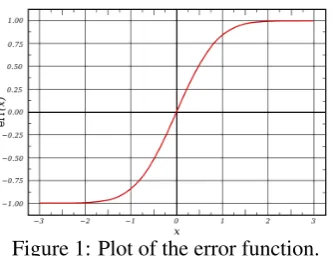
[image:5.595.305.524.60.220.2]The error function defines a sigmoid shape (see Figure 1), in line with the upward monotonicity of ‘tall’. The output ofκtall(µ, σ, r)corresponds to the probability that h will exceed the normal random threshold with meanµand deviationσ.
Figure 1: Plot of the error function.
Let us consider an example. Assume that we have
µtall(Human) = 1.87 and σtall(Human) = 0.05 (see Section 5.1 below for justification of the latter value). Let’s also assume the same ctxtas above in (8). In this case,tall.f(ctxt) will compute as in (12), given that
κtall(µtall, σtall,
c=Humanx=john smith
h=1.88
)=
1 2
1 + erf
1.88−1.87 0.05√2
= 0.579
3For an explanation of this standard definition, seehttp:
//en.wikipedia.org/wiki/Error_function, which is the source of the graph in Figure 1.
(12) λr: Tctxt.
sit =sit-type =r ctall: tall(r.x)
prob =κtall(µtall, σtall, r)
(
c = Humanx = john smith
h = 1.88
) =
sit =
c = Humanx = john smith
h = 1.88
sit-type = ctall: tall(john smith) prob =0.579
This probability can now be used in further prob-abilistic reasoning, to decide whether to refer to an individual x as tall, or to evaluate someone else’s utterance describing x is tall. For exam-ple, an agent may map different probabilities to different adjective qualifiers of tallness to yield compositional phrases such as ‘sort of tall’, ‘quite tall’, ‘very tall’, ‘extremely tall’, etc. The mean-ings of these composed adjectival phrases could specify probability ranges trained independently. Compositionality for vague perceptual meanings, and the interaction between compositionality and learning, is an exciting area for future research.4
5 Learning from Language Use
In this section we consider possibilities for com-puting the noisy threshold we have introduced in the previous section and discuss how such a threshold and the probabilistic judgements it gives rise to are updated with language use.
5.1 Computing the Noisy Threshold
We assume that agents keep track of judgements made by other agents. More concretely, for a vague scalar predicate like ‘tall’, we assume that an agent will have at its disposal a set of obser-vations consisting of entities of a particular type
T (a comparison class such asHuman) that have been judged to be tall, together with their observed heights. Judgements of tallness may vary across individuals—indeed, such variation (both inter-and intra-individual) is a hallmark of vague pred-icates. We useΩT
tall to refer to the set of heights of those entitiesx : T that have been considered tall by some individual. From this agent-specific set of observations, which is constantly updated as the agent is exposed to new judgements by other individuals, we want to compute a noisy threshold,
[image:5.595.98.265.403.531.2]which the agent uses to make her own judgements of tallness, as specified in (11).
Different functions can be used to computeµtall andσtall from ΩTtall. What constitutes an appro-priate function is an empirical matter and what the most suitable function is possibly varies across predicates (what may apply to ‘tall’ may not be suitable for ‘dark’ or ‘expensive’, for example). Hardly any work has been done on trying to iden-tify how the threshold is computed from experi-ence. A notable exception, however, is the work of Schmidt et al. (2009), who collect judgements of people asked to indicate which items are tall given distributions of items of different heights. Schmidt and colleagues then propose different probabilis-tic models to account for the data and compare their output to the human judgements. They ex-plore two types of models: threshold-based mod-els and category-based or cluster modmod-els. The best performing models within these two types perform equally well and the study does not identify any advantages of one type over the other one. Since we have chosen threshold models as our case-study, we focus our attention on those here.
Each of the threshold models tested by Schmidt et al. (2009) corresponds to a possible way of com-puting the meanµtall of a noisy threshold from a set of observations. The best performing threshold model in their study is therelative height by range model, where (in our notation):
(13) relative height by range (RH-R):µtall(T) =
max(ΩT
tall)−k·(max(ΩTtall)−min(ΩTtall))
Here max(ΩT
tall) and min(ΩTtall) stand for the maximum and the minimum height, respectively, of the items that have been judged to be tall by some individual. According to this threshold model, any item within the top k%of the range of heights that have been judged to be tall counts as tall. The model includes two parameters,kand a noise-width parameter that in our approach cor-responds to σtall. Schmidt et al. (2009) report that the best fit of their data was obtained with
k= 29%andσtall = 0.05.
5.2 Updating Vague Meanings
We now want to specify how the vague meaning of ‘tall’ is updated as an agent is exposed to new judgements via language use. Our setting so far offers a straightforward solution to this: If a new entityx:T with heighthis referred to as tall, the
agent adds h to its set of observations ΩT tall and recomputesµtall(Human), for instance using RH-R as defined in (13). If RH-RH-H is used, ideally the value ofkandσtall should be (re)estimated from
ΩT
tall. For the sake of simplicity, however, here we will assume that these two parameters take the values experimentally validated by Schmidt et al. (2009) and are kept constant. An update to µtall will take place if it is the case thath >max(ΩT
tall) orh < min(ΩT
tall). This in turn will trigger un update to the probability outputted byκtall.
As an example, let us assume that our initial set of observations is ΩHuman
tall = {1.87,1.92,1,90,1.75,1.80} (recall this corre-sponds to the perceived heights of individuals that have been described as tall by some agent). This means that max(ΩHuman
tall ) = 1.92 and
min(ΩHuman
tall ) = 1.75. Hence, given (13): (14) µtall(Human) =
1.92−0.29·(1.92−1.75) = 1.87
Let’s assume we now make an observation where a person of height 1.72 is judged to be tall. This will mean that the set of observations is now
ΩHuman
tall = {1.87,1.92,1,90,1.75,1.80,1.72} and consequently min(ΩHuman
tall ) = 1.72, which yields an updated mean of the noisy threshold: (15) µtall(Human) =
1.92−0.29·(1.92−1.72) = 1.862
If we were to re-evaluate John Smith’s tallness in light of this observation, we would get a new prob-ability 0.64 that he is tall (in contrast to the earlier probability of0.579given in (12)).
5.3 Possible Extensions The set of observations ΩHuman
tall can be derived from a set of Austinian propositions correspond-ing to instances where people have been judged to be tall. To update from an Austinian proposi-tion p we simply add p.sit.h toΩtall
one specified so far.
Somewhat related to the point above, note that in our approach we treat all judgements equally, i.e., we do not distinguish between possible dif-ferent levels of trustworthiness amongst speakers. An agent who is told that an entity with heighth
is tall adds that observation to its knowledge base without questioning the reliability of the speaker. This is clearly a simplification. For instance, there is developmental evidence showing that children are more sensitive to reliable speakers than to un-reliable ones during language acquisition (Scofield and Behrend, 2008).
6 Other Approaches
Within the literature in formal semantics, Las-siter (2011) has put forward a proposal that ex-tends in interesting ways earlier work by Barker (2002) and shares some aspects with the account we have presented here. Operating in a probabilis-tic version of classical possible-worlds semanprobabilis-tics, Lassiter assumes a probability distribution over a set of possible worlds and a probability distribu-tion over a set of possible languages. Each pos-sible language represents a precise interpretation of a predicate like ‘tall’: tall1 = λx.x’s height≥
5’6”; tall2 =λx.x’s height ≥5’7”; and so forth.
Lassiter thus treats “metalinguistic belief” (repre-senting an agent’s knowledge of the meaning of words) in terms of probability distributions over precise languages. Since each precise interpreta-tion of ‘tall’ includes a given threshold, this can be seen as defining a probability distribution over possible thresholds, similarly to the noisy thresh-old we have used in our account. Lassiter, how-ever, is not concerned with learning.
Within the computational semantics literature, DeVault and Stone (2004) describe an imple-mented system in a drawing domain that is able to interpret and execute instructions including vague scalar predicates such as ‘Make a small circle’. Their approach makes use of degree-based seman-tics, but does not take into account comparison classes. This is possible in their drawing domain since the kind of geometric figures it includes (squares, rectangles, circles) do not have intrinsic expected properties (size, length, etc). Their focus is on modelling how the threshold for a predicate such as ‘small’ is updated during an interaction with the system given the local discourse context. For instance, if the initial context just contains a square, the size of that square is taken to be the
standard of comparison for the predicate ‘small’. The user’s utterance ‘Make a small circle’ is then interpreted as asking for a circle of an arbitrary size that is smaller than the square.
In our characterisation of the context-sensitivity of vague gradable adjectives in Section 4.1, we have focused on their dependence on general com-parison classes corresponding to types of entities (such as Human, Woman, etc) with expected prop-erties such as height. Thus, in contrast to DeVault and Stone (2004), who focus on the local context of discourse, we have focused on what could be called theglobalcontext (an agent’s experience re-garding types of entities and their expected prop-erties). How these two types of context interact remains an open question, which we plan to ex-plore in our future work (see Kyburg and Morreau (2000), Kemp et al. (2007), and Fern´andez (2009) for pointers in this direction).
7 Conclusions and future work
Traditional formal semantics theories postulate a fixed, abstract interpretation function that medi-ates between natural language expressions and the world, but fall short of specifying how this func-tion is determined or modified dynamically by experience. In this paper we have presented a characterisation of the semantics of vague scalar predicates such as ‘tall’ that clarifies how their context-dependent meaning and their vague char-acter are connected with perceptual information, and we have also shown how this low-level per-ceptual information (here, real-valued readings from a height sensor) connects to high level logical semantics (ptypes) in a probabilistic framework. In addition, we have put forward a proposal for explaining how the meaning of vague scalar ad-jectives like ‘tall’ is dynamically updated through language use.
Acknowledgements
The first author acknowledges the support of the Netherlands Organisation for Scientific Research (NWO) and thanks the Centre for Language Tech-nology at the University of Gothenburg for gen-erously funding research visits that led to the work presented in this paper. The second au-thor acknowledges the support of Vetenskapsr˚adet, project 2009-1569, Semantic analysis of interac-tion and coordinainterac-tion in dialogue (SAICD); the Department of Philosophy, Linguistics, and The-ory of Science; and the Centre for Language Tech-nology at the University of Gothenburg.
References
Chris Barker. 2002. The dynamics of vagueness. Lin-guistics & Philosophy, 25(1):1–36.
Patrick Blackburn and Johan Bos. 2005. Represen-tation and Inference for Natural Language: A First
Course in Computational Semantics. CSLI
Publica-tions.
Robin Cooper and Jonathan Ginzburg. 2011. Negation in dialogue. InProceedings of the 15th Workshop on the Semantics and Pragmatics of Dialogue (SemDial
2011), Los Angeles (USA).
Robin Cooper, Simon Dobnik, Shalom Lappin, and Staffan Larsson. 2014. A probabilistic rich type theory for semantic interpretation. InProceedings of the EACL Workshop on Type Theory and Natural
Language Semantics (TTNLS).
Robin Cooper. 2005a. Austinian truth, attitudes and type theory. Research on Language and Computa-tion, 3(4):333–362, December.
Robin Cooper. 2005b. Austinian truth, attitudes and type theory. Research on Language and Computa-tion, 3:333–362.
Robin Cooper. 2010. Generalized quantifiers and clar-ification content. In Paweł Łupkowski and Matthew Purver, editors,Aspects of Semantics and Pragmat-ics of Dialogue. SemDial 2010, 14th Workshop on the Semantics and Pragmatics of Dialogue, Pozna´n. Polish Society for Cognitive Science.
Robin Cooper. 2012. Type theory and semantics in flux. In Ruth Kempson, Nicholas Asher, and Tim Fernando, editors, Handbook of the Philosophy of Science, volume 14: Philosophy of Linguistics. El-sevier BV. General editors: Dov M. Gabbay, Paul Thagard and John Woods.
David DeVault and Matthew Stone. 2004. Interpret-ing vague utterances in context. InProceedings of the 20th International Conference on Computational
Linguistics (COLING’04), pages 1247–1253.
Simon Dobnik, Robin Cooper, and Staffan Larsson. 2013. Modelling language, action, and perception in type theory with records. In Constraint Solving
and Language Processing, Lecture Notes in
Com-puter Science, pages 70–91. Springer.
Raquel Fern´andez. 2009. Salience and feature vari-ability in definite descriptions with positive-form vague adjectives. In Workshop on the Production of Referring Expressions: Bridging the gap between computational and empirical approaches to refer-ence (CogSci’09).
Jonathan Ginzburg. 2012. The Interactive Stance. Ox-ford University Press.
Hans Kamp. 1975. Two theories of adjectives. In E. Keenan, editor,Formal Semantics of Natural
Lan-guage, pages 123–155. Cambridge University Press.
John Kelleher, Fintan Costello, and Josef van Genabith. 2005. Dynamically structuring, updating and inter-relating representations of visual and linguistic dis-course context. Artificial Intelligence, 167(1):62– 102.
Charles Kemp, Amy Perfors, and Joshua B. Tenen-baum. 2007. Learning overhypotheses with hier-archical bayesian models. Developmental Science, 10(3):307–321.
Christopher Kennedy and Louise McNally. 2005. Scale structure, degree modification, and the seman-tics of gradable predicates. Language, pages 345– 381.
Christopher Kennedy. 2007. Vagueness and grammar: The semantics of relative and absolute gradable ad-jectives.Linguistics and Philosophy, 30(1):1–45. Ewan Klein. 1980. A semantics for positive and
comparative adjectives.Linguistics and Philosophy, 4:1–45.
Alice Kyburg and Michael Morreau. 2000. Fitting words: Vague language in context. Linguistics and
Philosophy, 23:577–597.
Staffan Larsson. 2009. Detecting and learning from lexical innovation in dialogue: a ttr account. In
Proceedings of the 5th International Conference on Generative Approaches to the Lexicon.
Staffan Larsson. 2013. Formal semantics for percep-tual classification. Journal of Logic and Computa-tion.
Dan Lassiter. 2011. Vagueness as probabilistic linguis-tic knowledge. In R. Nowen, R. van Rooij, U. Sauer-land, and H. C. Schmitz, editors,Vagueness in Com-munication. Springer.
Manfred Pinkal. 1979. Semantics from different points of view. In R. B¨aurle, U. Egli, and A. von Stechow, editors,How to Refer with Vague Descrip-tions, pages 32–50. Springer-Verlag.
Manfred Pinkal. 1995. Logic and lexicon: the seman-tics of the indefinite, volume 56 of Studies in Lin-guistics and Philosophy. Springer.
Franc¸ois Portet, Ehud Reiter, Albert Gatt, Jim Hunter, Somayajulu Sripada, Yvonne Freer, and Cindy Sykes. 2009. Automatic generation of textual sum-maries from neonatal intensive care data. Artificial Intelligence, 173(7):789–816.
Matthew Purver, Julian Hough, and Eleni Gre-goromichelaki. 2014. Dialogue and compound contributions. In A. Stent and S. Bangalore, ed-itors, Natural Language Generation in Interactive Systems. Cambridge University Press.
Ehud Reiter, Somayajulu Sripada, Jim Hunter, Jin Yu, and Ian Davy. 2005. Choosing words in computer-generated weather forecasts. Artificial Intelligence, 167(1):137–169.
Deb Roy. 2005. Semiotic schemas: A framework for grounding language in action and perception. Artifi-cial Intelligence, 167(1):170–205.
L.A. Schmidt, N.D. Goodman, D. Barner, and J.B. Tenenbaum. 2009. How tall is tall? composition-ality, statistics, and gradable adjectives. In Proceed-ings of the 31st annual conference of the cognitive science society.
Jason Scofield and Douglas A Behrend. 2008. Learn-ing words from reliable and unreliable speakers.
Cognitive Development, 23(2):278–290.
Jeffrey Mark Siskind. 2001. Grounding the lexical semantics of verbs in visual perception using force dynamics and event logic. Journal of Artificial In-telligence Research, (15):31–90.
Danijel Skocaj, M Janicek, Matej Kristan, Geert-Jan M Kruijff, Aleˇs Leonardis, Pierre Lison, Alen Vrecko, and Michael Zillich. 2010. A basic cognitive sys-tem for interactive continuous learning of visual concepts. InProceeding of the Workshop on Inter-active Communication for Autonomous Intelligent Robots, pages 30–36.
Stephanie Solt. 2011. Notes on the comparison class.
In Vagueness in communication, pages 189–206.
Springer.