
SpRL-CWW:
Spatial Relation Classification with Independent Multi-class Models
Eric Nichols Fadi Botros
Honda Research Institute Japan Co., Ltd. University of Calgary
[email protected] [email protected]
Abstract
In this paper we describe the SpRL-CWW en-try into SemEval 2015: Task 8 SpaceEval. It detects spatial and motion relations as de-fined by the ISO-Space specifications in two phases: (1) it detects spatial elements and spa-tial/motion signals with a Conditional Ran-dom Field model that uses a combination of distributed word representations and lexico-syntactic features; (2) given relation candidate tuples, it simultaneously detects relation types and labels the spatial roles of participating ele-ments by using a combination of syntactic and semantic features in independent multi-class classification models for each relation type. In evaluation on the shared task data, our system performed particularly well on detection of el-ements and relations in unannotated data.
1 Introduction
Understanding human language about location and motion is important for many applications includ-ing robotics, navigation systems, and wearable com-puting. Shared tasks dedicated to the problem of representing and detecting spatial and motion rela-tions have been organized for SemEval 2012 (Ko-rdjamshidi et al., 2012), 2013 (Kolomiyets et al., 2013), and 2015. In this paper we presentSpRL-CWW, our entry to SemEval 2015 Task 8: SpaceEval, and present extended evaluation of our system to inves-tigate the impact of the task annotations and system configurations on task performance.
2 SpaceEval Task Definition
Kordjamshidi et al. (2011) proposed the task of Spatial Role Labeling (SpRL) to detect spatial and motion relations in text. SpRL was modeled after
semantic role labeling (see (Fillmore et al., 2003; Màrquez et al., 2008)), with spatial indicators in-stead of predicates signaling the presence of rela-tions, and spatial roles instead of semantic roles.
A canonical example of a spatial relation from (Kordjamshidi et al., 2011) is:
(1) Give me the [grey book]T R [on]SP the [large table]LM.
The spatial indicator (SP) on indicates that there is aspatialrelation between the trajector (T R; pri-mary object of spatial focus) and the landmark (LM; secondary object of spatial focus). SpRL was formalized as a task of classifying tuples of
< wSP, wT R, wLM >as spatial relations or not. The SpRL task was reformulated and reintro-duced in SpaceEval1 using the ISO-Space annota-tion specificaannota-tions (Pustejovsky et al., 2012). The biggest change was the decoupling of the semantic
typeandroleof spatial relation arguments. A taxon-omy of Spatial Element (SE) types was introduced to describe the meaning of arguments independent of their participation in relations, and spatial roles were treated as instance-specific annotations on spa-tial and motion relations.
The SE types introduced are: SPATIAL_ENTITY, PATH, PLACE, MOTION, NON_MOTION_EVENT, and MEASURE. Two types were also introduced to rep-resent expressions that indicated the presence of re-lations: SPATIAL_SIGNALandMOTION.
Spatial and motion relations were redefined as:
• MOVELINK: motion relation
• QSLINK: qualitative spatial relation • OLINK: spatial orientation relation
1http://alt.qcri.org/semeval2015/task8/
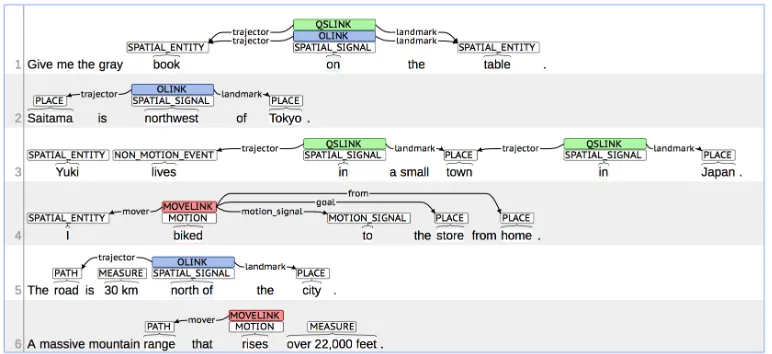
Figure 1: Example relations from the SpaceEval shared task. Only annotations that are targets are shown.
1. Only Unannotated Text is Provided
a. SE: precision, recall, and F1
b. SE: precision, recall, and F1 for each type, and an overall precision, recall, and F1 precision, recall, and F1
d. MOVELINK,QSLINK,OLINK: precision, recall, and F1 e. MOVELINK, QSLINK,OLINK: precision, recall, and F1
for each attribute, and an overall precision, recall, and F1
3. Spatial Elements, their Types, and their Attributes are Provided
a. MOVELINK,QSLINK,OLINK: precision, recall, and F1 b. MOVELINK, QSLINK,OLINK: precision, recall, and F1
[image:2.612.76.297.288.429.2]for each attribute, and an overall precision, recall, and F1
Figure 2: SpaceEval task configurations participated in bySpRL-CWW.
Examples of SpaceEval annotations are given in Figure 1. The training data for SpaceEval consists of portions of the corpora from past SemEval SpRL tasks as well as a new dataset consisting of passages from guidebooks. Following the schema described in this section, a total of 6,782 spatial elements and signals comprising 2,186 relations were annotated.
We participated in the task configurations given in Figure 2, as defined by the official SpaceEval task description.
3 Related Research
KUL-SKIP-CHAIN-CRF (Kordjamshidi et al., 2011) was a skip-chain CRF-based sequential labeling model. It used a combination of lexico-syntactic in-formation and semantic role inin-formation and used
preposition templates to represent long distance de-pendencies. It was used as a baseline system in the
SemEval 2012 and 2013 SpRL tasks.
UTD-SpRL (Roberts and Harabagiu, 2012) was
an entry into the SemEval 2012 SpRL task that adopted a joint relation detection and role label-ing approach with the motivation that roles in spa-tial relations were dependent on each other. The approach used heuristics to gather spatial relation candidate tuples. A hand-crafted dictionary was used to detectSPATIAL_INDICATORcandidates, and noun phrase heads were treated as TRAJECTORand LANDMARKcandidates. A model for relation classifi-cation and role labeling was then trained with lib-LINEAR using POS, lemma, and dependency-path-based features, with feature selection used to prune away ineffective features.
UNITOR-HMM-TK (Bastianelli et al., 2013) was an entry into the SemEval 2013 SpRL task. It used a pipeline approach with three sub-tasks: (1) spatial indicator detection, (2) spatial role2 classification and (3) spatial relation identification.
Spatial indicators and roles were detected with se-quential labeling usingSV Mhmm with detected in-dicators used as features for spatial role labeling. In addition, shallow grammatical features in the form of POS n-grams were used in place of richer syntac-tic information in order to avoid overfitting. The model also used PMI-score based word space repre-sentations as described in (Sahlgren, 2006).
UNITOR-HMM-TK’s approach to spatial relation identification avoided feature engineering by em-ploying an SVM model with a smoothed partial tree
Spatial Element and Signal
Detection
Spatial Relation Classification and Argument Labeling Candidate Tuple
Generation
Trigger Dictionary
QSLINK(arg1=trajector,arg2=landmark) QSLINK(arg1=landmark,arg2=trajector) NONE
{
}
OLINK(arg1=trajector,arg2=landmark) OLINK(arg1=landmark,arg2=trajector) NONE
{
}
MOVELINK(arg1=mover,arg2=goal) MOVELINK(arg1=goal,arg2=mover) NONE
[image:3.612.117.494.75.224.2]{
}
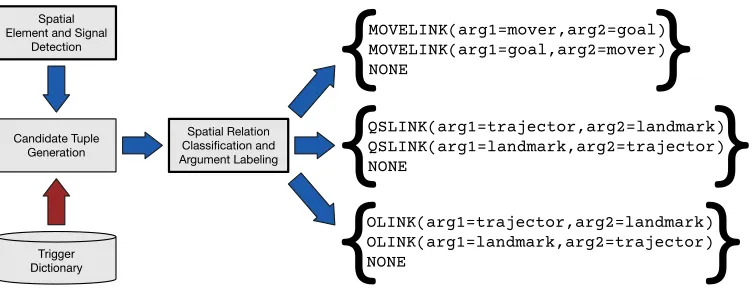
Figure 3: TheSpRL-CWWsystem architecture. Spatial elements and signals are detected, from which relation candidate tuples are generated, and then relations with their arguments labeled are identified by a separate classifier for each relation type. The red arrow indicates special trigger dictionary processing that is only carried out for SpaceEval tasks 1d and 1e, and for Setting F of the relation classification task extended evaluation in Table 3.
EF.1 Raw string in a 5-word window (i.e. Saitama is northwest of Tokyo) EF.2 Lemma in a 5-word window
(i.e. Saitama be northwest of Tokyo) EF.3 POS in a 5-word window
(i.e. NNP VBZ RB IN NNP)
EF.4 Named Entity in a 5-word window (i.e. LOC NONE NONE NONE LOC)
EF.5 Lemma concatenated with the POS in a 3-word window (i.ebe::VBZnorthwest::RBof::IN)
EF.6 Named Entity concatenated with the POS in a 3-word window
(i.eNONE::VBZ NONE::RB NONE::IN)
EF.7 Direct dependency on the head of the sentence if present (i.e. advmod)
EF.8 Direct dependency on the head of the sentence concate-nated with the lemma of the head
(i.e. advmod::be)
EF.9 300-dimension GloVe word vector EF.10 POS bigrams for a 5-word window
(i.e. NNP_VBZ VBZ_RB RB_IN IN_NNP) EF.11 Raw string n-grams for 3-word window
(i.e. is_northwest northwest_of)
Figure 4: Features for spatial element/signal detection for the sentence“Saitama is northwest of Tokyo.”
kernel over modified dependency trees to capture syntactic information.
More recent work on spatial relation identification includes (Kordjamshidi and Moens, 2014).
4 Spatial Element and Signal Detection
4.1 Approach
SpRL-CWW uses a feature-rich CRF model to jointly label spatial elements and spatial/motion signals. Previous approaches (Kordjamshidi et al., 2011;
Bastianelli et al., 2013) proposed a two-step sequen-tial labeling method for this task. In the first step, they label spatial signals3 since they indicate the presence of a relation, which spatial roles depend on. In the second step, they label all the other spa-tial roles in the sentence using the extracted sig-nals as features. However, any errors made in the first step will deteriorate the performance of the sec-ond. Furthermore, for SpaceEval 2015 the spatial element annotations are less likely to depend on the presence of a relation and can be detected indepen-dently. Thus, our system avoids the performance degradation associated with pipeline approaches by combining the two steps.
SpRL-CWW’s CRF model labels each word in a sen-tence with one of the labels described in Section 2, or with NONE. In line with UNITOR-HMM-TK (Bas-tianelli et al., 2013), shallow lexico-syntactic fea-tures are applied instead of the full syntax of the sentence to avoid over-fitting the training data. We use word vectors trained on Web-scale corpora for a fine-grained lexical representation.
An example of our feature representation for the sentence“Saitama is northwest of Tokyo.” is given in Figure 4.
4.2 Evaluation 4.2.1 Setup
Sentences were processed with Stanford CoreNLP (Manning et al., 2014) for POS tagging,
Task PrecisionOverall OverallRecall OverallF1 MeanF1 AccuracyOverall
1a 0.84 0.83 0.83 0.83 0.89
1b 0.77 0.76 0.76 0.76 0.91
1d 0.56 0.51 0.53 0.40 0.57
1e 0.03 0.04 0.03 0.03 0.25
3a 0.78 0.57 0.66 0.57 0.86
[image:4.612.313.531.57.442.2]3b 0.05 0.06 0.05 0.05 0.48
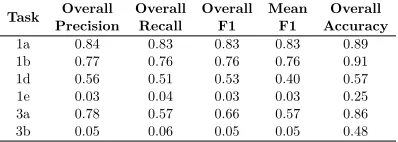
Table 1: Official SpaceEval submission results.
Training
5-fold cross validation Test
Label P R F1 P R F1
MEASURE 0.889 0.707 0.788 0.869 0.726 0.791
MOTION 0.823 0.700 0.756 0.808 0.733 0.769
MOTION_SIGNAL 0.766 0.600 0.673 0.801 0.772 0.786 NON_MOTION_EVENT 0.663 0.371 0.476 0.688 0.478 0.564
PATH 0.815 0.614 0.701 0.759 0.519 0.617
PLACE 0.802 0.777 0.789 0.742 0.752 0.747
SPATIAL_ENTITY 0.793 0.653 0.716 0.858 0.763 0.808 SPATIAL_SIGNAL 0.750 0.603 0.668 0.740 0.681 0.709
OVERALL 0.795 0.674 0.730 0.785 0.712 0.746
Table 2: Spatial Element/Signal detection results on training data and test data. Results are reproduced in-dependently of official evaluation.
tion, NER, and dependency parsing. The word rep-resentations are publicly-available 300-dimension GloVe4 word vectors trained on 42 billion tokens of Web data (Pennington et al., 2014). The model was trained using CRFsuite (Okazaki, 2007) with L-BFGS using L2 regularization withλ2= 1∗10−5. 4.2.2 Datasets
We evaluated our system on the SpaceEval train-ing data as described in Section 2, and additionally on the SpaceEval Task 3 test data, which was dis-tributed with gold labeled Spatial Elements, Indi-cators, and Motions. The test data consisted of 16 files with 317 sentences and 1,609 spatial roles.
4.2.3 Results
Official task results for spatial element/signal identification (Task 1a) and classification (Task 1b) are shown in Table 1.
We performed more detailed evaluation using 5-fold cross validation on the training data and on the released gold test data. Our results are pre-sented in Table 2. These results and have an f1-score that is slightly lower than the official reported result.5Evaluation over the test data produced a
4http://www-nlp.stanford.edu/projects/glove/ 5As the official evaluation data and scripts have not been
fully released at the time of writing, it is not possible to deter-mine the cause of the discrepancy in f1-scores. Comparison between strict and “relaxed” matching as used in prior Se-mEval SpRL tasks did not account for the difference.
Features representing the extracted trigger:
RF.1 Raw string RF.2 Lemma RF.3 POS
RF.4 RF.2 concatenated with RF.3
Features representing each of the two arguments:
RF.5 Raw string RF.6 Lemma RF.7 POS
RF.8 RF.6 concatenated with RF.7
RF.9 Spatial element type (i.e Place, Path, etc.) RF.10 RF.9 of each argument concatenated together RF.11 RF.10 concatenated with RF.2
RF.12 Direction of the argument with the respect to the ex-tracted trigger (i.e left/right)
RF.13 RF.12 of each argument concatenated together RF.14 RF.13 concatenated with RF.2
RF.15 Boolean value representing whether there are other spa-tial elements in between the argument and the extracted trigger
RF.16 RF.15 of each argument concatenated together RF.17 Dependency path between the argument and the
ex-tracted trigger (i.e. ↑conj↓dep↓nsubj) RF.18 RF.17 of each argument concatenated together RF.19 Dependency path between the two arguments RF.20 Length of the dependency path between the argument
and the extracted trigger
RF.21 Bag-of-words of tokens in between the argument and the extracted trigger
RF.22 Number of tokens in between the argument and the ex-tracted trigger
RF.23 RF.22 of each argument added together
RF.24 Boolean value representing whether either of the argu-ments are null values
Features representing the spatial elements that are di-rectly to the left and to the right of the trigger:
RF.25 Raw string RF.26 Lemma RF.27 POS
RF.28 RF.26 concatenated with RF.27
RF.29 Number of tokens in between the spatial element and the extracted trigger
Figure 5: Features for joint spatial relation classification and role labeling. Underlined features are withheld from quadratic feature Settings D and E of Table 3.
slightly higher f1-score than on the training data. We theorize that this is due to cross-fold validation using a smaller dataset for its model.
5 Spatial Relation Classification and Argument Labeling
5.1 Approach
[image:4.612.88.287.64.135.2] [image:4.612.76.304.162.272.2]Setting Regularization Features SEs Triggers P R F1
A no all gold gold 0.560 0.500 0.527
B yes all gold gold 0.599 0.496 0.544
C yes -SE types gold gold 0.597 0.430 0.500
D yes all + semantic types gold gold 0.636 0.501 0.561
E yes pre-quadratic gold gold 0.575 0.411 0.480
F yes quadratic gold gold 0.762 0.345 0.463
G yes all predicted dictionary 0.423 0.427 0.425
[image:5.612.122.490.65.154.2]H yes all predicted predicted 0.382 0.364 0.372
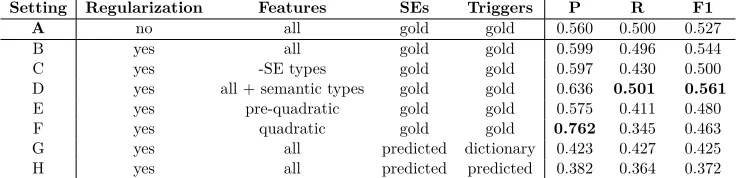
Table 3: Settings for extended relation detection evaluation over the SpaceEval 2015 training data. All evaluation is conducted with 5-fold cross validation, the full RE feature set from Figure 5, gold standard SEs, and gold standard triggers. The overall precision, recall, and f1-scores are reported for each setting with the highest performing in bold. Setting A was used for our official submission. Where indicated, L2 regularization was performed withλ2= 1∗10−14.
considering relations that contain a trigger and by labeling only the following attributes which corre-spond to primary spatial and motion roles:
• MOVELINK: trigger, mover, goal
• QSLINKandOLINK: trigger, trajector, landmark
5.1.1 Candidate Trigger Extraction
First, candidate triggers are extracted from each sentence. The model we presented for detecting signals in Section 4.1 has a high f1-score but low precision. Because we want to prioritize recall for generating candidate tuples, when classifying rela-tions on unannotated text, dictionaries of triggers automatically compiled from the training data are used to extract potential triggers from sentences. These dictionaries are used in Task 1d and 1e in Figure 2. In Task 3, where gold spatial roles are pro-vided,MOTIONs are used as potentialMOVELINK trig-gers,SPATIAL_SIGNALs are used as potentialQSLINK and OLINK triggers. Evaluation of the trigger dic-tionaries shows that they have much higher recall than CRF models6. Additional relation classifica-tion evaluaclassifica-tion in Table 3 show that the dicclassifica-tionar- dictionar-ies (Setting F) achieve an f1-score improvement of 0.055 over the CRF models (Setting G).
5.1.2 Candidate Tuple Generation
All possible candidate relations in a sentence are then generated using the extracted triggers and the spatial elements in the sentence. A candidate tuple consists of an extracted trigger and two other spa-tial elements: arg1 and arg2. Since some relations, such as the one represented in Figure 1 Example 6, can have undefined arguments, tuples with unde-fined arguments are also generated. For Example 4
6In particular, recall for
SPATIAL_SIGNALS increases from 0.603 to 0.936 andMOTIONrecall increases from 0.700 to 0.812 on the SpaceEval test data.
in Figure 1, the following candidate tuples will be generated forMOVELINKclassification:
• <trigger:biked, arg1:I, arg2:store>
• <trigger:biked, arg1:I, arg2:home>
• <trigger:biked, arg1:I, arg2:∅>
• <trigger:biked, arg1:home,arg2:store >
• <trigger:biked, arg1:home,arg2:∅> • <trigger:biked, arg1:store,arg2:∅>
Each tuple is represented by three main groups of features outlined in Figure 5. A one-against-all multi-class classifier is then applied to classify each candidate relation tuple into one of three possible classes. Three independent classifiers are trained, one for each spatial relation type, using Vowpal Wabbit (Agarwal et al., 2011). The classes used by theMOVELINKclassifier are:
Class 1 -REL(arg1=mover,arg2=goal) Class 2 -REL(arg1=goal,arg2=mover) Class 3 -NONE
The classes used by theQSLINKandOLINK classi-fiers are:
Class 1 -REL(arg1=trajector,arg2=landmark) Class 2 -REL(arg1=landmark,arg2=trajector) Class 3 -NONE
5.2 Evaluation
5.2.1 Setup
Relation Type P R F1
QSLINK 0.661 0.538 0.594
MOVELINK 0.571 0.451 0.504
OLINK 0.691 0.517 0.591
[image:6.612.345.506.64.116.2]OVERALL 0.636 0.501 0.561
Table 4: SpRL-CWW’s relation classification results for the highest-performing Setting D.
5.2.2 Datasets
We evaluated our system on the trial and train-ing data that was released for SpaceEval, with the exception of 9 files that didn’t have spatial relations annotated. Since our system focuses on relations with a trigger, we filtered out the relations that con-tained no trigger. The resulting dataset of 1,801 relations was used for training and evaluation.
5.2.3 Results
Official task results for relation classification are shown in Table 1. Task 1d results use the SEs that were detected in the previous step (Task 1b). Task 3a results are for relation classification using gold spatial elements and signals.
6 Discussion
Participation in SpaceEval raised several questions which we attempt to answer by conducting extended evaluation of our system on the SpaceEval training data using 5-fold cross validation7. The settings and results are summarized in Table 3.
Which features were effective?
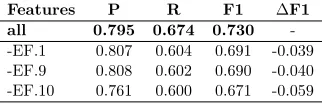
The feature ablation results in Table 5 show the three features with the largest contribution to SE and SI classification. They verify the contribution of word vectors trained on Web-scale data and sup-port Bastianelli’s et al. (2013)’s claim that shallow grammatical information is essential.
Does the fine-grained SpaceEval annotation scheme help or hinder?
In order to explore this, we compare the top per-forming setting with SE type-related features (Set-ting B) to a set(Set-ting with them removed (Set(Set-ting C). Absence of these features decrease the f1-score by 0.044, providing evidence that fine-grained SE types help relation classification, though the relation and spatial role taxonomy requires consideration.
7Partitions were made by taking a stratified split of the
document set when ordered by decreasing size.
Features P R F1 ∆F1 all 0.795 0.674 0.730 --EF.1 0.807 0.604 0.691 -0.039 -EF.9 0.808 0.602 0.690 -0.040 -EF.10 0.761 0.600 0.671 -0.059
Table 5: The three spatial element classification features with the largest delta in feature ablation.
Furthermore, each gold Spatial Signal that was provided for Task 3 had one of three possible se-mantic types; DIRECTIONAL, TOPOLOGICAL
or DIR_TOP (both). Instead of using all Spa-tial Signals as candidate triggers for QSLINKs and OLINKs, we only considered TOPOLOGICAL Spa-tial Signals as candidate triggers for QSLINK and DIRECTIONAL Spatial Signals as candidate trig-gers for OLINK. This setting (Setting D) achieved the highest f1-score and recall, demonstrating the importance of Spatial Signal semantic types in rela-tion classificarela-tion. Full relarela-tion classificarela-tion results for Setting D are summarized in Table 4.8
Is less (or no) feature engineering feasible?
We attempt this by automatically generating fea-tures using Vowpal Wabbit’s quadratic feature gen-eration. We disable all features underlined in Fig-ure 5) and instruct VW to automatically construct features by generating all possible feature combina-tions. Settings E and F compare the base feature set before and after quadratic features are added. While quadratic features achieve a lower f1-score, they have the highest precision of all settings, sug-gesting feature generation may be useful for increas-ing precision of relation classification, but the low f1-score of Setting F indicates care is needed in select-ing the base feature set. We are explorselect-ing feature engineering reduction further with a phrase vector-based model inspired by (Hermann et al., 2014).
7 Conclusion
In this paper we presented the SpRL-CWW entry to SpaceEval 2015: Task 8. Official evaluation showed that it performed especially well on unannotated data. Extended evaluation verified the contribution of Web-scale word vectors, trigger dictionaries, and SE type information; and automatic feature gener-ation showed promise. For future work, we plan to explore phrase vector-based approaches to SpRL.
8We thank an anonymous reviewer for the suggestion to
[image:6.612.115.262.64.115.2]Acknowledgments
This research was supported by Honda Research In-stitute Japan, Co., Ltd. We also thank the anony-mous reviewers for their many fruitful suggestions.
References
Alekh Agarwal, Olivier Chapelle, Miroslav Dudík, and John Langford. 2011. A reliable effective terascale linear learning system. CoRR, abs/1110.4198. Emanuele Bastianelli, Danilo Croce, Roberto Basili, and
Daniele Nardi. 2013. UNITOR-HMM-TK: Structured kernel-based learning for spatial role labeling. Proceed-ings of the Seventh International Workshop on Seman-tic Evaluation (SemEval 2013).
Charles J. Fillmore, Christopher R. Johnson, and Miriam R.L. Petruck. 2003. Background to FrameNet.
International Journal of Lexicography, 16.3:235–250. Karl Moritz Hermann, Dipanjan Das, Jason Weston, and
Kuzman Ganchev. 2014. Semantic frame identifica-tion with distributed word representaidentifica-tions. In Pro-ceedings of ACL, June.
Oleksandr Kolomiyets, Parisa Kordjamshidi, Steven Bethard, and Marie-Francine Moens. 2013. SemEval-2013 task 3: Spatial role labeling. In Second Joint Conference on Lexical and Computational Semantics (*SEM), Volume 2: Proceedings of the Seventh Inter-national Workshop on Semantic Evaluation (SemEval 2013), Second joint conference on lexical and compu-tational semantics, Atlanta, USA, 14-15 June 2013, pages 255–266.
Parisa Kordjamshidi and Marie-Francine Moens. 2014. Global machine learning for spatial ontology popula-tion. Web Semantics: Science, Services and Agents on the World Wide Web.
Parisa Kordjamshidi, Martijn Van Otterlo, and Marie-Francine Moens. 2011. Spatial role labeling: Towards extraction of spatial relations from natural language.
ACM Transactions on Speech and Language Processing (TSLP), 8(3):4.
Parisa Kordjamshidi, Steven Bethard, and Marie-Francine Moens. 2012. SemEval-2012 task 3: Spa-tial role labeling. In *SEM 2012: The First Joint Conference on Lexical and Computational Semantics – Volume 1: Proceedings of the Main Conference and the Shared Task, and Volume 2: Proceedings of the Sixth International Workshop on Semantic Evaluation (SemEval 2012), SemEval-2012, pages 365–373, June. Christopher D. Manning, Mihai Surdeanu, John Bauer, Jenny Finkel, Steven J. Bethard, and David McClosky. 2014. The Stanford CoreNLP natural language pro-cessing toolkit. In Proceedings of 52nd Annual Meet-ing of the Association for Computational LMeet-inguistics: System Demonstrations, pages 55–60.
Lluís Màrquez, Xavier Carreras, Kenneth C Litkowski, and Suzanne Stevenson. 2008. Semantic role labeling: an introduction to the special issue. Computational Linguistics, 34(2):145–159.
Naoaki Okazaki. 2007. CRFsuite: a fast implemen-tation of conditional random fields (CRFs). http: //www.chokkan.org/software/crfsuite/.
Jeffrey Pennington, Richard Socher, and Christopher Manning. 2014. Glove: Global vectors for word rep-resentation. In Proceedings of the 2014 Conference on Empirical Methods in Natural Language Processing (EMNLP), pages 1532–1543, Doha, Qatar, October. James Pustejovsky, Jessica Moszkowicz, and Marc
Ver-hagen. 2012. A linguistically grounded annotation language for spatial information. TAL, 53(2). Kirk Roberts and Sanda Harabagiu. 2012. UTD-SpRL:
A joint approach to spatial role labeling. In *SEM 2012: The First Joint Conference on Lexical and Com-putational Semantics – Volume 1: Proceedings of the main conference and the shared task, and Volume 2: Proceedings of the Sixth International Workshop on Semantic Evaluation (SemEval 2012), pages 419–424. Magnus Sahlgren. 2006. The Word-Space Model. Ph.D.
![Studies on the nitrification inhibitor, "nitrapyrin" [2 chloro 6(trichloromethyl) pyridine] in relation to availability and transformation of nitrogen in soil](data:image/gif;base64,R0lGODlhAQABAIAAAP///wAAACH5BAEAAAAALAAAAAABAAEAAAICRAEAOw==)