UNITOR-HMM-TK: Structured Kernel-based Learning
for Spatial Role Labeling
Emanuele Bastianelli(†)(?), Danilo Croce(‡), Daniele Nardi(?), Roberto Basili(‡)
(†) DICII
University of Roma Tor Vergata Rome, Italy
{bastianelli}@ing.uniroma2.it
(‡) DII
University of Roma Tor Vergata Rome, Italy
{croce,basili}@info.uniroma2.it
(?) DIAG
University of Roma La Sapienza Rome, Italy
{nardi}@dis.uniroma1.it
Abstract
In this paper the UNITOR-HMM-TK system participating in the Spatial Role Labeling task at SemEval 2013 is presented. The spatial roles classification is addressed as a sequence-based word classification problem: the SVMhmm learning algorithm is applied, based on a simple feature modeling and a ro-bust lexical generalization achieved through a Distributional Model of Lexical Semantics. In the identification of spatial relations, roles are combined to generate candidate relations, later verified by a SVM classifier. The Smoothed Partial Tree Kernel is applied, i.e. a con-volution kernel that enhances both syntactic and lexical properties of the examples, avoid-ing the need of a manual feature engineeravoid-ing phase. Finally, results on three of the five tasks of the challenge are reported.
1 Introduction
Referring to objects or entities in the space, as well as to relations holding among them, is one of the most important functionalities in natural language understanding. The detection of spatial utterances thus finds many applications, such as in GPS navi-gation systems, or Human-Robot Interaction (HRI). In Computational Linguistics, the task of recog-nizing spatial information is known as Spatial Role Labeling (SpRL), as discussed in (KordJamshidi et al., 2010). Let us consider the sentence:
[A man]TRAJECTORis sitting[on]SPATIALINDICATOR
[a chair]LANDMARKand talking on the phone. (1)
where three roles are labeled: the phrase “A man” refers to a TRAJECTOR, “a chair” to a LAND
-MARK and they are related by the spatial
expres-sion “on” denoted as SPATIAL INDICATOR. The last role establishes the type of the spatial relation, e.g. Regional. The ambiguity of natural language makes this task very challenging. For example, in the same Example 1, another preposition “on” can be considered, but the phrase “the phone” is not a spatial role, as it refers to a communication mean. This mainly depends on the semantics of the gram-matical head words, i.e.chairandphone. Such phe-nomena are crucial in many learning frameworks, as in kernel-based learning (Shawe-Taylor and Cris-tianini, 2004), where the decision is based on the similarity between training and testing data.
This paper describes the UNITOR-HMM-TK sys-tem participating in the Semeval 2013 Spatial Role Labeling Task (Kolomiyets et al., 2013), addressing three of the five defined sub-tasks:
• Task A: Spatial Role Classification. It con-sists in labeling short sentences with spatial roles among SPATIAL INDICATOR, TRAJEC
-TORand LANDMARK.
• Task B: Relation Identification. It consists in the identification of relations among roles iden-tified in Task A. This task does not involve the semantic relation classification.
• Task C: Spatial Role Classification. It con-sists in labeling short documents with spa-tial roles among the extended role set: TRA
-JECTOR, LANDMARK, SPATIAL INDICATOR, MOTION INDICATOR, PATH, DIRECTIONand DISTANCE.
TheUNITOR-HMM-TKsystem addresses both the problems of identifying spatial roles and relations as a sequence of two main classification steps.
In the first step, each word in the sentence is classified by a sequence-based classifier with re-spect to the possible spatial roles. It is in line with other methods based on sequence-based clas-sifier for SpRL (Kordjamshidi et al., 2011; Kord-jamshidi et al., 2012b). Our labeling has been in-spired by the work in (Croce et al., 2012), where the SVMhmmlearning algorithm, formulated in (Al-tun et al., 2003), has been applied to the classi-cal FrameNet-based Semantic Role Labeling. The main contribution in (Croce et al., 2012) is the adop-tion of shallow grammatical features (e.g. POS-tag sequences) instead of the full syntax of the sen-tence, in order to avoid over-fitting over training data. Moreover, lexical information has been gen-eralized through the use of a Word Space, in line with (Schutze, 1998; Sahlgren, 2006): it consists in a Distributional Model of Lexical Semantics de-rived from the unsupervised analysis of an unla-beled large-scale corpus. The result is a geometri-cal space where words with similar meaning, e.g. involved in a paradigmatic or almost-synonymic re-lations, will be projected in similar vectors. As an example, we expect that a word like “table”, maybe a LANDMARKin a training example, is more similar to “chair” as compared with “phone”.
In the second step, all roles found in a sentence are combined to generate candidate relations, which are then verified by a Support Vector Machine (SVM) classifier. As the entire sentence is informative to de-termine the proper conjunction of all roles, we apply a kernel function within the classifier, that enhances both syntactic and lexical information of the exam-ples. We adopted theSmoothed Partial Tree Kernel
(SPTK), defined in (Croce et al., 2011): it is con-volution kernel that allows to measure the similar-ity between syntactic structures, which are partially similar and whose nodes can differ, but are semanti-cally related. Each example is represented as a tree structure directly derived from the sentence depen-dency parse, thus avoiding the manual definition of features. Similarity between lexical nodes is mea-sured in the same Word Space mentioned above.
In the rest of the paper, Section 2 discusses the SVMhmm based approach. The SPTK-based learn-ing algorithm will be presented in Section 3. Finally, results obtained in the competition are discussed in Section 4.
2 Sequential Tagging for Spatial Role Classification
The system proposed for the Spatial Role Classi-fication task is based on the SVMhmm formula-tion discussed in (Altun et al., 2003). It extends classical SVMs by learning a discriminative model isomorphic to a k-order Hidden Markov Model through the Structural SVM formulation (Tsochan-taridis et al., 2005). In the discriminative view of SVMhmm, given an observed input word se-quence x= (x1. . . xl) ∈ X of feature vectors x1. . . xl, the model predicts a sequence of labels
y= (y1. . . yl) ∈ Y after learning a linear
discrim-inant functionF : X × Y → R over input/output pairs. Each word is then modeled as a set of linear features that express lexical information as well as syntactic information surrogated by POS n-grams. With respect to other works using SVMhmm for SpRL, such as (Kordjamshidi et al., 2012b), we in-vestigate another set of possible features, as the ones proposed in (Croce et al., 2012): the aim is to pro-vide an agile system that takes advantages in adopt-ing only shallow grammatical features, thus ignoradopt-ing the full syntactic information of a sentence. The syn-tactic features derived from a dependency parse pro-cess are surrogated by POS n-grams. According to this, our feature modeling adopts theIOBnotation discussed in (Croce et al., 2012). It provides a class label for each token, mapping them into artificial classes representing the beginning (B), the inside (I) or ending (O) of a spatial role, plus the label of the classified role (i.e.BSPIND for the starting token of a
SPATIAL INDICATOR); words external to every role are labeled with the special class ( ). According to this notation, the labeling of Example 1 can be ex-pressed as follows: “A/BTRAJman/OTRAJis/ sitting/ on/BSPINDa/BLANDchair/OLANDand/ . . .”.
Task A whileTRAJECTORS, LANDMARKS, PATHS,
DISTANCESandDIRECTIONSfor Task C.
For the classification of SPATIAL and MOTION
INDICATOR, each word, such as the first “on”
occur-rence in the Example 1, is modeled through the fol-lowing features: its lemma (on) and POS tag (IN); the left and right lexical contexts, represented by the
nwords before (man::NN is::VBZsitting::VBG) and after (a::DT chair::NN and::CC); the left and right syntactic contexts as the POS n-grams occurring be-fore (i.e. NN VBZ VBZ VBG NN VBZ VBG) and
after(i.e.DT NN NN CC DT NN CC) the word. For the TRAJECTORand LANDMARK classifica-tion in Task A, each word is represented by the same features described above, plus the following ones (with respect to Example 1, the token relative to the wordman): lemma of the SPATIAL INDICATOR
(on);Positional Feature: distance from the SPATIAL
INDICATORin terms of number of tokens (-3); rel-ative position with respect to the SPATIALINDICA -TOR, that isbeforeor after(before); a boolean fea-ture that indicates whether or not the current token is a SPATIAL INDICATOR; the number of words com-posing the SPATIALINDICATOR(here 1).
In Task C, for the classification with respect to the complete set of roles, each word is modeled by the previous features together with the following: distance from the MOTION INDICATOR in terms
of number of tokens; relative position with respect to the MOTION INDICATOR (before and after); a boolean feature that indicates whether or not the cur-rent token is a MOTIONINDICATOR; the number of words that composes the MOTION INDICATOR. In both Tasks A and C the symbolsSIandMIto rep-resent a SPATIAL INDICATOR or a MOTION INDI
-CATOR are used respectively to represent the target
pivot role within anyn-gram.
In order to increase the robustness of our model-ing, we extended the lexical information with fea-tures derived from a distributional analysis over large texts. In essence, we represent the lexical se-mantic similarity between different words with sim-ilar meaning. We extend a supervised approach through the adoption of vector based models of lex-ical meaning: a large-scale corpus is statistlex-ically an-alyzed and a Word Space, (Sahlgren, 2006), is ac-quired as follows. A word-by-context matrix M
is obtained through a large scale corpus analysis.
Then the Latent Semantic Analysis (Landauer and Dumais, 1997) technique is applied to reduce the space dimensionality. Moreover it provides a way to project a generic word wi into a k-dimensional
space where each row corresponds to the representa-tion vectorw~i. In such a space, the distance between vectors reflects the similarity between correspond-ing words. The resultcorrespond-ing feature vector representcorrespond-ing
wi is then augmented with w~i, as in (Croce et al.,
2010), where the benefits of such information have been reported in the FrameNet-based Semantic Role Labeling task.
3 Relation identification
TheUNITOR-HMM-TKsystem tacklesRelation Iden-tification task by determining which spatial roles, discovered in the previous classification phase, can be combined to determine valid spatial relations. Our method is inspired by the work of (Roberts and Harabagiu, 2012), where all possible spatial roles are first generated through heuristics and then com-binatorially combined to acquire candidate relations; valid spatial relations are finally determined using a SVM classifier. We aim at reducing the potentially huge search space, by considering only spatial roles proposed by our sequential tagging approach, de-scribed in Section 2. Most importantly, we avoid the manual feature engineering phase of (Roberts and Harabagiu, 2012). Candidate relations are not rep-resented as vectors, whose dimensions are manually defined features useful for the target classification. We directly apply the Smoothed Partial Tree-Kernel (SPTK), proposed in (Croce et al., 2011), to estimate the similarity among a specific tree representation.
Tree kernels exploit syntactic similarity through the idea of convolutions among substructures. Any tree kernel computes the number of common substructures between two treesT1 andT2 without explicitly considering the whole fragment space. Its general equation is reported hereafter:
T K(T1, T2) = X n1∈NT1
X
n2∈NT2
∆(n1, n2)
where NT1 and NT2 are the sets of the T1’s and
T2’s nodes respectively, and ∆(n1, n2) is equal to the number of common fragments rooted in then1
andn2nodes1. The SVM classifier is thus trained in
1
a implicit very high-dimensional space, where each dimension reflects a possible tree sub-structure, thus avoiding the need of an explicit feature definition. The function∆determines the nature of such space. For example, Syntactic Tree Kernel (STK) are used to model complete context free rules as in (Collins and Duffy, 2001).
The algorithm for SPTK (Croce et al., 2011) pushes for more emphasis on lexical nodes. The
∆function allows to recursively matches tree struc-tures and lexical nodes: this allows to match frag-ments having same structure but different lexical nodes, by assigning a score proportional to the product of the lexical similarities, thus generalizing grammatical and lexical information in training data. While similarity can be modeled directly over lexi-cal resources, e.g. WordNet as discussed in (Peder-sen et al., 2004), their development can be very ex-pensive, thus limiting the coverage of the resulting convolution kernel, especially in specific application domains. Again, a Word Space model is adopted: given two words, the term similarity function σ is estimated as the cosine similarity between the corre-sponding projections.
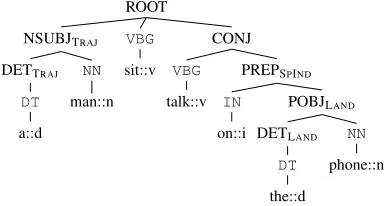
As proposed in (Croce et al., 2011), the SPTK is applied to examples modeled according the Gram-matical Relation Centered Tree(GRCT) representa-tion, which is derived from the original dependency parse structure. Figure 1 shows the GRCT for Exam-ple 1: non-terminal nodes reflect syntactic relations, such as subject (NSUBJ); pre-terminals are the POS, such as nouns (NN), and leaves are lexemes, such as
man::n2. Non-terminal nodes associated with a role are enriched with the role name, e.g. NSUBJTRAJ.
All nodes not covering any role are pruned out, so that all information not concerning spatial aspects that would introduce noise is ignored.
In this setting, positive examples are provided by considering sentences labeled by roles involved in a valid relation. The definition of negative exam-ples is more difficult. We considered all roles la-belled by the SVMhmm based system, discussed in Section 2. For each incorrect labeling over the
an-in the kernel space, i.e.√ T K(T1,T2)
T K(T1,T1)×T K(T2,T2)is applied.
2Each word is lemmatized to reduce data sparseness, but
they are enriched with POS tags to avoid confusing words from different grammatical categories.
ROOT
PREPSPIND
POBJLAND
NN
chair::n DETLAND
DT
a::d
IN
on::i
VBG
sit::v NSUBJTRAJ
NN
man::n DETTRAJ
DT
[image:4.612.343.508.62.145.2]a::d
Figure 1: GRCT representation of apositiveexample de-rived from a correct labeling from Example 1
ROOT
CONJ
PREPSPIND
POBJLAND
NN
phone::n DETLAND
DT
the::d
IN
on::i
VBG
talk::v
VBG
sit::v NSUBJTRAJ
NN
man::n DETTRAJ
DT
a::d
Figure 2: GRCT representation of anegativeexample de-rived from a wrong labeling from Example 1
notated material, a set of negative examples is ac-quired by combining all proposed roles. In order to avoid over-fitting, a n-fold schema has been ap-plied: it is needed to avoid the SVMhmm label-ing the same sentences used for trainlabel-ing. More-over, constraints over the relation are imposed to avoid violations of the Spatial Role theory: in Task B each relation must be composed at least by a SPATIAL INDICATOR, LANDMARK and a TRA -JECTOR or by a SPATIAL INDICATOR, implicit LANDMARK and a TRAJECTOR. Let us consider a possible labeling of Example 1: “[A man]TRAJ is sitting [on]SPIND [a chair]LAND and talking
[on]SPIND[the phone]LAND”; here, the second SPA
-TIAL INDICATOR “on” and the LANDMARK “the phone” are incorrectly labeled. A negative example is thus obtained by considering these roles togheter with the TRAJECTOR“the phone”, as shown in Fig-ure 2. Other two negative examples can be generated by combining the remaining two roles.
4 Results
In this section experimental results of the
[image:4.612.329.524.195.298.2]of the same training dataset employed in (Kord-jamshidi et al., 2012a)3. The dataset for Task C was part of the Confluence corpus4. More details about the dataset are provided in (Kolomiyets et al., 2013). In all experiments, sentences are processed with the Stanford CoreNLP5, for Part-of-Speech tagging,
lemmatization (Task A and C) and dependency parsing (Task B).
The sequential labeling system described in Sec-tion 2 has been made available by the SVMhmm software6. The estimation of the semantically Smoothed Partial Tree Kernel (SPTK), described in Section 3 is made available by an extended ver-sion of SVM-LightTK software7(Moschitti, 2006),
implementing the smooth matching between tree nodes. Similarity between lexical nodes is estimated as the cosine similarity in the co-occurrence Word Space described above, as in (Croce et al., 2011).
The co-occurrence Word Space is acquired through the distributional analysis of the UkWaC corpus (Baroni et al., 2009). First, all words oc-curring more than 100 times (i.e. the targets) are represented through vectors. The original space di-mensions are generated from the set of the 20,000 most frequent words (i.e. features) in the UkWaC corpus. One dimension describes the Pointwise Mu-tual Information score between one feature, as it oc-curs on a left or right window of3tokens around a target. Left contexts of targets are treated differently from the right ones, in order to capture asymmetric syntactic behaviors (e.g., useful for verbs): 40,000 dimensional vectors are thus derived for each tar-get. The Singular Value Decomposition is applied and the space dimensionality is reduced tok = 100.
4.1 Results in Task A
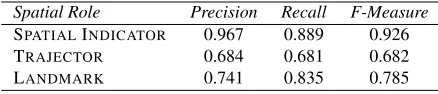
Two different runs were submitted for Task A. The first takes into account all roles labeled accordingly to the approach described in Section 2. Results, in term of precision, recall and F-measure for each spa-tial role are shown in Table 1. The second run con-siders only those roles composing the relations that
3
The initial number of sentences was of 600, but it decreased after the elimination of 21 duplicated sentences.
4
Three of the original 95 files were ignored because of some issues with their format. Seehttp://confluence.org
5
http://nlp.stanford.edu/software/corenlp.shtml
6
http://www.cs.cornell.edu/People/tj/svm light/svm hmm.html
7
http://disi.unitn.it/moschitti/Tree-Kernel.htm
are positively classified in Task B and it will be dis-cussed in Section 4.2.
A tuning phase has been carried out through a 10-fold cross validation: it allowed to find the best clas-sifier parameters. The evaluation of the system per-formances is measured using a character based mea-sure, i.e. considering the number of characters in the span that overlap a role in the gold-standard test.
Spatial Role Precision Recall F-Measure SPATIALINDICATOR 0.967 0.889 0.926
TRAJECTOR 0.684 0.681 0.682
[image:5.612.315.534.182.229.2]LANDMARK 0.741 0.835 0.785
Table 1: Task A results (first run)
The overall performances of the first run are very promising in terms of both precision and re-call. In particular, the SPATIAL INDICATOR
label-ing achieves a significant F-Measure of 0.926 with a precision of 0.967. The sequence labeling approach provides good results for the LANDMARK and the TRAJECTORroles too. Unfortunately, these results are not comparable with the performances obtained the last year edition of the SpRL task, where a gram-matical head word-based measure has been applied. The main difficulty in the SPATIAL INDICATOR
classification concerns the tagging of a larger or smaller span for the roles, as for“at the back”that is tagged as“at the back of ”. On the contrary, for roles like“to the left and the right”the system produces a tag covering just the first three words,“to the left”, because this shortest sequence was far more repre-sented within the training set. Some roles corre-sponding to unknown word sequences, such as“on the very right”, were not labeled, leading to the little drop in terms of recall for the SPATIALINDICATOR. Another issue in the TRAJECTOR and LAND
-MARKlabeling is due to the absence of specific role sequences in the training set, such as LANDMARK -TRAJECTOR-SPATIAL INDICATOR labeled in the test sentence “there is a[coffee table]LANDMARK with a [sofa]TRAJECTOR [around]SP.IND”: the SVMhmm
4.2 Results in Task B
Task B has been tackled using the SPTK-based Re-lation Identification approach, described in Section 3. In particular, the SVM classifier is fed with 741 positive examples, corresponding to the number of gold relations, while the negative examples genera-tion process, described in Secgenera-tion 3, yielded 2,256 examples. The same Word Space described in the previous section has been used to compute the se-mantic similarity within the SPTK. For the tuning phase, a 80-20 fixed split has been applied.
For this task, two different measures are pre-sented. TheRelaxed measure considers a relation correct if each role composing it has at least one character overlapping the corresponding gold role. TheStrictmeasure considers a relation correct only if each role in it has all the characters overlapping with the gold role. The first measure is more com-parable with the one used in (Kordjamshidi et al., 2012a), where a relation is considered correct only if each grammatical head word of the involved roles were correctly labeled. The results achieved in this task by our system are reported in Table 2.
Spatial Role Precision Recall F-Measure RELAXED 0.551 0.391 0.458 STRICT 0.431 0.306 0.358
Table 2: Task B results
The problem for this task is more challenging. In fact, the overall task is strictly biased by the quality of the SVMhmm based classifier and inherits all the limitations underlined in Section 4.2. This mostly affects the recall, because every error generated dur-ing the role classification is cumulative and losdur-ing only one role in Task A implies a misclassification of the whole relation. However, it is important to notice that these results have been achieved without any manual feature engineering nor any heuristics or hand coded lexical resource.
Spatial Role Precision Recall F-Measure SPATIALINDICATOR 0.968 0.585 0.729
TRAJECTOR 0.682 0.493 0.572
LANDMARK 0.801 0.560 0.659
Table 3: Task A results (second run)
In the second run of Task A, we evaluate the con-tribution of this syntactic information to filter out
roles. In Table 3 results of the second run for Task A are reported (see previous Section). As expected, the recall measure shows a performance drop with respect to results shown in Table 1: the results pro-posed in the first run represents an upperbound to the recall as any novel role is added here. However, the precision measure for the LANDMARKrole classifi-cation is improved of about 10%.
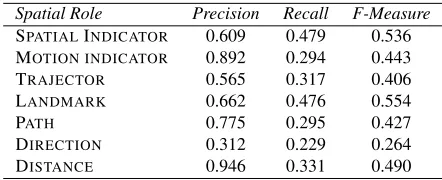
Spatial Role Precision Recall F-Measure SPATIALINDICATOR 0.609 0.479 0.536 MOTION INDICATOR 0.892 0.294 0.443
TRAJECTOR 0.565 0.317 0.406
LANDMARK 0.662 0.476 0.554
PATH 0.775 0.295 0.427
DIRECTION 0.312 0.229 0.264
[image:6.612.314.535.178.268.2]DISTANCE 0.946 0.331 0.490
Table 4: Task C results
4.3 Results in Task C
In Task C the extended set of roles is considered. According to this, the number of possible labels to be learnt by the system increases, thus making the problem more challenging. As for Task A, here the SVMhmm has been trained over the whole training set, using a 10-fold cross validation in the tuning phase. Moreover, the sentences of the Confluence corpus are far more complex than the ones from the CLEF corpus. Confluence sentences have a more narrative nature with respect to the CLEF sentences, that are simple description of images. The combina-tion of these two factors resulted in a large drop in the performance, especially for the recall.
As shown by the results in Table 4, DIRECTION
is the most difficult role to be classified, probably because it is represented by many different word se-quences. Other roles are found in few instances, but almost all correct, as for DISTANCE and MOTION
INDICATOR. The high value of Precision for the DISTANCErole is justified by the fact that when this
role is composed by a number, (i.e. “530 meters”), the system identified and classified it well, while for a representation with only words (i.e. “very close”) the system did not retrieved it at all.
References
Y. Altun, I. Tsochantaridis, and T. Hofmann. 2003. Hid-den Markov support vector machines. InProceedings of the International Conference on Machine Learning. Marco Baroni, Silvia Bernardini, Adriano Ferraresi, and Eros Zanchetta. 2009. The wacky wide web: a collection of very large linguistically processed web-crawled corpora. Language Resources and Evalua-tion, 43(3):209–226.
Michael Collins and Nigel Duffy. 2001. Convolution kernels for natural language. InProceedings of Neural Information Processing Systems (NIPS’2001), pages 625–632.
Danilo Croce, Cristina Giannone, Paolo Annesi, and Roberto Basili. 2010. Towards open-domain semantic role labeling. InACL, pages 237–246.
Danilo Croce, Alessandro Moschitti, and Roberto Basili. 2011. Structured lexical similarity via convolution kernels on dependency trees. In Proceedings of EMNLP, Edinburgh, Scotland, UK.
Danilo Croce, Giuseppe Castellucci, and Emanuele Bas-tianelli. 2012. Structured learning for semantic role labeling. In Intelligenza Artificiale, 6(2):163–176, January.
Oleksandr Kolomiyets, Parisa Kordjamshidi, Steven Bethard, and Marie-Francine Moens. 2013. Semeval-2013 task 2: Spatial role labeling. InProceedings of the 7th International Workshop on Semantic Evalua-tion. Association for Computational Linguistics. Parisa KordJamshidi, Martijn van Otterlo, and
Marie-Francine Moens. 2010. Spatial role labeling: Task definition and annotation scheme. InLREC.
Parisa Kordjamshidi, Martijn Van Otterlo, and Marie-Francine Moens. 2011. Spatial role labeling: To-wards extraction of spatial relations from natural lan-guage. ACM Trans. Speech Lang. Process., 8(3):4:1– 4:36, December.
Parisa Kordjamshidi, Steven Bethard, and Marie-Francine Moens. 2012a. Semeval-2012 task 3: Spa-tial role labeling. InSemEval 2012, pages 365–373, Montr´eal, Canada, 7-8 June. Association for Compu-tational Linguistics.
Parisa Kordjamshidi, Paolo Frasconi, Martijn Van Ot-terlo, Marie-Francine Moens, and Luc De Raedt. 2012b. Relational learning for spatial relation extrac-tion from natural language. In Proceedings of the 21st international conference on Inductive Logic Pro-gramming, ILP’11, pages 204–220, Berlin, Heidel-berg. Springer-Verlag.
T. Landauer and S. Dumais. 1997. A solution to plato’s problem: The latent semantic analysis theory of ac-quisition, induction and representation of knowledge.
Psychological Review, 104(2):211–240.
Alessandro Moschitti. 2006. Efficient convolution ker-nels for dependency and constituent syntactic trees. In
ECML, pages 318–329, Berlin, Germany, September. Ted Pedersen, Siddharth Patwardhan, and Jason
Miche-lizzi. 2004. WordNet::Similarity - Measuring the Re-latedness of Concept. InProc. of 5th NAACL, Boston, MA.
Kirk Roberts and Sanda Harabagiu. 2012. Utd-sprl: A joint approach to spatial role labeling. In SemEval 2012), pages 419–424, Montr´eal, Canada, 7-8 June. Association for Computational Linguistics.
Magnus Sahlgren. 2006. The Word-Space Model. Ph.D. thesis, Stockholm University.
Hinrich Schutze. 1998. Automatic word sense discrimi-nation. Journal of Computational Linguistics, 24:97– 123.
John Shawe-Taylor and Nello Cristianini. 2004. Kernel Methods for Pattern Analysis. Cambridge University Press.
Ioannis Tsochantaridis, Thorsten Joachims, Thomas Hof-mann, and Yasemin Altun. 2005. Large margin meth-ods for structured and interdependent output variables.