37
Annotating with Pros and Cons of Technologies in
Computer Science Papers
Hono Shirai1, Naoya Inoue1,2, Jun Suzuki1,2, Kentaro Inui1,2 1Tohoku University,2RIKEN AIP
{h.shirai, naoya-i, jun.suzuki, inui}@ecei.tohoku.ac.jp
Abstract
This study explores the task of extracting a technological expression and its pros/cons from computer science papers. We report the ongoing efforts on the annotated corpus of pros/cons and the analysis of the nature of the automatic extraction task. Specifically, we show how to adapt the targeted sentiment anal-ysis task for extracting pros/cons from com-puter science papers and conduct an annota-tion study. We construct a strong baseline model and conduct an error analysis to iden-tify the challenges of the automatic extraction task. Experimental results show that pros/cons can be consistently annotated by annotators, and that the task is challenging owing to the re-quirement of domain-specific knowledge. The annotated dataset is made publicly available for research purposes.
1 Introduction
The number of scientific publications has been rapidly increasing. Johnson et al.(2018) showed that over 3 million research articles are published annually. It is increasingly difficult for researchers to have a bird’s-eye view of current research trends with such a large number of publications.
This study explores information extraction from computer science papers. The main focus of com-puter science publications involves problem solv-ing (e.g., optimization algorithm). One typical form of computer science publications is present-ing an issue and then discusses solutions for it. Specifically, the pros and cons of previously pro-posed technologies are discussed and propose new technology. Example (1) discusses the cons of pre-vious technologies for coreference resolution:1
(1) While successful, these approaches require labeled training data, consisting of mention
1Throughout the paper, an appended 8-character identifier indicates the ACL anthology’s paper identifier.
pairs and the correct decisions for them.
(D08-1068)
Therefore, when computer scientists write a paper, it is important to have a bird’s-eye view of the pros and cons of previous technologies. As the number of publications rapidly increases, it is desirable to develop an automated tool for mining the pros and cons of technologies.
Previous works have explored automatic extrac-tion of a wide variety of scientific knowledge to assist researchers in collecting relevant publica-tions. This research direction includes domain-independent approaches, such as Citation Net-work (Kajikawa et al., 2007) and Argumenta-tive Zoning (Teufel et al., 1999), and domain-dependent approaches such as BioNLP (Del´eger et al.,2016). These technologies are the founda-tion of scientific search engines or knowledge dis-covery tools, such as Semantic Scholar2 and Dr. Inventor (Ronzano and Saggion,2015). Neverthe-less, less attention has been paid to the mining of the pros and cons of technologies.
This study performs a preliminary investiga-tion on automatically identifying technologies and their pros/cons from computer science papers (henceforth referred to as pros/cons identifica-tion). We frame pros/cons identification as the well-known NLP task of targeted sentiment anal-ysis (Jiang et al., 2011) and conduct an annota-tion study. Futhermore, we build a neural base-line model to identify the challenges of pros/cons identification task. The annotation study indicates that the pros/cons identification task can be rea-sonably framed as the task of targeted sentiment analysis. The experimental results of automatic extraction show that pros/cons identification is dif-ficult mainly owing to the requirement of domain-specific knowledge. The annotated dataset is made
publicly available.3
2 Annotation Scheme
We investigate the task of pros/cons identification task by adopting an existing annotation scheme to our task and conducting an annotation study. Specifically, we apply an annotation scheme from the targeted sentiment analysis task (Jiang et al.,
2011), which is mainly developed for mining pos-itive/negative opinion about named entities (e.g. person, products) from twitter.
2.1 TERM
We introduce TERMlabel to annotate with tech-nological terms. We define TERM as a noun phrase that represents a mechanism, a function, or a method to solve the problem. In Example (2),
recursive neural networkandAdaRNNare labeled as TERM because these are types of neural net-work models.
(2) We employ a novel adaptive multi-compositionality layer in recursive neural network, which is named as AdaRNN (Dong et al., 2014).(P14-2009)
Note that we also annotate a general noun phrase (e.g. our method) with the TERM label and named entities with theTERMlabel.
2.2 Sentiment
For each phrase labeled as TERM, we addition-ally annotate it with aSentimentattribute, which represents how a technology is evaluated. Fol-lowing the previous work on targeted sentiment analysis (Jiang et al., 2011, etc.), an evaluation is expressed by three types of attributes:
Posi-tive, Negative, and Neutral. These labels
rep-resent a local polarity within a sentence and are only judged based on the information obtained from a sentence containing TERM. In Example (3),the whole-sentence-based classifierthat is la-beled TERM is assigined Positive attribute, be-cause it is positively evaluated by the expression “performs the best”.
(3) The results indicate that the whole-sentence-based classifier performs:::::::
:::
the::::best. (D09-1019)
Similarly, the negative attribute is assigned to the examples of negative aspects of technologies.
3https://github.com/cl-tohoku/scientific-paper-pros-cons
Figure 1: The brat annotation interface used for con-ducting our annotation study.
Neutralattribute is given toTERMif only the
neutral features and properties of technology are described in the sentence. In Example (2), recur-sive neural networkandAdaRNN are assigned to
Neutralattributes.
3 Annotation Study
In this section, we describe our annotation study used for creating a dataset for the automatic ex-traction of pros/cons.
3.1 Dataset
We retrieved 92 computational linguistics papers that contained the keyword “coreference resolu-tion” in the title or body texts using Google Cus-tom Search in ACL Anthology.4 Various methods have been proposed for coreference resolution be-cause it has been a subject of research for numer-ous years. This is suitable for our trial annotation. These papers we considered were published from 1999 to 2017.
In a publication, the pros and cons of the pro-posed/existing methods are generally discussed in the introduction section. Therefore, we focus on annotating only the introduction section to reduce the cost of annotation.
3.2 Settings
We employed three fluent-English speakers who specialize in NLP. We assigned two annotators per paper to investigate the inter-annotator agree-ment. Figure1illustrates the annotation interface
brat(Stenetorp et al.,2012), which is used for con-ducting our annotation.
3.3 Results and Discussion
We measured the inter-annotator agreement after the annotation was completed.
TERM The percentage of the exact match of TERMspans between annotators was 24.0 %. We observed multiple of cases where one annotator la-beled a phrase asTERM, but the other annotator
did not. Such examples included joint inference
and a learned cluster ranker. We speculate that this is because these noun phrases indirectly indi-cate whether a phrase is a mechanism, function, or method.
The percentage ofpartialmatch between anno-tators was 38.2 %. We observed that the interpreta-tion of span was sometimes different across anno-tators in certain cases. For example, one annotator included a modifier such asa simplified semantic role labeling (SRL) framework, but the other did not (i.e.,semantic role labeling (SRL) framework).
Sentiment We calculated the inter-annotator agreement of theSentimentattributes for 390 in-stances whose TERM span annotation matched exactly matched between annotators. We obtained a Fleiss’s Kappa of 0.65, which indicated substan-tial agreement (Fleiss,1971).
Even though the inter-annotator agreement was generally high, there are a few disagreements. The primary cause of disagreements is that one annota-tor assigned theNeutralattribute, and the other as-signed the non-Neutralattributes (i.e.,Positiveor Negative). Among the disagreements, we found numerous cases where domain-specific knowledge was required. In Example (4), one annotator la-beledranking modelsasPositiveand the other la-beled them asNeutral. To judge the sentiment at-tributes correctly, one required the domain knowl-edge of coreference resolution that directly cap-turing the competition among potential antecedent candidatesis appropriate.
(4) In essence, ranking modelsdirectly:::::::::::::capture during training the competition among po-tential antecedent candidates, instead of con-sidering them independently. (D08-1069)
We found a large number of cases where sen-tences took the form of concession. In Example (5), one annotator labeledthe pairwise approach
as Negative and the other Neutral. We
spec-ulate that annotators were confused because the pairwise approach is evaluated positively by the phrase high precision in the subordinate clause, but negatively by the phraseneither realistic nor scalablein the main clause.
(5) While the pairwise approach has high pre-cision, it isneither::::::::::::::realistic::::nor::::::::scalable to explicitly enumerate all pairs of compatible word pairs. (N10-1061)
#TERMspans
# sentences Positive Neutral Negative
2,058 255 1,100 116
Table 1: Statistics of annotated corpus.
4 Experiments
To identify the challenges of the automatic extrac-tion task, we ran a strong baseline model to con-duct an error analysis.
4.1 Dataset
To obtain high-recall annotations, we aggregated all annotations from each annotator pair. We solved the conflicts betweenSentimentattributes by employing the following rules: (i) if both la-bels arePositiveandNegative,Neutrallabel is applied, and (ii) if one label being Positive or
Negativeand the otherNeutral, the non-Neutral
attribute is applied. Furthermore, we manually cleaned the data by resolving the conflicts be-tween the spans assigned by two annotators (e.g.,
a modelv.s.model). The statistics of the final cor-pus are shown in Table1.
4.2 Model
We formulate the automatic extraction task as a BIO sequence tagging task. Specifically, given a sentence, the model tags each word as one of{O, B-POS, I-POS, B-NEG, I-NEG, B-NEU, I-NEU}, where a combination of BI tags represents a Posi-tive(POS),Negative(NEG), andNeutral(NEU) technical term span.
We use the BiLSTM-CRF model proposed by Lample et al. (2016) which was originally designed for the task of named entity recog-nition.5 Regarding word embedding, we use
word2vec (Mikolov et al., 2013) embeddings trained on ACL Anthology Corpus (Aizawa et al.,
2018) (henceforth, CL), and ELMo (Peters et al.,
2018) embeddings trained on 1 Billion Word Benchmark (henceforth, EL).
4.3 Configurations
For the detection, TERM and Sentiment are judged as correct only if they exactly match with gold-standard spans. We report F1 scores as an evaluation measure. We evaluate our models in two configurations.
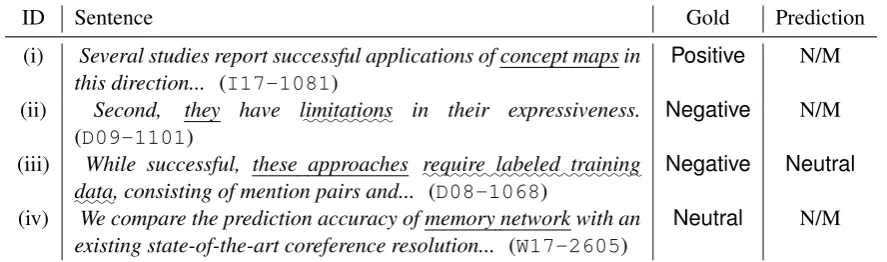
ID Sentence Gold Prediction
(i) Several studies report successful applications of concept maps in this direction... (I17-1081)
Positive N/M
(ii) Second, they have limitations::::::::: in their expressiveness.
(D09-1101)
Negative N/M
(iii) While successful, these approaches ::::::require::::::::labeled::::::::training
::::
data, consisting of mention pairs and... (D08-1068)
Negative Neutral
(iv) We compare the prediction accuracy of memory network with an existing state-of-the-art coreference resolution... (W17-2605)
[image:4.595.78.522.64.195.2]Neutral N/M
Table 2: Examples of the model predictions. Underlined words indicate aTERMphrase span. N/M indicates that the model does not label it asTERM.
Setting Emb. dev F1 test F1 / Prec. / Rec.
10-FCV CL 50.70 49.79 / 50.0 / 49.7
CL+EL 54.23 52.35 / 54.4 / 50.8
NEWYEAR CL+EL 53.29 42.69 / 51.8 / 36.3
Table 3: Performance of pros/cons identification.
10-FCV We employ 10-fold cross validation in this configuration. When data are split, we en-sure that the paper IDs in the training set do not have an overlap with the paper IDs in the test set. For model selection, we reserve 10% of the train-ing dataset as the development set. We report F1 scores averaged across all folds.
NEWYEAR In this configuration, to evaluate the models in real-life situations, we verify whether the models are able to extract the pros and cons of new papers after being trained on older papers. We utilize the papers from 2017 (i.e. the latest papers) and data from other years as the test and training sets, respectively.
4.4 Results and Discussion
The results are shown in Table3. ELMo embed-dings improve the prediction performance on the test and dev sets.6 This indicates that contextual information is important for pros/cons identifica-tion.
The results also highlight the difficulty of our task. We analyzed the results given by the best model (CL+EL model) to investigate how chal-lenging the task is. Model predictions along with their gold labels are shown in Table2.
First, we observe that when an input does not in-clude a word that directly indicates a method, then we are likely to obtain a false negative error (i.e.,
6The improvement is statistically significant (Wilcoxon’s signed-rank test,p <0.05).
the recognition of TERM fails). In sentence (i), the model is unable to predict a label for the term
concept mapsbecause it does not include a word that indicates a TERM. Sentence (ii) is another case in which the model cannot predict whether
they is TERM. Although they refers to a model,
our model cannot recognize it because it does not resolve coreference.
We also discovered that it is difficult to predict
Sentiment attributes when the phrase implicitly
expresses sentiment. In sentence (iii), the gold la-bel forthese approachesis Negative. However, the model predictsNeutralbecause successfulis a positive expression forthese approachesand re-quire labeled training data, ...is negative.
The performance of the models in the NEWYEAR configuration is poorer than that in the 10-FCV configuration. We observed that prediction fails for sentences that contain unknown words. For example, in sentence (iv),
memory networkis not observed in training data.
5 Use Case
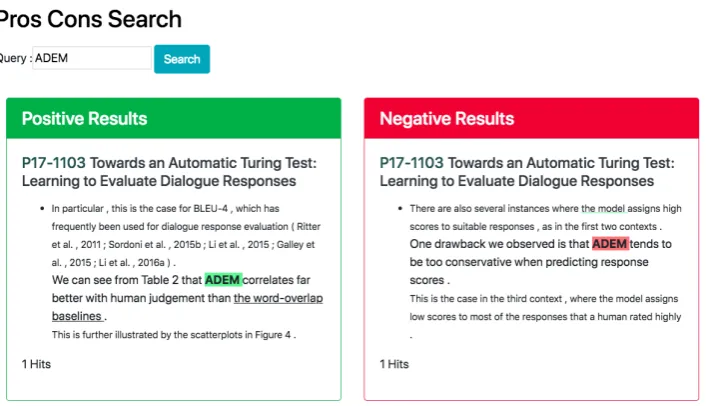
To show the use cases of our study, we parsed 60 ACL papers published in 2017 with our best per-forming model. One use case is to employ our system with a search engine-style interface. We implemented a prototype pros/cons identification system. We consider a situation in which we want to obtain an overview of the evaluation measures of dialogue responses and we already have sev-eral keywords such asADEMandBLEU. Given a search queryADEM, our system lists pros/cons of
re-Figure 2: Search results obtained from our pros/cons identification prototype system.
searchers who are starting work in a new field. Another possible interface is an “add-on” for a PDF viewer. For each important keyword in a PDF, a pop-up window can appear and inform the user about the pros/cons of the keyword.
6 Related Work
There are several types of attempts on extracting useful information from scientific papers. Cita-tion Network (Kajikawa et al.,2007) analyzes the trends of important technology in papers. Argu-mentative Zoning (Teufel et al., 1999) classifies the sentences in papers into an argumentative type such as BACKGROUNDand RELATEDWORK, etc.
A few studies annotate scientific pa-pers with relations between entities such as “APPLY-TO(CRF, POS tagger)”. Tateisi et al.
(2016) propose an annotation scheme for describ-ing the semantic structures of research articles. SemEval, which is one of the shared tasks workshop in NLP, proposes some information extraction tasks in the scientific paper domain. ScienceIE (Augenstein et al., 2017) is the task of extracting phrases and relationships from papers in multiple domains. SemEval-2018 Task 7 (G´abor et al., 2018) proposes a classification task that classifies the relations between entities in the ACL Anthology. BioNLP (Del´eger et al.,
2016) aims to extract technical terms, such as proteins, relations between proteins, and sub-stances and their side effects, in the biological and medical domains.
In the field of sentiment analysis, Aspect-Based Sentiment Analysis is performed in the domain of
review documents is performed. SemEval-2015 Task 12 (Pontiki et al., 2015) is the task of per-forming sentiment analysis based on the defined viewpoints such as the prices, cooking or qual-ity of service in hotels and restaurants. Targeted sentiment analysis (Jiang et al.,2011) is the task of classifying a sentiment towards a certain target entity in given sentences. The target entity is the name of persons, companies, and products. In the sentiment analysis in the scientific paper domain, Citation Sentiment Analysis (Yousif et al.,2017) has been performed to analyze the sentiment po-larity of an author against documents cited in a paper. However, targeted sentiment analysis of the paper content itself has not been explored.
7 Conclusion
We have proposed the task of pros/cons identifi-cation. We have designed a scheme for annotat-ing technological terms and its pros/cons. An an-notation study shows that annotators can consis-tently annotate sentiment attributes. Experiments performed on automatic extraction show that the task is still challenging because domain-specific knowledge and inference are required.
In our future work, we plan to expand our anno-tation to other domains such as computer vision. We also plan to develop a mechanism of recog-nizing sentiment attributes using domain-specific knowledge.
Acknowledgments
[image:5.595.125.480.62.265.2]References
Akiko Aizawa, Takeshi Sagara, Kenichi Iwatsuki, and Goran Topic. 2018. Construction of a new acl an-thology corpus for deeper analysis of scientific pa-pers. InThird International Workshop on SCIentific DOCument Analysis (SCIDOCA-2018).
Isabelle Augenstein, Mrinal Das, Sebastian Riedel, Lakshmi Vikraman, and Andrew McCallum. 2017. Semeval 2017 task 10: Scienceie - extracting keyphrases and relations from scientific publica-tions. In Proceedings of the 11th International Workshop on Semantic Evaluation (SemEval-2017), pages 546–555, Vancouver, Canada. Association for Computational Linguistics.
Louise Del´eger, Robert Bossy, Estelle Chaix, Mouhamadou Ba, Arnaud Ferr´e, Philippe Bessi`eres, and Claire N´edellec. 2016. Overview of the bacteria biotope task at bionlp shared task 2016. In Pro-ceedings of the 4th BioNLP Shared Task Workshop, pages 12–22, Berlin, Germany. Association for Computational Linguistics.
Joseph L Fleiss. 1971. Measuring nominal scale agree-ment among many raters. Psychological bulletin, 76(5):378.
Kata G´abor, Davide Buscaldi, Anne-Kathrin Schu-mann, Behrang QasemiZadeh, Haifa Zargayouna, and Thierry Charnois. 2018. Semeval-2018 task 7: Semantic relation extraction and classification in sci-entific papers. In Proceedings of The 12th Inter-national Workshop on Semantic Evaluation, pages 679–688, New Orleans, Louisiana. Association for Computational Linguistics.
Long Jiang, Mo Yu, Ming Zhou, Xiaohua Liu, and Tiejun Zhao. 2011. Target-dependent twitter senti-ment classification. InProceedings of the 49th An-nual Meeting of the Association for Computational Linguistics: Human Language Technologies, pages 151–160, Portland, Oregon, USA. Association for Computational Linguistics.
Rob Johnson, Anthony Watkinson, and M Wabe. 2018. The stm report. An overview of scientific and schol-arly publishing. 5th edition October.
Yuya Kajikawa, Junko Ohno, Yoshiyuki Takeda, Kat-sumori Matsushima, and Hiroshi Komiyama. 2007. Creating an academic landscape of sustainability science: an analysis of the citation network. Sus-tainability Science, 2(2):221.
Guillaume Lample, Miguel Ballesteros, Sandeep Sub-ramanian, Kazuya Kawakami, and Chris Dyer. 2016. Neural architectures for named entity recognition. InProceedings of the 2016 Conference of the North American Chapter of the Association for Computa-tional Linguistics: Human Language Technologies, pages 260–270. Association for Computational Lin-guistics.
Tomas Mikolov, Ilya Sutskever, Kai Chen, Greg Cor-rado, and Jeffrey Dean. 2013. Distributed represen-tations of words and phrases and their composition-ality. InProceedings of the 26th International Conference on Neural Information Processing Systems -Volume 2, NIPS’13, pages 3111–3119, USA. Curran Associates Inc.
Matthew Peters, Mark Neumann, Mohit Iyyer, Matt Gardner, Christopher Clark, Kenton Lee, and Luke Zettlemoyer. 2018. Deep contextualized word rep-resentations. In Proceedings of the 2018 Confer-ence of the North American Chapter of the Associ-ation for ComputAssoci-ational Linguistics: Human Lan-guage Technologies, pages 2227–2237. Association for Computational Linguistics.
Maria Pontiki, Dimitris Galanis, Haris Papageorgiou, Suresh Manandhar, and Ion Androutsopoulos. 2015. Semeval-2015 task 12: Aspect based sentiment anal-ysis. InProceedings of the 9th International Work-shop on Semantic Evaluation (SemEval 2015), pages 486–495, Denver, Colorado. Association for Com-putational Linguistics.
Francesco Ronzano and Horacio Saggion. 2015. Dr. inventor framework: Extracting structured informa-tion from scientific publicainforma-tions. In International Conference on Discovery Science, pages 209–220. Springer.
Pontus Stenetorp, Sampo Pyysalo, Goran Topi´c, Tomoko Ohta, Sophia Ananiadou, and Jun’ichi Tsu-jii. 2012. brat: a web-based tool for nlp-assisted text annotation. InProceedings of Conference of the European Chapter of the Association for Computa-tional Linguistics, pages 102–107. Association for Computational Linguistics.
Yuka Tateisi, Tomoko Ohta, Sampo Pyysalo, Yusuke Miyao, and Akiko Aizawa. 2016. Typed entity and relation annotation on computer science papers. In Proceedings of the Tenth International Confer-ence on Language Resources and Evaluation (LREC 2016), Paris, France. European Language Resources Association (ELRA).
Simone Teufel et al. 1999. Argumentative zoning: In-formation extraction from scientific text. Ph.D. the-sis, Citeseer.