A Systematic Comparison of Syntactic Representations of
Dependency Parsing
Guillaume Wisniewski
LIMSI, CNRS, Univ. Paris-Sud Universit´e Paris-Saclay
91 405 Orsay, France
Oph´elie Lacroix
DIKU, University of Copenhagen University Park 5
2100 Copenhagen [email protected]
Abstract
We compare the performance of a transition-based parser in regards to different annotation schemes. We pro-pose to convert some specific syntactic constructions observed in the universal dependency treebanks into a so-called more standard representation and to evaluate parsing performances over all the languages of the project. We show that the “standard” constructions do not lead systematically to better parsing performance and that the scores vary considerably according to the languages.
1 Introduction
Many treebanks have been developed for de-pendency parsing, following different annotations conventions. The divergence between the guide-lines can results from both the theoretical linguis-tic principles governing the choices of head status and dependency inventories or to improve the per-formance of down-stream applications (Elming et al., 2013). Therefore it is difficult to compare pars-ing performance across languages or even across the different corpora of a single language.
Two projects of unified treebanks have recently emerged: the HamleDT (Zeman et al., 2014) and the Universal Dependency Treebank (UDT) (Mc-Donald et al., 2013). They aim at harmonizing an-notation schemes (at the level of PoS-tags and de-pendencies) between languages by converting ex-isting treebanks to the new scheme. These works have led to the creation of the Universal Depen-dencies (UD) project (Nivre et al., 2016) that gath-ers treebanks for more than 45 languages (v1.3).
The UD annotation scheme has been designed to facilitate the transfer of annotations across lan-guages: similar syntactic relations are represented by similar syntactic structures in different lan-guages, and relations tend to hold between content
words rather than through function words. How-ever, (Schwartz et al., 2012) showed that, for En-glish, some of the choices made to increase the sharing of structures between languages actually hurts parsing performance. Since then the UD scheme has been hypothesized to be sub-optimal for (monolingual) parsing.
In this work, we propose to systematically com-pare the parsing performance of alternative syn-tactic representations over all the languages of the UD project. We design a set of rules1to automat-ically modify the representation of several syntac-tic constructions of the UD to alternative represen-tations proposed in the literature (§ 3) and
evalu-ate whether these transformations improve parsing performance or not (§4). Further we try to relate the choice of the syntactic representation to differ-ent measure oflearnabilityto see if it is possible to predict which representation will achieve the best parsing performance.
2 Related Work
Since (Nilsson et al., 2006) many works have shown that well-chosen transformations of syntac-tic representations can greatly improve the pars-ing accuracy achieved by dependency parsers. (Schwartz et al., 2012) shows that “selecting one representation over another may affect parsing performance”. Focusing on English, they com-pare parsing performance through several alterna-tives and conclude that parsers prefer attachment via function word over content-word attachments. They argue that the learnability of a representa-tion, estimated by the accuracy within this repre-sentation is a good criterion for selecting a syntac-tic representation among alternatives.
More recently, (de Lhoneux and Nivre, 2016)
1Source code to transform between the various de-pendency structures we consider can be downloaded fromhttps://perso.limsi.fr/wisniews/recherche/ #dependency-transformations
studies the representation of verbal constructions to see if parsing works better when auxiliaries are the head of auxiliary dependency relations, which is not the case in UD. They highlight that the pars-ing benefits from the disambiguation of PoS tags for main verbs and auxiliaries in UD PoS tagset even if the overall parsing accuracy decreases.
To the best of our knowledge, (Rosa, 2015) is the only work to study the impact of the annotation scheme on the performance of transferred parsers. It compares the Prague annotation style used in the HamleDT (Zeman et al., 2014) with the Stanford style (De Marneffe and Manning, 2008) that has inspired the UD guidelines and shows that Prague style results in better parsing performance. Never-theless — with a particular focus on the adposition attachment case — the Stanford style is advanta-geous for delexicalized parsing transfer.
Finally, (Silveira and Manning, 2015) performs an analysis very similar to ours and find that, for English, UD is a good parsing representation. More recently, (Kohita et al., 2017) shows that it is possible to improve parsing performance for a wide array of language by converting the depen-dency structure back-and-forth.
3 Conversion
We consider several alternatives to the UD an-notation scheme. Most have been proposed by (Schwartz et al., 2012) or have been discussed when defining annotations of the UD (e.g. when abandoning the so-called “standard” scheme of the UDT for the content-head scheme now used in the UD). The transformations are summarized in the upper part of Table 1. We omit the transformation of verb groups that is already analyzed in detail in (de Lhoneux and Nivre, 2016). In contrast to most works analyzing the impact of annotation conven-tions, the alternative representations we consider are defined by selecting dependencies according to their label and transforming them rather than by modifying the tree-to-dependency conversion scheme. It is therefore possible to apply them to any language of the UD initiative.
3.1 From Simple Conversions...
The syntactic relations that we transform are mostly represented with only one dependency which can be identified by its label. In this case the conversion simply consists in inverting the role of the tokens involved in the main dependency
rep-resenting the syntactic relation: the dependent be-comes the head and the head bebe-comes the depen-dent. Given an original dependency wi y wj in
whichwiis the head (i.e.wireceive a dependency
from another wordwh): i) the dependency is
re-placed by wi x wj, ii) the former head of wi,
named wh, become the new head of wj. These
transformations applies to relations such as the clause subordinates (mark), the determiners (det)
or the case markings (case).
3.2 ...to Non-Projectivity...
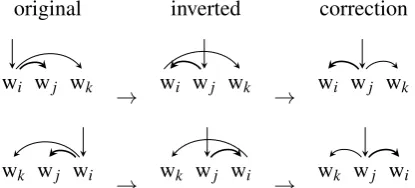
However, more than two tokens are frequently in-volved in the sub-structure carried by the depen-dency in question. In that case, the conversion may create non-projective dependencies (i.e. crossing between dependencies). Figure 1 illustrates this problem. Letwiywj be the original dependency
we want to invert, wi being the head andwj the
dependent. If the headwihas a childwk, i.e. there
is a wk such aswi y wk, and the tokens are
or-dered such as k<j<i or i<j<k then a crossing be-tween the dependencies2will appear when invert-ing the role ofwi andwj. To avoid introducing a
non-projectivity, it is necessary to attach the for-mer childwk ofwitowj.
original inverted correction
wi wj wk
→ wi wj wk → wi wj wk
wk wj wi
[image:2.595.315.523.428.522.2]→ wk wj wi → wk wj wi
Figure 1: Cases of non-projectivity caused by con-version, and correction. The main (bold) depen-dencywi ywj is the one to invert. When
invert-ing,wjbecomes the root of the sub-structure.
3.3 ... and Particular Cases
Noun Sequences For noun sequences (mwe,
nameandgoeswith), we systematically consider
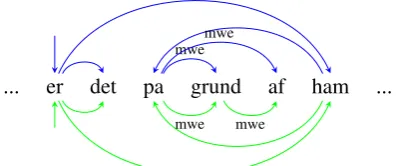
the first word of the sequence as the head, and, when the sequence contains several words, attach each word to its preceding word, while, in UD guidelines, noun sequences are annotated in a flat, head-initial structure, in which all words in the name modify the first one (see Figure 3.3).
Syntactic Functions Annotation Scheme
UD relations UD Alternative
Clause mark
to read to read
subordinates
Determiners det
the book the book
Noun mwe+goeswith,
John Jr. Doe John Jr. Doe sequences name
Case case
of Earth of Earth
marking
Coordinations cc+conj
me and you me and you Copulas cop+auxpass
is nice is nice
Verb root+aux
[image:3.595.138.458.60.231.2]have been done have been done groups
Table 1: Annotation scheme in the UD treebanks and standard alternatives.
... er det pa grund af ham ... mwemwe
[image:3.595.82.282.278.361.2]mwe mwe
Figure 2: Multi-word expression conversion for the danish phrase ‘it is because of him’. The de-pendencies following the UD conventions are rep-resented in blue above the words; the alternative structure is represented in green below the words.
Copulas In copula constructions (cop and
auxpass dependencies), the head of the
depen-dency is generally the root of the sentence (or of a subordinate clause). The transformation of a cop-ula dependencywiywj between the the i-th and
j-th word of the sentence consists in inverting the dependency (as for mark and case), making wj
the root of the sentence and attaching all words that were modifying wi to wj with a dependency
not related to nouns such asdet,amod, ornmod.
The last step allows us to ensure the coherence of the annotations (with respect, for instance, to the final punctuation).
Coordinations For coordinating structures (cc
and conj dependencies), in the UD scheme, the
first conjunct3is taken as the head of the
coordina-arriving onwj, i.e. coming from the former head ofwi.
3Typically a noun for instance (but could also be a verb or an adjective) for which the incoming dependency could be labeled withdobj,root,amod, etc.
tion and all the other conjuncts depend on it via the
conjrelation, and each coordinating conjunction4
is attached to the first conjunct with accrelation.5
As an alternative, we define the first coordinating conjunction as the head and attach all conjuncts to it (see Figure 3).
... tant en rouge qu’ en bleu ... cc
cc conj
conj cc
conj
Figure 3: Coordination conversion for the French phrase ‘as well in red as in blue’. The dependen-cies following the UD conventions are represented in blue above the words; the alternative structure is represented in green below the words.
4 Experimental Settings
To evaluate the proposed transformations, we fol-low the approach introduced in (Schwartz et al., 2012) consisting in comparing the original and the transformed data on their respective references.
4.1 Data
We experiment on data from the v1.3 of the Uni-versal Dependency project (Nivre et al., 2016), us-ing the official split into train, validation and test sets. We apply separately the 7 transformations described in Section 3 on the 38 languages of the
[image:3.595.319.516.360.445.2]UD, resulting in the creation of 266 transformed corpora, 44 of which were identical to the origi-nal corpora as the transformation can not be ap-plied (e.g. there are no multi-word expressions in Chinese). These corpora are not included in the different statistics presented in this Section.
For each configuration (i.e. a language and a transformation), a dependency parser is trained on the original data annotated with UD conven-tion (denoted UD) and the transformed data
(de-noted transformed). Parsing performance is
estimated using the usual Unlabeled Attachment Score (UAS, excluding punctuation). Reported scores are averaged over three trainings.
4.2 Parser
We use our own implementation of the arc-eager dependency parser with a dynamic oracle and an averaged perceptron (Aufrant and Wisniewski, 2016), using the features described in (Zhang and Nivre, 2011) which have been designed for En-glish. Preliminary experiments show that simi-lar results are achieved with other implementation of transition-based parsers (namely with the Malt-Parser (Nivre, 2003)).
5 Results
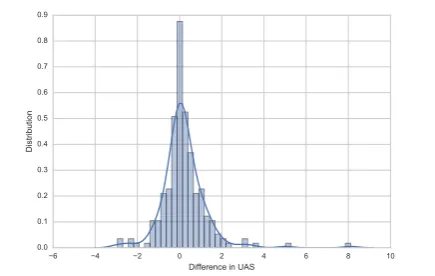
Figure 4 shows the distribution of differences in UAS between a parser trained on the original data and a parser trained on the transformed data (pos-itive differences indicates corpora for which the UD annotation scheme results in better predic-tions). As expected, the annotation scheme has a large impact on the quality of the prediction, with an average difference in scores of 0.66 UAS points and variations as large as 8.1 UAS points.
However, contrary to what is usually believed, the UD scheme appears to achieve, in most cases, better prediction performance than the proposed transformations: in 58.1% of the configurations, the parser trained and evaluated on transformed data is outperformed by the parser trained on the original UD data. More precisely, the difference in UAS is negative in 93 configurations and pos-itive in 129 configurations. Table 2 details for each transformation the percentage of languages for which the UD scheme results in better predic-tions. The cc dependency (conjunction), and to
a lesser extent the detdependency, are easier to
learn in the UD scheme than in the proposed trans-formed scheme. On the contrary, the choice of the
copandnamestructure in the UD results in large
losses for many languages. For the other varia-tions considered, the learnability of the scheme highly depends on the language. Table 3 shows the configurations with the largest positive and nega-tive differences in scores.
6 4 2 0 2 4 6 8 10
Difference in UAS
0.0 0.1 0.2 0.3 0.4 0.5 0.6 0.7 0.8 0.9
[image:4.595.308.526.162.300.2]Distribution
Figure 4: Distribution of differences between the UAS achieved on the UD and transformed cor-pora for the different languages and transforma-tions considered. Positive differences indicates better results with UD annotations.
[image:4.595.307.530.524.653.2]case 44.74% mark 58.33% det 80.56% cc 89.47% mwe 50.00% name 45.83% cop 25.00%
Table 2: Number of times, for each transforma-tion, a parser trained and evaluated on UD data outperforms a parser trained and evaluated on transformed data.
Lang. Transfo. UAS(trans.) UAS(UD) la conjunction 52.57% 60.69%
gl case 72.17% 77.21%
ar conjunction 72.35% 75.83%
kk case 56.62% 59.67%
zh mark 66.67% 69.65%
nl copule 69.82% 67.73%
fi copule 66.59% 64.30%
et copule 70.38% 67.95%
la copule 59.34% 56.47%
sl copule 79.69% 76.75%
Table 3: Languages and transformations with the highest UAS difference.
metric
distance 43.6%
predictability 64.8% derivation complexity 62.6% derivation perplexity 61.2%
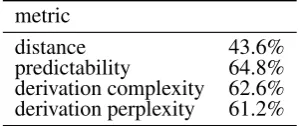
Table 4: Number of times a given learnabil-ity measure is able to predict which annotation scheme will result in the best parsing performance.
• the average absolute distance (in words) between a dependent and its head; be-cause transition-based dependency parsers are known to favor short dependencies over long ones (McDonald and Nivre, 2007);
• the predictability of the scheme introduced
by (Schwartz et al., 2012) defined as the en-tropy of the conditional distribution of the PoS of the dependent knowing the PoS of its head;
• the derivation perplexity introduced by
(Søgaard and Haulrich, 2010) defined as the perplexity of 3-gram language model esti-mated on a corpus in which words of a sen-tence appear in the order in which they are attached to their head;6
• thederivation complexitydefined as the sum of the number of distinct substrings in the gold derivations of the corpora references.
The first three metrics have been used in several studies on the learnability of dependencies anno-tations. We introduce the last one as a new way to characterize the difficulty of predicting a sequence of actions, building on the intuition that the more diverse a derivation, the harder its prediction. For this metric, the gold derivation is the concatena-tion of arc-eager acconcatena-tions representing the sequence of actions generating a reference tree. In case of ambiguity in the generation of the reference tree, we always select the actions in the following or-der: SHIFT, REDUCE, LEFT, RIGHT. Using a
gen-eralized suffix tree it is then possible to count the number of different substrings in the derivations with a complexity inO(n)(Gusfield, 1997).
6Similarly to (Søgaard and Haulrich, 2010) we consider a trigram language model but use a Witten-Bell smoothing as many corpora were too small to use a Knesser-Ney smooth-ing. As for the derivation complexity, the words are ordered according to an oracle prediction of the reference structure.
A metric is saidcoherentif it scores the syntac-tic structure that achieves the best parsing perfor-mance higher than its variation. Table 4 reports the numbers of times, averaged over languages and transformations, that each metric is coherent.
Contrarily to what has been previously reported, the considered metrics are hardly able to predict which annotation scheme will result in the best parsing performance. Several reasons can explain this result. First, it is the first time, to the best of our knowledge that these metrics are compared on such a wide array of languages. It is possible that these metrics are not as language-independent as can be expected. Second, as our transformations are directly applied on the dependency structures rather than when converting the dependency struc-ture from a constituency strucstruc-ture, it is possible that some of their transformations are erroneous and the resulting complexity metric biased.
6 Conclusion
Comparing the performance of parsers trained and evaluated on UD data and transformed data, it ap-pears that the UD scheme leads mainly to better scores and that measures of learnability and com-plexity are not sufficient to explain the annotation preferences of dependency parsers.
7 Acknowledgement
Oph´elie Lacroix is funded by the ERC Starting Grant LOWLANDS No. 313695.
References
Lauriane Aufrant and Guillaume Wisniewski. 2016. PanParser: a Modular Implementation for Efficient Transition-Based Dependency Parsing. Technical report, LIMSI-CNRS, March.
Miryam de Lhoneux and Joakim Nivre. 2016. Should have, would have, could have. investigating verb group representations for parsing with universal de-pendencies. In Proceedings of the Workshop on Multilingual and Cross-lingual Methods in NLP, pages 10–19, San Diego, California, June. Associ-ation for ComputAssoci-ational Linguistics.
Marie-Catherine De Marneffe and Christopher D Man-ning. 2008. The stanford typed dependencies repre-sentation. InProceedings of the workshop on Cross-Framework and Cross-Domain Parser Evaluation, pages 1–8. Association for Computational Linguis-tics.
[image:5.595.106.256.63.126.2]Anders Søgaard. 2013. Down-stream effects of tree-to-dependency conversions. InProceedings of the 2013 Conference of the North American Chap-ter of the Association for Computational Linguistics: Human Language Technologies, pages 617–626, At-lanta, Georgia, June. Association for Computational Linguistics.
Dan Gusfield. 1997.Algorithms on Strings, Trees, and Sequences: Computer Science and Computational Biology. Cambridge University Press, New York, NY, USA.
Ryosuke Kohita, Hiroshi Noji, and Yuji Matsumoto. 2017. Multilingual back-and-forth conversion be-tween content and function head for easy depen-dency parsing. InProceedings of the 15th Confer-ence of the European Chapter of the Association for Computational Linguistics: Volume 2, Short Papers, pages 1–7, Valencia, Spain, April. Association for Computational Linguistics.
Ryan McDonald and Joakim Nivre. 2007. Charac-terizing the errors of data-driven dependency pars-ing models. In Proceedings of the 2007 Joint Conference on Empirical Methods in Natural guage Processing and Computational Natural Lan-guage Learning (EMNLP-CoNLL), pages 122–131, Prague, Czech Republic, June. Association for Com-putational Linguistics.
Ryan McDonald, Joakim Nivre, Yvonne Quirmbach-Brundage, Yoav Goldberg, Dipanjan Das, Kuz-man Ganchev, Keith Hall, Slav Petrov, Hao Zhang, Oscar T¨ackstr¨om, Claudia Bedini, N´uria Bertomeu Castell´o, and Jungmee Lee. 2013. Universal Dependency Annotation for Multilingual Parsing. InProceedings of ACL 2013, the 51st An-nual Meeting of the Association for Computational Linguistics (Volume 2: Short Papers), pages 92–97, Sofia, Bulgaria, August.
Jens Nilsson, Joakim Nivre, and Johan Hall. 2006. Graph transformations in data-driven dependency parsing. In Proceedings of the 21st International Conference on Computational Linguistics and 44th Annual Meeting of the Association for Computa-tional Linguistics, pages 257–264, Sydney, Aus-tralia, July. Association for Computational Linguis-tics.
Joakim Nivre, ˇZeljko Agi´c, Lars Ahrenberg, Maria Je-sus Aranzabe, Masayuki Asahara, Aitziber Atutxa, Miguel Ballesteros, John Bauer, Kepa Bengoetxea, Yevgeni Berzak, Riyaz Ahmad Bhat, Cristina Bosco, Gosse Bouma, Sam Bowman, G¨uls¸en Ce-birolu Eryiit, Giuseppe G. A. Celano, C¸ar C¸¨oltekin, Miriam Connor, Marie-Catherine de Marneffe, Arantza Diaz de Ilarraza, Kaja Dobrovoljc, Timo-thy Dozat, Kira Droganova, Tomaˇz Erjavec, Rich´ard Farkas, Jennifer Foster, Daniel Galbraith, Sebas-tian Garza, Filip Ginter, Iakes Goenaga, Koldo Go-jenola, Memduh Gokirmak, Yoav Goldberg, Xavier G´omez Guinovart, Berta Gonz´ales Saavedra, Nor-munds Gr¯uz¯itis, Bruno Guillaume, Jan Hajiˇc, Dag
Haug, Barbora Hladk´a, Radu Ion, Elena Irimia, An-ders Johannsen, H¨uner Kas¸kara, Hiroshi Kanayama, Jenna Kanerva, Boris Katz, Jessica Kenney, Si-mon Krek, Veronika Laippala, Lucia Lam, Alessan-dro Lenci, Nikola Ljubeˇsi´c, Olga Lyashevskaya, Teresa Lynn, Aibek Makazhanov, Christopher Man-ning, C˘at˘alina M˘ar˘anduc, David Mareˇcek, H´ector Mart´ınez Alonso, Jan Maˇsek, Yuji Matsumoto, Ryan McDonald, Anna Missil¨a, Verginica Mititelu, Yusuke Miyao, Simonetta Montemagni, Keiko So-phie Mori, Shunsuke Mori, Kadri Muischnek, Nina Mustafina, Kaili M¨u¨urisep, Vitaly Nikolaev, Hanna Nurmi, Petya Osenova, Lilja Øvrelid, Elena Pas-cual, Marco Passarotti, Cenel-Augusto Perez, Slav Petrov, Jussi Piitulainen, Barbara Plank, Martin Popel, Lauma Pretkalnia, Prokopis Prokopidis, Ti-ina Puolakainen, Sampo Pyysalo, Loganathan Ra-masamy, Laura Rituma, Rudolf Rosa, Shadi Saleh, Baiba Saul¯ite, Sebastian Schuster, Wolfgang Seeker, Mojgan Seraji, Lena Shakurova, Mo Shen, Na-talia Silveira, Maria Simi, Radu Simionescu, Katalin Simk´o, Kiril Simov, Aaron Smith, Carolyn Spadine, Alane Suhr, Umut Sulubacak, Zsolt Sz´ant´o, Takaaki Tanaka, Reut Tsarfaty, Francis Tyers, Sumire Ue-matsu, Larraitz Uria, Gertjan van Noord, Vik-tor Varga, Veronika Vincze, Jing Xian Wang, Jonathan North Washington, Zdenˇek ˇZabokrtsk´y, Daniel Zeman, and Hanzhi Zhu. 2016. Univer-sal dependencies 1.3. LINDAT/CLARIN digital li-brary at Institute of Formal and Applied Linguistics, Charles University in Prague.
Joakim Nivre. 2003. An Efficient Algorithm for Projective Dependency Parsing. In Proceedings of IWPT 2003, the 8th International Workshop on Pars-ing Technologies, Nancy, France.
Rudolf Rosa, 2015. Proceedings of the Third In-ternational Conference on Dependency Linguistics (Depling 2015), chapter Multi-source Cross-lingual Delexicalized Parser Transfer: Prague or Stanford?, pages 281–290. Uppsala University, Uppsala, Swe-den.
Roy Schwartz, Omri Abend, and Ari Rappoport. 2012. Learnability-based syntactic annotation design. In Proceedings of COLING 2012, pages 2405–2422, Mumbai, India, December. The COLING 2012 Or-ganizing Committee.
Natalia Silveira and Christopher Manning. 2015. Does universal dependencies need a parsing representa-tion? an investigation of english. Depling 2015, 310.
Anders Søgaard and Martin Haulrich. 2010. On the derivation perplexity of treebanks. InProceedings of Treebanks and Linguistic Theories 9.