Using Graphs of Classifiers to Impose Constraints on Semi-supervised
Relation Extraction
Lidong Bing and William W. Cohen and Bhuwan Dhingra School of Computer Science
Carnegie Mellon Univeristy
{lbing, wcohen, bdhingra}@cs.cmu.edu
Richard C. Wang US Development Center
Baidu USA
Abstract
We propose a general approach to model-ing semi-supervised learnmodel-ing constraints on unlabeled data. Both traditional supervised classification tasks and many natural semi-supervised learning heuristics can be approx-imated by specifying the desired outcome of walks through a graph of classifiers. We demonstrate the modeling capability of this approach in the task of relation extraction, and experimental results show that the modeled constraints achieve better performance as ex-pected.
1 Introduction
Semi-supervised learning (SSL) methods often op-erate by introducing “soft constraints” on how a learned classifier will behave at points, or clusters of points, associated with unlabeled instances. For example, logistic regression with entropy regulariza-tion (Grandvalet and Bengio, 2004) and transductive SVMs (Joachims, 1999) constrain the classifier to make confident predictions at unlabeled points, and many graph-based SSL approaches require that the instances associated with the endpoints of an edge have similar labels (Zhu et al., 2003; Talukdar and Crammer, 2009). Other weakly-supervised methods also can be viewed as imposing constraints predic-tions made by a classifier: for instance, in distantly-supervised information extraction, constraints some-times are imposed which requires that the classifier, when applied to the set S of mentions of an entity pair that is a member of relationr, classify at least one mention inS as a positive instance ofr
(Hoff-mann et al., 2011). Different constraints (and dif-ferent assumptions about the loss function for the learner) lead to different SSL algorithms.
In this paper, we propose a general approach to modeling such constraints. In particular, we show that many types of constraints can be modeled by specifying the desired behavior of random walks through a graph of classifiers. In the graph, nodes correspond to relational conditions on small subsets of the data, and edges are annotated by feature vec-tors. Feature weights, combined with the feature vector at each edge and a non-linear postprocessing step, define a weighting of edges in the graph, and hence a transition function for a random walk. We will argue that traditional supervised classification tasks, as well as many natural SSL heuristics, can be approximated by specifying the desired outcome of walks through this graph.
Below we will make this notion precise. We will also define a succinct declarative language for spec-ifying these models, and introduce a corresponding graphical “plate” language for the models. We then present results obtained by optimizing performance on an appropriate ensemble of graphs for the task of relation extraction.
2 Specifying SSL Tasks
2.1 An Example: Intuition
We begin with an simple example. The left-hand side of Figure 1 illustrates how a traditional super-vised classification can be expressed as programs in ProPPR (Wang et al., 2013), a probabilistic first-order language. In ProPPR, following the conven-tion used on logic programming, capital letters are
predict(X,Y)← pickLabel(Y)∧ classify(X,Y). classify(X,Y)←true
{f(W,Y): hasFeature(X,W)}.
mutexFailure(X)← pickMutex(Y1,Y2)∧ classify(X,Y1)∧ classify(X,Y2).
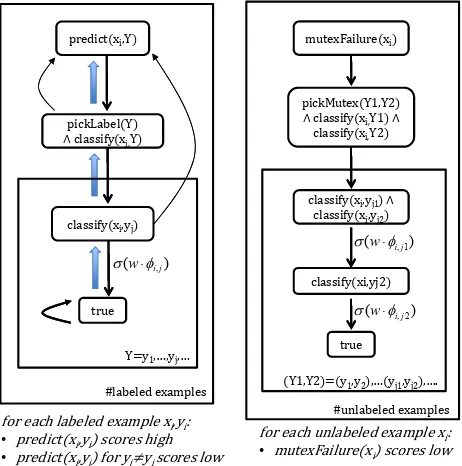
Figure 1: Declarative specifications of the models for super-vised learning, on the left, and for a mutual-exclusivity con-straint, on the right.
predict xi,Y
pickLabel Y ∧ classify xi,Y
classify xi,yj
true
Y y1,…,yj,…
#labeled examples
for each labeled example xi,yi:
• predict xi,yi scores high
• predict xi,yj for yj yi scores low
mutexFailure xi
pickMutex Y1,Y2 ∧ classify xi,Y1 ∧
classify xi,Y2
classify xi,yj1 ∧
classify xi,yj2
true
Y1,Y2 y1,y2,… yj1,yj2,….
#unlabeled examples classify xi,yj2
for each unlabeled example xi:
• mutexFailure xi scores low
(wi,j)
(wi,j1)
[image:2.612.70.301.155.388.2](wi,j2)
Figure 2: Plate diagrams for supervised learning, on the left, and a mutual-exclusivity constraint, on the right.
implicitly variables, and are universally quantified when they appear in the “head” of a rule, and rules can also be annotated with a set offeatures, which then weighted to define a strength for the rule. The symboltrueis a goal that always succeeds, and we omit, for brevity, the problem specific definition of pickLabel(Y), which would consist of rules for each possible labelyi (relation types), i.e. pickLabel(y1)
←true, . . . ,pickLabel(yK)←true.
ProPPR programs, like Prolog programs, are as-sociated with a backward-chaining proof process, and like Prolog programs, can be read either as logical constraints, or as a non-deterministic pro-gram, which is invoked when a query is submit-ted. If the queries processed by the program are all of the form predict(xi,Y) where xi is a
con-stant, the theory on the left-hand side of Figure 1 can be interpreted as saying: (1) To prove the goal of the form predict(xi,Y)—i.e., to predict a
label Y for the instance xi—non-deterministically
pick a possible class label yj, and then prove the
goal classify(xi,yi); (2) proofs for every the goal
classify(xi,yj)immediately succeed, with a strength
based on a weighted combination of the features in the set{f(w, yj) :hasF eature(xi, w)}. This set is
encoded in the usual way as a sparse vectorφxi,yj,
with one dimension for every object of the form
f(w, yj)whereyj is a class label andwis a
vocab-ulary word. For example, if the vocabvocab-ulary contains the wordhopeandsportsis a possible label, then one feature inφxi,yj might be active exactly when
doc-umentxi contains the word hopeandyj = sports.
The set of proofs associated with this theory are de-scribed by the plate diagram on the left-hand side of Figure 2. Although the nodes are not associ-ated with logical variables, the repetition suggested by the plates has the same meaning as in graphical models, and the heavy blue upward-pointing arrows denote logical implication.
In ProPPR1 it is possible to train weights to
maximize or minimize the score of a particular query response: i.e., one can say that for the query predict(xi, Y) responses where Y = yj∗ are
“pos-itive” and responses where Y = yj0 for j0 6= j∗
are “negative”. The training data needed for the su-pervised learning case is indicated in the bottom of the left-hand of the plate diagram. Learning is per-formed by stochastic gradient descent (Wang et al., 2013).
2.2 Unlabeled Data and Low-density Boundaries
We finally turn to the right-hand sides of Figures 1 and 2. These can be viewed as a sort of con-sistency test to be applied to an unlabeled exam-plexi. In ordinary classification tasks, any two
dis-tinct classes yj and yj0 should be mutually
exclu-sive. The theory on the right-hand side of Figure 1 1ProPPR’s semantics are defined by a slightly different
asserts that a “mutual exclusion failure” (mutex-Failure) occurs ifxi can be classified into two
dis-tinct classes. (Again there is a problem specific def-inition ofpickMutex(Y1,Y2), which would consist of trivial rules for each possible distinct label pair yj,
andyj0.) The corresponding plate diagram is shown
in Figure 2. To (softly) enforce this constraint, we need only introduce negative examples for each un-labeled example xi, specifying that proofs for the
goalmutexFailure(xi)should have a low scores.
Conceptually, this constraint encodes a common bias of SSL systems, namely, that the decision boundaries should be drawn in low-probability re-gions of the space. In this case, if a decision bound-ary is close to an unlabeled example, then more than oneclassifygoal with succeed with a high score.
2.3 Other SSL constraints
The framework describes above is flexible enough to handle many types of constraints. Here we are primarily interested in constraints associated with relation extraction. Before introducing these con-straints, we first describe our task, relation extrac-tion for entity-centric corpora.
Each document in an entity-centric corpus de-scribes aspects of a particular entity (calledsubject or title entity), e.g. each Wikipedia article is such a document. Relation extraction from a entity-centric document is reduced to predicting the relation be-tween the subject entity and an entity mention in the document. For example, for a drug article, if the target relation is sideEffects, we need to pre-dict for each candidate (extracted from a single sen-tence) whether it is a side effect of this drug. If no such relation holds, we predict the special la-bel “Other”. Besides the entropy regularization con-straint, i.e., mutexFailure introduced above, there are several other constraints that could be helpful for this task.
Sentence constraint. For each sentence, we con-strain that only one mention (here a mention can also refer to a coordinate-term list such as “vomit-ing, headache and nausea”) should be labeled as a particular relation:
sentFailure(X1,X2)←pickRealLabel(Y1)∧
pickRealLabel(Y2)∧classify(X1,Y1)∧classify(X2,Y2),
where pickRealLabel(Y) picks a label other than “Other”, X1 and X2 are a pair of mentions extracted
from a single sentence. This constraint penalizes ex-tracting multiple relation objects from a single sen-tence.
Document constraint.If an entity string appears as multiple mentions in one document, they should have the same relation label (relative to the subject entity), or some of them have “Other” label:
docFailure(X1,X2)←pickMutex(Y1,Y2)∧ pickRealLabel(Y1)∧pickRealLabel(Y2)∧ classify(X1,Y1)∧classify(X2,Y2).
Section title constraint. In some entity-centric corpora, the content of a document is organized into different sections. This constraint basically says if two mentions appear in the same section (currently determined simply by matching section titles) of two documents, they should have the same relation label, relative to their own document subjects:
titleFailure(X1,X2)←pickMutex(Y1,Y2)∧ pickRealLabel(Y1)∧pickRealLabel(Y2)∧ classify(X1,Y1)∧classify(X2,Y2).
3 Experiments
3.1 Settings
Corpora. Our drug corpus, DailyMed, is down-loaded from dailymed.nlm.nih.gov which contains 28,590 XML documents, each of which describes a drug that can be legally prescribed in the United States. Our disease corpus, WikiDisease, is ex-tracted from a Wikipedia dump of May 2015 and it contains 8,596 disease articles. We extract usedToTreat, conditionsThisMayPrevent, and side-Effects relations for the drug domain; treatments, symptoms, riskFactors, causes, and preventionFac-tors relations for the disease domain.
modi-fiers of this verb, and the path to this verb. For a list, the dependency features are computed relative to the head of the list.
Evaluation dataset. We manually labeled 10 pages from WikiDisease and 10 pages from DailyMed. The annotated text fragments are those NPs that are the second argument values of those 8 relations, with the title drug or disease entity of the corresponding document as the relation subject. In total, there are 436 triple facts for the disease domain and 320 triple facts for the drug domain. A pipeline’s task is to extract values of the second arguments of relations from a given document.
3.2 Training Data with Distant Supervision
We extract triples from Freebase as supervision to distantly label training examples. If the subject of a triple matches with a drug or disease title entity in a corpus and its object value also appears in that doc-ument, it is extracted. In total, we get 2022, 2453, 905, 753, and 164 triples for 5 disease relations re-spectively, and 3112, 315, and 265 triples for 3 drug relations, respectively.
Each triple is used to label the document whose subject entity is the same as the triple subject. For in-stance, triple sideEffects(Aspirin,heartburn) will la-bel a mention “heartburn” from the Aspirin article as an example of sideEffects relation. This raw data is very noisy (Bing et al., 2015; Bing et al., 2016), so we add a distillation step. We first distantly la-bel these relations in two small structured corpora, namely, WebMD for drug and MayoClinic for dis-ease.2 They have well-defined section information,
which can be matched with target relations. We only label usedToTreat and conditionsThisMayPre-vent from the “Uses” section, and label sideEffects from “Side Effects” section of WebMD. Similarly, the disease relations are labeled from “Treatments and drugs”,“Symptoms”, “Risk factors”, “Causes”, and “Prevention” sections of MayoClinic. After that we build a graph containing examples from both
cor-2WebMD is collected from www.webmd.com, and each
drug page has the same seven sections, such as Uses, Side Ef-fects, Precautions, etc. WebMD contains 2,096 pages. May-oClinic is collected from www.mayoclinic.org. The sections of MayoClinic pages include Symptoms, Causes, Risk Factors, Treatments and Drugs, Prevention, etc. MayoClinic contains 1,117 pages.
pora of a domain, and do label propagation in this graph with the section-labeled examples as seeds. We take top 2,000 examples from each WikiDisease relation and top 800 examples from each DailyMed relation as training data. We randomly pick 2,000 and 800 examples that are not distantly labeled by any relation as “Other” examples.
3.3 Algorithms Compared
Our SSL framework allows many constraints to be formulated, leading to several SSL methods: SSL m uses only the mutex constraint; SSL s, only the sen-tence constraint; SSL d, only the document con-straint; SSL t, only the section title constraint. We also consider some combinations of these: SSL sd; SSL st; SSL dt; and SSL sdt. All the SSL pipelines employ the evaluation pages as unlabeled data for those constraints (i.e., they are used transductively). As one baseline, we compare to a standard super-vised learning pipeline, SL, which learns a classifier with no constraints using ProPPR. We also compare against three existing methods: MultiR, (Hoffmann et al., 2011) which models each relation mention separately and aggregates their labels using a deter-ministic OR;Mintz++from (Surdeanu et al., 2012), which improves on the original model from (Mintz et al., 2009) by training multiple classifiers, and al-lowing multiple labels per entity pair; andMIML-RE (Surdeanu et al., 2012) which has a similar struc-ture toMultiR, but uses a classifier to aggregate the mention level predictions into an entity pair predic-tion. We used the publicly available code from the authors 3 for the experiments. Since these
meth-ods do not distinguish between structured and un-structured corpora, we used the union of these cor-pora in our experiments. We found that the per-formance of these methods varies significantly with the number of negative examples used during train-ing, and hence we tuned these and other parameters, including the number of epochs (for both MultiR andMIML-RE) and the number of training folds for MIML-RE, directly on the evaluation data and report their best performance.
Finally we compare with our previous system, DIEBOLDS, (Bing et al., 2016) which uses
docu-3http://aiweb.cs.washington.edu/ai/raphaelh/mr/ and
ment structure to construct a different label propa-gation graph. Briefly, DIEBOLDS first builds a bi-partite graph from the merged structured corpus and target corpus, and then performs relation type prop-agation with the extracted lists (including singleton ones) and their items. One set of vertices correspond to relation mentions. The other set of vertexes are identifiers for the lists. Additional couplings use the document structure and BOW context features of pairs. Label propagation uses the subject-NP pairs distantly labeled with relation seeds as starting points, and then binary classifiers are trained with the top N mentioned as score by label propagation.
3.4 Results
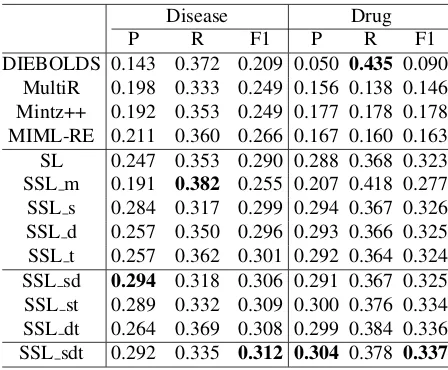
The SL and SSL pipelines can classify both single-ton and coordinate lists. After that, lists are broken into items, i.e. NPs, for evaluation. We evaluate the performance of different pipelines from IR perspec-tive, with a title entity (i.e., document name) and a relation together as a query, and extracted NPs as re-trieval results. The predicted probability by ProPPR serves as the ranking score inside each query. The results evaluated by precision, recall and F1 mea-sure are given in Table 1. DIEBOLDS’ results are extracted from (Bing et al., 2016), since the evalua-tion data is the same.
Among the individual constraints, SSL s, SSL d, and SSL t are found to improve the performance over SL (which is a strong baseline, perhaps be-cause of careful use of structured documents in our distant labeling procedure.) These SSL approaches lead to higher precision, showing that adding these constraints does reduce false positives. The sen-tence constraint is the most helpful for better preci-sion: mentions from the same sentence share token features from sentence content, which often mis-leads the classifiers, and the sentence constraint is designed to penalize such cases. SSL m is useful for improving recall, but its precision is much lower than SL. Unlike the other constraints, we note that SSL m is a domain-independent heuristic: it simply encourages confident decision on unlabeled exam-ples. This is a useful heuristic in many cases, and in particular encourages classifiers that lie in low-density areas of the example space; we conjectiure that this is inapproproate for this task because the data is noisy and the classes are not well-separated.
Disease Drug
P R F1 P R F1
DIEBOLDS 0.143 0.372 0.209 0.050 0.435 0.090
MultiR 0.198 0.333 0.249 0.156 0.138 0.146
Mintz++ 0.192 0.353 0.249 0.177 0.178 0.178 MIML-RE 0.211 0.360 0.266 0.167 0.160 0.163
SL 0.247 0.353 0.290 0.288 0.368 0.323
SSL m 0.191 0.382 0.255 0.207 0.418 0.277
SSL s 0.284 0.317 0.299 0.294 0.367 0.326
SSL d 0.257 0.350 0.296 0.293 0.366 0.325
SSL t 0.257 0.362 0.301 0.292 0.364 0.324
SSL sd 0.294 0.318 0.306 0.291 0.367 0.325
SSL st 0.289 0.332 0.309 0.300 0.376 0.334
SSL dt 0.264 0.369 0.308 0.299 0.384 0.336
[image:5.612.314.538.53.238.2]SSL sdt 0.292 0.335 0.312 0.304 0.378 0.337
Table 1:Average results from 3 runs.
Combining the individual constraints can further improve the results. SSL sdt is the most effective pipeline. Compared with SL, it achieves 4.3% and 7% relative improvements for drug domain and dis-ease domain, respectively. Compared with MultiR, Mintz++, and MIML-RE, the relative improvements are about 17% to 25% on the disease domain, and 89% to 131% on the drug domain. DIEBOLDS achieves the highest recall values, however, its pre-cision is much lower.
4 Conclusions
We proposed a general approach to modeling SSL constraints. It can approximate traditional super-vised learning and many natural SSL heuristics by specifying the desired outcome of walks through a graph of classifiers. An application case of this ap-proach is given by modeling the task of relation ex-traction. There are a few open questions to explore: adding hyperparameters (e.g., different weights for different constraints); adding more control over the supervised loss versus the constraint-based loss; and testing the approach on more tasks.
Acknowledgments
References
Lidong Bing, Sneha Chaudhari, Richard Wang C, and William W Cohen. 2015. Improving distant supervi-sion for information extraction using label propagation through lists. InProceedings of the 2015 Conference on Empirical Methods in Natural Language Process-ing, pages 524–529, Lisbon, Portugal, September. As-sociation for Computational Linguistics.
Lidong Bing, Mingyang Ling, Richard C. Wang, and William W. Cohen. 2016. Distant IE by bootstrapping using lists and document structure. In The Thirtieth AAAI Conference on Artificial Intelligence, AAAI ’16. Yves Grandvalet and Yoshua Bengio. 2004. Semi-supervised learning by entropy minimization. In Advances in neural information processing systems, pages 529–536.
Raphael Hoffmann, Congle Zhang, Xiao Ling, Luke Zettlemoyer, and Daniel S Weld. 2011. Knowledge-based weak supervision for information extraction of overlapping relations. InProceedings of the 49th An-nual Meeting of the Association for Computational Linguistics: Human Language Technologies-Volume 1, pages 541–550. Association for Computational Lin-guistics.
Thorsten Joachims. 1999. Transductive inference for text classification using support vector machines. In Proceedings of the Sixteenth International Conference on Machine Learning, ICML ’99, pages 200–209, San Francisco, CA, USA. Morgan Kaufmann Publishers Inc.
Mike Mintz, Steven Bills, Rion Snow, and Dan Jurafsky. 2009. Distant supervision for relation extraction with-out labeled data. InProceedings of the Joint Confer-ence of the 47th Annual Meeting of the ACL and the 4th International Joint Conference on Natural Lan-guage Processing of the AFNLP: Volume 2-Volume 2, pages 1003–1011. Association for Computational Lin-guistics.
Mihai Surdeanu, Julie Tibshirani, Ramesh Nallapati, and Christopher D. Manning. 2012. Multi-instance multi-label learning for relation extraction. In Proceed-ings of the 2012 Joint Conference on Empirical Meth-ods in Natural Language Processing and Computa-tional Natural Language Learning, EMNLP-CoNLL ’12, pages 455–465, Stroudsburg, PA, USA. Associa-tion for ComputaAssocia-tional Linguistics.
Partha Pratim Talukdar and Koby Crammer. 2009. New regularized algorithms for transductive learning. In Machine Learning and Knowledge Discovery in Databases, pages 442–457. Springer.
William Yang Wang, Kathryn Mazaitis, and William W Cohen. 2013. Programming with personalized pager-ank: a locally groundable first-order probabilistic logic. InProceedings of the 22nd ACM international conference on Conference on information & knowl-edge management, pages 2129–2138. ACM.