Learning Transducer Models for Morphological Analysis
from Example Inflections
Markus Forsberg
Språkbanken University of Gothenburg
Mans Hulden
Department of Linguistics University of Colorado
Abstract
In this paper, we present a method to con-vert morphological inflection tables into un-weighted and un-weighted finite transducers that perform parsing and generation. These transducers model the inflectional behavior of morphological paradigms induced from examples and can map inflected forms of previously unseen word forms into their lemmas and give morphosyntactic descrip-tions of them. The system is evaluated on several languages with data collected from the Wiktionary.
1 Introduction
Wide-coverage morphological parsers that return lemmas and morphosyntactic descriptions (MSDs) of arbitrary word forms are fundamental for achiev-ing strong performance of many downstream tasks in NLP (Tseng et al., 2005; Spoustová et al., 2007; Avramidis and Koehn, 2008; Zeman, 2008; Hulden and Francom, 2012). This is particularly true for languages that exhibit rich inflectional and deriva-tional morphology. Finite-state transducers are the standard technology for addressing this issue, but constructing them often requires not only signifi-cant commitment of resources but also demands linguistic expertise from the developers (Maxwell, 2015). Access to large numbers of example inflec-tions organized into inflection tables in resources such as the Wiktionary promises to offer a less laborious route to constructing robust large-scale analyzers. Learning morphological generalizations from such example data has been the focus of much recent research, particularly in the domain of mor-phologically complex languages (Cotterell et al., 2016).
In this paper we present a tool for automatic gen-eration of both probabilistic and non-probabilistic
morphological analyzers that can be represented as unweighted and weighted transducers. The assump-tion is that we have access to a collecassump-tion of exam-ple word forms together with corresponding MSDs. We present two systems: one that is designed to be high-recall and operates with unweighted automata, the purpose of which is to return all linguistically plausible analyses for an unknown word form; the second is an addition to the first in that the word shapes are modeled with a generative probabilis-tic model that can be implemented as a weighted transducer that produces a ranking of the plausible analyses. The analyzers are constructed with stan-dard finite state tools and are designed to operate similarly to a hand-constructed morphophonologi-cal analyzer extended with a ‘guesser’ module to handle unknown word forms.
The system takes as input sets of lemmatized words annotated with an MSD, all grouped into inflection tables—such as can be found in, for ex-ample, the Wiktionary. The output is a morpho-logical analyzer either as an unweighted (in the non-probabilistic case) or a weighted model (in the probabilistic case). For the non-probabilistic case we use the Xerox regular expression formalism (Karttunen et al., 1996), which we compile into a transducer with the open-source finite-state toolkit
foma(Hulden, 2009) and for the weighted case we have used theKleenetoolkit (Beesley, 2012).1
2 Paradigm Learning
The starting point for the research in this paper is the notion that inflections and derivations of related word forms can be expressed as functions—this idea is often filed under the rubric of ‘functional morphology’ and is strongly related to word-and-paradigm models of morphology (Hockett, 1954;
1Our code and data are available at:https://github. com/marfors/paradigmextract
drink drank drunk
x1 i x2
x1 a x2
x1 u x2
x1 i x2
x1 a x2
x1 u x2
x1 i x2
x1 a x2
x1 u x2
x1 x1 ed
x1 ed
x1 x1 ed
x1 ed
x1 x1 ed
x1 ed swim
swam swum
jump jumped jumped
climb climbed climbed
f1 f2
(a) inflection tables
(b) paradigms
(c) collapse paradigms
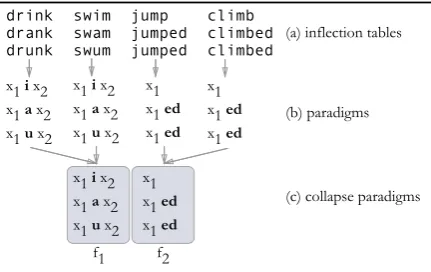
Figure 1: Generalizing inflection tables into paradigm functions: (1) a number of complete in-flection tables are given; (2) the aligned Longest Common Subsequence is extracted; (3) resulting identical paradigms are merged. If the resulting paradigmf1is interpreted as a function,f1(shr, nk)
producesshrink, shrank, shrunk.
Robins, 1959; Matthews, 1972; Stump, 2001). In particular, we assume a model where a single func-tion generates all the possible inflected forms of a group of lemmas that behave alike. This approach has earlier been seen as an alternative to finite-state morphology, and the functions that model inflec-tional behavior have been hand-built in much pre-vious work (Forsberg and Ranta, 2004; Forsberg et al., 2006; Détrez and Ranta, 2012). Here, we assume the recent model of Ahlberg et al. (2014) and Ahlberg et al. (2015), which work with a sys-tem that automatically learns these functions that model inflection tables from labeled data.
The purpose of modeling inflection types as func-tions is to be able to generalize concrete manifesta-tions of word inflection for specific lemmas, and to apply those generalizations to unseen word forms. The generalization in question is performed by ex-tracting the Longest Common Subsequence (LCS) from all word forms related to some specific lemma and then expressing each word form in terms of the LCS (Hulden, 2014). The LCS in turn is bro-ken down into possibly discontiguous sequences that express parts of word forms that are variable in nature. Figure 1 shows a toy example of four inflection tables generalized into variable- and non-variable parts by first extracting the LCS, express-ing the original word forms in terms of this LCS, and then collapsing the resulting functions that are identical. The resulting representation, which is es-sentially a set of strings which have variable parts (x1, . . . ,xn), and fixed parts (such asi,a,u) that
can be used to generate an unbounded number of new inflection tables by instantiating the variable parts in new ways and concatenating the variables and the fixed parts.
This learning method often produces a very small number of functions compared with the num-ber of complete inflection tables that have been input—obviously, because many lemmas behave alike and result in identical functions. We note that the output of this procedure is human-readable, i.e. it can be inspected (even in real-world scenarios) for correctness and also hand-corrected in case of noise in the learning data. In the current work, we use these functions as the backbone of a generative model and implement them as transducers that can be run in the inverse direction to map fully inflected forms into their lemmas and morphosyntactic de-scriptions.
2.1 Paradigm functions
The variables x1, . . . , xn that are used in the
paradigm function representation capture possible inter-word variation. This means that each lemma that gives rise to an inflection table can be directly represented as simply an instantiation of the vari-ables, together with the inflection function. As seen in Figure 1, the functionf1learned from the
inflec-tion tablesswimanddrinkcan be used to represent some other word, e.g.singby instantiatingx1ass
andx2asng.
As we collect a large number of inflection ta-bles, many of which result in identical paradigms, we can also collect statistics about the variables involved and how they were assumed to be instan-tiated in the original table. For example, from the truncated tables in Figure 1, we can gather that
f1 has witnessed x1 as both dr and sw, and x2
asnkandm. These statistics can be used to turn the learned functions into a restricted generative model that produces entire inflection tables, but also taking advantage of how variables tend to be instantiated in that paradigm function.
[image:2.595.75.291.62.198.2]on the nature ofx1andx2. This information can
then be encoded in transducer form where the vari-able parts can be modeled as a probabilistic lan-guage model (for weighted transducers) or a non-probabilistic, constrained model (for unweighted transducers).
Figure 2 illustrates this idea. We have learned a paradigm in Spanish—we call the paradigmavenir
(arbitrarily), since that is one of the verbs out of 12 that behaved the same way and gave rise to the same function. A natural mapping to learn from the data is how to go from any inflected form to the dictionary or ‘citation’ form. For example, going from thepresent participleto theinfinitivewould involve changing the fixedioccurring between the two variablesx1andx2intoeand then changing
the fixed suffix after x2 from iendo to ir. The
figure also shows how the different variables were instantiated in the training data: x1showed up in
variable shapes (but always ending inv), whilex2
was alwaysn.
Although the learning model in principle states nothing about the nature of the variables, mor-phophonological restrictions will constrain their appearance and the key to producing a transducer that can inflect unseen words without undue over-generation is to take these restrictions into account. We do so in two ways: (1) for the unweighted case, we collect statistics on the seen variables and con-strain their possible shapes in an absolute manner, and (2) for the weighted case, we induce a language model over the shapes of the variables, which can later be used to rank parses produced by the system.
3 The unweighted case: constraining variables
Different generalized inflection tables naturally give rise to different variable instantiations for
x1, . . . , xn. However, many of the seen variables
will not differ arbitrarily in a paradigm. This is something we can take advantage of when design-ing a parsdesign-ing mechanism; in particular, we can express preferences to the effect that such parses where variables resemble already seen instantia-tions should be preferred.
Figure 3 is a case in point. Here, we show the implicit string-to-string rule in the paradigm which derives the lemma form from the present partici-ple and the first person singular present forms in Spanish. In both the paradigms learned, the vari-ablesx1 andx2 show a somewhat repetitive
pat-tern. In the paradigmavenir,x1ends in the letterv
for all the inflection tables seen that produced that paradigm, whilex2 always consists of the single
lettern. Likewise, in the other paradigm (negar),
x2 is consistently the string eg across all forms
seen (the inflected forms ofcegar,denegar, etc.). The only variable that does not show such a regular pattern is thex1 variable for the paradigm called negar.
3.1 Estimating probabilities of new variable instantiations
That the parts of paradigms that vary from lemma to lemma, i.e. the ‘variables’, are not subject to arbitrary variation can be used to constrain their shape. To model the unweighted transducers, we begin by formalizing our belief in not seeing novel variable shapes in the future. To quantify this, we assume we have seennconcrete instantiations oft
different types of variables, and subsequently ask: if there were in factt+ 1types, all of which are drawn from a uniform distribution, how likely are we to have witnessed only thettypes we did? This quantity can be expressed as
punseen = (1−t+ 11 )n (1)
For example, the measure for thex2variable in
Figure 3 (avenir) becomes (1− 1
2)12 ≈ 0.0002.
We can use this as a cutoff parameter that defines how much evidence we require to declare a variable not subject to further variation apart from the types we have already seen. With this, we assume that ifpunseen ≤0.05for some variable, that variable in
the paradigm will not exhibit new types.2
3.2 Expressing constraints through regular expressions
We also expand this measure to cover variables that show variation only in non-edge positions. For example,x2 in theavenir-paradigm in Table 3 is
alwaysnand can be assumed to not be subject to variation by the calculation above. The paradigm’s
x1-variable, however, cannot. That variable seems
to vary much more, with the exception of the last letter, which is alwaysv. To capture this, we ex-tend the method to apply not only to the whole
0 @ 1 @
2 v @
v
3
i:e n 4 i 5 e:r 6 n:ϵ 7
8 d:ϵ
9 o:ϵ
10
ϵ:[
11
ϵ:type=participle
12
ϵ:]
x1 x2
0 @ 1
@
2 i:ϵ
3
e g 4 o:a 5 ϵ:r 6
7
ϵ:[
8
ϵ:person=1st
9
ϵ:number=singular
10
ϵ:tense=present
11
ϵ:mood=indicative
12
ϵ:]
x1 x2
aviniendo → avenir[type=participle]
[image:4.595.75.525.62.185.2]ciego → cegar[person=1st number=singular mood=indicative]
Figure 2: Examples of two single generalized word forms mapped to lemmas followed by morphosyntactic description. The parts that correspond to constraints of the variablesx1andx2are marked. Transitions
marked@are identity transduction ‘elsewhere’ cases, matching any symbol not explicitly mentioned in the state.
Inflection table Paradigm MSD Inflection table Paradigm MSD
avenir x1+e+x2+ir infinitive negar x1+x2+ar infinitive
aviniendo x1+i+x2+iendo pres part negando x1+x2+ando pres part
avenido x1+e+x2+ido past part negado x1+x2+ado past part
avengo x1+e+x2+go 1sg pres ind niego x1+i+x2+o 1sg pres ind
avienes x1+ie+x2+es 2sg pres ind niegas x1+i+x2+as 2sg pres ind
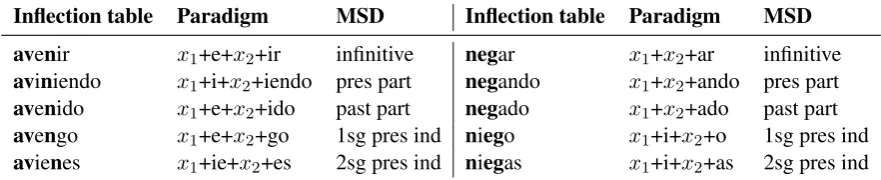
Table 1: Two partial Spanish verb inflection tables generalized into paradigm functions. The segments that are part of the longest common subsequence, which are cast as variables in the generalization, are shown in boldface in the inflection tables.
string, but also edge positions of the string. First, we examine the whole string, and if that fails to yield the conclusion that the variable is ‘fixed’, we find the longest prefix and suffix which can be as-sumed to be fixed by the same measure. With this we construct a regular expression that models the variables as follows:
1. (w1∪w2∪. . .∪wn)if the variable is assumed
to be fixed, where thewis are the complete
strings seen as instantiations.
2. (p1 ∪. . . ∪pn)Σ∗ ∩ Σ∗(s1 ∪ . . .∪sn), if
both prefixes and suffixes can be constrained; here thepis correspond to the prefixes of the
maximal length that can be assumed to be drawn from a fixed set of types, and thesis
the suffixes.
3. (p1∪. . .∪pn)Σ∗if only prefixes appear fixed.
4. Σ∗(s1∪. . .∪sn)if only suffixes appear fixed.
5. Σ+otherwise.
In the above,Σrepresents all the symbols seen in the training data. Under this formulation, the
variables in theavenirparadigm in Figure 3 yield the following regular expressions:
x1= (Σ∗v) x2 =n (2)
4 Deriving morphological analyzers
Once we have the constraints in place, they can be used to construct larger regular expressions that reflect mappings from a specific word form to a lemma together with the MSD. We convert each inflection form in a paradigm to a regular expres-sion that permits the above variable values in place ofx1, . . . , xn, and that maps the remaining fixed
strings to other fixed strings, depending on what kind of application is needed.
For example, to create a regular expression for mapping the 1p pres ind-form (exemplified by
niego) to the lemma form in Table 1, we proceed as follows: we construct a transducer that repeats thex1andx2-variables, possibly subject to the
con-straints on their shape, and maps anito the empty string andotoar. Sincex1 is not constrained in
the paradigm, whilex2is constrained to always be
[image:4.595.78.519.260.350.2]x1 + i→e + x2 + iendo→ir av circunv contrav conv dev entrev interv prev prov rev v adv n n n n n n n n n n n n av circunv contrav conv dev entrev interv prev prov rev v adv n n n n n n n n n n n n c den desasos despl fr n pl r ren repl restr s sos an eg eg eg eg eg eg eg eg eg eg eg eg eg eg eg eg eg eg eg eg eg eg eg eg eg eg eg eg
x1 + i→0 + x2 + o→ar Paradigm avenir
Rule: pres part →inf
Paradigm negar
[image:5.595.73.290.62.259.2]Rule: 1p sg pres →inf x1 + i e + x2 + iendo x1 + i 0 + x2 + o
Figure 3: Paradigm functions generalized from in-flection tables provide a mechanism for mapping an inflected form to any other inflected form. Illus-trated here are two rules extracted from different Spanish verb paradigms showing a string-to-string mapping from the participle to the infinitive, and from the first person singular present form to the infinitive. Also shown are the variable parts of the paradigmsx1andx2 and how they have been
instantiated in the training data.
(Σ+) | {z }
x1
(i:) |{z}e g
x2
(o:ar[1sg pres ind]) (3)
The transducer corresponding to the expression is seen in Figure 2, and will generalize to words that fit the variable pattern, e.g.ciego→cegar.
Each inflection form of every paradigm is con-verted in such a manner to a transducer that maps that single inflection to its lemma and morphosyn-tactic description. All such individual transducers can then be unioned together for every form in every paradigm:
f1∪f2∪. . .∪f1∪. . .∪fm (4)
5 Prioritizing analyses
The above formulation, though it already produces a working transducer that generalizes to unseen forms, can be refined further. First, if a word form matches the original variables seen exactly, it may be superfluous to return extra analyses from other paradigms that the word form might also fit. Sec-ondly, it may be the case that we have overcon-strained some variable with the heuristic described
Analysis:peleaste
O pelear [pers=2 number=sg tense=past mood=ind]
C
peleastar [pers=1 num=sg tense=pres mood=subj] peleastar [pers=3 num=sg tense=pres mood=subj] peleastir [pers=3 num=sg tense=pres mood=ind]
pelear [pers=2 num=sg tense=past mood=ind]
U
peleaster [pers=3 num=sg tense=pres mood=ind] peleastar [pers=1 num=sg tense=pres mood=subj] peleastar [pers=3 num=sg tense=pres mood=subj] peleastir [pers=3 num=sg tense=pres mood=ind]
pelear [pers=2 num=sg tense=past mood=ind]
pelastir [pers=3 num=sg tense=pres mood=ind] pleastir [pers=3 num=sg tense=pres mood=ind]
Analysis:aceleran
O ??? ???
C aceleraracelerir [pers=3 num=pl tense=pres mood=ind][pers=3 num=pl tense=pres mood=subj]
U
acelerar [pers=3 num=pl tense=pres mood=ind]
aceler [pers=3 num=pl tense=imp-ra mood=subj] acelerir [pers=3 num=pl tense=pres mood=subj] acelerer [pers=3 num=pl tense=pres mood=subj] acelrir [pers=3 num=pl tense=pres mood=subj] acelir [pers=3 num=pl tense=imp-ra mood=subj] aclerir [pers=3 num=pl tense=pres mood=subj]
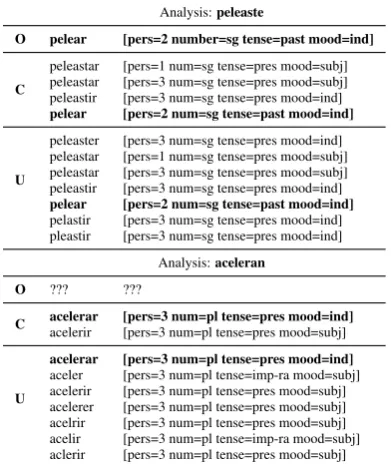
Table 2: Example of the tri-level analyses pro-duced by the unweighted system: here the three sub-grammars (Original= O,Constrained =C,
Unconstrained= U) each allow for successively more analyses. The wordpeleaste ‘quarrel’ has been seen in the training data and thus receives an analysis from the constrained analyzer, whereas
aceleran ‘accelerate’ has not and only receives parses fromCandU.
earlier, and so return no analyses at all, motivating a potential relaxation of the constraints on variable shapes.
To provide a ranking of the analyses in the un-weighted analyzer, we actually generate a layered approach with three different models:
• Original: an analyzer where each xi must
match exactly some shape seen in training data.
• Constrained: an analyzer where variables are constrained as described above.
• Unconstrained: an analyzer where there are no constraints on variables, except that they must be at least one symbol long, i.e. match Σ+.
[image:5.595.319.515.64.297.2]This in effect leads to an analyzer that can be thought of as first consultingOriginal, and that fail-ing to produce an analysis, consultsConstrained, and if that also fails, consultsUnconstrained. The same effect can also be modeled in runtime code by keeping the three transducers separate for potential savings of space. Table 2 illustrates this priority effect with two Spanish words being analyzed.
6 The weighted case: language models over variables
The above unweighted model provides a hierarchi-cal system by which to return plausible analyses, while curbing implausible ones. However, it lacks the power to provide a ranking of analyses within each layer of ever laxer constraints on the vari-ables. An alternative to that model is to directly use the statistics over the variable parts to generate a weighted transducer that performs the same type of parsing, but with a (hopefully) strict ranking of candidate parses. We address this by inducing an n-gram model over each variable in each paradigm. We calculate these individual n-gram models in the usual way for a single variablev, consisting of the lettersv1, . . . , vn:
P(v1, . . . , vn) = n
Y
i=1
P(vi|vi−(n−1), . . . , vi−1)
(5) For each variable and function, we perform a standard maximum likelihood estimate of the n-grams by
P(vi|vi−(n−1), . . . , vi−1)
= #(vi−(n−1), . . . , vi−1, vi) #(vi−(n−1), . . . , vi−1) (6)
with some additional add-δsmoothing to prevent zero counts. The resulting variable models can then (after taking negative logs) replace the variable portions of each individual transducer that maps a word form to its citation form. The fixed parts of the inflection mappings retain the weight0.
These language models are then concatenated with the same model as used for the unweighted case in place of the variables. This is illustrated in Figure 4.
We tune the model for each language evaluated by doing a grid search on (1) the order of the n-gram (1–5), (2) the prior on the n-n-grams (0.01–3.0),
(3) the prior of picking a paradigm (we include a paradigm weight for each individual paradigm).
Similarly to the unweighted case, the final model is a union of all the individual inflection models for each paradigm and word, with the language models for the variables interleaved.
7 Evaluation
To evaluate the systems, we used the data set pub-lished by Durrett and DeNero (2013) (D&DN13), which includes full inflection tables for a large number of lemmas in German (nouns and verbs), Spanish (verbs), and Finnish (nouns+adjectives and verbs). That source also provides a division into train/dev/test splits, with 200 tables in dev and test, respectively. We then evaluated the ability of our systems to provide a correct lemmatization and MSD of each word form in the held-out tables, testing separately on each part of speech. For the unweighted analyzer, we use the three-part setup as described above. For the weighted case, we produce a single highest scoring analysis. The train/dev/test sets are entirely disjoint and share no tables.
We trained the models by inspecting all the word forms and corresponding MSDs, organizing them into tables, learning the paradigms, and the gen-erating weighted and unweighted transducers as described above. These transducers were then run on the test data to provide lemmatization and analy-ses of the unseen word forms. Table 4 summarizes the number of inflection tables seen during train-ing, together with the final number of paradigms learned. Table 5 shows the statistics in the held-out data.
Because we focus on the recall figures of the analyzers, we also calculated an “inherent ambi-guity” measure of the test data. This is the aver-age number of different MSDs that are given for each word form. This ambiguity may arise as fol-lows: the Spanish verb tenga, for example, can be either the first person singular present subjunc-tive oftener‘to have’ or the third person singular present subjunctive. Such ambiguity shows that there exist cases where returning multiple analy-ses is warranted, given that we do not have any sentence context to determine the correct choice.
multi-Language L-recall L+M-recall L/W L+M/W
nouns 95.30 95.06 2.08 9.52
German verbs 91.18 92.44 4.16 9.57
nouns+verbs 92.11 93.04 4.91 14.10
Spanish verbs 98.06 97.98 1.93 2.20
nounadj 88.69 88.48 4.10 5.30
Finnish verbs 94.52 94.47 3.77 4.60
[image:7.595.76.523.276.340.2]nounadj+verbs 92.63 92.43 12.56 16.40
Table 3: The result of the unweighted evaluation, where we report separately on the recall of just the lemma (L-recall), and the recall of the lemma and corresponding MSD (L+M-recall). Also shown are the average number of unique lemmas returned per word form to be analyzed (L/W), and the average number of lemmas and MSDs returned (L+M/W).
i:e/0.0 i/0.0 e:r/0.0 n:ϵ/0.0 d:ϵ/0.0 o:ϵ/0.0 ϵ:[/0.0 ϵ:type=participle/0.0 ϵ:]/0.0
x
1x
2aviniendo → avenir[type=participle]
LM
x
1LM
x
2Figure 4: Illustration of the coupling of language models for variablesx1andx2to create the weighted
analyzer. Here,LMx1 andLMx2 illustrate a collection of states representing the language models for the
variables, inferred from variable instantiations seen in the training data.
Language Tables Paradigms
nouns 2564 70 German verbs 1827 139 nouns+verbs 4391 209 Spanish verbs 3855 96 nounadj 6200 259 Finnish verbs 7049 276 nounadj+verbs 13249 535
Table 4: Statistics on the D&DN13 train+dev sets.
Paradigms is the corresponding number of in-duced paradigm functions.
Language Tables Unique wf’s Amb.
nouns 200 553 2.89 German verbs 200 2324 2.32 nouns+verbs 400 2877 2.43 Spanish verbs 200 10003 1.14 nounadj 200 5198 1.08 Finnish verbs 200 10466 1.03 nounadj+verbs 400 15664 1.05
Table 5: Statistics on the D&DN13 test set.Amb.
is the average number of lemma-MSD pairs per unique word form (wf).
Language Lemma L+MSD MSD
German nounsverbs 77.0690.02 69.4489.76 79.5092.78
Spanish verbs 96.92 96.92 97.43
[image:7.595.94.267.429.515.2]Finnish nounadjverbs 70.2990.44 69.6890.44 91.5998.02
Table 6: Evaluation of the weighted model (all figures represent the recall).
ple MSDs often have the same surface form. For example, Spanishcompraba‘bought 1P/3P’ (and
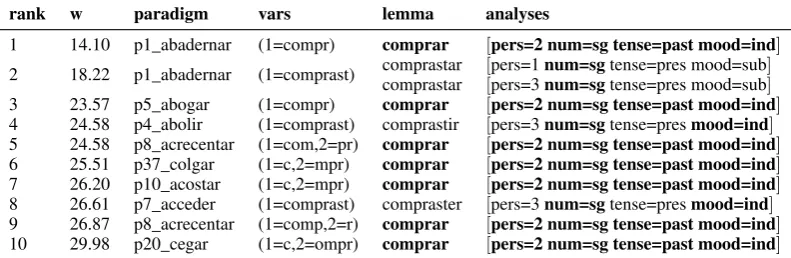
-abasuffix-bearing verbs in general) are always am-biguous between 1st/3rd past tense. For this reason, we calculate the recall (as opposed to accuracy) of all the top scoring parses. The weighted system always returns a single lemma in the evaluation. It can, of course, produce a number of ranked analy-ses if needed—an example of extracting the top-10 ranked analyses of a word form is given in Table 7.
7.1 Results
rank w paradigm vars lemma analyses
[image:8.595.101.497.64.193.2]1 14.10 p1_abadernar (1=compr) comprar [pers=2 num=sg tense=past mood=ind] 2 18.22 p1_abadernar (1=comprast) comprastarcomprastar [[pers=1pers=3num=sgnum=sgtense=pres mood=subtense=pres mood=sub]] 3 23.57 p5_abogar (1=compr) comprar [pers=2 num=sg tense=past mood=ind] 4 24.58 p4_abolir (1=comprast) comprastir [pers=3num=sgtense=presmood=ind] 5 24.58 p8_acrecentar (1=com,2=pr) comprar [pers=2 num=sg tense=past mood=ind] 6 25.51 p37_colgar (1=c,2=mpr) comprar [pers=2 num=sg tense=past mood=ind] 7 26.20 p10_acostar (1=c,2=mpr) comprar [pers=2 num=sg tense=past mood=ind] 8 26.61 p7_acceder (1=comprast) compraster [pers=3num=sgtense=presmood=ind] 9 26.87 p8_acrecentar (1=comp,2=r) comprar [pers=2 num=sg tense=past mood=ind] 10 29.98 p20_cegar (1=c,2=ompr) comprar [pers=2 num=sg tense=past mood=ind]
Table 7: Weighted parsing example: top-10 ranked parses for the word form compraste‘buy PAST’
in Spanish with weights (in effect the negative log probability), the inferred variable division, the lemmatization, and MSDs. Lemmas and parts of the analysis that are correct are given in boldface. Note that several paradigms can produce an entirely correct parse for a single form such as this one, even though the paradigms would differ in other forms.
we consider the lemma-recall and lemma+MSD recall, and also document the average number of unique parses returned (lemma or lemma+MSD). For the weighted model, we give the recall for all combinations of lemma+MSD.
The weighted recall is—for obvious reasons— consistently below the unweighted version as the unweighted case uses the hierarchical model to potentially return a much larger number of anal-yses. The weighted version always returns a sin-gle lemma, and possibly several equally ranked MSDs, as discussed above. Still, for some lan-guages (Spanish and Finnish verbs in particular), despite returning only a single analysis, perfor-mance is on par with the unweighted model, which returns 1.93 analyses on average (Spanish) and 3.77 (Finnish). We emphasize that the test set for our experiments is entirely disjoint from the training set, and that the figures therefore reflect potential performance on unseen word forms, not standard per-token performance in running text, which is presumably much higher. The reported figures can thus be interpreted to correspond to a type per-formance for OOV items.
8 Conclusion and future work
We have described two supervised methods for pro-ducing finite-state models morphological analyzers and guessers from labeled word forms, organized into inflection tables. The method can be used to quickly produce high-recall morphological anal-ysis from labeled data with little or no linguistic development effort.
These tools can be used as is and can also be
modified to exploit unlabeled data in the form of raw text corpora in a semi-supervised lexicon ex-pansion setting. Some potential extensions could be of immediate value: the generative weighted model could be combined and evaluated on a task of tagging/disambiguating running text where contextual features could be used and seamlessly combined with the morphological language model. The weighted model also offers paths for further experimentation—for example, it is not immedi-ately obvious that an n-gram model is the best choice. It seems reasonable to assume that those parts of the variables modeled that stand closer to the fixed parts, i.e. at the edges, would be more important in judging similarity to previously seen inflected forms. Table 2 hints at this being the case since, for example, the Spanish variables seem far more constrained at edge positions than in the mid-dle of the variable string. Which parts to weight as more important in judging similarity could also be inferred from data. Another potential extension is to also constrain the analysis form by integrat-ing a word-level language model instead of only a level one, either replacing the variable-level model or working in conjunction with it.
Acknowledgements
This work has been partly funded by the Swedish Research Council under grant number 2012-5738,
References
Malin Ahlberg, Markus Forsberg, and Mans Hulden. 2014. Semi-supervised learning of morphological paradigms and lexicons. InProceedings of the 14th EACL, pages 569–578, Gothenburg, Sweden. Asso-ciation for Computational Linguistics.
Malin Ahlberg, Markus Forsberg, and Mans Hulden. 2015. Paradigm classification in supervised learning of morphology. InProceedings of the NAACL-HLT 2015, pages 1024–1029, Denver, Colorado, May– June. Association for Computational Linguistics. Eleftherios Avramidis and Philipp Koehn. 2008.
En-riching morphologically poor languages for statisti-cal machine translation. NAACL-HLT 2008, pages 763–770.
Kenneth R. Beesley. 2012. Kleene, a free and open-source language for finite-state programming. In
10th International Workshop on Finite State Meth-ods and Natural Language Processing, page 50. Stanley F. Chen and Joshua Goodman. 1996. An
em-pirical study of smoothing techniques for language modeling. In Proceedings of the 34th ACL, pages 310–318. Association for Computational Linguis-tics.
Ryan Cotterell, Christo Kirov, John Sylak-Glassman, David Yarowsky, Jason Eisner, and Mans Hulden. 2016. The SIGMORPHON 2016 shared task— morphological reinflection. In Proceedings of the 2016 Meeting of SIGMORPHON, Berlin, Germany, August. Association for Computational Linguistics. Grégoire Détrez and Aarne Ranta. 2012. Smart paradigms and the predictability and complexity of inflectional morphology. InProceedings of the 13th EACL, pages 645–653.
Greg Durrett and John DeNero. 2013. Supervised learning of complete morphological paradigms. In
Proceedings of NAACL-HLT, pages 1185–1195. Markus Forsberg and Aarne Ranta. 2004. Functional
morphology. ACM SIGPLAN Notices, 39(9):213– 223.
Markus Forsberg, Harald Hammarström, and Aarne Ranta. 2006. Morphological lexicon extraction from raw text data. In Advances in Natural Lan-guage Processing, pages 488–499. Springer. Irving J. Good. 1953. The population frequencies of
species and the estimation of population parameters.
Biometrika, 40(3-4):237–264.
Charles F Hockett. 1954. Two models of grammati-cal description. Morphology: Critical Concepts in Linguistics, 1:110–138.
Mans Hulden and Jerid Francom. 2012. Boosting statistical tagger accuracy with simple rule-based grammars. In Proceedings of the Language Re-sources and Evaluation Conference (LREC 2012), pages 2114–2117.
Mans Hulden. 2009. Foma: a finite-state compiler and library. InProceedings of the 12th EACL, pages 29– 32, Athens, Greece. Association for Computational Linguistics.
Mans Hulden. 2014. Generalizing inflection tables into paradigms with finite state operations. In Pro-ceedings of the 2014 Joint Meeting of SIGMOR-PHON and SIGFSM, pages 29–36. Association for Computational Linguistics.
Kyo Kageura and Satoshi Sekine. 1999. A note on Ogino’s “method to estimate probability of new appearance”. Journal of Mathematical Linguistics, 22(3).
Ronald M. Kaplan. 1987. Three seductions of com-putational psycholinguistics. In P. Whitelock, M. M. Wood, H. L. Somers, R. Johnson, and P. Bennett, ed-itors,Linguistic Theory and Computer Applications, London. Academic Press.
Lauri Karttunen, Jean-Pierre Chanod, Gregory Grefen-stette, and Anne Schiller. 1996. Regular expres-sions for language engineering. Natural Language Engineering, 2(4):305–328.
Peter H. Matthews. 1972. Inflectional morphology: A theoretical study based on aspects of Latin verb con-jugation. Cambridge University Press.
Michael Maxwell. 2015. Grammar debugging. In Sys-tems and Frameworks for Computational Morphol-ogy, pages 166–183. Springer.
T. Ogino. 1999. How many examples are required in language research—a proposal of a method to esti-mate probability of new appearance. Mathematical Linguistics, 22(1):11–17.
Robert H Robins. 1959. In defence of WP. Transac-tions of the Philological Society, 58(1):116–144. Drahomíra Spoustová, Jan Hajiˇc, Jan Votrubec, Pavel
Krbec, and Pavel Kvˇetoˇn. 2007. The best of two worlds: Cooperation of statistical and rule-based tag-gers for Czech. InProceedings of the Workshop on Balto-Slavonic Natural Language Processing, pages 67–74.
Gregory T. Stump. 2001. A theory of paradigm struc-ture. Cambridge University Press.
Huihsin Tseng, Daniel Jurafsky, and Christopher Man-ning. 2005. Morphological features help POS tag-ging of unknown words across language varieties. In
Proceedings of the fourth SIGHAN workshop on Chi-nese language processing, pages 32–39.