Proceedings of the IWCS 2019 Workshop on Computing Semantics with Types, Frames and Related Structures, pages 28–36
28
Complex event representation in a typed feature structure
implementation of Role and Reference Grammar
Erika Bellingham University at Buffalo
Abstract
Role and Reference Grammar (RRG) (Foley and Van Valin, 1984; Van Valin and LaPolla, 1997; Van Valin, 2005) is typologically general, semantically-driven syntactic framework. A major fo-cus of RRG is a fine-grained typology of form-to-meaning mapping, emphasizing the syntactic and semantic structure of complex event descriptions. I introduce a constraint-based typed feature struc-ture variant of RRG which exploits RRG’s semantically-motivated syntactic backbone: the Layered Structure of the Clause (LSC). Each layer in the LSC is represented as a subtype ofsign, and the unique combination of syntactic and semantic properties possessed by each layer is captured by a set of constraints on the appropriatesignsubtype. Sentences are incrementally built up from predicates (represented semantically as event frames) to propositions using constructions to pass and combine information through the different layers (and juncture types) in the LSC. An English fragment of this constraint-based RRG is implemented using the Attribute Logic Engine (Carpenter, 1992).
1
Introduction
Role and Reference Grammar (RRG) offers a typologically motivated constructional approach to gram-mar, in which semantics plays a very significant role in syntactic structure. RRG’s semantically mo-tivated structural backbone, the Layered Structure of the Clause (LSC), offers several key advantages for capturing fine-grained semantic properties of classes of linguistic structures, particularly for complex sentences with multiple verbal elements. Semantic modifiers (adjuncts), as well as grammatical operators (e.g. tense, aspect, modals, negation), each apply to a specific layer of the clause, with the layer of ap-plication predicting both the position of the operator/modifier relative to the predicate (the nucleus of the clause), and the semantic scope of the operator/modifier. Complex event descriptions involving multiple verbal predicates vary in terms of their degree of both syntactic integration and semantic cohesion. The syntactic and semantic structures are isomorphically related to such a degree that an important concep-tual property of the overall event representation - whether the event is represented as a single concepconcep-tual event (versus multiple conceptual events) - can be predicted based on the syntactic packaging.
The major effort towards formalizing RRG (Kallmeyer et al., 2013; Kallmeyer and Osswald, 2017; Osswald and Kallmeyer, 2018) uses the building blocks provided by Tree Adjoining Grammar (TAG) (Joshi and Schabes, 1997), with modified operations for combining trees. This paper introduces an alter-native formalization possibility: a constraint-based variant of RRG, in which the layers in the LSC are implemented as typed feature structures. The focus is on building the backbone of syntactic and seman-tic representations to produce complex event representations that exploit the form-to-meaning mapping properties captured by the LSC, rather than on broad coverage of all syntactic possibilities. Drawing from Sign-based Construction Grammar (Sag, 2012), constructions are represented as typed feature structures with syntactic and semantic components. Events and entities are represented in a typed hierarchy of semantic frames, while the layers in the LSC are represented as subtypes of sign. Sentences are incre-mentally built from predicates using constructions to pass information between layers in the LSC.
con-struction grammars. A fragment an English grammar using the proposed constraint-based RRG is im-plemented with the Attribute Logic Engine (ALE) (Carpenter and Penn, 2001), a Prolog implementation of the formalism in Carpenter (1992). The paper is structured as follows. Section 2 summarizes the relevant components of Role and Reference Grammar, focusing on RRG’s Layered Structure of the Clause. Section 3 briefly discusses unification-based construction grammars, and Section 4 introduces this constraint-based variant of RRG. The ALE implementation is discussed in Section 5.
2
The Layered Structure of the Clause in RRG
Syntactic structure in RRG is built around abstract syntactic categories with semantic correlates: the layers in the Layered Structure of the Clause. The LSC is based on two apparently universal contrasts in the structure of natural languages: (1) predicating elements versus non-predicating elements, and (2) arguments versus non-arguments. Predicating elements (canonically verbs) are contained withinnuclei, predicating elements plus their arguments are contained withincores, (most) non-arguments (adjuncts) are contained within thecore periphery, and cores plus their peripheries are contained within theclause. Each layer is compatible with certain types of grammatical operators (Section 2.1) and semantic modi-fiers (Section 2.2): these operators or modimodi-fiers scope over a particular layer, which becomes especially relevant when considering the structure and interpretation of complex event descriptions (Section 2.3).
[image:2.595.407.518.326.526.2]2.1 Grammatical operators
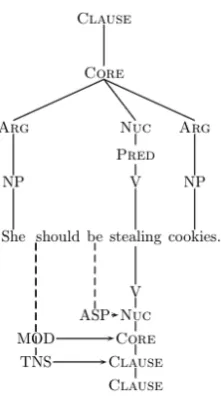
Figure 1: English clause structure with operator projection
Grammatical categories (e.g. tense, aspect, modality, negation) are mod-elled in RRG as ‘operators’, each of which may apply only to a specific layer in the LSC. Not all languages have all operators: Standard German lacks grammatical aspect, English lacks grammatical evidentiality, Yu-catec Maya lacks grammatical tense, and so on. Nuclear operators (e.g. aspect) modify something about the event/action/state without reference to any of the event participants, and therefore have scope only over the nu-cleus. Core operators (e.g. deontic modals) modify some property of the involvement of the participants in the event, and have scope over the core. Clausal operators, which modify propositions, fall into two distinct cate-gories: tense and status operators situation the proposition expressed by the clause temporally and along the irrealis-realis dimension respectively; while illocutionary force and evidentiality are more sentential in nature, scoping over the first category of clausal operators and applying only to main clauses which are immediately dominated by a sentence node.
An English clause with three grammatical operators is shown in Figure 1. The syntactic and the operator structures are projected above and below the sentence respectively. The aspectual operator expressed by thebe V-ingconstruction applies to the nucleus. The deontic modal operator expressed by theshouldauxiliary applies to the core. The tense operator is expressed by the finite auxiliaryshould.
2.2 Semantic modifiers
The clause, core, and nucleus each have their own periphery, containing modifiers that combine with the non-peripheral constituent in that layer. Modifiers include prepositional phrases and adverbs. Just as the layer of application for each type of grammatical operator is semantically motivated, so too is the layer of application for each semantic category of modifier. Aspectual adverbs (e.g. completelyor
continuously) modify the nucleus and occur in the nuclear periphery; pace adverbs (e.g.quickly), manner adverbs (e.g. carefully) and temporal and locative modifiers (e.g. yesterday,on Friday, in the kitchen,
in an hour) modify the core and occur in the core periphery, and epistemic and evidential adverbs (e.g.
than another modifier, it cannot occur between that lower modifier and the verb. For example in (1c), but not in in (1a-b), the core modifieron Fridayintervenes between the nucleusdestroyedand the nuclear modifiercompletely, and so the sentence is anomalous.
(1) a. Janedestroyedthe paintingcompletelyN U CM OD on FridayCOREM OD. b. JanecompletelyN U CM ODdestroyedthe paintingon FridayCOREM OD. c. # Janedestroyedthe paintingon FridayCOREM ODcompletelyN U CM OD.
The application of operators and modifiers is also relevant when considering the structure of complex sentences with multiple predicates. This is discussed further in Section 2.3.
[image:3.595.376.521.240.378.2]2.3 The structure and interpretation of complex event descriptions
Figure 2: Core cosubordination
While simple sentences are built around a single predicating ele-ment, with a single nucleus, core, clause and sentence, more com-plex sentences can contain multiple predicating elements, requir-ing a more complex syntactic structure to combine them. Tradi-tional theories of grammar typically assume that syntactic units are either joined together viacoordinationinside a larger unit, or via subordination (with one unit embedded in the other, as ei-ther an argument or a modifier). RRG recognizes a third possible nexus type,cosubordination, which shares some properties with coordination, and some with subordination.
In cosubordination (Figure 2), two units of the same type are joined together to form a unit of that same type (i.e. two nuclei
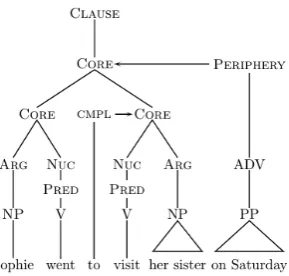
form a nucleus, two cores form a core, or two clauses form a clause). The operators and periphery (mod-ifiers) that apply to that type are shared across both units (only the mother unit, and not the daughter units, has its own periphery and operators). In coordination, each unit has its own operators and pe-riphery, and the two units join together to form a larger unit (e.g. two cores form a clause, two clauses form a sentence). A sentence instantiating core coordination is shown in Figure 3. In non-subordinate core junctures, each core has its own argument structure, but an argument can be shared between the two cores via a control or raising relationship (argument sharing is obligatory in core cosubordinations, and possible but not obligatory in core coordinations). In this case, the argument NPSophieoccurs in the first core, but is also an argument of the second core (the Actor in the visiting event).
Figure 3: Core coordination
The possible linkage relations (juncture-nexus types) can be arranged hierarchically in terms of the strength of the syntactic bond between the units: from closer to being integrated into a single unit (e.g. a complex predicate - nuclear cosubordi-nation), to closer to being two separate units (e.g. sentential coordination). Nuclear junctures are the most compact, followed by core, clausal and sen-tential. Within each layer, cosubordination is the tightest nexus type, followed by subordination and
then coordination. The hierarchy of syntactic relations aligns with a hierarchy of semantic relations ac-cording to the degree of semantic cohesion between the the two units: closer to being conceptualized as facets of a single event/action, or to being conceptualized as two distinct events/actions.
(MEP) (Bohnemeyer et al., 2007) is a possible semantic property of a syntactic construction (containing an event description). Constructions which have the MEP package an event representation such that any time-positional modifiers necessarily have scope over all of the subevents in the construction: the event is construed as more like a single event. Constructions which lack the MEP package an event representation such that multiple time-positional modifiers are possible (such that they each have scope over a different subpart of the complex event): the complex event is construed more like multiple events. (2) exemplifies this property using English infinitival constructions.
(2) a. Lara persuaded Sophie on Thursday to visit her sister on Saturday. (Core coordination) b. Sophie went (#yesterday) to visit her sister today. (Core cosubordination)
Nuclear junctures necessarily have the MEP, as do cosubordinate core junctures, while core coordi-nation, core subordicoordi-nation, and all clausal and sentential junctures lack the MEP. This fits neatly with the idea of a shared periphery: because time-positional modifiers occur in the core periphery, and core co-subordinations (as well as all nuclear junctures) share a single core periphery, time-positional modifiers necessarily have scope over the entire complex event. This distinction between complex events descrip-tions that have the MEP, construing the event as a singlemacro event, and those that lack the MEP, and construe the complex event as multiplemacro events, is exploited in the semantic representation of the implemented grammar (see Section 4.3.1).
3
A typed feature structure approach to Construction Grammar
The term Construction Grammar describes a family of grammatical theories in which constructions (de-fined as form-meaning pairings) are basic units. Sign-based Construction Grammar (SBCG) (Sag, 2012) combines insights from HPSG (Pollard and Sag, 1994) and Berkeley Construction Grammar (Fillmore and Kay, 1996). The grammar signature is an inheritance hierarchy of types. Each type has an asso-ciated set of features, and the value of each feature is itself typed. Features and their type constraints are inherited in the type hierarchy: subtypes must have all the features and value type restrictions of their ancestors, plus any additional restrictions introduced for that subtype. Words and phrases aresigns
(pairings of form and meaning). Local trees are encoded as feature structures as shown in (3).
(3) "
MOTHER np DTRS hdet,ni
#
Although the proposed constraint-based RRG variant shares with SBCG the use of Frame Semantics (Fillmore, 1982), frames are embedded hierarchically rather than as a flat list. The focus of the present work is on the structure of complex event representations (distinguishing event frames, macroevents and propositions), rather than on the ability to handle phenomena such as quantifier scope ambiguity.1
4
A constraint-based variant of Role and Reference Grammar
Role and Reference Grammar (Van Valin, 2005) traditionally recognizes constructions as an important part of the grammar, but restricts them to cover only the more idiosyncratic structures in a language. Unlike constructions in SBCG and other unification-based construction grammars, RRG’s constructions rely heavily on additional linking rules and template selection principles (Van Valin, 2005, p.244). RRG posits an inventory of abstract syntactic templates and linking relations (juncture-nexus types) which are distinct from grammatical construction types: these templates/relations may appear on the syntactic side of a constructional schema. Unlike standard RRG, where only idiosyncratic phenomena are cap-tured with explicit constructional schemas, in the proposed constraint-based RRG variant all syntactic structures are captured as constructions (of varying degrees of abstraction).
1
The various layers (nucleus, core, clause, sentence) are represented as subtypes oflayer, a subtype of
sign(Figure 4a). Other layer subtypes arepp(prepositional phrase) andnp(noun phrase). As in SBCG, phrasal constructions (Figure 4b) are represented as feature structures withMOTHERandDTRSfeatures.
sign
layer
nucleus core clause sentence mods pp np word lex sign
lexeme
(a) Sign types
phrasal-cx
pump-cx arg-struc-cx arg-cx mod-cx junct-cx pp-cx np-cx
(b) Phrasal construction types
Figure 4: Type hierarchies in a constraint-based variant of RRG
The type signature forsign is shown in (4): objects of typesign have a SYN feature of type syn-obj,2 and aSEMfeature of typesem-obj. The subtypelayeradditionally introduces the boolean feature
PERIPHERY, to indicate whether any peripheral modification has already been applied to that layer (co-subordination constructions require that the daughter layers have not yet had modification applied).
(4) sign SYN syn-obj SEM sem-obj
(5) "layer (↑sign) PERIPHERY boolean # (6)
pumping-cx (↑phrasal-cx)
MOTHER " layer SYN 1 # DTRS * layer SYN 1 h
CLM clm-nonei
+ sentence FORM 3 SYN|VAL hi
clause FORM 3 SYN|VAL hi
core
FORM 3hPat,laughedi SYN|VAL hi
XX XXX 1 np
FORM hPati SYN|VAL hi
core FORM 2 SYN|VAL h1i
nucleus FORM 2 SYN|VAL hi
word
FORM 2hlaughedi SYN|VAL hi
[image:5.595.78.512.248.647.2]
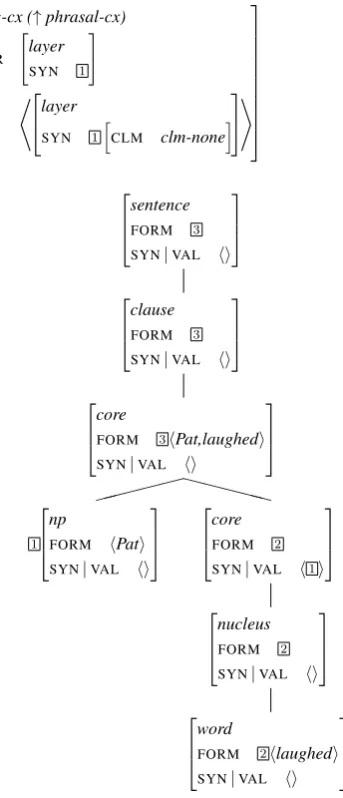
Figure 5: Simplified derivationPat laughed
Pumping constructions pass each non-complex layer up to the next layer. DTRS in a pumping construction is a singleton list containing onelayertype (e.g. acore), and the
MOTHERis thelayerabove (e.g. aclause). Syntactic (SYN)
features are passed from the daughter to the mother, while some elements of the semantics (SEM) are changed from layer to layer (discussed in Section 4.3). The transition from nucleus to core is not captured in a pumping construction, but in an argument structure construction, as changes must be made to the valence list (SYN|VAL) (SYNvalues remain
constant for all other layer transitions). Instead of RRG’s standard linking algorithms,argument structure construc-tions assign the appropriate number and ordering of argu-ments positions to a core, andargument constructionsadd appropriate arguments to those positions.3
Figure 5 shows the derivation of a simple intransitive sentence (Pat laughed). A sentence is produced from a clause through a pumping construction (or via a more com-plex juncture). A minimum of four pumping constructions (or more complex juncture constructions) plus an argument construction are required to produce a sentence from a verb. As a consequence, there is a core node for every argument, unlike standard RRG. This tree structure captures more of the argument linking process than a standard RRG tree, where the linking algorithm is represented separately.
Juncture constructionscombine two units of the same layer in coordinate or cosubordinate nexus. For example, a core cosubordination construction combines two daughter cores and produces a mother core, while a core coordination construction combines two daughter cores and produces a mother clause. Juncture constructions may place both syntactic (e.g. verb form, presence of a particular clause linkage
2
I omit further discussion of thesyn-objtype here for space reasons. 3
[image:5.595.338.510.253.653.2]marker) and semantic (e.g. subtypes of a certain semantic event frame) restrictions on their constituents.
4.1 Operators and modifiers
The sem-objtype (7) has a featureOPERATORS (OPS), which records the value of each of the nuclear,
core and clausal operators that have been incorporated into a representation. These operators are then passed to the representation of the relevant semantic unit (see Section 4.3.1) at the time it is generated. In this way, the grammar is able to handle operators that occur on the surface between elements of a lower layer in the LSC (e.g. clausal operators inside the core, or tense morphemes attached to predicates).
Modifier constructionscombine a layer in the LSC with something in its periphery. As discussed in Section 2.2, different semantic categories of verbal modifier apply to different layers in the clause. This restriction is captured by having a different modifier construction for each semantic category of modifi-cation, and restricting each modifier construction to apply to a particular layer (nucleus, core, clause or sentence). As modifiers combine a layer in the LSC with something in its periphery, all modifier con-structions constrain the mother’sPERIPHERYto+. This value is effectively reset each time a new layer is reached, as it is not passed from daughter to mother. While this approach does not allow for modifiers applicable to one layer to be interspersed between the elements of a lower layer, this could be improved in the future by adjusting the representation of modifiers to be more like the operator representation.
4.2 Comparison to a Tree Adjoining Grammar-based RRG formalization
The TAG-inspired approach to RRG formalization pursued by Osswald and Kallmeyer (2018) produces trees that are more consistent with standard RRG that the approach I have proposed. In the TAG approach, the trees are flatter, represent the fully derived structure rather than the steps involved in derivation, and capture the extended domain of locality in a way that is more consistent with standard RRG: long distance dependencies are captured using a ‘wrapping substitution’ mechanism, in which the predicate-argument structure that is the source of the long distance dependency is wrapped around the intervening elements. In the present approach, long distance dependencies would need to be percolated through the layered structure of the clause, as in Pollard and Sag (1994).
4.3 Semantics representation
event-fr
protag-ev-fr
action-fr
intern-act-fr communication-fr ...
cause-fr change-state ...
no-protag-ev
phase-fr
phase-onset-fr
beginning-fr ...
keeping-fr finishing-fr ... appears-fr ...
Figure 6: A section of the event frame type hierarchy
Although not explicitly arranged hi-erarchically, or using typed fea-ture strucfea-tures, the verbal repre-sentations in standard RRG can be straightforwardly adapted to
hierar-chically organized feature structure representations (semantic frames). RRG’s lexical decomposition semantics already organizes verbs into a number of classes. A fragment of the proposed event frame hierarchy is shown in Figure 6. Each event frame is associated with a set of boolean aspectual features (STATIC, DYNAMIC, TELIC and PUNCTUAL), following Van Valin (2005). These features are used to restrict the application of constructions that are sensitive to the aspectual properties of their constituents, such as phase constructions (e.g. begin to X) and duration (e.g. for an hour) or time-to-completion modifiers (e.g. in two hours). Participant roles are already hierarchically organized in RRG, so that most roles are fairly specific but can also be categorized into more coarsely grained thematic relations and macro roles (see Van Valin, 2005, p.54). Verbs describingactivitiesare represented withdo’in the logical representation. This could be transformed into an abstractACTORrole in an event frame, to be realized asEATER,RUNNER,TALKERand so on in specific event frames.
4.3.1 Semantic representation: entities, event frames, macroevents and propositions
com-posed from the event frame in the nucleus, any additional event frame contributed by the argument struc-ture construction, and any core cosubordination juncstruc-tures. As the macroevent is built up from the nucleus to the core to be passed on to the clause, it is represented inSEM|FRAMES|BUILD-MACROEVENT
(abbre-viated toSEM|FRMS|B-MACRO). Once a core becomes a clause, either through a pumping construction (10), or through a core coordination construction, themacro-event-objinBUILD-MACROEVENTis trans-ferred to the MACRO-EVENTS (M-EVS) list in the firstproposition-objin the PROPOSITIONS(PROPS) list. The type signatures forsem-obj,macro-event-objandproposition-objare shown in (7-9):
(7) sem-obj INDEX index FRMS ENTITIES list(ref-descriptor-obj) PROPS list(proposition-obj) PROP-RELS list(proposition-rel-obj)
OPS
NUCLEAR-OPS nuclear-ops-obj CORE-OPS core-ops-obj CLAUSAL-OPS clausal-ops-obj
(8) macro-event-obj
EV-FRMS list(frame) MODS list(frame) OPERATORS core-ops-obj ASPECT-PROF aspect-obj
INDEX index (9) proposition-obj
M-EVS list(macro-ev-obj) MODS list(frame) OPERATORS clausal-ops-obj M-EV-RELS list(macroevrel-obj)
INDEX index
list(τ) represents a list containing only elements of type τ. Propositions (9) are composed from the macroevent/s contributed by the core/s that feed into a sentence. Core coordination constructions produce two macroevents, while core cosubordination constructions produce only one: the events contributed by each daughter core are integrated into the semantics of a single macroevent in the juncture construction.
(10)
core-to-clause (↑pumping-cx)
MTR clause
SEM|FRMS
ENTITIES 1 M-EVS 5⊕ 2
PROPS 4
PROP-RELS 3
DTRS * core
SEM|FRMS
ENTITIES 1 PROPS 4
PROP-RELS 3 BUILD-M-EV 2
+ (11)
core-cosub (↑juncture-cx)
MTR core SEM INDEX i OPERATORS 1
FRMS|B-MACRO|ASPECTP2
DTRS * core PERIPHERY − SEM INDEX i OPERATORS 1 FRMS "
B-MACRO|ASPECTP2 ENTITIEShi # , " core PERIPHERY − # +
The precise relationship between event frames (contributed either by a predicate or by a construction) is specified in the constraints of each construction. Core layer modifiers are added to theMODSlist of the macro-event-obj. The onset-phase construction shown in (12) specifies that the first core must contribute a phase-onset-fr, while the second core must contribute anevent-fr which fills theEVENT role of the
phase-onset-fr. The ultimate semantic output of a sentence is a list of entities, and a list of propositions (plus proposition relations, in the case of sentences containing multiple clause nodes).
(12)
ccosub-onset-phase (↑core-cosub)
MTR
SEM|FRMS|B-MACRO|EV-FS * 3 " phase-onset-fr EVENT4 #+ DTRS h
SEM|FRMS|B-MACRO|EV-FSh3ii,hSEM|FRMS|B-MACRO|EV-FSh4event-frii
5
Implementation in ALE
The Attribute Logic Engine (ALE) is a freeware logic programming and grammar parsing and generation system written in Prolog. For a full description of ALE, see Carpenter and Penn (2001). The proposed constraint-based RRG-variant is implemented for a fragment of English.4 The current fragment contains a restricted set of 419 lexical items and 45 leaf node constructions. A semi-automatic expansion of the lexicon using FrameNet is planned. The implementation includes: a type-hierarchy, containing all types and their features; a list of constraints on types; a lexicon; a list of lexical rules; a list of phrase rules which map constituents to the daughters of a compatible construction, thus generating a mother constituent; a list of declarative statements which constrain the parser so that only the leaf construction types in the hierarchy (and not the more abstract parent types) can be parsed; and macros to simplify repeated chunks of code. Listing 1 shows the implementation of the constraints on the abstract core-cosubordination construction(11). Listing 2 shows the output of therecsem()command, which parses a sentence and displays the semantic output of a sentence: a list of entities and a list of propositions.
Listing 1: Core cosubordination constraints in ALE
coreCosub cons (mother:(core,
syn:(category: Cat, clmm: clm_none), sem:(index:I,
operators: O,
frames:(buildMacroEvent:(aspectprofile:Asp)))), dtrs:[(core,
periphery: minus, syn:(category: Cat,
clmm:clm_none), sem:(index:I,
operators: O,
frames:(buildMacroEvent:(aspectprofile:Asp), entities: []))),
(core, periphery: minus)]).
Listing 2: Semantic output forThe cat began to purr.
sem_output
ENTS referentdescriptor BOUNDED plus CAT cat_fr
ENTITY [0] DEF definite IX [0] NUMBER sg PROPS proposition
MACROEVS macroEvent
ASPECTPROF [1] achievement EV-FRMS beginning_fr
ASPECT [1]
PHASE_EV purring_fr PROTAG [0] SIT [2] OPERATORS clauseops
TENSE past PROP_INDEX [2]
Constructions are parsed via phrase rules. Phrase rules in ALE specify an output, one or more con-stituents (cat>) in the order they must be encountered, and goals (goal>) which evaluate Prolog predi-cates with respect to variables from the output or constituents of the phrase rule. In this implementation, the type of each constituent is always phrasal-cx, andcat> is only ever sensitive to the constituent’s
MOTHERvalue. The phrase rule output is also a construction, and each item in itsDTRSlist must unify
with theMOTHERof a particular constituent. The possible output construction types are restricted via the
goal: only construction types which satisfy a specified Prolog predicate (defined in a list of declarative statements) are eligible. In this way, parsing is restricted to only leaf node construction types, and not their more abstract/underspecified supertypes.
6
Future work
The current implementation of this constraint-based variant of RRG has focused primarily on: a) building out the backbone of the layered structure of the clause; and b) the structure and semantic representation of complex event descriptions. Two major additional features are currently being developed: the incorpo-ration of information structure (the third projection in RRG’s LSC model), which will extend the model beyond parsing declarative sentences with broad focus; and aspectual coercion (c.f. Michaelis, 2004), which will increase the flexibility of the grammar in parsing event descriptions that do not make use of the default aspectual profile of a particular event.
References
Bohnemeyer, J., N. J. Enfield, J. Essegbey, I. Ibarretxe-Antunano, S. Kita, F. L¨upke, and F. K. Ameka (2007). Principles of event segmentation in language: The case of motion events. Language 83(3), 495–532.
Bohnemeyer, J. and R. D. Van Valin (2017). The macro-event property and the layered structure of the clause. Studies in Language 41(1), 142–197.
Carpenter, B. (1992).The Logic of Typed Feature Structures. New York, NY, USA: Cambridge University Press.
Carpenter, B. and G. Penn (2001). ALE: The attribute logic engine user’s guide [Version 3.2.1]. Carnegie-Mellon University.
Copestake, A., D. Flickinger, C. Pollard, and I. A. Sag (2005). Minimal Recursion Semantics: An Introduction. Research on Language and Computation 3(2-3), 281–332.
Fillmore, C. J. (1982). Frame Semantics. InLinguistics in the Morning Calm, pp. 111–137. Hanshin Publishing Co.
Fillmore, C. J. and P. Kay (1996). Construction grammar coursebook.
Foley, W. and R. D. Van Valin (1984).Functional syntax and universal grammar. Cambridge: Cambridge University Press.
Joshi, A. K. and Y. Schabes (1997). Tree-adjoining grammars. InHandbook of formal languages, pp. 69–123. Springer.
Kallmeyer, L. and R. Osswald (2017). Combining predicate-argument structure and operator projection: Clause structure in role and reference grammar. InProceedings of the 13th International Workshop on Tree Adjoining Grammars and Related Formalisms, pp. 61–70.
Kallmeyer, L., R. Osswald, and R. D. Van Valin (2013). Tree wrapping for role and reference grammar. InFormal Grammar, pp. 175–190. Springer.
Michaelis, L. A. (2004). Type shifting in construction grammar: An integrated approach to aspectual coercion. Cognitive Linguistics 15(1), 1–67.
Osswald, R. and L. Kallmeyer (2018). Towards a formalization of role and reference grammar. In R. Kailuweit, L. Knkel, and E. Staudinger (Eds.),Applying and Expanding Role and Reference Gram-mar, NIHIN Studies, pp. 355–378. Freiburg: Albert-Ludwigs-Universit¨at, Universit¨atsbibliothek.
Pollard, C. and I. A. Sag (1994). Head-driven phrase structure grammar. University of Chicago Press.
Sag, I. A. (2012). Sign-based construction grammar: An informal synopsis. InSign-based construction grammar, Volume 193, pp. 69–202. CSLI: CSLI Publications.
Van Valin, R. D. (2005). Exploring the syntax-semantics interface. Cambridge: Cambridge University Press.