Injecting Logical Background Knowledge into
Embeddings for Relation Extraction
Tim Rockt¨aschel
University College London London, UK
Sameer Singh
University of Washington Seattle, WA
Sebastian Riedel
University College London London, UK
Abstract
Matrix factorization approaches to relation extraction provide several attractive features: they support distant supervision, handle open schemas, and leverage unlabeled data. Unfortu-nately, these methods share a shortcoming with all other distantly supervised approaches: they cannot learn to extract target relations with-out existing data in the knowledge base, and likewise, these models are inaccurate for rela-tions with sparse data. Rule-based extractors, on the other hand, can be easily extended to novel relations and improved for existing but inaccurate relations, through first-order formu-lae that capture auxiliary domain knowledge. However, usually a large set of such formulae is necessary to achieve generalization. In this paper, we introduce a paradigm for learning low-dimensional embeddings of entity-pairs and relations that combine the ad-vantages of matrix factorization with first-order logic domain knowledge. We introduce simple approaches for estimating such embeddings, as well as a novel training algorithm to jointly optimize over factual and first-order logic in-formation. Our results show that this method is able to learn accurate extractors with little or no distant supervision alignments, while at the same time generalizing to textual patterns that do not appear in the formulae.
1 Introduction
Relation extraction, the task of identifying rela-tions between named entities, is a crucial compo-nent for information extraction. A recent successful approach (Riedel et al., 2013) relies on two ideas:
(a) unifying traditional canonical relations, such as those of the Freebase schema, with OpenIE surface form patterns in auniversal schema, and (b) complet-ing a knowledge base of such a schema uscomplet-ing matrix factorization. This approach has several attractive properties. First, for canonical relations it effectively performs distant supervision (Bunescu and Mooney, 2007; Mintz et al., 2009; Yao et al., 2011; Hoffmann et al., 2011; Surdeanu et al., 2012) and hence re-quires no textual annotations. Second, in the spirit of OpenIE, a universal schema can use textual patterns as novel relations and thus increases the coverage of traditional schemas (Riedel et al., 2013; Fan et al., 2014). Third, matrix factorization learns better embeddings for entity-pairs for which only surface form patterns are observed, and these can also lead to better extractions of canonical relations.
Unfortunately, populating a universal schema knowledge base using matrix factorization suffers from a problem all distantly-supervised techniques share: you can only reliably learn relations that ap-pear frequently enough in the knowledge base. In par-ticular, for relations that do not appear in the knowl-edge base or for which no facts are known we cannot learn a predictor at all. One way to overcome this problem is to incorporate additional domain knowl-edge, either specified manually or bootstrapped from auxiliary sources. In fact, domain knowledge en-coded as simple logic formulae over patterns and relations has been used in practice to directly specify relation extractors (Reiss et al., 2008; Chiticariu et al., 2013; Akbik et al., 2014). However, these extractors can be brittle and obtain poor recall, since they are unable to generalize to textual patterns that are not
found in given formulae. Hence, there is a need for learning extractors that are able to combine logical knowledge with benefits of factorization techniques to facilitate precise extractions and generalization to novel relations.
In this paper, we propose a paradigm for learning universal schema extractors by combining matrix fac-torization based relation extraction with additional in-formation in the form of first-order logic knowledge. Our contributions are threefold: (i) We introduce sim-ple baselines that enforce logic constraints through deterministic inference before and after matrix factor-ization (§3.1). (ii) We propose a novel joint training algorithm that learns vector embeddings of relations and entity-pairs using both distant supervision and first-order logic formulae such that the factorization captures these formulae (§3.2). (iii) We present an empirical evaluation using automatically mined rules that demonstrates the benefits of incorporating logi-cal knowledge in relation extraction, in particular that joint factorization of distant and logic supervision is efficient, accurate, and robust to noise (§5).
2 Matrix Factorization and Logic
In this section we provide background on matrix fac-torization for universal schema relation extraction, and describe its connections to first-order logic.
2.1 Notation
In order to later unify observed facts and logical back-ground knowledge, we first represent given factual data in terms of first-order logic. We have a setE ofconstantsthat refer to entities, and a set of predi-catesRthat refer to relations between these entities. In the following we will focus on binary relations in auniversal schemathat contains both structured relations from one (or more) knowledge bases, and surface-form relations. Further, withP ⊆ E × Ewe denote the domain over entity-pairs of interest.
In function-free first-order logic a term is de-fined as a constant or a variable, and the most basic form of a formula is an atom such as
professorAt(x, y) that applies a predicate to a pair of terms. More complex formulae such as∀x, y : professorAt(x, y)⇒employeeAt(x, y) can be constructed by combining atoms with logical con-nectives (such as¬and∧) and quantifiers (∃x,∀x).
The simplest form of first-order formulae are ground atoms: predicates applied to constants, such asdirectorOf(NOLAN,INTERSTELLAR). A
pos-sible world is a set of ground atoms. Ground lit-erals are either ground atoms or negated ground atoms such as ¬bornIn(NOLAN,BERLIN), and
correspond to positive or negative facts. Training data for distant supervision can now be viewed as a knowledge base of such ground literals. Our goal is to extend the class of formulae from such facts to rules such as the first-order formula above.
2.2 Matrix Factorization with Ground Atoms Given the notation presented above, matrix factor-ization can now be seen as a learning task in which low-dimensional embeddings are estimated for all constant pairs inP and predicates (relations) inR, given a collection of ground atoms (facts) as supervi-sion. We represent constant-pairs as rows and predi-cates as columns of a|P| × |R|binary matrix, and each atom in the training data represents an observed cell in this matrix. As introduced in Riedel et al. (2013), we seek to find a low-rank factorization into a|P| ×kmatrix of embeddings of constant-pairs and ak× |R|matrix of predicate embeddings such that they approximate the observed matrix.
More precisely, letv(·)denote the mapping from constant-pairs and predicates to their corresponding embedding. That is,vrmis the embedding for
predi-caterm, andv(ei,ej) is the embedding for the pair
of constants (ei, ej). Let w be a possible world
(i.e. a set of ground atoms), and V be the set of all entity-pair and relation embeddings. Further, let
πei,ej
m =σ(vrm·vei,ej)whereσis the sigmoid
func-tion andvrm·v(ei,ej)denotes the vector dot-product
between the embeddings of relationrm and
entity-pair(ei, ej). We define the conditional probability of
a possible worldwgiven embeddingsVas
p(w|V) = Y
rm(ei,ej)∈w πei,ej
m
Y
rm(ei,ej)∈/w
1−πei,ej
m .
KB
∀x, y:co-founder-of(x, y)⇒company/founders(y, x)
∀x, y:review-by(x, y)⇒author/works written(y, x)
∀x, y:daughter-of(x, y)⇒person/parents(x, y) |R|
|P|
k
|P| |R|
k
|R|
|P|
Evidence Sparse Training Matrix Low-rank Logic Embeddings Completed Matrix
Facts
[image:3.612.97.512.61.199.2]First-order Formulae
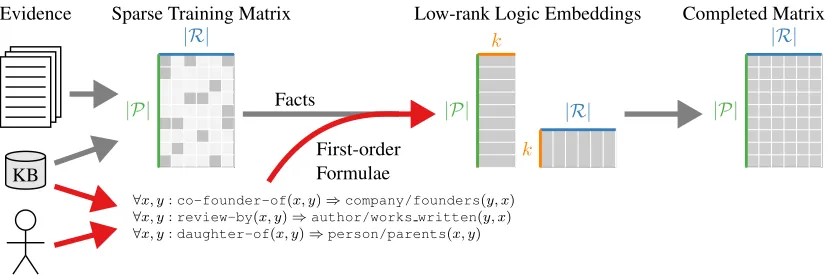
Figure 1:Injecting Logic into Matrix Factorization:Given a sparse binary matrix consisting of observed facts over entity-pairsPand predicates/relationsR, matrix factorization is used to learnk-dimensional relation and entity-pair embeddings that approximate the observed matrix. In this paper we use additional first-order logic formulae over entities and relations to learn the embeddings such that the predictions (completed matrix) also satisfy these formulae.
3 Injecting Logic Into Factorization
Matrix factorization is capable of learning complex dependencies between relations, but requires ob-served facts as training signal. However, often we either do not have this signal because the relations of interest do not have pre-existing facts, or this signal is noisy due to alignment errors or mismatches when linking knowledge base entities to mentions in text.
To overcome this problem we investigate the use of first-order logic background knowledge (e.g. im-plications) to aid relation extraction. One option is to rely on a fully symbolic approach that exclusively uses first-order logic (Bos and Markert, 2005; Baader et al., 2007; Bos, 2008). In this case incorporating additional background knowledge is trivial. However, it is difficult to generalize and deal with noise and uncertainty in language when relying only on manual rules. In contrast, matrix factorization methods can overcome these shortcomings, but it is not clear how they can be combined with logic formulae.
In this section, we propose to inject formulae into the embeddings of relations and entity-pairs,i.e., esti-mate the embeddings such that predictions based on them conform to given logic formulae (see Figure 1 for an overview). We refer to such embeddings as low-rank logic embeddings. Akin to matrix factoriza-tion, inference of a fact at test time still amounts to an efficient dot product of the corresponding relation and entity-pair embeddings, and logical inference is not needed. We present two techniques for inject-ing logical background knowledge,pre-factorization
inference (§3.1) andjoint optimization(§3.2), and demonstrate in subsequent sections that they gen-eralize better than direct logical inference, even if such inference is performed on thepredictionsof the matrix factorization model.
3.1 Pre-Factorization Inference
Background knowledge in form of first-order formu-lae can be seen ashintsthat can be used to generate additional training data (Abu-Mostafa, 1990). For pre-factorization inferencewe first perform logical inference on the training data and add inferred facts as additional training data. For example, for a for-mula F = ∀x, y : rs(x, y)⇒rt(x, y), we add an
additional observed cell rt(x, y) for any(x, y)for
whichrs(x, y)is observed in the distant supervision
training data. This is repeated until no further facts can be inferred. Subsequently, we run matrix factor-ization on the extended set of observed cells.
The intuition is that the additional training data generated by the formulae provide evidence of the logical dependencies between relations to the matrix factorization model, while at the same time allowing the factorization to generalize to unobserved facts and to deal with ambiguity and noise in the data. No further logical inference is performed during or after training of the factorization model as we expect that the learned embeddings encode the given formulae. 3.2 Joint Optimization
i.e., first-order dependencies onpredictedfacts are ignored. Instead we would like to include a loss term for the logical formulae directly in the matrix factor-ization objective, thus jointly optimizing embeddings to reconstruct factual training data as well as obeying to first-order logical background knowledge.
3.2.1 Training Objective
Here we first present a learning objective that uni-fies ground atoms (facts) and logical background knowledge by treating both as logic formulae (atomic or complex), and define a loss function over this gen-eral representation. We then define the loss function for ground atoms and simple implications, along with a brief sketch of how the loss can be defined for arbi-trarily complex logic formulae.
As introduced in §2.1, let R be the set of all relations/predicates and P be the set of all entity-pairs/constants. Furthermore, letFbe a training set of logic formulaeF, andLa loss function. The train-ing objective (omitttrain-ing`2regularization onv(·)for simplicity) is
min
V
X
F∈F
L([F]) (1)
whereVis the set of all relation and entity-pair em-beddings, and[F]is the marginal probabilityp(w|V)
that the formulaFis true under the model. In this pa-per we use the logistic loss: L([F]) := −log([F]). The objective thus prefers embeddings that assign formulae a high marginal probability.
To optimize this function we need the marginal probabilities [F], and the gradients of the losses L([F]) for every F ∈ F with respect to entity-pair and relation embeddings, i.e., ∂L([F])/∂vrm
and∂L([F])/∂v(ei,ej). Below we discuss how these
quantities can be computed or approximated for arbi-trary first-order logic formulae, with details provided for ground atoms and implications.
Ground Atoms Due to the conditional indepen-dence of ground atoms in the distributionp(w|V), the marginal probability of a ground atom F = rm(ei, ej)is[F] =πmei,ej =σ(vrm·vei,ej). Hence
when only ground atoms (or literals) are used, objec-tive (1) reduces to the standard log-likelihood loss. The gradients of the loss for the entity-pair
embed-dingv(ei,ej)and relation embeddingvrm are
∂[F]/∂v(ei,ej)= [F](1−[F])vrm (2) ∂[F]/∂vrm = [F](1−[F])v(ei,ej) (3) ∂L([F])/∂v(ei,ej)=−[F]−1∂[F]/∂v(ei,ej) (4) ∂L([F])/∂vrm =−[F]−1∂[F]/∂vrm. (5)
First-order Logic Crucially, and in contrast to the log-likelihood loss for matrix factorization, we can in-ject more expressive logic formulae than just ground atoms. We briefly outline how to recursively compute the probability of the formula[F]and the gradients of the lossL([F])for any first-order formulaF. Again, note that the probabilities of ground atoms in our model are independent conditioned on embeddings. This means that for any two formulaeAandB, the marginal probability of[A ∧ B]can be computed as
[A][B](known asproduct t-norm), provided both for-mula concern non-overlapping sets of ground atoms. In combination with[¬ A] := 1−[A]and the [ ]
operator as defined for ground atoms earlier, we can compute the probability ofanypropositional formula recursively,e.g.,
[A ∨ B] = [A] + [B]−[A][B] [A ⇒ B] = [A]([B]−1) + 1
[A ∧ ¬ B ⇒ C] = ([A](1−[B]))([C]−1) + 1.
Note that for statements[F] ∈ {0,1}, we directly recover logical semantics. First-order formulae in finite domains can be embedded through explicit grounding. For universal quantification we can get
[∀x, y :F(x, y)] = [Vx,yF(x, y)]. If we again as-sume non-overlapping ground atoms in each of the arguments of the conjunction, we can simplify this to
Q
x,y[F(x, y)]. When arguments do overlap we can
think of this simplification as an approximation. Since [F(x, y)] is defined recursively, we can back-propagate the training signal through the structure of [F] to compute ∂[F(x, y)]/∂vrm and ∂[F(x, y)]/∂vei,ej for any nested formula.
Implications A particularly useful family of for-mulae for relation extraction are universally quanti-fied first-order formula over a knowledge base such as F = ∀x, y : rs(x, y) ⇒ rt(x, y). Assuming
each entity-pair(ei, ej)in the domain. Specifically, [F] = Q(ei,ej)∈P[Fij], and therefore L([F]) =
P
(ei,ej)∈PL([Fij]). The gradients are derived as:
[Fij] = [rs(ei, ej)] ([rt(ei, ej)]−1) + 1 (6) ∂L([Fij])
∂vrs
=−[Fij]−1([rt(ei, ej)]−1)∂[rs∂v(ei, ej)] rs ∂L([Fij])
∂vrt =−[Fij]
−1[r
s(ei, ej)]∂[rt∂v(ei, ej)]
rt (7)
∂L([Fij])
∂vei,ej =−[Fij]
−1([r
t(ei, ej)]−1)∂[r∂vs(ei, ej)] ei,ej
−[Fij]−1[rs(ei, ej)]∂[r∂vt(ei, ej)] ei,ej
. (8)
Following such a derivation, one can obtain gradients for other first-order logic formulae as well.
3.2.2 Learning
We learn the embeddings by minimizing Eq. 1 with`2-regularization using AdaGrad (Duchi et al., 2011). Since we have no negative training facts, we follow Riedel et al. (2013) by sampling unobserved facts that we assume to be false. Specifically, in ev-ery epoch and for evev-ery true training factrm(ei, ej)
we sample an(ep, eq)such thatrm(ep, eq)is
unob-served. Subsequently, we perform two kinds of up-dates: F = rm(ei, ej)andF =¬rm(ep, eq). For
every non-atomic first-order formula inFwe iterate over all entity-pairs for which at least one atom in the formula is observed (in addition to as many sampled entity-pairs for whichnoneof the atoms have been observed) and add corresponding grounded propo-sitional formulae to the training objective. At test time, predicting a score for any unobserved state-ment rm(ei, ej) is done efficiently by calculating [rm(ei, ej)]. Note that this does not involve any
ex-plicit logical inference, instead we expect that the predictions from the learned embeddings already re-spect the provided formulae.
4 Experimental Setup
There are two orthogonal question when evaluat-ing the effectiveness of low-rank logic embeddevaluat-ings: a) does injection of logic formulae into the embed-dings of entity-pairs and relations provide any bene-fits, and b) where do the background formulae come from? The latter is a well-studied problem (Hipp et al., 2000; Schoenmackers et al., 2010; V¨olker and
Niepert, 2011). In this paper we focus the evaluation on the ability of various approaches to benefit from formulae that we directly extract from the training data using a simple method.
Distant Supervision Evaluation We follow the procedure as used in Riedel et al. (2013) for eval-uating knowledge base completion of Freebase (Bol-lacker et al., 2008) with textual data from the NY-Times corpus (Sandhaus, 2008). The training matrix consists of 4 111 columns, representing 151 Free-base relations and3 960textual patterns,41 913rows (entity-pairs) and 118 781 training facts of which
7 293belong to Freebase relations. The entity-pairs are divided into train and test, and we hide all Free-base relations for the test pairs from training. Our pri-mary evaluation measure is average and (weighted) mean average precision,MAPandwMAP respec-tively (see Riedel et al. (2013) for details).
Formulae Extraction and Annotation We use a simple technique for extracting formulae from the matrix factorization model. We first run matrix fac-torization over the complete training data to learn accurate relation and entity-pair embeddings. After training, we iterate over all pairs of relations(rs, rt)
wherertis a Freebase relation. For every
relation-pair we iterate over all training atomsrs(ei, ej),
eval-uate the score[rs(ei, ej)⇒ rt(ei, ej)]as described
in §3.2.1, and calculate the average to arrive at a score for the formula. Finally, we rank all formulae by their score and manually filter the top 100 for-mulae, which resulted in36annotated high-quality formulae (see Table 1 for examples). Note that our formula extraction approach does not observe the re-lations for test entity-pairs. All models used in our experiments have access to these formulae, except for the matrix factorization baseline.
embed-Formula Score ∀x, y:#2-unit-of-#1(x, y)⇒org/parent/child(x, y) 0.97
∀x, y:#2-city-of-#1(x, y)⇒location/containedby(x, y) 0.97
∀x, y:#2-minister-#1(x, y)⇒person/nationality(x, y) 0.97
∀x, y:#2-executive-#1(x, y)⇒person/company(x, y) 0.96
[image:6.612.314.533.62.207.2]∀x, y:#2-co-founder-of-#1(x, y)⇒company/founders(y, x) 0.96
Table 1: Sample Extracted Formulae: Top implica-tions of textual patterns to five different Freebase relaimplica-tions. These implications were extracted from the matrix factor-ization model and manually annotated. The premises of these implications are dependency paths, but we present a simplified version to make them more readable.
dings (i.e. it has no access to any formulae). Further-more, we consider purelogical inference(Inf). Our final approach, post-factorization inference (Post), first runs matrix factorization and then performs logi-cal inference on the known and predicted facts. Post-inference is computationally expensive, since for all premises of formulae we have to iterate over all rows (entity-pairs) in the matrix to assess whether the premise is true or not.
Parameters For every matrix factorization based method we usek= 100as the dimension for the em-beddings,λ= 0.01as parameter of`2-regularization and α = 0.1 as initial learning rate for AdaGrad, which we run for200epochs.
Complexity Each AdaGrad update is defined over a single cell of the matrix, and thus training data can be streamed one ground atom at a time. For matrix factorization, each AdaGrad epoch touches all the observed atoms once, and as many sampled negative atoms. With given formulae, it additionally revisits all the observed atoms that appear as an atom in the formula (and as many sampled negative atoms), and thus more general formulae will be more expensive. However the updates over atoms are performed inde-pendently and thus not all the data needs to be stored in memory. All presented models take less than 15 minutes to train on a 2.8 GHz Intel Core i7 machine.
5 Results and Discussion
To evaluate the utility of injecting logic formulae into embeddings, we present a comparison on a va-riety of benchmarks. First, in §5.1 we study the scenario of learning extractors for relations for which we do not have any Freebase alignments, evaluating how the approaches are able to generalize only from
Relation # MF Inf Post Pre Joint
person/company 102 0.07 0.03 0.15 0.31 0.35
location/containedby 72 0.03 0.06 0.14 0.22 0.31
author/works written 27 0.02 0.05 0.18 0.31 0.27 person/nationality 25 0.01 0.19 0.09 0.15 0.19
parent/child 19 0.01 0.01 0.48 0.66 0.75
person/place of birth 18 0.01 0.43 0.40 0.56 0.59
person/place of death 18 0.01 0.24 0.23 0.27 0.23 neighborhood/neighborhood of 11 0.00 0.00 0.60 0.63 0.65
person/parents 6 0.00 0.17 0.19 0.37 0.65
company/founders 4 0.00 0.25 0.13 0.37 0.77
film/directed by 2 0.00 0.50 0.50 0.36 0.51
film/produced by 1 0.00 1.00 1.00 1.00 1.00
MAP 0.01 0.23 0.34 0.43 0.52
Weighted MAP 0.03 0.10 0.21 0.33 0.38
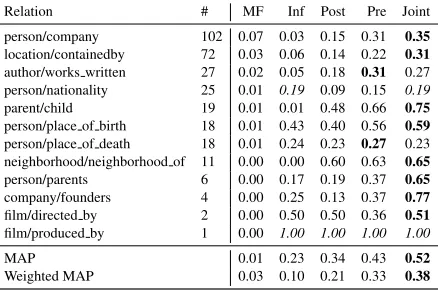
Table 2: Zero-shot Relation Learning: Average and (weighted) mean average precisions with relations that do not appear in any of the annotated formulae omitted from the evaluation. The difference between “Pre” and “Joint” is significant according to the sign-test (p <0.05).
logic formulae and textual patterns. In §5.2 we then describe an experiment where the amount of Free-base alignments is varied in order to assess the effect of combining distant supervision and background knowledge on the accuracy of predictions. Although the methods presented in this paper target relations with insufficient alignments, we also provide a com-parison on the complete distant supervision dataset in §5.3. We conclude in §5.4 with a brief analysis of the reasoning capacity of the learned embeddings.
5.1 Zero-shot Relation Learning
We start with the scenario of learning extractors for relations that do not appear in the knowledge base schema,i.e., those that do not have any textual align-ments. Such a scenario occurs in practice when a new relation needs to be added to a knowledge base for which there are no facts that connect the new relation to existing relations or surface patterns. For accurate extractions of such relations, the model needs to rely primarily on background domain knowledge to iden-tify relevant textual alignments, but at the same time it also needs to utilize correlations between textual patterns for generalization. To simulate this setup, we remove all alignments between all entity-pairs and Freebase relations from the distant supervision data, use the extracted logic formulae (§4) as back-ground knowledge, and evaluate on the ability of the different methods to recover the lost alignments.
0 0.2 0.4 0.6
0 0.1 0.2 0.3 0.4 0.5
wMAP
[image:7.612.312.528.64.208.2]Fraction of Freebase training facts MF Joint Pre Post Inf
Figure 2: Relations with Few Distant Labels:
Weighted mean average precisions of the various methods as the fraction of Freebase training facts is varied. For 0% Freebase training facts we get the zero-shot relation learning results presented in Table 2.
matrix factorization (MF) performs poorly since em-beddings cannot be learned for the Freebase relations without any observed cells. Scores higher than zero for matrix factorization are caused by random pre-dictions. Logical inference (Inf) is limited by the number of known facts that appear as premise in one of the implications. Although post-factorization in-ference (Post) is able to achieve a large improvement over logical inference, explicitly injecting logic for-mulae into the embeddings (i.e. learning low-rank logic embeddings) using pre-factorization inference (Pre) or joint optimization (Joint) gives superior re-sults. Last, we observe that joint optimization is able to best combine logic formulae and textual patterns for accurate, zero-shot learning of relation extractors. 5.2 Relations with Few Distant Labels
In this section we study the scenario of learning rela-tions that have only a few distant supervision align-ments, in particular, we observe the behavior of the various methods as the amount of distant supervi-sion is varied. We run all methods on training data that contains different fractions of Freebase training facts (and therefore different degrees of relation/text pattern alignment), but keep all textual patterns in addition to the set of extracted formulae.
Figure 2 summarizes the results. The performance of pure logical inference does not depend on the amount of distant supervision data, since it does not take advantage of the correlations in the data.
0.2 0.4 0.6 0.8 1
0 0.1 0.2 0.3 0.4 0.5 0.6 0.7 0.8 0.9 1
Precision
Recall
Joint MF Mintz09 Yao11 Surdeanu12 Riedel13-F
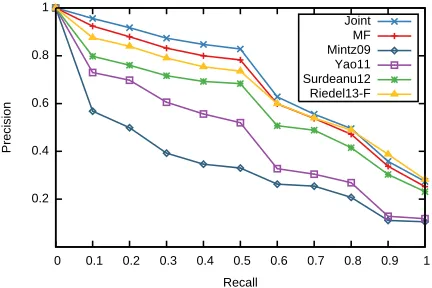
Figure 3: Comparison on Complete Data: Aver-aged precision/recall curve demonstrating that the “Joint” method outperforms existing factorization approaches (“MF” and “Riedel13-F”). The formulae used by our ap-proach have been extracted only from the training data.
trix factorization ignores logic formulae, and thus is the baseline performance when only using distant supervision. For the factorization based methods, only a small fraction (15%) of the training data is needed to achieve around0.50wMAP performance, thus demonstrating that they are efficiently exploiting correlations and generalizing to unobserved facts.
Pre-factorization inference, however, does not out-perform post-factorization inference, and is on par with matrix factorization for most of the curve. This suggests that it is not an effective way of injecting logic into embeddings when ground facts are also available. In contrast, joint optimization leads to low-rank logic embeddings that outperform all other methods in the0to30% Freebase training data inter-val. Beyond30% there seem to be sufficient Freebase facts for matrix factorization to encode these formu-lae, thus yielding diminishing returns.
5.3 Comparison on Complete Data
[image:7.612.73.291.65.210.2]in Figure 3, demonstrating that joint optimization provides benefits over the existing factorization and distant supervision techniques even on the complete dataset, and obtains66% wMAP and69% MAP. This improvement over the matrix factorization model can be explained by reinforcement of high-quality anno-tated formulae via the joint model.
5.4 Analysis of Asymmetry in the Predictions Since the injected formulae are of the form∀x, y : rs(x, y)⇒rt(x, y), it is worthwhile to study the
ex-tent to which these rules are captured, and which approaches are in fact capturing the asymmetric na-ture of the implication. To this end, we compute the probabilities that the formulae and their inverse hold, averaged over all annotated formulae and cells. The degree to whichrs⇒rtis captured is quite high for
all models (0.94,0.96, and0.97for matrix factoriza-tion, pre-factorization inference, and joint optimiza-tion respectively). On the other hand, the probability ofrt⇒rsis also relatively high for matrix
factoriza-tion and pre-factorizafactoriza-tion inference (0.81and0.83
respectively), suggesting that these methods are pri-marily capturing symmetric similarity between rela-tions. Joint optimization, however, produces much more asymmetric predictions (probability ofrt⇒rs
is0.49), demonstrating that it is appropriate for en-coding logic in the embeddings.
6 Related Work
Embeddings for Knowledge Base Completion Embedding predicates and constants (or pairs of con-stants) based on factual knowledge for knowledge base completion has for instance been investigated by Bordes et al. (2011), Nickel et al. (2012), Socher et al. (2013), Riedel et al. (2013) and Fan et al. (2014). Our work goes further in that we learn embeddings that follow not only factual but also first-order logic knowledge, and the ideas presented in this paper can be incorporated with any embedding-based method that uses a per-atom loss.
Logical Inference A common alternative that di-rectly incorporates first-order logic knowledge is to perform logical inference (Bos and Markert, 2005; Baader et al., 2007; Bos, 2008), however such purely symbolic approaches cannot deal with the uncertainty inherent to natural language, and generalize poorly.
Probabilistic Inference To ameliorate some of the drawbacks of symbolic logical inference, proba-bilistic logic based approaches have been proposed (Schoenmackers et al., 2008; Garrette et al., 2011; Beltagy et al., 2013; Beltagy et al., 2014). Since log-ical connections between relations are modeled ex-plicitly, such approaches are generally hard to scale. Specifically, approaches based on Markov Logic Net-works (MLNs) (Richardson and Domingos, 2006) encode logical knowledge in dense, loopy graphical models, making structure learning, parameter estima-tion, and inference hard for the scale of our data. In contrast, in our model the logical knowledge is cap-tured directly in the embeddings, leading to efficient inference. Furthermore, as our model is based on matrix factorization, we have a natural way to deal with linguistic ambiguities and label errors.
Weakly Supervised Learning Our work is also in-spired by weakly supervised approaches (Ganchev et al., 2010) that use structural constraints as a source of indirect supervision, and have been used for several NLP tasks (Chang et al., 2007; Mann and McCallum, 2008; Druck et al., 2009; Singh et al., 2010). Carlson et al. (2010) in particular is similar since they use common sense constraints to jointly train multiple information extractors. In this work, however, we are training a matrix factorization model, and allowing for arbitrarily complex logic formulae.
Combining Symbolic and Distributed Represen-tations There have been a number of recent ap-proaches that combine distributed representations with symbolic knowledge. Grefenstette (2013) de-scribes an isomorphism between first-order logic and tensor calculus, using full-rank matrices to ex-actly memorize facts. Based on this isomorphism, Rockt¨aschel et al. (2014) combine logic with ma-trix factorization for learning low-dimensional em-beddings that approximately satisfy given formulae and generalize to unobserved facts on toy data. Our work extends this workshop paper by proposing a simpler formalism without tensor-based logical con-nectives, presenting results on a real-world task, and demonstrating the utility of this approach for learning relations with few textual alignments.
approach is imposing soft constraints that are formu-lated as universally quantified first-order formula.
de Lacalle and Lapata (2013) combine first-order logic knowledge with a topic model to improve sur-face pattern clustering for relation extraction. Since these formulae only specify which relations can be clustered and which not, they do not capture the va-riety of dependencies embeddings can model, such as asymmetry. Lewis and Steedman (2013) use dis-tributed representations to cluster predicates before logical inference. Again, this approach is not as pow-erful as factorizing the relations, as it makes symme-try assumptions for the predicates.
Several studies have investigated the use of sym-bolic representations (such as dependency trees) to guide the composition of distributed representa-tions (Clark and Pulman, 2007; Mitchell and Lapata, 2008; Coecke et al., 2010; Hermann and Blunsom, 2013). Instead we are using symbolic representa-tions (first-order logic) as prior domain knowledge to directly learn better embeddings.
Combining symbolic information with neural net-works has also been an active area of research. Towell and Shavlik (1994) introduce Knowledge-Based Arti-ficial Neural Networks whose topology is isomorphic to a knowledge base of facts and inference formulae. There, facts are input units, intermediate conclusions hidden units, and final conclusions (inferred facts) output units. Unlike our work, there is no latent rep-resentation of predicates and constants. H¨olldobler et al. (1999) and Hitzler et al. (2004) prove that for every logic program theoretically there exists a recur-rent neural network that approximates the semantics of that program. Finally, Bowman (2014) recently demonstrated that a neural tensor network can accu-rately learn natural logic reasoning.
7 Conclusions
Inspired by the benefits of logical background knowl-edge that can lead to precise extractors, and of distant supervision based matrix factorization that can utilize dependencies between textual patterns to generalize, in this paper we introduced a novel training paradigm for learning embeddings that combine matrix factor-ization with logic formulae. Along with a determin-istic approach to enforce the formulae a priori, we propose a joint objective that rewards predictions that
satisfy given logical knowledge, thus learning embed-dings that do not require logical inference at test time. Experiments show that the proposed approaches are able to learn extractors for relations with little to no observed textual alignments, while at the same time benefiting more common relations. The source code of the methods presented in this paper and the anno-tated formulae used for evaluation are available at
github.com/uclmr/low-rank-logic.
This research has thrown up many questions in need of further investigation. As opposed to our ap-proach that modifies both relation and entity-pair embeddings, further work needs to explore train-ing methods that only modify relation embeddtrain-ings in order to encode logical dependencies explicitly, and thus avoid memorization. Although we ob-tain significant gains by using implications, our ap-proach facilitates the use of arbitrary formulae; it would be worthwhile to pursue this direction by fol-lowing the steps outlined in §3.2.1. Furthermore, we are interested in combining relation extraction with models that learn entity type representations (e.g. tensor factorization or neural models) to al-low for expressive logical statements such as∀x, y: nationality(x, y)⇒country(y). Since such common sense formulae are often not directly ob-served in distant supervision, they can go a long way in fixing common extraction errors. Finally, we will investigate methods to automatically mine common-sense knowledge for injection into embeddings from additional resources such as Probase (Wu et al., 2012) or directly from text using a semantic parser (Zettle-moyer and Collins, 2005).
Acknowledgments
References
Yaser S Abu-Mostafa. 1990. Learning from hints in neural networks. Journal of complexity, 6(2):192–198. Alan Akbik, Thilo Michael, and Christoph Boden. 2014. Exploratory relation extraction in large text corpora. In
International Conference on Computational Linguistics (COLING), pages 2087–2096.
Franz Baader, Bernhard Ganter, Baris Sertkaya, and Ulrike Sattler. 2007. Completing description logic knowledge bases using formal concept analysis. InIJCAI, pages 230–235.
Islam Beltagy, Cuong Chau, Gemma Boleda, Dan Gar-rette, Katrin Erk, and Raymond Mooney. 2013. Mon-tague meets markov: Deep semantics with probabilis-tic logical form. In2nd Joint Conference on Lexical and Computational Semantics: Proceeding of the Main Conference and the Shared Task, Atlanta, pages 11–21. Islam Beltagy, Katrin Erk, and Raymond J. Mooney. 2014. Probabilistic soft logic for semantic textual similarity. InProceedings of the 52nd Annual Meeting of the As-sociation for Computational Linguistics (ACL-14), Bal-timore, MD.
Kurt Bollacker, Colin Evans, Praveen Paritosh, Tim Sturge, and Jamie Taylor. 2008. Freebase: a collabo-ratively created graph database for structuring human knowledge. InProceedings of the 2008 ACM SIGMOD international conference on Management of data, pages 1247–1250. ACM.
Antoine Bordes, Jason Weston, Ronan Collobert, and Yoshua Bengio. 2011. Learning structured embed-dings of knowledge bases. InAAAI.
Johan Bos and Katja Markert. 2005. Recognising textual entailment with logical inference. InProceedings of the conference on Human Language Technology and Em-pirical Methods in Natural Language Processing, pages 628–635. Association for Computational Linguistics. Johan Bos. 2008. Wide-coverage semantic analysis with
boxer. In Johan Bos and Rodolfo Delmonte, editors,
Semantics in Text Processing. STEP 2008 Conference Proceedings, Research in Computational Semantics, pages 277–286. College Publications.
Samuel R Bowman. 2014. Can recursive neural tensor networks learn logical reasoning? InICLR’14. Razvan C. Bunescu and Raymond J. Mooney. 2007.
Learning to Extract Relations from the Web using Mini-mal Supervision. InAnnual Meeting of the Association for Computational Linguistics (ACL), Prague, Czech Republic, June.
Andrew Carlson, Justin Betteridge, Richard C. Wang, Es-tevam R. Hruschka, Jr., and Tom M. Mitchell. 2010. Coupled semi-supervised learning for information ex-traction. In International conference on Web search and data mining (WSDM).
Ming-Wei Chang, Lev Ratinov, and Dan Roth. 2007. Guiding semi-supervision with constraint-driven learn-ing. InAnnual Meeting of the Association for Compu-tational Linguistics (ACL), pages 280–287.
Kai-Wei Chang, Wen-tau Yih, Bishan Yang, and Christo-pher Meek. 2014. Typed tensor decomposition of knowledge bases for relation extraction.
Laura Chiticariu, Yunyao Li, and Frederick R. Reiss. 2013. Rule-based information extraction is dead! long live rule-based information extraction systems! In
Empirical Methods in Natural Language Processing (EMNLP), pages 827–832.
Stephen Clark and Stephen Pulman. 2007. Combining symbolic and distributional models of meaning. In
AAAI Spring Symposium: Quantum Interaction, pages 52–55.
Bob Coecke, Mehrnoosh Sadrzadeh, and Stephen Clark. 2010. Mathematical foundations for a composi-tional distribucomposi-tional model of meaning. CoRR, abs/1003.4394.
Michael Collins, Sanjoy Dasgupta, and Robert E Schapire. 2001. A generalization of principal components anal-ysis to the exponential family. InAdvances in neural information processing systems, pages 617–624. Oier Lopez de Lacalle and Mirella Lapata. 2013.
Unsu-pervised relation extraction with general domain knowl-edge. InEMNLP, pages 415–425.
Gregory Druck, Gideon Mann, and Andrew McCallum. 2009. Semi-supervised learning of dependency parsers using generalized expectation criteria. InJoint Confer-ence of the Annual Meeting of the ACL and the Interna-tional Joint Conference on Natural Language Process-ing of the AFNLP.
John Duchi, Elad Hazan, and Yoram Singer. 2011. Adaptive subgradient methods for online learning and stochastic optimization.The Journal of Machine Learn-ing Research, 12:2121–2159.
Miao Fan, Deli Zhao, Qiang Zhou, Zhiyuan Liu, Thomas Fang Zheng, and Edward Y Chang. 2014. Distant supervision for relation extraction with matrix completion. InProceedings of the 52nd Annual Meet-ing of the Association for Computational LMeet-inguistics, volume 1, pages 839–849.
Kuzman Ganchev, Joao Graca, Jennifer Gillenwater, and Ben Taskar. 2010. Posterior regularization for struc-tured latent variable models.Journal of Machine Learn-ing Research (JMLR), July.
Edward Grefenstette. 2013. Towards a formal distribu-tional semantics: Simulating logical calculi with ten-sors. InProceedings of the Second Joint Conference on Lexical and Computational Semantics, pages 1–10. Karl Moritz Hermann and Phil Blunsom. 2013. The role of syntax in vector space models of compositional semantics. InProc. of ACL, pages 894–904.
Jochen Hipp, Ulrich G¨untzer, and Gholamreza Nakhaeizadeh. 2000. Algorithms for association rule mininga general survey and comparison.ACM sigkdd explorations newsletter, 2(1):58–64.
Pascal Hitzler, Steffen H¨olldobler, and Anthony Karel Seda. 2004. Logic programs and connectionist net-works.Journal of Applied Logic, 2(3):245–272. Raphael Hoffmann, Congle Zhang, Xiao Ling, Luke
Zettlemoyer, and Daniel S. Weld. 2011. Knowledge-based weak supervision for information extraction of overlapping relations. InAnnual Meeting of the Associ-ation for ComputAssoci-ational Linguistics (ACL).
Steffen H¨olldobler, Yvonne Kalinke, and Hans-Peter St¨orr. 1999. Approximating the semantics of logic programs by recurrent neural networks. Appl. Intell., 11(1):45– 58.
Mike Lewis and Mark Steedman. 2013. Combined distri-butional and logical semantics. InTransactions of the Association for Computational Linguistics, volume 1, pages 179–192.
Gideon S. Mann and Andrew McCallum. 2008. General-ized expectation criteria for semi-supervised learning of conditional random fields. InAnnual Meeting of the Association for Computational Linguistics (ACL), pages 870–878.
Mike Mintz, Steven Bills, Rion Snow, and Daniel Juraf-sky. 2009. Distant supervision for relation extraction without labeled data. InAssociation for Computational Linguistics (ACL).
Jeff Mitchell and Mirella Lapata. 2008. Vector-based models of semantic composition. In Proc. of ACL, pages 236–244.
Maximilian Nickel, Volker Tresp, and Hans-Peter Kriegel. 2012. Factorizing yago: scalable machine learning for linked data. InProc. of WWW, pages 271–280. Frederick Reiss, Sriram Raghavan, Rajasekar
Krishna-murthy, Huaiyu Zhu, and Shivakumar Vaithyanathan. 2008. An algebraic approach to rule-based informa-tion extracinforma-tion. InInternational Conference on Data Engineering (ICDE), pages 933–942, April.
Matthew Richardson and Pedro Domingos. 2006. Markov logic networks. Machine Learning, 62(1-2):107–136. Sebastian Riedel, Limin Yao, Andrew McCallum, and
Benjamin M Marlin. 2013. Relation extraction with matrix factorization and universal schemas. In Proceed-ings of NAACL-HLT, pages 74–84.
Tim Rockt¨aschel, Matko Bosnjak, Sameer Singh, and Sebastian Riedel. 2014. Low-Dimensional Embed-dings of Logic. InACL Workshop on Semantic Parsing (SP’14).
Evan Sandhaus. 2008. The New York Times annotated corpus.Linguistic Data Consortium.
Stefan Schoenmackers, Oren Etzioni, and Daniel S. Weld. 2008. Scaling textual inference to the web. In
Empirical Methods in Natural Language Processing (EMNLP).
Stefan Schoenmackers, Jesse Davis, Oren Etzioni, and Daniel Weld. 2010. Learning first-order horn clauses from web text. InEmpirical Methods in Natural Lan-guage Processing (EMNLP).
Sameer Singh, Dustin Hillard, and Chris Leggetter. 2010. Minimally-supervised extraction of entities from text advertisements. In North American Chapter of the Association for Computational Linguistics - Human Language Technologies (NAACL HLT).
Richard Socher, Danqi Chen, Christopher D. Manning, and Andrew Y. Ng. 2013. Reasoning with neural tensor networks for knowledge base completion. In
NIPS, pages 926–934.
Mihai Surdeanu, Julie Tibshirani, Ramesh Nallapati, and Christopher D. Manning. 2012. Multi-instance multi-label learning for relation extraction. In Empirical Methods in Natural Language Processing (EMNLP). Geoffrey G Towell and Jude W Shavlik. 1994.
Knowledge-based artificial neural networks.Artificial intelligence, 70(1):119–165.
Johanna V¨olker and Mathias Niepert. 2011. Statistical schema induction. InThe Semantic Web: Research and Applications, pages 124–138. Springer.
Wentao Wu, Hongsong Li, Haixun Wang, and Kenny Q Zhu. 2012. Probase: A probabilistic taxonomy for text understanding. InProceedings of the 2012 ACM SIGMOD International Conference on Management of Data, pages 481–492. ACM.
Limin Yao, Aria Haghighi, Sebastian Riedel, and Andrew McCallum. 2011. Structured relation discovery using generative models. InProceedings of the Conference on Empirical methods in natural language processing (EMNLP ’11), July.
Luke S Zettlemoyer and Michael Collins. 2005. Learn-ing to map sentences to logical form: Structured clas-sification with probabilistic categorial grammars. In