411
Multi-Task Learning of System Dialogue Act Selection for Supervised
Pretraining of Goal-Oriented Dialogue Policies
Sarah McLeod1, Ivana Kruijff-Korbayov´a2, Bernd Kiefer2
1Saarland University, Saarbr¨ucken, Germany
2German Research Center for Artificial Intelligence (DFKI), Saarbr¨ucken, Germany
{ivana.kruijff, bernd.kiefer}@dfki.de
Abstract
This paper describes the use of Multi-Task Neural Networks (NNs) for system dialogue act selection. These models leverage the rep-resentations learned by the Natural Language Understanding (NLU) unit to enable robust initialization/bootstrapping of dialogue poli-cies from medium sized initial data sets. We evaluate the models on two goal-oriented di-alogue corpora in the travel booking domain. Results show the proposed models improve over models trained without knowledge of NLU tasks.
1 Introduction
To be successful, goal-oriented dialogue systems must accurately determine the intent(s) of a user, identify and understand the relevant information they have provided, and based on that informa-tion, select the appropriate response at each turn in the conversation. One way to model conver-sation is as a partially observable Markov deci-sion process (Young et al., 2013). In this frame-work system response generation is modeled as a stochastic policy, and research into statistically optimizing dialogue policies with Reinforcement Learning (RL) is an active area of research ( Ga-sic and Young,2014;Lemon and Pietquin,2007). However, learning optimal dialogue policies with RL can be challenging since large state and ac-tion spaces require large amounts of training data to densely sample the space (Lemon and Pietquin,
2007;Wen et al.,2016;Li et al.,2017). Addition-ally, networks trained with RL learn in a trial-and-error process, guided by a potentially delayed re-ward function. This exploration process can lead to poor performance in the early training stages, which in turn can lead to a negative user experi-ence (Su et al.,2016).
To address these issues supervised learning has been used for pre-training of dialogue policies (Su
et al.,2016;Henderson et al.,2007;Williams and Zweig, 2016), however the previous approaches only considered one aspect of dialogue during training. Grosz and Sidner (1986) describe dis-course structure as a composite of multiple as-pects that interact and co-constrain one other. This structure determines the meaning of a discourse and provides a framework for processing dialogue. The question then arises whether it would be ben-eficial to view dialogue policy training as a multi-task learning (MTL) problem. MTL is an ac-tive area of research and has been shown to im-prove performance on a number Natural Language Processing (NLP) tasks (Ruder,2017;Zhang and Yang,2017). In this work we propose a method to use the training signals of related tasks during supervised pre-training of system dialogue act se-lection as part of dialogue policy initialization. We also experiment with multiple architectures across two data sets and evaluate against two basline ar-chitectures.
Corpus # Slots # Intents # Actions Avg. UL # Train # Dev # Test Vocab ATIS 79 17 NA 11.13 4478 500 894 900 Frames 21 45 52 8.05 6131 1532 1916 3249 COMM ATT 34 10 56 1.86 3960 442 781 545 COMM BBN 37 18 48 2.30 3168 351 622 490 COMM CMU 45 32 72 2.58 2793 310 548 580 COMM SRI 37 17 25 2.44 4076 452 800 569
Table 1: The number of slot types, user speech acts, and system dialogue acts for each corpus, as well as the average length of the user input utterances.
the neural models we tested, and the results of the evaluation.
2 Related work
Multi-Task Learning: In MTL the training sig-nals of related tasks are used to learn features that are relevant to multiple tasks, including a pri-mary task of interest. In learning these shared features the model learns a representation that im-proves generalization on that primary task. Caru-ana(1998) andZhang and Yang (2017) describe a number of tasks where the shared representation learned with MTL improves generalization. MTL has also been shown to improve a number NLP tasks (Toshniwal et al., 2017; Arik et al., 2017;
Dong et al.;Zoph and Knight,2016;Johnson et al.,
2016). See Ruder (2017) and Zhang and Yang
(2017) for additional examples of MTL for NLP. Goal-Oriented Dialogue systems: Wen et al.
(2016) treat dialogue as a sequence to sequence mapping problem and design a dialogue man-ager where each component is modularly con-nected and trainable from data. Previous work also learns state-tracking and other NLU tasks simultaneously. Hakkani-Tur et al. (2016) use a bi-directional LSTM to jointly model slot fill-ing, intent determination, and domain classifica-tion for different domains. Chen et al.(2016) use a knowledge-guided structural attention network (K-SAN) to model intent prediction and slot fill-ing simultaneously. Both published results on the ATIS corpus (Price, 1990). Padmakumar et al.
(2017) train a semantic parser and policy network in batches, giving the policy network access to the updated semantic parser after every batch. Zhao and Eskenazi(2016) jointly learn policies for state tracking and dialogue strategies using Deep Re-current Q-Network (DRQN).Li et al. (2017) use a single RNN with LSTM to jointly learn user in-tent as well as slot filling. Their dialogue man-ager is initialized by supervised learning of labels generated by a rule system, then end-to-end
train-ing is continued with RL ustrain-ing a user simulator. Results were published on data from movie-ticket booking domain. We also propose to initialize the dialogue manager with supervised learning, how-ever we use the information from upstream dia-logue system tasks during supervised pre-training. We also experiment on two distinct corpora in the travel planning domain across multiple architec-tures.
3 Data
We evaluated our models on three corpora: the Maluuba Frames (El Asri et al., 2017), DARPA COMMUNICATOR (Georgila et al.,2009,2005) and ATIS (Price, 1990) data sets. The Frames corpus is a collection of human-human dia-logues that captures realistic behaviors in natu-ral conversations. The DARPA COMMUNICA-TOR corpus is a collection of human-computer interactions from users calling into the COM-MUNICATOR travel planning system. We use the version described in (Georgila et al., 2005), Georgila:COMMUNICATOR, which includes an-notations from the original corpus plus additional user-intent and task level annotations automati-cally added by a system they designed. The com-plete COMMUNICATOR corpus includes data for all systems evaluated as part of the DARPA pro-gram. As inHenderson et al.(2007) we use only the data from the ATT, BBN, CMU and SRI sys-tems. The ATIS corpus is a collection of spon-taneous speech and associated annotations, col-lected in a Wizard-of-Oz setup. The corpus was included in the software released byHakkani-Tur et al.(2016) and we used it to for a comparison to their work. The number of unique labels for each task as well as the train, dev and test data splits for each corpus are listed in Table1.
3.1 Preprocessing
for each input sequence X tokens t1, ...., tn are assigned a slot label s1, ..., sn and multi-token values are labeled with B (begin) and I (inside) to indicate the extent of the tokens that fill that slot. Tokens that are not relevant to any slot are tagged with O (outside). Some turns in the Frames and COMMUNICATOR corpora were la-beled with duplicate user-intent labels and system action labels. One option was to ignore these du-plicate labels, however these dudu-plicates occurred frequently enough to be considered informative; therefore when more than one class label exists for a single input utterance, we concatenated all of the labels into a single label. For example, if the system dialogue act was annotated with negate,
negate, andinformthe labels are concatenated to create a singlenegate#negate#informlabel.
4 Experiments
We completed three sets of experiments: two base-line experiments and a final experiment with the multi-task architecture. Each of these experiments included three tasks: slot-filling, framed as se-quence prediction, user-intent classification, and system dialogue act selection. In the first base-line experiment the models described in Hakkani-Tur et al. (2016) were extended to new corpora and new tasks using the software released by the authors. In the second baseline experiment we trained single-task models for each of the three tasks individually, on each corpus. Following the methodology suggested inCaruana(1998), these models were tuned for each corpus and architec-ture. The Maluuba Frames and DARPA COM-MUNICATOR Corpora were used in baseline and multi-task experiments; the ATIS corpus does not contain annotations for system dialogue act selec-tion and was therefore only used in the baseline experiments.
4.1 Architectures
Baseline A:Hakkani-Tur et al.(2016) describe a recurrent neural network (RNN) architecture for simultaneous learning of slot-filling, domain clas-sification, and user intent classification. They treat joint learning as a sequence labeling task and use a modification of the encoder-decoder model. To represent the data they use the IOB style annota-tions for slots and for each utterace U associate the sentence final token with a single label gener-ated by concatenating the associgener-ated domaindand
(a) BLSTM1
(b) CNN1
[image:3.595.313.518.63.265.2](c) CNN2
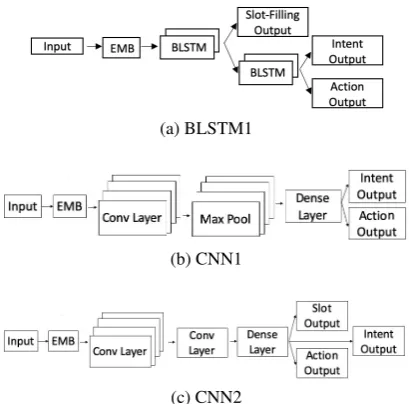
Figure 1: Model architectures for the multi-task exper-iments.
user-intentu labels. In this framework the input and output utterances become:
X=t1, . . . , tn, < EOS >
Y =s1, . . . , sn, du uu
The model weights are learned by maximizing the conditional likelihood of the training set labels. In our first baseline experiment we use this ar-chitecture to jointly learn user-intent classifica-tion, slot-filling, and system dialogue act selection (replacing domain classification) on the Frames and COMMUNICATOR corpora. In our experi-ments the sentence final token is created by con-catenating the user-intent and system dialogue act labels.
Baseline B: Next we trained Bi-directional LSTM (BLSTM) and Convolutional Neural Net-work (CNN) single-task models to perform each task individually. The BLSTM consisted of an in-put layer, hidden layer, and outin-put layer. Softmax is used to produce a distribution (pt) of likely la-bels at each time-step . The final output is then
individual models for all three tasks. The CNN ar-chitecture was used to train individual user-intent and system dialogue act selection models only.
Multi-Task Models: Lastly, we created multi-task models with BLSTMs and CNNs, and a com-bination of the two. In these architectures each task has a separate output, and all tasks share hid-den layers. We implemented three BLSTM ver-sions. BLSTM1 consists of two stacked BLSTMs and the slot-filling output layer is positioned as an auxiliary output at the first BLSTM. For BLSTM1 the loss for slot-filling is backprogagated through the first BLSTM. The loss for user-intent and system dialogue act selection is backprogagated through both BLSTM layers. Figure1aillustrates this architecture. BLSTM2 uses the BLSTM1 ar-chitecture plus a skip connection from the em-bedding layer to the second BLSTM layer. In BLSTM3 the first BLSTM layer weights are ini-tialized with the weights learned when training slot-filling alone. The intent was to explore the possible benefit of transfer learning from a previ-ously trained model. Experiments on the subsets of the COMMUNICATOR corpus with BLSTM3 include model training where the weights of the first BLSTM layer are initialized with the weights learned on the Frames data (BLSTM3b). Finally, ablation testing was also done to explore the in-fluence of each auxiliary task. The BLSTM1 model was trained on all three tasks simultane-ously (BLSTM1a), on slot-filling and the primary task alone (BLSTM1b), and on user-intent classi-fication and the primary task alone (BLSTM1c).
The CNN1 network design was inspired by
Yoon(2014) and is illustrated in Figure1b. This network uses 4 filters of different widths each fol-lowed by max pooling over time. Filter widths, the number of feature maps, and the number of nodes in the fully connected layer were chosen based on the suggestions of Zhang and Wallace
(2015). Early experiments on the BLSTM net-works showed a potential benefit to using user-intent classification alone as an auxiliary task, therefore these experiments used only user-intent classification as the auxiliary task.
We also conducted experiments with net-works inspired by Google’s Inception architecture (Szegedy et al.,2014). This is a general purpose architecture where the output from multiple con-volutional layers is passed to a single convolu-tional layer, called a bottle-neck, which constrains
Corpus best F Avg F
ATIS 95.48% 94.70%
Frames 74.26% 73.05%
COMMUNICATOR ATT 48.17% 45.98%
COMMUNICATOR BBN 50.34% 48.77%
COMMUNICATOR CMU 53.96% 52.59%
[image:4.595.306.529.61.160.2]COMMUNICATOR SRI 59.74% 58.55%
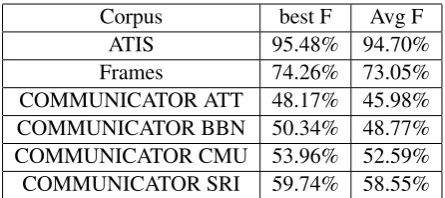
Table 2: The best F-measure and average F-measure on slot-filling alone for each corpus using the architecture released byHakkani-Tur et al.(2016).
the number of features that subsequent layers take as input, keeping the number of parameters low while retaining the expressive power of the net-work. Our architecture is illustrated in Figure1c. This network uses 5 convolutional layers of differ-ent filter widths followed by a single bottle-neck convolutional layer. The CNN2b network is com-posed of three CNN2a networks concatenated to-gether.
The final multi-task network is a hybrid CNN + BLSTM architecture. In this network the in-put is connected to a CNN network of three con-volutional layers with different filter widths each followed by max pooling. This is then con-nected to the BLSTM1 architecture. The goal was to explore the possibility of extracting fea-tures with a CNN layer that could then be used by the BLSTM1 network.
4.2 Training
All network development and training was done in Keras (Chollet et al., 2015) and the code will be released with the final version of this paper. We experimented with batch sizes of 15, 25, 50 and 100, hidden layers of 25, 50 and 100 units, and drop-out ratios of 0,0.25, and 0.5 on the fully-connected layers. GloVe (Pennington et al.,2014) word embeddings were used as pre-trained word embeddings. The Adam optimizer was used with a learning rate of 0.001. All weights were initial-ized with glorot uniform. The BLSTM layers used tanh as the activation function. During training the validation loss was monitored and early stopping was used to prevent over-fitting.
5 Evaluation
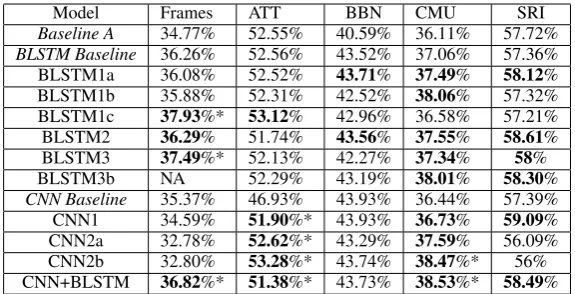
Model Frames ATT BBN CMU SRI Baseline A 34.77% 52.55% 40.59% 36.11% 57.72% BLSTM Baseline 36.26% 52.56% 43.52% 37.06% 57.36% BLSTM1a 36.08% 52.52% 43.71% 37.49% 58.12% BLSTM1b 35.88% 52.31% 42.52% 38.06% 57.32% BLSTM1c 37.93%* 53.12% 42.96% 36.58% 57.21% BLSTM2 36.29% 51.74% 43.56% 37.55% 58.61% BLSTM3 37.49%* 52.13% 42.27% 37.34% 58% BLSTM3b NA 52.29% 43.19% 38.01% 58.30% CNN Baseline 35.37% 46.93% 43.93% 36.44% 57.39% CNN1 34.59% 51.90%* 43.93% 36.73% 59.09% CNN2a 32.78% 52.62%* 43.29% 37.59% 56.09% CNN2b 32.80% 53.28%* 43.74% 38.47%* 56% CNN+BLSTM 36.82%* 51.38%* 43.73% 38.53%* 58.49%
Table 3: The best F-measure achieved for each multi-task model on the system action classification task. Results in bold indicate an improvement over the associated single-task baseline (BLSTM or CNN baseline). An asterisk indicates a statistically significant improvement over the respective baseline.
Both best and average F-measure were calculated on the held-out test set, where the average was calculated over 10 different weight initilizations.
Hakkani-Tur et al.(2016) experimented with mul-tiple LSTM and BLSTM models, but noted that comparable results were achieved on each and therefore only report results on the BLSTM mod-els. We do the same and only report on experi-ments with their BLSTM architecture. The results on the ATIS corpus are the metrics reported by the authors (and confirmed by us).
For each corpus many of the multi-task models achieved a higher metric score than the Baseline B models on the test data, however significance testing showed not all of these improvements were statistically significant. Significance testing was done with randomized approximation (Yeh,2000). Table 3 lists the best F-measure values for each model for the primary task of system action selec-tion.
The majority of the multi-task models, as well as the Baseline B models on the Frames, BBN, and SRI corpora, achieved a higher F-measure than the Baseline A models. (We did not test for statistical significance between the MTL models and the Baseline A). The multi-task CNN mod-els showed statistically significant improvement on three data sets and were faster to train than the BLSTM models, even when larger. Half of the BLSTM models achieved significant improvement on the Frames corpus, but improvement was more sporadic on the COMMUNICATOR corpus. In the Frames corpus most input utterances are much longer since the user provides significant context at each turn. In the COMMUNICATOR corpus af-ter the initial request most user utaf-terances are
lim-ited to one or two word responses to questions pre-sented by the system. This creates a dialogue that looks more like a system initiative dialogue, as compared to the more unconstrained Frames cor-pus. The CNN+BLSTM network improved per-formance on three data sets and is the largest of the proposed models.
6 Conclusion
We present multi-task BLSTM and CNN models that use slot-filling and user-intent classification as auxiliary tasks for the primary task of system dialogue act selection as part of dialogue policy initialization. The models bootstrap dialogue pol-icy optimization without the need for hand-written rules, as done, e.g., in (Li et al., 2017). We also empirically evaluate multiple RNN and CNN ar-chitectures on multiple data sets against two base-lines architectures. Our MTL models improve over the performance achieved on single task base-line models (Basebase-line B) as well as the jointly trained BLSTM model released by Hakkani-Tur et al.(2016).
References
Sercan O. Arik, Mike Chrzanowski, Adam Coates, Gregory Diamos, Andrew Gibiansky, Yongguo Kang, Xian Li, John Miller, Andrew Ng, Jonathan Raiman, Shubho Sengupta, and Mohammad Shoeybi. 2017. Deep voice: Real-time neural text-to-speech. ICML 2017.
Rich Caruana. 1998. Multitask learning. Autonomous Agents and Multi-Agent Systems, 27(1):95133.
Yun-Nung (Vivian) Chen, Dilek Hakkani-Tur, Gokhan Tur, Asli Celikyilmaz, and Jianfeng and Gao. 2016.
Syntax or semantics? knowledge-guided joint se-mantic frame parsing. IEEE Workshop on Spoken Language Technology (SLT 2016).
Franc¸ois Chollet et al. 2015. Keras. GitHub.
Daxiang Dong, Hua Wu, Wei He, Dianhai Yu, and Haifeng Wang. Multi-task learning for multiple lan-guage translation. In Proceedings of the 53rd An-nual Meeting of the Association for Computational Linguistics and the 7th International Joint Confer-ence on Natural Language Processing, pages 1723– 1732.
Layla El Asri, Hannes Schulz, Shikhar Sharma, Jeremie Zumer, Justin Harris, Emery Fine, Rahul Mehrotra, and Kaheer Suleman. 2017. Frames: a corpus for adding memory to goal-oriented dialogue systems. InProceedings of the 18th Annual SIGdial Meeting on Discourse and Dialogue, pages 207– 219, Saarbr¨ucken, Germany. Association for Com-putational Linguistics.
Milica Gasic and Steve Young. 2014. Gaussian pro-cesses for pomdp-based dialogue manager optimi-sation. IEEE Transactions on Audio, Speech, and Language Processing.
Kallirroi Georgila, Oliver Lemon, and James Hen-derson. 2005. Annotation of communicator di-alogue data for learning didi-alogue strategies and user simulations. Proceedings of the 9th Work-shop on the Semantics and Pragmatics of Dia-logue(SEMDIAL:DIALOR), pages 61–68.
Kallirroi Georgila, Oliver Lemon, James Henderson, and Johanna D. Moore. 2009. Automatic annota-tion of context and speech acts for dialogue corpora.
Natural Language Engineering, 15(3):315–353.
Barbara J. Grosz and Candace L. Sidner. 1986. Atten-tion, intentions, and the structure of discourse. Com-putational Linguistics, 12:175–204.
Dilek Hakkani-Tur, Gokhan Tur, Asli Celikyilmaz, Yun-Nung Chen, Jianfeng Gao, Li Deng, and Ye-Yi Wang. 2016. Multi-domain joint semantic frame parsing using bi-directional rnn-lstm. In Proceed-ings of Interspeech., pages 715–719.
James Henderson, Oliver Lemon, and Kallirroi Georgila. 2007. Hybrid reinforcement/supervised
learning of dialogue policies from fixed data sets.
ACL.
Melvin Johnson, Mike Schuster, Quoc V. Le, Maxim Krikun, Yonghui Wu, Zhifeng Chen, Nikhil Thorat, Fernanda Vigas, Martin Wattenberg, Greg Corrado, Macduff Hughes, and Jeffrey Dean. 2016. Googles multilingual neural machine translation system: En-abling zero-shot translation. arXiv:1611.0455.
Oliver Lemon and Oivier Pietquin. 2007. Machine learning for spoken dialogue systems. INTER-SPEECH.
Xiujun Li, Yun-Nung Chen, Lihong Li, Jianfeng Gao, and Asli Celikyilmaz. 2017. End-to-end task-completion neural dialogue systems. In Proceed-ings of the The 8th International Joint Conference on Natural Language Processing, pages 733–743.
Aishwarya Padmakumar, Jesse Thomason, and Ray-mond J. Mooney. 2017. Integrated learning of di-alog strategies and semantic parsing. In Proceed-ings of the 15th Conference of the European Chap-ter of the Association for Computational Linguistics (EACL).
Jeffrey Pennington, Richard Socher, and Christo-pher D. Manning. 2014. Glove: Global vectors for word representation. InEmpirical Methods in Nat-ural Language Processing (EMNLP), pages 1532– 1543.
P.J. Price. 1990. Evaluation of spoken language sys-tems: The atis domain. In Proceedings of the DARPA Workshop on Speech and Natural Language.
Sebastian Ruder. 2017. Multi-task learning objectives for natural language processing.
Pei-Hao Su, Milica Gasic, Nikola Mrksic, Lina Rojas-Barahona, Stefan Ultes, David Vandyke, Tsung-Hsien Wen, and Steve Young. 2016. Con-tinuously learning neural dialogue management.
arXiv:1606.02689.
Christian Szegedy, Wei Liu, Yangqing Jia, Pierre Sermanet, Scott Reed, Dragomir Anguelov, Du-mitru Erhan, Vincent Vanhoucke, and Andrew Ra-binovich. 2014. Going deeper with convolutions.
CoRR, pages 1746–1751. Abs/1409.4842.
Shubham Toshniwal, Hao Tang, Liang Lu, and Karen Livescu. 2017. Multitask learning with low-level auxiliary tasks for encoder-decoder based speech recognition.arXiv:1704.01631.
Jason D. Williams and Geoffrey Zweig. 2016. End-to-end lstm-based dialog control optimized with su-pervised and reinforcement learning. arXiv preprint arXiv:1606.01269.
Alexander Yeh. 2000. More accurate tests for the sta-tistical significance of result differences. In Pro-ceedings of the 18th conference on Computational linguistics, COLING ’00.
Kim Yoon. 2014. Convolutional neural networks for sentence classification. InProceedings of the 2014 Conference on Empirical Methods in Natural Lan-guage Processing (EMNLP), pages 1746–1751.
S. Young, M. Gasic, B. Thomson, and J.D. Williams. 2013. Pomdp-based statistical spoken dialog systems: A review. proceedings of the ieee. 101(5):1160–1179.
Ye Zhang and Byron C. Wallace. 2015. A sensitiv-ity analysis of (and practitioners guide to) convo-lutional neural networks for sentence classification.
arXiv:1510.03820.
Yu Zhang and Qiang Yang. 2017. A survey on multi-task learning.arXiv:1707.08114.
Tiancheng Zhao and Maxine Eskenazi. 2016. Towards end-to-end learning for dialog state tracking and management using deep reinforcement learning. the Annual SIGdial Meeting on Discourse andDialogue (SIGDIAL).