NILC at CWI 2018: Exploring Feature Engineering and Feature Learning
Nathan Siegle Hartmann1,2and Leandro Borges dos Santos1,2 1Data Science Team, Ita´u-Unibanco, S˜ao Paulo, Brazil∗
2Institute of Mathematics and Computer Science, University of S˜ao Paulo, S˜ao Carlos, Brazil
[email protected], [email protected]
Abstract
This paper describes the results of NILC team at CWI 2018. We developed solutions follow-ing three approaches: (i) a feature engineerfollow-ing method using lexical, n-gram and psycholin-guistic features, (ii) a shallow neural network method using only word embeddings, and (iii) a Long Short-Term Memory (LSTM) language model, which is pre-trained on a large text cor-pus to produce a contextualized word vector. The feature engineering method obtained our best results for the classification task and the LSTM model achieved the best results for the probabilistic classification task. Our results show that deep neural networks are able to per-form as well as traditional machine learning methods using manually engineered features for the task of complex word identification in English.
1 Introduction
Research efforts on text simplification have mostly focused on either lexical (Devlin and Tait, 1998;
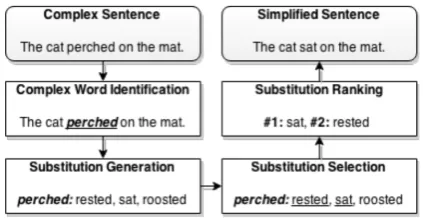
Biran et al.,2011;Glavaˇs and ˇStajner,2015; Paet-zold and Specia, 2016b) or syntactic simplifica-tion (Siddharthan,2006;Kauchak,2013). Lexical simplification involves replacing specific words in order to reduce lexical complexity. Lexical sim-plification is an open problem, as identifying and simplifying complex words in a given context is not straightforward. Although very intuitive, this is a challenging task since the substitutions must preserve both the original meaning and the gram-maticality of the sentence being simplified. Com-plex word identification is part of the usual lex-ical simplification pipeline (Paetzold and Specia,
2015), which is illustrated in Figure1.
[image:1.595.310.522.223.332.2]For the challenge, we focused on the English monolingual CWI track. We implemented three ∗The opinions expressed in this article are those of the authors and do not necessarily reflect the official policy or position of the Ita´u-Unibanco.
Figure 1: Lexical Simplification pipeline.
approaches using machine learning: the first one uses feature engineering; the second one takes the average embedding of target words as input to a neural network; and the third approach models the context of the target words using an LSTM (Gers et al., 1999). Our code is publicly available at github1.
2 Task Description
The setup of the CWI Shared Task 2018 is as fol-lows: given a target word (or a chunk of words) in a sentence, predict whether or not a non-native English speaker would be able to understand it. These predictions are based on annotations col-lected from a mixture of 10 native and 10 non-native speakers. The labels in the binary classifi-cation task were assigned “1” if at least one of the 20 annotators did not understand it (complex), and “0” otherwise (simple). The labels in the prob-abilistic classification task were assigned as the number of annotators who marked the word as dif-ficult divided by the total number of annotators.
In this edition a multilingual dataset was avail-able and participants could choose to partici-pate in one or more of the following tracks: English monolingual CWI, German monolingual
1https://github.com/nathanshartmann/ NILC-at-CWI-2018
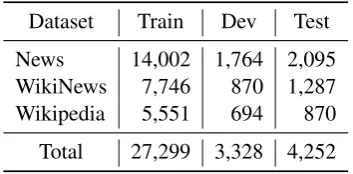
CWI, Spanish monolingual CWI, Multilingual CWI shared task with French test set. Also, the participants could choose between binary classi-fication or probabilistic classiclassi-fication task. We chose to participate in the English monolingual track and in both classification tasks (see in Table
1the dataset distribution for the track).
[image:2.595.93.270.168.255.2]Dataset Train Dev Test News 14,002 1,764 2,095 WikiNews 7,746 870 1,287 Wikipedia 5,551 694 870 Total 27,299 3,328 4,252
Table 1: CWI 2018 english dataset distribution.
More relevant task description, data and results are available inYimam et al.(2018).
3 Datasets
In this work, we used two extra corpora to train language models, one of these to train a neural lan-guage model:
• BookCorpus dataset: which has 11,038 free books written by yet unpublished authors (Zhu et al.,2015);
• One Billion Word dataset: which is the largest public benchmark for language mod-eling (Chelba et al.,2013).
4 Proposed Methods
In this section we show our developed methods, following three approaches: feature engineering, feature learning and ensembles.
4.1 Methods based on Feature Engineering
We used linguistic, psycholinguistic and language model features to train several classification and probabilistic classification methods. Our feature set consists of three groups of features:
• LEX: includes word length, number of sylla-bles, number of senses, hypernyms and hy-ponyms in WordNet (Fellbaum,1998);
• N-gram: includes log probabilities of an n-gram containing target words in two language models trained on BookCorpus and One Bil-lion Word datasets using SRILM (Stolcke,
2002);
• PSY: contains word-level psycholinguistic features such as familiarity, age of acquisi-tion, concreteness and imagery values for ev-ery target word (Paetzold and Specia,2016a).
Because an instance can contain more than a tar-get word, mean, standard deviation, min and max values were calculated for each feature. A total of 38 features are extracted for each instance. We also normalized features using Z-score.
We trained Linear Regression, Logistic Regres-sion, Decision Trees, Gradient Boosting, Extra Trees, AdaBoost and XGBoost methods for both classification and probabilistic classification tasks.
4.2 Methods based on Feature Learning and Transfer Learning
An alternative approach to feature engineering is to make the machine learning model itself create a data representation. This is the principle of feature learning. In this scenario, all elements of the vec-tor contain an independent value, which has some meaning for the model (LeCun et al.,2015).
Most importantly, we can reuse this representa-tion in another tasks, which is called transfer learn-ing or domain adaptation. This strategy is already used with success in Computer Vision, where deep neural networks are pre-trained in large supervised training sets like ImageNet (Girshick et al.,2014;
Esteva et al.,2017).
It is common in Natural Language Process-ing (NLP) tasks to use pre-trained word embed-dings with models like Word2Vec (Mikolov et al.,
2013) or GloVe (Pennington et al., 2014). How-ever, more recently some studies have used dis-tributed sentences to produce contextualized em-beddings, from a language model, machine trans-lation model, or auto-encoder (Dai and Le,2015;
Kiros et al., 2015; Yuan et al., 2016; Le et al.,
2017; Peters et al., 2017, 2018; McCann et al.,
2017;Howard and Ruder,2018).
In the next section we will explain how we used both strategies.
4.2.1 Average Embedding Method
Word embedding is a technique to represent words into dense real vectors, that helps NLP tasks and improves neural networks models (Collobert et al.,
complex words. When a complex word was a chunk of words, we took the average of their vec-tors. We used word vectors from GloVe (6B to-kens (Pennington et al.,2014)).
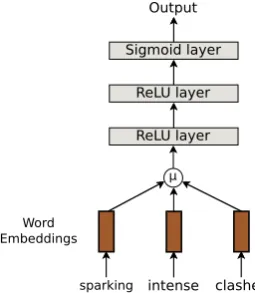
The resulting vector was passed on to a neural network with two ReLU layers (Nair and Hinton,
2010) followed by a Sigmoid layer, which pre-dicted the probability of whether or not the word was complex (Figure2).
sparking intense clashes Output
μ
ReLU layer ReLU layer Sigmoid layer
[image:3.595.311.519.153.246.2]Word Embeddings
Figure 2: Example of average embedding method processing target words.
4.2.2 LSTM Method
LSTM is a powerful tool for modeling sequen-tial data. This type of neural network architec-ture can learn to map an input sentence of vari-able length into a fixed-dimensional vector repre-sentation. For this reason, a lot of state-of-the-art systems in several NLP tasks incorporate an LSTM, for example, language modeling ( Joze-fowicz et al., 2016; Melis et al., 2017), machine translation (Di Gangi et al., 2017), textual infer-ence (Tay et al.,2017), and others.
Some studies used a pre-trained LSTM lan-guage model (Dai and Le,2015;Yuan et al.,2016;
Le et al.,2017;Peters et al.,2017,2018) to repre-sent a repre-sentence/document and used this represen-tation to improve their results.
Therefore, we trained a language model in the One Billion Word dataset using similar parame-ters fromLe et al.(2017): one-layer LSTM with 512 units, 128 embedding size, and sampled soft-max loss (Jean et al., 2015). However, we used weight tying, which means the weights between the embedding and softmax layer are shared, con-sequently reducing the total parameters of the model (Melis et al., 2017). For the CWI task, the LSTM read five words before the complex word, then the complex word itself (or the chunk
of words). We took the last hidden vector from the LSTM and passed it through a Sigmoid layer.
In Figure3we show the pipeline where the blue boxes represent the context words and red boxes represents the complex word, which is a chunk in this example.
and the Philippinesflexed muscles
Both China their
Sigmoid layer Output
Figure 3: Example of a LSTM processing target words.
4.2.3 Sent2Vec
We also used sentence embeddings generated by Skip-thought (Kiros et al.,2015). This model pro-duces a sentence representation of 2,400 dimen-sions. We trained two models using sentence em-bedding. In the first, we passed the embedding through a sigmoid layer and in the second, we used two layers with ReLUs of 1,200 and 600 dimen-sions respectively, followed by a Sigmoid layer. In the last model we employed a dropout layer (0.7) between all of the layers. Both models obtained good results in the training set, however, the mod-els had poor results in the development set.
4.3 Ensembles
We combined our three best systems: Feature En-gineering, MLP Average Embedding and LSTM Transfer Learning. For the binary classification task, we combined the system by majority vot-ing rule. For the probabilistic classification task we used stacking with Linear Regression as a base learner, which took the probabilities from our three best system as features.
5 Results
[image:3.595.114.242.195.342.2]News WikiNews Wikipedia F1 #Subm. #Author F1 #Subm. #Author F1 #Subm. #Author XGBoost Linguistics 0.8606 9th 0.8277 7th 3rd 0.7918 4th
MLP Avg. Embeddings 0.8467 15th 0.7977 16th 0.7360 26th
LSTM Transfer Learning 0.8173 27th 0.7961 17th 0.7528 20th
Voting 0.8636 5th 4th 0.8270 8th 0.7965 2nd 2nd
[image:4.595.83.517.64.158.2]Best competition results 0.8736 0.8400 0.8115
Table 2: F1 (macro) for English monolingual classification task.
News WikiNews Wikipedia
MAE #Subm. #Author MAE #Subm. #Author MAE #Subm. #Author
XGBoost Linguistics 0.2978 14th 0.3203 15th 0.3819 7th
MLP Avg. Embeddings 0.2958 13th 0.3240 16th 0.3578 7th
LSTM Transfer Learning 0.0588 7th 4th 0.0742 7th 0.0822 7th
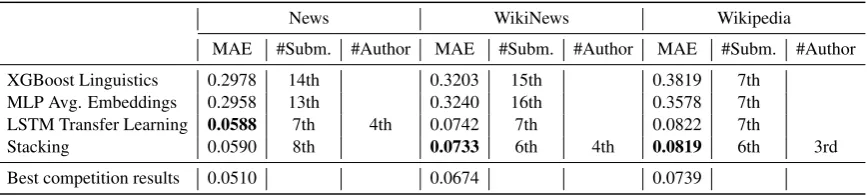
Stacking 0.0590 8th 0.0733 6th 4th 0.0819 6th 3rd
Best competition results 0.0510 0.0674 0.0739
Table 3: MAE for English monolingual probabilistic classification task.
thresholds were found for the whole training set and not for each subset. This guarantees that we are not overfitting our method to test data or to a specific dataset. Our results for the English mono-lingual classification task are described in Table
2. The Feature Engineering method itself achieved by far our best results for the three test sets. In or-der to achieve better results, we submitted a fourth system which calculated the majority voting of our three methods. This voting system surpassed our individual methods in two test sets, but was infe-rior compared to the Feature Engineering method by less than1−3F1 in the WikiNews dataset.
Ma-jority voting was our best method for the classifi-cation task.
For the probabilistic classification task, our Fea-ture Engineering method used also an XGBoost classifier which achieved the best MAE in de-velopment set (0.28). Our results for English monolingual probabilistic classification task are described in Table 3. While both Feature Engi-neering and Average Embedding did not perform well, our best individual system by a large margin was the LSTM method. In order to achieve better results, we used stacking of our three models. The stacking performed better than individual methods in two datasets, but was not better than LSTM for the News test set (2−4gap).
6 Conclusion
For the binary classification task, majority voting achieved our best results, although only slightly better than the standalone Feature Engineering model.
For the probabilistic classification task, LSTM had better results in one data set, but the stacking method performed slightly better in the other data sets. The deep learning method showed its poten-tial when contrasted with the feature engineering method.
In the future, we intend to explore more pow-erful neural language models, such as encod-ing characters embeddencod-ings (Jozefowicz et al.,
2016), bidirectional language model (Peters et al.,
2017,2018), and other transfer learning methods (Howard and Ruder,2018).
Acknowledgments
This work was supported by CAPES, CNPq and Google Research Awards in Latin America. We would like to thank NVIDIA for their donation of Titan X. Research carried out using the compu-tational resources of the Center for Mathematical Sciences Applied to Industry (CeMEAI) funded by FAPESP (grant 2013/07375-0).
References
[image:4.595.84.518.194.292.2]ap-proach to lexical simplification. In Proceedings of the 49th Annual Meeting of the Association for Computational Linguistics: Human Language Technologies: short papers-Volume 2, pages 496– 501. Association for Computational Linguistics. Samuel R Bowman, Gabor Angeli, Christopher Potts,
and Christopher D Manning. 2015. A large anno-tated corpus for learning natural language inference. arXiv preprint arXiv:1508.05326.
Ciprian Chelba, Tomas Mikolov, Mike Schuster, Qi Ge, Thorsten Brants, Phillipp Koehn, and Tony Robin-son. 2013.One billion word benchmark for measur-ing progress in statistical language modelmeasur-ing. Tech-nical report, Google.
Ronan Collobert, Jason Weston, L´eon Bottou, Michael Karlen, Koray Kavukcuoglu, and Pavel Kuksa. 2011. Natural language processing (almost) from scratch. Journal of Machine Learning Research, 12(Aug):2493–2537.
Andrew M Dai and Quoc V Le. 2015. Semi-supervised sequence learning. In Advances in Neural Information Processing Systems, pages 3079–3087.
Siobhan Devlin and John Tait. 1998. The use of a psy-cholinguistic database in the simplification of text for aphasic readers. Linguistic databases, pages 161–173.
Mattia Antonino Di Gangi, Nicola Bertoldi, and Mar-cello Federico. 2017. Fbk’s participation to the english-to-german news translation task of wmt 2017. In Proceedings of the Second Conference on Machine Translation, pages 271–275.
Andre Esteva, Brett Kuprel, Roberto A Novoa, Justin Ko, Susan M Swetter, Helen M Blau, and Sebas-tian Thrun. 2017. Dermatologist-level classification of skin cancer with deep neural networks. Nature, 542(7639):115.
Christiane Fellbaum. 1998. WordNet. Wiley Online Library.
Felix A Gers, J¨urgen Schmidhuber, and Fred Cummins. 1999. Learning to forget: Continual prediction with lstm.
Ross Girshick, Jeff Donahue, Trevor Darrell, and Ji-tendra Malik. 2014. Rich feature hierarchies for accurate object detection and semantic segmenta-tion. In Proceedings of the 2014 IEEE Conference on Computer Vision and Pattern Recognition, pages 580–587. IEEE Computer Society.
Goran Glavaˇs and Sanja ˇStajner. 2015. Simplifying Lexical Simplification: Do We Need Simplified Cor-pora? In Proceedings of the 53rd Annual Meeting of the Association for Computational Linguistics and the 7th International Joint Conference on Natural Language Processing (ACL-IJCNLP-2015), vol-ume 2, pages 63–68.
Jeremy Howard and Sebastian Ruder. 2018. Fine-tuned language models for text classification. arXiv preprint arXiv:1801.06146.
S´ebastien Jean, Kyunghyun Cho, Roland Memise-vic, and Yoshua Bengio. 2015. On using very large target vocabulary for neural machine transla-tion. In Proceedings of the 53rd Annual Meeting of the Association for Computational Linguistics and the 7th International Joint Conference on Natural Language Processing (Volume 1: Long Papers), vol-ume 1, pages 1–10.
Rafal Jozefowicz, Oriol Vinyals, Mike Schuster, Noam Shazeer, and Yonghui Wu. 2016. Exploring the limits of language modeling. arXiv preprint arXiv:1602.02410.
David Kauchak. 2013. Improving Text Simplifica-tion Language Modeling Using Unsimplified Text Data. In Proceedings of the 51st Annual Meeting of the Association for Computational Linguistics (ACL-2013), pages 1537–1546.
Yoon Kim. 2014. Convolutional neural networks for sentence classification. In Proceedings of the 2014 Conference on Empirical Methods in Natural Language Processing (EMNLP), pages 1746–1751. Ryan Kiros, Yukun Zhu, Ruslan R Salakhutdinov,
Richard Zemel, Raquel Urtasun, Antonio Torralba, and Sanja Fidler. 2015. Skip-thought vectors. In Advances in neural information processing systems, pages 3294–3302.
Minh Le, Marten Postma, and Jacopo Urbani. 2017. Word sense disambiguation with lstm: Do we re-ally need 100 billion words? arXiv preprint arXiv:1712.03376.
Yann LeCun, Yoshua Bengio, and Geoffrey Hinton. 2015. Deep learning. nature, 521(7553):436. Bryan McCann, James Bradbury, Caiming Xiong, and
Richard Socher. 2017. Learned in translation: Con-textualized word vectors. In Advances in Neural Information Processing Systems, pages 6297–6308. G´abor Melis, Chris Dyer, and Phil Blunsom. 2017. On the state of the art of evaluation in neural language models. arXiv preprint arXiv:1707.05589.
Tomas Mikolov, Kai Chen, Greg Corrado, and Jef-frey Dean. 2013. Efficient estimation of word representations in vector space. arXiv preprint arXiv:1301.3781.
Vinod Nair and Geoffrey E Hinton. 2010. Rectified linear units improve restricted boltzmann machines. In Proceedings of the 27th International Conference on International Conference on Machine Learning, pages 807–814. Omnipress.
Gustavo Paetzold and Lucia Specia. 2016a. In-ferring psycholinguistic properties of words. In Proceedings of the 2016 Conference of the North American Chapter of the Association for Computational Linguistics: Human Language Technologies, pages 435–440.
Gustavo Henrique Paetzold and Lucia Specia. 2016b. Benchmarking lexical simplification systems. Proceedings of the 10th International Conference on Language Resources and Evaluation (LREC-2016), pages 3074–3080.
Jeffrey Pennington, Richard Socher, and Christo-pher Manning. 2014. Glove: Global vectors for word representation. In Proceedings of the 2014 conference on empirical methods in natural language processing (EMNLP), pages 1532–1543. Matthew Peters, Waleed Ammar, Chandra
Bhagavat-ula, and Russell Power. 2017. Semi-supervised se-quence tagging with bidirectional language models. In Proceedings of the 55th Annual Meeting of the Association for Computational Linguistics (Volume 1: Long Papers), volume 1, pages 1756–1765. Matthew E Peters, Mark Neumann, Mohit Iyyer, Matt
Gardner, Christopher Clark, Kenton Lee, and Luke Zettlemoyer. 2018. Deep contextualized word rep-resentations. arXiv preprint arXiv:1802.05365. Advaith Siddharthan. 2006. Syntactic simplification
and text cohesion. Ph.D. thesis, University of Cam-bridge, Inglaterra.
Andreas Stolcke. 2002. Srilm-an extensible lan-guage modeling toolkit. In Seventh international conference on spoken language processing.
Yi Tay, Luu Anh Tuan, and Siu Cheung Hui. 2017. A compare-propagate architecture with alignment factorization for natural language inference. arXiv preprint arXiv:1801.00102.
Seid Muhie Yimam, Chris Biemann, Shervin Mal-masi, Gustavo Paetzold, Lucia Specia, Sanja ˇStajner, Ana¨ıs Tack, and Marcos Zampieri. 2018. A Re-port on the Complex Word Identification Shared Task 2018. In Proceedings of the 13th Workshop on Innovative Use of NLP for Building Educational Applications, New Orleans, United States. Associa-tion for ComputaAssocia-tional Linguistics.
Dayu Yuan, Julian Richardson, Ryan Doherty, Colin Evans, and Eric Altendorf. 2016. Semi-supervised word sense disambiguation with neural mod-els. In Proceedings of COLING 2016, the 26th International Conference on Computational Linguistics: Technical Papers, pages 1374–1385. Yukun Zhu, Ryan Kiros, Richard Zemel, Ruslan