796
USF at SemEval-2019 Task 6: Offensive Language Detection Using LSTM
With Word Embeddings
Bharti Goel and Ravi Sharma
Department of Computer Science and Engineering, University of South Florida, USA Emails: [email protected], [email protected]
Abstract
In this paper, we present a system description for the SemEval-2019 Task 6 submitted by our team. For the task, our system takes tweet as an input and determine if the tweet is of-fensive or non-ofof-fensive (Sub-task A). In case a tweet is offensive, our system identifies if a tweet is targeted (insult or threat) or non-targeted like swearing (Sub-task B). In tar-geted tweets, our system identifies the target as an individual or group (Sub-task C). We used data pre-processing techniques like splitting hashtags into words, removing special charac-ters, stop-word removal, stemming, lemmati-zation, capitalilemmati-zation, and offensive word dic-tionary. Later, we used keras tokenizer and word embeddings for feature extraction. For classification, we used the LSTM (Long short-term memory) model of keras framework. Our accuracy scores for Sub-task A, B and C are 0.8128,0.8167 and0.3662respectively. Our results indicate that fine-grained classification to identify offense target was difficult for the system. Lastly, in the future scope section, we will discuss the ways to improve system per-formance.
1 Introduction
In recent years, there has been a rapid rise in social media platforms and surge in the number of users registering in order to communicate, publish con-tent, showcase their skills and express their views. Social media platforms like Facebook and Twit-ter have millions of regisTwit-tered users influenced by the countless user-generated posts on daily basis (Zeitel-Bank and Tat,2014). While on one hand social media platforms facilitate the exchange of views, effective communication and can be seen as a helping mode in crisis. On the other hand, they open up the window for anti-social behavior such as bullying, stalking, harassing, trolling and hate
speech (Malmasi and Zampieri, 2018; Wiegand
et al., 2018; ElSherief et al., 2018; Zhang et al.,
2018). These platforms provide the anonymity
and hence aid users to indulge in aggressive be-havior which propagates due to the increased
will-ingness of people sharing their opinions (Fortuna
and Nunes,2018).
This aggression can lead to foul language which is seen as “offensive”, “abusive”, or “hate speech”,
terms, which are used interchangeably (Waseem
et al.,2017). In general, offensive language is de-fined as derogatory, hurtful/ obscene remarks or comments made by an individual (or group) to
an individual (or group) (Wiegand et al., 2018;
Baziotis et al.,2018). The offensive language can be targeted towards a race, religion, color, gen-der, sexual orientation, nationality, or any char-acteristics of a person or a group. Hate Speech is slowly plaguing the social media users with
de-pression and anxiety (Davidson et al.,2017;Zhang
et al.,2018), which can be presented in the form of images, text or media such as audio, video, etc. (Schmidt and Wiegand,2017).
Our paper presents the data and task description followed by results, conclusion and future work. The purpose of Task 6 is to address and pro-vide an effective procedure for detecting offen-sive tweets from the data set provided by shared
task report paper (Zampieri et al., 2019b). The
2 Related Work
Technological giants like Facebook, Google, YouTube and Twitter have been investing a significant amount of time and money towards the detection and removal of offensive and hate speech posts that give users a direct or indirect
negative influence (Fortuna and Nunes, 2018).
However, lack of automation techniques and ineffectiveness of manual flagging has lead to a lot of criticism for not having potent control for
the problem (Zhang et al., 2018). The process
of manual tagging is not sustainable or scalable with the large volumes of data exchanged in Social media. Hence, the need of the hour is to do automatic detection and filtering of offensive
posts to give the user quality of service (Fortuna
and Nunes,2018).
The problem of automatic Hate Speech Detection is not trivial as offensive language may or may not be meant to insult or hurt someone and can
be used in common conversations. Different
language contexts are rampant in social media (Davidson et al.,2017). In recent years, linguis-tics, researchers, computer scientists, and related professionals have conducted research towards finding an effective yet simple solution for the
problem. In papers, (Schmidt and Wiegand,2017;
Fortuna and Nunes, 2018), authors survey the state of the art methods along with the description of the nature of hate speech, limitations of the methods proposed in literature and categorization of the hate speech. Further, authors mainly classi-fied the features as general features like N-grams, Part-Of-Speech (POS) and sentiment scores and, specific features such as othering language, the
superiority of in-group and stereotype. In (Silva
et al.,2016), authors list categories of hate speech and possible targets examples.
The research carried over the years has employed various features and classification techniques. The
features include the bag of words (Greevy and
Smeaton, 2004; Kwok and Wang, 2013), dictio-naries, distance metrics, N-grams, IF-IDF scores,
and profanity windows (Fortuna and Nunes,
2018). Authors in (Davidson et al., 2017) used
a crowdsourced hate speech lexicon to collect tweets and train a multi-class classifier to distin-guish between hate speech, offensive language, and non-offensive language. The authors in paper (Waseem et al., 2017) presents a typology that gives the relationship between various sub-tasks
such as cyber-bullying, hate speech, offensive,
and online abuse. They synthesize the various
literature definitions and contradiction together to emphasize the central affinity among these
sub-tasks. In (Gamb¨ack and Sikdar, 2017),
au-thors used a Convolutional Neural Network model for Twitter hate speech text classification into 4 classes: sexism, racism, both sexism-racism and neither. Similar approaches using deep learning
have been employed in (Agrawal and Awekar,
2018; Badjatiya et al., 2017) for detecting hate speech and cyberbullying respectively.
Authors in (Zhang et al., 2018) have proposed
Deep Neural Network (DNN) structures which serve as a feature extractor for finding key
se-mantics from hate speech. Prior to that, they
emphasize the linguistics of hate speech, that it lacks discriminative features making hate speech
difficult to detect. Authors in (ElSherief et al.,
2018) have carried out the analysis and detection
of the hate speech by classifying the target as directed towards a specific person/identity or generalized towards a group of people sharing common characteristics. Their assessment states that directed hate consists of informal, angrier and name calling while generalized hate consists of more religious hate and use of lethal words like murder, kills and exterminate.
3 Problem Statement
In Task 6, three level offensive language identi-fication is described as three Sub-tasks A, B and C. For Sub-task A, tweets were identified as of-fensive (tweet with any form of unacceptable lan-guage, targeted/non-targeted offense) or not of-fensive. For Sub-task B, the offensive tweets are further categorized into targeted or non-targeted tweets. The targeted offense is made for an in-dividual or group while the untargeted offense is a general use of offensive language. Later for Sub-task C, targeted tweets are further categorized ac-cording to the target, individual, group or others. This step by step tweet classification will lead to the detailed categorization of offensive tweets.
4 Data
The data collection methods used to compile the dataset used in OffensEval are described in
labels for Sub-task A, B, and C. We have also
used Offensive/Profane Word List (Ahn, 2019)
with1,300+ English terms that could be found of-fensive for lexical analysis of tweets to see check probability of tweet being offensive if a tweet has an offensive word.
4.1 Data Pre-processing
The data is raw tweet data from Twitter and hence data cleaning and pre-processing is required. We used the following steps for data pre-processing:
1. Split hashtags over Capital letters: In this step hashtags are divided into separate words (for example, “#TweetFromTheSeat” will be con-verted to “Tweet from the seat”). Generally, while writing hashtags multiple words are combined to form single hashtag, where each word is started with a capital letter. Here, we take advantage of this property of hashtag and generate a string of words from it.
2. Remove special characters: In this step we removed all special characters from the tweet and resultant tweet will contain only alphabets and number. In Twitter domain “#” is important spe-cial character. Splitting of hashtags,“#Text” into “#” and “Text”, retains the purpose of the hashtags after removal of “#” . Other special characters (for e.g. “,”, “.”,“!”, etc) are not much informative for given context.
3. Removal of stop-words, Stemming and Lemmatization: In this step we used NLTK (Loper and Bird, 2002) list of stop-words to
re-move stopwords, classic Porter Stemmer (Porter,
1980) for stemming and NLTK (Loper and Bird,
2002) Word Net Lemmatizer for lemmatization.
4. Capitalization: This is the last step for data pre-processing and all characters are converted to capital letters. In Twitter domain uppercase char-acters are said to portray expression, but this is not true for all cases. Also, keeping cases intact may lead to over-fitting during training.
5. Embedding “Offensive”: This is an
op-tional step. We used offensive word list (Ahn,
2019) to find offensive words in the tweet. Later
for tweets with matched offensive words were em-bedded with “Offensive” as a word.
5 System Description
We used a four-layer neural network with each layer detailed below:
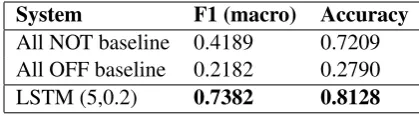
System F1 (macro) Accuracy
All NOT baseline 0.4189 0.7209
All OFF baseline 0.2182 0.2790
LSTM (5,0.2) 0.7382 0.8128
Table 1: Results for Sub-task A.
System F1 (macro) Accuracy
All TIN baseline 0.4702 0.8875
All UNT baseline 0.1011 0.1125
LSTM (5,0.2) 0.5925 0.8167
LSTM (20,0.2) 0.5291 0.6125
LSTM (20,0.2) and 0.6171 0.7667
[image:3.595.310.520.62.120.2]word list
Table 2: Results for Sub-task B.
The first layer of our network is an embed-ding layer, which takes tokens as inputs (each sen-tence is converted into index sequences using to-kenizer). This layer convert sequences to dense vector sequences generating embedding table used
by the next layer. We used tokenizer for top1000
words and embedding dimension of 128 for our
system. The second layer is SpatialDropout1D layer which helps promote independence between
feature maps. We used 0.1 as rate or Fraction
of the input units to drop. This layer is mainly used to covert multi-dimensional input to one-dimensional input using dropout method.
Third layer is LSTM (Hochreiter and
Schmid-huber, 1997) layer with dropout and recurrent
dropout as 0.2. This layer serves as a recurrent
neural network layer which was only for short term memory. LSTM (long short-term memory) takes care of longer dependencies. The dimension
of LSTM hidden states is200for our system.
Fi-nally, we used a dense layer with Softmax func-tion for binary classificafunc-tion in-case of Sub-task A and B, and three class classification for Sub-task
C. The dimension of the dense layer is200.
For hyperparameter selection, we used different
train and validation splits. The batch size is 64,
and the maximal training epoch is varied with
dif-ferent system ranging from5to50(Performance
NOT OFF Predicted label NOT
OFF
True label
579 41
120 120
Confusion Matrix
0.0 0.2 0.4 0.6 0.8
TIN UNT
Predicted label TIN
UNT
True label
167 46
10 17
Confusion Matrix
0.0 0.1 0.2 0.3 0.4 0.5 0.6 0.7
GRP IND OTH Predicted label GRP
IND
OTH
True label
37 19 22
43 32 25
20 6 9
Confusion Matrix
0.0 0.1 0.2 0.3 0.4 0.5
Figure 1: a) Sub-task A, LSTM (epoch=5, dropout= 0.2), b) Sub-task B, LSTM (dropout=0.2, epochs=20), c) Sub-task C, LSTM(dropout=0.2, epochs=50)
System F1 (macro) Accuracy
All GRP baseline 0.1787 0.3662
All IND baseline 0.2130 0.4695
All OTH baseline 0.0941 0.1643
LSTM (20,0.2) and 0.1849 0.1878
word list
LSTM (50,0.2) 0.3404 0.3662
LSTM (50,0.2) and 0.2832 0.3521
[image:4.595.74.526.63.189.2]word list
Table 3: Results for Sub-task C.
6 Results
Tables1,2and3shows F1 (macro) and Accuracy
scores for the submitted systems. We can see that for all the sub-tasks our system has F1 (macro) and
as described in (Zampieri et al.,2019a) F1 (macro)
is used for performance analysis by task coordina-tors. Best results are highlighted in bold ink in ta-bles and confusion matrix for them is also shown
in Figure 1 for Sub-tasks A, B and C. InSub-task
Awe achieved0.8128and0.7382as accuracy and
F1 respectively. For this task we submitted only
one system with LSTM network dropout0.2and5
epochs. ForSub-task Bwe submitted three runs
but, the best performance is achieved by system
with LSTM dropout of0.2,20 epochs and
offen-sive word list described in Section4. Later in
Sub-task C we submitted three runs and best
perfor-mance was LSTM with50epochs and0.2dropout.
7 Conclusion
In this paper we used LSTM network to identify offensive tweets and categorize offense in
subcate-gories as described in Section3for Task 6:
Identi-fying and Categorizing Offensive Language in So-cial Media. We used an embedding layer followed
by LSTM layer for tweet classification. Three
tasks of OffensEval Sub-task A, B, and C were of varied difficulty level. The main reason can be de-creasing amount of data for each of them, where Sub-task A has more data followed by Sub-task B categorizing offensive tweets identified by Sub-task A and, Sub-Sub-task C categorizing targeted of-fense identified by Sub-task B. Data was also un-balanced leading to more importance for major-ity class but after applying cost function we found that accuracy was decreased with increased errors in identification of majority class.
8 Future Work
For future work, we would like to use additional
datasets like TRAC-1 data (Kumar et al., 2018),
(Davidson et al., 2017), and would collect data from Twitter to get diverse data. To be consis-tent with substantial research done in recent years we want to employ a combination of textual fea-tures like the bag of words n-grams, capitalized characters, sentiment scores, e.t.c. Also, we want to focus more on specific features like semantics and linguistic features intrinsic to hate/offensive rather than just generic text-based features. For that, we want to use character level deep LSTM which can be used to extract the semantic and syn-tactic information. Finally, we want to explore more about the similarities and dissimilarities be-tween the profanity and hate speech, establishing more profound way of extracting features in order to make the detection system more responsive.
References
Sweta Agrawal and Amit Awekar. 2018. Deep learn-ing for detectlearn-ing cyberbullylearn-ing across multiple
[image:4.595.75.290.242.369.2]Luis von Ahn. 2019. Offensive/profane word list. Carnegie Mellon School of Computer Science.
Pinkesh Badjatiya, Shashank Gupta, Manish Gupta, and Vasudeva Varma. 2017. Deep learning for hate
speech detection in tweets. InProceedings of the
26th International Conference on World Wide Web Companion, WWW ’17 Companion, pages 759– 760, Republic and Canton of Geneva, Switzerland. International World Wide Web Conferences Steer-ing Committee.
Baziotis, Christos, Athanasiou, Nikos, Athana-sia, Paraskevopoulos, Georgios, Ellinas, Nikolaos, Alexandros, and et al. 2018. Ntua-slp at semeval-2018 task 3: Tracking ironic tweets using ensembles
of word and character level attentive rnns.
Thomas Davidson, Dana Warmsley, Michael Macy, and Ingmar Weber. 2017. Automated Hate Speech Detection and the Problem of Offensive Language. InProceedings of ICWSM.
Mai ElSherief, Vivek Kulkarni, Dana Nguyen, William Yang Wang, and Elizabeth Belding. 2018. Hate Lingo: A Target-based Linguistic Analysis of Hate Speech in Social Media. arXiv preprint arXiv:1804.04257.
Paula Fortuna and S´ergio Nunes. 2018. A Survey on Automatic Detection of Hate Speech in Text. ACM Computing Surveys (CSUR), 51(4):85.
Bj¨orn Gamb¨ack and Utpal Kumar Sikdar. 2017. Using Convolutional Neural Networks to Classify Hate-speech. In Proceedings of the First Workshop on Abusive Language Online, pages 85–90.
Edel Greevy and Alan F. Smeaton. 2004. Classifying
racist texts using a support vector machine. In
Pro-ceedings of the 27th Annual International ACM SI-GIR Conference on Research and Development in Information Retrieval, SIGIR ’04, pages 468–469, New York, NY, USA. ACM.
Sepp Hochreiter and J¨urgen Schmidhuber. 1997. Long
short-term memory. Neural Comput., 9(8):1735–
1780.
Ritesh Kumar, Atul Kr. Ojha, Shervin Malmasi, and Marcos Zampieri. 2018. Benchmarking Aggression Identification in Social Media. InProceedings of the First Workshop on Trolling, Aggression and Cyber-bulling (TRAC), Santa Fe, USA.
Irene Kwok and Yuzhou Wang. 2013. Locate the hate: Detecting Tweets Against Blacks. In Twenty-Seventh AAAI Conference on Artificial Intelligence.
Edward Loper and Steven Bird. 2002. Nltk: The
natu-ral language toolkit. InProceedings of the ACL-02
Workshop on Effective Tools and Methodologies for Teaching Natural Language Processing and Com-putational Linguistics - Volume 1, ETMTNLP ’02, pages 63–70, Stroudsburg, PA, USA. Association for Computational Linguistics.
Shervin Malmasi and Marcos Zampieri. 2018. Chal-lenges in Discriminating Profanity from Hate Speech. Journal of Experimental & Theoretical Ar-tificial Intelligence, 30:1–16.
M.F. Porter. 1980. An algorithm for suffix stripping. Program, 14(3):130–137.
Anna Schmidt and Michael Wiegand. 2017. A Sur-vey on Hate Speech Detection Using Natural Lan-guage Processing. InProceedings of the Fifth Inter-national Workshop on Natural Language Process-ing for Social Media. Association for Computational Linguistics, pages 1–10, Valencia, Spain.
Silva, Leandro, Mondal, Correa, Denzil, Benevenuto, Fabricio, Weber, and Ingmar. 2016. Analyzing the
targets of hate in online social media.
Zeerak Waseem, Thomas Davidson, Dana Warmsley, and Ingmar Weber. 2017. Understanding Abuse: A Typology of Abusive Language Detection Subtasks. In Proceedings of the First Workshop on Abusive Langauge Online.
Michael Wiegand, Melanie Siegel, and Josef Rup-penhofer. 2018. Overview of the GermEval 2018 Shared Task on the Identification of Offensive Lan-guage. InProceedings of GermEval.
Marcos Zampieri, Shervin Malmasi, Preslav Nakov, Sara Rosenthal, Noura Farra, and Ritesh Kumar. 2019a. Predicting the Type and Target of Offensive Posts in Social Media. InProceedings of NAACL.
Marcos Zampieri, Shervin Malmasi, Preslav Nakov, Sara Rosenthal, Noura Farra, and Ritesh Kumar. 2019b. SemEval-2019 Task 6: Identifying and Cat-egorizing Offensive Language in Social Media (Of-fensEval). InProceedings of The 13th International Workshop on Semantic Evaluation (SemEval).
Natascha Zeitel-Bank and Ute Tat. 2014. Social Me-dia and Its Effects on Individuals and Social Sys-tems, Human Capital without Borders: Knowledge and Learning for Quality of Life; Proceedings of the Management, Knowledge and Learning Inter-national Conference 2014, pages 1183–1190. To-KnowPress.