Proceedings of the 7th Joint Conference on Lexical and Computational Semantics (*SEM), pages 142–147
Halo
: Learning Semantics-Aware Representations for Cross-Lingual
Information Extraction
Hongyuan Mei∗, Sheng Zhang∗, Kevin Duh, Benjamin Van Durme Center for Language and Speech Processing, Johns Hopkins University
{hmei,s.zhang,kevinduh,vandurme}@cs.jhu.edu
Abstract
Cross-lingual information extraction (CLIE) is an important and challenging task, especially in low resource scenarios. To tackle this chal-lenge, we propose a training method, called
Halo, which enforces the local region of each hidden state of a neural model to only gener-ate target tokens with the same semantic struc-ture tag. This simple but powerful technique enables a neural model to learn semantics-aware representations that are robust to noise, without introducing any extra parameter, thus yielding better generalization in both high and low resource settings.
1 Introduction
Cross-lingual information extraction (CLIE) is the task of distilling and representing factual informa-tion in a target language from the textual input in a source language (Sudo et al.,2004;Zhang et al.,
2017b). For example, Fig. 1 illustrates a pair of input Chinese sentence and its English predicate-argument information1, where predicate and
argu-ment are well usedsemantic structure tags. It is of great importance to solve the task, as to provide viable solutions to extracting information from the text of languages that suffer from no or little existing information extraction tools. Neu-ral models have empirically proven successful in this task (Zhang et al., 2017b,c), but still remain unsatisfactory in low resource (i.e. small number of training samples) settings. These neural models learn to summarize a given source sentence and target prefix into a hidden state, which aims to generate the correct next target token after being
∗equal contribution
1The predicate-argument information is usually denoted by relation tuples. In this work, we adopt the tree-structured representation generated by PredPatt (White et al., 2016;
Zhang et al.,2017d), which was a lightweight tool available athttps://github.com/hltcoe/PredPatt.
Figure 1: Example of cross-lingual information extraction: Chinese input text (a) and linearized English PredPatt output (b), where ‘:p’ andbluestand for predicate while ‘:a’ and purpledenote argument.
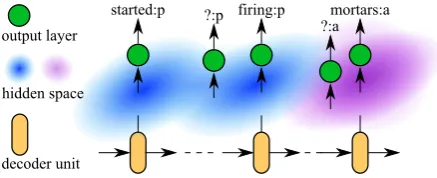
passed through an output layer. As each member in the target vocabulary is essentially either pred-icate or argument, a random perturbation on the hidden state should still be able to yield a token with the same semantic structure tag. This induc-tive bias motivates an extra term in training objec-tive, as shown in Fig.2, which enforces the sur-roundings of any learned hidden state to generate tokens with the same semantic structure tag (either predicate or argument) as the centroid. We call this techniqueHalo, because the process of each hidden state taking up its surroundings is analo-gous to how the halo is formed around the sun. The method is believed to help the model gen-eralize better, by learning more semantics-aware and noise-insensitive hidden states without intro-ducing extra parameters.
2 The Problem
We are interested in learning a probabilistic model that directly maps an input sentence {xi}I
i=1 =
x1x2. . . xI of the source languageS into an out-put sequence {yt}T
t=1 = y1y2. . . yT of the tar-get languageT, whereS can be any human natu-ral language (e.g. Chinese) andT is the English PredPatt (White et al., 2016). In the latter vo-cabulary, each type is tagged as either predicate or argument—those with “:p” are predicates while those with “:a” are arguments.
For any distribution P in our proposed
fam-ily, thelog-likelihood`of the modelP given any
mortars:a firing:p
started:p ?:p
?:a output layer
[image:2.595.71.290.61.150.2]decoder unit hidden space
Figure 2: Visualization ofHalomethod. While a neural model learns to summarizes the current known information into a hidden state and predict the next target token, the surroundings of this hidden state in the same space (two-dimensional in this example) are supervised to generate to-kens with the same semantic structure tag. For example, at the last shown step, the centroid ofpurplearea is the summa-rized hidden state and learns to predict ‘mortars:a’, while a randomly sampled neighbor is enforced to generate an argu-ment, although it may not be ‘mortars’ (thus denoted by ‘?’). Similar remarks apply to theblueregions.
({yt}T
t=1| {xi}Ii=1)pair is:
T X
t=1
logP yt|yt−1, . . . , y0,{xi}Ii=1
(1)
wherey0is a special beginning of sequence token. We denote vectors by bold lowercase Roman letters such ash, and matrices by bold capital Ro-man letters such asWthroughout the paper.
Sub-scripted bold letters denote distinct vectors or ma-trices (e.g.,pt). Scalar quantities, including vec-tor and matrix elements such ashdandpt,yt, are written without bold. Capitalized scalars represent upper limits on lowercase scalars, e.g., 1 ≤ d ≤ D. Function symbols are notated like their return
type. AllR → Rfunctions are extended to apply elementwise to vectors and matrices.
3 The Method
In this section, we first briefly review how the baseline neural encoder-decoder models work on this task, and then introduce our novel and well-suited training methodHalo.
3.1 Baseline Neural Models
Previous neural models on this task (Zhang et al.,
2017b,c) all adopt an encoder-decoder architec-ture with recurrent neural networks, particularly LSTMs (Hochreiter and Schmidhuber,1997). At each steptin decoding, the models summarize the
input{xi}Ii=1 and output prefix y1, . . . , yt−1 into a hidden state ht ∈ (−1,1)D, and then project it with a transformation matrix W ∈ R|V|×D to a distributionpt over the target English PredPatt
vocabularyV:
pt=ot/(1>ot) (2a)
ot= expWht∈R|V|+ (2b)
where1is a|V|-dimensional one vector such that
ptis a valid distribution.
Suppose that the ground truth target token at this step is yt, the probability of generating yt under the current model ispt,yt, obtained by accessing theyt-th element in the vectorpt. Then the log-likelihood is constructed as ` = PTt=1logpt,yt, and the model is trained by maximizing this ob-jective over all the training pairs.
3.2 Halo
Our method adopts a property of this task—the vo-cabularyV is partitioned intoP, set of predicates that end with “:p”, and A, set of arguments that end with “:a”. As a neural model would summa-rize everything known up to steptintoht, would a perturbationh0taroundhtstill generate the same tokenyt? This bias seems too strong, but we can still reasonably assume that h0t would generate a
token with the same semantic structure tag (i.e. predicate or argument). That is, the prediction made by h0t should end with “:p” if yt is a pred-icate, and with “:a” otherwise.
This inductive bias provides us with another level of supervision. Suppose that at step t, a
neighboring h0t is randomly sampled around ht, and is then used to generate a distribution p0
t in the same way as equation (2). Then we can get a distributionq0toverC ={predicate,argument},
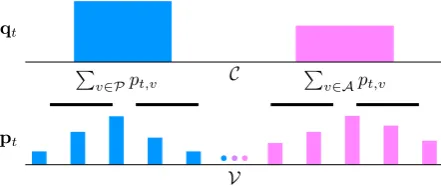
by summing all the probabilities of predicates and those of arguments:
qt,0predicate=X v∈P
p0t,v (3a)
q0t,argument=X v∈A
p0t,v (3b)
This aggregation is shown in Fig.3. Then the ex-tra objective is`0 = PTt=1logqt,c0 t, wherect = predicate if the target token yt ∈ P (i.e. ending with “:p”) andct=argument otherwise.
Therefore, we get the joint objective to maxi-mize by adding`and`0:
`+`0= T X
t=1
logpt,yt+ T X
t=1
P
v2Ppt,v Pv2Apt,v
pt
qt
|
{z
}
|
{z
}
V
[image:3.595.72.293.64.157.2]C
Figure 3: Visualization of howq(distribution overC) is ob-tained by aggregatingp(distribution overV).
which enables the model to learn more semantics-aware and noise-insensitive hidden states by en-forcing the hidden states within a region to share the same semantic structure tag.2
3.2.1 Sampling Neighbors
Sampling a neighbor around ht is essentially equivalent to adding noise to it. Note that in a LSTM decoder that previous work used, ht ∈ (−1,1)Dbecauseh
t=ottanh(ct)whereot∈ (0,1)D andtanh(ct)∈ (−1,1)D. Therefore, ex-tra work is needed to ensureh0t ∈ (−1,1)D. For this purpose, we follow the recipe3:
• Sample h00t ∈ (−1,1)D by independently sampling each entry from an uniform distri-bution over(−1,1);
• Sample a scalarλt ∈ (0,1)from a Beta dis-tributionB(α, β) whereα andβ are
hyper-parameters to be tuned;
• Computeh0t = ht+λt(h00t −ht)such that h0t ∈ (−1,1)D lies on the line segment be-tweenhtandh00t.
Note that the sampled hidden state h0t is only
used to computeq0t, but not to update the LSTM
hidden state, i.e.,ht+1is independent ofh0t.
3.2.2 Roles of Hyperparameters
TheHalotechnique adds an inductive bias into the model, and its magnitude is controlled byλt:
• λt∈(0,1)to ensureh0t∈(−1,1)D;
• λt → 0makesh0t → ht, thus providing no extra supervision on the model;
2One can also sample multiple, rather than one, neighbors for one hidden state and then average theirlogqt,c0 t. In our
experimental study, we only try one for computational cost and found it effective enough.
3Alternatives do exist. For example, one can transformh t from(−1,1)Dto(−∞,∞)D, add random (e.g. Gaussian) noise in the latter space and then transform back to(−1,1)D. These tricks are valid as long as they find neighbors within the same space(−1,1)Dash
tis.
• λt→1makesh0tuniformly sampled in entire (−1,1)D, and causes underfitting just like a
L-2 regularization coefficient goes to infinity.
We sample a valid λt from a Beta distribution withα > 0andβ > 0, and their magnitude can be tuned on the development set:
• Whenα→0andβis finite, orαis finite and β→ ∞, we haveλt→0;
• Whenα → ∞ andβ is finite, or αis finite
andβ →0, we haveλt→1;
• Larger α andβ yield larger variance ofλt, and setting λt to be a constant is a special case thatα→ ∞,β → ∞andα/βis fixed.
Besidesαandβ, the way of partitioningV (i.e. the definition ofC) also serves as a knob for tuning the bias strength. Although on this task, the pred-icate and argument tags naturally partition the vo-cabulary, we are still able to explore other possibil-ities. For example, an extreme is to partitionVinto |V| different singletons, meaning that C = V— a perturbation around ht should still predict the same token. But this extreme case does not work well in our experiments, verifying the importance of the semantic structure tags on this task.
4 Related Work
Cross-lingual information extraction has drawn a great deal of attention from researchers. Some (Sudo et al., 2004; Parton et al., 2009;Ji,
2009;Snover et al.,2011;Ji and Nothman,2016) worked in closed domains, i.e. on a predefined set of events and/or entities,Zhang et al. (2017b) explored this problem in open domain and their at-tentional encoder-decoder model significantly out-performed a baseline system that does translation and parsing in a pipeline. Zhang et al. (2017c) further improved the results by inventing a hier-archical architecture that learns to first predict the next semantic structure tag and then select a tag-dependent decoder for token generation. Orthog-onal to these efforts,Haloaims to helpall neural models on this task, rather than any specific model architecture.
DATASET NUMBER OFPAIRS VOCABULARYSIZE TOKEN/TYPE TRAIN DEV TEST SOURCE TARGET
CHINESE 941040 10000 39626 258364 234832 91.94 UZBEK 31581 1373 1373 69255 37914 12.18
TURKISH 20774 903 903 51248 32009 11.97
SOMALI 10702 465 465 29591 18616 12.78
Table 1: Statistics of each dataset.
METHOD CHINESE UZBEK TURKISH SOMALI
BLEU F1 BLEU F1 BLEU F1 BLEU F1
PRED ARG PRED ARG PRED ARG PRED ARG
MODELZ 22.07 30.06 39.06 10.76 12.46 24.08 7.47 6.49 17.76 13.06 13.91 25.38 MODELP 22.10 30.04 39.83 12.50 18.81 25.93 9.04 12.90 21.13 13.22 16.71 26.83 MODELP-Halo 23.18 30.85 41.23 12.95 19.23 27.63 10.21 12.55 22.57 14.26 17.06 27.73
Table 2: BLEUand F1 scores of different models on all these datasets, where PREDstands for predicate and ARGfor argument. Best numbers are highlighted asbold.
2000;Simonyan and Zisserman,2015;Arpit et al.,
2017; Zhang et al., 2017a) and speech recogni-tion (Graves et al., 2013; Amodei et al., 2016). Halo differs from these methods because 1) it makes use of the task-specific information— vocabulary is partitioned by semantic structure tags; and 2) it makes use of the human belief that the hidden representations of tokens with the same semantic structure tag should stay close to each other. Some
5 Experiments
We evaluate our method on several real-world CLIE datasets measured by BLEU (Papineni et al.,2002) and F1, as proposed byZhang et al.
(2017b). For the generated linearized PredPatt outputs and their references, the former metric4
measures their n-gram similarity, and the latter measures their token-level overlap. In fact, F1 is computed separately for predicate and argument, as F1 PREDand F1 ARGrespectively.
5.1 Datasets
Multiple datasets were used to demonstrate the ef-fectiveness of our proposed method, where one sample in each dataset is a source language sen-tence paired with its linearized English PredPatt output. These datasets were first introduced as the DARPA LORELEI Language Packs (Strassel and Tracey,2016), and then used for this task by
Zhang et al. (2017b,c). As shown in table1, the CHINESEdataset has almost one million training samples and a high token/type ratio, while the
oth-4The MOSES implementation (Koehn et al.,2007) was used as in all the previous work on this task.
ers are low resourced, meaning they have much fewer samples and lower token/type ratios.
5.2 Model Implementation
Before applying ourHalotechnique, we first im-proved the current state-of-the-art neural model of
Zhang et al. (2017c) by using residual connec-tions (He et al.,2016) and multiplicative attention (Luong et al., 2015), which effectively improved the model performance. We refer to the model of
Zhang et al.(2017c) and our improved version as ModelZ and ModelP respectively5.
5.3 Experimental Details
In experiments, instead of using the full vocab-ularies shown in table 1, we set a minimum count threshold for each dataset, to replace the rare words by a special out-of-vocabulary symbol. These thresholds were tuned on dev sets.
The Beta distribution is very flexible. In gen-eral, its variance is a decreasing function ofα+β,
and whenα+β is fixed, the mean is an
increas-ing function of α. In our experiments, we fixed α+β = 20and only lightly tunedαon dev sets.
Optimal values ofαstay close to1.
5.4 Results
As shown in Table2, ModelP outperforms Mod-elZ on all the datasets measured by all the met-rics, except for F1 PRED on CHINESE dataset. OurHalotechnique consistently boosts the model performance of MODELP except for F1 PREDon TURKISH.
Additionally, experiments were also conducted on two other low resource datasets AMHARICand YORUBAthatZhang et al. (2017c) included, and
α = 0inHalowas found optimal on the dev sets. In such cases, this regularization was not helpful so no comparison need be made on the held-out test sets.
6 Conclusion and Future Work
We present a simple and effective training tech-nique Halofor the task of cross-lingual informa-tion extracinforma-tion. Our method aims to enforce the local surroundings of each hidden state of a neu-ral model to only generate tokens with the same semantic structure tag, thus enabling the learned hidden states to be more aware of semantics and robust to random noise. Our method provides new state-of-the-art results on several benchmark cross-lingual information extraction datasets, in-cluding both high and low resource scenarios.
As future work, we plan to extend this technique to similar tasks such as POS tagging and Semantic Role Labeling. One straightforward way of work-ing on these tasks is to define the vocabularies as set of ‘word-type:POS-tag’ (soct=POS tag) and ‘word-type:SR’ (soct =semantic role), such that our method is directly applicable. It would also be interesting to applyHalowidely to other tasks as a general regularization technique.
Acknowledgments
This work was supported in part by the JHU Hu-man Language Technology Center of Excellence (HLTCOE), and DARPA LORELEI. The U.S. Government is authorized to reproduce and dis-tribute reprints for Governmental purposes. The views and conclusions contained in this publica-tion are those of the authors and should not be interpreted as representing official policies or en-dorsements of DARPA or the U.S. Government.
References
Dario Amodei, Sundaram Ananthanarayanan, Rishita Anubhai, Jingliang Bai, Eric Battenberg, Carl Case, Jared Casper, Bryan Catanzaro, Qiang Cheng, Guo-liang Chen, et al. 2016. Deep speech 2: End-to-end speech recognition in english and mandarin. In In-ternational Conference on Machine Learning. pages 173–182.
Devansh Arpit, Stanislaw Jastrzkebski, Nicolas Bal-las, David Krueger, Emmanuel Bengio,
Maxin-der S Kanwal, Tegan Maharaj, Asja Fischer, Aaron Courville, Yoshua Bengio, et al. 2017. A closer look at memorization in deep networks. InInternational Conference on Machine Learning. pages 233–242.
Olivier Chapelle, Jason Weston, L´eon Bottou, and Vladimir Vapnik. 2001. Vicinal risk minimization. In Advances in neural information processing sys-tems. pages 416–422.
Yarin Gal and Zoubin Ghahramani. 2016. A theoret-ically grounded application of dropout in recurrent neural networks. InAdvances in neural information processing systems. pages 1019–1027.
Alex Graves, Abdel-rahman Mohamed, and Geoffrey Hinton. 2013. Speech recognition with deep recur-rent neural networks. InAcoustics, speech and sig-nal processing (icassp), 2013 ieee internatiosig-nal con-ference on. IEEE, pages 6645–6649.
Kaiming He, Xiangyu Zhang, Shaoqing Ren, and Jian Sun. 2016. Deep residual learning for image recog-nition. InThe IEEE Conference on Computer Vision and Pattern Recognition (CVPR).
Sepp Hochreiter and J¨urgen Schmidhuber. 1997. Long short-term memory. Neural computation
9(8):1735–1780.
Heng Ji. 2009. Cross-lingual predicate cluster acquisi-tion to improve bilingual event extracacquisi-tion by
induc-tive learning. InProceedings of the Workshop on
Unsupervised and Minimally Supervised Learning of Lexical Semantics. Association for Computational Linguistics, Boulder, Colorado, USA, pages 27– 35.http://www.aclweb.org/anthology/ W09-1704.
Heng Ji and Joel Nothman. 2016. Overview of TAC-KBP2016 Tri-lingual EDL and its impact on end-to-end cold-start KBP. In Proceedings of the Text Analysis Conference (TAC).
Philipp Koehn, Hieu Hoang, Alexandra Birch, Chris Callison-Burch, Marcello Federico, Nicola Bertoldi, Brooke Cowan, Wade Shen, Christine Moran, Richard Zens, et al. 2007. Moses: Open source toolkit for statistical machine translation. In Pro-ceedings of the 45th annual meeting of the ACL on interactive poster and demonstration sessions. As-sociation for Computational Linguistics, pages 177– 180.
Minh-Thang Luong, Hieu Pham, and Christopher D Manning. 2015. Effective approaches to attention-based neural machine translation. InProceedings of the 2015 Conference on Empirical Methods in Nat-ural Language Processing.
Kristen Parton, Kathleen R. McKeown, Bob Coyne, Mona T. Diab, Ralph Grishman, Dilek Hakkani-T¨ur, Mary Harper, Heng Ji, Wei Yun Ma, Adam Meyers, Sara Stolbach, Ang Sun, Gokhan Tur, Wei Xu, and Sibel Yaman. 2009. Who, what, when, where, why? comparing multiple approaches to the cross-lingual 5w task. In Proceedings of the Joint Conference of the 47th Annual Meeting of the ACL and the 4th International Joint Conference on Nat-ural Language Processing of the AFNLP. Associa-tion for ComputaAssocia-tional Linguistics, Suntec, Singa-pore, pages 423–431. http://www.aclweb. org/anthology/P/P09/P09-1048.
Patrice Y Simard, Yann A Le Cun, John S Denker, and Bernard Victorri. 2000. Transformation invariance in pattern recognition: Tangent distance and prop-agation. International Journal of Imaging Systems and Technology11(3):181–197.
Karen Simonyan and Andrew Zisserman. 2015. Very deep convolutional networks for large-scale image recognition. InInternational Conference on Learn-ing Representations.
Matthew Snover, Xiang Li, Wen-Pin Lin, Zheng Chen, Suzanne Tamang, Mingmin Ge, Adam Lee, Qi Li, Hao Li, Sam Anzaroot, and Heng Ji. 2011.
Cross-lingual slot filling from comparable corpora. In
Proceedings of the 4th Workshop on Building and Using Comparable Corpora: Comparable Corpora and the Web. Association for Computational Lin-guistics, Stroudsburg, PA, USA, BUCC ’11, pages
110–119. http://dl.acm.org/citation.
cfm?id=2024236.2024256.
Nitish Srivastava, Geoffrey E Hinton, Alex Krizhevsky, Ilya Sutskever, and Ruslan Salakhutdinov. 2014. Dropout: a simple way to prevent neural networks from overfitting. Journal of Machine Learning Re-search15(1):1929–1958.
Stephanie Strassel and Jennifer Tracey. 2016. Lorelei language packs: Data, tools, and resources for technology development in low resource languages. In Nicoletta Calzolari (Conference Chair), Khalid Choukri, Thierry Declerck, Sara Goggi, Marko Gro-belnik, Bente Maegaard, Joseph Mariani, Helene Mazo, Asuncion Moreno, Jan Odijk, and Stelios Piperidis, editors,Proceedings of the Tenth Interna-tional Conference on Language Resources and Eval-uation (LREC 2016). European Language Resources Association (ELRA), Paris, France.
Kiyoshi Sudo, Satoshi Sekine, and Ralph Grishman. 2004. Cross-lingual information extraction system evaluation. InProceedings of the 20th international Conference on Computational Linguistics. Associa-tion for ComputaAssocia-tional Linguistics, page 882.
Christian Szegedy, Vincent Vanhoucke, Sergey Ioffe, Jon Shlens, and Zbigniew Wojna. 2016. Rethinking the inception architecture for computer vision. In
Proceedings of the IEEE Conference on Computer Vision and Pattern Recognition. pages 2818–2826.
Laurens Van der Maaten, Minmin Chen, Stephen Tyree, and Kilian Weinberger. 2013. Learning with marginalized corrupted features. In Proceedings of The 30th International Conference on Machine Learning.
Aaron Steven White, Drew Reisinger, Keisuke Sak-aguchi, Tim Vieira, Sheng Zhang, Rachel Rudinger, Kyle Rawlins, and Benjamin Van Durme. 2016.
Universal Decompositional Semantics on Universal
Dependencies. In Proceedings of the 2016
Con-ference on Empirical Methods in Natural Language Processing. Association for Computational Linguis-tics, Austin, Texas, pages 1713–1723. https: //aclweb.org/anthology/D16-1177.
Hongyi Zhang, Moustapha Cisse, Yann N Dauphin, and David Lopez-Paz. 2017a. mixup: Be-yond empirical risk minimization. arXiv preprint arXiv:1710.09412.
Sheng Zhang, Kevin Duh, and Benjamin Van Durme. 2017b. MT/IE: Cross-lingual Open Information Ex-traction with Neural Sequence-to-Sequence Mod-els. In Proceedings of the 15th Conference of the European Chapter of the Association for Compu-tational Linguistics: Volume 2, Short Papers. As-sociation for Computational Linguistics, Valencia, Spain, pages 64–70. http://www.aclweb. org/anthology/E17-2011.
Sheng Zhang, Kevin Duh, and Benjamin Van Durme. 2017c. Selective Decoding for Cross-lingual Open
Information Extraction. In Proceedings of the
Eighth International Joint Conference on Natural Language Processing (Volume 1: Long Papers). Asian Federation of Natural Language Processing, Taipei, Taiwan, pages 832–842. http://www. aclweb.org/anthology/I17-1084. Sheng Zhang, Rachel Rudinger, and Benjamin Van
Durme. 2017d.An Evaluation of PredPatt and Open
IE via Stage 1 Semantic Role Labeling. InIWCS