Decoding Sentiment from Distributed Representations of Sentences
Edoardo Maria Ponti
[email protected] [email protected] Vuli´c
Language Technology Lab, University of Cambridge
Anna Korhonen
Abstract
Distributed representations of sentences have been developed recently to represent their meaning as real-valued vectors. How-ever, it is not clear how much information such representations retain about the po-larity of sentences. To study this question, we decode sentiment from unsupervised sentence representations learned with dif-ferent architectures (sensitive to the order of words, the order of sentences, or none) in 9 typologically diverse languages. Senti-ment results from the (recursive) composi-tion of lexical items and grammatical strate-gies such as negation and concession. The results are manifold: we show that there is no ‘one-size-fits-all’ representation ar-chitecture outperforming the others across the board. Rather, the top-ranking archi-tectures depend on the language and data at hand. Moreover, we find that in several cases the additive composition model based on skip-gram word vectors may surpass su-pervised state-of-art architectures such as bidirectional LSTMs. Finally, we provide a possible explanation of the observed varia-tion based on the type of negative construc-tions in each language.
1 Introduction
Distributed representations of sentences are usu-ally acquired in an unsupervised fashion from raw texts. Those inferred from different algorithms are prone to grasp parts of their meaning and disregard others. Representations have been evaluated thor-oughly, both intrinsically (interpretation through distance measures) and extrinsically (performance on downstream tasks). Moreover, several methods have been considered, based on both the
compo-sition of word embeddings (Milajevs et al.,2014;
Marelli et al.,2014;Sultan et al.,2015) and direct
generation (Hill et al.,2016). The evaluation was
focused solely on English, and it rarely concerned
other languages (Adi et al.,2017;Conneau et al.,
2017). As a consequence, many ‘core’ methods
to learn distributed sentence representations are largely under-explored in a variety of typologically diverse languages, and still lack a demonstration of their usefulness in actual downstream tasks.
In this work, we study how well distributed
sen-tence representations capture thepolarity of a
sen-tence. To this end, we choose the Sentiment Anal-ysis task as an extrinsic evaluation protocol: it di-rectly detects the polarity of a text, where polarity is defined as the attitude of the speaker with respect to the whole content of the string or one of the enti-ties mentioned therein. This attitude is measured quantitatively on a scale spanning from negative to positive with arbitrary granularity. As such, po-larity consists in a crucial part of the meaning of a sentence, which should not be lost.
The polarity of a sentence depends heavily on a complex interaction between lexical items endowed with an intrinsic polarity, and morphosyntactic con-structions altering polarity, most notably negation and concession. The interaction is deemed to be recursive, hence some approaches take into account word order and phrase boundaries in order to apply
the correct composition (Socher et al.,2013).
How-ever, some languages lack continuous constituents: contiguous spans of words do not correspond to syntactic subtrees, making composition unreliable (Ponti,2016). Moreover, the expression of negation varies across languages, as demonstrated by works
in Linguistic Typology (Dahl,1979,inter alia). In
particular, negation can appear as a bounded mor-pheme or a free mormor-pheme; it can precede or follow the verb; it can ‘agree’ or not in polarity with indef-inite pronouns; it can alter the expression of verbal
categories (e.g. tense, aspect, or modality). We explore a series of methods endowed with different features: some hinge upon word order, others on sentence order, others on neither. We evaluate these unsupervised representations using a Multi-Layer Perceptron which uses the gener-ated sentence representations as input and predicts sentiment classes (positive vs. negative) as output. Training and evaluation are based on a collection of annotated databases. Owing to the variety of methods and languages, we expect to observe a variation in the performance correlated with the properties of both.
Moreover, we establish a ceiling to the possible performances of our method based on decoding unsupervised distributed representations. In fact, we offer a comparison between this and supervised deep learning architectures that achieve state-of-art scores in the Sentiment Analysis task. In particular,
we also evaluate a bi-directional LSTM (Li et al.,
2015) on the same task. These models have
ad-vantage over distributed representations as: i) they are specialised on a single task rather than built as general-purpose representations; ii) their recurrent nature allows to capture the sequential composition of polarity in a sentence. However, since training these models requires large amounts of annotated data, resource scarcity in other languages hampers their portability.
The aim of this work is to assess which algo-rithm for distributed sentence representations is the most appropriate for capturing polarity in a given language. Moreover, we study how language-specific properties have an impact on performance, finding an explanation in Language Typology. We also provide an in-depth analysis of the most rele-vant features by visualising the activation of hidden neurons. This will hopefully contribute to advanc-ing the Sentiment Analysis task in the multiladvanc-ingual
scenarios. In§2, we survey prior work on
multi-lingual sentiment analysis. Afterwards, we present the tested algorithms for generating distributed
rep-resentations of sentences in§3. In§4, we sketch
the dataset and the experimental setup. Finally,§
5examines the results in light of the sensitivity of
the algorithms and the typology of negation.
2 Multilingual Sentiment Analysis
The task of sentiment classification is mostly ad-dressed through supervised approaches. However, these achieve unsatisfactory results in resource-lean
languages because of the scarcity of resources to
train dedicated models (Denecke,2008). This
af-flicts state-of-art deep learning architectures even more compared to traditional machine learning
al-gorithms (Chen et al.,2016). As a consequence,
previous work resorted to i) language transfer or ii) joint multilingual learning. The former adapts models from a source resource-rich language to a target resource-poor language; the latter infers a sin-gle model portable across languages. Approaches based on distributed representations induced in an unsupervised fashion do not face the difficulty re-sulting from resource scarcity: they are portable to other tasks and languages. In this section we survey deep learning techniques, adaptive models, and unsupervised distributed representations for sentiment classification in a multilingual scenario. The last approach is the focus of this work.
Deep learning algorithms for sentiment classifi-cation are designed to deal with compositionality. Hence, they often rely on recurrent networks trac-ing the sequential history of a sentence, or special compositional devices. Recurrent models include
bi-directional LSTMs (Li et al., 2015), possibly
enriched with context (Mousa and Schuller,2017).
On the other hand,Socher et al.(2013) put forth
a Recursive Neural Tensor Network, which com-poses representations recursively through a single tensor-based composition function. Subsequent improvements of this line of research include the
Structural Attention Neural Networks (Kokkinos
and Potamianos,2017), which adds structural in-formation around each node of a syntactic tree.
When supervised monolingual models are not feasible, language transfer can bridge between mul-tiple languages, for instance through supervised
la-tent Dirichlet allocation (Boyd-Graber and Resnik,
2010). Direct transfer relies on word-aligned
par-allel texts where the source language text is either manually or automatically annotated. The senti-ment information is then projected onto the
tar-get text (Almeida et al., 2015), also leveraging
non-parallel data (Zhou et al.,2015). Chen et al.
(2016) devised a multi-task network where an
ad-versarial branch spurs the shared layers to learn
language-independent features. Finally,Lu et al.
(2011) learned from annotated examples in both
the source and target language. Alternatively, sen-tences from other languages are translated into En-glish and assigned a sentiment based on lexical
(Balahur and Turchi,2014).
Finally, cross-lingual sentiment classification can leverage on shared distributed representations.
Zhou et al.(2016) captured shared high-level fea-tures across aligned sentences through autoen-coders. In this latent space, distances were op-timised to reflect differences in sentiment. On the
other hand,Fern´andez et al.(2015) exploited
bilin-gual word representations, where vector dimen-sions mirror the distributional overlap with respect
to a pivot. Le and Mikolov(2014) concatenated
sentence representations obtained through variants of Paragraph Vector and trained a Logistic Regres-sion model on top of them.
Previous studies thus demonstrated that sen-tence representations retain information about po-larity, and that they partly alleviate the drawbacks of deep architectures (single-purposed and data-demanding). Hence, the Sentiment Analysis tasks seems convenient to compare different sentence representation architectures. Nonetheless, a sys-tematic evaluation has never taken place for this task, and a large-scale study over typologically di-verse languages has not been attempted for any of the algorithms reviewed. We intend to fill these gaps, considering the methods to generate sentence representations outlined in the next section.
3 Distributed Sentence Representations
Word vectors can be combined through various compositional operations to obtain representations
of phrases and sentences. Mitchell and Lapata
(2010) explored two operations: addition and
mul-tiplication. Notwithstanding their simplicity, they are hardly outperformed by more sophisticated
op-erations (Rimell et al.,2016). Some of these
com-positional representations based on matrix multipli-cation were also evaluated on sentiment
classifica-tion (Yessenalina and Cardie,2011). Alternatively,
sentence representations can be induced directly with no intermediate step at the word level. In this paper, we focus on sentence representations that are generated in an unsupervised fashion. Furthermore, they are ‘fixed’, that is, they are not fine-tuned for any particular downstream task, since we are
inter-ested in their intrinsic content.1
1This excludes methods concerned with phrases, like the ECO embeddings (Poliak et al.,2017), or requiring structured knowledge, like CHARAGRAM (Wieting et al.,2016a).
3.1 Algorithms
We explore several methods to generate sentence representations. One exploits a compositional op-eration (addition) over word representations
stem-ming from a Skip-Gram model (§3.1.1). Others are
direct methods, including FastSent (§3.1.2), a
Se-quential Denoising AutoEncoder (SDAE,§3.1.3)
and Paragraph Vector (§3.1.4). Note that FastSent
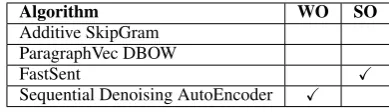
relies on sentence order, SDAE on word order, and Paragraph Vector on neither. All these algorithms were trained on cleaned-up Wikipedia dumps.
The choice of the algorithms was based on fol-lowing criteria: i) their performance reported in recent surveys (n.b., the surveys were limited to English and evaluated on other tasks), most notably
Hill et al.(2016) andMilajevs et al.(2014); ii) the variety of their modelling assumptions and features encoded. The referenced surveys already hinted that the usefulness of a representation is largely dependent on the actual application. Shallower but more interpretable representations can be decoded with spatial distance metrics. Others, more deep and convoluted architectures, outperform the others in supervised tasks. We inquire whether the gen-eralisation is tenable also in the task of Sentiment Analysis targeting sentence polarity.
3.1.1 Additive Skip-Gram
As a bottom-up method, we train word embeddings
using skip-gram with negative sampling (Mikolov
et al.,2013). The algorithm finds the parameterθ
such that, given a pair of a wordwand a context
c, the model discriminates correctly whether it
be-longs to a set of sentencesSor a set of randomly
generated incorrect sentencesS0:
Y
(w,c)∈S
p(S = 1|w, c, θ) Y
(w,c)∈S0
p(S0 = 0|w, c, θ)
The representation of a sentence was obtained via element-wise addition of the vectors of the words
belonging to it (Mitchell and Lapata,2010).
3.1.2 FastSent
The FastSent model was proposed by Hill et al.
(2016). It hinges on a sentence-level distributional
hypothesis (Polajnar et al.,2015;Kiros et al.,2015).
Hence, it was preferred over SkipThought (Kiros et al.,2015) because of i) these efficiency issues and ii) its competitive performances reported by
Hill et al.(2016). In FastSent, sentences are repre-sented as bags of words: a context of sentences is used to predict the adjacent sentence. Each word
wcorresponds to a source vectoruw and a target
vector vw. A sentence Si is represented as the
sum of the source vectors of its wordsPw∈Siuw.
Hence, the costCof a representation is given by
the softmaxσ(x)of a sentence representation and
the target vectors of the words in its contextc.
CSi =
X
c∈Si−1∪Si+1
σ(X
w∈Si
uw, vc) (1)
This model does not rely on word order, but rather on sentence order. It encodes new sentences by summing over the source vectors of their words.
3.1.3 Sequential Denoising AutoEncoder
Sequential Denoising AutoEncoders (SDAEs) com-bine features of Denoising AutoEncoders (DAE) and Sequence-to-Sequence models. In DAE, the in-put representation is corrupted by a noise function and the algorithms learns to recover the original (Vincent et al.,2008). Intuitively, this makes the model more robust to changes in input that are irrelevant for the task at hand. This architecture was later adapted to encode and decode variable-length inputs, and the corruption process was
imple-mented in the form of dropout (Iyyer et al.,2015).
In the implementation byHill et al.(2016),2 the
corruption function is defined asf(S|po, px).Sis
a list of words (a sentence) where each has a
prob-abilitypoto be deleted, and the order of the words
in every distinct bigram has a probabilitypxto be
swapped. The architecture consists in a Recurrent
Layer and predictsp(S|f(S|po, px)).
3.1.4 Paragraph Vector
Paragraph Vector is a collection of log-linear
mod-els proposed byLe and Mikolov(2014) for
para-graph/sentence representation. It consists of two different models, namely the Distributed Memory model (DM) and the Distributed Bag Of Words model (DBOW). In DM, the ID of every distinct paragraph (or sentence) is mapped to a unique
vec-tor in a matrixD and each word is mapped to a
unique vector in matrixW. Given a sentenceiand
2https://github.com/fh295/
SentenceRepresentation
a window sizek, the vector Di,· is used in
con-junction with the concatenation of the vectors of
the words in a sampled contexthwi1, . . . , wikito
predict the next word through logistic regression:
p(Wik+1| hDi, Wi1, . . . , Wiki) (2)
Note that the sentence ID vector is shared by the contexts sampled from the same sentence. On the other hand, DBOW focuses on predicting the word
embedding Wij for a sampled wordj belonging
to sentenceigiven the sentence representationDi.
As a result, the main difference between the two Paragraph Vector models is that the first is sensitive to word order (represented by the word vector con-catenation), whereas the second is insensitive with respect to it. These models store a representation for each sentence in the training set, hence they are
memory demanding. We use thegensim
implemen-tation of the two models available as Doc2Vec.3
3.2 Hyper-parameters
The choice of the models’ hyper-parameters was based on two (contrasting) criteria: i) conservative-ness with those proposed in the original models and ii) comparability among the models in this work. In particular, we ensured that each model had the same sentence vector dimensionality: 300. The only exception is SDAE: we kept the recom-mended value of 2400. Paragraph Vector DBOW and SkipGram were trained for 10 epochs, with a window size of 10, a minimum frequency count of
5, and a sampling threshold of10−5. FastSent was
set as having a minimum count of 3, and no sam-pling. The probabilities in the corruption function
of the SDAE were set aspo = 0.1(deletion) and
px = 0.1(swapping). The dimension of the RNN
(GRU) hidden states (and hence sentence vector) was 2400, whereas single words were assigned 100 dimensions. The learning rate was set to 0.01 with-out decay, and the training lasted 7.2 hours on a
NVIDIATitan XGPU. The main properties of each
algorithm are summarised in Table1.
Algorithm WO SO
Additive SkipGram ParagraphVec DBOW
FastSent X
[image:4.595.317.512.648.704.2]Sequential Denoising AutoEncoder X
Table 1: Sensitivity to Word or Sentence Order.
3https://radimrehurek.com/gensim/
0 25 50 75 100
Negative Positive Polarity
Percentage
(a) Arabic
0 25 50 75 100
Negative Positive Polarity
Percentage
(b) Chinese
0 25 50 75 100
Negative Positive Polarity
Percentage
(c) Dutch
0 25 50 75 100
Negative Positive Polarity
Percentage
(d) English
0 25 50 75 100
Negative Positive Polarity
Percentage
(e) French
0 25 50 75 100
Negative Positive Polarity
Percentage
(f) Italian
0 25 50 75 100
Negative Positive Polarity
Percentage
(g) Russian
0 25 50 75 100
Negative Positive Polarity
Percentage
[image:5.595.78.529.68.456.2](h) Spanish
Figure 1: Percentages of negative (left) and positive (right) sentences with the same amount of negative grammatical markers. A count of 0 is represented in dark blue, 1 in light blue, and 2 or more in green.
4 Experimental Setup
Now, we evaluate the quality of the distributed
sen-tence representations from§3on Sentiment
Anal-ysis. In§4.1we introduce the datasets of all the
considered languages, and the evaluation protocol
in§4.2. Finally, to provide a potential performance
ceiling, we compare the obtained results with those
of a deep, state-of-art classifier, outlined in§4.3.
4.1 Datasets
The data for training and testing are sourced from
the SemEval 2016: Task 5 (Pontiki et al.,2016).
These datasets provide customer reviews in 8 lan-guages labelled with Aspect-Based Sentiment, i.e., opinions about specific entities or attributes rather than generic stances. The languages include Ara-bic (hotels domain), Chinese (electronics), Dutch (restaurants and electronics), English (restaurants
and electronics), French, Russian, Spanish, and Turkish (restaurants all). We mapped the labels to an overall polarity class (positive or negative) by selecting the majority class among the aspect-based sentiment classes for a given sentence. Note that no general sentiment for the sentence was in-cluded in this pool. Moreover, we added data for
Italian (tweets) from theSENTIPOLCshared task in
EVALITA2016 (Barbieri et al.,2016). We discarded
neutral stances from the corpus, and retained only
positive and negative ones. Table2 shows the
fi-nal size of the dataset partitions and the Wikipedia
dumps. In Figure1, we report the percentage of
sentences with the same amount of negative
gram-matical markers (e.g. the wordnotand the suffix
n’tin English) based on their polarity class. We
discuss the impact of the variation of these
Language Wikipedia
Dumps Train Test
Arabic 3406732 4570 1163
Chinese 8067971 2593 1011
Dutch 11860559 2169 683
English 30000002 3584 1102
French 26024881 1410 534
Italian 15338617 4588 512
Russian 16671224 2555 835
Spanish 22328668 1553 646
Turkish 3622336 1008 121
Table 2: Size of the data partitions (# sentences).
4.2 Evaluation Protocol
After mapping each sentence in the dataset to its distributed representation, we fed them to a Multi-Layer Perceptron (MLP), trained to detect the sen-tence polarity. In the MLP, a logistic regression layer is stacked onto a 60-dimensional hidden layer with a hyperbolic tangent activation. The weights
were initialised from the randomxavierdistribution
Glorot and Bengio(2010). The cross-entropy loss was normalised with the L2-norm of the weights
scaled byλ= 10−3. The optimisation with
gradi-ent descgradi-ent ran for 20 epochs with early stopping.
Batch size was 10 and the learning rate10−2.
4.3 Comparison with State-of-Art Models
In addition to unsupervised distributed sentence representations, we test a bi-directional Long Short-Term Memory neural network (bi-LSTM) on the same task. This is a benchmark to compare against results of deep state-of-art architectures. The choice is based on the competitive results of this algorithm and on its sensitivity to word order. The accuracy of this architecture is 45.7 for 5-class and 85.4 for 2-class Sentiment Analysis on the standard dataset of the Stanford Sentiment Treebank.
The importance of word order is evident from the architecture of the network. In a recurrent model,
the word embedding of a wordwtat timetis
com-bined with the hidden stateht−1from the previous
time step. The process is iterated throughout the whole sequence of words of a sentence. This model can be extended to multiple layers. LSTM is a re-finement associating each time epoch with an input, control and memory gate, in order to filter out
ir-relevant information (Hochreiter and Schmidhuber,
1997). This model is bi-directional if it is split in
two branches reading simultaneously the sentence
in opposite directions (Schuster and Paliwal,1997).
Contrary to the evaluation protocol sketched in§
4.2, the bi-LSTM does not utilise unsupervised
sen-tence representations. Rather, it is trained directly
on the datasets from§4.1. The optimisation ran for
20 epochs, with a batch size of 20 and a learning
rate of5·10−2. The 60-dimensional hidden layer
had a dropout probability of 0.2. Crucially, the word embeddings were initialised with the
Skip-Gram model described in § 3.1.1. Since
perfor-mance tends to vary depending on the initialisation, this ensures a fair comparison.
5 Results
The results are displayed in Figure2. Weighted F1
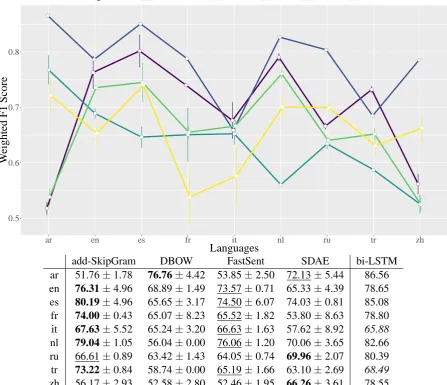
scores were preferred over accuracy scores, since the two classes (positive and negative) are unbal-anced. We decoded the unsupervised representa-tions multiple times through different initialisation of the MLP weights, hence we report both the mean value and its standard deviation. The results are not straightforward: there is no algorithm outper-forming the others in each language; unexpectedly not even the bi-LSTM used as a ceiling. However, the variation in performance follows certain trends, depending on the properties of languages and algo-rithms. We now examine: i) how performance is affected by the properties of the algorithms, such
as those summarised in Table1; ii) how typological
features concerning negation and the text domain could make polarity harder to detect; iii) the inter-action between negation and indefinite pronouns, by visualising the contribution of each word to the predicted class probabilities.
5.1 Feature Sensitivity of the Algorithms
The state-of-art bi-LSTM algorithm chosen as a ceiling is not the best choice in some languages (Italian, and Turkish). In these cases, it is always surpassed by the same model: additive Skip-Gram. The drop in Italian is possibly linked to its dataset in specific, since all the algorithms behave simi-larly badly. Turkish is possibly challenging for a recursive model because of the sparsity of its vo-cabulary. These cases, however, are not isolated: averaged word embeddings outperformed LSTMs
in text similarity tasks (Arora et al.,2016) and
pro-vide a strong baseline in English (Adi et al.,2017).
● ●
●
● ●
● ●
● ●
●
● ●
●
●● ●
●
●●
●
● ● ● ●
●
● ●
● ●
●
● ●
●● ●
●
●
● ● ●
● ●
●● ●
0.5 0.6 0.7 0.8
ar en es fr it nl ru tr zh
Languages
W
eighted F1 Score
Algorithms: ● add−SkipGram ● bi−LSTM ● DBOW ● FastSent ● SDAE
add-SkipGram DBOW FastSent SDAE bi-LSTM
ar 51.76±1.78 76.76±4.42 53.85±2.50 72.13±5.44 86.56
en 76.31±4.96 68.89±1.49 73.57±0.71 65.33±4.39 78.65 es 80.19±4.96 65.65±3.17 74.50±6.07 74.03±0.81 85.08 fr 74.00±0.43 65.07±8.23 65.52±1.82 53.80±8.63 78.80 it 67.63±5.52 65.24±3.20 66.63±1.63 57.62±8.92 65.88
nl 79.04±1.05 56.04±0.00 76.06±1.20 70.06±3.65 82.66
ru 66.61±0.89 63.42±1.43 64.05±0.74 69.96±2.07 80.39
tr 73.22±0.84 58.74±0.00 65.19±1.66 63.10±2.69 68.49
[image:7.595.75.523.81.466.2]zh 56.17±2.93 52.58±2.80 52.46±1.95 66.26±3.61 78.55
Figure 2: Results of 5 different algorithms on 9 languages. Values report the mean Weighted F1 Score and the standard deviation. The best results per language are given in bold and the second-best is underlined. Data points where the ceiling is outperformed are in italics.
representations. This result is in line with other
findings:Wieting et al.(2016b) showed that word
embeddings, once retrained and decoded by lin-ear regression, beat many methods that generate sentence representations directly.
Moreover, the second-best method for languages is always FastSent, which is the only one hing-ing upon neighbourhing-ing sentences as features. This demonstrate that sentiment is encoded not only within a sentence, but also in its textual context. As a consequence, a relatively small and accessi-ble dataset (Wikipedia) is sufficient to provide a reliable model in most languages. Nonetheless, the varying size of the dumps affects FastSent as well as the other unsupervised algorithms: limited data hinders them from learning faithful representations,
as in Arabic, Chinese, and Turkish (see Table2).
In general, algorithms sensitive to the same fea-tures behave similarly, e.g. SDAE and bi-LSTM. They follow the same trend in relative improve-ments from one language to another. The generally low performance of SDAE could depend on the lim-ited training time, which was necessary to evaluate the algorithm on the whole set of languages.
5.2 Typology of Negation and Domain
0 10 20 30 40 50 10 20 30 40 50
(a) Arabic positive
0 10 20 30 40 50 1 2 3 4 5 6 7
(b) Arabic negative
0 10 20 30 40 50 me
gusta
todo
en
este
restaurante 1
2 3 4 5 6 7 8
(c) Spanish positive
0 10 20 30 40 50 no
me gusta nada en este
restaurante 5
10 15 20 25 30 35
(d) Spanish negative
0 10 20 30 40 50 0.2 0.4 0.6 0.8 1.0
(e) Russian positive
0 10 20 30 40 50 0.5 1.0 1.5 2.0 2.5 3.0
[image:8.595.82.521.71.302.2](f) Russian negative
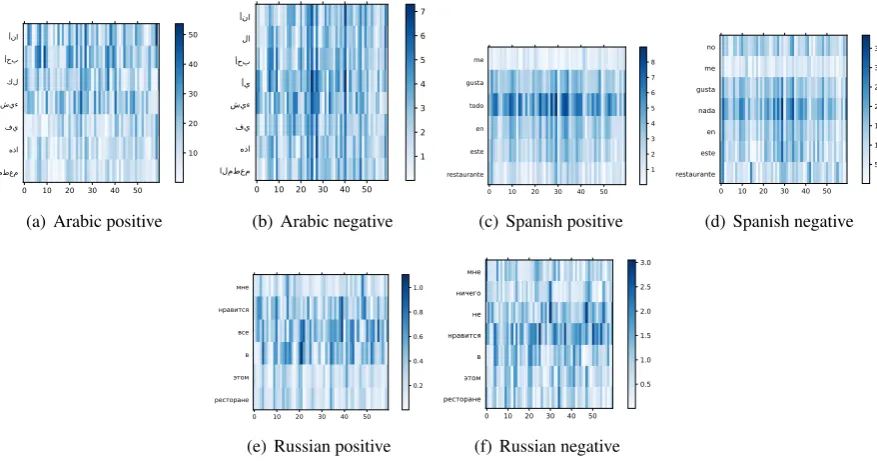
Figure 3: Visualization of the derivative of the class scores with respect to the word embeddings.
scores in the fusional languages, save Italian. A fine-grained analysis shows also that the per-formance is affected by the typology of the nega-tion in each language, although negative mark-ers appear in a reduced number of examples (see
Figure 1). Semantically, negation is crucial in
switching or mitigating the polarity of lexical items and phrases. Morpho-syntactically, negation is ex-pressed through several constructions across the languages of the world. Constructions differ in many respects, which are classified as feature-value pairs in databases like the World Atlas of Language
Structures (Dryer and Haspelmath,2013).4
Negation can affect the declarative verbal main clauses. In fact, negative clauses can be: i) sym-metric, i.e., identical to the affirmative counterpart except for the negative marker; ii) asymmetric, i.e. showing structural differences between neg-ative and affirmneg-ative clauses (in constructions or paradigms); iii) showing mixed behaviour. Alter-ations concern for instance finiteness, the oblig-atory marking of unreality status, or the expres-sion of verbal categories. Secondly, negation
inter-acts with indefinite pronoun (e.g.nobody,nowhere,
never). Negative indefinites can i) co-occur with standard negation; ii) be forbidden in concurrence;
4The features considered here for negation are 113A ‘Sym-metric and Asym‘Sym-metric Standard Negation’, 114A ‘Subtypes of Asymmetric Standard Negation’, 115A ‘Negative Indefi-nite Pronouns and Predicate Negation’, and 143A ‘Order of Negative Morpheme and Verb’.
iii) display a mixed behaviour. Finally, the rela-tion of the negative marker with respect to verb is prone to change. Firstly, it can be either an af-fix or a prosodically independent word. Secondly, its position can be anchored to the verb (preced-ing, follow(preced-ing, or both). Thirdly, negation can be omitted, doubled or even tripled.
Performances seem to suffer the ambiguity in mapping between a negative marker and negative meaning. In fact, the bi-LSTM achieves lower scores in languages with asymmetric constructions (Chinese, English, and Turkish): the additional changes in the sentence construction and/or verb paradigm might create noise. Additional reasons of difficulty may occur when negation is doubled (French) or affixed (Turkish), since this makes nega-tion redundant or sparse. On the other hand, add-SkipGram appears to be sensitive to the presence
of negation: according to the counts in Figure1,
when this is too pervasive (Arabic and Russian) or rare (Chinese), the scores tend to decrease.
with redundancies and noise. Filtering out words that contribute to this effect might benefit the qual-ity of the representation. Moreover, the sparsqual-ity due to cases where negation is an affix might be mitigated by introducing character-level features.
The other inherent source of variation is the text domain, on which the difficulty of the task depends (Glorot et al.,2011). Although the unstructured nature of tweets could hinder the quality of the sentence representations in Italian, however, no clear effect is evident based on the other domains.
5.3 Visualisation
Since languages vary in the “polarity agreement” between verbs and indefinite pronouns, algorithms may weigh these as features differently. We analyse their role through a visualizasion of the activation in the hidden layer of the bi-LSTM. In particular, we approximated the objective function through a linear function, and estimated the contribution of each word to the true class probability by com-puting the prime derivative of the output scores with respect to the embeddings. This technique is
presented and detailed byLi et al.(2015). The
visu-alised hidden layers are shown in Figure3, whereas
the sentences used as input are glossed in Ex. (3)
(Arabic), Ex. (4) (Spanish), and Ex.5(Russian).
(3) ‘ana
1SG ‘uhibulike.NPST.1SG klevery shay‘thing fiin hadhathis almataeim
restaurant // ‘ana1SG la
not.NPST
‘uhibu
like.NPST.1SG ‘ayu
any shay‘thing fiin hadhathis almataeamrestaurant
(4) me
1SG.DAT gust-alike-3SG todoeverything enin est-ethis-SG restaurant-e
restaurant-SG // nonot me1SG.DAT gust-alike-3SG nada
nothing enin est-ethis-SG restaurant-erestaurant-SG
(5) mne
1SG.DAT nr´av-itsjalike.IMPV-PRS.3SG vs-joall-NOM.SG vin ´et-om
this-PREP.SG restor´anerestaurant-PREP.SG // mne1SG.DAT ni-ˇcev´o
nothing-GEN ne
not nr´av-itsjalike.IMPV-PRS.3SG v
in
´et-om
this-PREP.SG restor´an-erestaurant-PREP.SG
The two compared sentences correspond to the translation of two English sentences. The first is positive: ‘I like everything in this restaurant’; the second is negative: ‘I don’t like anything in
this restaurant’. These include a domain-specific but sentiment-neutral word that plays the role of a touchstone. The more a cell tends to blue, the higher its activation. In some languages (e.g. Ara-bic), the sentiment verb elicits a stronger reaction in the positive polarity, whereas the indefinite pro-noun dominates in the negative polarity. In several other languages (e.g. Spanish), indefinite pronouns are more relevant than any other feature. In Rus-sian, only sentiment verbs always provoke a re-action. These differences might be related to the “polarity agreement” of these languages, which
hap-pens always, sometimes, and never, respectively. In some other languages, however, no evidence is found of any similar activation pattern.
6 Conclusion
In this work, we examined how much sentiment polarity information is retained by distributed rep-resentations of sentences in multiple typologically diverse languages. We generated the representa-tions through various algorithms, sensitive to dif-ferent properties from training corpora (e.g, word or sentence order). We decoded them through a simple MLP and compared their performance with one of the state-of-art algorithms for Sentiment Analysis: bi-directional LSTM. Unexpectedly, for some languages the bi-directional LSTM is outper-formed by unsupervised strategies like the addi-tion of the word embeddings obtained from a Skip-Gram model. This model, in turn, surpasses more sophisticated algorithms for most of the languages. This demonstrates i) that no algorithm is the best across the board; and ii) that some simple mod-els are to be preferred even for downstream tasks, which partially contrasts with the conclusions of
Hill et al.(2016). Moreover, representation algo-rithms sensitive to word order have similar trends, but they do not always achieve performance su-perior to algorithms based on the sentence order. Finally, some properties of languages (i.e. their type of negation) appear to have an impact on the scores: in particular, the asymmetry of negative and affirmative clauses and the doubling of nega-tive markers.
Acknowledgements
References
Yossi Adi, Einat Kermany, Yonatan Belinkov, Ofer Lavi, and Yoav Goldberg. 2017. Fine-grained analysis of sentence embeddings using auxil-iary prediction tasks. In Proceedings of ICLR. http://arxiv.org/abs/1608.04207.
Mariana SC Almeida, Cl´audia Pinto, Helena Figueira, Pedro Mendes, and Andr´e FT Martins. 2015. Align-ing opinions: Cross-lAlign-ingual opinion minAlign-ing with de-pendencies. InProc. of the Annual Meeting of the Association for Computational Linguistics.
Sanjeev Arora, Yingyu Liang, and Tengyu Ma. 2016. A simple but tough-to-beat baseline for sentence em-beddings. InICLR 2017.
Alexandra Balahur and Marco Turchi. 2014. Compar-ative experiments using supervised learning and ma-chine translation for multilingual sentiment analysis.
Computer Speech & Language28(1):56–75. Francesco Barbieri, Valerio Basile, Danilo Croce,
Malvina Nissim, Nicole Novielli, and Viviana Patti. 2016. Overview of the evalita 2016 sentiment po-larity classification task. In Proceedings of Third Italian Conference on Computational Linguistics (CLiC-it 2016) & Fifth Evaluation Campaign of Nat-ural Language Processing and Speech Tools for
Ital-ian. Final Workshop (EVALITA 2016).
Jordan Boyd-Graber and Philip Resnik. 2010. Holis-tic sentiment analysis across languages: Multilin-gual supervised latent dirichlet allocation. In Pro-ceedings of the 2010 Conference on Empirical
Meth-ods in Natural Language Processing. Association
for Computational Linguistics, pages 45–55. Xilun Chen, Ben Athiwaratkun, Yu Sun, Kilian
Wein-berger, and Claire Cardie. 2016. Adversarial deep averaging networks for cross-lingual sentiment clas-sification.arXiv preprint arXiv:1606.01614. Alexis Conneau, Douwe Kiela, Holger Schwenk,
Lo¨ıc Barrault, and Antoine Bordes. 2017. Su-pervised learning of universal sentence representa-tions from natural language inference data. CoRR
abs/1705.02364. http://arxiv.org/abs/1705.02364. ¨Osten Dahl. 1979. Typology of sentence negation.
Lin-guistics17(1-2):79–106.
Kerstin Denecke. 2008. Using sentiwordnet for mul-tilingual sentiment analysis. In Data Engineering Workshop, 2008. ICDEW 2008. IEEE 24th Interna-tional Conference on. pages 507–512.
Matthew S. Dryer and Martin Haspelmath, editors. 2013. WALS Online. Max Planck Institute for Evo-lutionary Anthropology, Leipzig. http://wals.info/. Alejandro Moreo Fern´andez, Andrea Esuli, and
Fab-rizio Sebastiani. 2015. Distributional correspon-dence indexing for cross-lingual and cross-domain sentiment classification. Journal of Artificial
Intelli-gence Research55:131–163.
Xavier Glorot and Yoshua Bengio. 2010. Understand-ing the difficulty of trainUnderstand-ing deep feedforward neural networks. InAistats. volume 9, pages 249–256. Xavier Glorot, Antoine Bordes, and Yoshua Bengio.
2011. Domain adaptation for large-scale sentiment classification: A deep learning approach. In Pro-ceedings of the 28th international conference on
ma-chine learning (ICML-11). pages 513–520.
Felix Hill, Kyunghyun Cho, and Anna Korhonen. 2016. Learning distributed representations of sentences from unlabelled data. arXiv preprint
arXiv:1602.03483.
Sepp Hochreiter and J¨urgen Schmidhuber. 1997. Long short-term memory. Neural computation9(8):1735– 1780.
Mohit Iyyer, Varun Manjunatha, Jordan L Boyd-Graber, and Hal Daum´e III. 2015. Deep unordered composition rivals syntactic methods for text classi-fication. InACL (1). pages 1681–1691.
Ryan Kiros, Yukun Zhu, Ruslan R Salakhutdinov, Richard Zemel, Raquel Urtasun, Antonio Torralba, and Sanja Fidler. 2015. Skip-thought vectors. In
Advances in neural information processing systems. pages 3294–3302.
Filippos Kokkinos and Alexandros Potamianos. 2017. Structural attention neural networks for improved sentiment analysis. InEACL 2017.
Quoc V Le and Tomas Mikolov. 2014. Distributed rep-resentations of sentences and documents. InICML. volume 14, pages 1188–1196.
Jiwei Li, Xinlei Chen, Eduard Hovy, and Dan Jurafsky. 2015. Visualizing and understanding neural models in nlp. arXiv preprint arXiv:1506.01066.
Bin Lu, Chenhao Tan, Claire Cardie, and Benjamin K Tsou. 2011. Joint bilingual sentiment classifica-tion with unlabeled parallel corpora. In Proceed-ings of the 49th Annual Meeting of the Association for Computational Linguistics: Human Language
Technologies-Volume 1. Association for
Computa-tional Linguistics, pages 320–330.
Marco Marelli, Luisa Bentivogli, Marco Baroni, Raf-faella Bernardi, Stefano Menini, and Roberto Zam-parelli. 2014. Semeval-2014 task 1: Evaluation of compositional distributional semantic models on full sentences through semantic relatedness and textual entailment.SemEval-2014.
Tomas Mikolov, Ilya Sutskever, Kai Chen, Greg S Cor-rado, and Jeff Dean. 2013. Distributed representa-tions of words and phrases and their compositional-ity. InAdvances in neural information processing systems. pages 3111–3119.
Jeff Mitchell and Mirella Lapata. 2010. Composition in distributional models of semantics. Cognitive sci-ence34(8):1388–1429.
Amr El-Desoky Mousa and Bj¨orn Schuller. 2017. Con-textual bidirectional long short-term memory recur-rent neural network language models: A generative approach to sentiment analysis. InEACL 2017. Tamara Polajnar, Laura Rimell, and Stephen Clark.
2015. An exploration of discourse-based sentence spaces for compositional distributional semantics.
In Workshop on Linking Models of Lexical,
Sen-tential and Discourse-level Semantics (LSDSem).
page 1.
Adam Poliak, Pushpendre Rastogi, M Patrick Martin, and Benjamin Van Durme. 2017. Efficient, compo-sitional, order-sensitive n-gram embeddings. EACL 2017page 503.
Edoardo Maria Ponti. 2016. Divergence from syntax to linear order in ancient greek lexical networks. In
The 29th International FLAIRS Conference.
Maria Pontiki, Dimitrios Galanis, Haris Papageor-giou, Ion Androutsopoulos, Suresh Manandhar, Mo-hammad Al-Smadi, Mahmoud Al-Ayyoub, Yanyan Zhao, Bing Qin, Orph´ee De Clercq, V´eronique Hoste, Marianna Apidianaki, Xavier Tannier, Na-talia Loukachevitch, Evgeny Kotelnikov, Nuria Bel, Salud Marıa Jim´enez-Zafra, , and G¨ulsen Eryigit. 2016. Semeval-2016 task 5: Aspect based senti-ment analysis. InProceedings of the 10th
Interna-tional Workshop on Semantic Evaluation, SemEval.
volume 16.
Laura Rimell, Jean Maillard, Tamara Polajnar, and Stephen Clark. 2016. Relpron: A relative clause evaluation dataset for compositional distributional semantics.Computational Linguistics.
Mike Schuster and Kuldip K Paliwal. 1997. Bidirec-tional recurrent neural networks. IEEE Transactions
on Signal Processing45(11):2673–2681.
Richard Socher, Alex Perelygin, Jean Y Wu, Jason Chuang, Christopher D Manning, Andrew Y Ng, Christopher Potts, et al. 2013. Recursive deep models for semantic compositionality over a senti-ment treebank. InProceedings of the conference on empirical methods in natural language processing
(EMNLP). Citeseer, volume 1631, page 1642.
Md Arafat Sultan, Steven Bethard, and Tamara Sum-ner. 2015. Dls@ cu: Sentence similarity from word alignment and semantic vector composition. In Pro-ceedings of the 9th International Workshop on Se-mantic Evaluation. pages 148–153.
Pascal Vincent, Hugo Larochelle, Yoshua Bengio, and Pierre-Antoine Manzagol. 2008. Extracting and composing robust features with denoising autoen-coders. In Proceedings of the 25th international
conference on Machine learning. ACM, pages 1096–
1103.
John Wieting, Mohit Bansal, Kevin Gimpel, and Karen Livescu. 2016a. Charagram: Embedding words and sentences via character n-grams. arXiv preprint
arXiv:1607.02789.
John Wieting, Mohit Bansal, Kevin Gimpel, and Karen Livescu. 2016b. Towards universal paraphrastic sen-tence embeddings. InICLR 2017.
Ainur Yessenalina and Claire Cardie. 2011. Compo-sitional matrix-space models for sentiment analy-sis. InProceedings of the Conference on Empirical
Methods in Natural Language Processing.
Associa-tion for ComputaAssocia-tional Linguistics, pages 172–182. Guangyou Zhou, Tingting He, Jun Zhao, and
Wen-sheng Wu. 2015. A subspace learning framework for cross-lingual sentiment classification with partial parallel data. In Proceedings of the international joint conference on artificial intelligence, Buenos Aires.