Neural Paraphrase Generation using Transfer Learning
Florin Brad Bitdefender, Romania
Traian Rebedea
University Politehnica of Bucharest
Abstract
Progress in statistical paraphrase generation has been hindered for a long time by the lack of large monolingual parallel corpora. In this paper, we adapt the neural machine translation approach to paraphrase generation and per-form transfer learning from the closely related task of entailment generation. We evaluate the model on the Microsoft Research Paraphrase (MSRP) corpus and show that the model is able to generate sentences that capture part of the original meaning, but fails to pick up on important words or to show large lexical vari-ation.
1 Introduction
Paraphrase generation is the problem of restating a given sentence such that its overall meaning is pre-served. This can be seen as a task useful in and of it-self or it can serve in proxy applications such as sen-tence summarization, sensen-tence simplification, ques-tion expansion in quesques-tion answering or rephrasing utterances generated by a conversational agent.
Paraphrase generation has been previously treated as a monolingual machine translation (MT) problem (Quirk et al., 2004; Finch et al., 2004). Lately, Neu-ral Machine Translation (NMT) has revived inter-est in statistical machine translation through the use of sequence-to-sequence (SEQ2SEQ) models that learn to maximize the probability of a sentence in a target language, given a sentence in a source lan-guage (Cho et al., 2014; Sutskever et al., 2014). The SEQ2SEQ model is composed of an encoder that recurrently consumes the words in the source sen-tence and a decoder that sequentially predicts words
in the target sentence, conditioned on the encoder’s last hidden state and the previously translated words. This model was later improved by using an atten-tion mechanism (Bahdanau et al., 2014) that allowed the decoder to focus on the relevant words from the source sentence.
NMT can then be used for paraphrase genera-tion by maximizing the probabilityP(Y|Y0), where
(Y, Y0)is a pair of paraphrases. While parallel
cor-pora are abundantly available for machine transla-tion, paraphrase corpora featuring pairs of complex sentences are prohibitively small for training large models. We propose to overcome this aspect by per-forming transfer learning from a similar task - en-tailment generation, which is facilitated by the large number of entailment pairs featured in the Stanford Natural Language Inference (Bowman et al., 2015, SNLI) corpus.
2 Related Work
Paraphrase generation has been recently explored as a statistical machine translation problem in a neu-ral setting. Prakash et al. (2016) used a stacked-LSTM (Long Short-Term Memory) SEQ2SEQ net-work with residual connections and demonstrated strong performance over the simple and attention-enhanced SEQ2SEQ models. They report superior scores on several datasets: the Paraphrase Database corpus (Ganitkevitch et al., 2013, PPDB), captions from Common Objects in Context (Lin et al., 2014, MSCOCO), and question pairs from WikiAnswers (Fader et al., 2013). Mallinson et al. (2017) adapt the NMT architecture to incorporate bilingual pivoting and report improvements over the baseline in
larity prediction, paraphrase identification as well as paraphrase generation.
Our work is different in that we focus on trans-fer learning to improve performance, using state of the art neural models employed mainly for machine translation.
Transfer learning has been recently investigated by Mou et al. (2016), who distinguish two set-tings: semantically equivalent transfer (where both source and target tasks are natural language infer-ence) and semantically different transfer (where the source task is natural language inference and the target task is paraphrase detection). They report increased performance only in the former setting. Zoph et al. (2016) train a parent model on a high-resource language pair (such as English-French) in order to improve low-resource language pairs. They manage to improve the baseline with an average 5.6 BLEU points.
3 Experiments
Paraphrases can be seen as mostly bidirectional tex-tual entailments (Androutsopoulos and Malakasio-tis, 2010). Sentential paraphrase corpora are pro-hibitively small for training large neural networks, but textual entailment corpora are quite large thanks to the SNLI dataset. Our aim is to exploit this situa-tion by performing transfer learning from the entail-ment generation (EG) task (given sentenceS, gen-erate sentenceT that can be inferred fromS) to the paraphrase generation (PG) task. We also fine-tune the weights on the larger PPDB corpus before trans-ferring to the Microsoft Research Paraphrase Cor-pus (Dolan and Brockett, 2005, MSRP), used for the paraphrase detection task. In addition, we also test the multiple transfer in reverse order.
3.1 Model
We use the state of the art SEQ2SEQ models with attention1, described in Luong et al. (2015). We train
a 2-layer LSTM with 2000 hidden units and word embeddings of size 1000.
3.2 Datasets
We use the MSRP and PPDB datasets featuring paraphrase pairs and the SNLI dataset featuring
tex-1https://github.com/harvardnlp/seq2seq-attn
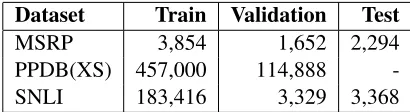
Dataset Train Validation Test
[image:2.612.323.528.54.110.2]MSRP 3,854 1,652 2,294 PPDB(XS) 457,000 114,888 -SNLI 183,416 3,329 3,368
Table 1:Datasets statistics (number of pairs)
tual entailments. We discard the negative examples from the MSRP dataset. We discard the neutral and contradiction examples and only keep entail-ment pairs from the SNLI corpus. We also use the small (XS) phrasal subset of the PPDB dataset, due to its higher-scoring pairs as compared to the other variants of PPDB. We also augmented all datasets with the inverse pair (Y, X) for each pair of sen-tences(X, Y)- this approach is completely justified for paraphrases, but it also makes sense for SNLI if we treat an entailment pair just as a paraphrase pair. The MSRP dataset is small, but it features long sentences with lots of numbers and proper nouns, which is rather problematic when predicting words from fixed-size vocabularies. The PPDB dataset contains a large number of short, but high-quality paraphrase pairs. We hypothesize that the SNLI en-tailments could prove useful in paraphrase genera-tion, due to the large lexical overlap between the premise and the hypothesis.
An overview of the datasets and their train/validation/test sizes is shown in Table 1.
3.3 Transfer learning
In order to perform transfer learning in scenarios of type X −→ Y, where X andY are two datasets for the same or different tasks, we follow the next steps. We train the SEQ2SEQ models on dataset X, keeping the configuration with the lowest perplexity on the validation set of X. We then transfer the pa-rameters to a new model that are retrained on dataset Y.
Transfer learning in scenarios of type X −→ Y −→ Z is similar to the process described above, but with the additional transfer from task/dataset Y to task/dataset Z.
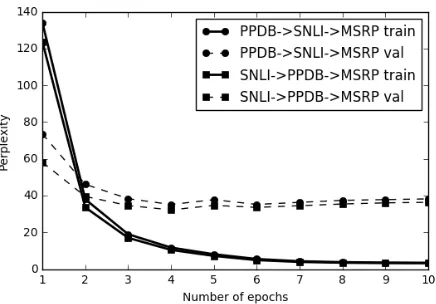
Figure 1:Perplexities with direct transfer
Experiment name test perplexity per word
BLEU score
MSRP 14.37 0.09
SNLI−→MSRP 3.97 7.17 PPDB−→MSRP 3.73 10.29 SNLI−→PPDB
−→MSRP 3.08 15.76
PPDB−→SNLI
−→MSRP 3.78 12.91
Table 2:BLEU score and perplexity on the MSRP test set over different transfer scenarios
3.4 Training
All models are trained using stochastic gradient de-scent (SGD), with a learning rate decay of 0.5 if the validation perplexity does not decrease on consecu-tive epochs. The models are trained for 20 epochs each. We perform early stopping by keeping the configurations with the lowest perplexity on the val-idation set.
3.5 Evaluation
[image:3.612.77.296.56.209.2]To generate paraphrases, we use beam-search with a beam size of 5. We report the BLEU score (Pa-pineni et al., 2002) and the perplexity of the recon-structed sentences for the MSRP test corpus. Al-though no standard metric has proved conclusive for evaluating paraphrase generation, BLEU score has been shown to correlate fairly well with hu-man judgements (Chen and Dolan, 2011), especially when more references are being used. We also plot the perplexity on the training and validations sets of different transfer scenarios.
Figure 2:Perplexities with one-hop transfer
4 Results
4.1 Quantitative results
Transfer learning improves perplexity and BLEU score
In Figure 1 we notice that transferring from the PPDB paraphrases yields lower perplexities than from the SNLI entailments. Not surprisingly, the additional transfer further lowers perplexity. How-ever, Figure 2 shows that perplexity is slightly lower when transferring from entailments through addi-tional paraphrases than the other way around.
The higher BLEU scores in Table 2 also seem to correlate well with the lower validation perplexities, with SNLI−→PPDB−→MSRP proving to be the best transfer setting. One possible explanation is that entailment pairs have a stronger lexical, but a weaker semantic overlap. Then phrasal (multi-word) para-phrases from PPDB are used to improve the seman-tic equivalence needed for paraphrasing. We turn to qualitative analysis, where we generate sentences using the SNLI−→PPDB−→MSRP model.
4.2 Qualitative results
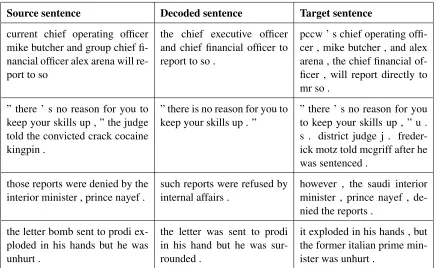
Results in Table 3 show that the model is able to restate parts of the input sentences, but fails to retain the whole meaning.
re-Source sentence Decoded sentence Target sentence
current chief operating officer mike butcher and group chief fi-nancial officer alex arena will re-port to so
the chief executive officer and chief financial officer to report to so .
pccw ’ s chief operating offi-cer , mike butcher , and alex arena , the chief financial of-ficer , will report directly to mr so .
” there ’ s no reason for you to keep your skills up , ” the judge told the convicted crack cocaine kingpin .
” there is no reason for you to
keep your skills up . ” ” there ’ s no reason for youto keep your skills up , ” u . s . district judge j . freder-ick motz told mcgriff after he was sentenced .
those reports were denied by the
interior minister , prince nayef . such reports were refused byinternal affairs . however , the saudi interiorminister , prince nayef , de-nied the reports .
the letter bomb sent to prodi ex-ploded in his hands but he was unhurt .
the letter was sent to prodi in his hand but he was sur-rounded .
[image:4.612.89.526.53.321.2]it exploded in his hands , but the former italian prime min-ister was unhurt .
Table 3:Four examples of source sentences from the MSRP test set, along with the decoded and the target sentences
tains part of the original meaning, but doesn’t con-tain important words such as ’bomb’ and ’exploded’. The truncation effect may be due to training on the entailment pairs, because most of the hypothe-ses featured in the SNLI dataset are shorter than the premises.
Also, without a copying mechanism, it is chal-lenging for SEQ2SEQ models to predict proper names, especially if they are rare or out of training vocabulary.
5 Conclusions and future work
In this paper, we investigated the use of SEQ2SEQ neural models for paraphrase generation. The ma-jor limitation in training such models is the shortage of corpora with (complex) sentential paraphrases, which we overcame by performing transfer learning, first using textual entailment and then phrasal para-phrase pairs.
We showed that transfer learning improves the BLEU score of the generated paraphrases in all transfer settings and that transfer works best when transferring entailments to short paraphrases and then to the longer paraphrases from the MSRP cor-pus.
Qualitative results showed promising results, with the model being able to restate parts of the input sen-tence fairly well. Further areas of research should address the lexical variety and should look into in-corporating copying mechanism into the network so that rare or unknown words are picked up during paraphrasing.
References
Ion Androutsopoulos and Prodromos Malakasiotis. 2010. A survey of paraphrasing and textual entailment methods. Journal of Artificial Intelligence Research, 38:135–187.
Dzmitry Bahdanau, Kyunghyun Cho, and Yoshua Ben-gio. 2014. Neural machine translation by jointly learning to align and translate. CoRR, abs/1409.0473. Samuel R. Bowman, Gabor Angeli, Christopher Potts, and Christopher D. Manning. 2015. A large annotated corpus for learning natural language inference. CoRR, abs/1508.05326.
D L Chen and W B Dolan. 2011. Collecting Highly Par-allel Data for Paraphrase Evaluation. Proceedings of the 49th Annual Meeting of the Association for Com-putational Linguistics, pages 190–200.
and Yoshua Bengio. 2014. Learning Phrase Repre-sentations using RNN Encoder-Decoder for Statistical Machine Translation.Proceedings of the 2014 Confer-ence on Empirical Methods in Natural Language
Pro-cessing (EMNLP), pages 1724–1734.
William B. Dolan and Chris Brockett. 2005. Automati-cally Constructing a Corpus of Sentential Paraphrases.
Proceedings of the Third International Workshop on
Paraphrasing (IWP2005), pages 9–16.
Anthony Fader, Luke Zettlemoyer, and Oren Etzioni. 2013. Paraphrase-Driven Learning for Open Question Answering. Acl, pages 1608–1618.
Andrew Finch, Taro Watanabe, Yasuhiro Akiba, and Eiichiro Sumita. 2004. Paraphrasing as machine translation. Journal of Natural Language Processing, 11(5):87–111.
Juri Ganitkevitch, Benjamin Van Durme, and Chris Callison-Burch. 2013. PPDB: the paraphrase database. pages 758–764.
Tsung-Yi Lin, Michael Maire, Serge Belongie, Lubomir D Bourdev, Ross B Girshick, James Hays, Pietro Perona, Deva Ramanan, Piotr Doll´ar, and C Lawrence Zitnick. 2014. Microsoft{COCO:}
Common Objects in Context. {arXiv}:1405.0312, pages 740–755.
Minh-Thang Luong, Hieu Pham, and Christopher D. Manning. 2015. Effective approaches to attention-based neural machine translation. CoRR, abs/1508.04025.
Jonathan Mallinson, Rico Sennrich, and Mirella Lap-ata. 2017. Paraphrasing revisited with neural machine translation. InProceedings of the 15th Conference of the European Chapter of the Association for Computa-tional Linguistics: Volume 1, Long Papers, pages 881– 893, Valencia, Spain, April. Association for Computa-tional Linguistics.
Lili Mou, Zhao Meng, Rui Yan, Ge Li, Yan Xu, Lu Zhang, and Zhi Jin. 2016. How transferable are neural networks in NLP applications? pages 479–489. Kishore Papineni, Salim Roukos, Todd Ward, and Wei-Jing Zhu. 2002. Bleu: A method for automatic evaluation of machine translation. In Proceedings of the 40th Annual Meeting on Association for Computa-tional Linguistics, ACL ’02, pages 311–318, Strouds-burg, PA, USA. Association for Computational Lin-guistics.
Aaditya Prakash, Sadid A. Hasan, Kathy Lee, Vivek Datla, Ashequl Qadir, Joey Liu, and Oladimeji Farri. 2016. Neural Paraphrase Generation with Stacked Residual LSTM Networks. Coling.
Chris Quirk, Chris Brockett, and William B. Dolan. 2004. Monolingual machine translation for paraphrase generation. pages 142–149.
Ilya Sutskever, Oriol Vinyals, and Quoc V Le. 2014. Sequence to sequence learning with neural networks.
Advances in Neural Information Processing Systems
(NIPS), pages 3104–3112.