Original Article
The association between OGG1
Ser326Cys polymorphism and breast cancer risk:
an updated meta-analysis of 20 case-control studies
Li-Wen He1,2, Jie Liu3, Rong Shi1, Hai-Lang Yu1, Jue-Yu Zhou1
1Institute of Genetic Engineering, School of Basic Medical Sciences, Southern Medical University, Guangzhou
510515, China; 2Zhujiang Hospital, Southern Medical University, Guangzhou 510515, China; 3Department of
Gynaecology and Obstetrics, Nanfang Hospital, Southern Medical University, Guangzhou 510515, China Received August 29, 2015; Accepted January 16, 2016; Epub February 15, 2016; Published February 29, 2016
Abstract: Human 8-oxoguanine glycosylase 1 (hOGG1) plays an important role in the base excision repair (BER) pathway. Numerous epidemiological studies have explored the association between hOGG1 Ser326Cys polymor-phism and breast cancer risk, but the results are inconsistent. We performed this meta-analysis to assess the as-sociation between Ser326Cys polymorphism and the risk of breast cancer, by critically reviewing 20 case-control studies including 9989 cases and 11759 controls. Pooled odds ratios (ORs) and 95% confidence intervals (CIs) were calculated using fixed- or random-effects models to estimate the association strength. Our analysis suggested that Ser326Cys polymorphism was significant associated with an increased risk of breast cancer for recessive model (OR=1.10, 95% CI=1.01-1.19) in the whole population. In the subgroup analysis by ethnicity, a significant association was found among Asians (recessive model: OR=1.10, 95% CI=1.00-1.21; homozygote model: OR=1.15, 95% CI=1.01-1.31 and additive model: OR=1.07, 95% CI=1.01-1.14), but not Caucasians. When stratified by the source of controls, we observed a significantly increased risk of breast cancer in hospital-based studies (recessive model: OR=1.19, 95% CI=1.07-1.31; homozygote model: OR=1.16, 95% CI=1.01-1.32). Furthermore, we found a significant increased risk of breast cancer in hospital-based studies among both Asians (recessive model: OR=1.17, 95% CI=1.05-1.31; homozygote model: OR=1.19, 95% CI=1.02-1.39; additive model: OR=1.10, 95% CI=1.02-1.19) and Caucasians (recessive model: OR=1.25, 95% CI=1.01-1.56). This update meta-analysis suggests that OGG1 Ser326Cys polymorphism may be a risk factor of breast cancer. Nevertheless, large-scale, well-designed and pop-ulation-based studies are needed to further evaluate gene-environment interaction on Ser326Cys polymorphism and breast cancer risk.
Keywords: OGG1, breast cancer, polymorphism, meta-analysis
Introduction
Breast cancer is one of the most common malignancies in females today, and its morbid-ity and mortalmorbid-ity are still increasing [1]. Worldwide, breast cancer accounts for 22.9% of all cancers (excluding non-melanoma skin cancers) in females, with an estimated 1.38 million new cases and 458,000 deaths in 2008 [2]. Although the etiology of breast cancer is still not completely known, previous studies have shown that various factors have been associated with the increased risk of breast cancer, including family history of breast can-cer, ionizing radiation (IR), reactive oxygen radi-cals, bulky DNA adducts, oxidized DNA bases,
DNA strand breaks, heterocyclic aromatic amines, and alcohol [3-6]. However, only a por-tion of those who have been exposed to these risk factors will develop breast cancer, indicat-ing that different genetic background may mod-ify the individual’s susceptibility to breast cancer.
that oxidative DNA damage induced by reactive oxygen species plays an important role in carci-nogenesis, which is usually repaired through the base excision repair (BER) pathway. 8-Oxodeoxyguanosine, the most abundant lesion generated by oxidative stress can be excised by 8-oxoguanine DNA glycosylase/AP lyase, the key enzyme in BER pathway encoded by human 8-oxoguanine glycosylase 1 (hOGG1). hOGG1 located on chromosome 3p26, is highly polymorphic, and a number of single nucleotide polymorphisms (SNPs) have been identified, and a common functional polymorphism (Ser326Cys) on exon 7 (rs1052133; C/G) was extensively investigated for its association with the risks of several cancers, such as colorectal cancer, childhood acute lymphoblastic leuke-mia, nasopharyngeal carcinoma and lung can-cer [10-12].
Although several epidemiological studies have reported the association between OGG1 Ser326Cys polymorphism and breast cancer risk, the results were contradictory [13-30]. Besides, two previous published meta-analy-ses reported the conflicting results regarding OGG1 Ser326Cys polymorphism and the sus-ceptibility to breast cancer [31-33]. What’s more, several new associated case-control studies of different population have since been published. In order to provide strong evidence of the effects of this polymorphism on breast cancer risk, we performed a meta-analysis with subgroup analysis based on all available stud-ies to estimate the relationship between OGG1 Ser326Cys polymorphism and breast cancer risk.
Materials and methods
Search strategy
We managed to search the electronic literature by using PubMed and EMBASE databases for all relevant articles that evaluated the associa-tion between OGG1 Ser326Cys polymorphism and the risk of breast cancer up to June 28, 2015. The following terms were used in this search: (“human 8-oxoguanine DNA glycosyl-ase” or hOGG1 or OGG1 or OGG) AND (polymor-phism or variation or mutation) AND (“breast cancer” or “breast tumor” or “breast carcino-ma” or “breast neoplasm”). The references cited in all studies were also reviewed to
iden-tify additional published articles, which was not indexed by the above databases.
Inclusion criteria
Studies which meet the following criteria were included in our meta-analysis: 1) a case-control study evaluating the OGG1 Ser326Cys poly-morphism; 2) studies with full text articles; 3) containing enough data for estimating the odds ratios (OR) with the corresponding 95% confi-dence intervals (CI); 4) no overlapping data. Exclusion criteria
Studies were excluded if they meet the follow-ing criteria: 1) studies without Ser326Cys fre-quency for the OGG1 polymorphism; 2) not design as a case-control study; 3) without suf-ficient data to estimate OR with 95% CI; 4) stud-ies not in Hardy-Weinberg equilibrium (HWE). Data extraction
Information was carefully extracted from all the eligible studies independently by three investi-gators according to the inclusion criteria listed above and reached a consensus on all of the eligibility items. For each study, the following data were collected: first author, publication year, country of origin, ethnicity, menopausal status, source of controls, genotyping method, numbers of cases and controls, genotype fre-quency of cases and controls, and the result of Hardy-Weinberg equilibrium test. Different racial descents were categorized as Caucasian and Asian.
Statistical analysis
a P value of less than 0.05 was considered sig-nificant. A chi-square-based Q test was used to test heterogeneity [34], and the proportion of the total variation due to heterogeneity was quantified by calculating I2 statistics [35]. If the
P value of the Q test was greater than 0.05 which indicates a lack of heterogeneity among studies, the Mantel-Haenszel method-based fixed-effects model was used to calculate the pooled OR [36]. Otherwise, the DerSimonian and Laird method-based random-effects model was applied [37]. Subgroup analyses were also performed by ethnicity, menopausal status and source of control. Moreover, sensitivity analysis was mainly performed by excluding a single study each time. Publication bias was evaluat-ed with funnel plot, in which the standard error of log (OR) of each study was plotted against its log (OR). Funnel plot asymmetry was further assessed by the method of Egger’s linear regression test (P<0.05 was considered a
sig-include small proportions of non-Caucasian subjects, the data for all subjects were used because we could not extract ethnicity specific data from the studies [20, 22]. Therefore, there were 11 studies of Caucasians and 9 studies of Asians. The study was by Vogel et al. [27] only provided the data of postmenopausal female, and it was still included in this meta-analysis. Among them, 8 studies (2 studies of Caucasians and 6 studies of Asians) provided the data of premenopausal females, and 9 studies (3 stud-ies of Caucasians and 6 studstud-ies of Asians) of postmenopausal females. The main character-istics of these included studies and allele fre-quencies of OGG1 Ser326Cys polymorphism in case and control were shown in Table 1. Meta-analysis results
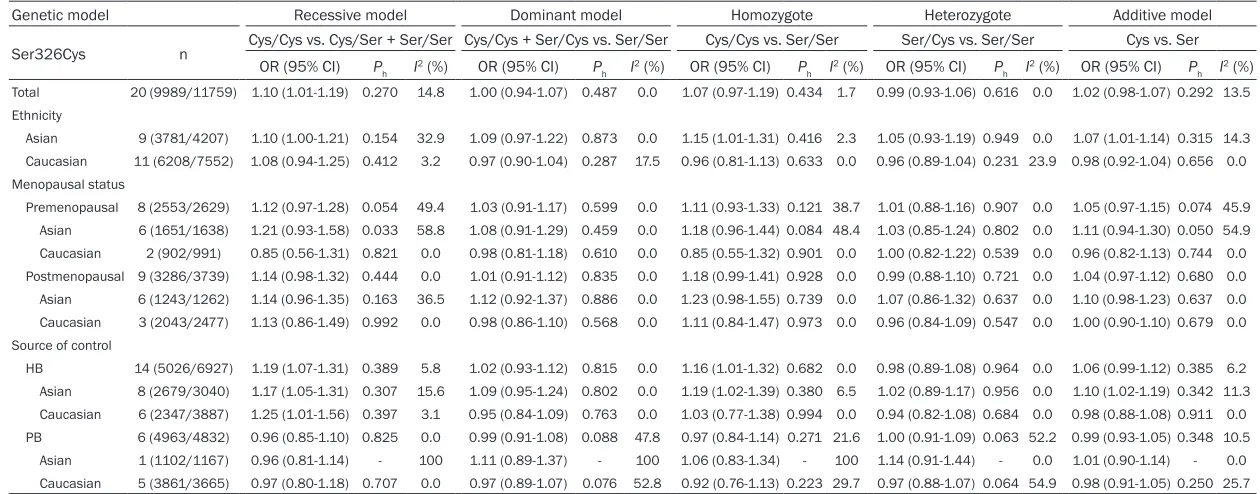
[image:3.612.89.365.71.421.2]The results of the meta-analysis of OGG1 Ser326Cys polymorphism were listed in Table 2. The combined result based on all studies
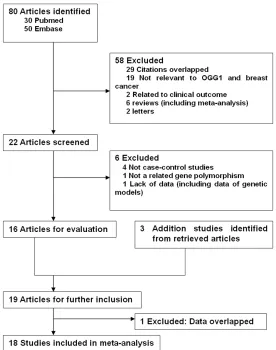
Figure 1. Flow of included studies.
nificant publication bias) [38]. All of the statistical analyses were carried by STATA version 11.0 (Stata, College Station, TX, USA). Result
Extraction process and study characteristics
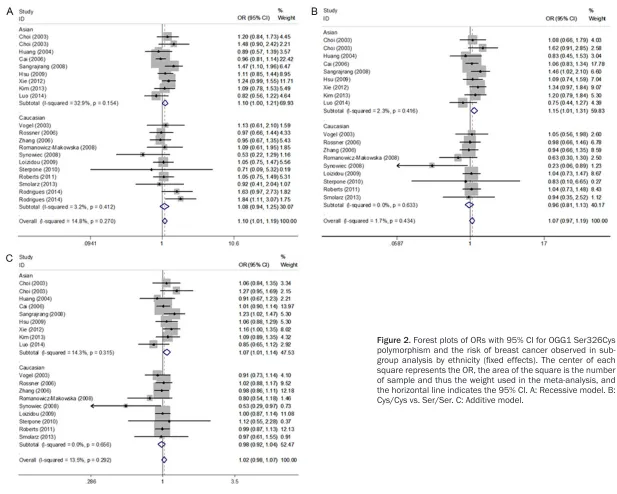
showed that OGG1 Ser326Cys polymorphism was significantly associated with an increased risk of breast cancer for recessive model (OR=1.10, 95% CI=1.01-1.19; Figure 2; Table 2). In terms of subgroup analyses by ethnicity, significantly increased risks were found among Asians for recessive model (OR=1.10, 95% CI=1.00-1.21; Figure 2; Table 2), homozygote model (OR=1.15, 95% CI=1.01-1.31; Figure 2; Table 2) and additive model (OR=1.07, 95% CI=1.01-1.14; Figure 2; Table 2), but not among Caucasians. As for the subgroup analyses by source of control, significantly increased risks were found in hospital-based studies (reces-sive model: OR=1.19, 95% CI=1.07-1.31; homo-zygote model: OR=1.16, 95% CI=1.01-1.32; Figure 3; Table 2), but not in population-based studies. However, we noticed a significant increased risk of breast cancer in hospital-based studies among both Asians (recessive model: OR=1.17, 95% CI=1.05-1.31; homozy-gote model: OR=1.19, 95% CI=1.02-1.39; addi-tive model: OR=1.10, 95% CI=1.02-1.19; Figure 3; Table 2) and Caucasians (recessive model: OR=1.25, 95% CI=1.01-1.56; Figure 3; Table 2). Meanwhile, stratified analyses by meno-pausal status indicated that no significant association was found in both premenopausal
and postmenopausal females for all genetic models. Additionally, further analyses stratified by menopausal status in different ethnicities revealed this polymorphism had no influence on the risk of breast cancer in either premeno-pausal or postmenopremeno-pausal females of different ethnicities.
Test of heterogeneity and sensitivity analyses
The results of heterogeneity test indicated that there was no significant heterogeneity in overall comparisons (Table 2). Furthermore, influence analysis was performed to assess the influence of a single study on the pooled ORs by sequen-tial omission of individual studies and no indi-vidual study significantly influenced the pooled ORs as a result, suggesting that the results of this meta-analysis are credible.
Publication bias
Both Begg’s funnel plot and Egger’s test were performed to assess the publication bias of lit-eratures. The shapes of the funnel plots did not reveal any evidence of obvious asymmetry. We present funnel plot for ORs of recessive model and additive model for OGG1 Ser326Cys poly-Table 1. Characteristics of studies included in the meta-analysis and their genotype distributions of OGG1 Ser326Cys polymorphisms
First author Ethnicity Year Design (case/control)Sample size Case Control HWE MAF AA Aa aa AA Aa aa
Choi Asian 2003 HB 265 284 48 132 85 49 155 80 0.078 0.555
Choi Asian 2003 HB 201 184 57 95 49 62 89 33 0.914 0.421
Vogel Caucasian 2003 HB 425 434 256 147 22 245 169 20 0.175 0.241
Huang Asian 2004 HB 136 232 25 63 48 38 106 88 0.525 0.608
Cai Asian 2006 PB 1102 1167 186 534 382 214 537 416 0.080 0.587
Rossner Caucasian 2006 PB 1041 1093 615 375 51 653 385 55 0.857 0.226
Zhang Caucasian 2006 PB 1571 1244 967 532 72 760 424 60 0.930 0.219
Romanowicz-Makowska Caucasian 2008 PB 100 106 32 34 34 20 52 34 0.988 0.566
Sangrajrang Asian 2008 HB 506 424 112 232 162 104 217 103 0.627 0.499
Synowiec Caucasian 2008 PB 41 48 10 19 12 4 23 21 0.507 0.677
Hsu Asian 2009 HB 401 533 64 165 172 87 231 215 0.064 0.620
Loizidou Caucasian 2009 PB 1108 1174 615 422 71 647 455 72 0.499 0.255
Sterpone Caucasian 2010 HB 43 31 18 23 2 15 14 2 0.593 0.290
Roberts Caucasian 2011 HB 1054 1887 634 366 54 1125 670 92 0.543 0.226
Xie Asian 2012 HB 630 777 96 310 224 137 401 239 0.161 0.566
Kim Asian 2013 HB 346 361 73 181 92 86 185 90 0.634 0.506
Smolarz Caucasian 2013 HB 70 70 16 39 15 16 38 16 0.473 0.500
Luo Asian 2014 HB 194 245 42 87 65 45 107 93 0.151 0.598
Rodrigues Caucasian 2014 HB 347 665 319 28 631 34 0.870 0.213
Rodrigues Caucasian 2014 HB 408 800 378 30 767 33 -
Table 2. Results of meta-analysis for Ser326Cys polymorphisms and the risk of breast cancer
Genetic model Recessive model Dominant model Homozygote Heterozygote Additive model
Ser326Cys n Cys/Cys vs. Cys/Ser + Ser/Ser Cys/Cys + Ser/Cys vs. Ser/Ser Cys/Cys vs. Ser/Ser Ser/Cys vs. Ser/Ser Cys vs. Ser OR (95% CI) Ph I2 (%) OR (95% CI) P
h I2 (%) OR (95% CI) Ph I2 (%) OR (95% CI) Ph I2 (%) OR (95% CI) Ph I2 (%)
Total 20 (9989/11759) 1.10 (1.01-1.19) 0.270 14.8 1.00 (0.94-1.07) 0.487 0.0 1.07 (0.97-1.19) 0.434 1.7 0.99 (0.93-1.06) 0.616 0.0 1.02 (0.98-1.07) 0.292 13.5 Ethnicity
Asian 9 (3781/4207) 1.10 (1.00-1.21) 0.154 32.9 1.09 (0.97-1.22) 0.873 0.0 1.15 (1.01-1.31) 0.416 2.3 1.05 (0.93-1.19) 0.949 0.0 1.07 (1.01-1.14) 0.315 14.3 Caucasian 11 (6208/7552) 1.08 (0.94-1.25) 0.412 3.2 0.97 (0.90-1.04) 0.287 17.5 0.96 (0.81-1.13) 0.633 0.0 0.96 (0.89-1.04) 0.231 23.9 0.98 (0.92-1.04) 0.656 0.0 Menopausal status
Premenopausal 8 (2553/2629) 1.12 (0.97-1.28) 0.054 49.4 1.03 (0.91-1.17) 0.599 0.0 1.11 (0.93-1.33) 0.121 38.7 1.01 (0.88-1.16) 0.907 0.0 1.05 (0.97-1.15) 0.074 45.9 Asian 6 (1651/1638) 1.21 (0.93-1.58) 0.033 58.8 1.08 (0.91-1.29) 0.459 0.0 1.18 (0.96-1.44) 0.084 48.4 1.03 (0.85-1.24) 0.802 0.0 1.11 (0.94-1.30) 0.050 54.9 Caucasian 2 (902/991) 0.85 (0.56-1.31) 0.821 0.0 0.98 (0.81-1.18) 0.610 0.0 0.85 (0.55-1.32) 0.901 0.0 1.00 (0.82-1.22) 0.539 0.0 0.96 (0.82-1.13) 0.744 0.0 Postmenopausal 9 (3286/3739) 1.14 (0.98-1.32) 0.444 0.0 1.01 (0.91-1.12) 0.835 0.0 1.18 (0.99-1.41) 0.928 0.0 0.99 (0.88-1.10) 0.721 0.0 1.04 (0.97-1.12) 0.680 0.0 Asian 6 (1243/1262) 1.14 (0.96-1.35) 0.163 36.5 1.12 (0.92-1.37) 0.886 0.0 1.23 (0.98-1.55) 0.739 0.0 1.07 (0.86-1.32) 0.637 0.0 1.10 (0.98-1.23) 0.637 0.0 Caucasian 3 (2043/2477) 1.13 (0.86-1.49) 0.992 0.0 0.98 (0.86-1.10) 0.568 0.0 1.11 (0.84-1.47) 0.973 0.0 0.96 (0.84-1.09) 0.547 0.0 1.00 (0.90-1.10) 0.679 0.0 Source of control
HB 14 (5026/6927) 1.19 (1.07-1.31) 0.389 5.8 1.02 (0.93-1.12) 0.815 0.0 1.16 (1.01-1.32) 0.682 0.0 0.98 (0.89-1.08) 0.964 0.0 1.06 (0.99-1.12) 0.385 6.2 Asian 8 (2679/3040) 1.17 (1.05-1.31) 0.307 15.6 1.09 (0.95-1.24) 0.802 0.0 1.19 (1.02-1.39) 0.380 6.5 1.02 (0.89-1.17) 0.956 0.0 1.10 (1.02-1.19) 0.342 11.3 Caucasian 6 (2347/3887) 1.25 (1.01-1.56) 0.397 3.1 0.95 (0.84-1.09) 0.763 0.0 1.03 (0.77-1.38) 0.994 0.0 0.94 (0.82-1.08) 0.684 0.0 0.98 (0.88-1.08) 0.911 0.0 PB 6 (4963/4832) 0.96 (0.85-1.10) 0.825 0.0 0.99 (0.91-1.08) 0.088 47.8 0.97 (0.84-1.14) 0.271 21.6 1.00 (0.91-1.09) 0.063 52.2 0.99 (0.93-1.05) 0.348 10.5 Asian 1 (1102/1167) 0.96 (0.81-1.14) - 100 1.11 (0.89-1.37) - 100 1.06 (0.83-1.34) - 100 1.14 (0.91-1.44) - 0.0 1.01 (0.90-1.14) - 0.0 Caucasian 5 (3861/3665) 0.97 (0.80-1.18) 0.707 0.0 0.97 (0.89-1.07) 0.076 52.8 0.92 (0.76-1.13) 0.223 29.7 0.97 (0.88-1.07) 0.064 54.9 0.98 (0.91-1.05) 0.250 25.7
morphism in Figure 4. And the results of Egger’s test still did not suggest any evidence of publication bias (P=0.319 for dominant model, P=0.971 for recessive model, P=0.066 for homozygote model, P=0.199 for heterozy-gote model, and P=0.329 for additive model).
[image:7.612.90.381.67.550.2]In the present meta-analysis, we performed a quantitative synthesis of the evidence on the association between OGG1 Ser326Cys poly-morphism and the risk of breast cancer based on 20 case-control studies with 9989 cases and 11759 controls. The combined results
Figure 3. Forest plots of ORs with 95% CI for OGG1 Ser326Cys polymorphism and the risk of breast cancer observed in hospital-based controls (fixed ef-fects). The center of each square represents the OR, the area of the square is the number of sample and thus the weight used in the meta-analysis, and the horizontal line indicates the 95% CI. A: Recessive model. B: Cys/Cys vs. Ser/Ser.
Discussion
revealed that OGG1 Ser326Cys polymorphism was significantly associated with an increased risk of breast cancer in the whole population, which was inconsistent with all the previous meta-analyses [31-33, 41]. When stratified by ethnicity, our results showed that Ser326Cys polymorphism might contribute to the suscepti-bility of breast cancer among Asians, but not Caucasians, which were differed from the con-clusions drawn by Gu et al. [31] and Yuan et al. [32] in their meta-analyses. Interestingly, sev-eral meta-analyses suggested that Ser326Cys polymorphism may increase the predisposition to esophageal cancer [42] among Asians, whereas it may confer significantly increased risks of lung cancer [43] or colorectal cancer [44] among Caucasians. However, Xu et al. [43]
[image:8.612.90.367.70.451.2]influence of the genetic variant. Thus, further investigations are warranted to validate ethnic differences in the effect of this functional poly-morphism on cancer risk, especially in Asians. Furthermore, subgroup analyses based on the source of control showed that individuals who carried Cys allele might have a significantly increased risk of breast cancer among the hos-pital-based studies but not the population-based. The reason may be that hospital-based studies have some bias. Because these con-trols may suffer certain begin disease which have different risks of developing malignancy and may not be very representative of the gen-eral population. Thus, the use of a proper and representative cancer-free control subjects is
Figure 4. Begg’s funnel plots of OGG1 Ser326Cys polymorphism and breast cancer risk for publication bias test. Each point represents a sepa-rate study for the indicated association. Log (OR), natural logarithm of OR. Horizontal line, means effect size. A: Recessive model. B: Additive model.
very important in reducing biases in such case-control studies. While stratified analyses by ethnicities in hospital-based studies, the result indicated that significant associations were observed among both Asians and Caucasians, implying that source of controls may affect the overall results in the whole population. Additionally, there was no evidence for the association between Ser326Cys polymorphism and breast cancer risk in both premenopausal and postmenopausal females, which was inconsistent with the conclusion drawn by Peng et al. [33]. Similarly, Ser326Cys polymorphism is not associated with increased breast cancer risk in either premenopausal or postmeno-pausal females among different ethnicities. Previous meta-analysis by Yuan et al. [32] reported that 326Cys allele might have signifi-cant protective effects on breast cancer among Caucasian women. However, the meta-analy-ses by Gu et al. [31] and Peng et al. [33] did not show the significant results of Caucasian popu-lation. In addition, the studies by Yuan et al. [31] and Zhou et al. [41] did not conduct with all published case-control studies, which may interfere with the results. In the published stud-ies, one study showed a significantly increased risk of postmenopausal females in dominant model [23], but the other studies provided inconsistent results [13-15, 20, 27, 28]. Studies with small sample sizes may have insufficient statistical power to detect any slight effect, so a positive association between this polymor-phism and breast cancer might therefore not be ruled out. But in this update meta-analysis, the sample size was large enough to detect a moderate statistical significance of Ser326Cys polymorphism. For example, the subgroup anal-ysis of Asians, including 9 studies (3781 cases and 4207 controls), the sample size was enough to ascertain the association strength of Ser326Cys polymorphism with breast cancer risk. With the accumulating evidence and enlarged sample size, we enhance statistical power to provide more precise and reliable risk estimates than the previous meta-analyses. First, sensitivity analyses revealed that the results were robust. Second, there was no sig-nificant heterogeneity in most of the compari-sons. Third, funnel plots and Egger’s tests found no significant publication bias.
In interpreting our results of the present meta-analysis, several limitations merit
consider-ation. First, the number of published studies was not sufficiently large for stratified analysis by menopausal status in different ethnicities. Our results were hindered because of limited available data for the Caucasian population. Larger studies are needed to clarify whether OGG1 Ser326Cys polymorphism affects the risk of breast cancer in both premenopausal and postmenopausal females from different ethnicities. Second, these results for hospital-based studies should be interpreted with cau-tion because the controls were not uniformly defined. Some studies used a healthy popula-tion as the control group, whereas others selected hospital patients without cancer. Therefore, non-differential misclassification bias is possible because these studies may have included the individuals who have differ-ent risks of developing breast cancer. Third, our results were based on single-factor estimates without adjustment for other risk factors such as smoking status, drinking consumption, envi-ronmental factors and other variables, which might have caused serious confounding bias. In conclusion, our meta-analysis suggested that OGG1 Ser326Cys polymorphism was sig-nificantly associated with increased risk of breast cancer. Nevertheless, large-scale, well-designed and population-based studies are needed to further evaluate gene-environment interaction on Ser326Cys polymorphism and breast cancer risk. Additional studies exploring the combined effects of different polymor-phisms in genes involved in DNA repair path-way should be investigated.
Acknowledgements
This work was supported by the National Na- tural Science Foundation of China (81201565), Program of the Pearl River Young Talents of Science and Technology in Guangzhou, China (2013J2200042), Natural Science Foundation of Guangdong Province, China (2014A0303- 13293) and Specialized Research Fund for the Doctoral Program of Higher Education of China (20124433120001).
Disclosure of conflict of interest
None.
Sciences, Southern Medical University, Guangzhou 510515, China. Tel: 20-61648209; Fax: +86-20-62789098; E-mail: [email protected]
References
[1] Ferlay J, Shin HR, Bray F, Forman D, Mathers C and Parkin DM. Estimates of worldwide burden of cancer in 2008: GLOBOCAN 2008. Int J Cancer 2010; 127: 2893-2917.
[2] Boyle PL, B. International Agency for Research on Cancer. World Cancer Report 2008. [3] Dumitrescu RG and Cotarla I. Understanding
breast cancer risk -- where do we stand in 2005? J Cell Mol Med 2005; 9: 208-221. [4] Hu JJ, Smith TR, Miller MS, Lohman K and
Case LD. Genetic regulation of ionizing radia-tion sensitivity and breast cancer risk. Environ Mol Mutagen 2002; 39: 208-215.
[5] Parshad R, Price FM, Bohr VA, Cowans KH, Zujewski JA and Sanford KK. Deficient DNA re-pair capacity, a predisposing factor in breast cancer. Br J Cancer 1996; 74: 1-5.
[6] Smith TR, Miller MS, Lohman K, Lange EM, Case LD, Mohrenweiser HW and Hu JJ. Polymorphisms of XRCC1 and XRCC3 genes and susceptibility to breast cancer. Cancer Lett 2003; 190: 183-190.
[7] Marnett LJ. Oxyradicals and DNA damage. Carcinogenesis 2000; 21: 361-370.
[8] Ramana CV, Boldogh I, Izumi T and Mitra S. Activation of apurinic/apyrimidinic endonucle-ase in human cells by reactive oxygen species and its correlation with their adaptive response to genotoxicity of free radicals. Proc Natl Acad Sci U S A 1998; 95: 5061-5066.
[9] Robertson AB, Klungland A, Rognes T and Leiros I. DNA repair in mammalian cells: Base excision repair: the long and short of it. Cell Mol Life Sci 2009; 66: 981-993.
[10] Weiss JM, Goode EL, Ladiges WC and Ulrich CM. Polymorphic variation in hOGG1 and risk of cancer: a review of the functional and epide-miologic literature. Mol Carcinog 2005; 42: 127-141.
[11] Canbay E, Cakmakoglu B, Zeybek U, Sozen S, Cacina C, Gulluoglu M, Balik E, Bulut T, Yamaner S and Bugra D. Association of APE1 and hOGG1 polymorphisms with colorectal cancer risk in a Turkish population. Curr Med Res Opin 2011; 27: 1295-1302.
[12] Li Q, Wang JM, Peng Y, Zhang SH, Ren T, Luo H, Cheng Y and Wang D. Association of DNA base-excision repair XRCC1, OGG1 and APE1 gene polymorphisms with nasopharyngeal carcino-ma susceptibility in a Chinese population. Asian Pac J Cancer Prev 2013; 14: 5145-5151. [13] Cai Q, Shu XO, Wen W, Courtney R, Dai Q, Gao
YT and Zheng W. Functional Ser326Cys
poly-morphism in the hOGG1 gene is not associat-ed with breast cancer risk. Cancer Epidemiol Biomarkers Prev 2006; 15: 403-404.
[14] Choi JY, Hamajima N, Tajima K, Yoo KY, Yoon KS, Park SK, Kim SU, Lee KM, Noh DY, Ahn SH, Choe KJ, Han W, Hirvonen A and Kang D. hOGG1 Ser326Cys polymorphism and breast cancer risk among Asian women. Breast Cancer Res Treat 2003; 79: 59-62.
[15] Luo H, Li Z, Qing Y, Zhang SH, Peng Y, Li Q, Wang D. Single Nucleotide Polymorphisms of DNA Base-excision Repair Genes (APE1, OGG1 and XRCC1) Associated with Breast Cancer Risk in a Chinese Population. Asian Pac J Cancer Prev 2014; 15: 1133-1140.
[16] Hsu MS, Yu JC, Wang HW, Chen ST, Hsiung CN, Ding Sl, Wu PE, Shen CY and Cheng CW. Synergistic Effects of Polymorphisms in DNA Repair Genes and Endogenous Estrogen Exposure on Female Breast Cancer Risk. Ann Surg Oncol 2009; 17: 760-771.
[17] Huang CC, Yang J, Cheng S, Chern C, Chang H, Wu K, Shen P, Breast C. Cancer Risk Associated with Genotypic Polymorphism of Oxidative DNA Damage Repair Genes - A Multigenic Study of Base Excision Repair and Transcription-Coupled Repair in Cancer Susceptibility. Genet Mol Biol 2004; 15: 116-136.
[18] Kim KY, Han W, Noh DY, Kang D and Kwack K. Impact of genetic polymorphisms in base exci-sion repair genes on the risk of breast cancer in a Korean population. Gene 2013; 532: 192-196.
[19] Loizidou MA, Michael T, Neuhausen SL, Newbold RF, Marcou Y, Kakouri E, Daniel M, Papadopoulos P, Malas S, Hadjisavvas A and Kyriacou K. DNA-repair genetic polymorphisms and risk of breast cancer in Cyprus. Breast Cancer Res Treat 2009; 115: 623-627. [20] Roberts MR, Shields PG, Ambrosone CB, Nie J,
Marian C, Krishnan SS, Goerlitz DS, Modali R, Seddon M, Lehman T, Amend KL, Trevisan M, Edge SB and Freudenheim JL. Single-nucleotide polymorphisms in DNA repair genes and association with breast cancer risk in the web study. Carcinogenesis 2011; 32: 1223-1230.
[21] Romanowicz-Makowska H, Smolarz B, Ma-kowski M, Polac I and Pertynski T. Ser326Cys polymorphism in DNA repair genes hOGG1 in breast cancer women. Pol J Pathol 2008; 59: 201-204.
[23] Sangrajrang S, Schmezer P, Burkholder I, Waas P, Boffetta P, Brennan P, Bartsch H, Wiangnon S and Popanda O. Polymorphisms in three base excision repair genes and breast cancer risk in Thai women. Breast Cancer Res Treat 2008; 111: 279-288.
[24] Smolarz B, Makowska M, Samulak D, Michalska MM, Mojs E, Wilczak M and Romanowicz H. Single nucleotide polymor-phisms (SNPs) of ERCC2, hOGG1, and XRCC1 DNA repair genes and the risk of triple-nega-tive breast cancer in Polish women. Tumour Biol 2014; 35: 3495-502.
[25] Sterpone S, Mastellone V, Padua L, Novelli F, Patrono C, Cornetta T, Giammarino D, Donato V, Testa A and Cozzi R. Single-nucleotide poly-morphisms in BER and HRR genes, XRCC1 haplotypes and breast cancer risk in Caucasian women. J Cancer Res Clin Oncol 2010; 136: 631-636.
[26] Synowiec E, Stefanska J, Morawiec Z, Blasiak J and Wozniak K. Association between DNA damage, DNA repair genes variability and clini-cal characteristics in breast cancer patients. Mutat Res 2008; 648: 65-72.
[27] Vogel U, Nexo BA, Olsen A, Thomsen B, Jacobsen NR, Wallin H, Overvad K and Tjonneland A. No association between OGG1 Ser326Cys polymorphism and breast cancer risk. Cancer Epidemiol Biomarkers Prev 2003; 12: 170-171.
[28] Xie H, Xia K, Rong H and Chen X. Genetic poly-morphism in hOGG1 is associated with triple-negative breast cancer risk in Chinese Han women. Breast 2013; 22: 707-712.
[29] Zhang Y, Newcomb PA, Egan KM, Titus-Ernstoff L, Chanock S, Welch R, Brinton LA, Lissowska J, Bardin-Mikolajczak A, Peplonska B, Szeszenia-Dabrowska N, Zatonski W and Garcia-Closas M. Genetic polymorphisms in base-excision repair pathway genes and risk of breast cancer. Cancer Epidemiol Biomarkers Prev 2006; 15: 353-358.
[30] Rodrigues P, de Marco G, Furriol J, Mansego ML, Pineda-Alonso M, Gonzalez-Neira A, Martin-Escudero JC, Benitez J, Lluch A, Chaves FJ and Eroles P. Oxidative stress in susceptibil-ity to breast cancer: study in Spanish popula-tion. BMC Cancer 2014; 14: 861.
[31] Gu D, Wang M, Zhang Z and Chen J. Lack of association between the hOGG1 Ser326Cys polymorphism and breast cancer risk: evi-dence from 11 case-control studies. Breast Cancer Res Treat 2010; 122: 527-531. [32] Yuan W, Xu L, Feng Y, Yang Y, Chen W, Wang J,
Pang D and Li D. The hOGG1 Ser326Cys poly-morphism and breast cancer risk: a meta-anal-ysis. Breast Cancer Res Treat 2010; 122: 835-842.
[33] Peng Q, Lu Y, Lao X, Chen Z, Li R, Sui J, Qin X and Li S. Association between OGG1 Ser-326Cys and APEX1 Asp148Glu polymorphisms and breast cancer risk: a meta-analysis. Diagn Pathol 2014; 9: 108.
[34] W C. The combination of estimates from differ-ent experimdiffer-ents. 1954; 101-129.
[35] Higgins JP, Thompson SG, Deeks JJ and Altman DG. Measuring inconsistency in meta-analy-ses. BMJ 2003; 327: 557-560.
[36] Mantel N and Haenszel W. Statistical aspects of the analysis of data from retrospective stud-ies of disease. J Natl Cancer Inst 1959; 22: 719-748.
[37] DerSimonian R and Laird N. Meta-analysis in clinical trials. Control Clin Trials 1986; 7: 177-188.
[38] Egger M, Davey Smith G, Schneider M and Minder C. Bias in meta-analysis detected by a simple, graphical test. BMJ 1997; 315: 629-634.
[39] Dianov GL, Souza-Pinto N, Nyaga SG, Thybo T, Stevnsner T and Bohr VA. Base excision repair in nuclear and mitochondrial DNA. Prog Nucleic Acid Res Mol Biol 2001; 68: 285-297. [40] Karahalil B, Hogue BA, de Souza-Pinto NC,
Bohr VA. Base excision repair capacity in mito-chondria and nuclei: tissue-specific variations. FASEB J 2002; 16: 1895-902.
[41] Zhou PT, Li B, Ji J, Wang MM and Gao CF. A systematic review and meta-analysis of the as-sociation between OGG1 Ser326Cys polymor-phism and cancers. Med Oncol 2015; 32: 472. [42] Wang Z, Gan L, Nie W and Geng Y. The OGG1
Ser326Cys polymorphism and the risk of esophageal cancer: a meta-analysis. Genet Test Mol Biomarkers 2013; 17: 780-785. [43] Xu Z, Yu L and Zhang X. Association between
the hOGG1 Ser326Cys polymorphism and lung cancer susceptibility: a meta-analysis based on 22,475 subjects. Diagn Pathol 2013; 8: 144.
[44] Su Y, Xu A and Zhu J. The effect of oxoguanine glycosylase 1 rs1052133 polymorphism on colorectal cancer risk in Caucasian population. Tumour Biol 2014; 35: 513-517.
[45] Wang Z, Hu J, Cai W and Zhong J. Lack of as-sociation between the 8-oxoguanine DNA gly-cosylase gene Ser326Cys polymorphism and gastric cancer: evidence from a meta-analysis. Asian Pac J Cancer Prev 2011; 12: 3427-3431. [46] Yan Y, Chen X, Li T, Li M and Liang H. Association of OGG1 Ser326Cys polymorphism and pan-creatic cancer susceptibility: evidence from a meta-analysis. Tumour Biol 2014; 35: 2397-2402.