Proceedings of the Fourth Joint Conference on Lexical and Computational Semantics (*SEM 2015), pages 92–100,
Non-Orthogonal Explicit Semantic Analysis
Nitish Aggarwal Kartik Asooja Georgeta Bordea Paul Buitelaar
Insight Centre for Data Analytics National University of Ireland
Galway, Ireland
Abstract
Explicit Semantic Analysis (ESA) utilizes the Wikipedia knowledge base to represent the se-mantics of a word by a vector where every dimension refers to an explicitly defined con-cept like a Wikipedia article. ESA inherently assumes that Wikipedia concepts are orthog-onal to each other, therefore, it considers that two words are related only if they co-occur in the same articles. However, two words can be related to each other even if they appear separately in related articles rather than co-occurring in the same articles. This leads to a need for extending the ESA model to sider the relatedness between the explicit con-cepts (i.e. Wikipedia articles in Wikipedia based implementation) for computing textual relatedness. In this paper, we present Non-Orthogonal ESA (NESA) which represents more fine grained semantics of a word as a vector of explicit concept dimensions, where every such concept dimension further consti-tutes a semantic vector built in another vec-tor space. Thus, NESA considers the concept correlations in computing the relatedness be-tween two words. We explore different ap-proaches to compute the concept correlation weights, and compare these approaches with other existing methods. Furthermore, we eval-uate our model NESA on several word related-ness benchmarks showing that it outperforms the state of the art methods.
1 Introduction
Significance of quantifying relatedness between two natural language texts has been shown in various
tasks which deal with information retrieval (IR), natural language processing (NLP), or other related fields. The semantics of a word can be obtained from existing lexical resources like WordNet and FrameNet. However, such lexical resources require domain expertise for defining the hierarchical structure, which makes their creation very expen-sive. Therefore, distributional semantic models (DSMs) have achieved much attention as they uti-lize available document collections like Wikipedia, and do not depend upon human expertise (Harris, 1954). DSMs represent the semantics of a word by transforming it to a high dimensional distributional vector in a predefined concept space. Many models have been proposed that derive this concept space by using explicit concepts or implicit concepts. Explicit Semantic Analysis (ESA) (Gabrilovich and Markovitch, 2007) utilizes the concepts which are explicitly derived under human cognition like Wikipedia concepts (articles). However, Latent Semantic Analysis (LSA) derives a latent concept space by performing dimensionality reduction (Landauer et al., 1998).
Table 1: Top 5 Wikipedia concepts for “football” and “soccer” in the ESA vector
# football soccer
1 FIFA History of soccer in the United States
2 Football Soccer in the United States
3 History of association football United States Soccer Federation 4 Football in England North American Soccer League (196884) 5 Association football United Soccer Leagues
of the corresponding vector dimension. To obtain the semantic relatedness between two words, it computes the vector dot product between their vec-tors. ESA considers the dimensions as orthogonal to each other. For instance, the synonyms like “soccer” and “football” are highly related, however, they may not co-occur together in many Wikipedia articles. Table 1 shows that the top 5 Wikipedia concepts retrieved for “football” and “soccer” do not share any concept, however, the concepts may exhibit relatedness to each other. Consequently, ESA model assumes that words can be related only if they co-occur in the same articles. However, two words can also be related even if they do not share the same articles at all, but appear in the related ones. LSA resolves the orthogonality issue to some extent by building latent concept space in an unsupervised way (Landauer et al., 1998). However, the resulting latent concepts are not as clearly interpretable as the human-labeled concepts in the ESA model. Previous studies (Gabrilovich and Markovitch, 2007; Cimiano et al., 2009; Hassan and Mihalcea, 2011) show that ESA performs better than LSA for computing text relatedness. Therefore, it is important to consider the relatedness between dimensions in the ESA model, rather than con-sidering them orthogonal, and also without losing the explicit property of ESA model at the same time.
In this paper, we present Non-Orthogonal ESA (NESA) model, an extension to ESA, which also uses relatedness between the explicit concepts for computing semantic relatedness between texts. The concepts in ESA model are clearly interpretable and they refer to the title of Wikipedia articles. This characteristic provides an opportunity to investigate different concept relatedness measures, such as relatedness between articles’ content (document
relatedness) or relatedness between corresponding Wikipedia titles. In order to investigate the perfor-mance of these concept relatedness measures, we evaluate them on an entity relatedness benchmark called KORE (Hoffart et al., 2012) as Wikipedia article title generally refers to an entity.
We then apply the different approaches for computing concept relatedness in our model NESA to compute text relatedness. We evaluate NESA on several word relatedness benchmarks to verify whether considering non-orthogonality in ESA model improves its performance.
2 Related Work
2.1 Text Relatedness
portable to multiple languages due to unavailability of lexical resources in multiple languages.
Corpus-based methods such as LSA (Landauer et al., 1998), Latent Dirichlet Allocation (LDA) (Blei et al., 2003), and ESA (Gabrilovich and Markovitch, 2007) employ statistical models to build the semantic profile of a word. LSA and LDA generate unsupervised topics from a textual corpus, and represent the semantics of a word by its distribution over these topics. LSA performs singular value decomposition (SVD) to obtain a latent concept space. On the contrary, ESA directly uses supervised topics such as Wikipedia concepts that are built manually, and considers that every concept is orthogonal to each other. Polajnar at el. (2013) proposed an approach to improve ESA by considering the concept relatedness using word overlap in Wikipedia articles’ content. Radinsky at el. (2011) introduced Temporal Semantic Analysis (TSA) also considers the concept relatedness in ESA model, which is computed by using their temporal distribution over the NewYork Times news archives from the last 100 years. Although, these approaches consider relatedness between explicit concepts (Polajnar et al., 2013; Radinsky et al., 2011) and improve the accuracy, however, either they define a weak concept relatedness measure or require an external corpus statistics. Our approach takes inspiration from them and uses more advanced concept relatedness measures that rely on the same corpus statistics, which is used to build the ESA model.
2.2 Concept Relatedness
As NESA model requires a concept relatedness mea-sure to overcome orthogonality, we address here the existing methods of computing it (Strube and Ponzetto, 2006; Witten and Milne, 2008; Polajnar et al., 2013). Most of these approaches rely on Wikipedia and its derived knowledge bases such as DBpedia1, YAGO2 and FreeBase3. These
knowl-edge bases provide immense amount of informa-tion about millions of concepts or entities which can be utilized for computing concept relatedness.
1http://dbpedia.org/About 2http://yago-knowledge.org/ 3https://www.freebase.com/
Strube and Ponzetto (2006) proposed WikiRelate that counts the edges between two concepts in Wikipedia link structure, and also considers the depth of a concept in the Wikipedia category struc-ture. Witten and Milne (2008) applied Google dis-tance metric (Cilibrasi and Vitanyi, 2007) on incom-ing links in Wikipedia. Hoffart at el. (2012) utilized the textual content associated with the Wikipedia concepts. It observes the partial overlap between the concepts (key-phrases) appearing in the article con-tent. The above mentioned approaches mainly ex-ploit the article content or Wikipedia link structure for computing concept relatedness. In this paper, we also utilize the distributional information of the title and hyperlinks for computing concept relatedness. 3 Non-Orthogonal Explicit Semantic
Analysis
To compute text relatedness, NESA uses relatedness between the dimensions of the distributional vec-tors to overcome the orthogonality in ESA model. In addition to represent the words as distributional vectors, where each dimension is associated with a Wikipedia concept as in ESA model, NESA also uti-lizes a square matrix Cn,n (n is the total number of dimensions) containing the correlation weights be-tween the dimensions. Thus, to obtain the related-ness score between the words w1 and w2, NESA formulates the measure as follows:
relNESA(w1,w2) =w1T1,n.Cn,n.w2n,1 (1) wherew1n,1andw2n,1are the corresponding distri-butional vectors consisting of n dimensions. Every concept dimension can be further semantically inter-preted as a distributional vector in some other vector space of m dimensions. This transformation allows the computation of the correlation weights between the concept dimensions. Thus, a transformation ma-trix Em,n can be built, where each column corre-sponds to a transformation vector for each concept dimension. Using the matrix Em,n, we can com-pute the matrix Cn,n by multiplying Em,n with its transpose as in equation 2. In the next section, we discuss the different approaches used for computing Cn,ncontaining the relatedness between the concept dimensions .
4 Computing Concept Relatedness
NESA requires the relatedness scores between Wikipedia concepts (articles), therefore we present the different approaches for computing Cn,n ma-trix using Em,n. Every Wikipedia article consists of different fields to represent the semantics of the concept dimensions, such as Wikipedia title, textual description and hyperlinks. We utilize this infor-mation to implement four different concept related-ness measures: VSM-Text, VSM-Hyperlinks, ESA-WikiTitle, and DiSER. These approaches represent the semantics of a concept with a distributional vec-tor of m dimensions. All such vecvec-tors combined as column vectors for n concept dimensions form the matrixEm,n.
4.1 VSM-Text
This approach is based on plain Vector Space Model (VSM) for text. It calculates the relatedness scores between concepts by taking word overlap between their corresponding Wikipedia article content. The concept is transformed to a column vector mx1, where m is the total number of unique words in the Wikipedia corpus. The magnitude of each dimen-sion is calculated on the basis of the number of oc-currences of the different words in the associated Wikipedia article content.
4.2 VSM-Hyperlink
Similar to the VSM-Text, this approach calculates the concept relatedness by taking the overlap be-tween the hyperlinks present in their corresponding Wikipedia articles’ content. The concept is trans-formed to a column vector mx1, where m is the total number of hyperlinks in the whole Wikipedia. The magnitude of each dimension is calculated on the basis of the number of occurrences of the different hyperlinks in the associated Wikipedia article con-tent.
4.3 ESA-WikiTitle
One intuitive way of obtaining concept relatedness scores is by using ESA itself for calculating the re-latedness between the concepts. We use the associ-ated Wikipedia article title for this purpose. ESA represents the semantics of a word with a high dimensional vector over the Wikipedia concepts.
Therefore, each concept dimension is transformed into a column vector of mx1, where m is the to-tal number of Wikipedia concepts. The magni-tude of each dimension is computed by using the term frequency (tf) and inverse document frequency (idf) for the terms appearing in the Wikipedia arti-cle title over the Wikipedia corpus (Gabrilovich and Markovitch, 2007).
4.4 DiSER
Distributional Semantics for Entity Relatedness (DiSER) (Aggarwal and Buitelaar, 2014) is a model for computing relatedness scores between entities. DiSER considers every Wikipedia concept as an en-tity. Therefore, it can be used for computing concept relatedness matrix Cn,n, as required by the NESA model. In contrast to text relatedness measures based on DSMs such as ESA, which do not distin-guish between entity and text, DiSER differentiate between entity and its surface forms by using unique hyperlinks referring to entities in Wikipedia for en-coding entities while building DSMs. It uses the distributional information of such hyperlinks only over the whole Wikipedia corpus for representing a concept by a high dimensional distributional vector. Therefore, each concept dimension is transformed into a column vector of mx1, where m is the total number of Wikipedia concepts. The magnitude of each dimension is computed by using the concept frequency (ef) and inverse document frequency (idf) for an concept in the Wikipedia corpus. The concept frequency (cf) is a slight variation of term frequency. It computes the frequency of a concept appearing as hyperlink in the Wikipedia articles. To obtain the DiSER based relatedness scores between Wikipedia concepts, we use Entity Relatedness Graph (EnRG)4
(Aggarwal et al., 2015), which is a focused related entities explorer based on DiSER scores.
5 Evaluation of Concept Relatedness Measures
In this section, we evaluate the different approaches defined for computing concept relatedness measures in the previous section. For our evaluation, we use the snapshot of English Wikipedia from1stOctober, 2013. This snapshot consists of 13,872,614 articles,
in which 5,934,022 are Wikipedia redirects. We filtered out all the namespace5 pages by using the
articles’ titles as they have specific namespace patterns. There are 3,571,206 namespace pages in this snapshot. We remove all those articles which contain less than 100 unique words or less than 5 hyperlinks; such articles are too specific and may generate some noise. We perform further filtering by removing all the articles if their titles are numbers like “19”, dates like “June 1”, or if the title starts with “list”. We finally obtain a total of 3,635,833 Wikipedia articles for our experiment. We implement all the concept relatedness measures by using these obtained Wikipedia articles.
VSM-Text represents the semantics of a con-cept with a column vector of mx1, where m is the total number of unique words appear in Wikipedia. Wikipedia contains more than 2.5 billion unique words, therefore, to reduce the matrix size, we use only 5 million most frequent words. ESA-WikiTitle represents the semantics of a concept with a col-umn vector of mx1, where m is 3,635,833 in our implementation. In order to obtain the hyperlinks for VSM-Hyperlink and DiSER, we retain only those text segments which have manually defined links provided by Wikipedia volunteers. However, the volunteers may not create the link for every surface form appearing in the article content. For instance, “Apple” occurs 213 times in “Steve Jobs” Wikipedia page in our corpus, but only 7 out of these 213 are linked to the “Apple Inc.” Wikipedia page. The term frequency of “Apple” is calculated without considering the partial string matches, for example, we do not count if “apple” appears as a substring of any annotated text segment like “Apple Store” or “Apple Lisa”. To obtain the actual frequency of every hyperlink for computing the magnitude of the dimension, we apply “one sense per discourse” heuristic (Gale et al., 1992), which assumes that a term tends to have the same meaning in the same discourse. We link every additional un-linked occurrence of the text segment with the same hyperlink appearing most of the times for the same segment in the article. The total number of hyperlinks possible in our corpus would be
5http://en.wikipedia.org/wiki/Wikipedia:Namespace
equal to the total number of Wikipedia articles i.e. 3,635,833.
5.1 Dataset
In order to evaluate the concept relatedness mea-sures, we performed our experiments on the gold standard benchmark dataset KORE (Hoffart et al., 2012). The KORE dataset consists of 21 seed Wikipedia concepts selected from the YAGO knowl-edge base6. Every seed concept has a ranked list
of 20 related Wikipedia concepts. In order to build this dataset, 20 concept candidates are se-lected and ranked by human evaluators on crowd-sourcing platforms to give the relative comparison between two candidates against the corresponding seed Wikipedia concept. For instance, human evalu-ators provide their judgement if “Mark Zuckerberg” is more related to “Facebook” than “Sean Parker”. With the answers for such binary questions, a ranked list is prepared for every seed Wikipedia concept. The KORE dataset7consists of 21 seed candidates,
thus forming 420 concept pairs with their related-ness scores assigned by 15 human evaluators.
5.2 Experiment
We compare the concept relatedness measures de-scribed in section 4 against other existing methods. Hoffart at el. (2012) proposed KORE and KPCS which use the article content to compute the con-cept relatedness. They use Mutual Information (MI-weight) to capture the importance of the hyperlink for a Wikipedia concept. To evaluate the concept relatedness measures using KORE dataset, we com-pute the concept relatedness scores for all the con-cept pairs and rank the list of 20 candidates for each seed Wikipedia concept. We calculated Spearman Rank correlation between the gold standard dataset and the results obtained from Text, VSM-Hyperlink, ESA-WikiTitle and DiSER.
5.3 Results and Discussion
Experimental results are shown in Table 2. We compare our results with the other existing methods of computing concept relatedness: WLM, KORE, and KPCS. WLM is the Wikipedia Link-based ap-proach by Witten and Milne (2008). KPCS and
6http://datahub.io/dataset/yago
Table 2: Spearman rank correlation of concept related-ness measures with gold standard
Concept Relatedness Spearman Rank Measures Correlation with human
VSM-Text 0.510
VSM-Hyperlink 0.637
ESA 0.661
DiSER 0.781
WLM 0.610
KPCS 0.698
KORE 0.673
KORE are the approaches proposed in (Hoffart et al., 2012), where KPCS is the cosine similarity on MI-weighted keyphrases while KORE represents the keyphrase overlap relatedness. These keyphrases can be the text segment with hyperlinks in the article content. Therefore, KPCS is a similar approach to VSM-Hyperlink, besides KPCS assigns MI-weights to capture the generality and specificity of concept in the Wikipedia article. Many concepts in the gold standard dataset are defined by ambiguous surface forms such as “NeXT” and “Nice”, or they have ambiguous text segments in their surface forms like “Jobs” in “Steve Jobs” and “Guitar” in the “Guitar Hero” video game. Therefore, the effect of using only hyperlinks can be observed with the remarkable difference between the results obtained by ESA and DiSER. DiSER improves the accuracy over ESA by 20%. These scores illustrate that ESA fails in gen-erating the appropriate semantic profiles for ambigu-ous terms. VSM-Text does not capture the semantics of Wikipedia concepts as the textual description in Wikipedia article also contains generic terms which are not enough to specify the precisely semantics of Wikipedia concepts. Therefore, VSM-Hyperlink achieved noticeable improvement over VSM-Text as VSM-Hyperlink builds the semantic profile by us-ing hyperlinks in the article content. These hyper-links are created by Wikipedia volunteers, therefore, it can be assumed that the text segments which are linked to other Wikipedia article, are more important than un-linked ones. However, KPCS and KORE achieved significantly higher accuracy in compari-son to VSM-Hyperlink, which indicates that gener-ality and specificity of hyperlinks in the article
con-tent are very influential features for concept related-ness measures.
6 Evaluation of NESA for Word Relatedness
In this section, we evaluate NESA for word relat-edness. We experiment by using different concept relatedness measures as explained in section 4 for building theCn,nin NESA model as shown in equa-tions 1 and 2. We use the same filtered Wikipedia articles as used for evaluating the concept related-ness measures in the previous section.
6.1 Dataset
We use 6 different word relatedness benchmarks to evaluate NESA.
WN353 consists of 353 word pairs annotated by 13-15 human experts on a scale of 0-10. 0 refers to un-related and 10 stands for highly related or identical. This dataset mainly contains generic words like “money”, “drink”, “movie”, etc.. It also contains named entities such as “Jerusalem”, “Palestinian” and “Israel”, which makes this dataset more challenging for approaches that use only the lexical resources.
WN353Rel and WN353Sim datasets are the subsets of WN353. As WN353 contains similar and related word pairs, Agirre at el. (2009) refine the WN353 gold standard by splitting it in two parts: related word pairs and similar word pairs. The notion of similarity and relatedness are defined as follow: two words are similar if they are connected through the taxonomic relations like synonym or hyponym in lexical resources, while two words can be considered related if they are connected through other relations such as meronym and holonym. For instance, “football” and “soccer” are two similar words while “computer” and “software” can be considered as related. Finally, WN353Rel and WN353Sim contain 252 and 203 word pairs respectively.
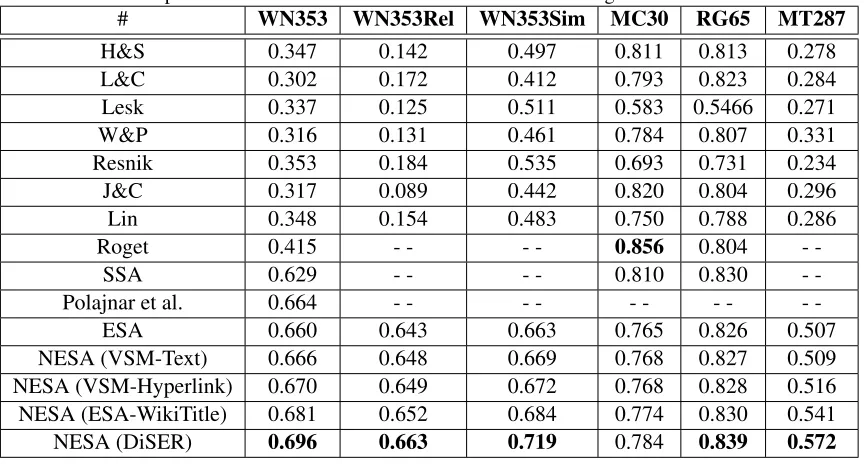
Table 3: Spearman rank correlation of relatedness measures with gold standard datasets
# WN353 WN353Rel WN353Sim MC30 RG65 MT287
H&S 0.347 0.142 0.497 0.811 0.813 0.278
L&C 0.302 0.172 0.412 0.793 0.823 0.284
Lesk 0.337 0.125 0.511 0.583 0.5466 0.271
W&P 0.316 0.131 0.461 0.784 0.807 0.331
Resnik 0.353 0.184 0.535 0.693 0.731 0.234
J&C 0.317 0.089 0.442 0.820 0.804 0.296
Lin 0.348 0.154 0.483 0.750 0.788 0.286
Roget 0.415 - - - - 0.856 0.804
-SSA 0.629 - - - - 0.810 0.830
-Polajnar et al. 0.664 - - -
-ESA 0.660 0.643 0.663 0.765 0.826 0.507
NESA (VSM-Text) 0.666 0.648 0.669 0.768 0.827 0.509
NESA (VSM-Hyperlink) 0.670 0.649 0.672 0.768 0.828 0.516 NESA (ESA-WikiTitle) 0.681 0.652 0.684 0.774 0.830 0.541
NESA (DiSER) 0.696 0.663 0.719 0.784 0.839 0.572
provided by 38 human experts on a scale of 0-4.
RG65 is a collection of 65 non-technical word pairs. These word pairs are annotated by 51 human experts (see for more detail (Rubenstein and Good-enough, 1965)).
MT287 is a relatively newer dataset that con-tains 287 word pairs. This dataset is prepared mainly to study the effect of temporal distribution (Radinsky et al., 2011) of a word over several years. The relatedness scores of the word pairs are obtained from 15-20 mechanical turkers.
6.2 Experiment
We compare the NESA model with other state of the art methods of calculating word relatedness: Ex-plicit Semantic Analysis (ESA), Salient Semantic Analysis (SSA), and several WordNet-based simi-larity measures. Hassan and Mihalcea (2011) re-ported SSA performance on WN353, MC30 and RG65 datasets as shown in table 3. The WordNet-based similarity measures are implemented using WS4J (WordNet Similarity for Java)8 library built
on WordNet 3.0.
8https://code.google.com/p/ws4j/
6.3 Results and Discussion
obtained poor results on WN353Rel in contrast to WN353Sim dataset. However, corpus-based measures performed well for both type of relations i.e. similarity and relatedness.
The NESA model combined with any concept relatedness measure outperforms ESA for all the word relatedness benchmark datasets. It shows that considering non-orthogonality between explicit concepts in ESA model improves the accuracy. NESA-VSM-Hyperlink performs better than NESA-VSM-Text implying that considering only the hyperlinks from the article content works better than taking the overlap of whole content. NESA-ESA-WikiTitle and NESA-DiSER achieved higher scores than both VSM-Text and NESA-VSM-Hyperlink. It shows that the distributional representation of the article title captures the se-mantic information better than considering only the corresponding article content. Another interesting thing to note is that the correlation scores obtained by NESA model with the four concept relatedness measures follow the same order in table 3 as of the correlation scores obtained in evaluating concept relatedness shown in table 2. It represents the con-sistency of proposed concept relatedness measures in two different experiment settings. NESA-DiSER achieved the highest correlation scores in all the word relatedness benchmark datasets.
7 Conclusion
We presented Non-Orthogonal ESA which intro-duces the relatedness between the explicit concepts in the ESA model for computing semantic related-ness, without compromising with the explicit prop-erty of the ESA concept space. We showed that the word relatedness results vary with the different con-cept relatedness measures. NESA outperformed all state of the art methods, in particular, NESA-DiSER achieved the highest correlation with the gold stan-dard. We also evaluated the different concept relat-edness measures using benchmark dataset KORE, in which DiSER outperformed all others.
8 Acknowledgements
This work has been funded by a research grant from Science Foundation Ireland (SFI) under Grant Num-ber SFI/12/RC/2289 (INSIGHT).
References
Nitish Aggarwal and Paul Buitelaar. 2014. Wikipedia-based distributional semantics for entity relatedness. In2014 AAAI Fall Symposium Series.
Nitish Aggarwal, Kartik Asooja, and Paul Buitelaar. 2014. Exploring esa to improve word relatedness. Lexical and Computational Semantics (* SEM 2014), 51.
Nitish Aggarwal, Kartik Asooja, Housam Ziad, and Paul Buitelaar. 2015. Who are the american vegans related to brad pitt? exploring related entities. In24th Inter-national World Wide Web Conference (WWW 2015), Florence, Italy.
Eneko Agirre, Enrique Alfonseca, Keith Hall, Jana Kravalova, Marius Pas¸ca, and Aitor Soroa. 2009. A study on similarity and relatedness using distributional and wordnet-based approaches. InProceedings of Hu-man Language Technologies: The 2009 Annual Con-ference of the North American Chapter of the Associ-ation for ComputAssoci-ational Linguistics, pages 19–27. Satanjeev Banerjee and Ted Pedersen. 2002. An adapted
lesk algorithm for word sense disambiguation using wordnet. InComputational linguistics and intelligent text processing, pages 136–145. Springer.
David M. Blei, Andrew Y. Ng, and Michael I. Jordan. 2003. Latent dirichlet allocation. J. Mach. Learn. Res., 3:993–1022.
Rudi L Cilibrasi and Paul MB Vitanyi. 2007. The google similarity distance. Knowledge and Data Engineering, IEEE Transactions on, 19(3):370–383.
Philipp Cimiano, Antje Schultz, Sergej Sizov, Philipp Sorg, and Steffen Staab. 2009. Explicit versus la-tent concept models for cross-language information re-trieval. InIJCAI, volume 9, pages 1513–1518. Evgeniy Gabrilovich and Shaul Markovitch. 2007.
Com-puting semantic relatedness using wikipedia-based ex-plicit semantic analysis. In Proceedings of the 20th IJCAI, pages 1606–1611.
William A Gale, Kenneth W Church, and David Yarowsky. 1992. One sense per discourse. In Pro-ceedings of the workshop on Speech and Natural Lan-guage, pages 233–237. ACL.
Thomas Gottron, Maik Anderka, and Benno Stein. 2011. Insights into explicit semantic analysis. In Proceed-ings of the 20th CIKM, pages 1961–1964. ACM. Zellig Harris. 1954. Distributional structure. InWord 10
(23), pages 146–162.
Samer Hassan and Rada Mihalcea. 2011. Semantic re-latedness using salient semantic analysis. InAAAI. Graeme Hirst and David St-Onge. 1998. Lexical chains
Johannes Hoffart, Stephan Seufert, Dat Ba Nguyen, Mar-tin Theobald, and Gerhard Weikum. 2012. Kore: Keyphrase overlap relatedness for entity disambigua-tion. In Proceedings of the 21st ACM international conference on Information and knowledge manage-ment, pages 545–554. ACM.
Mario Jarmasz and Stan Szpakowicz. 2004. Rogets thesaurus and semantic similarity1. Recent Advances in Natural Language Processing III: Selected Papers from RANLP, 2003:111.
Jay J Jiang and David W Conrath. 1997. Semantic simi-larity based on corpus statistics and lexical taxonomy. arXiv preprint cmp-lg/9709008.
T K Landauer, P. W. Foltz, and D Laham. 1998. An in-troduction to latent semantic analysis. Discourse Pro-cesses, 25:259–284.
Claudia Leacock and Martin Chodorow. 1998. Com-bining local context and wordnet similarity for word sense identification. WordNet: An electronic lexical database, 49(2):265–283.
Dekang Lin. 1998. An information-theoretic definition of similarity. InICML, volume 98, pages 296–304. George A Miller and Walter G Charles. 1991.
Contex-tual correlates of semantic similarity. Language and cognitive processes, 6(1):1–28.
Tamara Polajnar, Nitish Aggarwal, Kartik Asooja, and Paul Buitelaar. 2013. Improving esa with docu-ment similarity. InAdvances in Information Retrieval, pages 582–593. Springer.
Kira Radinsky, Eugene Agichtein, Evgeniy Gabrilovich, and Shaul Markovitch. 2011. A word at a time: com-puting word relatedness using temporal semantic anal-ysis. In20th WWW, pages 337–346.
Philip Resnik. 1995. Using information content to eval-uate semantic similarity in a taxonomy. arXiv preprint cmp-lg/9511007.
Herbert Rubenstein and John B Goodenough. 1965. Contextual correlates of synonymy. Communications of the ACM, 8(10):627–633.
Michael Strube and Simone Paolo Ponzetto. 2006. Wikirelate! computing semantic relatedness using wikipedia. InAAAI, volume 6, pages 1419–1424. I Witten and David Milne. 2008. An effective,
low-cost measure of semantic relatedness obtained from wikipedia links. InProceeding of AAAI Workshop on Wikipedia and Artificial Intelligence: an Evolving Syn-ergy, AAAI Press, Chicago, USA, pages 25–30. Zhibiao Wu and Martha Palmer. 1994. Verbs semantics