Metaphor as a Medium for Emotion: An Empirical Study
Saif M. Mohammad National Research Council Canada [email protected]
Ekaterina Shutova University of Cambridge, UK
Peter D. Turney Allen Institute for Artificial Intelligence
Abstract
It is generally believed that a metaphor tends to have a stronger emotional im-pact than a literal statement; however, there is no quantitative study establishing the extent to which this is true. Further, the mechanisms through which metaphors convey emotions are not well understood. We present the first data-driven study comparing the emotionality of metaphor-ical expressions with that of their literal counterparts. Our results indicate that metaphorical usages are, on average, sig-nificantly more emotional than literal us-ages. We also show that this emotional content is not simply transferred from the source domain into the target, but rather is a result of meaning composition and inter-action of the two domains in the metaphor.
1 Introduction
Metaphor gives our expression color, shape and character. Metaphorical language is a result of complex knowledge projection from one domain, typically a physical, closely experienced one, to another, typically more abstract and vague one (Lakoff and Johnson, 1980). For instance, when we say “Heshot down all of my arguments”, we project knowledge and inferences from the domain ofbattle (the source domain) onto our reasoning about arguments and debates (thetargetdomain). While preserving the core meaning of the sen-tence, the use of metaphor allows us to introduce additional connotations and emphasize certain as-pects of the target domain, while downplaying oth-ers. Consider the following examples:
(1) a. The new measuresare stranglingbusiness. b. The new measures tightly regulate business.
When we talk about “stranglingbusiness” in (1a) we express a distinct viewpoint on governmental regulation of business, as opposed to a more neu-tral factual statement expressed in (1b).
The interplay of metaphor and emotion has been an object of interest in fields such as linguistics (Blanchette et al., 2001; Kovecses, 2003), polit-ical science (Lakoff and Wehling, 2012), cogni-tive psychology (Crawford, 2009; Thibodeau and Boroditsky, 2011) and neuroscience (Aziz-Zadeh and Damasio, 2008; Jabbi et al., 2008). A num-ber of computational approaches for sentiment po-larity classification of metaphorical language have also been proposed (Veale and Li, 2012; Kozareva, 2013; Strzalkowski et al., 2014). However, there is no quantitative study establishing the extent to which metaphorical language is used to express emotion nor a data-supported account of the mech-anisms by which this happens.
Our study addresses two questions: (i) whether a metaphorical statement is likely to convey a stronger emotional content than its literal coun-terpart; and (ii) how this emotional content arises in the metaphor, i.e. whether it comes from the source domain, or from the target domain, or rather arises compositionally through interaction of the source and the target. To answer these ques-tions, we conduct a series of experiments, in which human subjects are asked to judge metaphoricity and emotionality of a sentence in a range of set-tings. We test two experimental hypotheses.
Hypothesis 1: metaphorical uses of words tend to convey more emotion than their literal paraphrases in the same context.
Hypothesis 2: the metaphorical sense of a word tends to carry more emotion than the literal sense of the same word.
To test Hypothesis 1, we compare the emotional content of a metaphorically used word to that of
its literal paraphrase in a fixed context, as in the following example.
(2) a. Hillarybrushed offthe accusations. b. Hillary dismissed the accusations.
To test Hypothesis 2, we compare the emotional content of the metaphorical sense of a word to a literal sense of that same word in its literal context, as follows.
(3) a. Hillarybrushed offthe accusations. b. He brushed off the snow.
Here,brushed off is metaphorical in the context of “accusations” but literal in the context of “snow”.
Our experiments focus on metaphors expressed by a verb, since this is the most frequent type of metaphor, according to corpus studies (Cameron, 2003; Shutova and Teufel, 2010). In order to ob-tain a sufficient coverage across metaphorical and literal verb senses we extract our data from Word-Net. For 1639 senses of 440 verbs, we anno-tate their usage as metaphorical or literal using the crowdsourcing platform, CrowdFlower1. We then
create datasets of pairs of these usages to test Hy-potheses 1 and 2.
Our results support both hypotheses, providing evidence that metaphor is an important mecha-nism for expressing emotions. Further, the fact that metaphorical uses of words tend to carry more emotion than their literal uses indicates that the emotional content is not simply transferred from the source domain into the target, but rather is a result of meaning composition and interaction of the two domains in the metaphor. For this project, we created a dataset in which verb senses are annotated for both metaphoricity and emo-tionality. In addition, the metaphorical uses are paired with their human-validated interpretations in the form of literal paraphrases. We have made this dataset freely available online.2 We expect
that this dataset, the first of its kind, will find many applications in NLP, including the develop-ment and testing of metaphor identification and in-terpretation systems, modeling regular polysemy in word sense disambiguation, distinguishing be-tween near-synonyms in natural language genera-tion, and, not least, the development of sentiment analysis systems that can operate on real-world, metaphor-rich texts.
1www.crowdflower.com
2http://saifmohammad.com/WebPages/metaphor.html
2 Related Work
Word sense, metaphor and emotion: The stan-dard approach to word sense disambiguation (WSD) is to develop a model for each polyse-mous word (Navigli, 2009). The model for a word predicts the intended sense, based on context. A problem with this approach to WSD is that good coverage of common polysemous English words would require about 3,200 distinct models. Kil-garriff (1997) has argued there are systematic re-lations among word senses across different words, focusing in particular on metaphor as a ubiqui-tous source of polysemy. This area of research is known as regular polysemy. Thus, there is a systematic relation between metaphor and word sense (Kilgarriff, 1997; Turney et al., 2011) and the emotion associated with a word depends on the sense of the word (Strapparava and Valitutti, 2004; Mohammad and Turney, 2013).3 This raises the
question of whether there is a systematic relation between presence of metaphor and the emotional content of words. As far as we know, this is the first paper to quantitatively explore this question.
Gibbs et al. (2002) conducted a study that looked at how listeners respond to metaphor and irony when they are played audio tapes describing emotional experiences. They found that on aver-age metaphors were rated as being more emotional than non-metaphoric expressions. However, that work did not compare paraphrase pairs that dif-fered in just one word (metaphorically or literally used) and thus did not control for context. Citron and Goldberg (2014) compared metaphorical and literal sentences differing only in one word, and found that metaphorical sentences led to more ac-tivity in the the amygdala and the anterior portion of the hippocampus. They hypothesized that this is because metaphorical sentences are more emo-tionally engaging than literal sentences.
Metaphor annotation: Metaphor annotation studies have typically been corpus-based and in-volved either continuous annotation of metaphor-ical language (i.e., distinguishing between literal and metaphorical uses of words in a given text), or search for instances of a specific metaphor in a corpus and an analysis thereof. The majority of corpus-linguistic studies were concerned with metaphorical expressions and mappings within a limited domain, e.g., WAR, BUSINESS, FOOD or
PLANT metaphors (Santa Ana, 1999; Izwaini, 2003; Koller, 2004; Skorczynska Sznajder and Pique-Angordans, 2004; Lu and Ahrens, 2008; Low et al., 2010; Hardie et al., 2007), in a partic-ular genre or type of discourse (Charteris-Black, 2000; Cameron, 2003; Lu and Ahrens, 2008; Mar-tin, 2006; Beigman Klebanov and Flor, 2013).
Two recent studies (Steen et al., 2010; Shutova and Teufel, 2010) moved away from investigat-ing particular domains to a more general study of how metaphor behaves in unrestricted con-tinuous text. Steen and colleagues (Pragglejaz Group, 2007; Steen et al., 2010) proposed a metaphor identification procedure (MIP), in which every word is tagged as literal or metaphorical, based on whether it has a “more basic mean-ing” in other contexts than the current one. The basic meaning was defined as “more concrete; related to bodily action; more precise (as op-posed to vague); historically older” and its iden-tification was guided by dictionary definitions. Shutova and Teufel (2010) extended MIP to the identification of conceptual metaphors along with the linguistic ones. L¨onneker (2004) investi-gated metaphor annotation in lexical resources. Their Hamburg Metaphor Database contains ex-amples of metaphorical expressions in German and French, which are mapped to senses from Eu-roWordNet4and annotated with source–target
do-main mappings taken from the Master Metaphor List (Lakoff et al., 1991).
Emotion annotation: Sentiment analysis is de-fined as detecting the evaluative or affective atti-tude in text. A vast majority of work in sentiment analysis has focused on developing classifiers for valence prediction (Kiritchenko et al., 2014; Dong et al., 2014; Socher et al., 2013; Mohammad et al., 2013), i.e., determining whether a piece of text expresses positive, negative, or neutral attitude. However, there is a growing interest in detecting a wider range of emotions such as joy, sadness, op-timism, etc. (Holzman and Pottenger, 2003; Alm et al., 2005; Brooks et al., 2013; Mohammad, 2012). Much of the this work has been influenced by the idea that some emotions are more basic than others (Ekman, 1992; Ekman and Friesen, 2003; Plutchik, 1980; Plutchik, 1991). Moham-mad (2012) polled the Twitter API for tweets that have hashtag words such as#angerand#sadness
corresponding to the eight Plutchik basic
emo-4http://www.illc.uva.nl/EuroWordNet/
tions. He showed that these hashtag words act as good labels for the rest of the tweets. Suttles and Ide (2013) used a similar distant supervision tech-nique and collected tweets with emoticons, emoji, and hashtag words corresponding to the Plutchik emotions. Emotions have also been annotated in lexical resources such as the Affective Norms for English Words, the NRC Emotion Lexicon (Mo-hammad and Turney, 2013), and WordNet Affect (Strapparava and Valitutti, 2004). The annotated corpora mentioned above have largely been used as training and test sets, and the lexicons have been used to provide features for emotion classifi-cation. (See Mohammad (2016) for a survey on af-fect datasets.) None of this work explicitly studied the interaction between metaphor and emotions.
3 Experimental Setup
To test Hypotheses 1 and 2, we extracted pairs of metaphorical and literal instances from Word-Net. In WordNet, each verb sense corresponds to a
synset, which consists of a set of near-synonyms, a
gloss(a brief definition), and one or moreexample sentencesthat show the usage of one or more of the near-synonyms. We will refer to each of these sentences as theverb-sense sentence, or just sen-tence. The portion of the sentence excluding the target verb will be called thecontext. We will refer to each pair of target verb and verb-sense sentence as an instance. We extracted the following types of instances from WordNet:
Instance 1 Target verb:erase
Sentence:The Turks erased the Armenians.
Here,eraseis used metaphorically. We will refer to such instances asmetaphorical instances.
Now consider an instance similar to the one above, but where the target verb is replaced by its near-synonym or hypernym. For example:
Instance 2 Target verb:kill
Sentence:The Turks killed the Armenians.
both individually and in pairs to determine how much emotion the target verbs convey in the sen-tences.
Another instance of the verberase, correspond-ing to a different sense, is shown below:
Instance 3 Target verb:erase
Sentence:Erase the formula on the blackboard.
This instance contains a literal use of erase. To test Hypothesis 2, we will compare pairs such as Instance 1–Instance 3 that have the same target verb, but different contexts such that one instance is metaphorical and another is literal. We will ask human annotators to examine these instances both individually and in pairs to determine how much emotion the target verbs convey in the sentences.
In the sub-sections below, we describe: (3.1) How we compiled instance pairs to test Hypothe-ses 1 and 2. This involved annotating instances as metaphorical or literal. (3.2) How we anno-tated pairs of instances to determine which is more metaphorical. (3.3) How we annotated instances for emotionality. And finally, (3.4) how we anno-tated pairs of instances to determine which is more emotional.
3.1 Compiling pairs of instances
In order to create datasets of pairs such as In-stance 1–InIn-stance 2 and InIn-stance 1–InIn-stance 3, we first determine whether WordNet verb instances are metaphorical or literal. Specifically, we chose verbs with at least three senses (so that there is a higher chance of at least one sense being metaphorical) and less than ten senses (to avoid highly ambiguous verbs). In total, 440 verbs sat-isfied this criterion, yielding 1639 instances. We took example sentences directly from WordNet and automatically checked to make sure that the verb appeared in the gloss and the example sen-tence. In cases where the example sentence did not contain the focus word, we ignored the synset. We used the Questionnaire 1 to annotate these in-stances for metaphoricity:
Questionnaire 1: Literal or Metaphorical? Instructions
You will be given a focus word and a sentence that contains the focus word (highlighted in bold). You will be asked to rate whether the focus word is used in a literal sense or a metaphorical sense in that sentence. Below are some typical properties of metaphorical and literal senses:
Literal usages tend to be:
- more basic, straightforward meaning; more physical, closely tied to our senses: vision, hearing, touching, tasting Metaphorical usages tend to be:
- more complex; more distant from our senses; more abstract; more vague; often surprising; tend to bring in imagery from a different domain
Example 1
Focus Word:shoot down
Sentence:The enemyshot downseveral of our aircraft.
Question: In the above sentence, is the focus word used in a literal sense or a metaphorical sense?
- the focus word’s usage is metaphorical - the focus word’s usage is literal Solution: the focus word’s usage is literal Example 2
Focus Word:shoot down
Sentence:Heshot downthe student’s proposal.
Question: In the above sentence, is the focus word used in a literal sense or a metaphorical sense?
- the focus word’s usage is metaphorical - the focus word’s usage is literal
Solution: the focus word’s usage is metaphorical Your Task
Focus Word:answer
Sentence:This steering wheelanswersto the slightest touch.
In the above sentence, is the focus word used in a literal sense or a metaphorical sense?
- the focus word’s usage is metaphorical - the focus word’s usage is literal
3.1.1 Instances to test Hypothesis 1
For each of the 176 metaphorical instances in the Master Set, the three authors of this paper inde-pendently chose a synonym of the target verb that would make the instance literal. For example, for Instance 1 shown earlier,kill was chosen as syn-onym oferase(forming Instance 2). The synonym was chosen either from the list of near-synonyms in the same synset as the target word or from WordNet hypernyms of the target word. The three authors discussed amongst themselves to resolve disagreements. Five instances were discarded be-cause of lack of agreement. Thus corresponding to each of the remaining 171 metaphorical instances, 171 literal instances were generated that had non-identical, similar meaning target verbs, but iden-tical contexts. This set of 171 pairs of instances forms the dataset used to test Hypothesis 1, and we will refer to these instance pairs as theHypothesis 1 Pairsand to the set of 342 (171×2) instances as theHypothesis 1 Instances.
3.1.2 Instances to test Hypothesis 2
In order to test Hypothesis 2, we compare in-stances with the same target verb, but correspond-ing to its different senses. We use all of the 460 (176+284) instances in the Master Set, and refer to them asHypothesis 2 Instances. As for Hypoth-esis 1, we also group these instances into pairs. For each of the verbs in the Master Set, all pos-sible pairs of metaphorical and literal instances were generated. For example, if a verb had two metaphorical instances and three literal instances, then2×3 = 6pairs of instances were generated. In total, 355 pairs of instances were generated. We will refer to his set of instance pairs as Hypothe-sis 2 Cross Pairs (pairs in which one instance is labeled metaphoric and the other is literal).
Rather than viewing instances as either metaphorical or literal, one may also consider a graded notion of metaphoricity. That is, on a scale from most literal to most metaphorical, instances may have different degrees of metaphoricity (or literalness). Therefore, we also evaluate pairs where the individual instances have not been ex-plicitly labeled as metaphorical or literal; instead, they have been marked according to whether one instance is more metaphorical than the other. For each of the verbs in the Master Set, all possible pairs of instances were generated. For example, if a verb had five instances in the Master Set, then ten pairs of instances were generated. This
resulted in 629 pairs in total. We will refer to them asHypothesis 2 All Pairs(all possible pairs of instances, without regard to their labels).
3.2 Relative metaphoricity annotation
For each of the pairs in bothHypothesis 2 Cross Pairs and in Hypothesis 2 All Pairs, we ask an-notators which instance is more metaphorical, as shown in Questionnaire 2 below:
Questionnaire 2: Which is more metaphorical? Instructions
You will be given two sentences with similar meanings. Each sentence contains a focus word. You will be asked to compare how the focus words are used in the two sentences. You will be asked to decide whether the focus word’s usage in one sentence is more metaphorical than the focus word’s usage in the other sentence.
– Description of metaphorical and literal usages same as in Questionnaire 1 (not repeated here due to space constraints)– Your Task
Focus Word 1:attack
Sentence 1:Iattackedthe problem as soon as I was up.
Focus word 2:attack
Sentence 2:The Serbsattackedthe village at night.
Which is more metaphorical?
- focus word’s usage in the sentence 1 is more metaphorical - the focus word’s usage in sentence 2 is more metaphorical - the usages in the two sentences are equally metaphorical or equally literal
The instance pairs within a question were pre-sented in random order. The questions themselves were also in random order.
3.3 Absolute emotion annotation
For each of the Hypothesis 1 and Hypothesis 2 instances, we used responses to Questionnaire 3 shown below to determine if the target verb con-veys an emotion in the sentence.
Questionnaire 3: Does the focus word convey emotion? Instructions
You will be given a focus word and a sentence that includes the focus word. You will be asked to rate whether the focus word conveys some emotion in the sentence.
Your Task
Focus Word:answer
Sentence:This steering wheelanswersto the slightest touch.
3.4 Relative emotion annotation
Just as instances can have degrees of metaphoric-ity, they can have degrees of emotion. Thus, for each of the Hypothesis 1 Pairs we asked annota-tors to mark which instance is more emotional, as shown in Questionnaire 4 below:
Questionnaire 4: Which of the two given sentences conveys more emotion?
Instructions
You will be given two sentences with similar meanings. Each sentence contains a focus word. You will be asked to compare how the focus words are used in the two sentences and whether the focus word conveys more emotion in one sentence than in the other sentence.
Your Task
Focus Word 1:attack
Sentence 1:Iattackedthe problem as soon as I was up.
Focus word 2:start
Sentence 2:Istartedon the problem as soon as I was up.
Which conveys more emotion?
- focus word in first sentence conveys more emotion - focus word in second sentence conveys more emotion - focus words in the two sentences convey a similar degree of emotion
The order in which the instance pairs were pre-sented for annotation was determined by random selection. Whether the metaphorical or the literal instance of a pair was chosen as the first instance shown in the question was also determined by ran-dom selection. The same questionnaire was used for Hypothesis 2 pairs as well.
4 Results and data analysis
4.1 Hypothesis 1 results
An analysis of the responses to Questionnaire 3 for the Hypothesis 1 instances is shown in Ta-ble 1. Recall that the annotators were given 342 in-stances where half were metaphoric and half were literal. Additionally each literal instance was cre-ated by replacing the target verb in a metaphorical instance with a synonym of the target verb. Recall also that the 342 instances were presented in ran-dom order. Table 1 shows that a markedly higher number of metaphorical instances (39.8%) are considered emotional than literal ones (16.1%). Fisher’s exact test shows that this difference is sig-nificant with greater than 95% confidence5.
5In the following experiments, we use Fisher’s exact test
[image:6.595.321.515.114.228.2]for two-by-two tables of event counts and we use the bino-mial exact test (i.e., the Clopper-Pearson interval) for binary (heads/tails) event counts (Agresti, 1996).
Table 1: Summary of responses to Q3 (emotional or not emotional) for Hypothesis 1 Instances (342 instances – 171 metaphorical and 171 literal).
# instances that are:
emotional 191 (55.8%)
not emotional 151 (44.2%)
Total 342 (100%)
# instances that are:
metaphorical and emotional 136 (39.8%) metaphorical and not emotional 35 (10.2%) literal and emotional 55 (16.1%) literal and not emotional 116 (33.9%)
Total 342 (100%)
Table 2: Summary of responses to Q4 (which is more emotional) for Hypothesis 1 Pairs (171 pairs of metaphorical and literal instances).
# instances that are:
metaphorical and more emotional 143 (83.6%) literal and more emotional 17 (09.9%)
similarly emotional 11 (06.4%)
Total 171 (100%)
An analysis of the responses to Questionnaire 4 for the Hypothesis 1 pairs is shown in Table 2. Here, the annotators were given pairs of instances where one is metaphorical and one is literal (and the two instances differ only in the target verb), and the annotators were asked to determine which instance is more emotional. Metaphorical in-stances were again predominantly marked as more emotional (83.6%) than their literal counterparts (9.9%). This difference is significant with greater than 95% confidence, using the binomial exact test. Thus, results from both experiments support Hypothesis 1.
4.2 Hypothesis 2 results
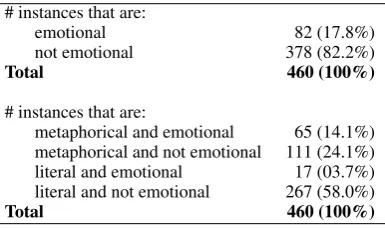
Table 3: Summary of responses to Q3 (emotional or not emotional) for Hypothesis 2 Instances (460 instances – 176 metaphorical and 284 literal).
# instances that are:
emotional 82 (17.8%)
not emotional 378 (82.2%)
Total 460 (100%)
# instances that are:
metaphorical and emotional 65 (14.1%) metaphorical and not emotional 111 (24.1%) literal and emotional 17 (03.7%) literal and not emotional 267 (58.0%)
Total 460 (100%)
Hypothesis 2 All Pairs received lower over-all emotionality scores than Hypothesis 1 Pairs. Some variation is expected because the two datasets are not identical. Additionally, when an annotator finds the same word in many literal (non-emotional contexts) as in the Hypothesis 2 setup (but not in Hypothesis 1 setup), then they are less likely to tell us that the same word, even though now used in a metaphorical context, is con-veying emotion. Despite the lower overall emo-tionality of Hypothesis 2 All Pairs, our hypoth-esis that metaphorical instances are more emo-tional than the literal ones still holds. Further, experiments with pairs of emotions (described be-low) avoid the kind of bias mentioned above, and also demonstrate the higher relative emotionality of metaphorical instances.
Table 4 shows the analysis for Hypothesis 2 Cross Pairs in the relative emotion annotation set-ting. The annotators were given pairs of in-stances where one is metaphorical and one is lit-eral (and the two instances have the same focus verb in different context). The annotators were asked to determine which instance is more emo-tional. Metaphorical instances were marked as be-ing more emotional than their literal counterparts in 59.4% of cases. Literal instances were marked as more emotional only in 8.7% of cases. This dif-ference is significant with greater than 95% confi-dence, using the binomial exact test.
[image:7.595.86.279.114.228.2]An analysis of the responses to Questionnaire 4 for the Hypothesis 2 All Pairs is shown in Ta-ble 5. This dataset included all possiTa-ble pairs of instances associated with each verb in the Master Set. Thus in addition to pairs where one is highly metaphorical and one highly literal, this set also includes pairs where both instances may be highly metaphorical or both highly literal. Observe that
Table 4: Summary of responses to Q4 (which is more emotional) for Hypothesis 2 Cross Pairs (355 pairs of metaphorical and literal instances).
# instances that are:
metaphorical and more emotional 211 (59.4%) literal and more emotional 31 (08.7%) similarly emotional 113 (31.8%)
Total 355 (100%)
Q1:drain-v-1 The rain waterdrainsinto this big vat.LIT0.9
drain-v-2 The [..] classdrainsme of energy.MET0.8 drain-v-3 Wedrainedthe oil tank.LIT0.9
drain-v-4 Life in the campdrainedhim.MET0.91 Q1 and Q3, Hypothesis 1 (Table 1):
Life in the campdrainedhim.METsome emotion
Life in the campweakenedhim.LITsome emotion
The [..] classdrainsme of energy.METsome emotion
The [..] classdepletesme of energy.LITsome emotion
Q1 and Q4, Hypothesis 1 (Table 2): Life in the campdrainedhim.MET
Life in the campweakenedhim.LIT
– the first sentence conveys more emotion The exercise classdrainsme of energy.MET
The exercise classdepletesme of energy.LIT
– the first sentence conveys more emotion Q1 and Q3, Hypothesis 2 (Table 3):
Life in the campdrainedhim.METsome emotion
The rain waterdrainsinto this big vat.LITno emotion
The [..] classdrainsme of energy.METsome emotion
Wedrainedthe oil tank.LITno emotion
Q1 and Q4, Hypothesis 2 (Table 4): Life in the campdrainedhim.MET
The rain waterdrainsinto this big vat.LIT
– the first sentence conveys more emotion Wedrainedthe oil tank.LIT
The exercise classdrainsme of energy.MET
– the second sentence conveys more emotion
Figure 1: Complete annotation cycle for the verb
drain (some sense pairs are omitted for brevity). LIT stands for literal and MET for metaphoric. The annotations in Q1 are accompanied by their confidence scores.
once again a higher number of instances that were marked as more metaphorical were also marked as being more emotional (than less or similarly emo-tional). This difference is significant with greater than 95% confidence (binomial exact test).
Table 5: Summary of responses to Q4 (which is more emotional) for Hypothesis 2 All Pairs (629 pairs of instances). Note that in addition to pairs where one is highly metaphorical and one highly literal, the All Pairs set also includes pairs where both instances may be highly metaphorical or both highly literal.
# instances that are more metaphorical and more emotional 227 (36.1%) # instances that are more metaphorical but less emotional 28 (04.4%) # instances that are more metaphorical but similarly emotional 119 (18.9%) # instances that are similarly metaphorical and similarly emotional 196 (31.2%) # instances that are similarly metaphorical but differ in emotionality 59 (09.4%)
Total 629 (100%)
5 Discussion
It is generally believed that the senses of a word can be divided into a metaphorical subset and a literal subset (Kilgarriff, 1997). It is easy to find examples of this particular pattern of polysemy, but a few examples do not justify the claim that this pattern is a widespread regularity. The annota-tions of our dataset confirm the hypothesis that the metaphorical/literal distinction is a common pat-tern for polysemous verbs (as many as 38% of all verb senses we annotated were metaphorical). As far as we know, this is the first study that gives a solid empirical foundation to the belief that the metaphorical/literal distinction is a central form of regular polysemy.
Furthermore, the annotated dataset can be used for research into the nature of metaphorical/literal regular polysemy. Previous research on metaphor annotation identified metaphorical uses of words in text, thus analysing data for only one sense at a time. In contrast, our dataset allows one to anal-yse a range of metaphorical and literal uses of the same word, potentially shedding light on the ori-gins of regular polysemy and metaphor. Such a structure of the dataset also provides a new frame-work for computational modelling of metaphor. A system able to systematically capture metaphori-cal sense extensions will be in a better position to generalise to unseen metaphors rather than a sys-tem trained on individual examples of metaphori-cal word uses in their specific contexts. The large size and coverage across many senses makes this dataset particularly attractive for computational modeling of metaphor. Our analysis also sug-gests that the work on emotion detection in text may be useful to support algorithms for handling metaphorical sense extension. Perhaps emotion analysis may yield insights into other forms of reg-ular polysemy (Boleda et al., 2012).
We hypothesized that literal paraphrases tend to express less emotion than their metaphorical
coun-terparts. This conjecture is related to Hypothesis 1. All of the sentence pairs that we used to test Hypothesis 1 are essentially a special type of para-phrase, in which only one word is varied. The re-sults in Section 4.1 support Hypothesis 1, and thus they lend some degree of support to our hypothe-sis about paraphrases. It might be argued that we have only tested a special case of paraphrase, and we agree that further experiments are needed, with more general types of paraphrase (including, for instance, multi-word paraphrases). We leave this as a topic for future work. However, our results confirm the validity of our hypothesis with respect to metaphorical and literal lexical substitutes.
The results of our experiments are also rele-vant to many other NLP tasks modelling lexical meaning, for instance, natural language genera-tion (NLG). It can be difficult to make the cor-rect choice among several near-synonyms in NLG (Inkpen and Hirst, 2006); for example, the near-synonyms error, mistake, slip, and blunder vey the same core meaning but have different con-notations. The degree to which two words are near-synonyms is proportional to the degree to which one can substitute for another in a given context (Inkpen and Hirst, 2006). Substituting a metaphoric term with a literal one tends to change the meaning of the sentence in an im-portant respect—its emotional content. The de-gree of metaphor in the generated sentences would thus become an important factor in selecting the most appropriate candidate in NLG. It follows from Hypothesis 1 that terms with the same de-gree of metaphor will be more substitutable than terms with different degrees of metaphor. There-fore NLG systems can benefit from taking the de-gree of metaphor into account.
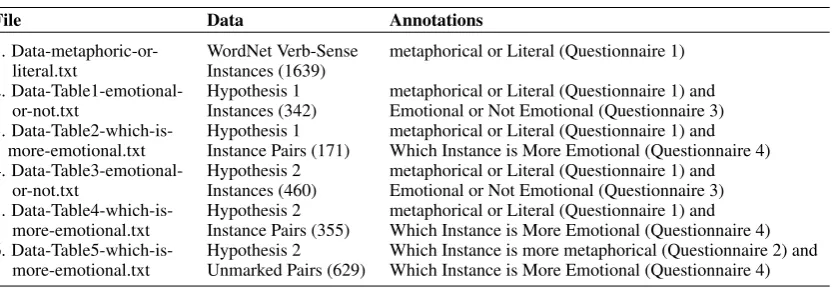
Table 6: Summary of data annotated for metaphoricity and emotionality.
File Data Annotations
1. Data-metaphoric-or- WordNet Verb-Sense metaphorical or Literal (Questionnaire 1) literal.txt Instances (1639)
2. Data-Table1-emotional- Hypothesis 1 metaphorical or Literal (Questionnaire 1) and or-not.txt Instances (342) Emotional or Not Emotional (Questionnaire 3) 3. Data-Table2-which-is- Hypothesis 1 metaphorical or Literal (Questionnaire 1) and
more-emotional.txt Instance Pairs (171) Which Instance is More Emotional (Questionnaire 4) 4. Data-Table3-emotional- Hypothesis 2 metaphorical or Literal (Questionnaire 1) and
or-not.txt Instances (460) Emotional or Not Emotional (Questionnaire 3) 5. Data-Table4-which-is- Hypothesis 2 metaphorical or Literal (Questionnaire 1) and
more-emotional.txt Instance Pairs (355) Which Instance is More Emotional (Questionnaire 4) 6. Data-Table5-which-is- Hypothesis 2 Which Instance is more metaphorical (Questionnaire 2) and
more-emotional.txt Unmarked Pairs (629) Which Instance is More Emotional (Questionnaire 4)
The judgeclappedhim in jail.METsome emotion
The judgeputhim in jail.LITno emotion
The wings of the birdsclappedloudly.LITno emotion This writerfracturesthe language.METsome emotion
This writermisusesthe language.LITno emotion
The potholefractureda bolt on the axle.LITno emot.
The spaceshipblazedout into space.METsome emot. The spaceshipdepartedout into space.LITno emotion
The summer sun can cause a pine toblaze.LITno emot.
Figure 2: Hypothesis 1 and 2 pairs merged into triples, demonstrating higher emotionality arising through metaphorical composition.
as their literal paraphrases. This suggests that emotional content is not merely a property of the source or the target domain (and the respec-tive word senses), but rather it arises through metaphorical composition. Figure 2 shows some examples of this phenomenon in our dataset. This is the first such finding, and it highlights the im-portance of metaphor as a mechanism for express-ing emotion. This, in turn, suggests that joint mod-els of metaphor and emotion are needed in order to create real-world systems for metaphor interpreta-tion, as well as for sentiment analysis. All of the data created as part of this project, as summarized in Table 6, is made freely available.6
6 Conclusions
This paper confirms the general belief that metaphorical language tends to have a stronger emotional impact than literal language. As far as we know, our study is the first attempt to clearly formulate and test this belief. We formulated two hypotheses regarding emotionality of metaphors. Hypothesis 1: metaphorical uses of words tend to
6http://saifmohammad.com/WebPages/metaphor.html
convey more emotion than their literal paraphrases in the same context. Hypothesis 2: the metaphor-ical sense of a word tends to carry more emotion than the literal sense of the same word. We con-ducted systematic experiments to show that both hypotheses are true for verb metaphors. A further contribution of this work is to the areas of senti-ment analysis and metaphor detection. At training time, sentiment classifiers could, for example, use the information that a particular word or expres-sion is metaphorical as a feature, and similarly, metaphor detection systems could use the infor-mation that a particular word or expression con-veys sentiment as a feature.
The results are significant for the study of reg-ular polysemy as the senses of many verbs read-ily divide into literal and metaphorical groups. We hope that research in regular polysemy will be able to build on the datasets that we have released. Our results also support the idea that a metaphor con-veys emotion that goes beyond the source and tar-get domains taken separately. The act of bridg-ing the two domains creates somethbridg-ing new, be-yond the component domains. This remains a rich topic for further research. Finally, we hope that the results in this paper will encourage greater collaboration between the Natural Language Pro-cessing research communities in sentiment analy-sis and metaphor analyanaly-sis. All of the data anno-tated for metaphoricity and emotionality is made freely available.
Acknowledgments
References
Alan Agresti. 1996. Categorical data analysis,
vol-ume 996. New York: John Wiley & Sons.
Cecilia Ovesdotter Alm, Dan Roth, and Richard Sproat. 2005. Emotions from text: Machine
learn-ing for text-based emotion prediction. In
Proceed-ings of the Joint Conference on HLT–EMNLP, Van-couver, Canada.
Lisa Aziz-Zadeh and Antonio Damasio. 2008. Em-bodied semantics for actions: findings from func-tional brain imaging. Journal of Physiology - Paris, 102(1-3).
Beata Beigman Klebanov and Michael Flor. 2013. Argumentation-relevant metaphors in test-taker
es-says. In Proceedings of the First Workshop on
Metaphor in NLP, pages 11–20, Atlanta, Georgia.
Isabelle Blanchette, Kevin Dunbar, John Hummel, and Richard Marsh. 2001. Analogy use in naturalis-tic settings: The influence of audience, emotion and
goals. Memory and Cognition, 29(5).
Gemma Boleda, Sebastian Pad´o, and Jason Utt. 2012.
Regular polysemy: A distributional model. In
Pro-ceedings of the First Joint Conference on Lexical and Computational Semantics-Volume 1: Proceed-ings of the main conference and the shared task, and Volume 2: Proceedings of the Sixth International Workshop on Semantic Evaluation, pages 151–160. Association for Computational Linguistics.
Michael Brooks, Katie Kuksenok, Megan K Torkild-son, Daniel Perry, John J RobinTorkild-son, Taylor J Scott, Ona Anicello, Ariana Zukowski, Paul Harris, and Cecilia R Aragon. 2013. Statistical affect
detec-tion in collaborative chat. In Proceedings of the
2013 conference on Computer supported coopera-tive work, pages 317–328. ACM.
Lynne Cameron. 2003. Metaphor in Educational
Dis-course. Continuum, London.
Jonathan Charteris-Black. 2000. Metaphor and
vocab-ulary teaching in esp economics. English for
Spe-cific Purposes, 19(2):149–165.
Francesca MM Citron and Adele E Goldberg. 2014. Metaphorical sentences are more emotionally
en-gaging than their literal counterparts. Journal of
cognitive neuroscience.
Elizabeth Crawford. 2009. Conceptual Metaphors of Affect.Emotion Review, 1(2).
Li Dong, Furu Wei, Chuanqi Tan, Duyu Tang, Ming Zhou, and Ke Xu. 2014. Adaptive recursive neural network for target-dependent twitter sentiment clas-sification. InProceedings of the 52nd Annual Meet-ing of the Association for Computational LMeet-inguis- Linguis-tics, pages 49–54.
Paul Ekman and Wallace V Friesen. 2003.
Unmask-ing the face: A guide to recognizUnmask-ing emotions from facial clues. Ishk.
Paul Ekman. 1992. An Argument for Basic Emotions.
Cognition and Emotion, 6(3):169–200.
Raymond W Gibbs, John S Leggitt, and Elizabeth A Turner. 2002. Whats special about figurative
lan-guage in emotional communication. The verbal
communication of emotions. Interdisciplinary per-spectives, pages 125–149.
Andrew Hardie, Veronika Koller, Paul Rayson, and Elena Semino. 2007. Exploiting a semantic
anno-tation tool for metaphor analysis. In Proceedings
of the Corpus Linguistics Conference, Birmingham, UK.
Lars E. Holzman and William M. Pottenger. 2003. Classification of emotions in internet chat: An appli-cation of machine learning using speech phonemes. Technical report, Leigh University.
Sattar Izwaini. 2003. Corpus-based study of metaphor
in information technology. In Proceedings of the
Workshop on Corpus-based Approaches to Figura-tive Language, Corpus Linguistics 2003, Lancaster.
Mbemba Jabbi, Jojanneke Bastiaansen, and Christian Keysers. 2008. A common anterior insula represen-tation of disgust observation, experience and imagi-nation shows divergent functional connectivity
path-ways. PLoS ONE, 3(8):e2939.
Adam Kilgarriff. 1997. I don’t believe in word senses.
Computers and the Humanities, 31(2):91–113.
Svetlana Kiritchenko, Xiaodan Zhu, and Saif M. Mo-hammad. 2014. Sentiment analysis of short in-formal texts. Journal of Artificial Intelligence Re-search, 50:723–762.
Veronika Koller. 2004. Metaphor and Gender in
Busi-ness Media Discourse: A Critical Cognitive Study. Palgrave Macmillan, Basingstoke: New York.
Z. Kovecses. 2003.Metaphor and Emotion Language,
Culture, and Body in Human Feeling. Cambridge University Press, Cambridge.
Zornitsa Kozareva. 2013. Multilingual affect polar-ity and valence prediction in metaphor-rich texts. In
Proceedings of the 51st Annual Meeting of the As-sociation for Computational Linguistics (Volume 1: Long Papers), pages 682–691, Sofia, Bulgaria, Au-gust. Association for Computational Linguistics.
George Lakoff and Mark Johnson. 1980. Metaphors
We Live By. University of Chicago Press, Chicago.
George Lakoff and Elisabeth Wehling. 2012. The
George Lakoff, Jane Espenson, and Alan Schwartz. 1991. The master metaphor list. Technical report, University of California at Berkeley.
Birte L¨onneker. 2004. Lexical databases as resources for linguistic creativity: Focus on metaphor. In Pro-ceedings of the LREC 2004 Workshop on Language Resources for Linguistic Creativity, pages 9–16, Lis-bon, Portugal.
Graham Low, Zazie Todd, Alice Deignan, and Lynne
Cameron. 2010. Researching and Applying
Metaphor in the Real World. John Benjamins, Am-sterdam/Philadelphia.
Louis Lu and Kathleen Ahrens. 2008. Ideological in-fluences on building metaphors in taiwanese presi-dential speeches. Discourse and Society, 19(3):383– 408.
James Martin. 2006. A corpus-based analysis of con-text effects on metaphor comprehension. In A.
Ste-fanowitsch and S. T. Gries, editors, Corpus-Based
Approaches to Metaphor and Metonymy, Berlin. Mouton de Gruyter.
Saif M. Mohammad and Peter D. Turney. 2013.
Crowdsourcing a word–emotion association lexicon.
Computational Intelligence, 29(3):436–465. Saif M. Mohammad, Svetlana Kiritchenko, and
Xiao-dan Zhu. 2013. NRC-Canada: Building the state-of-the-art in sentiment analysis of tweets. In Pro-ceedings of the International Workshop on Semantic Evaluation, SemEval ’13, Atlanta, Georgia, USA, June.
Saif M. Mohammad. 2012. #emotional tweets. In
Proceedings of the First Joint Conference on Lexi-cal and Computational Semantics, *SEM ’12, pages 246–255, Montr´eal, Canada. Association for Com-putational Linguistics.
Saif M. Mohammad. 2016. Sentiment analysis: De-tecting valence, emotions, and other affectual states
from text. In Herb Meiselman, editor,Emotion
Mea-surement. Elsevier.
Roberto Navigli. 2009. Word sense disambiguation: A
survey. ACM Computing Surveys (CSUR), 41(2):10.
Robert Plutchik. 1980. A General Psychoevolutionary
Theory of Emotion. Emotion: Theory, research, and
experience, 1(3):3–33.
Robert Plutchik. 1991. The emotions. University Press of America.
Pragglejaz Group. 2007. MIP: A method for iden-tifying metaphorically used words in discourse.
Metaphor and Symbol, 22:1–39.
Otto Santa Ana. 1999. Like an animal I was treated?: anti-immigrant metaphor in US public discourse.
Discourse Society, 10(2):191–224.
Ekaterina Shutova and Simone Teufel. 2010.
Metaphor corpus annotated for source - target
do-main mappings. In Proceedings of LREC 2010,
pages 3255–3261, Malta.
Hanna Skorczynska Sznajder and Jordi Pique-Angordans. 2004. A corpus-based description of metaphorical marking patterns in scientific and
popular business discourse. In Proceedings of
European Research Conference on Mind, Language and Metaphor (Euresco Conference), Granada, Spain.
Richard Socher, Alex Perelygin, Jean Y. Wu, Jason Chuang, Christopher D. Manning, Andrew Y. Ng, and Christopher Potts. 2013. Recursive deep mod-els for semantic compositionality over a sentiment
treebank. InProceedings of the Conference on
Em-pirical Methods in Natural Language Processing, EMNLP ’13. Association for Computational Lin-guistics.
Gerard J. Steen, Aletta G. Dorst, J. Berenike Herrmann, Anna A. Kaal, Tina Krennmayr, and Trijntje Pasma.
2010. A method for linguistic metaphor
identifica-tion: From MIP to MIPVU. John Benjamins, Ams-terdam/Philadelphia.
Carlo Strapparava and Alessandro Valitutti. 2004. Wordnet affect: an affective extension of wordnet.
InLREC, volume 4, pages 1083–1086.
Tomek Strzalkowski, Samira Shaikh, Kit Cho, George Aaron Broadwell, Laurie Feldman, Sarah Taylor, Boris Yamrom, Ting Liu, Ignacio Cases, Yuliya Peshkova, and Kyle Elliot. 2014. Computing affect
in metaphors. InProceedings of the Second
Work-shop on Metaphor in NLP, pages 42–51, Baltimore, MD, June. Association for Computational Linguis-tics.
Jared Suttles and Nancy Ide. 2013. Distant supervi-sion for emotion classification with discrete binary values. InComputational Linguistics and Intelligent Text Processing, pages 121–136. Springer.
Paul H. Thibodeau and Lera Boroditsky. 2011.
Metaphors we think with: The role of metaphor in
reasoning.PLoS ONE, 6(2):e16782, 02.
Peter D. Turney, Yair Neuman, Dan Assaf, and Yohai Cohen. 2011. Literal and metaphorical sense iden-tification through concrete and abstract context. In
Proceedings of the 2011 Conference on the Empiri-cal Methods in Natural Language Processing, pages 680–690.
Tony Veale and Guofu Li. 2012. Specifying viewpoint and information need with affective metaphors: A system demonstration of the metaphor magnet web
app/service. InProceedings of the ACL 2012 System