DynamicPower at SemEval-2016 Task 8: Processing syntactic parse trees
with a Dynamic Semantics core
Alastair Butler
National Institute for Japanese Language and Linguistics
Abstract
This is a system description paper for a sub-mission to Task 8 of SemEval-2016: Meaning Representation Parsing. No use was made of the training data provided by the task. Instead existing components were combined to form a pipeline able to take raw sentences as input and output meaning representations. Compo-nents are a part-of-speech tagger and parser trained on the Penn Parsed Corpus of Mod-ern British English to produce syntactic parse trees, a semantic role labeller and a named en-tity recogniser to supplement obtained parse trees with word sense, functional and named entity information, followed by an adapted Tarskian satisfaction relation for a Dynamic Semantics that is used to transform a syntac-tic parse into a predicate logic based meaning representation, followed by conversion to pen-man/AMR notation required for the task ap-praisal.
1 Introduction
This is a system description paper for a submission to Task 8 of SemEval-2016: Meaning Representa-tion Parsing. Syntactic structures are first obtained by parsing raw language input, from which mean-ing representations are derived by printmean-ing off infor-mation accumulated with an adapted Tarskian satis-faction relation for a Dynamic Semantics (Dekker, 2012). This is akin to compositional approaches of formal semantics that view the task of reaching a semantic value as being rooted in first obtaining a syntactic parse. Key advantages are modularity and domain independence.
This paper is structured as follows. Section 2 sketches the method used to obtain a syntactic parse. Section 3 covers reaching a semantic representation. Section 4 outlines conversion to penman/AMR no-tation. Section 5 reports experiment results. Section 6 is a conclusion. An appendix details how to run the available implementation.
2 Obtaining a syntactic parse
The approach first needs a way to obtain syntactic parse trees. Major components used were the Stan-ford Log-linear Part-Of-Speech Tagger1 (Toutanova
et al., 2003) and the Berkeley Parser2 (Petrov and
Klein, 2003), both trained on data from the years of 1840–1908 of the Penn Parsed Corpus of Mod-ern British English3 (Kroch et al., 2010). The
par-ticular setup followed suggestions of pre-processing and post-processing made by Kulick et al. (2014) and used tools, notably create_stripped, from
the system of Fang, Butler and Yoshimoto (2014).4
Dating from over one hundred years ago, train-ing data for the syntactic parser was not chosen for suitability to a potential task domain, but instead for the practical benefit that parse results would con-form to the scheme proposed in theAnnotation man-ual for the Penn Historical Corpora and the Parsed Corpus of Early English Correspondence (PCEEC) (Santorini, 2010). This scheme is exceptionally con-sistent, especially with regards to facilitating
identi-1http://nlp.stanford.edu/software/tagger.html 2https://github.com/slavpetrov/berkeleyparser 3
http://www.ling.upenn.edu/hist-corpora/PPCMBE-RELEASE-1/index.html
4http://www.compling.jp/haruniwa/index.html
fication of construction types (small clause, compar-ative, cleft, etc.) and for its handling of coordination, offering the least obstacle for a robust conversion to the structures fed to the semantic component (seen in the next section).
As an example, consider:
(1) Upon turning 80, Mao Zedong felt that he would die soon.
A parse in tree form returned looks like:
✭ ✭ ✭ ❤❤❤ ✘ ✘ ❳❳❳ ✭ ✭ ✭ ✭ ✘ ✘ ❳❳ ❍❍ ✭ ✭ ✭ ✭ ❤❤❤❤❤ ✭ ✭ ✭ ✭
✭ ✦ PP✦❤❤❤❤❤
IP-MAT PP P Upon IP-PPL VAG turning NP NUM 80 PU , NP NPR Mao NPR Zedong VBD felt CP-THT C that IP-SUB NP PRO he MD would VB die ADVP ADV soon PU .
All words are part-of-speech labelled. Clause struc-ture is generally flat with multiply branching nodes and no specified VP level, except with VP coor-dination. Phrasal nodes (NP, PP, ADVP, etc.) im-mediately dominate the phrase head (N, P, ADV, etc.) which has as sisters both modifiers and com-plements.
Despite such flat clause and phrase structure, ex-tended phrase labels marking function enable dis-tinguishing the presence of modifiers (participial clauses (IP-PPL), adverbial clauses (CP-ADV), rel-ative clauses (CP-REL), etc.) from complements (infinitive complements (IP-INF), that-complements (CP-THT), embedded questions (CP-QUE), etc.).
To arrive at a more complete parse for the task, word sense and functional information was obtained with mateplus5 (Roth and Woodsend, 2014), which
is an extended version of the mate-tools semantic role labeller (Björkelund et al., 2009). In addition, named entity information was gathered with the Stanford Named Entity Recognizer6 (Finkel et al.,
2005) using the MUC model that labels e.g., PER-SON, ORGANIZATION, and LOCATION. Further-more, pronouns, e.g., he, she, they, are default
5https://github.com/microth/mateplus
6http://nlp.stanford.edu/software/CRF-NER.html
marked PERSON. From (1) as input, the combina-tion of these tools collects the following informa-tion:
upon TMP _ O
turn PMOD turn.02 O
80 OBJ _ O
, P _ O
mao NAME _ PERSON zedong SBJ _ PERSON felt ROOT feel.01 O
that OBJ _ O
he SBJ _ PERSON would SUB _ O die VC die.01 O
soon TMP _ O
. P _ O
The first column gives word lemmas, the second contains functional information to identify syntac-tic subjects (SBJ) and objects (OBJ) as well as ad-junct roles such as LOC, MSR and TMP, the third column provides word sense information related to PropBank (Bonial et al., 2010) semantic frames (‘turn.02’, ‘feel.02’, ‘die.01’), and the fourth column provides entity information. This column informa-tion is integrated with the parse to return:
✭ ✭ ✭ ❤❤❤ ✘ ✘ ✘ ❵❵❵ ✭ ✭ ✭ ✭ ✭ ✭ ✭ ✭ ✭ ❤❤❤❤ ❤❤❤❤ ✭ ✭ ✭ ✭ ✭ ❤❤❤❤❤❤ ✘ ✘ ❳❳ ✘ ✘ ❵❵❵ IP-MAT PP-TMP P upon IP-PPL VAG turn.02 NP-OB1 NUM 80 PU , NP-SBJ BIND *PERSON* NPR mao NPR zedong VBD feel.01 CP-THT C that IP-SUB NP-SBJ BIND *PERSON* PRO he MD would VB die.01 ADVP-TMP ADV soon PU .
The tree now includes extended phrase labels mark-ing function (e.g., NP-SBJ=subject, NP-OB1=direct object, ADVP-TMP=temporal modifier). Terminal nodes are either word lemmas or, whenever avail-able, PropBank word senses. Furthermore entity in-formation is integrated with a BIND tag.
3 Obtaining semantic analysis
Having syntactic structures, the next step is to reach a level of semantic analysis. This is derived by print-ing off information accumulated with an adapted Tarskian satisfaction relation for a Dynamic Seman-tics (Dekker, 2012). Specifically, use is made of the Treebank Semantics implementation,7 with
syn-tactic structures converted into expressions of a for-mal language (Scope Control Theory or SCT) with a number of primitive operations (notably, among
others: Namely to make available fresh bindings, Tto create bound arguments,Atto allocate
seman-tic roles, Closeto bring about quantificational
clo-sures,Relto establish predicate or connective
rela-tions, andIfto conditionalise how calculation of a
semantic value proceeds based on assignment state). The full list of operations and details are given in Butler (2015). Operations access or possibly al-ter a sequence based information state (Vermeulen, 2000) that retains binding information by assign-ing (possibly empty) sequences of values to bindassign-ing names. This can be demonstrated with Rel
creat-ing an"and"relation with four arguments, each of
which are processed against a different assignment state determined by instances ofNamelyembedded
in occurrences ofSomeone:
".e"→[y,x]
"*"→[] Rel ([".e"], ["*"], "and" [_, _, _, _])
".e"→[x] "*"→[]
".e"→[] "*"→[x]
".e"→[y] "*"→[x]
".e"→[] "*"→[y,x]
Someonexsmiles. He
x/∗ylaughs. Someoneysees himx/∗y. The end.
Pronouns are able to link to"*"bindings, which are accessible bindings that have reached the discourse context because of prior indefinites, while indefi-nites take bindings from".e", which is a source for fresh bindings. This approach gives a handle on dis-course, and more generally governs the interaction of quantification to capture the empirical results of accessibility from Discourse Representation Theory (Kamp and Reyle, 1993), as well as intra-sentential binding conditions (Butler, 2010).
Regarding the running example, the tree for (1) is converted to the following:
val ex1 = ( fn fh =>
( fn lc =>
( npr "PERSON" "mao_zedong" "ARG0"
( ( someFact fh ( gensym "TIME") ".e" "FACT" ( control lc
( ( fn lc =>
( some lc fh ( gensym "ENTITY") ".e"
( someClassic lc fh ( gensym "ATTRIB") ".e" nil ( adj lc "80") "CARDINAL"
( nn lc "")) "ARG1"
( verb lc ( gensym "EVENT") ".event" ["ARG1"] "turn.02"))) [ "CARDINAL", "ARG1", "ARG0", "h"]))) "TMP"
( past ".event"
( embVerb lc ( gensym "EVENT") ".event" ["TMP", "ARG0"] "feel.01" ( THAT lc
( ( fn lc =>
( pro ["*"] fh ["PERSON"] ( gensym "PERSON") ".e" "he" "ARG0" ( md fh "would" free
( advp lc fh ".event" ( adv lc "TMP_soon")
( verb lc ( gensym "EVENT") ".event" ["ARG0"] "die.01"))))) [ "FACT", "ARG0", "ARG1", "h"])))))))
[ "TMP", "ARG0", "ARG1", "h"]) [ "@e", ".e", ".event"]
Such an expression is built exploiting the input syn-tactic structure by locating any complement for the phrase head to scope over, and adding modifiers with scope over the head. During construction informa-tion about binding names is gathered and integrated at clause levels withfn fh =>andfn lc =>
act-ing as lambda abstractions.
With conversion toex1, part of speech tags
trans-form to operations (some (indefinite), nn (noun
predicate), verb (predicate with an event
argu-ment), pro (pronoun), gensym (trigger to
cre-ate a fresh binding), free (ensures no
quantifica-tional closure), etc.). Also, constructions can bring about the inclusion of operations (e.g., someFact
with the participial clause, andTHATwith the
that-complement). Conversion also adds (i) informa-tion about local binding names (e.g.,"ARG0"
(logi-cal subject role) and "ARG1"(logical object role))
and (ii) information about sources for fresh bind-ings from quantificational closures ("@e",".e"and ".event"). Once builtex1reduces to primitives of
the SCT language, the start of which is as follows:
Sct.Close ("∃",["@e", ".e", ".event"], Sct.Clean (0, ["ARG0"], "*",
Sct.Namely (Lang.C ("mao_zedong", "PERSON"),"@e", Sct.Lam ("@e", "ARG0",
Sct.Clean (0, ["TMP"], "*",
Sct.QuantThrow (Lang.X (1, "TIME"),".e", Sct.Lam (".e", "TMP",
Sct.Rel (["@e", ".e", ".event"], ["*", "*", "*"], "", [ Sct.Throw (".e",
Sct.Rel ([], [], "FACT", [Sct.At (Sct.T ("TMP", 0), "FACT"), Sct.At (
Sct.Lam ("TMP", "",
Sct.Clean (0, ["ARG1", "LGS", "ARG2"], "ARG0", Sct.Clean (0, ["TMP", "ARG1", "h"], "*",
Sct.If (fn,
Sct.Clean (0, ["ARG1", "LGS", "ARG2"], "ARG0", Sct.Clean (0, ["TMP", "ARG1", "h"], "*", ...
Such an expression is given to the adapted Tarskian satisfaction procedure which, instead of returning a semantic value (e.g.,trueorfalsewith respect to
a model), is used to produce a meaning representa-tion by printing accumulated informarepresenta-tion, thus:
∃ PERSON[6] ATTRIB[3] TIME[1] EVENT[4] EVENT[7] EVENT[5] ENTITY[2] (
80(ATTRIB[3]) ∧ is_CARDINAL(ENTITY[2], ATTRIB[3]) ∧ is_FACT_THAT(TIME[1],
turn.02(EVENT[4], PERSON[mao_zedong], ENTITY[2])) ∧ PERSON[6] = he{PERSON[mao_zedong]}∧
TMP_soon(EVENT[7]) ∧ past(EVENT[5]) ∧ feel.01(EVENT[5], PERSON[mao_zedong],
This gives a Davidsonian representation (Davidson, 1967) in which verbs are encoded with minimally an event argument. All bindings are existentially quantified over at the highest level, which is a conve-nience for reaching penman/AMR notation and not an approach limitation. Also note the pronoun is re-solved to the only accessible PERSON antecedent.
4 Conversion to penman/AMR notation
Conversion to penman/AMR notation (Matthiessen and Bateman, 1991; Banarescu et al., 2015) involves transforming obtained semantic structures into trees with explicit argument role information. An argu-ment of each predicate (e.g., ‘@EVENT’ if present, or the sole argument of a one-place predicate) is made the parent of the predicate. Also, binding is made implicit with the removal of quantification lev-els. Thus, the running example becomes:
✭ ✭ ✭ ✭ ✭ ✭ ❤❤❤❤❤❤ ❳❳ TOP AND @ATTRIB;3 80 @ENTITY;2 h :CARDINAL @ATTRIB;3 @TIME;1 FACT :THAT @EVENT;4 turn.02 :ARG1 @ENTITY;2 :ARG0 @PERSON;@mao_zedong @PERSON;6 -PERSON-:namely @PERSON;@mao_zedong @EVENT;7 TMP_soon @EVENT;5 past @EVENT;5 feel.01 :TMP @TIME;1 :ARG0 @PERSON;@mao_zedong :THAT @MD-10 MD_would :domain @EVENT;7 die.01 :ARG0 @PERSON;6
Content is further re-packaged: a daughter D of an AND level is moved inside a sister S when the gument name at the root of D is contained as an ar-gument within S. Movement is to only one location.
✭ ✭ ✭ ✭ ✭ ✭ ❤❤❤❤❤❤ ✭ ✭ ✭ ✭ ✭ ✭ ✭ ❤❤❤❤ TOP @EVENT;5 feel.01 :TMP @TIME;1 FACT :THAT @EVENT;4 turn.02 :ARG1 @ENTITY;2 -ENTITY-:CARDINAL @ATTRIB;3 80 :ARG0 @PERSON;@mao_zedong :ARG0 @PERSON;@mao_zedong :THAT @MD-10 MD_would :domain @EVENT;7 die.01 :ARG0 @PERSON;6 -PERSON-:namely @PERSON;@mao_zedong :MOD @mod-11 TMP_soon :MOD @mod-12 past
In addition, flatter structures are arrived at by ex-cising redundant linking information, e.g.,@TIME;1 FACT :THAT and folding tree material around
in-verse roles (signalled by ending the role name with
‘-of’). The latter is seen with the modal (would),
but also serves to compact long distance dependen-cies that arise with relative clauses, comparatives, clefts, etc. There is also expansion of name infor-mation and some reordering of role placement.
✭ ✭ ✭ ✭ ✭ ✭ ❤❤❤❤❤❤ ❳❳❳ TOP @EVENT;5 feel.01 :ARG0 @PERSON;@mao_zedong -PERSON-:name @n-13 name :op1 "mao_zedong" :TMP @EVENT;4 turn.02 :ARG0 @PERSON;@mao_zedong :ARG1 @ENTITY;2 -ENTITY-:CARDINAL @ATTRIB;3 80 :THAT @EVENT;7 die.01 :ARG0 @PERSON;@mao_zedong :TMP @TIME-11 soon :domain-of @MD-10 MD_would :MOD @mod-12 past
The final step involves pretty printing the assem-bled tree into the penman/AMR format, as well as the removal of tense information and remapping role names, e.g., :THAT changes to :ARG1, :TMP to :time,:ONto:prep-on,:CARDINALto:quant, :ATTRIBUTEto:mod, and:POSto:poss.
( EVENT-5 / feel-02
:ARG0 ( PERSON-mao_zedong / PERSON
:name ( n-13 / name :op1 "mao" :op2 "zedong")) :ARG1 ( EVENT-7 / die-01
:ARG0 PERSON-mao_zedong :time ( TIME-11 / soon)) :time ( EVENT-4 / turn-02
:ARG0 PERSON-mao_zedong :ARG1 ( ENTITY-2 / ENTITY
:quant ( ATTRIB-3 / 80))))
For comparison, the gold analysis from the task training data for the running example is as follows: ( f / feel-02
:ARG0 ( p / person :wiki "Mao_Zedong"
:name ( n / name :op1 "Mao" :op2 "Zedong")) :ARG1 ( d / die-01
:ARG1 p
:time ( s / soon)) :time ( t / turn-02
:ARG1 p
:ARG2 ( t2 / temporal-quantity :quant 80
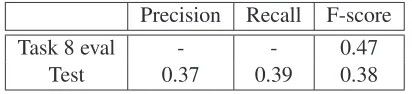
Table 1: Parsing results on the evaluation data of SemEval-2016 Task 8 and test data of LDC2015E86
Precision Recall F-score
Task 8 eval - - 0.47
Test 0.37 0.39 0.38
It can be seen that gaps remain. In particular, there is no wikification to ground terms, and there is a lack of named entity information. Establishment of ar-guments as well as multiple roles for the same en-tity is largely successful, although there are mis-matches withdie-01andturn-02, reflecting that
the semantic analysis stage lacks information for how PropBank roles for arguments should be allo-cated.
5 Experiments
The method of this paper is evaluated on the shared task evaluation data, which includes 1053 sentences. The smatch score on the evaluation data is 0.47. Ta-ble 1 also reports smatch score on the LDC2015E86 dataset, which includes 1371 test sentences. The scores are calculated with Smatch v2.0.2 (Cai and Knight, 2013), which evaluates the precision, re-call, and F1 of the concepts and relations all to-gether. The score for Task 8 is higher than the per-formance on the LDC2015E86 test data. Reasons for the difference include parser performance being better on the evaluate data, and there being fewer non-compositional aspects of representation in the evaluate data.
6 Conclusion
To sum up, this paper has described a modularised approach for building meaning representations, with a key role for an adapted Tarskian satisfaction re-lation for a Dynamic Semantics as the method to integrate and connect information sourced from a syntactic parser, semantic role labeller and named entity recogniser. Task performance was limited by not using the training data provided by the task, in particular: lacking information to allocate PropBank roles, neglecting wikification, and missing entity in-formation to replicate non-compositional aspects of the Abstract Meaning Representation (AMR) spec-ification (Banarescu et al., 2015). Nevertheless,
this contribution indicates that AMRs are not far removed from what a compositional semantics can achieve, which is of interest for connecting to results from the formal semantics literature, such as gain-ing a treatment for quantification, as well as for re-lating to “Sembank” resources built with Discourse Representation Theory/Dynamic Semantics, such as the Groningen Meaning Bank8 (Basile et al., 2012)
and Treebank Semantics Corpus9(Butler and
Yoshi-moto, 2012).
Appendix: Implementation10
Assuming text is some original (multi-)sentence
segmented data,text.psdcontains the output from
a parser trained on the PPCMBE,text.mateis
out-put from mateplus, andtext.neris output from the
Stanford Named Entity Recognizer, the following pipeline creates fully parsed data as described in sec-tion 2.
cat text.psd | add_functional text.mate | add_sense text.mate | add_tsv_ner text.ner | add_lemma text.mate | tree_select_word_2 > fullparse.psd
A script to recover the potentially multiple sen-tence segmentation oftext obscured by parsing is
achieved thus:
cat fullparse.psd | parse_discourse_split text > segment.sh
The following pipeline achieves the semantic anal-ysis of section 3, as well as the conversion to pen-man/AMR notation of section 4.
cat fullparse.psd | prepare_PPCMBE | segment.sh | parse_normalize -propbank -free -bind | see_sct -free -reset | run_sct -penman | penman_like_amr | pretty_penman
Acknowledgements
This paper has benefitted from the comments of three anonymous reviewers, discussions with Pas-cual Martínez-Gómez, Masaaki Nagata, and Kei Yoshimoto, and most particularly advice from the SemEval Task 8 organiser Jonathan May, all of
8http://gmb.let.rug.nl
9https://github.com/ajb129/tscorpus
which is very gratefully acknowledged. This re-search is supported by the Japan Society for the Pro-motion of Science (JSPS), Research Project Num-ber: 15K02469.
References
Laura Banarescu, Claire Bonial, Shu Cai, Madalina Georgescu, Kira Griffitt, Ulf Hermjakob, Kevin Knight, Philipp Koehn, Martha Palmer, and Nathan Schneider. 2015. Abstract Meaning Representation (AMR) 1.2.2 Spec-ification. https://github.com/amrisi/amr-guidelines/blob/master/amr.md.
V. Basile, J. Bos, K. Evang, and N.J. Venhuizen. 2012. Developing a large semantically annotated corpus. InProceedings of the 8th Int. Conf. on Language Resources and Evaluation. Istanbul, Turkey. Claire Bonial, Olga Babko-Malaya, Jinho D. Choi, Jena
Hwang, and Martha Palmer. 2010.PropBank Anno-tation Guidelines. Center for CompuAnno-tational Lan-guage and Education Research, Institute of Cogni-tive Science, University of Colorado at Boulder, 3rd edn.
Anders Björkelund, Love Hafdell, and Pierre Nugues. 2014. Multilingual semantic role labeling. In Proceedings of The Thirteenth Conference on Com-putational Natural Language Learning (CoNLL), pages 43–48. Boulder, Colorado.
Alastair Butler. 2010. The Semantics of Grammatical Dependencies, vol. 23 ofCurrent Research in the Semantics/Pragmatics Interface. Bingley: Emer-ald.
Alastair Butler. 2015. Linguistic Expressions and Se-mantic Processing: A Practical Approach. Heidel-berg: Springer-Verlag.
Alastair Butler and Kei Yoshimoto. 2012. Banking meaning representations from treebanks.Linguistic Issues in Language Technology - LiLT7(1):1–22. Shu Cai and Kevin Knight. 2013. Smatch: an evaluation
metric for semantic feature structures. InProc. of the ACL 2013.
Donald Davidson. 1967. The logical form of action sen-tences. In N. Rescher, ed.,The Logic of Decision and Action. Pittsburgh: University of Pittsburgh Press. Reprinted in: D. Davidson, 1980.Essays on Actions and Events. Claredon Press, Oxford, pages 105–122.
Paul Dekker. 2012. Dynamic Semantics, vol. 91 of Studies in Linguistics and Philosophy. Dordrecht: Springer Verlag.
Tsaiwei Fang, Alastair Butler, and Kei Yoshimoto. 2014. Parsing Japanese with a PCFG treebank grammar. InProceedings of the Twentieth Annual Meeting of the Association of Natural Language Processing, pages 432–435. Sapporo, Japan. Jenny Finkel, Trond Grenager, and Christopher
Man-ning. 2005. Incorporating non-local information into information extraction systems by gibbs sam-pling. InProceedings of the 43nd Annual Meet-ing of the Association for Computational LMeet-inguis- Linguis-tics (ACL 2005), pages 363–370.
Hans Kamp and Uwe Reyle. 1993. From Discourse to Logic: Introduction to Model-theoretic Semantics of Natural Language, Formal Logic and Discourse Representation Theory. Dordrecht: Kluwer. Anthony Kroch, Beatrice Santorini, and Ariel Diertani.
2010.The Penn-Helsinki Parsed Corpus of Modern British English (PPCMBE). Department of Linguis-tics, University of Pennsylvania. CD-ROM, second edition, (http://www.ling.upenn.edu/hist-corpora). Seth Kulick, Anthony Kroch, and Beatrice Santorini.
2014. The Penn Parsed Corpus of Modern British English: First parsing results and analysis. In Pro-ceedings of the 52nd Annual Meeting of the Associ-ation for ComputAssoci-ational Linguistics (Short Papers), pages 662–667. Baltimore, Maryland, USA: Asso-ciation for Computational Linguistics.
Christian Matthiessen and John A Bateman. 1991. Text generation and systemic-functional linguistics: ex-periences from English and Japanese. Pinter Pub-lishers.
Slav Petrov and Dan Klein. 2007. Improved infer-ence for unlexicalized parsing. InProceedings of NAACL HLT 2007, pages 404–411.
Michael Roth and Kristian Woodsend. 2014. Com-position of word representations improves semantic role labelling. InProceedings of the 2014 Con-ference on Empirical Methods in Natural Language Processing (EMNLP), pages 407–413. Doha, Qatar. Beatrice Santorini. 2010. Annotation man-ual for the Penn Historical Corpora and the PCEEC (Release 2). Tech. rep., Depart-ment of Computer and Information Science, University of Pennsylvania, Philadelphia. (http://www.ling.upenn.edu/histcorpora/annotation). Kristina Toutanova, Dan Klein, Christopher Manning,
and Yoram Singer. 2003. Feature-rich part-of-speech tagging with a cyclic dependency network. InProceedings of HLT-NAACL 2003, pages 252– 259.