S Bandyopadhyay, D S Sharma and R Sangal. Proc. of the 14th Intl. Conference on Natural Language Processing, pages 50–55, Kolkata, India. December 2017. c2016 NLP Association of India (NLPAI)
POS Tagging For Resource Poor Indian Languages Through
Feature Projection
Pruthwik Mishra1 Vandan Mujadia2 Dipti Misra Sharma3
Language Technologies Research Center, IIIT Hyderabad Kohli Center On Intelligent Systems
[email protected],[email protected],[email protected]
Abstract
We present an approach for POS tag-ging with out any labeled data. Our method requires translated sentences from a pair of languages. We used feature transfer from a resource rich language to resource poor languages. Across 8 different Indian Languages, we achieved encouraging accuracies without any knowledge of the target language and any human annotation. This will help us in creating annotated corpora for resource poor Indian lan-guages.
Keywords
POS, NLP, corpus, parallel corpora, Feature Transfer, Alignment, Mapping
1 Introduction
Part-Of-Speech(POS) (Bharati et al., 2007) Tagging is considered as a preliminary task for various Natural Language Processing(NLP) tasks. POS Tagging primarily assigns class labels to words based on some extracted fea-tures. The POS tagged corpus can further be used for parsing, building lexical dictionar-ies, frequency lists and many more subsequent tasks1. For automatic POS tagging, the state-of-the-art POS taggers use large POS anno-tated data sets and try to learn the appropri-ate class labels for words depending on various hand annotated features. There are many In-dian Languages which are unexplored due to the unavailability of annotated corpora. But recently, there has been a lot of efforts to cre-ate monolingual as well as bilingual corpora
1
http://www.ahds.ac.uk/creating/guides/linguistic-corpora/
for different Indian Languages.
Hindi is resource rich in this regard as there are many linguistic resources created for Hindi. One of the notable corpus available is the Hindi Treebank (Bharati et al., 2006). Statis-tical POS taggers trained on Hindi Treebank data for Hindi achieved around 93% accuracy (Gadde and Yeleti, 2008). Stochastic or Sta-tistical Taggers are also used for Indian lan-guages like Punjabi, Urdu, Marathi, Telugu, but their accuracies fall due to lack of large annotated corpora. POS Taggers for other In-dian Languages have not been evaluated. So these languages are resource poor in terms of high quality linguistic annotated data.
The motivation behind this work is to create lexical resources for resource poor Indian lan-guages. All the Indian Languages are mor-phologically rich, prefixes and the word end-ing suffixes encode a lot information about the category of the word. We try to leverage these similarities and availability of Hindi corpus for creating resources for other languages.
The paper is divided as per the following. In the section 2, we describe Background of Pro-jection using aligned Corpora. Section 3 gives an account of Corpus Details, section 4 de-scribes the Algorithm and various tools used. Section 5 presents the Experimental Results and in the subsequent section 6, we have the error analysis. The future work is discussed in the concluding section.
2 Background
for agglutinative Dravidian Languages. But one major bottleneck in POS tagging is the requirement of a large labeled corpus which is difficult to create. To overcome this dif-ficulty, many researchers have employed un-supervised techniques which are less accurate (Accuracies reported in the range of 70-80%) (Christodoulopoulos et al., 2010)
So in our approach, we leveraged the gold quality corpus of a resource rich language and transferred features to a resource poor lan-guage. The only resource available to us is a parallel corpus with the resource rich one. We report the results using two different tag-sets - one being the tag-set defined for Indian Lan-guages named as the IIIT - tagset (Bharati et al., 2006) which is fine-grained and the Univer-sal Tag-set (Petrov et al., 2011) mostly used for Unsupervised and semi-supervised POS-Tagging which is coarse-grained. We evaluated on 8 Indian Languages and obtained overall average accuracies of 81%.
(Yarowsky et al., 2001) introduced robust pro-jections across aligned corpora. They used a statistical POS tagger for tagging source side text and transferred the POS tags to the target side from the word alignments ob-tained. The noisy transfers were filtered out re-estimating the the most frequent tag se-quence model. Other works (Das and Petrov, 2011) used bilingual projections using Univer-sal Tag-set. All these methods employ Label Propagation (LP) to transfer the tags from la-beled data to unlala-beled data. These are exam-ples of semi-supervised techniques and major work has been done on European languages. The work of (Das and Petrov, 2011) is clos-est to (Yarowsky et al., 2001). These meth-ods are evaluated on data sets which are very similar to the parallel corpus. Direct transfer of tags using raw projection can lead to very noisy POS tags. Instead of directly matching words from the word alignments available; we use the feature of the words which are clear indicators of POS tags realized through rich morphology. Because of the limited size of bi-text (parallel corpus) chances of finding exact matching words gets reduced. We do not use the observed word as a feature. For avoiding non-matched features, we use back-off smooth-ing. Thus we have an approximate feature
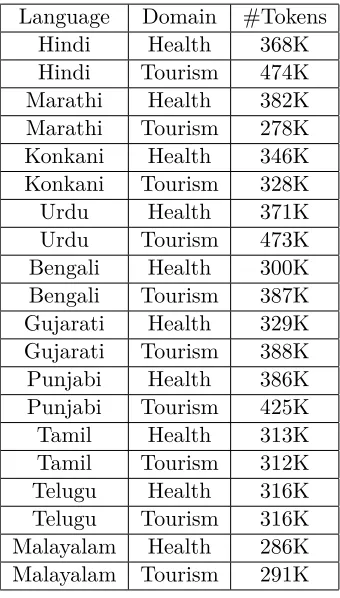
[image:2.612.340.510.36.335.2]Language Domain #Tokens Hindi Health 368K Hindi Tourism 474K Marathi Health 382K Marathi Tourism 278K Konkani Health 346K Konkani Tourism 328K Urdu Health 371K Urdu Tourism 473K Bengali Health 300K Bengali Tourism 387K Gujarati Health 329K Gujarati Tourism 388K Punjabi Health 386K Punjabi Tourism 425K Tamil Health 313K Tamil Tourism 312K Telugu Health 316K Telugu Tourism 316K Malayalam Health 286K Malayalam Tourism 291K
Table 1: ILCI Corpus Details
representation for any word occurring in the corpus. The features used suffice to the back-off model. The Suffixes and prefixes provide valuable cue in the identification of a particu-lar POS category. Additionally, suffixes help to disambiguate between various similar cate-gories.
We trained the models on general domain and tested on health domain data. The performance of our models is comparable to the state-of-the-art systems in out-of-domain data.
3 Corpus Details
We used two data sets for our experiments. 1. ILCI (Indian Languages Corpora
Initia-tive) parallel corpora 2. Hindi Tree-bank
The data used for parallel corpora was the ILCI (Choudhary and Jha, 2014) corpora re-leased for different languages. We have exper-imented on 8 languages :- Punjabi, Konkani, Bengali, Telugu, Malayalam, Urdu, Marathi, Gujarati
Data-Set #Sentences #Tokens Hindi Treebank 21K 450K
Table 2: Hindi Treebank Details
language was 25K.
The Hindi Treebank (Bharati et al., 2006) creation task was taken up at IIIT, Hyder-abad. The treebank is a multi-layered rep-resentation of sentences with syntactic and semantic annotation. The syntactic annota-tion includes morph analysis, POS Tagging, Chunking of words or tokens occurring in a sentence. We used Hindi treebank for ensur-ing high quality projection of POS tags. The Hindi Treebank is annotated with POS tags from IIIT tag-set(tagging annotation guide-lines described in (Bharati et al., 2006)). The details of the Hindi Treebank is presented in Table 2. We also converted IIIT tags to Uni-versal tags (Petrov et al., 2011) and evaluated the POS Tagging accuracy for both the tag-sets. Universal Tag-set is often used for projec-tion techniques to remove ambiguities related to finer grained tags.
4 Algorithm
Our approach is an example of feature repre-sentation transfer. We transfered the knowl-edge acquired from a language to another lan-guage. In this paper, the source language used for feature transfer was Hindi and the target languages for projection were resource poor In-dian Languages explained in the above section. The scarcity of data for any language will not impact the performance if a huge training data set is available for another language. With a mapping between the feature sets of the con-cerned languages, we have the luxury of cre-ating training data of comparable size for a resource poor language.
Our algorithm has 5 steps.
4.1 Word Alignment
Learning word alignments from the parallel text is the first step in our approach. We used GIZA++ tool 2 for capturing the word level
alignment between sentences that are aligned for a pair of languages. The raw text files for a source language and target language serve as
2https://github.com/moses-smt/giza-pp.git
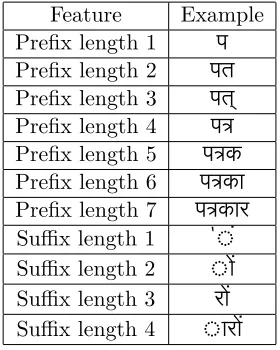
[image:3.612.355.495.37.212.2]Feature Example Prefix length 1 प Prefix length 2 पत Prefix length 3 पत् Prefix length 4 पतर् Prefix length 5 पतर्क Prefix length 6 पतर्का Prefix length 7 पतर्कार Suffix length 1 '◌ं Suffix length 2 ◌ Suffix length 3 र Suffix length 4 ◌ार
Table 3: Features for Hindi
the inputs for the tool. In this case, the source language was Hindi and target language was any of the resource poor Indian languages. GIZA++ tool finds the alignments between words with translation probabilities. It also generates files with translation probabilities of aligned sentences. A word can have multiple alignments, but we selected the alignment with highest probability. We were able to eliminate noisy alignments by only selecting the most likely alignment for a word.
4.2 Feature Selection
As POS Tagging is sequence labeling task, cer-tain features need to be captured in classify-ing the words and assignclassify-ing them appropriate tags. Indian Languages are morphologically rich, therefore prefixes and suffixes provide a lot of information about the category of the word. For Indian Languages, we considered the following morph
features:-• The prefix characters up to 7 characters
• The suffix characters up to 4 characters
• Length of the word
• Context Window size of 3 (Previous word, Current word and Next word)
For example the feature representation for a Hindi word पतर्कार (Patrakāron - Journalists) is given in Table 1:
iflength(word)<length(f eature)then ▷ The prefix length can vary from 1-7 and suffix length can range from 1-4
f eature←N U LL
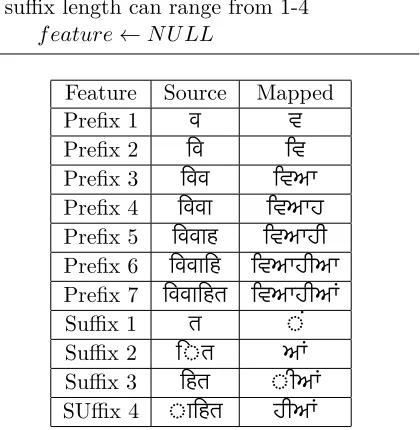
Feature Source Mapped
Prefix 1 व ਵ
Prefix 2 िव ਿਵ
Prefix 3 िवव ਿਵਆ Prefix 4 िववा ਿਵਆਹ Prefix 5 िववाह ਿਵਆਹੀ Prefix 6 िववािह ਿਵਆਹੀਆ Prefix 7 िववािहत ਿਵਆਹੀਆਂ
Suffix 1 त ◌ਂ
[image:4.612.89.299.69.284.2]Suffix 2 ि◌त ਆਂ Suffix 3 िहत ◌ੀਆਂ SUffix 4 ◌ािहत ਹੀਆਂ
Table 4: Feature Mapping Between Hindi and Punjabi
4.3 Mapping File Creation
After obtaining word level alignments, we cre-ated feature level mapping files based on the features defined in the previous subsection. As the word alignments with highest probabili-ties were taken into account, the correspond-ing feature files supported the best possible mapping from the source language to the tar-get language. The example of Hindi - Pun-jabi pair mapping file is given in Table 4. The word in Hindi is'िववािहत' (Vivāhita - married) and the aligned word in Punjabi is'ਿਵਆਹੀਆਂ' (Vivāhita - married). We did not normaliza-tion the text before the feature transfer. This was done keeping in our effort of not includ-ing any language specific information for any resource poor language. If the same feature got mapped to multiple target features, we se-lected the target feature with highest proba-bility. There are 7 features corresponding to prefixes and 4 features for suffix, so there are total 11 feature mapping files from Hindi to one of the resource poor languages.
4.4 Feature Transfer
This is the most vital step of the algorithm in which the features obtained from the to-kens present in the Hindi Treebank are trans-ferred to other languages. Hindi Treebank
data is used to avoid noisy projections from Hindi to resource poor languages. Each word in the treebank is represented by the features described above. From the mapping files, we obtain a particular Hindi feature and its corre-sponding mapped feature in the language un-der test. If a feature is missing from the fea-ture mapping file, a back-off model finds the next lower length feature. These feature trans-formations are essential for a sound represen-tation in the target side. Otherwise, in case of features that are not-found, the target side would have been filled with NULL features and will affect the performance of the POS Tagger.
4.5 Creation of Training Model
This step is the training phase of POS Tagging where the samples are assigned pre-defined la-bels i.e. POS tags. We have used Conditional Random Fields(CRF) classification algorithm for our task. The conditional random fields are implemented via CRF++3tool. This tool receives features in the form of a template. From the training samples, CRF creates a model assigning feature weights to the indi-vidual features. After the model is created, a test data set is used to predict the POS tags of the test samples.
The whole process can be modeled as a com-position of different functions. The final model for predicting POS tags is given in equation 1
f inal_model=M(T(f(A(x, y)))) (1)
where A→ Alignment between word x and y f→ Feature Representation for the words x, y T→ Transfer of Features from x to y
M→ Model creation using the transferred fea-tures
5 Experiments & Results
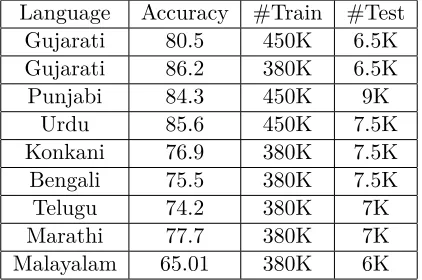
The experimental results are shown in Table 5. The 1st entry for Gujarati corresponds to the word alignments obtained from Original Hindi - Gujarati ILCI parallel corpus. The other en-try reflects the accuracy obtained after pre-processing the parallel corpus. Case markers are not present as separate tokens in Gujarati. As a result of this, there were no alignments for many post-positions used as case markers
3https://taku910.github.io/crfpp/
Language Accuracy #Train #Test Gujarati 80.5 450K 6.5K Gujarati 86.2 380K 6.5K
Punjabi 84.3 450K 9K
Urdu 85.6 450K 7.5K
Konkani 76.9 380K 7.5K
Bengali 75.5 380K 7.5K
Telugu 74.2 380K 7K
Marathi 77.7 380K 7K
[image:5.612.85.296.38.178.2]Malayalam 65.01 380K 6K
Table 5: Accuracies for Different Languages
in Hindi. So we combined the post-positions with the preceding noun on the Hindi side and found word alignments from the changed par-allel corpus.
6 Error Analysis
Languages which are close to Hindi gave better results than other languages. Gujarati, Urdu and Punjabi have similar syntactic structure to Hindi with minor variations. Gujarati does not separate case markers as Hindi, where the case markers are present as a suffix in the nouns. Other languages like Bengali, Konkani, Marathi, Telugu, Malayalam are morpholog-ically richer than Hindi. So the word level alignment is less accurate. To overcome this shortcomings, we combined the post positions marking the case, the auxiliary verbs with the preceding head categories. The head cate-gory in the former was the noun and the cor-responding head in the latter was the verb. By incorporating these changes, we were able to capture the inherent syntactic behavior of these languages. The increase in accuracy for Gujarati showed this. This heuristic helped to create a better feature mapping (Petrov et al., 2011).
The sources of major errors are listed as fol-lows:
• Errors in the Gold Data
• Ambiguities between Nouns and Adjec-tive
• Ambiguities between particle and con-junction
• Ambiguities between Verbs and Auxiliary Verbs
• Alignment Issues
7 Future Work
We would extend this work to other resource poor Indian languages. Semantic Clustering using neural networks is an interesting area to explore. As the efficiency of the system re-lies heavily on the word alignments between a pair of languages, new methods can be im-plemented to improve the alignments. We will experiment with other sequence labelers like structured perceptron (Collins, 2002), SVM-Struct (Tsochantaridis et al., 2004), sequence-to-sequence learners(Sutskever et al., 2014). We will explore (Das and Petrov, 2011) the label propagation of tags between languages.
Acknowledgement
We thank DIT for providing ILCI corpus which enabled us to carry out the research. We would also like to thank people of different languages for helping out in the error analysis of POS tagging.
References
Akshar Bharati, Rajeev Sangal, Dipti Misra Sharma, and Lakshmi Bai. 2006. Anncorra: Annotating corpora guidelines for pos and chunk annotation for indian languages. LTRC-TR31.
Akshar Bharati, Rajeev Sangal, and Dipti M Sharma. 2007. Ssf: Shakti standard format guide. Language Technologies Research Centre, International Institute of Information Technol-ogy, Hyderabad, India, pages 1–25.
Narayan Choudhary and Girish Nath Jha. 2014. Creating multilingual parallel corpora in indian languages. In Human Language Technology Challenges for Computer Science and Linguis-tics, pages 527–537. Springer.
Christos Christodoulopoulos, Sharon Goldwater, and Mark Steedman. 2010. Two decades of unsupervised pos induction: How far have we come? In Proceedings of the 2010 Conference on Empirical Methods in Natural Language Pro-cessing, pages 575–584. Association for Compu-tational Linguistics.
Michael Collins. 2002. Discriminative training methods for hidden markov models: Theory and experiments with perceptron algorithms. In Proceedings of the ACL-02 conference on Em-pirical methods in natural language processing-Volume 10, pages 1–8. Association for Compu-tational Linguistics.
Dipanjan Das and Slav Petrov. 2011. Unsu-pervised part-of-speech tagging with bilingual graph-based projections. In Proceedings of the 49th Annual Meeting of the Association for Computational Linguistics: Human Language Technologies-Volume 1, pages 600–609. Associa-tion for ComputaAssocia-tional Linguistics.
Phani Gadde and Meher Vijay Yeleti. 2008. Im-proving statistical pos tagging using linguistic feature for hindi and telugu. Proc. of ICON.
Slav Petrov, Dipanjan Das, and Ryan McDonald. 2011. A universal part-of-speech tagset. arXiv preprint arXiv:1104.2086.
Ilya Sutskever, Oriol Vinyals, and Quoc V Le. 2014. Sequence to sequence learning with neu-ral networks. InAdvances in neural information processing systems, pages 3104–3112.
Ioannis Tsochantaridis, Thomas Hofmann, Thorsten Joachims, and Yasemin Altun. 2004. Support vector machine learning for interdependent and structured output spaces.
David Yarowsky, Grace Ngai, and Richard Wicen-towski. 2001. Inducing multilingual text anal-ysis tools via robust projection across aligned corpora. In Proceedings of the first interna-tional conference on Human language technol-ogy research, pages 1–8. Association for Compu-tational Linguistics.