S Bandyopadhyay, D S Sharma and R Sangal. Proc. of the 14th Intl. Conference on Natural Language Processing, pages 312–321, Kolkata, India. December 2017. c2016 NLP Association of India (NLPAI)
Normalization of Social Media Text using Deep Neural Networks
Ajay Shankar Tiwari Jadavpur University
India
Sudip Kumar Naskar Jadavpur University
India
Abstract
This paper sets out to investigate ways of normalizing noisy text that appear on social media platforms like Facebook, Twitter, Whatsapp, etc. We proposed a deep learn-ing based approach to text normalization using Recurrent Neural Network (RNN) based Encoder–Decoder architecture with Long Short Term Memory (LSTM). To circumvent the unavailability of suitable large noisy–clean parallel dataset, we de-veloped synthetic datasets. We trained and evaluated the proposed model on our syn-thetic datasets and the WNUT1shared task dataset. The uniqueness of our approach is in the use of synthetic datasets in a transfer learning approach for improving the perfor-mance of text normalization based on deep neural models. Our transfer learning based deep neural model produced state-of-the-art results (F1 score 0.9098) outperforming the previous best performing model on the WNUT test set by 7%.
1 Introduction
There is a large quantity of user-generated content on the web, characterized by social media, creativ-ity and individualcreativ-ity, which has created problems at two levels. Firstly, social media text is often un-suitable for various Natural Language Processing (NLP) tasks, such as Information Retrieval, Ma-chine Translation, Opinion Mining, etc., due to the irregularities found in such content. Secondly, non-native speakers of English, older Internet users and non-members of the in-groups often find such texts difficult to comprehend. Prompt use of Internet and the resulting noisy user generated text found in different social media platforms such as social networking sites, blogs, etc., cause a hindrance in
1https://noisy-text.github.io/2015/norm-shared-task.html
understanding casual written English, which often does not conform to the rules of spelling, grammar and punctuation.
In this paper, we present an approach for text normalization of social media text. Our approach uses a sequence to sequence model (Sutskever et al., 2014) in which we tried Recurrent Neural Network (RNN) based encoder-decoder approach (Bahdanau et al., 2014) with Long Short Term Memory (LSTM). The use of LSTMs for text nor-malization in the present work is motivated by (Sproat and Jaitly, 2016). We take a character based LSTM approach motivated by the work of (Ling et al., 2015) who showed that character based approach is superior to word based approach for neural network based sequence to sequence mod-elling tasks2. Our LSTM model was trained with attention mechanism (Bahdanau et al., 2014).
2 Related Work
Text Normalization is a well known task in the field of NLP, particularly in the Social Media do-main. Clark and Araki (2011) provides a detailed survey on the challenges and applications of text normalization in Social Media.
Researchers have shown that text normalization is a major factor in improving performance of NLP intermediate tasks like part-of-speech tagging (Han et al., 2013) and NLP applications like machine translation (Hassan and Menezes, 2013).
Research in text normalization started with spelling correction with noisy channel model (Kernighan et al., 1990; Mays et al., 1991). Since then several different approaches have been pro-posed by researchers. We report here a few of the most prominent works on text normalization, with a particular focus on social media.
2(Ling et al., 2015) showed improvement on the machine
translation task. Text normalization is conceptually very simi-lar to and can be modelled as a machine translation task using noisy–clean parallel corpus..
Statistical Approaches:In the early 1990’s, re-searchers in the AT&T Bell Labs (Kernighan et al., 1990) and IBM Research (Mays et al., 1991) car-ried out independent work on spelling correction using noisy channel model. This generative model has remained the most dominant and successful approach to text normalization until very recently. Hassan and Menezes (2013) proposed an ap-proach for normalizing social media text which used random walk framework on a contextual simi-larity bipartite graph constructed from n-grams se-quences, which they interpolated with edit distance . They used the proposed method as a preprocess-ing step to improve machine translation quality on social media text.
Pennell and Liu (2010) proposed text normaliza-tion for text messages (SMS) to make them suitable as input to speech synthesizer. They used statisti-cal classifier which tries to learn when and which character to delete and then reverse the mappings to normalize short text messages.
Sproat et al. (2001) proposed a taxonomy of non-standard words (NSW) and explored several methods like n-gram language models, decision trees, weighted finite state transducers, etc., for text normalization of NSWs. They reported that a sys-tematic class-specific treatment results in improved text normalization.
Choudhury et al. (2007) proposed a Hidden Markov model based text normalization approach for SMS texts and texting language. Aw et al. (2006) used SMT models to normalize noisy SMS text by translating SMS text to Regular English text. Mikheev (2000) solved three major problems in text normalization: sentence boundary disambigua-tion, disambiguation of capitalized words when they are used in positions where capitalization is expected, and identification of abbreviations.
Deep Learning Based Approaches: Deep learning based approaches have emerged as a com-petitive alternative in recent years and research have been reported on deep learning based text normalization.
One of the most prominent work on deep learn-ing based approach to text normalization is (Sproat and Jaitly, 2016) which proposed different RNN architectures to normalize texts for text-to-speech (TTS) Systems. The main focus of their work was to normalizewritten textsto theircorrect spoken form. The proposed system used LSTMs and at-tention based Sequence-To-Sequence models
(Bah-danau et al., 2014). Sproat and Jaitly (2017) used the same framework to build their TTS text normal-ization models for English and Russian and trained their models on huge amount of training data. Their dataset consists of 1.1 billion English words and 290 million Russian words and they reported very high accuracy, over 0.99 for both English and Rus-sian. They also augmented their system with a finite-state transducer (FST) filter to take care of mistakes made by the RNN based model.
Deep Neural Network models suffer from the
Out-Of-Vocabulary(OOV) problem (Luong et al., 2014), when text normalization is performed using word based approach. Xie et al. (2016) solved this problem by illustrating how character based neural networks are much better in normalizing noisy and user generated texts. They also showed that results can be improved by introducing synthesized errors in a datasets. They showed improvement using noisy text collected from English learner forum.
Leeman-Munk et al. (2015) proposed a model for normalizing noisy text which uses two aug-mented feed forward networks (Glorot and Bengio, 2010), flagger to identify the word to be normalized and at last a normalizer which provides the correct output for one token at a time.
Chollampatt et al. (2016) showed that neural ma-chine translation models are better in correcting grammatical errors, a task closely related to text normalization, as compared to phrase based sta-tistical machine translation models (Wang et al., 2014).
Other noticeable works in text normalization in-clude the use of adaptive parser-centric strategy (Zhang et al., 2013) to convert noisy texts into gram-matically correct texts, unsupervised model using semantic similarity and Re-ranking strategy (Li and Liu, 2014). Toruno˘glu and Eryi˘git (2014) proposed a cascaded approach for normalizing Turkish text by dividing the main problem into sub problems and solving them one by one. Liu (2012) used character-block level SMT to normalize SMS and Twitter text. Pusateri et al. (2017) reports the use of bi-directional LSTM for the task ofinversetext normalization, the objective of which is the exact opposite of (Sproat and Jaitly, 2016), i.e. to con-vert the spoken form token sequence produced by a speech recognizer into written form.
3 System Architecture 3.1 Recurrent Neural Network
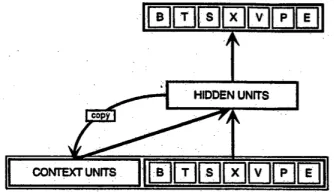
The main motive behind using RNN for text nor-malization is to utilize sequential content. Input to the RNNs is the current information they see as well as the previous information remembered by them at that time. In Fig 1, taken from (Elman, 1991), “BTSXVPE” at the bottom shows the cur-rent input and “CONTEXT UNITS” represents the output at the previous step. The decision of recur-rent net reached at time steptiaffects the decision
it will reach one moment later at time stepti+1.
[image:3.612.106.273.401.499.2]As discussed in (Quast, 2016), RNNs are called recurrent because they perform the same task for every element of a sequence, with the output being dependent on the previous computations. It is often said that recurrent networks have memory. Adding memory to neural networks has a purpose: there is information in the sequence itself and recurrent nets use it to perform tasks. That sequential in-formation is preserved in the recurrent network’s hidden state which manages to span many time steps as it cascades forward to affect the processing of each new example. This feature of RNN makes it an efficient approach for normalizing noisy text.
Figure 1: RNN Network Architecture
A drawback of the RNN is that, as the gap be-tween the relevant information and the point where it is needed widens, RNNs fail in remembering the information. This problem with RNN was explored by Bengio et al. (1994). To overcome this problem, LSTM Networks were introduced by Hochreiter and Schmidhuber (1997).
3.2 Long-Short Term Memory Network
As discussed in (Olah, 2015), LSTM networks are another variety of RNNs, mainly used for learning long-term dependencies. In standard RNNs, there is always a chain of repeating modules containing a simple structure.
LSTMs are a fairly simple extension of RNNs.
The objective of LSTM can be briefly described into three points as follows.
• Deciding which information to remem-ber/forget: The model needs to learn a sepa-rate method to forget/remember information when new inputs come in; it needs to know which beliefs to keep and which ones to throw away.
• Updating new information: When new in-put comes in, the model first forgets any long-term information it decides it no longer needs. Then it learns which parts of the new input are worth using and saves them into its long-term memory.
• Handling long-term dependencies: Finally, the model needs to learn which parts of its long-term memory are immediately useful and therefore it needs to focus on.
3.3 RNN Encoder–Decoder
RNN Encoder–Decoder models (Cho et al., 2014) can be stated a sequence to sequence mapping be-tween two sequences, learned using two RNNs, one on either side, encoder and decoder, which are trained jointly. For example, in our model, stences having erroneous words were kept at the en-coder side and the corresponding sentences having correctly spelled words were kept at the decoder side. The encoder part receives a sequence and then coverts it into an encoded representation of the se-quence, which is further decoded by the decoder to provide the output sequence. RNN encoder-decoder models may contain different cells like GRU or LSTM, or simply RNN. It is quite obvious that the encoded representation of a sequence must be a fixed size vector.
The encoder encodes an input sequence into a fixed-length vector representation and the decoder decodes a given fixed-length vector representation into an output sequence.
3.4 Attention-based Bidirectional RNN Model
Attention Mechanisms in Neural Networks are (very) loosely based on the visual attention mech-anism found in humans. Our bidirectional RNN encoder consists of forward and backward RNNs. Using attention mechanism, the decoder gives at-tention to different parts of the input sequence at each step of the output generation .
4 Data Sets and Resources
As discussed in Section 3.4, we trained a mono-lingual encoder-decoder based S2S model for our task, where the encoder encodes the input incorrect text and the decoder produces the correct text as output. We consider noisy texts and their corre-sponding corrected version as a parallel data on which we train our S2S model. However, it is a well known fact that deep neural network models (S2S in our case) typically require large amount of training data. Obtaining such large parallel training data, particularly for the social media domain is a major challenge itself in text normalization re-search. Therefore, in the absence of such parallel training data, we constructed synthetic data, i.e. ar-tificially developed parallel dataset in which one side consists of sentences having misspelled and noisy words and the other side consists of sentences containing correctly spelled and normalized words. The noisy side (having misspelled words) of the parallel data was created by randomly replacing words in a clean text corpus with the help of four different dictionaries mentioned in Section 4.1. All of these dictionaries consist of parallel list (a hash table) of correct words and their corresponding in-correct noisy versions, where the in-correct word is stored as akeyand the values for those keys are one or many misspelled words corresponding to the key.
4.1 Dictionaries
We used Peter Norvig Copus3, one of the most pop-ular resource in text normalization research, there were containing 7,841 correctly spelled words and their corresponding misspelled version(s). A snap-shot of the Peter Norvig Corpus is shown below.
...
looking: loking, begining, luing, look*2, locking, lucking, louk, looing, lookin, liking
eligible: eligble, elegable, eligable scold: schold, skold
...
However, the Peter Norvig corpus is a general domain spelling error corpus, i.e., it is not specifi-cally designed for noisy social media content and as such does not contain spelling error phenomena that are typical to social media text. To include the flavour of errors which occur in social media con-versations, we used two spelling error dictionaries
3http://norvig.com/ngrams/spell-errors.txt
provided by the WNUT 2015 shared task4on “Nor-malization of Noisy Text” which contain one to one mapping of incorrect words to correct words. The two dictionaries contain 3,804 and 41,182 [correct, incorrect] word pairs respectively. To make the dataset even noisier, we also constructed another social media spelling error dictionary containing 652 new word pairs by manually observing dif-ferent Whatsapp Group chat conversations, public comments on Facebook’s posts and Facebook Con-versations.
4.2 Synthetic Dataset Preparation
We crawled 500K sentences from different news do-main websites such as Fox News5, The Guardian6, Yahoo News7and CNN News8and then with the help of Peter Norvig’s corpus we prepared a syn-thetic noisy dataset by replacing some words in each sentence with their corresponding misspelled words, if found in the Peter Norvig corpus. If there exist multiple misspelled versions for the same word in the Peter Norvig corpus, then the choice of misspelled word was taken randomly. Since many of the sentences were very long in the crawled cor-pus, we broke them (both the original sentence and the corresponding noisy sentence) down to se-quences of five-grams in order to keep the sequence length shorter. Here sequence length refers to the number of characters in a sequence. Thus, we cre-ated a synthetic parallel dataset,Synthetic1, and
Table 1 shows how our parallel synthetic dataset look like, in which the misspelled words are shown as underlined.
We also created another synthetic dataset (Synthetic2) using a Chat Conversation dataset9
in a similar manner, however, with two noticeable changes. For this dataset we did not split the quence into n-grams because in this dataset se-quence length was not too large as compared to Synthetic1 dataset and we took the help of all
the four dictionaries to create the parallel dataset. The chat conversation dataset belongs to the Cor-nell Movie Dialogue dataset (Danescu-Niculescu-Mizil and Lee, 2011) and it contains conversational data extracted from movie scripts. The dataset was
4https://noisy-text.github.io/2015/norm-shared-task.html 5http://www.foxnews.com/
6https://www.theguardian.com/international 7http://noornotews.yahoo.com/
8http://edition.cnn.com/
9
https://github.com/1228337123/tensorflow-seq2seq-chatbot/tree/master/data
Raw Corpus
...
The government guidance will be reviewed early next year after a period of public comment ...
Clean Text Noisy Text
...
The government guidance will be reviewed government guidance will be reviewed guidance will be reviewed early will be reviwed early next be reviewed early next year reviewed early next year after ...
...
The govment guidence will be reviewed guverment guidence we’ll be reviewed guidance wil be reviewed erly
[image:5.612.100.517.68.216.2]wiull be reviewed eigly next be reviewed erly enxt yeer reviewed erly nexst year afert ...
Table 1: A snapshot of theSynthetic1 dataset
originally built for building chat systems. We con-structed our synthetic data from this raw data. With Synthetic2, our main motive was to build a very
noisy dataset containing errors that are typical to so-cial media. Therefore, we replaced as many words as we could find in the two WNUT dictionaries and our social media dictionary. At last, we checked if any of the non-replaced words in a sequence occurs in keys of the Peter Norvig corpus, and if found, they were also replaced with a correspond-ing (randomly chosen) misspelled word. Thus, we created the parallel datasetSynthetic2reflecting
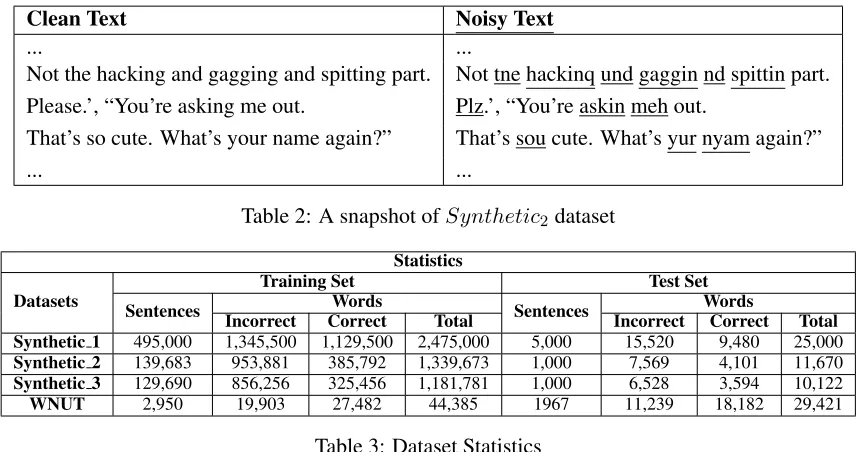
errors typical of social media text. A snapshot of theSynthetic2dataset is shown in Table 2.
Other than these synthetic datasets, we also used the standard training dataset released by the WNUT 2015 shared task on “Normalization of Noisy Text”. This dataset consists of real Twitter data containing different types of abbreviations used and errors made in social media conversations.
Thus, we ended up with three different datasets10 – Synthetic1, Synthetic2 and WNUT. Table 3
presents the dataset statistics of all the datasets that we used to train and evaluate our models.
5 Proposed Models
Model 1 (M1) :This model was trained and tested
on the Synthetic1 training and test set,
respec-tively. A batch size of 305 was considered and model was trained for 20 epochs at constant learn-ing rate of 0.001. In this dataset sequence length was 74. Training this model took 20 hours (1 hour/epoch) on a single GPU. This model was built
10We will release the synthetics datasets and make available
for text normalization research upon publication of the paper.
as a general purpose spelling corrector for regular English sentences.
Model 2 (M2) : From this model onwards, all
our models are focused mainly on in social media text. This model was trained and tested on the Synthetic2 training and test set, respectively. The
sequence length of was 214 and batch size was kept to 32. The model was trained for 4 epochs as after 4th epoch, loss function started diverging and after making changes in the learning rate, there was no sign of convergence of loss. Learning rate was kept constant for 4 epochs at 0.001. Training this model took 16 hours (4 hour/epoch) on a single GPU.
Model 3 (M3) : This model was also trained
and tested onSynthetic2dataset, however, the
se-quence length was kept to 160. We decreased the sequence length so that we could train our model for more number of epochs. Decreasing the se-quence length made the training dataset smaller to 1,29,590 sentences, we refer to this dataset as Synthetic3. We were able to train this model for
7 epochs by changing the learning rate form 0.001 to 0.0001 after 4 epochs. Training this model took 17.5 hours (2.5 hour/epoch) on a single GPU.
Model 4 (M4) : This model was trained and
tested on WNUT datasets. Sequence length was kept at 160 and model was trained for 50 epochs and batch size for this experiment was 32. Learning rate was changed from 0.001 to 0.0001 and then back to 0.001, in between the epochs after observ-ing the behaviour of the loss function. Trainobserv-ing this model took 2.5 hours (3 minutes/epoch) on a single GPU.
Model 5 (M5): This model was trained on
the merged training datasets of Synthetic3 and
Clean Text Noisy Text
... ...
Not the hacking and gagging and spitting part. Not tne hackinq und gaggin nd spittin part. Please.’, “You’re asking me out. Plz.’, “You’re askin meh out.
That’s so cute. What’s your name again?” That’s sou cute. What’s yur nyam again?”
... ...
Table 2: A snapshot ofSynthetic2dataset
Statistics
Datasets Sentences Training SetWords Sentences Test SetWords
Incorrect Correct Total Incorrect Correct Total
Synthetic 1 495,000 1,345,500 1,129,500 2,475,000 5,000 15,520 9,480 25,000
Synthetic 2 139,683 953,881 385,792 1,339,673 1,000 7,569 4,101 11,670
Synthetic 3 129,690 856,256 325,456 1,181,781 1,000 6,528 3,594 10,122
[image:6.612.93.522.35.261.2]WNUT 2,950 19,903 27,482 44,385 1967 11,239 18,182 29,421
Table 3: Dataset Statistics
WNUT. The model was trained for 15 epochs. Loss function was constant at 0.001 and batch size was 256. Training this model took 18.75 hours (1.25 hours/epoch).
Model 6 (M6):This model was built using
trans-fer learning approach by using the trained weights of modelM3for further training of the model on
the WNUT dataset. Sequence length was kept at 160 and the model was trained for 10 epochs. The batch size was 32. The objective behind using transfer learning approach was to make use of the additional synthetic training dataset and hopefully to improve the system performance on the WNUT test set.
Model 7 (M7):This is another model built using
transfer learning approach, however, in this case training was first carried out on the WNUT datasets for 20 epochs and then the learned weights were further used to retrain the model on theSynthetic3
dataset (10 epochs). Loss function for this model was constant at 0.001 and the batch size was 128. Training this model on the WNUT dataset and the Synthetic3 dataset took 65 minutes (3.25
min-utes/epoch) and 6.5 hours (40 minmin-utes/epoch), re-spectively.
“Negative log Likelihood” was used as the loss function for all the experiments (M1–M7) as
ac-cording to (Lewis and Gale, 1994), this loss func-tion proved to be quite perfect for Sequence to Se-quence models. “ADAM” optimizer as described in (Kingma and Ba, 2014) was used for all the experi-ments. All models mentioned here, used 3 layers on each side encoder & decoder.
6 Experimental Setup
Before loading the datasets for experiments, we padded the data. For faster computation, input sequences were divided into number of batches. Since there were variations in sequence length, we padded the data to make them all having uniform length. “EOS” token was kept at the end of each sequence, to identify its end. Shorter length se-quences were padded with trailing zeros. We used word2index dictionary containingkeyas all char-acters and numbers as their indices. “EOS” and “PAD” were given “0” and “1” index respectively.
The length of this dictionary was 98. The synthetic data and the dictionaries mentioned in Section 4.1 will be made publicly available for research upon publication of the paper.
Our models were built using deep learning li-brary Tensorflow11. TensorFlow allows to effi-ciently perform specific machine learning number-crunching operations like derivatives on huge ma-trices . With Tensorflow, processing can be easily distributed across CPU cores, GPU cores, or mul-tiple devices like mulmul-tiple GPUs and even across a distributed network of computers.Python12was used for preparation of the dataset as mentioned in section 4.2 and scripting of the models.
7 Results
Since the proposed model can also mistakenly mod-ify some correct words that should not be changed, precision and recall are the most suitable metrics
11https://www.tensorflow.org/ 12https://www.python.org/
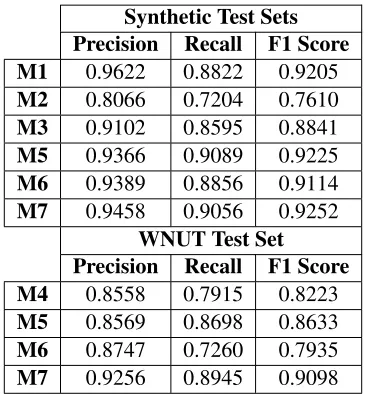
for evaluating this scenario (Powers, 2011). Ac-cordingly, we evaluated the proposed models using precision, recall and F1-score. In the context of text normalization, true positives refer to cases where incorrect words are replaced by the correct words, and true negatives represent correct words being left as they are. False positives concern cases when the model replaces a correct word by an incorrect word. False negatives pertain two cases when the model either does not provide any correction or provides a wrong correction for an incorrect word. Table 4 shows the evaluation results of all the ex-periments mentioned in Section 5. For the benefit of comparison, Table 5 groups these results into two subsets - the ones evaluated on the synthetic test sets and the others evaluated on the WNUT test set. It is to be noted here that the models trained only with the synthetic data (M1,M2andM3) are
not meant to be evaluated with the WNUT test set, however, for the sake of comparison, we also evaluated these models on the the WNUT test set. Among the experiments carried out only with synthetic datasets, the best result (F1 Score = 0.9205) was achieved withM1. The other
mod-els trained on other synthetic datasets,M2andM3,
could not achieve similar results sinceM2andM3
could not be trained much due to their large se-quence length. However, it is to be noted that only the Peter Norvig spelling error corpus was used on news domain data to introduce noise and prepare theSynthetic1 dataset, while all the four
dictio-naries were employed to introduce noise in con-versational data to prepare theSynthetic2dataset.
Therefore,Synthetic2dataset is much more
reflec-tive of social media data and hence more challeng-ing. AmongM2andM3, sinceM3was trained on
shorter sequences and was also trained for more epochs, it was able to produce better performance thanM2.
Then we evaluated our models on the WNUT dataset, the only standard dataset available for text normalization research. Since the training dataset size was very small, the model (M4) produced
rel-atively low performance (F1 Score = 0.8223) even after training for 50 epochs. This relatively low performance can be attributed to the very small amount of training data (only 2,950 sentences) in the WNUT dataset; deep learning based models are known to perform poorly than traditional ma-chine learning based methods on small training data. However, this result is only next to the best
result (F1 Score = 0.8421) achieved in the WNUT 2015 shared task (Baldwin et al., 2015) in the con-strained category.
M5, trained on a merged training set of
Synthetic3 and WNUT, produced better results
on both theSynthetic3as well as WNUT test sets,
which can be observed by comparing the perfor-mance ofM5withM3andM4.
BothM6andM7make use of transfer learning
approach. M6 improves the model performance
on the Synthetic3 test set over M3, however, it
could not improve over M5. On the other hand,
M6 could not beat the performance ofM4on the
WNUT test set. The reason behind this could be thatM6is essentially a pre-trained modelM3,
trained onSynthetic3 and further trained on the
WNUT dataset. It is to be noticed however that it provides huge improvement over M3’s
perfor-mance on the WNUT testset.
We changed the sequence of training inM7, i.e.,
first on WNUT and then on Synthetic3 dataset,
and also increased the batch size to 128. These changes improved the model performance signifi-cantly and provided the best performance on both theSynthetic3 and WNUT test sets. It provided
an F1 Score of 0.9098 on the WNUT test set which outperforms the best result (F1 Score = 0.8421) reported in the WNUT shared task (Baldwin et al., 2015).
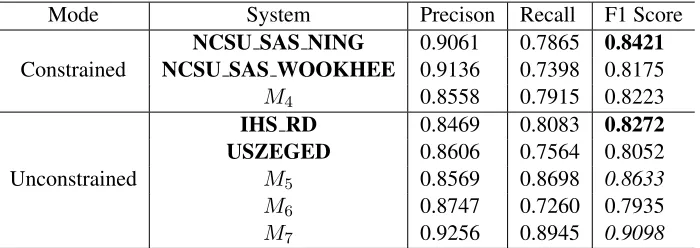
Table 6 shows a comparison of the results ob-tained by our systems against the two top perform-ing systems in the WNUT shared task in both con-strained and unconcon-strained track. Surprisingly, un-constrained systems were not able to outperform constrained systems in the WNUT shared task, as is also noted in (Baldwin et al., 2015). However, by making use of our synthetic training data and using a transfer learning approach, we were able to obtain state of the art results on the WNUT dataset.
Our models were able to correctly normalize so-cial media specific errors and abbreviations. For example“LOL”was normalized to“Laughing out Loud”or“Lots of Laughs” depending upon the context, “GM”was normalized to“Good Morn-ing”, “k”to“ok”and so on. Among other types of social media errors,“ohhhhhhhhhhhhhhhh”was normalized to”oh”,“b4”to“before”,“hiiiiiiiii”
Model Train SequenceLength Test Precision Recall F1 Score
M1 Synthetic1 74 SyntheticWNUT 1 0.96220.1845 0.88220.1756 0.92050.1784
M2 Synthetic2 214 SyntheticWNUT 2 0.80660.2569 0.72040.2356 0.76100.2457
M3 Synthetic3 160 SyntheticWNUT 3 0.91020.3096 0.85950.3156 0.88410.3125
M4 WNUT 160 WNUT 0.8558 0.7915 0.8223
M5 ( Merged datasets
Synthetic3+ WNUT) 160
Synthetic3 0.9366 0.9089 0.9225
WNUT 0.8569 0.8698 0.8633
M6 Transfer Learning
Synthetic3→W N U T 160
Synthetic3 0.9389 0.8856 0.9114
WNUT 0.8747 0.7260 0.7935
M7 WNUTTransfer Learning
→Synthetic3 160
Synthetic3 0.9458 0.9056 0.9252
[image:8.612.93.521.39.247.2]WNUT 0.9256 0.8945 0.9098
Table 4: Results of different models on synthetic and WNUT datasets
Synthetic Test Sets Precision Recall F1 Score
M1 0.9622 0.8822 0.9205
M2 0.8066 0.7204 0.7610
M3 0.9102 0.8595 0.8841
M5 0.9366 0.9089 0.9225
M6 0.9389 0.8856 0.9114
M7 0.9458 0.9056 0.9252
WNUT Test Set Precision Recall F1 Score
M4 0.8558 0.7915 0.8223
M5 0.8569 0.8698 0.8633
M6 0.8747 0.7260 0.7935
M7 0.9256 0.8945 0.9098
Table 5: Results of RNN based LSTM Models on Synthetic and WNUT Test Sets
8 Conclusions & Future work
In this paper we presented a work on text normal-ization using RNN based encoder-decoder LSTM with an attention mechanism. We illustrate the usefulness of our approach on a variety of noisy datasets - standard real dataset as well as synthetic datasets. We obtained state of the art results on the WNUT dataset using our synthetic training data and a transfer learning approach. Another impor-tant contribution of this study is the development of noisy–clean parallel synthetic datasets from user-generated text reflecting both error patterns in reg-ular text as well as social media. The proposed model, with further improvisations, can be useful
in the field of social media to make social media communications better and more understandable.
Our next goal is to construct a large real (i.e., not synthetic) social media dataset, similar to WNUT, suitable for training deep learning models which will definitely help to improve text normalization of social media texts. We would also like to explore other deep learning based models for the task.
Acknowledgments
We would like to thank the anonymous reviewers for their feedback. Sudip Kumar Naskar is sup-ported by Media Lab Asia, MeitY, Government of India, under the Young Faculty Research Fellow-ship of the Visvesvaraya PhD Scheme for Electron-ics & IT.
References
Aw, A., Zhang, M., Xiao, J., and Su, J. (2006). A phrase-based statistical model for sms text nor-malization. InProceedings of the COLING/ACL on Main conference poster sessions, pages 33– 40. Association for Computational Linguistics. Bahdanau, D., Cho, K., and Bengio, Y. (2014).
Neural machine translation by jointly learn-ing to align and translate. arXiv preprint arXiv:1409.0473.
Baldwin, T., De Marneffe, M. C., Han, B., Kim, Y.-B., Ritter, A., and Xu, W. (2015). Shared tasks of the 2015 workshop on noisy user-generated text: Twitter lexical normalization and named entity recognition. InProceedings of the Workshop on
[image:8.612.98.285.283.480.2]Mode System Precison Recall F1 Score
Constrained NCSU SAS NING
0.9061 0.7865 0.8421
NCSU SAS WOOKHEE 0.9136 0.7398 0.8175
M4 0.8558 0.7915 0.8223
Unconstrained
IHS RD 0.8469 0.8083 0.8272 USZEGED 0.8606 0.7564 0.8052
M5 0.8569 0.8698 0.8633
M6 0.8747 0.7260 0.7935
[image:9.612.134.484.37.161.2]M7 0.9256 0.8945 0.9098
Table 6: Comparison of results between our systems and top two systems of the WNUT shared task
Noisy User-generated Text (WNUT 2015), Bei-jing, China.
Bengio, Y., Simard, P., and Frasconi, P. (1994). Learning long-term dependencies with gradient descent is difficult. IEEE transactions on neural networks, 5(2):157–166.
Cho, K., Van Merri¨enboer, B., Gulcehre, C., Bah-danau, D., Bougares, F., Schwenk, H., and Bengio, Y. (2014). Learning phrase repre-sentations using rnn encoder-decoder for sta-tistical machine translation. arXiv preprint arXiv:1406.1078.
Chollampatt, S., Taghipour, K., and Ng, H. T. (2016). Neural network translation models for grammatical error correction. arXiv preprint arXiv:1606.00189.
Choudhury, M., Saraf, R., Jain, V., Mukherjee, A., Sarkar, S., and Basu, A. (2007). Investi-gation and modeling of the structure of texting language. International journal on document analysis and recognition, 10(3):157–174. Clark, E. and Araki, K. (2011). Text
normaliza-tion in social media: progress, problems and applications for a pre-processing system of ca-sual english. Procedia-Social and Behavioral Sciences, 27:2–11.
Danescu-Niculescu-Mizil, C. and Lee, L. (2011). Chameleons in imagined conversations: A new approach to understanding coordination of lin-guistic style in dialogs. InProceedings of the 2Nd Workshop on Cognitive Modeling and Com-putational Linguistics, CMCL ’11, pages 76–87, Stroudsburg, PA, USA. Association for Compu-tational Linguistics.
Elman, J. L. (1991). Distributed representations, simple recurrent networks, and grammatical structure. Machine learning, 7(2-3):195–225.
Glorot, X. and Bengio, Y. (2010). Understanding the difficulty of training deep feedforward neural networks. InProceedings of the Thirteenth In-ternational Conference on Artificial Intelligence and Statistics, pages 249–256.
Han, B., Cook, P., and Baldwin, T. (2013). Lexical normalization for social media text.ACM Trans-actions on Intelligent Systems and Technology (TIST), 4(1):5.
Hassan, H. and Menezes, A. (2013). Social text normalization using contextual graph random walks. InACL (1), pages 1577–1586.
Hochreiter, S. and Schmidhuber, J. (1997). Long short-term memory. Neural computation, 9(8):1735–1780.
Kernighan, M. D., Church, K. W., and Gale, W. A. (1990). A spelling correction program based on a noisy channel model. In Proceedings of the 13th Conference on Computational Linguis-tics - Volume 2, COLING ’90, pages 205–210, Stroudsburg, PA, USA. Association for Compu-tational Linguistics.
Kingma, D. and Ba, J. (2014). Adam: A method for stochastic optimization. arXiv preprint arXiv:1412.6980.
Leeman-Munk, S., Lester, J., and Cox, J. (2015). Ncsu sas sam: Deep encoding and reconstruc-tion for normalizareconstruc-tion of noisy text. In Proceed-ings of the Workshop on Noisy User-Generated Text at ACL, Beijing, China, pages 154–61. Lewis, D. D. and Gale, W. A. (1994). A sequential
algorithm for training text classifiers. In Pro-ceedings of the 17th annual international ACM SIGIR conference on Research and development in information retrieval, pages 3–12. Springer-Verlag New York, Inc.
tion via unsupervised model and discriminative reranking. InACL (Student Research Workshop), pages 86–93.
Ling, W., Trancoso, I., Dyer, C., and Black, A. W. (2015). Character-based neural machine transla-tion.arXiv preprint arXiv:1511.04586.
Liu, Y. (2012). Improving text normalization us-ing character-blocks based models and system combination.
Luong, M.-T., Sutskever, I., Le, Q. V., Vinyals, O., and Zaremba, W. (2014). Addressing the rare word problem in neural machine translation.
arXiv preprint arXiv:1410.8206.
Mays, E., Damerau, F. J., and Mercer, R. L. (1991). Context based spelling correction. Inf. Process. Manage., 27(5):517–522.
Mikheev, A. (2000). Document centered approach to text normalization. In Proceedings of the 23rd annual international ACM SIGIR confer-ence on Research and development in informa-tion retrieval, pages 136–143. ACM.
Olah, C. (2015). Understanding lstm networks. Pennell, D. L. and Liu, Y. (2010). Normalization
of text messages for text-to-speech. InAcoustics Speech and Signal Processing (ICASSP), 2010 IEEE International Conference on, pages 4842– 4845. IEEE.
Powers, D. M. (2011). Evaluation: from preci-sion, recall and f-measure to roc, informedness, markedness and correlation.
Pusateri, E., Ambati, B. R., Brooks, E., Platek, O., McAllaster, D., and Nagesha, V. (2017). A mostly data-driven approach to inverse text nor-malization.Proc. Interspeech 2017, pages 2784– 2788.
Quast, B. (2016). rnn: a recurrent neural network in r. Working Papers.
Sproat, R., Black, A. W., Chen, S., Kumar, S., Ostendorf, M., and Richards, C. (2001). Normal-ization of non-standard words.Computer speech & language, 15(3):287–333.
Sproat, R. and Jaitly, N. (2016). Rnn approaches to text normalization: A challenge.arXiv preprint arXiv:1611.00068.
Sproat, R. and Jaitly, N. (2017). An rnn model of text normalization. Proc. Interspeech 2017, pages 754–758.
Sutskever, I., Vinyals, O., and Le, Q. V. (2014). Sequence to sequence learning with neural net-works. InAdvances in neural information pro-cessing systems, pages 3104–3112.
Toruno˘glu, D. and Eryi˘git, G. (2014). A cascaded approach for social media text normalization of turkish. InProceedings of the 5th Workshop on Language Analysis for Social Media (LASM), pages 62–70.
Wang, Y., Wang, L., Zeng, X., Wong, D. F., Chao, L. S., and Lu, Y. (2014). Factored statistical machine translation for grammatical error cor-rection. InCoNLL Shared Task, pages 83–90. Xie, Z., Avati, A., Arivazhagan, N., Jurafsky, D.,
and Ng, A. Y. (2016). Neural language cor-rection with character-based attention. arXiv preprint arXiv:1603.09727.
Zhang, C., Baldwin, T., Ho, H., Kimelfeld, B., and Li, Y. (2013). Adaptive parser-centric text normalization. InACL (1), pages 1159–1168.