Fully Delexicalized Contexts for Syntax-Based Word Embeddings
JennaKanerva TurkuNLPGroup UniversityofTurku GraduateSchool(UTUGS)
Turku Finland [email protected]
SampoPyysalo LanguageTechnologyLab
DTAL
UniversityofCambridge United Kingdom
FilipGinter TurkuNLPGroup UniversityofTurku
Finland [email protected]
Abstract
Word embeddings induced from large amounts of unannotated text are a key resource for many NLP tasks. Several recent studies have proposed extensions of the basic distributional semantics ap-proach where words form the context of other words, adding features from e.g. syn-tactic dependencies. In this study, we look in a different direction, exploring models that leave words out entirely, instead bas-ing the context representation exclusively on syntactic and morphological features. Remarkably, we find that the resulting vec-tors still capture clear semantic aspects of words in addition to syntactic ones. We assess the properties of the vectors using both intrinsic and extrinsic evaluations, demonstrating in a multilingual parsing experiment using 55 treebanks that fully delexicalized syntax-based word represen-tations give a higher average parsing per-formance than conventional word2vec
embeddings.
1 Introduction
The recent resurgence of interest in neural meth-ods for natural language processing involves a particular focus on neural approaches to induc-ing representations of words from large text cor-pora based on distributional semantics approaches (Bengio et al., 2003; Collobert et al., 2011). The methods introduced by Mikolov et al. (2013a) and implemented in their popularword2vectool have been proven both effective and a good foun-dation for further exploration. In addition to rep-resenting word contexts as sliding windows of words in linear sequence, recent work has in-cluded efforts of building the word vectors using dependency-based approaches (Levy and
Gold-berg, 2014), where the context is based on nearby words in the syntactic tree.
In this paper, we set out to study dependency-based contexts further, exploring word embed-dings derived from fully delexicalized syntactic contexts, and in particular the degree to which models induced using such context representations are dependent on word forms.
2 Methods
Our study builds on the seminal work introducing
word2vecand later efforts generalizing it from a linear representation of context words to arbi-trary contexts. We next present these methods and our proposed formulation of delexicalized syntax-based word embeddings.
2.1 Word2vec embeddings
Theword2vectool1implements two related ap-proaches for inducing word representations – con-tinuous bag-of-words (CBOW) and skip-grams – as well as a number of ways to train and parametrise them (Mikolov et al., 2013a; Mikolov et al., 2013b). Of these variants, the skip-gram with negative sampling (SGNS) model has been shown to be particularly effective and has become a de facto standard for neural word vector in-duction and the basis for many recent studies in the field. While the original work of Mikolov et al. explored different model architectures and ap-proaches to learning, they all shared the property that the contexts of words in the model consisted of words.
2.2 Dependency-based word embeddings
Observing that the SGNS model is not inherently restricted to working with contexts consisting of words, Levy and Goldberg (2014) extended the model to work with arbitrary contexts, focusing
1https://code.google.com/p/word2vec/
in particular on dependency-based contexts con-sisting of combinations of a neigbouring word in the dependency graph and its dependency relation to the target word (e.g. scientist/nsubj). Compared to embeddings based on linear contexts of words, they showed dependency-based embed-dings to emphasize functional over topical simi-larity and to have benefits in distinguishing word relatedness from similarity. Levy and Goldberg released their generalized version of word2vec
allowing arbitrary contexts asword2vecf.2
2.3 Delexicalized syntax-based embeddings
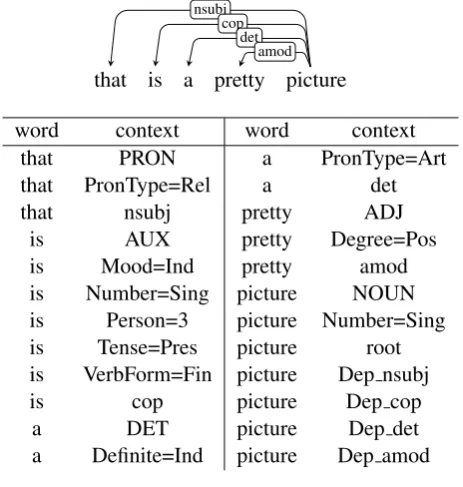
Although the context definition of Levy and Gold-berg incorporates dependency information, it re-mains lexicalized, including also the surface form of the dependent or head word. Here, we con-sider whether it is possible to induce useful word embeddings withdelexicalized contexts that omit the word form entirely. Specifically, we define the context of a target word as 1) the set of all depen-dency relations headed by the target word, 2) the relation where the target word is the dependent, marked to differentiate it from those in set 1), 3) the part-of-speech tag of the target word, and 4) the set of morphological features assigned to the target word. This context definition is illustrated in Figure 1. We use theword2vecf implemen-tation to create embeddings using this context def-inition.
3 Experimental setup
We next present the sources of the unannotated texts and their syntactic analyses used as input and the methods and resources applied to create word embeddings and evaluate them.
3.1 Texts and dependency analyses
The texts used to induce word vectors are derived from the multilingual text collection recently in-troduced by Ginter et al. (2017) covering 45 lan-guages. This resource consists primarily of texts collected through a combination of Internet crawl and extraction from Wikipedia data. The sizes of the 45 language-specific subcorpora range from 29,000 tokens for Old Church Slavonic to 9.5 bil-lion tokens for English, averaging approximately 2B tokens with roughly half of the languages stay-ing under the 1B token range. In addition to
2https://bitbucket.org/yoavgo/
word2vecf
that is a pretty picture
nsubj cop
det amod
word context word context
that PRON a PronType=Art
that PronType=Rel a det
that nsubj pretty ADJ
is AUX pretty Degree=Pos
is Mood=Ind pretty amod is Number=Sing picture NOUN is Person=3 picture Number=Sing is Tense=Pres picture root is VerbForm=Fin picture Dep nsubj
is cop picture Dep cop
a DET picture Dep det
[image:2.595.306.538.63.307.2]a Definite=Ind picture Dep amod
Figure 1: Delexicalized context for words in an English sentence.
plain texts, the resource provides also full syn-tactic analyses following Universal Dependencies (UD) (Nivre et al., 2016) version 2.0 guidelines, including tokenization, lemmatization, full mor-phological analyses and parses produced with the UDPipe pipeline (Straka et al., 2016). We note that even though many languages in the UD col-lection are covered by more than one treebank (and analyses may differ across treebanks for a single language), only one set of automatic anal-yses are provided per language in this resource.
3.2 Embeddings
We use theword2vecembeddings provided to-gether with the CoNLL 2017 Shared Task auto-matically analyzed corpora (Ginter et al., 2017) as a baseline in our experiments. These mod-els are trained on tokenized and lowercased text using the SGNS approach with a window size of 10, minimum word frequency count 10, and 100-dimensional vectors. Our new delexicalized
france jesus xbox reddish scratched megabits belgium christ playstation brownish knicked megabit luxembourg jesus. ps3 yellowish bruised kilobits
nantes god ps4 greenish nicked gigabits
[image:3.595.108.492.62.214.2]marseille ahnsahnghong xbox360 pinkish scuffed mbps bretagne jesuschrist wii grayish chewed mbits boulogne y’shua xbla bluish sandpapered terabits poitou christ psvita -orange scratches mbit rouen christ. titanfall orangish brusied kbits paris jesus xboxone greyish scraped kilobit toulouse yeshua gamecube mid-brown thwacked megabytes
Table 1: Nearest neighbours inword2vecembeddings
3.3 Intrinsic evaluation
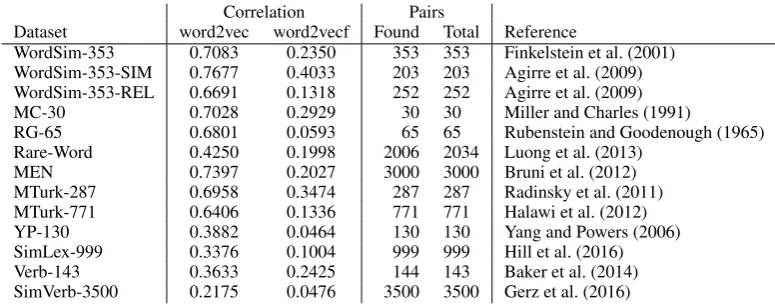
Word vectors are frequently evaluated by assess-ing how well their distance correlates with hu-man judgments of word similarity. Although these intrinsic evaluations have known issues (see e.g. Batchkarov et al. (2016), Chiu et al. (2016), Faruqui et al. (2016)) and we agree with the criti-cism that they are frequently poor indicators of the merits of representations, we include this common form of intrinsic evaluation here for reference pur-poses. We provide results using a comprehensive collection of English datasets annotated for word similarity and relatedness. Specifically, we used the evaluation service introduced by Faruqui and Dyer (2014) to evaluate on the 13 datasets avail-able on the service3at the time of this writing. The datasets are summarized below in Table 3.
3.4 Extrinsic evaluation
Our primary evaluation is based on dependency parsing, where we evaluate parsing accuracy us-ing different pre-trained word embeddus-ings durus-ing parser training. We use the UDPipe pipeline4for tokenizing, tagging, lemmatizing and parsing Uni-versal Treebanks (Straka et al., 2016). In all ex-periments, we use system parameters optimized on baseline models separately for each treebank,5 keeping the parameters fixed in the comparative evaluations of the different word representations. We note that any possible bias introduced by this parameter selection strategy would favour the baseline model rather than one using the delexical-ized syntax-based representations proposed here.
3
http://wordvectors.org/
4
http://ufal.mff.cuni.cz/udpipe
5Optimized UDPipe parameters for UD v2.0 treebanks are released in the supplementary data of UDPipe models at
http://hdl.handle.net/11234/1-1990.
Parsing results are reported for all UD v2.0 tree-banks in the CoNLL 2017 Shared Task release6 that have a separate development set which can be used for testing and raw data for training em-beddings. Of the 64 treebanks in the release, 9 do not fulfill these criteria (French-ParTUT, Galician-TreeGal, Irish, Kazakh, Latin, Slovenian-SST, Ukrainian and Uyghur do not have development data, Gothic does not have raw data) and are not included in the evaluation. Models are trained on the training section of a treebank and tested on the development section.7
4 Results
We next informally illustrate the characteristics of the English word vectors using nearest neighbours and give the intrinsic evaluation results for these vectors before presenting the results of our pri-mary multilingual parsing experiments.
4.1 Nearest neighbours
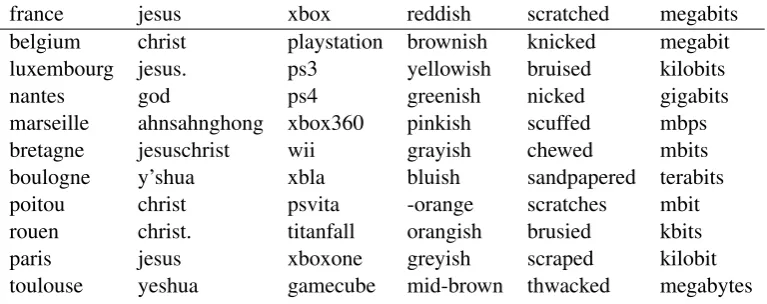
Table 1 shows nearest neighbours in the conven-tional word2vec embeddings using the cosine similarity metric for a somewhat arbitrary selec-tion of English words.8 As has been well estab-lished in previous work, near words inword2vec
representations are commonly (near) synonyms (e.g.jesus/christ,scratched/scuffed), cohyponyms (france/belgium, xbox/playstation), or topically related (france/paris,scratched/sandpaper).
We expected that the use of delexicalized con-texts would eliminate much of the ability of the
6
http://hdl.handle.net/11234/1-1983
7The test sections of the treebanks were held out for the final shared task evaluation and were thus not available for our experiments.
france jesus xbox reddish scratched megabits lebanon osama vbox greenish snatched megabytes australia napoleon whitesox grayish touched microseconds england ophelia matchbox bluish punched hectares bolivia gautama firefox greyish deflected tonnes scotland scipio wmp pinkish warmed microns estonia sauron audiovox yellowish levelled micrograms switzerland chandragupta virtualbox brownish booted litres finland claudius equinox blackish stalked megawatts slovenia jamarcus rotax temperate ditched gallons algeria olivia hmp redish swallowed bushels
Table 2: Nearest neighbours in delexicalized syntax-based word embeddings
embeddings to organize words by factors such as synonymy, cohyponymy, and topic and that near-est neighbours in our delexicalized syntax-based representations would be associated much more loosely, by syntactic behaviour rather than any as-pect of meaning. Of the words illustrated in Ta-ble 2, scratchedandxboxcan be seen as broadly following this expected pattern in neighbouring past form verbs and singular nouns (respectively) with little semantic coherence. However, by con-trast, all ten words nearest tofranceare countries, the neighbours ofjesusare first names, nine out of ten nearest toreddishhave the form colorish, and
megabitsis nearest ten different units. This unex-pected result suggests that the syntactic structures and morphological features associated with a word can generate surprisingly useful word representa-tions even in the absence of any lexical informa-tion. We also note the concerning (and system-atic) tendency for nearest neighbours to end with the same characters (e.g. 8/10 nearestxbox inx). Although this may seem very surprising, we ruled out the possibility of leaking any word-suffix in-formation by obtaining the same results when only word hashes were used during the model train-ing. Our explanation is to note that the effect is strongest for rare words and that the parses are generated with a complex statistical model with access to word surface forms which are indirectly reflected in the predicted morphological and syn-tactic structures. In particular, the POS and mor-phological tagger naturally uses word suffix infor-mation, and we hypothesize that the vector model is able to pick this weak signal from the output of the morphological tagger and syntactic parser.
4.2 Intrinsic evaluation results
The results for the intrinsic evaluation based on the comparison of word pair similarity ranking with human judgments on 13 datasets are sum-marized in Table 3. The correlations seen for the
word2vecembeddings are in line with those for previously released representations generated us-ing the algorithm (e.g. (Mikolov et al., 2013a)), confirming that the texts used to induce these rep-resentations are appropriate for generating high-quality word embeddings.
The results for the delexicalized syntax-based embeddings are, as expected, much lower and far from competitive on any of the datasets. Neverthe-less, the correlations remain positive in all 13 eval-uations, providing support for the proposition that delexicalized contexts representations can identify similarities in word meaning.
4.3 Dependency parsing results
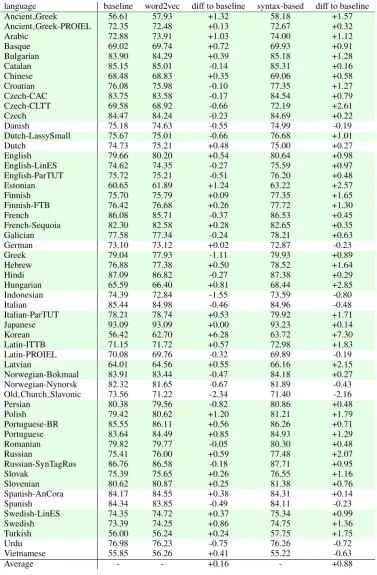
Parsing performance for the 55 treebanks is sum-marized in Table 4. We report labeled attach-ment scores evaluated using gold standard word segmentation with predicted part-of-speech tags and morphological features for parsers trained using three different pre-trained word embed-dings: word2vec embeddings trained on the texts of the manually annotated UD treebanks (baseline),word2vecembeddings trained on the large unannotated corpora, and our delexicalized syntax-based embeddings trained on the automat-ically analyzed corpora.
word2vec embeddings trained on the large unannotated corpora yield on average a +0.16% point improvement over the baseline model. Somewhat surprisingly, incorporating standard
cor-Correlation Pairs
Dataset word2vec word2vecf Found Total Reference
WordSim-353 0.7083 0.2350 353 353 Finkelstein et al. (2001) WordSim-353-SIM 0.7677 0.4033 203 203 Agirre et al. (2009) WordSim-353-REL 0.6691 0.1318 252 252 Agirre et al. (2009) MC-30 0.7028 0.2929 30 30 Miller and Charles (1991)
RG-65 0.6801 0.0593 65 65 Rubenstein and Goodenough (1965) Rare-Word 0.4250 0.1998 2006 2034 Luong et al. (2013)
[image:5.595.104.492.61.213.2]MEN 0.7397 0.2027 3000 3000 Bruni et al. (2012) MTurk-287 0.6958 0.3474 287 287 Radinsky et al. (2011) MTurk-771 0.6406 0.1336 771 771 Halawi et al. (2012) YP-130 0.3882 0.0464 130 130 Yang and Powers (2006) SimLex-999 0.3376 0.1004 999 999 Hill et al. (2016) Verb-143 0.3633 0.2425 144 143 Baker et al. (2014) SimVerb-3500 0.2175 0.0476 3500 3500 Gerz et al. (2016)
Table 3: Intrinsic evaluation results. The numbers of found pairs are identical for the two methods.
pora produces notably worse results compared to the baseline model for a number of languages. For Old Church Slavonic, the over 2% point drop in performance can likely be attributed to the mod-est size of the unannotated corpus available for that language: only 29,000 words are available in the raw data collection, compared to 37,500 words in the treebank training set. Otherwise, the differences range between -1.55% points and +6.28% points, with 31 treebanks showing posi-tive results and 23 negaposi-tive results. While some of these negative effects may be attributable to do-main mismatches between the treebanks and the web-crawled and Wikipedia-derived texts, further study is required to analyze these findings in de-tail.
The delexicalized syntax-based embeddings yield an average 0.88% point improvement. Ex-cluding Old Church Slavonic, which behaves sim-ilarly as withword2vecembeddings, the differ-ence to the baseline ranges between -0.80% points and +7.30% points, with 45 treebanks showing a positive effect and 9 negative results. Overall, our results indicate the surprising conclusion that delexicalized syntactic embeddings lead to higher performance than conventional word2vec em-beddings as well as generalize better across lan-guages when evaluated in this closely related task.
4.4 Analysis
Given the positive effects of delexicalized syntax-based embeddings on the parsing task, it is natural to ask how the baseline parser performance affects the quality of the word embeddings. We set out to test this on Finnish, where our syntax-based em-beddings have a clear positive effect compared to conventionalword2vecembeddings and where
our baseline parser accuracy is relatively low com-pared to the state-of-the-art parsers.
We first study whether the better parsing model showing a 1.65% point improvement in labeled attachment score can be used in a bootstrap-ping setup to generate yet better embeddings and parsers. We parsed the Finnish raw data with this better model, induced word vectors on the newly parsed data, and trained a UDPipe parsing model with the newly created word vectors. The results of this experiment are shown in Table 5. In terms of LAS, the second iteration model is +0.23% points better than the model from the first itera-tion.
We note that UDPipe may not be the optimal parsing pipeline for this experiment: our syntax-based embeddings are trained using both morpho-logical features and syntactic trees, but while the UDPipe parser (Parsito (Straka et al., 2015)) uses pre-trained embeddings, the morphological tagger (MorphoDiTa (Strakov´a et al., 2014)) does not, thus leaving part-of-speech tags and morpholog-ical features intact in newly parsed data. This means that the difference between old and new vector training data is relatively small.
de-language baseline word2vec diff to baseline syntax-based diff to baseline Ancient Greek 56.61 57.93 +1.32 58.18 +1.57 Ancient Greek-PROIEL 72.35 72.48 +0.13 72.67 +0.32
Arabic 72.88 73.91 +1.03 74.00 +1.12
Basque 69.02 69.74 +0.72 69.93 +0.91
Bulgarian 83.90 84.29 +0.39 85.18 +1.28
Catalan 85.15 85.01 -0.14 85.31 +0.16
Chinese 68.48 68.83 +0.35 69.06 +0.58
Croatian 76.08 75.98 -0.10 77.35 +1.27
Czech-CAC 83.75 83.58 -0.17 84.54 +0.79
Czech-CLTT 69.58 68.92 -0.66 72.19 +2.61
Czech 84.47 84.24 -0.23 84.69 +0.22
Danish 75.18 74.63 -0.55 74.99 -0.19
Dutch-LassySmall 75.67 75.01 -0.66 76.68 +1.01
Dutch 74.73 75.21 +0.48 75.00 +0.27
English 79.66 80.20 +0.54 80.64 +0.98
English-LinES 74.62 74.35 -0.27 75.59 +0.97 English-ParTUT 75.72 75.21 -0.51 76.20 +0.48
Estonian 60.65 61.89 +1.24 63.22 +2.57
Finnish 75.70 75.79 +0.09 77.35 +1.65
Finnish-FTB 76.42 76.68 +0.26 77.72 +1.30
French 86.08 85.71 -0.37 86.53 +0.45
French-Sequoia 82.30 82.58 +0.28 82.65 +0.35
Galician 77.58 77.34 -0.24 78.21 +0.63
German 73.10 73.12 +0.02 72.87 -0.23
Greek 79.04 77.93 -1.11 79.93 +0.89
Hebrew 76.88 77.38 +0.50 78.52 +1.64
Hindi 87.09 86.82 -0.27 87.38 +0.29
Hungarian 65.59 66.40 +0.81 68.44 +2.85
Indonesian 74.39 72.84 -1.55 73.59 -0.80
Italian 85.44 84.98 -0.46 84.96 -0.48
Italian-ParTUT 78.21 78.74 +0.53 79.92 +1.71
Japanese 93.09 93.09 +0.00 93.23 +0.14
Korean 56.42 62.70 +6.28 63.72 +7.30
Latin-ITTB 71.15 71.72 +0.57 72.98 +1.83 Latin-PROIEL 70.08 69.76 -0.32 69.89 -0.19
Latvian 64.01 64.56 +0.55 66.16 +2.15
Norwegian-Bokmaal 83.91 83.44 -0.47 84.18 +0.27 Norwegian-Nynorsk 82.32 81.65 -0.67 81.89 -0.43 Old Church Slavonic 73.56 71.22 -2.34 71.40 -2.16
Persian 80.38 79.56 -0.82 80.86 +0.48
Polish 79.42 80.62 +1.20 81.21 +1.79
Portuguese-BR 85.55 86.11 +0.56 86.26 +0.71 Portuguese 83.64 84.49 +0.85 84.93 +1.29
Romanian 79.82 79.77 -0.05 80.30 +0.48
Russian 75.41 76.00 +0.59 77.48 +2.07
Russian-SynTagRus 86.76 86.58 -0.18 87.71 +0.95
Slovak 75.39 75.65 +0.26 76.55 +1.16
Slovenian 80.62 80.87 +0.25 81.38 +0.76
Spanish-AnCora 84.17 84.55 +0.38 84.31 +0.14
Spanish 84.34 83.85 -0.49 84.11 -0.23
Swedish-LinES 74.35 74.72 +0.37 75.34 +0.99
Swedish 73.39 74.25 +0.86 74.75 +1.36
Turkish 56.00 56.24 +0.24 57.75 +1.75
Urdu 76.98 76.23 -0.75 76.26 -0.72
Vietnamese 55.85 56.26 +0.41 55.22 -0.63
[image:6.595.74.452.96.672.2]Average - - +0.16 - +0.88
baseline iteration 1 iteration 2 Finnish 75.70 77.35 77.57
Table 5: Bootstrapping results for Finnish syntax-based embeddings.
pendency parsing pipeline9 trained on the UD Finnish treebank (Pyysalo et al., 2015) version 1.2. The Finnish parsing pipeline uses the OMorFi rule-based morphological analyzer (Pirinen, 2008) converted to the UD scheme, the Marmot tag-ger (M¨uller et al., 2013) and the graph-based de-pendency parser of Bohnet (2010). The labeled attachment score of the pipeline is estimated to be 82% based on the experiments reported in Pyysalo et al. (2015).
Interestingly, when the UDPipe parser was trained with syntax-based word embeddings in-duced from Finnish Internet Parsebank, UDPipe performance improved to the general level of the original parser used, giving a LAS of 82.21%. It must be noted that this number is not comparable to our main parsing results as the version of the UD Finnish treebank is different (version 1.2 com-pared to version 2.0), and the raw text collection is more than three times bigger. With UDPipe us-ing standardword2vecpre-trained embeddings trained on the same Finnish Internet Parsebank data, parsing accuracy was 78.35%. These prelim-inary results are very promising and indicate that with good pre-trained word embeddings, we are able to improve a fast and comparatively simple feedforward parser near the numbers of the new DRAGNN-based SyntaxNet (Kong et al., 2017; Alberti et al., 2017) parser, which is more complex and much slower. Currently, we were only able to “mimic” the numbers of a good parser as we needed a high-quality parsebank to achieve these results, and the question whether similar results could be obtained without the near state-of-the-art parser remains open.
5 Conclusions and Future Work
In this work, we proposed a fully delexicalized syntax-based context representation for inducing word vectors using the Levy and Goldberg (2014) generalization of the word2vecskip-gram with negative sampling (SGNS) model. Building on a recently developed large-scale multilingual
re-9https://github.com/TurkuNLP/
Finnish-dep-parser
source of texts automatically annotated with Uni-versal Dependencies, we created delexicalized syntax-based word embeddings for 45 different languages. Examination of nearest neighbours and evaluation against 13 English datasets annotated for human judgments of word similarity suggested that the embeddings retained a substantial degree of information on not only the syntactic and mor-phological aspects of words but also on aspects of their meaning despite being induced through a process with no access to lexical information. An extensive extrinsic evaluation using the UDPipe parser and 55 CoNLL 2017 shared task corpora demonstrated that the addition of our syntax-based embeddings not only substantially improved the performance of the baseline UDPipe model on av-erage, but also that this improvement was greater than when using standardword2vecSGNS em-beddings. A detailed analysis on Finnish showed potential additional promise from approaches us-ing bootstrappus-ing as well as combinations of em-beddings induced using parses generated using complex models in simpler and faster parsers.
Our initial exploration suggests that fully delex-icalized syntax-based embeddings have intrigu-ing properties and show promise for use in prac-tical applications. In future work, we will fur-ther explore how delexicalized context representa-tions can capture aspects of word meaning – both in terms of degree and mechanism – as well as explore their use in improving mono- and multi-lingual parsing performance in combination with state-of-the-art models.
References
Eneko Agirre, Enrique Alfonseca, Keith Hall, Jana Kravalova, Marius Pas¸ca, and Aitor Soroa. 2009. A study on similarity and relatedness using
distribu-tional and wordnet-based approaches. In
Proceed-ings of HLT-NAACL’09, pages 19–27.
Chris Alberti, Daniel Andor, Ivan Bogatyy, Michael Collins, Dan Gillick, Lingpeng Kong, Terry Koo, Ji Ma, Mark Omernick, Slav Petrov, et al. 2017. Syntaxnet models for the conll 2017 shared task.
arXiv preprint arXiv:1703.04929.
Simon Baker, Roi Reichart, and Anna Korhonen. 2014. An unsupervised model for instance level
subcatego-rization acquisition. InProceedings of EMNLP’14,
pages 278–289.
word similarity as a method for evaluating
distribu-tional semantic models. In Proceedings of
RepE-val’16.
Yoshua Bengio, R´ejean Ducharme, Pascal Vincent, and Christian Jauvin. 2003. A neural probabilistic lan-guage model. Journal of machine learning research, 3(Feb):1137–1155.
Bernd Bohnet, Joakim Nivre, Igor Boguslavsky, Richrd Farkas, Filip Ginter, and Jan Haji. 2013. Joint mor-phological and syntactic analysis for richly inflected languages. Transactions of the Association for
Com-putational Linguistics, 1:415–428.
Bernd Bohnet. 2010. Very high accuracy and fast de-pendency parsing is not a contradiction. In Proceed-ings of the 23rd international conference on
compu-tational linguistics, pages 89–97.
Elia Bruni, Gemma Boleda, Marco Baroni, and Nam-Khanh Tran. 2012. Distributional semantics in
tech-nicolor. InProceedings of ACL’12, pages 136–145.
Billy Chiu, Anna Korhonen, and Sampo Pyysalo. 2016. Intrinsic evaluation of word vectors fails to
predict extrinsic performance. In Proceedings of
RepEval’16, pages 1–6.
Ronan Collobert, Jason Weston, L´eon Bottou, Michael Karlen, Koray Kavukcuoglu, and Pavel Kuksa. 2011. Natural language processing (almost) from
scratch. Journal of Machine Learning Research,
12(Aug):2493–2537.
Manaal Faruqui and Chris Dyer. 2014. Community evaluation and exchange of word vectors at word-vectors.org. InProceedings of ACL’14.
Manaal Faruqui, Yulia Tsvetkov, Pushpendre Rastogi, and Chris Dyer. 2016. Problems with evaluation of word embeddings using word similarity tasks. In
Proceedings of RepEval’16, pages 30–35.
Lev Finkelstein, Evgeniy Gabrilovich, Yossi Matias, Ehud Rivlin, Zach Solan, Gadi Wolfman, and Eytan Ruppin. 2001. Placing search in context: The
con-cept revisited. In Proceedings of WWW’01, pages
406–414.
Daniela Gerz, Ivan Vuli´c, Felix Hill, Roi Reichart, and Anna Korhonen. 2016. SimVerb-3500: A large-scale evaluation set of verb similarity. In
Proceed-ings of EMNLP’16.
Filip Ginter, Jan Hajiˇc, Juhani Luotolahti, Milan
Straka, and Daniel Zeman. 2017. CoNLL 2017
shared task - automatically annotated raw texts and
word embeddings. LINDAT/CLARIN digital
li-brary at the Institute of Formal and Applied Linguis-tics, Charles University.
Guy Halawi, Gideon Dror, Evgeniy Gabrilovich, and
Yehuda Koren. 2012. Large-scale learning of
word relatedness with constraints. InProceedings
of SIGKDD’12, pages 1406–1414. ACM.
Felix Hill, Roi Reichart, and Anna Korhonen. 2016. Simlex-999: Evaluating semantic models with (gen-uine) similarity estimation. Computational Linguis-tics.
Lingpeng Kong, Chris Alberti, Daniel Andor, Ivan
Bogatyy, and David Weiss. 2017. Dragnn:
A transition-based framework for dynamically
connected neural networks. arXiv preprint
arXiv:1703.04474.
Omer Levy and Yoav Goldberg. 2014.
Dependency-based word embeddings. InProceedings of ACL.
Thang Luong, Richard Socher, and Christopher D Manning. 2013. Better word representations with
recursive neural networks for morphology. In
Pro-ceedings of CoNLL’13, pages 104–113.
Juhani Luotolahti, Jenna Kanerva, Veronika Laippala, Sampo Pyysalo, and Filip Ginter. 2015. Towards universal web parsebanks. InProceedings of the In-ternational Conference on Dependency Linguistics
(Depling’15), pages 211–220. Uppsala University.
Tomas Mikolov, Kai Chen, Greg Corrado, and Jeffrey Dean. 2013a. Efficient estimation of word represen-tations in vector space. InProceedings of ICLR.
Tomas Mikolov, Ilya Sutskever, Kai Chen, Greg S Cor-rado, and Jeff Dean. 2013b. Distributed representa-tions of words and phrases and their compositional-ity. InProceedings of NIPS, pages 3111–3119.
GeorgeAMillerandWalterGCharles. 1991.
Contex-tual correlates of semantic similarity. Language and
cognitive processes, 6(1):1–28.
Thomas M¨uller, Helmut Schmid, and Hinrich Sch¨utze. 2013. Efficient higher-order crfs for morphological
tagging. InProceedings of the 2013 Conference on
Empirical Methods in Natural Language Process-ing, pages 322–332.
Joakim Nivre, Marie-Catherine de Marneffe, Filip Gin-ter, Yoav Goldberg, Jan Hajic, Christopher D Man-ning, Ryan McDonald, Slav Petrov, Sampo Pyysalo, Natalia Silveira, et al. 2016. Universal dependen-cies v1: A multilingual treebank collection. In Pro-ceedings of the 10th International Conference on
Language Resources and Evaluation (LREC 2016),
pages 1659–1666.
Tommi Pirinen. 2008. Suomen kielen ¨a¨arellistilainen
automaattinen morfologinen j¨asennin avoimen
l¨ahdekoodin resurssein. University of Helsinki.
Sampo Pyysalo, Jenna Kanerva, Anna Missil¨a,
Veronika Laippala, and Filip Ginter. 2015.
Uni-versal dependencies for Finnish. In Proceedings
of NODALIDA 2015, May 11-13, 2015, Vilnius,
Lithuania, pages 163–172.
Kira Radinsky, Eugene Agichtein, Evgeniy
Gabrilovich, and Shaul Markovitch. 2011. A
temporal semantic analysis. In Proceedings of
WWW’11, pages 337–346.
Herbert Rubenstein and John B Goodenough. 1965.
Contextual correlates of synonymy.
Communica-tions of the ACM, 8(10):627–633.
Milan Straka, Jan Hajiˇc, Jana Strakov´a, and Jan Hajiˇc jr. 2015. Parsing universal dependency tree-banks using neural networks and search-based
or-acle. In Proceedings of Fourteenth International
Workshop on Treebanks and Linguistic Theories
(TLT 14), December.
Milan Straka, Jan Hajiˇc, and Jana Strakov´a. 2016. UD-Pipe: trainable pipeline for processing CoNLL-U files performing tokenization, morphological
anal-ysis, POS tagging and parsing. In Proceedings of
LREC’16.
Jana Strakov´a, Milan Straka, and Jan Hajiˇc. 2014.
Open-Source Tools for Morphology, Lemmatiza-tion, POS Tagging and Named Entity Recognition.
In Proceedings of 52nd Annual Meeting of the
As-sociation for Computational Linguistics: System
Demonstrations, pages 13–18, Baltimore,
Mary-land, June. Association for Computational Linguis-tics.
Dongqiang Yang and David MW Powers. 2006. Verb
similarity on the taxonomy of wordnet. In