Proceedings of the 1st Workshop on Discourse Structure in Neural NLG, pages 18–23 18
Fine-Grained Control of Sentence Segmentation and Entity Positioning in
Neural NLG
Kritika Mehta Raheel Qader Cyril Labb´e Franc¸ois Portet
Univ. Grenoble Alpes, LIG 38000 Grenoble, France
[email protected] [email protected] {cyril.labbe,francois.portet}@imag.fr
Abstract
The move from pipeline Natural Language Generation (NLG) approaches to neural end-to-end approaches led to a loss of control in sentence planning operations owing to the conflation of intermediary micro-planning stages into a single model. Such control is highly necessary when the text should be tailored to respect some constraints such as which entity to be mentioned first, the entity position, the complexity of sentences, etc. In this paper, we introduce fine-grained control of sentence planning in neural data-to-text gener-ation models at two levels - realizgener-ation of input entities in desired sentences and realization of the input entities in the desired position among individual sentences. We show that by aug-menting the input with explicit position identi-fiers, the neural model can achieve a great con-trol over the output structure while keeping the naturalness of the generated text intact. Since sentence level metrics are not entirely suitable to evaluate this task, we used a metric spe-cific to our task that accounts for the model’s ability to achieve control. The results demon-strate that the position identifiers do constraint the neural model to respect the intended out-put structure which can be useful in a variety of domains that require the generated text to be in a certain structure.
1 Introduction
Typical NLG models are characterized by a pipeline of stages (Walker et al., 2007; Barzilay and Lapata,2006;Walker et al.,2002;Stent,2002;
Barzilay and Lee, 2002; Langkilde and Knight,
1998;Reiter and Dale,1997). This approach can be conceptually divided into solving two ques-tions: what to say?aka content determination and planning, andhow to say it? aka text realization (Gatt and Krahmer, 2018). In contrast, end-to-end NLG systems combine these stages in a single
end-to-end learning framework. Recently, there has been a lot of interest in combining sentence planning and realization stage into a single neural model (Nayak et al., 2017; Duˇsek and Jurˇc´ıˇcek,
2016;Lampouras and Vlachos,2016;Wen et al.,
2015; Mei et al., 2015). Although this resulted in some improvement at the grammatical level, in neural natural language generation this led to a loss of control that was otherwise possible in the pipeline approaches.
Neural NLG systems struggle to produce a con-sistent order of entities and are sometimes not faithful to the input by either hallucinating, omit-ting or repeaomit-ting the entities (Moryossef et al.,
2019). They do not allow control over the out-put structure and while they exhibit impressive levels of fluency, they are less equipped to deal with higher levels of text structuring in a consis-tent manner. They are also unable to generalize sentence planning operations beyond what is seen in the training. It is therefore important to intro-duce explicit control in neural NLG so that the output is faithful to the input. In this way, the sys-tem would be able to generate diverse realizations making way for explicit control over the output text structure.
(1)Alignment information “name[Blue Spice], eatType[coffee shop], area[city centre]”,
A coffee shop in the city centre area called Blue Spice.,(2: eattype) (21: area) (45: name)
(2)Annotated reference text a (eattype)coffee shop in the (area)city centre area called (name)blue spice.
(3)MR with sentence id. 1 name[ blue spice ], 1 eattype[ coffee shop ], 1 area[ city centre ]
(4)MR with sentence and slot id. 1 3 name[ blue spice ], 1 1 eattype[ coffee shop ], 1 2 area[ city centre ]
Table 1: Example of an MR augmented with sentence and slot position identifiers.
main company selling points in front, and when generating messages for user with low literacy it is important to break sentences in small pieces, etc.
Recently there has been some work on control-ling outputs of neural NLG models. In (Reed et al.,
2018), authors use token supervision to reproduce sentence planning and discourse operations where a sentence scoping operation controls the number of sentences in the generated output which is mea-sured using the period operator. This method does not provide any information about the word or-der in a particular sentence. While in (Moryossef et al., 2019) an explicit and symbolic text plan-ner is proposed which determines the information structure and expresses it in the form of ordered trees. The plan structures in this work take the form of ad-hoc explorations for specific tasks and does not evolve into general-purpose plan struc-tures. Moreover, this work is dataset dependent and does not generalize to datasets other than graph-based ones. To improve over the work in the literature of controlling neural NLG systems, in this paper, we propose an approach to explicitly control the realization of input entities in the de-sired sentences and in the dede-sired position among individual sentences.
2 Overview of the Approach
Our method focuses on the control of sentence planning at two levels - 1) realization of input facts in the desired sentences and 2) realization of in-put facts in the desired position in the individual sentences. The idea is to directly attach sentence identifiers and slot identifiers to each slot, that in-dicate the sentence number and the position of the slot within that sentence respectively. The next step is to feed the modified Meaning Representa-tion (MR) as an input to the seq2seq model and test if the model is able to learn to realize the slots in the correct positions.
2.1 Data Preparation
We used the E2E dataset for the experiments which provides information about restaurants and consists of about 50k combinations of a dialogue-act-based MR and 8.1 text references on an aver-age. Each MR consists of up to 8 slots/attributes and their corresponding values.
As the dataset does not already contain a sen-tence plan, we modified it in a way that the MRs contain sentence and slot position identifiers. More specifically, given a reference text, two po-sition identifiers were attached to each slot of the MR representing the sentence number in which the slot is found and the location of the slot in that specific sentence. The alignment information is extracted using a script1 provided by the authors ofJuraska et al.(2018). Table1provides an exam-ple of different stages of aligning the reference text with the MR. Initially, we annotate the reference text to identify the beginning of each slot value in the text (line 2), then using this annotation, we first attach the sentence identifiers (line 3), and finally the MRs are augmented with the position of each slot within a sentence (line 4). Owing to faults in the alignment information, in some cases the slot values are not detected in the reference text despite being present in the MR and for other cases the sentences do not contain some slots present in the MR. For such cases, a position token in the format 0 0 Slottype[ Slot value ] is attached.
Ideally, we expect a human to assign the posi-tion identifiers to each slot in the MR based on the desired output text. However, doing so for 4000 samples of the test set for validating our work would be very exhaustive. Therefore, we experi-ment with two different strategies to attach the po-sition identifiers. Firstly, we directly use the test set reference text to extract the position identifiers. However, this will lead to biased results when computing the automatic metrics scores. Second
Figure 1: The three proposed approaches to automati-cally assign position identifiers to an MR.
strategy is to predict the position identifiers auto-matically. For this, we propose three different ap-proaches as shown in Figure 1 and described in detail below:
• Random: The position identifiers are ran-domly chosen and assigned to the slots in the MR by taking care of a few rules.
• Seq2seq:The position identifiers are learned using a sequence-to-sequence (seq2seq) model. The train set MR without the position identifiers and the corresponding train set MR with the position identifiers are fed as training data to the model described in the Section 3. The test set MR without the position identifiers are then fed to the trained model, which outputs the test set MR with learned position identifiers.
• Top Frequent: The position identifiers for the test set are obtained from the most fre-quent combination of position identifiers in the train set. For each entry in the test set, the slot types (e.g., name) and slot values (e.g, blue spice) are separated and then the train-ing entries which have slots with the same values are identified. Then, the most com-monly occurring position identifier combina-tion is picked for the test set entry.
Our random approach could be considered as a very naive baseline as randomly assigned identi-fiers might not even make sense in some cases. For example, having only one single slot in the first sentence (which never happens in the training set) would not be enough to form a grammatically cor-rect sentence. Thus, in such cases, the model will fail to follow the assigned identifiers. The seq2seq model should perform much better than the ran-dom approach since it learns how to put position identifiers directly from the training data. How-ever, this model has to re-generate the whole se-quence including the slot type, slot value, and the
newly added position identifiers. This means that any errors introduced during the generation pro-cess will significantly effect the text generated by the NLG model. Lastly, the top frequent approach is expected to perform better than the other two approaches. It extracts the most common sentence plan for some given values directly from the train-ing set. Thus, the chosen sentence plan is among the ones that the NLG model was most exposed to during the training process.
2.2 Evaluation Metrics
In most NLG problems, sentence level metrics such as BLEU, ROUGE and METEOR are used to evaluate the results. However, these metrics are not entirely suitable to evaluate slot positioning since they measure performance at sentence level and do not provide precision in terms of sentence planning accuracy. In addition to using these au-tomatic metrics to compare the results of the po-sition augmented dataset with the original dataset, we evaluate the sentence planning accuracy using a modified version of the word error rate called the Slot Error Rate (SER) which is computed as:
SER= S+D+I
N ,
where S refers to number of substitutions, D
refers to number of deletions,I refers to number of insertions andN refers to the total number of slots in the input MR. If a slot is realized in the wrong sentence it is counted as wrong-sentence
MR:1 1 name[ the cricketers ], 1 2 eattype[ restaurant ], 1 3 food[ chinese ], 1 4 pricerange[ 20-25 ], 4 1 customer rating[ high ], 2 1 area[ riverside ], 0 0 familyfriendly[ no ], 3 1 near[ all bar one ]
Output:the cricketers is a restaurant providing chinese food in the 20-25 price range. it is located in the riverside. it is near all bar one. its customer rating is high.
MR:1 1 name[ the cricketers ], 1 3 eattype[ restaurant ], 1 2 food[ chinese ], 1 7 pricerange[ cheap ], 1 6 customer rating[5 out of 5 ], 1 5 area[ city centre ], 1 8 familyfriendly[ yes ], 1 4 near[ all bar one ]
Outputthe cricketers is a chinese restaurant near all bar one in the city centre with a customer rating of 5 out of 5 and is cheap and family friendly.
Table 2: Output examples: position identifiers added from text references.
Experiment Type SER
MR with sentence identifier 27%
[image:4.595.72.287.284.335.2]MR with sentence and slot identifier 7%
Table 3: Results: SER on the test set prepared from test set alignment information.
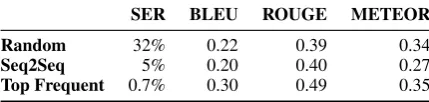
SER BLEU ROUGE METEOR
Random 32% 0.22 0.39 0.34
Seq2Seq 5% 0.20 0.40 0.27
Top Frequent 0.7% 0.30 0.49 0.35
Table 4: Results: SER and sentence-level metrics on different versions of the test set with sentence and slot identifiers
3 Model Architecture
We use a standard seq2seq model with atten-tion (Bahdanau et al., 2014; Luong et al., 2015). The seq2seq model consists of an encoder and a decoder based on Long Short-Term Memory (LSTM) (Hochreiter and Schmidhuber, 1997). The encoder reads the position augmented MR to-kens one by one and feeds each token into an em-bedding layer and then to an LSTM layer. Fi-nally the LSTM-based decoder takes the last hid-den state from the encoder and starts generating output tokens one by one. Our decoder uses the dot attention mechanism as described in (Luong et al.,2015).
4 Experiments and Results
We begin by comparing the SER obtained using the test set with only sentence identifier and the test set with both sentence and slot identifiers. The position identifiers are attached based on the align-ment information obtained from the test set. Ta-ble3shows that the SER for the model with both sentence and slot identifiers is significantly lower. This is probably because the model in this case has more information to learn from and the slot iden-tifier proves to be very important. In order to
the previously unique MRs. To make the results consistent, we report single reference scores for the other two approaches as well.
When it comes to SER, we can see that top frequent again achieves the lowest score of 0.7%. The seq2seq model was trained with the position augmented train set that mostly consists of text with just one sentence. As data with one sen-tence is relatively easier than the data with multi-ple sentences, the SER of 5% with seq2seq model based test set is justifiable. The test set prepared with random identifiers reports an SER of 32%, which can be explained by the fact that the iden-tifiers are attached without significant rules, and hence, some of the MRs do not make a logical sense if realized as text. Nevertheless, the model still learns to produce logically and grammatically correct sentences.
To better assess the faithfulness of the model, we used human verification of the model’s output. We randomly selected 50 generated outputs (from samples of Table3,line 2) and 4 annotators man-ually annotated the MR to show deletion, inser-tion, substitution and hallucination of slots where hallucination refers to realization of a wrongslot value. The original MR is compared with the new annotated MR to obtain an SER. The different scores obtained were averaged and the final SER reported is 14.25%. This score is slightly higher than the 7% reported in Table3since human sub-jects were additionally annotating hallucinations too. Excluding hallucinations will lead to a similar score obtained using the SER metric. Thus we can say that the human verification scores is consistent with the scores obtained from the SER metric.
5 Conclusion
We presented an approach to explicitly control the output text structure by incorporating control at two levels of sentence planning- realization of in-put entities in desired sentences and in the de-sired position among individual sentences. We created a new data set with position identifiers de-signed specifically for controlling sentence plan-ning operations and we investigated different ways of preparing such sentence plans. Our results show that the model learns from the extra position iden-tifiers which provide the capability to control vari-ation in the output and enables generalizing to un-seen combinations without a significant loss of performance in terms of sentence-level metrics.
Acknowledgments
This project was partly funded by the IDEX Uni-versit´e Grenoble Alpes innovation grant (AI4I-2018-2019) and the R´egion Auvergne-Rhˆone-Alpes (AISUA-2018-2019).
References
Dzmitry Bahdanau, Kyunghyun Cho, and Yoshua Ben-gio. 2014. Neural machine translation by jointly learning to align and translate. arXiv preprint arXiv:1409.0473.
Regina Barzilay and Mirella Lapata. 2006. Aggrega-tion via set partiAggrega-tioning for natural language genera-tion. InProceedings of the main conference on Hu-man Language Technology Conference of the North American Chapter of the Association of Computa-tional Linguistics, pages 359–366. Association for Computational Linguistics.
Regina Barzilay and Lillian Lee. 2002. Bootstrapping lexical choice via multiple-sequence alignment. In Proceedings of the ACL-02 conference on Empirical methods in natural language processing-Volume 10, pages 164–171. Association for Computational Lin-guistics.
Ondˇrej Duˇsek and Filip Jurˇc´ıˇcek. 2016. Sequence-to-sequence generation for spoken dialogue via deep syntax trees and strings. arXiv preprint arXiv:1606.05491.
Albert Gatt and Emiel Krahmer. 2018. Survey of the state of the art in natural language generation: Core tasks, applications and evaluation. J. Artif. Intell. Res., 61:65–170.
Sepp Hochreiter and J¨urgen Schmidhuber. 1997. Long short-term memory. Neural computation, 9(8):1735–1780.
Juraj Juraska, Panagiotis Karagiannis, Kevin K Bow-den, and Marilyn A Walker. 2018. Slug2slug: A deep ensemble model with slot alignment for sequence-to-sequence natural language generation.
Gerasimos Lampouras and Andreas Vlachos. 2016. Imitation learning for language generation from un-aligned data. In Proceedings of COLING 2016, the 26th International Conference on Computational Linguistics: Technical Papers, pages 1101–1112.
Minh-Thang Luong, Hieu Pham, and Christopher D Manning. 2015. Effective approaches to attention-based neural machine translation. arXiv preprint arXiv:1508.04025.
Hongyuan Mei, Mohit Bansal, and Matthew R Walter. 2015. What to talk about and how? selective gen-eration using lstms with coarse-to-fine alignment. arXiv preprint arXiv:1509.00838.
Amit Moryossef, Yoav Goldberg, and Ido Dagan. 2019. Step-by-step: Separating planning from realization in neural data-to-text generation. arXiv preprint arXiv:1904.03396.
Neha Nayak, Dilek Hakkani-T¨ur, Marilyn A Walker, and Larry P Heck. 2017. To plan or not to plan? discourse planning in slot-value informed sequence to sequence models for language generation. In IN-TERSPEECH, pages 3339–3343.
Lena Reed, Shereen Oraby, and Marilyn Walker. 2018. Can neural generators for dialogue learn sentence planning and discourse structuring? arXiv preprint arXiv:1809.03015.
Ehud Reiter and Robert Dale. 1997. Building applied natural language generation systems. Natural Lan-guage Engineering, 3(1):57–87.
Amanda J Stent. 2002. A conversation acts model for generating spoken dialogue contributions. Com-puter Speech & Language, 16(3-4):313–352.
Marilyn A Walker, Owen C Rambow, and Monica Ro-gati. 2002. Training a sentence planner for spoken dialogue using boosting. Computer Speech & Lan-guage, 16(3-4):409–433.
Marilyn A Walker, Amanda Stent, Franc¸ois Mairesse, and Rashmi Prasad. 2007. Individual and domain adaptation in sentence planning for dialogue. Jour-nal of Artificial Intelligence Research, 30:413–456.