Mapping to Declarative Knowledge for Word Problem Solving
Subhro Roy∗
Massachusetts Institute of Technology [email protected]
Dan Roth∗
University of Pennsylvania [email protected]
Abstract
Math word problems form a natural abstrac-tion to a range of quantitative reasoning prob-lems, such as understanding financial news, sports results, and casualties of war. Solving such problems requires the understanding of several mathematical concepts such as dimen-sional analysis, subset relationships, etc. In this paper, we develop declarative rules which govern the translation of natural language de-scription of these concepts to math expres-sions. We then present a framework for in-corporating such declarative knowledge into word problem solving. Our method learns to map arithmetic word problem text to math ex-pressions, by learning to select the relevant declarative knowledge for each operation of the solution expression. This provides a way to handle multiple concepts in the same prob-lem while, at the same time, supporting in-terpretability of the answer expression. Our method models the mapping to declarative knowledge as a latent variable, thus remov-ing the need for expensive annotations. Exper-imental evaluation suggests that our domain knowledge based solver outperforms all other systems, and that it generalizes better in the realistic case where the training data it is ex-posed to is biased in a different way than the test data.
1 Introduction
Many natural language understanding situations re-quire reasoning with respect to numbers or
quanti-∗Most of the work was done when the authors were at the
University of Illinois, Urbana Champaign.
ties – understanding financial news, sports results, or the number of casualties in a bombing. Math word problems form a natural abstraction to a lot of these quantitative reasoning problems. Conse-quently, there has been a growing interest in devel-oping automated methods to solve math word prob-lems (Kushman et al., 2014; Hosseini et al., 2014; Roy and Roth, 2015).
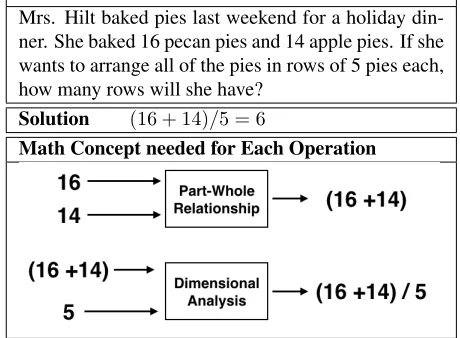
Arithmetic Word Problem
Mrs. Hilt baked pies last weekend for a holiday din-ner. She baked 16 pecan pies and 14 apple pies. If she wants to arrange all of the pies in rows of 5 pies each, how many rows will she have?
Solution (16 + 14)/5 = 6
[image:1.612.311.541.368.537.2]Math Concept needed for Each Operation
Figure 1: An example arithmetic word problem and its
solution, along with the concepts required to generate each operation of the solution
Understanding and solving math word problems involves interpreting the natural language descrip-tion of mathematical concepts, as well as under-standing their interaction with the physical world. Consider the elementary school level arithmetic word problem shown in Fig 1. To solve the prob-lem, one needs to understand that “apple pies” and “pecan pies” are kinds of “pies”, and hence, the
159
number of apple pies and pecan pies needs to be summed up to get the total number of pies. Simi-larly, detecting that “5” represents “the number of pies per row” and applying dimensional analysis or unit compatibility knowledge, helps us infer that the
total number of pies needs to be divided by 5 to
get the answer. Besides part-whole relationship and dimensional analysis, there are several other con-cepts that are needed to support reasoning in math word problems. Some of these involve understand-ing comparisons, transactions, and the application of math or physics formulas. Most of this knowledge can be encoded as declarative rules, as illustrated in this paper.
This paper introduces a framework for incorpo-rating this “declarative knowledge” into word lem solving. We focus on arithmetic word prob-lems, whose solution can be obtained by combin-ing the numbers in the problem with basic opera-tions (addition, subtraction, multiplication or divi-sion). For combining a pair of numbers or math
sub-expressions, our method first predicts themath
con-ceptthat is needed for it (e.g., subset relationship,
di-mensional analysis, etc.), and then predicts a
declar-ative ruleunder that concept to infer the mathemati-cal operation. We model the selection of declarative rules as a latent variable, which removes the need for expensive annotations for the intermediate steps. The proposed approach has some clear advan-tages compared to existing work on word problem solving. First, it provides interpretability of the so-lution, without expensive annotations. Our method selects a declarative knowledge based inference rule for each operation needed in the solution. These rules provide an explanation for the operations per-formed. In particular, it learns to select relevant rules without explicit annotations for them. Second, each individual operation in the solution expression can be generated independently by a separate mathemat-ical concept. This allows our method to handle mul-tiple concepts in the same problem.
We show that existing datasets of arithmetic word problems suffer from significant vocabulary biases and, consequently, existing solvers do not do well on conceptually similar problems that are not biased in the same way. Our method, on the other hand, learns the right abstractions even in the presence of biases in the data. We also introduce a novel approach to
gather word problems without these biases, creating
a new dataset of1492problems.
The next section discusses related work. We next introduce the mathematical concepts required for arithmetic word problems, as well as the declara-tive rules for each concept. Section 4 describes our model – how we predict answers using declarative knowledge – and provides the details of our train-ing paradigm. Finally, we provide an experimental evaluation of our proposed method in Section 6, and then conclude with a discussion of future work.
2 Related Work
Our work is primarily related to three major strands of research - automatic word problem solving, se-mantic parsing, and approaches incorporating back-ground knowledge in learning.
2.1 Automatic Word Problem Solving
There has been a growing interest in automatically solving math word problems, with various systems focusing on particular types of problems. These can be broadly categorized into two types: arithmetic and algebra.
our method provides a framework for including any form of declarative knowledge, exemplified here by incorporating common concepts required for arith-metic problems.
Algebra Word Problems Algebra word problems are characterized by the use of (one or more) variables in contructing (one or more) equations. These are typically middle or high school problems. Koncel-Kedziorski et al. (2015) looks at single equa-tion problems, and Shi et al. (2015) focuses on num-ber word problems. Kushman et al. (2014) intro-duces a template based approach to handle general algebra word problems and several works have later proposed improvements over this approach (Zhou et al., 2015; Upadhyay et al., 2016; Huang et al., 2017). There has also been work on generating ra-tionale for word problem solving (Ling et al., 2017). More recently, some focus turned to pre-university exam questions (Matsuzaki et al., 2017; Hopkins et al., 2017), which requires handling a wider range of problems and often more complex semantics.
2.2 Semantic Parsing
Our work is also related to learning semantic parsers from indirect supervision (Clarke et al., 2010; Liang et al., 2011). The general approach here is to learn a mapping of sentences to logical forms, with the only supervision being the response of executing the log-ical form on a knowledge base. Similarly, we learn to select declarative rules from supervision that only includes the final operation (and not which rule gen-erated it). However, in contrast to the semantic pars-ing work, in our case the selection of each declar-ative rule usually requires reasoning across multi-ple sentences. Further, we do not require an explicit grounding of words or phrases to logical variables.
2.3 Background Knowledge in Learning Approaches to incorporate knowledge in learning started with Explanation Based Learning (EBL) (DeJong, 1993; DeJong, 2014). EBL uses domain knowledge based on observable predicates, whereas we learn to map text to predicates of our declara-tive knowledge. More recent approaches tried to in-corporate knowledge in the form of constraints or expectations from the output (Roth and Yih, 2004; Chang et al., 2007; Chang et al., 2012; Ganchev et al., 2010; Smith and Eisner, 2006; Naseem et
al., 2010; Bisk and Hockenmaier, 2012; Gimpel and Bansal, 2014).
Finally, we note that there has been some work in the context of Question Answering on perturbing questions or answers as a way to test or assure the robustness, or lack of, the approach (Khashabi et al., 2016; Jia and Liang, 2017). We make use of similar ideas in order to generate an unbiased test set for Math word problems (Sec. 6).
3 Knowledge Representation
Here, we introduce our representation of domain knowledge. We organize the knowledge hierarchi-cally in two levels – concepts and declarative rules. Amath conceptis a phenomenon which needs to be understood to apply reasoning over quantities. Ex-amples of concepts include part-whole relations, di-mensional analysis, etc. Under each concept, there are a few declarative rules, which dictate which op-eration is needed in a particular context. An
exam-ple of a declarative rule under the part-whole
con-ceptcan be that “if two numbers quantify “parts” of
a larger quantity, the operation between them must be addition”. These rules use concept specific pred-icates, which we exemplify in the following subsec-tions.
Since this work focuses on arithmetic word
prob-lems, we consider4math concepts which are most
common in these problems, as follows:
1. Transfer: This involves understanding the transfer of objects from one person to another. For example, the action described by the sen-tence “Tim gave 5 apples to Jim”, results in Tim losing “5 apples” and Jim gaining “5 apples”. 2. Dimensional Analysis: This involves
under-standing compatibility of units or dimensions. For example, “30 pies” can be divided by “5 pies per row” to get the number of rows. 3. Part-Whole Relation: This includes asserting
that if two numbers quantify parts of a larger quantity, they are to be added. For example, the problem in Section 1 involves understand-ing “pecan pies” and “apple pies” are parts of “pies”, and hence must be added.
entities in the problem. For example, “Jim is 5 inches taller than Tim”. This concept captures the reasoning needed for such relationships.
Each of these concepts comprises a small number of declarative rules which determine the math oper-ations; we describe them below.
3.1 Transfer
Consider the following excerpt of a word problem
exhibiting a transfer phenomenon:“Stephen owns5
books. Daniel gave him4 books.” The goal of the
declarative rules is to determine which operation is
required between5and4, given that we know that a
transfer is taking place. We note that a transfer usu-ally involves two entities, which occurs as subject and indirect object in a sentence. The direction of transfer is determined by the verbs associated with the entities. We define a set of variables to denote these properties; we define as Subj1, Verb1, IObj1 the subject, verb and indirect object associated with the first number, and as Subj2, Verb2, IObj2 the sub-ject, verb and indirect object related to the second number. For the above example, the assignment of the variables are shown below:
[Stephen]Subj1 [owns]V erb1 5 books.
[Daniel]Subj2 [gave]V erb2 [him]IObj24books.
In order to determine the direction of the transfer, we require some classification of verbs. In partic-ular, we classify each verb into one of five classes: HAVE, GET, GIVE, CONSTRUCT and DESTROY. The HAVE class consists of all verbs which sig-nify the state of an entity, such as “have”, “own”, etc. The GET class contains verbs which indicate the gaining of things for the subject. Examples of such verbs are “acquire”, “borrow”, etc. The GIVE class contains verbs which indicate the loss of things for the subject. Verbs like “lend”, “give” belong to this class. Finally CONSTRUCT class consti-tutes verbs indicating construction or creation, like “build”, “fill”, etc., while DESTROY verbs indi-cate destruction related verbs like “destroy”, “eat”, “use”, etc. This verb classification is largely based on the work of Hosseini et al. (2014).
Finally, the declarative rules for this concept have the following form:
[Verb1 ∈ HAVE] ∧ [Verb2 ∈ GIVE] ∧
[Coref(Subj1,IObj2)]⇒Addition
where Coref(A, B) is true when A and B
repre-sent the same entity or are coreferent, and is false otherwise. In the examples above, Verb1 is “own”
and hence [Verb1 ∈ HAVE] is true. Verb2 is
“give” and hence [Verb2 ∈ GIVE] is true.
Fi-nally, Subj1 and IObj2 both refer to Stephen, so
[Coref(Subj1,IObj2)]returns true. As a result, the
above declarative rule dictates that addition should
be performed between5and4.
We have18such inference rules for transfer,
cov-ering all combinations of verb classes andCoref()
values. All these rules generate addition or subtrac-tion operasubtrac-tions.
3.2 Dimensional Analysis
We now look at the use of dimensional analysis knowledge in word problem solving. To use di-mensional analysis, one needs to extract the units of numbers as well as the relations between the units. Consider the following excerpt of a word problem: “Stephen has5bags. Each bag has4apples.
Know-ing that the unit of5is “bag” and the effective unit
of4is “apples per bag”, allows us to infer that the
numbers can be multiplied to obtain the total number of apples.
To capture these dependencies, we first introduce a few terms. Whenever a number has a unit of the form “A per B”, we refer to “A” as the unit of the
number, and refer to “B” asthe rate component of
the number. In our example, the unit of4is “apple”,
and the rate component of 4 is “bag”. We define
variables Unit1 and Rate1 to denote the unit and the rate component of the first number respectively. We similarly define Unit2 and Rate2. For the above ex-ample, the assignment of variables is shown below:
Stephen has5[bags]U nit1. Each [bag]Rate2has
4[apples]U nit2.
[Coref(Unit1,Rate2)]⇒Multiplication
We only have3rules for dimensional analysis. They
generate multiplication or division operations.
3.3 Explicit Math
In this subsection, we want to capture the reasoning behind explicit math relationships expressed in word
problems such as the one described in:“Stephen has
5apples. Daniel has4more apples than Stephen”. We define Math1 and Math2 by any explicit math term associated with the first and second numbers respectively. As was the case for transfers, we also define Subj1, IObj1, Subj2, and IObj2 to denote the entities participating in the math relationship. The assignment of these variables in our example is:
[Stephen]Subj1 has5apples. [Daniel]Subj2 has
4[more apples than]M ath2[Stephen]IObj2.
We classify explicit math terms into one of three classes - ADD, SUB and MUL. ADD comprises terms for addition, like “more than”, “taller than” and “heavier than”. SUB consists of terms for sub-traction like“less than”, “shorter than”, etc., and MUL contains terms indicating multiplication, like “times”, “twice” and “thrice”. Finally, the declara-tive rule that applies for our example is:
[Coref(Subj1,IObj2)]∧[Math2∈ADD]⇒
Addition.
We have only7rules for explicit math.
3.4 Part-Whole Relation
Understanding part-whole relationships entails un-derstanding whether two quantities are hyponym, hypernym or siblings (that is, co-hyponym, or parts of the same quantity). For example, in the excerpt “Mrs. Hilt has 5 pecan pies and 4 apple pies”, de-termining that pecan pies and apple pies are parts of all pies, helps infer that addition is needed. We have 3 simple rules which directly map from Hyponym, Hypernym or Sibling detection to the corresponding math operation. For the above example, the applica-ble declarative rule is:
[Sibling(Number1,Number2)]⇒Addition
The rules for the part-whole concept can generate addition and subtraction operations. Table 1 gives a list of all the declarative rules. Note that all the declarative rules are designed to determine an op-eration between two numbers only. We introduce a strategy in Section 4, which facilitates combining sub-expressions with these rules.
4 Mapping of Word Problems to Declarative Knowledge
Given an input arithmetic word problemx, the goal
is to predict the math expressiony, which generates
the correct answer. In order to derive the
expres-siony from the word problemx, we leverage math
concepts and declarative rules that we introduced in Section 3. In order to combine two numbers
men-tioned inx, we first predict a conceptk, and then we
choose a declarative knowledge ruler fromk. The
ruler generates the math operation needed to
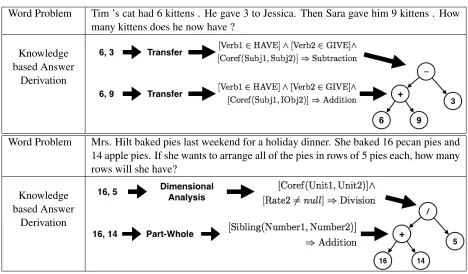
com-bine the two numbers. Consider the first example
in Table 2. To combine6and9, we first decide on
the transfer concept, and then choose an appropriate rule under the transfer to generate the operation.
Next we need to combine the sub-expression(6 +
9)with the number3. However, our inference rules
were designed for the combination of two num-bers only. In order to combine a sub-expression,
we choose a representative number from the
sub-expression, and use that number to determine the
operation. In our example, we choose the number6
as the representative number for(6 + 9), and decide
the operation between 6and3, following a similar
procedure as before. This operation is now used to
combine(6 + 9)and3.
The representative number for a sub-expression is chosen such that it preserves the reasoning needed for the combination of this sub-expression with other numbers. We follow a heuristic to choose a representative number from a sub-expression:
1. For transfers and part-whole relationships, we choose the representative number of the left subtree.
Transfer
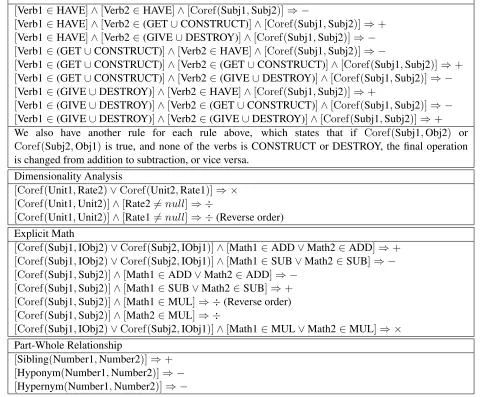
[Verb1∈HAVE]∧[Verb2∈HAVE]∧[Coref(Subj1,Subj2)]⇒ −
[Verb1∈HAVE]∧[Verb2∈(GET∪CONSTRUCT)]∧[Coref(Subj1,Subj2)]⇒+
[Verb1∈HAVE]∧[Verb2∈(GIVE∪DESTROY)]∧[Coref(Subj1,Subj2)]⇒ −
[Verb1∈(GET∪CONSTRUCT)]∧[Verb2∈HAVE]∧[Coref(Subj1,Subj2)]⇒ −
[Verb1∈(GET∪CONSTRUCT)]∧[Verb2∈(GET∪CONSTRUCT)]∧[Coref(Subj1,Subj2)]⇒+
[Verb1∈(GET∪CONSTRUCT)]∧[Verb2∈(GIVE∪DESTROY)]∧[Coref(Subj1,Subj2)]⇒ −
[Verb1∈(GIVE∪DESTROY)]∧[Verb2∈HAVE]∧[Coref(Subj1,Subj2)]⇒+
[Verb1∈(GIVE∪DESTROY)]∧[Verb2∈(GET∪CONSTRUCT)]∧[Coref(Subj1,Subj2)]⇒ −
[Verb1∈(GIVE∪DESTROY)]∧[Verb2∈(GIVE∪DESTROY)]∧[Coref(Subj1,Subj2)]⇒+
We also have another rule for each rule above, which states that if Coref(Subj1,Obj2) or
Coref(Subj2,Obj1) is true, and none of the verbs is CONSTRUCT or DESTROY, the final operation
is changed from addition to subtraction, or vice versa. Dimensionality Analysis
[Coref(Unit1,Rate2)∨Coref(Unit2,Rate1)]⇒ × [Coref(Unit1,Unit2)]∧[Rate26=null]⇒ ÷
[Coref(Unit1,Unit2)]∧[Rate16=null]⇒ ÷(Reverse order)
Explicit Math
[Coref(Subj1,IObj2)∨Coref(Subj2,IObj1)]∧[Math1∈ADD∨Math2∈ADD]⇒+ [Coref(Subj1,IObj2)∨Coref(Subj2,IObj1)]∧[Math1∈SUB∨Math2∈SUB]⇒ − [Coref(Subj1,Subj2)]∧[Math1∈ADD∨Math2∈ADD]⇒ −
[Coref(Subj1,Subj2)]∧[Math1∈SUB∨Math2∈SUB]⇒+ [Coref(Subj1,Subj2)]∧[Math1∈MUL]⇒ ÷(Reverse order) [Coref(Subj1,Subj2)]∧[Math2∈MUL]⇒ ÷
[Coref(Subj1,IObj2)∨Coref(Subj2,IObj1)]∧[Math1∈MUL∨Math2∈MUL]⇒ × Part-Whole Relationship
[Sibling(Number1,Number2)]⇒+
[Hyponym(Number1,Number2)]⇒ −
[image:6.612.65.545.65.462.2][Hypernym(Number1,Number2)]⇒ −
Table 1:List of declarative rules used in our system.÷(reverse order) indicates the second number being divided by the first. To determine the order of subtraction, we always subtract the smaller number from the larger number.
3. In the case of explicit math, we choose the number which is not directly associated with the explicit math expression.
4.1 Scoring Answer Derivations
Given the input word problemx, the solution math
expressiony is constructed by combining numbers
inx with operations. We refer to the set of
opera-tions used in an expressionyas(y). Each
opera-tionoin(y)is generated by first choosing a
con-ceptko, and then selecting a declarative rulerofrom that concept.
In order to discriminate between multiple
candi-date solution expressions of a word problemx, we
score them using a linear model over features ex-tracted from the derivation of the solution. Our scor-ing function has the followscor-ing form:
SCORE(x, y) = X
o∈(y)
wkφk(x, ko) +wrφr(x, ro)
whereφk(x, ko)andφr(x, ro)are feature vectors
re-lated to conceptko, and declarative rulero,
respec-tively, andwk andwrare the corresponding weight
vectors. The termwkφk(x, ko) is the score for the
selection ofko, and the termw
rφr(x, ro)is the score
Word Problem Tim ’s cat had 6 kittens . He gave 3 to Jessica. Then Sara gave him 9 kittens . How many kittens does he now have ?
Knowledge based Answer
Derivation
Word Problem Mrs. Hilt baked pies last weekend for a holiday dinner. She baked 16 pecan pies and
14 apple pies. If she wants to arrange all of the pies in rows of 5 pies each, how many rows will she have?
Knowledge based Answer
[image:7.612.72.540.48.322.2]Derivation
Table 2:Two examples of arithmetic word problems, and derivation of the answer. For each combination, first a math concept is chosen, and then a declarative rule from that concept is chosen to infer the operation.
4.2 Learning
We wish to estimate the parameters of the weight
vectors wk and wr, such that our scoring function
assigns a higher score to the correct math expres-sion, and a lower score to other competing math expressions. For learning the parameters, we as-sume access to word problems paired with the cor-rect math expression. In Section 5, we show that certain simple heuristics and rate component tations can be used to create somewhat noisy anno-tations for the concepts needed for individual op-erations. Hence, we will assume for our formu-lation access to concept supervision as well. We
thus assume access tomexamples of the following
form: {(x1, y1,{ko}o∈(y1)),(x2, y2,{k
o}
o∈(y2)),
. . . ,(xm, ym,{ko}o∈(ym))}.
We do not have any supervision for declarative rule selection, which we model as a latent variable. Two Stage Learning: A straightforward solution for our learning problem could be to jointly learn
wk andwr using latent structured SVM. However,
we found that this model does not perform well. In-stead, we chose a two stage learning protocol. At the
first stage, we only learnwr, the weight vector for
scoring the declarative rule choice. Once learned,
we fix the parameters forwr, and then learn the
pa-rameters forwk.
In order to learn the parameters forwr, we solve:
min
wr
1 2||wr||
2+C
m X
i=1 X
o∈(yi)
h
max ˆ
r∈ko,rˆ⇒ˆowr·φr(x,ˆr)+
∆(ˆo, o)i− max ˆ
r∈ko,ˆr⇒owr·φr(x,rˆ),
where rˆ ∈ ko implies thatrˆis a declarative rule
for conceptko,rˆ⇒ osignifies that the declarative rulerˆgenerates operationo, and∆(ˆo, o)represents
a measure of dissimilarity between operationsoand
ˆ
o. The above objective is similar to that of latent
structured SVM. For each operation o in the
solu-tion expressionyi, the objective tries to minimize the
difference between the highest scoring rule from its
conceptko, and highest scoring rule fromkowhich
explains or generates the operationo.
Next we fix the parameters ofwr, and solve:
min
wk
1 2||wk||
2+C
m X
i=1 max
This is equivalent to a standard structured SVM ob-jective. We use a0−1loss for∆(ˆo, o). Note that
fixing the parameters of wr determines the scores
for rule selection, removing the need for any latent variables at this stage.
4.3 Inference
Given an input word problem x, inferring
the best math expression involves computing
arg maxy∈YSCORE(x, y), whereY is the set of all math expressions that can be created by combining
the numbers inxwith basic math operations.
The size of Y is exponential in the number of
quantities mentioned inx. As a result, we perform
approximate inference using beam search. We
ini-tialize the beam with the setE of all numbers
men-tioned in the problemx. At each step of the beam
search, we choose two numbers (or sub-expressions) e1ande2fromE, and then select a math concept and
a declarative rule to infer an operationo. We
cre-ate a new sub-expressione3 by combining the
sub-expressionse1 ande2 with operationo. We finally
create a new set E0 from E, by removing e1 and
e2 from it, and adding e3 to it. We removeE from
the beam, and add all such modified setsE0 to the
beam. We continue this process until all sets in the beam have only one element in them. We choose the highest scoring expression among these elements as the solution expression.
5 Model and Implementation Details
5.1 Supervision
Each word problem in our dataset is annotated with the solution math expression, along with alignment of numbers from the problem to the solution expres-sion. In addition, we also have annotations for the numbers which possess a rate component. An ex-ample is shown in Fig 2. This is the same level of supervision used in Roy and Roth (2017). Many of the annotations can be extracted semi-automatically. The number list is extracted automatically by a num-ber detector, the alignments require human supervi-sion only when the same numeric value is mentioned multiple times in the problem. Most of the rate com-ponent annotations can also be extracted automati-cally, see Roy and Roth (2017) for details.
We apply a few heuristics to obtain noisy
anno-Problem: Mrs. Hilt baked pies last weekend for a holiday dinner. She baked 16 pecan pies and 14 apple pies. If she wants to arrange all of the pies in rows of 5 pies each, how many rows will she have?
Number List:16,14,5
Solution:(16[1]+ 14[2])/5[3]= 6 Rates:5
Figure 2:Annotations in our dataset. Number List refers to the numbers detected in the problem. The subscripts in the solution indicate the position of the numbers in the number list.
tations for the math concepts for operations.
Con-sider the case for combining two numbersnum1and
num2, by operationo. We apply the following rules:
1. If we detect an explicit math pattern in the
neighborhood of num1 or num2, we assign
conceptkoto be Explicit Math.
2. If o is multiplication or division, and one of
num1ornum2has a rate component, we
as-signkoto be Dimensional Analysis.
3. Ifois addition or subtraction, we check if the
dependent verb of both numbers are identical.
If they are, we assignkoto be a Part-Whole
re-lationship; otherwise, we assign it to be Trans-fer. We extract the dependent verb using the Stanford dependency parser (Chen and Man-ning, 2014).
The annotations obtained via these rules are of course not perfect. We could not detect certain
uncommon rate patterns like “dividing the cost 4
ways”, and “I read the same number of books4days
running”. There were part-whole relationships
ex-hibited with complementary verbs, as in “I won 4
games, and lost3.”. Both of these cases lead to noisy
math concept annotations.
However, we tested a small sample of these
anno-tations, and found less than5%of them to be wrong.
As a result, we assume these annotations to be cor-rect in our problem formulation.
5.2 Features
mentioned in the problem. Details of these extrac-tions can be found in the released codebase. Us-ing these extractions, we define two feature func-tions φk(x, ko) and φr(x, ro), where x is the
in-put word problem, and ko and ro are the concept
and the declarative rule for operationorespectively.
φr(x, ro)constitutes the following features:
1. If ro contains Coref(·) function, we add
fea-tures related to similarity of the arguments of
Coref(·)(jaccard similarity score and presence
of pronoun in one of the arguments).
2. For part-whole relationships, we add indica-tors for a list of words like “remaining”, “rest”, “either”, “overall”, “total”, conjoined with the
part-whole function inro (Hyponymy,
Hyper-nymy, Sibling).
3. Unigrams from the neighborhood of numbers being combined.
Finally,φk(x, ko)generates the following features:
1. Ifkois related to dimensional analysis, we add
features indicating the presence of a rate com-ponent in the combining numbers.
2. Ifko is part-whole, we add features indicating
whether the verbs of combining numbers are identical.
Note that these features capture several interpretable functions like coreference, hyponymy, etc.
We do not learn three components of our system – verb classification for transfer knowledge, catego-rization of explicit math terms, and irrelevant num-ber detection. For verb classification, we use a seed
list of around 10 verbs for each category. Given a
new verbv, we choose the most similar verbv0from
the seed lists according to the GloVe vector (Pen-nington et al., 2014) based similarity . We assign
v the category of v0. This can be replaced by a
learned component (Hosseini et al., 2014). However we found the seed list based categorization worked well in most cases. For explicit math, we check for a small list of patterns to detect and categorize math terms. Note that for both the cases above, we still
have to learnCoref(·)function to determine the
fi-nal operation. Fifi-nally, to detect irrelevant numbers
(numbers which are not used in the solution), we use a set of rules based on the units of numbers. Again, this can be replaced by a learned model (Roy and Roth, 2015).
6 Experiments
6.1 Results on Existing Dataset
We first evaluate our approach on the existing datasets of AllArith, AllArithLex, and AllAr-ithTmpl (Roy and Roth, 2017). AllArithLex and Al-lArithTmpl are subsets of the AllArith dataset, cre-ated to test the robustness to new vocabulary, and new equation forms respectively. We compare to the top performing systems for arithmetic word prob-lems. They are as follows:
1. TEMPLATE : Template based algebra word
problem solver of Kushman et al. (2014).
2. LCA++ : System of Roy and Roth (2015) based on lowest common ancestors of math expres-sion trees.
3. UNITDEP: Unit dependency graph based
solver of Roy and Roth (2017).
We refer to our approach as KNOWLEDGE. For all solvers, we use the system released by the
respec-tive authors. The system of TEMPLATE expects an
equation as the answer, whereas our dataset contains only math expressions. We converted expressions to equations by introducing a single variable and as-signing the math expression to it. For example, an expression “(2 + 3)” gets converted to “X = (2 + 3)”. The first few columns of Table 3 shows the per-formance of the systems on the aforementioned
datasets1. The performance of KNOWLEDGE is on
System AllArith AllArith
Lex AllArithTmpl Aggregate AggregateLex AggregateTmpl Train onAllArith, Test on Perturb
TEMPLATE 71.96 64.09 70.64 54.62 45.05 54.69 24.2
LCA++ 78.34 66.99 75.66 65.21 53.62 63.0 43.57
UNITDEP 79.67 71.33 77.11 69.9 57.51 68.64 46.29
[image:10.612.76.539.54.157.2]KNOWLEDGE 77.86 72.53 74.7 73.32∗ 66.63∗ 68.62 65.66∗
Table 3: Accuracy in solving arithmetic word problems. All columns except the last report 5-fold cross validation
results.∗indicates statistically significant improvement (p= 0.05) over second highest score in the column.
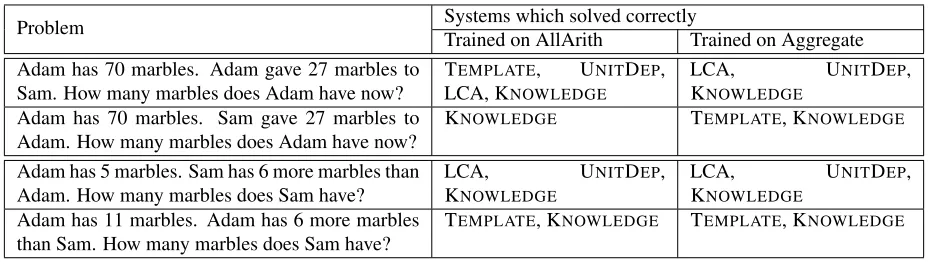
Problem Systems which solved correctlyTrained on AllArith Trained on Aggregate
Adam has 70 marbles. Adam gave 27 marbles to Sam. How many marbles does Adam have now? T
EMPLATE, UNITDEP,
LCA, KNOWLEDGE
LCA, UNITDEP,
KNOWLEDGE
Adam has 70 marbles. Sam gave 27 marbles to Adam. How many marbles does Adam have now? K
NOWLEDGE TEMPLATE, KNOWLEDGE
Adam has 5 marbles. Sam has 6 more marbles than
Adam. How many marbles does Sam have? LCA, U
NITDEP,
KNOWLEDGE
LCA, UNITDEP,
KNOWLEDGE
Adam has 11 marbles. Adam has 6 more marbles than Sam. How many marbles does Sam have? T
EMPLATE, KNOWLEDGE TEMPLATE, KNOWLEDGE
Table 4:Pairs of pertubed problems, along with the systems which get them correct
learning an erroneous correlation of “give” with sub-traction. Since the test also exhibits the same bias, these systems get all the “give”-related questions correct. However, they fail to solve the problem in Table 4, where “give” results in addition. We
also tested KNOWLEDGEon the addition subtraction
problems dataset released by Hosseini et al. (2014).
It achieved a cross validation accuracy of77.19%,
which is competitive with the state of the art
accu-racy of78%achieved with the same level of
supervi-sion. The system of Mitra and Baral (2016) achieved
86.07% accuracy on this dataset, but requires rich
annotations for formulas and alignment of numbers to formulas.
6.2 New Dataset Creation
In order to remove the aforementioned biases from the dataset, we augment it with new word problems collected via a crowdsourcing platform. These new word problems are created by perturbing the original problems minimally, such that the answer is differ-ent from the original problem. For each word
prob-lemp with an answer expression a in our original
dataset AllArith, we replace one operation in ato
create a new math expressiona0. We ask annotators
to modify problempminimally, such thata0 is now
the solution to the modified word problem.
We createa0 fromaeither by replacing an
addi-tion with subtracaddi-tion or vice versa, or by replacing multiplication with division or vice versa. We do not replace addition and subtraction with multiplication or division, since there might not be an easy per-turbation that supports this conversion. We only al-lowed perturbed expressions which evaluate to
val-ues greater than 1. For example, we generate the
expression “(3+2)” from “(3-2)”; we generated ex-pressions “(10+2)/4” and “(10-2)*4” for the expres-sion “(10-2)/4”. We generate all possible perturbed expressions for a given answer expression, and ask for problem text modification for each one of them.
[image:10.612.74.541.200.332.2]modified problem should also contain two “3”s and one “2”.
We manually pruned problems which did not
yield the desired solution a0, or were too different
from the input problemp. This procedure gave us
a set of661new word problems, which we refer to
asPerturb. Finally we augmentAllArithwith the
problems ofPerturb, and call this new dataset
Ag-gregate. Aggregate has a total of1492problems.
The addition of the Perturb problems ensures
that the dataset now has problems with similar lex-ical items generating different answers. This mini-mizes the bias that we discussed in subsection 6.1. To quantify this, consider the probability
distribu-tion over operadistribu-tions for a quantityq, given that word
w is present in the neighborhood ofq. For an
un-biased dataset, you will expect the entropy of this distribution to be high, since the presence of a sin-gle word in a number neighborhood will seldom be completely informative for the operation. We com-pute the average of this entropy value over all num-bers and neighborhood words in our dataset.
AllAr-ith and Perturb have an average entropy of0.34and
0.32respectively, whereas Aggregate’s average
en-tropy is0.54, indicating that, indeed, the complete
data set is significantly less biased.
6.3 Generalization from Biased Dataset
First, we evaluate the ability of systems to general-ize from biased datasets. We train all systems on AllArith, and test them on Perturb (which was cre-ated by perturbing AllArith problems). The last col-umn of Table 3 shows the performance of systems
in this setting. KNOWLEDGE outperforms all other
systems in this setting with around19%absolute
im-provement over UNITDEP. This shows that declara-tive knowledge allows the system to learn the correct abstractions, even from biased datasets.
6.4 Results on the New Dataset
Finally, we evaluate the systems on the Aggre-gate dataset. Following previous work (Roy and Roth, 2017), we compute two subsets of Aggregate
comprising756problems each, using the MAWPS
(Koncel-Kedziorski et al., 2016) system. The first, called AggregateLex, is one with low lexical repeti-tions, and the second called AggregateTmpl is one with low repetitions of equation forms. We also
evaluateonthesetwosubsetsona5-foldcross
val-idation. Columns 4-6 of Table 3 show the
perfor-manceofsystemsonthissetting.KNOWLEDGE
sig-nificantlyo utperformso thers ystemso nAggregate
and AggregateLex, andis similar to UNITDEP on
AggregateTmpl. There is a 9% absolute
improve-mentonAggregateLex,showingthatKNOWLEDGE
is significantlym orer obustt ol owl exicaloverlap
betweentrainandtest. The lastcolumnofTable4
also shows thatthe other systemsdo not learnthe
rightabstraction,evenwhentrainedonAggregate.
6.5 Analysis
Coverage of the Declarative Rules We chose
mathconcepts and declarative rulesbased on their
prevalanceinarithmeticword problems. Wefound
thatthefourconceptsintroducedinthispapercover
almostalltheproblemsinourdataset;onlymissing
4 problemsinvolvingapplication ofarea formulas.
Wealsocheckedearlierarithmeticproblemdatasets
from the works of Hosseini et al. (2014); Roy
andRoth(2015), andfound thatthe math concepts
and declarative rules introduced in this paper
cover alltheirproblems.
Amajorchallengeinapplyingtheseconceptsand
rulestoalgebrawordproblemsistheuseofvariables
in constructing equations. Variables are often
im-plicitlydescribed,anditisdifficulttoextractunits,
dependentverbs,associatedsubjectsandobjectsfor
thevariables.However,weneedtheseextractionsin
ordertoapplyourdeclarativerulestocombine
vari-ables.Therehasbeensomeworktoextractmeaning
ofvariables(Royetal.,2016)inalgebraword
prob-lems; an extensionofthiscanpossiblysupportthe
applicationofrulesinalgebra word problems. We
leavethisexplorationtofuturework.
Higherstandard wordproblemsoftenrequirethe
application of math formulas like ones related to
area, interest, probability, etc. Extending our
ap-proach to handle such problems will involve
en-coding math formulas in terms of concepts and
rules,aswellasaddingconceptspecificfeaturesto
thelearned predictors. The declarative rulesunder
the Explicit Math category currently handles
sim-plecases;thissetneeds tobe augmentedtohandle
complex number word problems found in algebra
datasets.
Isabel had 2 pages of math homework and 4 pages of reading homework. If each page had 5 prob-lems on it, how many probprob-lems did she have to complete total ?
Tim’s cat had kittens. He gave 3 to Jessica and 6 to Sara . He now has 9 kittens . How many kittens did he have to start with ?
[image:12.612.316.538.53.188.2]Mrs. Snyder made 86 heart cookies. She made 36 red cookies, and the rest are pink. How many pink cookies did she make?
Table 5:Examples which KNOWLEDGEgets correct, but
UNITDEPdoes not.
shows examples of problems which KNOWLEDGE
gets right, but UNITDEP does not. The gains can
be attributed to the injection of declarative
knowl-edge. Earlier systems like UNITDEPtry to learn the
reasoning required for these problems from the data alone. This is often difficult in the presence of lim-ited data, and noisy output from NLP tools. In con-trast, we learn probabilistic models for interpretable functions like coreference, hyponymy, etc., and then use declarative knowledge involving these functions to perform reasoning. This reduces the complexity of the target function to be learned considerably, and hence we end up with a more robust model.
Effect of Beam SizeWe used a beam size of1000in
all our experiments. However, we found that vary-ing the beam size does not effect the performance
significantly. Even lowering the beam size to 100
reduced performance by only1%.
Weakness of ApproachA weakness of our method is the requirement to have all relevant declarative knowledge during training. Many of the component functions (like coreference) are learned through la-tent alignments with no explicit annotations. If too many problems are not explained by the knowledge, the model will learn noisy alignments for the com-ponent functions.
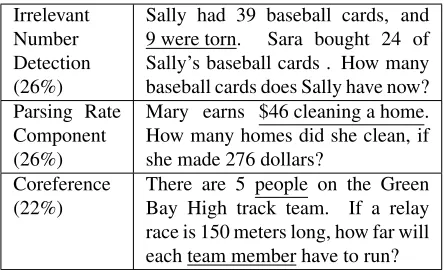
Table 6 shows the major categories of errors with
examples. 26% of the errors are due to extraneous
number detection. We use a set of rules based on units of numbers, to detect such irrelevant numbers. As a result, we fail to detect numbers which are ir-relevant due to other factors, like associated entities, or associated verb. We can potentially expand our rule based system to detect those, or replace it by a learned module like Roy and Roth (2015). Another
Irrelevant Number Detection (26%)
Sally had 39 baseball cards, and 9 were torn. Sara bought 24 of Sally’s baseball cards . How many baseball cards does Sally have now? Parsing Rate
Component (26%)
Mary earns $46 cleaning a home. How many homes did she clean, if she made 276 dollars?
Coreference
(22%) There are 5 people on the GreenBay High track team. If a relay race is 150 meters long, how far will each team member have to run?
Table 6:Examples of errors made by KNOWLEDGE
major source of errors is parsing of rate components; that is, understanding “earns $46 cleaning a home” should be normalized to “$46 per home”. Although we learn a model for coreference function, we make several mistakes related to coreference. For the ex-ample in Table 6, we fail to detect the coreference between “team member” and “people”.
7 Conclusion
In this paper, we introduce a framework for incorpo-rating declarative knowledge in word problem solv-ing. Our knowledge based approach outperforms all other systems, and also learns better abstractions from biased datasets. Given that the variability in text is much larger than the number of declarative rules that governs Math word problems, we believe that this is a good way to introduce Math knowledge to a natural language understanding system. Conse-quently, future work will involve extending our ap-proach to handle a wider range of word problems, possibly by supporting better grounding of implicit variables and including a larger number of math con-cepts and declarative rules. An orthogonal explo-ration direction is to apply these techniques to erate summaries of financial or sports news, or gen-erate statistics of war or gun violence deaths from news corpora. A straightforward approach can be to augment news documents with a question asking for the required information, and treating this aug-mented news document as a math word problem.
Code and dataset are available at https://
Acknowledgments
We are grateful to anonymous reviewers for their in-sightful comments. This work is funded by DARPA under agreement number FA8750-13-2-0008, and a grant from the Allen Institute for Artificial Intelli-gence (allenai.org).
References
Yonatan Bisk and Julia Hockenmaier. 2012. Simple ro-bust grammar induction with combinatory categorial grammars. InProceedings of the Twenty-Sixth Confer-ence on Artificial IntelligConfer-ence (AAAI-12), pages 1643– 1649, Toronto, Canada, July.
Ming-Wei Chang, Lev Ratinov, and Dan Roth. 2007. Guiding semi-supervision with constraint-driven learning. InProceedings of the Annual Meet-ing of the Association for Computational LMeet-inguistics (ACL), pages 280–287, Prague, Czech Republic, 6. Association for Computational Linguistics.
Ming-Wei Chang, Lev Ratinov, and Dan Roth. 2012. Structuredlearningwithconstrainedconditional mod-els. MachineLearning,88(3):399–431,6.
DanqiChenandChristopher D. Manning.2014. Afast
and accurate dependency parser using neural networks.In Proceedingsof the 2014Conference on EmpiricalMethods in Natural Language Processing (EMNLP), pages 740–750, Doha, Qatar, October. AssociationforComputationalLinguistics.
James Clarke, Dan Goldwasser, Ming-Wei Chang, and Dan Roth. 2010. Driving semantic parsing from the world’s response. InProc. of the Conference on Com-putational Natural Language Learning (CoNLL), 7. Gerald DeJong. 1993. Investigating explanation-based
learning. Kluwer International Series in Engineering and Computer Science. Kluwer Academic Publishers. Gerald DeJong. 2014. Explanation-based learning. In T. Gonzalez, J. Diaz-Herrera, and A. Tucker, editors,
CRC Computing Handbook: Computer Science and Software Engineering, pages 66.1–66.26. CRC Press, Boca Raton.
Kuzman Ganchev, Joao Grac¸a, Jennifer Gillenwater, and Ben Taskar. 2010. Posterior regularization for struc-tured latent variable models. Journal of Machine Learning Research.
Kevin Gimpel and Mohit Bansal. 2014. Weakly-supervised learning with cost-augmented contrastive estimation. In Proceedings of the 2014 Conference on Empirical Methods in Natural Language Process-ing (EMNLP), pages 1329–1341, Doha, Qatar, Octo-ber. Association for Computational Linguistics.
Mark Hopkins, Cristian Petrescu-Prahova, Roie Levin, Ronan Le Bras, Alvaro Herrasti, and Vidur Joshi. 2017. Beyond sentential semantic parsing: Tack-ling the math SAT with a cascade of tree transducers. In Proceedings of the 2017 Conference on Empirical Methods in Natural Language Processing, pages 806– 815, Copenhagen, Denmark, September. Association for Computational Linguistics.
Mohammad Javad Hosseini, Hannaneh Hajishirzi, Oren Etzioni, and Nate Kushman. 2014. Learning to solve arithmetic word problems with verb categorization. In
Proceedings of the Conference on Empirical Methods for Natural Language Processing (EMNLP).
Danqing Huang, Shuming Shi, Chin-Yew Lin, and Jian Yin. 2017. Learning fine-grained expressions to solve math word problems. InProceedings of the 2017 Con-ference on Empirical Methods in Natural Language Processing, pages 816–825, Copenhagen, Denmark, September. Association for Computational Linguis-tics.
Robin Jia and Percy Liang. 2017. Adversarial exam-ples for evaluating reading comprehension systems. In Proceedings of the 2017 Conference on Empiri-cal Methods in Natural Language Processing, pages 2021–2031. Association for Computational Linguis-tics, September.
Daniel Khashabi, Tushar Khot, Ashish Sabharwal, Peter Clark, Oren Etzioni, and Dan Roth. 2016. Ques-tion answering via integer programming over semi-structured knowledge. InProceedings of the Interna-tional Joint Conference on Artificial Intelligence (IJ-CAI).
Rik Koncel-Kedziorski, Hannaneh Hajishirzi, Ashish Sabharwal, Oren Etzioni, and Siena Ang. 2015. Pars-ing Algebraic Word Problems into Equations. Trans-actions of the Association of Computational Linguis-tics.
Rik Koncel-Kedziorski, Subhro Roy, Aida Amini, Nate Kushman, and Hannaneh Hajishirzi. 2016. MaWPS: A math word problem repository. InProceedings of the 2016 Conference of the North American Chapter of the Association for Computational Linguistics. Nate Kushman, Luke Zettlemoyer, Regina Barzilay, and
Yoav Artzi. 2014. Learning to automatically solve algebra word problems. InProceedings of the Annual Meeting of the Association for Computational Linguis-tics (ACL), pages 271–281.
Percy Liang, Michael Jordan, and Dan Klein. 2011. Learning dependency-based compositional semantics. InProceedings of the Annual Meeting of the Associa-tion for ComputaAssocia-tional Linguistics (ACL).
problems. InProceedings of the 55th Annual Meeting of the Association for Computational Linguistics. Takuya Matsuzaki, Takumi Ito, Hidenao Iwane, Hirokazu
Anai, and Noriko H. Arai. 2017. Semantic parsing of pre-university math problems. InProceedings of the 55th Annual Meeting of the Association for Compu-tational Linguistics (Volume 1: Long Papers), pages 2131–2141, Vancouver, Canada, July. Association for Computational Linguistics.
Arindam Mitra and Chitta Baral. 2016. Learning to use formulas to solve simple arithmetic problems. In Pro-ceedings of the 54th Annual Meeting of the Association for Computational Linguistics.
Tahira Naseem, Harr Chen, Regina Barzilay, and Mark Johnson. 2010. Using universal linguistic knowl-edge to guide grammar induction. In Proceedings of the 2010 Conference on Empirical Methods in Natural Language Processing, EMNLP ’10, pages 1234–1244, Stroudsburg, PA, USA. Association for Computational Linguistics.
Jeffrey Pennington, Richard Socher, and Christopher D. Manning. 2014. GloVe: Global vectors for word rep-resentation. In Proceedings of the 2014 Conference on Empirical Methods in Natural Language Process-ing (EMNLP).
Dan Roth and Wen-Tau Yih. 2004. A linear program-ming formulation for global inference in natural lan-guage tasks. In Hwee Tou Ng and Ellen Riloff, edi-tors,Proceedings of the Conference on Computational Natural Language Learning (CoNLL), pages 1–8. As-sociation for Computational Linguistics.
Subhro Roy and Dan Roth. 2015. Solving general arith-metic word problems. InProc. of the Conference on Empirical Methods in Natural Language Processing (EMNLP).
Subhro Roy and Dan Roth. 2017. Unit dependency graph and its application to arithmetic word problem solving. InProceedings of the Conference on Artifi-cial Intelligence (AAAI).
Subhro Roy, Shyam Upadhyay, and Dan Roth. 2016. Equation parsing: Mapping sentences to grounded equations. In Proceedings of the Conference on Empirical Methods in Natural Language Processing (EMNLP).
Shuming Shi, Yuehui Wang, Chin-Yew Lin, Xiaojiang Liu, and Yong Rui. 2015. Automatically solving num-ber word problems by semantic parsing and reasoning. In Empirical Methods in Natural Language Process-ing.
Noah Smith and Jason Eisner. 2006. Annealing struc-tural bias in multilingual weighted grammar induction. In Proceedings of the Annual Meeting of the Associ-ation for ComputAssoci-ational Linguistics (ACL), ACL-44,
pages 569–576, Stroudsburg, PA, USA. Association for Computational Linguistics.
Shyam Upadhyay, Ming-Wei Chang, Kai-Wei Chang, and Wen-tau Yih. 2016. Learning from explicit and implicit supervision jointly for algebra word problems. In Proceedings of the 2016 Conference on Empirical Methods in Natural Language Processing.