Sparse Coding of Neural Word Embeddings for Multilingual Sequence
Labeling
G´abor Berend Department of Informatics
University of Szeged
2 ´Arp´ad t´er, 6720 Szeged, Hungary [email protected]
Abstract
In this paper we propose and carefully eval-uate a sequence labeling framework which solely utilizes sparse indicator features de-rived from dense distributed word represen-tations. The proposed model obtains (near) state-of-the art performance for both part-of-speech tagging and named entity recognition for a variety of languages. Our model relies only on a few thousand sparse coding-derived features, without applying any modification of the word representations employed for the different tasks. The proposed model has fa-vorable generalization properties as it retains over 89.8% of its average POS tagging accu-racy when trained at 1.2% of the total available training data, i.e. 150 sentences per language.
1 Introduction
Determining the linguistic structure of natural lan-guage texts based on rich hand-crafted features has a long-going history in natural language processing. The focus of traditional approaches has mostly been on building linguistic analyzers for aparticular kind of analysis, which often leads to the incorporation of extensive linguistic and/or domain knowledge for defining the feature space. Consequently, traditional models easily become language and/or task specific resulting in improper generalization properties.
A new research direction has emerged recently, that aims at building more general models that re-quire far less feature engineering or none at all. These advancements in natural language processing, pioneered by Bengio et al. (2003), followed by Col-lobert and Weston (2008), ColCol-lobert et al. (2011),
Mikolov et al. (2013a) among others, employ a dif-ferent philosophy. The objective of these works is to find representations for linguistic phenomena in an unsupervised manner by relying on large amounts of text.
Natural language phenomena are extremely sparse by their nature, whereas continuous word em-beddings employ dense representations of words. In our paper we empirically verify via rigorous exper-iments that turning these dense representations into a much sparser (yet denser than one-hot encoding) form can keep the most salient parts of word repre-sentations that are highly suitable for sequence mod-els.
Furthermore, our experiments reveal that our pro-posed model performs substantially better than tra-ditional feature-rich models in the absence of abun-dant training data. Our proposed model also has the advantage of performing well on multiple sequence labeling tasks without any modification in the ap-plied word representations thanks to the sparse fea-tures derived from continuous word representations. Our work aims at introducing a novel sequence la-beling model solely utilizing features derived from the sparse coding of continuous word embeddings. Even though sparse coding had previously been uti-lized in NLP prior to us (Faruqui et al., 2015; Chen et al., 2016), to the best of our knowledge, we are the first to propose a sequence labeling framework incorporating it with the following contributions:
• We show that the proposed sparse
represen-tation is general as sequence labeling models trained on them achieve (near) state-of-the-art performances for both POS tagging and NER.
247
• We show that the representation is general in the other sense, that it produces reasonable re-sults for more than 40 treebanks for POS tag-ging,
• rigorously compare different sparse coding
ap-proaches in conjunction with differently trained continuous word embeddings,
• highlight the favorable generalization
proper-ties of our model in settings when access to a very limited training corpus is assumed,
• release the sparse word representations
de-termined for our experiments at https://
begab.github.io/sparse_embeds to ensure the replicability of our results and to fos-ter further multilingual NLP research.
2 Related work
The line of research introduced in this paper re-lies on distributed word representations (Al-Rfou et al., 2013) and dictionary learning for sparse coding (Mairal et al., 2010) and also shows close resem-blance to (Faruqui et al., 2015).
2.1 Distributed word representations
Distributed word representations assign some rela-tively low-dimensional, dense vectors to each word in a corpus such that words with similar context and meaning tend to have similar representations. From an algebraic point of view, the embedding of wordi
having indexidxiin a vocabularyV can be thought of as the result of a matrix-vector multiplication
W1i,where theith column of matrixW ∈ Rk×|V|
contains thek-dimensional (k |V|) embedding
for wordiand vector1i ∈ R|V|is the one-hot rep-resentation of wordi. The one-hot representation of wordiis such a vector, which contains zeros for all
of its entries except for indexidxi where it stores a
one. Depending on how the columns ofW (i.e. the
word embeddings) get determined, we could distin-guish a plethora of approaches (Bengio et al., 2003; Lebret and Collobert, 2014; Mnih and Kavukcuoglu, 2013; Collobert and Weston, 2008; Mikolov et al., 2013a; Pennington et al., 2014).
Prediction-based distributed word embedding
ap-proaches such as word2vec (Mikolov et al.,
2013a) have been conjectured to have superior per-formance over count-based word representations (Baroni et al., 2014). However, as Lebret and Col-lobert (2015), Levy et al. (2015) and Qu et al. (2015) point out count-based distributional models can per-form on par with prediction-based distributed word embedding models. Levy et al. (2015) illustrate that the effectiveness of neural word embeddings largely depend on the selection of model hyperparameters and other design choices.
According to these findings, in order to avoid any hassles of tuning the hyperparameters of the word embedding model employed, we primarily use the
publicly available pre-trainedpolyglotword
em-beddings of Al-Rfou et al. (2013) instead, without any task specific modification for our experiments.
A key thing to note is thatpolyglotword
embed-dings are not tailored toward any specific language analysis task such as POS tagging or NER. These word embeddings are instead trained in a manner fa-voring the word analogy task introduced by Mikolov
et al. (2013c). Thepolyglot project distributes
word embeddings for more than 100 languages. Al-Rfou et al. (2013) also report results on POS tagging, however, word representations they apply for these experiments are different from the task-agnostic rep-resentations they made publicly available.
There has been previous research on training neu-ral networks for learning distributed word represen-tations for various specific language analysis tasks. Collobert et al. (2011) propose neural network archi-tectures to four natural language processing tasks, i.e. POS tagging, named entity recognition, semantic role labeling and chunking. Collobert et al. (2011) train word representations on large amounts of unan-notated texts from Wikipedia, then update the pre-trained word representations for the individual tasks. Our approach is different in that we do not up-date our word representations for the different tasks and most importantly that we use successfully the features derived from sparse coding in a log-linear model instead of a neural network architecture. A final difference to (Collobert et al., 2011) is that we experiment with a much wider range of languages while they report results for English only.
chunking and multiword expression identification. The hand-crafted features they employ for POS tag-ging and NER are the same as in Collobert et al. (2011) and Turian et al. (2010).
2.2 Sparse coding
The general goal of sparse coding is to express sig-nals in the form ofsparselinear combination of ba-sis vectors and the task of finding an appropriate set of basis vectors is referred to as the dictionary learn-ing problem (Mairal et al., 2010). Generally, given a data matrixX∈Rk×nwith itsithcolumnxi rep-resenting theithk-dimensional signal, the task is to findD∈Rk×mandα∈Rm×n, such thatX≈Dα. This can be formalized into an`1-regularized linear least-squares minimization problem having the form
min
D∈C,α
1 2n
n
X
i=1
kxi−Dαik22+λkαik1
, (1)
withC being the convex set of matrices of column
vectors having an `2 norm at most one, matrix D
acting as the shared dictionary across the signals,
and the columns of the sparse matrixα containing
the coefficients for the linear combinations of each of thenobserved signals.
Performing sparse coding of word embeddings has recently been proposed by Faruqui et al. (2015), however, the objective function they optimize dif-fers from (1). In Section 4, we compare the effects of employing different sparse coding paradigms in-cluding the ones in (Faruqui et al., 2015).
In their work, Yogatama et al. (2015) proposed an efficient learning algorithm for determining hi-erarchically organized sparse word representations using stochastic proximal methods. Most recently, Sun et al. (2016) have proposed an online learn-ing algorithm uslearn-ing regularized dual averaglearn-ing to di-rectly obtain`1regularized continuous bag of words (CBOW) representations (Mikolov et al., 2013a) without the need to determine dense CBOW repre-sentations first.
3 Sequence labeling framework
This section introduces the sequence labeling frame-work we use for both POS tagging and NER. Since our goal is to measure the effectiveness of sparse
word embeddings alone, we do not apply any fea-tures based on gazetters, capitalization patterns or character suffixes.
As described previously, word embedding meth-ods turn a high-dimensional (i.e., as many dimen-sions as words in the vocabulary) and extremely sparse (i.e. containing only one non-zero element at the vocabulary index of the word it represents) one-hot encoded representation of words into a dense
embedding of much lower dimensionalityk.
In our work, instead of using the low dimensional dense word embeddings, we use a dictionary learn-ing approach to obtain sparse codlearn-ings for the em-bedded word representations. Formally, given the lookup matrixW ∈Rk×|V|which contains the
em-bedding vectors, we learnedD ∈ Rk×m being the
dictionary matrix shared across all the embedding vectors and α ∈ Rm×|V| containing sparse linear
combination coefficients for each of the word em-beddings so thatkW−Dαk2
F+λkαk1is minimized.
Once the dictionary matrix D is learned, the
sparse linear combination coefficientsαi can easily
be determined for a word embedding vectorwi by
solving an`1-regularized linear least-squares mini-mization problem (Mairal et al., 2010). We define features based on vectorαi by taking the signs and indices of its non-zero coefficients, that is
f(wi) ={sign(αi[j])j|αi[j]6= 0}, (2)
whereαi[j]denotes thejthcoefficient in the sparse vectorαi. The intuition behind this feature is that words with similar meaning are expected to use an overlapping set of basis vectors from dictionaryD. Incorporating the signs of coefficients into the fea-ture function can help to distinguish cases when a basis vector takes part in the reconstruction of a word representation “destructively” or “construc-tively”.
When assigning features to a target word at some position within a sentence, we determine the same set of feature functions for the target word itself and its neighboring words of window size 1. Ex-periments with window size 2 were also performed. However, we omit these results for brevity as they do not substantially differ from those obtained with a window size of 1.
using CRFsuite (Okazaki, 2007) with its default set-tings for hyperparameters, i.e., the coefficients of1.0
and0.001for`1and`2regularization, respectively.
4 Experiments
We rely on the SPArse Modeling Software1
(SPAMS) (Mairal et al., 2010) for performing sparse coding of distributed word representations. For dic-tionary learning as formulated in Equation 1, one
should choosem andλ, controlling the number of
the basis vectors and the regularization coefficient affecting the sparsity of α, respectively. Starting
withm = 256and doubling it at each iteration, our
preliminary investigations showed a steady growth in the usefulness of sparse word representations as a
function ofm, plateauing at m = 1024. We setm
to that value for further experiments.
4.1 Baseline methods
Brown clustering Various studies have identified Brown clustering (Brown et al., 1992) as a useful source of feature generation for sequence labeling tasks (Ratinov and Roth, 2009; Turian et al., 2010; Owoputi et al., 2013; Stratos and Collins, 2015; Der-czynski et al., 2015). We should note that sparse coding can also be viewed as a kind of clustering that – unlike Brown clustering – has the capability of assigning word forms to multiple clusters at a time (corresponding to the non-zero coefficients inα).
We thus define a linear chain CRF relying on fea-tures from the Brown cluster identifier of words as one of our baseline approach. Since Brown clus-tering defines a hierarchical clusclus-tering over words, cluster supersets can easily function as features. We generate features from length-p(p ∈ {4,6,10,20}) prefixes of Brown cluster identifiers similar to Rati-nov and Roth (2009) and Turian et al. (2010).
In our experiments we use the implementation by Liang (2005) for performing Brown clustering2. We provide the very same Wikipedia articles as input text for determining Brown clusters that are used
for training thepolyglot3word embeddings. We
1http://spams-devel.gforge.inria.fr/ 2https://github.com/percyliang/
brown-cluster
3https://sites.google.com/site/rmyeid/
projects/polyglot
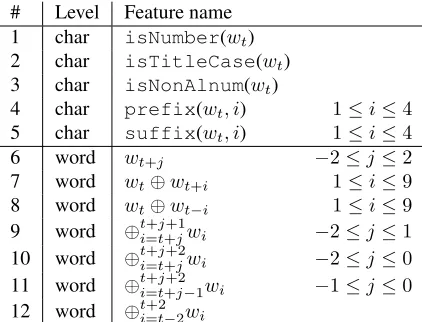
# Level Feature name 1 char isNumber(wt)
2 char isTitleCase(wt)
3 char isNonAlnum(wt)
4 char prefix(wt, i) 1≤i≤4
5 char suffix(wt, i) 1≤i≤4
6 word wt+j −2≤j≤2
7 word wt⊕wt+i 1≤i≤9
8 word wt⊕wt−i 1≤i≤9
9 word ⊕ti+=tj++1jwi −2≤j≤1
10 word ⊕ti+=tj++2jwi −2≤j≤0
11 word ⊕ti+=jt++2j−1wi −1≤j≤0
12 word ⊕t+2
[image:4.612.321.532.54.215.2]i=t−2wi
Table 1: Features and feature templates applied by our feature-rich baseline for target word wt. ⊕is a binary
operator forming a feature from words and their relative positions by combining them together.
also set the number of Brown clusters to be identi-fied to 1024, which is the number of basis vectors applied during sparse coding (cf.D∈R64×1024).
Feature-rich representation We report results re-lying on linear chain CRFs that assign standard state-of-the-art feature-rich representation to se-quences. We apply the very same features and fea-ture templates included in the POS tagging model of CRFSuite4. We summarize these features in Table 1,
where⊕denotes the binary operator which defines
features as a combination of word forms at different (not necessarily contiguous) positions of a sentence. We use the same pool of features described in Ta-ble 1 for both POS tagging and NER. The reason why we do not adjust the feature-rich representation employed as our baseline for the different tasks is that we do not alter our representation in any way when using our sparse coding-based model either.
Note that features #1 through #5 in Table 1 oper-ate at character-level, whereas our proposed frame-work solely uses features derived from the sparse coding of word forms. We thus distinguish two
feature-rich baselines, i.e. FRw+c including both
word and character-level features and FRw treating word forms as atomic units to derive features from.
Using dense word representations As our ulti-mate goal is to demonstrate the usefulness of sparse
4http://github.com/chokkan/crfsuite/
features derived from dense word representations, it is important to address the question of whether sparse word representations are more beneficial for sequence labeling tasks compared to their dense counterparts. To this end, we developed a similar model to the one proposed in Section 3, except for using the original dense word representations for in-ducing features.
According to this modification, we made the fol-lowing change in our feature function: instead of calculating Equation (2) for some wordi, the
modi-fied feature function we use for this baseline is
f(wi) ={j:wi[j]| ∀j∈ {1, . . . , k}}.
That is, instead of relying on the nonzero values in
αi, each word is characterized by its kreal-valued
coordinates in the embedding space. In order to no-tationally distinguish sparse and dense representa-tions, we add subscript SC when we refer to a sparse coded version of some word embedding (e.g. SGSC).
4.2 POS tagging experiments
Even though it is reasonable to assume that lan-guages share a common coarse set of linguistic cat-egories, linguistic resources had their own notations for part-of-speech tags. The first notable attempt to canonize the multiple tag sets was the Google uni-versal part-of-speech tags introduced by Petrov et al. (2012) in which the POS tags of various tagging schemes were mapped to 12 language-independent part-of-speech tags.
The recent initiative of universal dependencies (UD) (Nivre, 2015) aims to provide a unified no-tation for multiple linguistic phenomena, including part-of-speech tags as well. The POS tag set pro-posed for UD has 17 categories which partially over-lap with those defined by Petrov et al. (2012).
4.2.1 Experiments using CoNLL 2006/07 data
We use 12 treebanks in the CoNLL-X format from the CoNLL-2006/07 (Buchholz and Marsi, 2006; Nivre et al., 2007) shared tasks. The complete list of the treebanks included in our experiments is pre-sented in Table 2.
We rely on the official scripts released by Petrov
et al. (2012)5 for mapping the treebank specific
5https://github.com/slavpetrov/
universal-pos-tags
Language Source
bg BTB/CoNLL06 (2005) da DDT/CoNLL06 (2004) de Tiger/CoNLL06 (2002) en Penn Treebank (1993) es Cast3LB/CoNLL06 (2008) hu Szeged Treebank/CoNLL07 (2005) it ISST/CoNLL07 (2003)
nl Alpino/CoNLL06 (2002)
pt Floresta Sint(c)tica/CoNLL06 (2002) sl SDT/CoNLL06 (2006)
[image:5.612.322.533.55.211.2]sv Talbanken05/CoNLL06 (2006) tr METU-Sabanci/CoNLL07 (2003)
Table 2: Treebanks used for POS tagging experiments from the CoNLL 2006/07 shared task.
bg da de en es hu it nl pt sl sv tr Avg. 50
60 70 80 90 100
Co
verage(%)
Token Word form
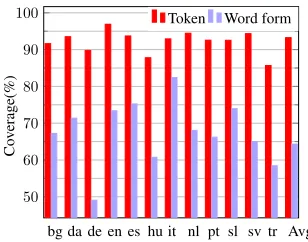
Figure 1: Token and word form-level coverages of the word vectors against the combined train/test sets of the CoNLL-2006/07 POS tagging datasets.
POS tags to the Google universal POS tags in or-der to obtain results comparable across languages. For our experiments we used the original CoNLL-X train/test splits of the treebanks.
[image:5.612.352.506.260.381.2]0.94 0.95 0.96 0.97 0.98 0.99 1 0.93
0.94 0.95 0.96 0.97
Sparsity Per tok en accurac y (a) bg
0.94 0.95 0.96 0.97 0.98 0.99 1 0.92
0.93 0.94 0.95 0.96 0.97
Sparsity
(b) da
0.94 0.95 0.96 0.97 0.98 0.99 1 0.94
0.95 0.96 0.97 0.98
Sparsity
(c) de
0.94 0.95 0.96 0.97 0.98 0.99 1 0.96
0.97 0.98
Sparsity
(d) en
0.94 0.95 0.96 0.97 0.98 0.99 1 0.92
0.93 0.94 0.95 0.96
Sparsity Per tok en accurac y (e) es
0.94 0.95 0.96 0.97 0.98 0.99 1 0.86
0.88 0.9 0.92 0.94 0.96
Sparsity
(f) hu
0.94 0.95 0.96 0.97 0.98 0.99 1 0.9
0.92 0.94 0.96
Sparsity
(g) it
0.94 0.95 0.96 0.97 0.98 0.99 1 0.9
0.92 0.94
Sparsity
(h) nl
0.94 0.95 0.96 0.97 0.98 0.99 1 0.93
0.94 0.95 0.96 0.97 0.98
Sparsity Per tok en accurac y (i) pt
0.94 0.95 0.96 0.97 0.98 0.99 1 0.88
0.9 0.92 0.94
Sparsity
(j) sl
0.94 0.95 0.96 0.97 0.98 0.99 1 0.92
0.93 0.94 0.95
Sparsity
(k) sv
0.94 0.95 0.96 0.97 0.98 0.99 1 0.84
0.86 0.88 0.9
Sparsity
(l) tr
[image:6.612.72.537.63.430.2]polyglotSC CBOWSC SGSC GloveSC FRw+c FRw Brown
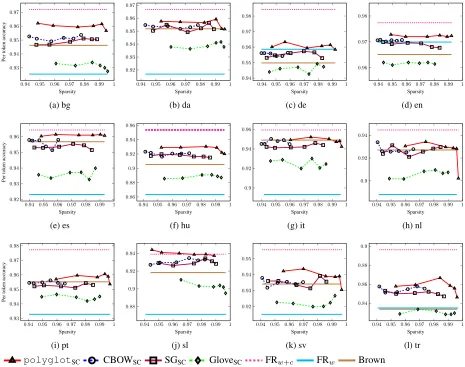
Figure 2: POS tagging results on the CoNLL 2006/07 treebanks evaluating against universal POS tags. Ticks are placed forλ= 0.05,0.1,0.2,0.3,0.4,0.5. The x-axis shows the sparsity of the representations.
Comparing word embeddings Our motivation
for choosing polyglot word embeddings as
in-put to sparse coding is that they are publicly avail-able for a variety of languages. However, distributed word representations trained in any other reasonable manner can serve as input to our approach. In order to investigate if some of the popular word embed-ding techniques seem favorable for our algorithm, we conduct experiments using alternatively trained embeddings, i.e. skip-gram (SG), continuous bag-of-words (CBOW) and Glove.
In order that the utility of different word embed-dings not to be conflated with other factors, we train them on the same Wikipedia dumps used for
train-ing thepolyglotword vectors. We choose further
hyperparameters identically topolyglot, i.e. we
train 64 dimensional dense word representations us-ing a symmetric context window of size 2 for both
SG/CBOW6and Glove7.
Figure 2 includes POS tagging accuracies over the 12 treebanks from the CoNLL 2006/07 shared tasks evaluated against Google Universal POS tags. Instead of reporting results as a function of λ, we
rather present accuracies as a function of the
dif-ferent sparsity levels induced by difdif-ferent λ
val-ues. Figure 2 demonstrates that POS tagging perfor-mance is quite insensitive to the choice ofλunless
it yields some extreme sparsity level (>99.5%). Figure 2 also reveals that the usage of
6https://code.google.com/archive/p/
word2vec/
bg da de en es hu it nl pt sl sv tr Avg.
polyglotSC 96.04 95.71 96.33 97.20 96.14 92.92 95.21 93.43 95.96 94.10 94.36 85.93 94.44
CBOWSC 95.10 95.35 95.61 97.08 95.75 92.17 94.51 92.61 95.42 92.96 93.18 85.12 93.74
SGSC 94.67 95.49 95.47 96.91 95.29 91.97 94.11 93.12 95.28 92.63 93.60 84.99 93.63
GloveSC 93.16 93.63 94.61 96.10 93.36 88.62 92.88 90.16 94.65 90.31 92.19 83.36 91.92
(a) Results obtained using sparse word representations (λ= 0.1, m= 1024).
bg da de en es hu it nl pt sl sv tr Avg.
polyglot 92.11 93.03 93.10 94.80 94.64 89.23 92.90 90.07 94.36 89.36 89.14 81.33 91.17 CBOW 90.19 90.36 88.46 91.22 91.55 86.07 87.11 88.09 92.45 87.82 87.00 79.30 88.30 SG 88.10 88.84 86.48 90.19 91.34 84.38 85.09 85.11 91.77 88.17 84.48 78.72 86.89 Glove 83.10 81.95 83.07 86.64 84.65 77.34 79.98 78.54 86.62 80.91 78.77 76.77 81.53
[image:7.612.79.544.54.199.2](b) Results obtained using dense word representations.
Table 3: Performances of sparse and dense word representations for POS tagging over the 12 CoNLL-X datasets.
polyglotSCword representations tend to produce superior results over all alternative representations we experiment with. Furthermore, models using
polyglotSCconsistently outperform the FRwand Brown clustering-based baselines.
Models relying on SGSCand CBOWSC
represen-tations have an average tagging accuracy of 93.74 and 93.63, respectively, and they typically perform better than the baseline using Brown clustering with
an average tagging performance of 93.27.
Al-though utilizing Glove embeddings produce the low-est scores (91.92 on average), its scores still surpass those of the FRw baseline for all languages except for Turkish.
The average tagging performance over the 12 languages when relying on features based on
polyglotSC is only 1.3 points below that of F Rw+c (i.e. 94.4 versus 95.7). Recall thatF Rw+c uses a feature-rich representation, whereas our pro-posed model uses onlyO(m)features, i.e. it is tied
to the number of the basis vectors employed for sparse coding. Furthermore, our model does not employ word identity features, nor does it rely on character-level features of words.
Analyzing the effects of window size Hyper-parameters for training word representations can greatly impact their quality as also concluded by Levy et al. (2015). We thus investigate if provid-ing a larger context window size durprovid-ing the trainprovid-ing of CBOW, SG and Glove embeddings can improve their performance in our model.
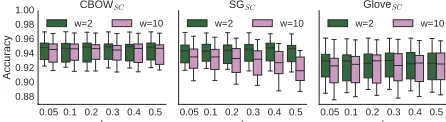
According to Figure 3 applying context window sizes of 2 for training the word embeddings tend to
0.05 0.1 0.2 0.3 0.4 0.5 λ 0.88
0.90 0.92 0.94 0.96 0.98 1.00
Accuracy
CBOWSC
w=2 w=10
0.05 0.1 0.2 0.3 0.4 0.5 λ
SGSC
w=2 w=10
0.05 0.1 0.2 0.3 0.4 0.5 λ
GloveSC
w=2 w=10
Figure 3: Overview of POS tagging accuracies over the 12 CoNLL-X datasets when relying on sparse coded ver-sions of alternative word embeddings trained with context window size of 2 and 10.
produce better overall POS tagging accuracies than applying a larger window size of 10. Differences are the most pronounced in case of skip-gram represen-tation, confirming the findings of Lin et al. (2015), i.e. embedding models that model short-range con-text are more effective for POS tagging.
Comparing dense and sparse representations
Unless stated otherwise, we use λ = 0.1 for the
experiments below in accordance to Figure 2. Ta-ble 3 demonstrates that performances obtained by models using dense word representations as features are consistently inferior to those models relying on sparse word representations.
In Table 3b, we can see that polyglot
em-beddings perform the best for dense representations as well. When using dense features, the CBOW representation-based model tends to produce results better than by a 1.4 points margin on average com-pared to SG embeddings. This performance gap
be-tween the twoword2vecvariants vanishes,
[image:7.612.314.537.248.309.2]model bg da de en es hu it nl pt sl sv tr Avg.
polyglotSC 96.04 95.71 96.33 97.20 96.14 92.92 95.21 93.43 95.96 94.10 94.36 85.93 94.44
FRw 92.55 91.68 95.86 96.99 92.31 86.33 89.32 88.79 93.28 87.12 91.51 83.50 90.77
FRw+c 97.20 96.67 98.42 97.74 96.43 95.36 95.94 94.47 97.73 93.90 95.56 89.63 95.75
#train sents. 12823 5190 39216 39832 3306 6035 3110 13349 9071 1534 11042 4997 12458 (a) Results obtained with different models when all the training corpora was used.
model bg da de en es hu it nl pt sl sv tr Avg.
polyglotSC 88.20 94.04 93.47 95.76 95.63 91.15 94.19 87.28 94.60 94.12 91.14 83.23 91.90
FRw 79.63 87.75 85.58 90.93 89.87 80.01 86.60 74.40 89.13 86.93 80.16 77.59 85.05
FRw+c 88.71 93.52 95.77 94.59 95.42 92.74 93.66 84.94 95.13 93.82 88.56 84.92 91.82
train sents. % 11.70 28.90 3.82 3.77 45.37 24.86 48.23 11.24 16.54 97.78 13.58 30.02 12.04 (b) Results obtained with different models when the first 1,500 sentences of the training corpora were used.
model bg da de en es hu it nl pt sl sv tr Avg.
polyglotSC 76.46 89.51 88.29 90.46 91.32 86.51 89.13 75.24 90.74 86.67 82.50 71.17 84.83
FRw 62.44 74.88 72.46 78.10 77.80 67.20 75.45 56.67 79.38 72.46 65.13 61.38 70.28
FRw+c 74.87 83.34 89.64 85.75 85.88 83.54 84.99 69.28 87.52 83.88 76.71 67.40 81.07
[image:8.612.72.556.55.283.2]train sents. % 1.17 2.89 0.38 0.38 4.54 2.49 4.82 1.12 1.65 9.78 1.36 3.00 1.20 (c) Results obtained with different models when the first 150 sentences of the training corpora were used.
Table 4: Comparison of models based on different amount of training data. Bold numbers indicate the best results for a given training regime (i.e. either training on 150/1,500/all training sentences).polyglotSCusesm= 1024, λ= 0.1.
sparse word representations improve average POS tagging accuracy by 3.3, 5.4, 6.7 and 10.4 points for
polylgot, CBOW, SG and Glove word represen-tations, respectively.
Comparing the effects of training corpus size
We also investigate the generalization characteristics of the proposed representation by training models that have access to substantially different amounts of training data per language. We distinguish three scenarios, i.e. when using only the first150, the first
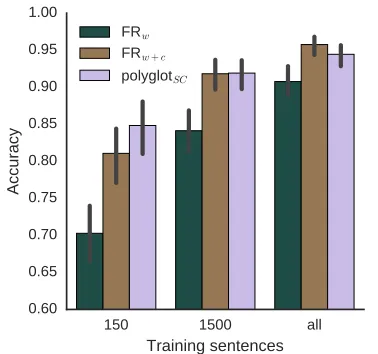
1,500andall the available training sentences from each corpus. Figure 4 illustrates the average POS tagging accuracy over the 12 CoNLL-X datasets for different amounts of training data and models.
Table 4 further reveals that the average
perfor-mance of polyglotSC is 14.55 and 3.76 points
better compared to the FRw and FRw+c baselines
when using only 1.2% of all the available training data, i.e. 150 sentences per language. By
discard-ing 98.8% of the traindiscard-ing datapolyglotSCobtains
89.8% of its average performance compared to the scenario when it has access to all the training sen-tences. However, under the same scenario the FRw+c
and FRwmodels only manage to preserve 85% and
77% of their original performance, respectively.
Our model performs on par with FRw+cand has a
150 1500 all
Training sentences
0.60 0.65 0.70 0.75 0.80 0.85 0.90 0.95 1.00
Accuracy
FRw FRw+c polyglotSC
Figure 4: Average tagging accuracies over the 12 CoNLL-X languages using varying amount of training sentences.
6.85 points advantage over FRwwith a training cor-pus of 1,500 sentences. FRw+chas an average of 1.3
points advantage overpolyglotSCwhen we
pro-vide access to all training data during training,
nev-ertheless FRw still underperformspolyglotSCin
that setting by 3.67 points.
[image:8.612.334.523.342.519.2]pre-trainedpolyglot word representations. The recent work of Faruqui et al. (2015) formulated al-ternative approaches to determine sparse word rep-resentations. One of the objective functions Faruqui et al. (2015) apply is
min D,α 1 2n n X i=1
kxi−Dαik22+λkαik1+τkDk22. (3)
The main difference in Eq. 1 and 3 is that the
lat-ter does not explicitly constrainDto be a member
of the convex set of matrices comprising of column vectors having a pre-defined upper bound on their norm. In order to implicitly control for the norms of the basis vectors Faruqui et al. (2015) apply an additional regularization term affected by an extra parameterτ in their objective function.
Faruqui et al. (2015) also formulated a con-strained objective function of the form
min
D∈Rk×m
≥0
α∈Rk×|V|
≥0 1 2n n X i=1
kxi−Dαik22+λkαik1+τkDk22, (4)
for which a non-negativity constraint on the
ele-ments of α (but no constraint on D) is imposed.
When using the objective functions introduced by Faruqui et al. (2015), we use the defaultτ = 10−5 value. Notationally, we distinguish the sparse cod-ing approaches based on the equation they use as their objective function, i.e. SC-i,i∈ {1,3,4}.
We appliedλ = 0.05 for SC-1 andλ = 0.5for
SC-3 and SC-4 in order to obtain word representa-tions of comparable average sparsity levels across the 12 languages, i.e. 95.3%, 94.5% and 95.2%, re-spectively (cf. the left of Figure 5). The right of Fig-ure 5 further illustrates the spread of POS tagging accuracies over the 12 CoNLL-X treebanks when using models that rely on different sparse coding strategies with comparable sparsity levels.
Although Murphy et al. (2012) mentions non-negativity as a desired property of word representa-tions for cognitive plausibility, Figure 5 reveals that our sequence labeling model cannot benefit from it as the average POS tagging accuracy for SC-4 is 0.7 points below that of SC-3 approach. The aver-age performances when applying SC-1 and SC-3 are nearly identical with a 0.18 point difference between the two.
SC1 SC3 SC4
Sparse coding approach 90 91 92 93 94 95 96 97 % Sparsity
SC1 SC3 SC4
[image:9.612.317.537.57.163.2]Sparse coding approach 84 86 88 90 92 94 96 98 POS tagging accuracy
Figure 5: Comparison of the POS tagging accuracies of different sparse coding techniques with comparable aver-age sparseness levels over the 12 CoNLL-X languaver-ages.
bg da de en es hu it nl pt sl sv tr 0 5 10 15 20 25 30 `2 n or m SC1
bg da de en es hu it nl pt sl sv tr
SC3
bg da de en es hu it nl pt sl sv tr
SC4
(a)`2norms
bgdadeen es hu it nl pt sl sv tr 0.00 0.02 0.04 0.06 0.08 0.10 Relative frequency SC1
bgdadeen es hu it nl pt sl sv tr
SC3
bgdadeen es hu it nl pt sl sv tr
SC4
(b) Relative frequencies
Figure 6: Characteristics of the different sparse coding techniques over the 12 CoNLL-X languages.
It is instructive to analyze the patterns different sparse coding approaches exhibit. Even though the objective functions used by the different approaches are similar, decompositions obtained by them con-vey rather different sparsity structures.
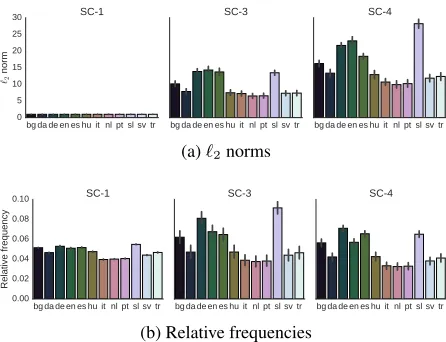
Figure 6a illustrates that there exist substantial variation in the length of the basis vectors obtained by SC-3 and SC-4 both within and across languages. However, SC-1 produces practically no variation in the length of the basis vectors comprisingDdue to the constraint present in the objective function it em-ploys. Figure 6b shows similar differences about the relative frequency of basis vectors taking part in the reconstruction of word embeddings.
Figure 7 shows a strong correlation between the
`2norm of basis vectors and the relative number of times a non-zero coefficient is assigned to them inα
for SC-3 and SC-4 but not for SC-1.
[image:9.612.315.538.224.395.2]0 20 40 60 80 100 120
`
2norm
0.0
0.1
0.2
0.3
0.4
0.5
0.6
0.7
Relative frequency
[image:10.612.82.281.55.257.2]SC1
SC3
SC4
Figure 7: Relative frequency of basis vectors receiving nonzero coefficients inαas a function of their`2norm.
of the basis vectors determined by SC-3 and SC-4 are often orders of magnitude larger than those de-termined by SC-1. This effect, however, can be nat-urally mitigated by increasingτ.
Overall, the different approaches convey compa-rable POS tagging accuracies but different decom-positions due to the differences in the objective func-tions they employ. Experiments described below are conducted using the objective function in Eq. 1.
4.2.2 Experiments using UD treebanks
For POS tagging we also experiment with UD v1.2 (Nivre et al., 2015) treebanks. We used the default train-test splits of the treebanks not utiliz-ing the development sets for fine tunutiliz-ing performance on any of the languages during our experiments. We omitted the Japanese treebank as words in it are stripped off due to licensing issues. Also there
is no polyglot vector released for Old Church
Slavonic and Gothic. Even thoughpolyglotword
representations are released for Arabic, it was of no practical use as it contained unvocalized surface forms of tokens in contrast to the vocalized forms in UD v.1.2. For this reason, we discarded the Arabic treebank as less than 30% of its tokens could be as-sociated with a representation. By omitting these 4 languages from our experiments we are finally left with 33 treebanks for 29 languages. We note that for
Ancient Greek treebanks (grc*) we use word embed-dings trained on Modern Greek.
We should add that there are 4 languages (related
to 6 treebanks) for whichpolyglotword vectors
are accessible, however, the Wikipedia dumps used for training them are not distributed. For this reason, Brown clustering-based baselines are missing for the affected treebanks.
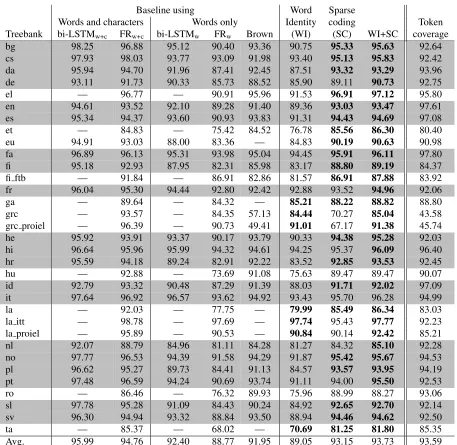
We report our results on UD v1.2 in Table 5. Re-call that the default behavior of our sparse coding-based models (SC in Table 5) is that they do not handle word identity as an explicit feature. We now investigate how much contribution word iden-tity features convey on their own and also when used in conjunction with sparse coding-derived features. For this end we introduce a simple linear chain CRF model generating features solely on the identity of the current word and the ones surrounding it (WI in Table 5). Likewise, we define a model that relies on WI and SC features simultaneously (WI+SC). Ta-ble 5 reveals that SC outperforms WI by a large mar-gin and that combining the two feature sets together yields some further improvements over SC scores.
We also present in Table 5 the state-of-the-art re-sults of the bidirectional LSTM models by Plank et al. (2016) for comparative purposes. Note that the authors reported results only on a subset of UD v1.2 (i.e. treebanks with at least 60k tokens), for which reason we can include their results on 21 treebanks. Out of these 21 UD v1.2 treebanks there are 15 and 20 cases, respectively, for which SC and WI+SC produces better results than bi-LSTMw. Only FRw+c and bi-LSTMw+c, models which enjoy the additional benefit of employing character-level features besides word-level ones, are capable of outperforming SC and WI+SC.
4.3 Named entity recognition experiments
Besides the POS tagging experiments, we investi-gated if the very same features as the ones applied for POS tagging can be utilized in a different se-quence labeling task, namely named entity recog-nition. In order to evaluate our approach, we ob-tained the English, Spanish and Dutch datasets from the 2002 and 2003 CoNLL shared tasks on multilin-gual Named Entity Recognition (Tjong Kim Sang, 2002; Tjong Kim Sang and De Meulder, 2003).
or-Baseline using Word Sparse
Words and characters Words only Identity coding Token Treebank bi-LSTMw+c FRw+c bi-LSTMw FRw Brown (WI) (SC) WI+SC coverage
bg 98.25 96.88 95.12 90.40 93.36 90.75 95.33 95.63 92.64 cs 97.93 98.03 93.77 93.09 91.98 93.40 95.13 95.83 92.42 da 95.94 94.70 91.96 87.41 92.45 87.51 93.32 93.29 93.96 de 93.11 91.73 90.33 85.73 88.52 85.90 89.11 90.73 92.75
el — 96.77 — 90.91 95.96 91.53 96.91 97.12 95.80
en 94.61 93.52 92.10 89.28 91.40 89.36 93.03 93.47 97.61 es 95.34 94.37 93.60 90.93 93.83 91.31 94.43 94.69 97.08
et — 84.83 — 75.42 84.52 76.78 85.56 86.30 80.40
eu 94.91 93.03 88.00 83.36 — 84.83 90.19 90.63 90.98
fa 96.89 96.13 95.31 93.98 95.04 94.45 95.91 96.11 97.80 fi 95.18 92.93 87.95 82.31 85.98 83.17 88.80 89.19 84.37
fi ftb — 91.84 — 86.91 82.86 81.57 86.91 87.88 83.92
fr 96.04 95.30 94.44 92.80 92.42 92.88 93.52 94.96 92.06
ga — 89.64 — 84.32 — 85.21 88.22 88.82 88.80
grc — 93.57 — 84.35 57.13 84.44 70.27 85.04 43.58
grc proiel — 96.39 — 90.73 49.41 91.01 67.17 91.38 45.74 he 95.92 93.91 93.37 90.17 93.79 90.33 94.38 95.28 92.03 hi 96.64 95.96 95.99 94.32 94.61 94.25 95.37 96.09 96.40 hr 95.59 94.18 89.24 82.91 92.22 83.52 92.85 93.53 92.45
hu — 92.88 — 73.69 91.08 75.63 89.47 89.47 90.07
id 92.79 93.32 90.48 87.29 91.39 88.03 91.71 92.02 97.09 it 97.64 96.92 96.57 93.62 94.92 93.43 95.70 96.28 94.99
la — 92.03 — 77.75 — 79.99 85.49 86.34 83.03
la itt — 98.78 — 97.69 — 97.74 95.43 97.77 92.23
la proiel — 95.89 — 90.53 — 90.84 90.14 92.42 85.21
nl 92.07 88.79 84.96 81.11 84.28 81.27 84.32 85.10 92.28 no 97.77 96.53 94.39 91.58 94.29 91.87 95.42 95.67 94.53 pl 96.62 95.27 89.73 84.41 91.13 84.57 93.57 93.95 94.19 pt 97.48 96.59 94.24 90.69 93.74 91.11 94.00 95.50 92.53
ro — 86.46 — 76.32 89.93 75.96 88.99 88.27 93.06
sl 97.78 95.28 91.09 84.43 90.24 84.92 92.65 92.70 92.14 sv 96.30 94.94 93.32 88.84 93.50 88.94 94.46 94.62 92.50
ta — 85.37 — 68.02 — 70.69 81.25 81.80 85.35
[image:11.612.79.536.50.495.2]Avg. 95.99 94.76 92.40 88.77 91.95 89.05 93.15 93.73 93.59
Table 5: Per token POS tagging accuracies for 33 UD treebanks. For sparse coding SPAMS is used onpolyglot vectors withλ = 0.1 andm = 1024. Results in bold are better than any of bi-LSTMw, FRw and Brown models
(i.e. the baselines using features based on words only). Average is calculated over the 20 highlighted treebanks for which there are results in every column. The bi-LSTM results are from Plank et al. (2016).
ganizers and report our NER results using the F1 scores based on the official evaluation script of the CoNLL shared task. Similar to Collobert et al. (2011) we also apply the 17-tag IOBES tagging scheme during training and inference. The best F1 scores reported for English by Collobert et al. (2011) without employing additional unlabeled texts to enhance their language model is 81.47. When pre-training their neural language model on large
amounts of Wikipedia texts they report an F1 score of 87.58.
Figure 8 includes our NER results obtained us-ing different word embeddus-ing representations as in-put for sparse coding and different levels of spar-sity. Similar to our POS tagging experiments, using
0.94 0.95 0.96 0.97 0.98 0.99 1
0.7
0.75
0.8
0.85
Sparsity
F1
score
(a) en
0.94 0.95 0.96 0.97 0.98 0.99 1
0.7
0.72
0.74
0.76
0.78
Sparsity
(b) es
0.94 0.95 0.96 0.97 0.98 0.99 1
0.55
0.6
0.65
0.7
0.75
Sparsity
(c) nl
polyglotSC
CBOWSC
SGSC
GloveSC FRw+c
[image:12.612.75.533.63.176.2]FRw Brown
Figure 8: NER results relying on sparse coding of different word representations. The x-axis shows the sparsity of the representations with ticks atλ= 0.05,0.1,0.2,0.3,0.4,0.5.
en es nl Avg.
polyglotSC 82.92 77.03 72.66 77.54
CBOWSC 83.40 75.51 71.36 76.76
SGSC 82.83 75.22 70.86 76.30
GloveSC 82.31 75.78 69.85 75.98 (a) Sparse (m= 1024, λ= 0.1)
en es nl Avg.
polyglot 78.80 70.13 65.58 71.50 CBOW 72.68 64.49 64.80 67.32 SG 74.68 66.17 63.95 68.27 Glove 74.33 65.11 57.73 65.72
(b) Dense
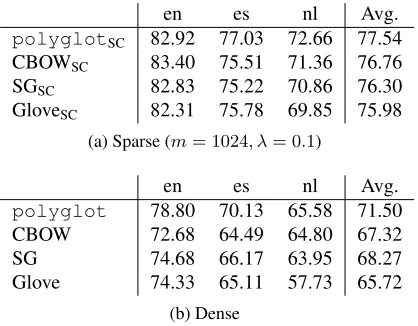
Table 6: Comparison of the performance of sparse and dense word representations for NER.
do not degrade even for extreme levels of sparsity. Also, the sparse coding-based models perform much better when compared to the FRw+cbaseline.
In Table 6, we compare the effectiveness of mod-els relying on sparse and dense word representations for NER. In order not to fine-tune hyperparameters for a particular experiment, similarly to our previ-ous choices m and λ are set to 1024 and 0.1,
re-spectively. Results in Table 6 are in line with those reported in Table 3 for POS tagging.
5 Conclusion
In this paper we show that it is possible to train se-quence models that perform nearly as well as best existing models on a variety of languages for both POS tagging and NER. Our approach does not re-quire word identity features to perform reliably, fur-thermore, it is capable of achieving comparable re-sults to traditional feature-rich models. We also
il-lustrate the advantageous generalization property of our model as it retained 89.8% of its original average POS tagging accuracy when trained on only 1.2% of the total accessible training sentences.
As Mikolov et al. (2013b) pointed out the simi-larities of continuous word embeddings across lan-guages, we think that our proposed model could be employed not in just multi-lingual, but also in cross-lingual language analysis settings. In fact, we inves-tigate its feasibility in our future work. Finally, we have made the sparse coded word embedding vec-tors publicly available in order to facilitate the re-producibility of our results and to foster multilingual and cross-lingual research.
Acknowledgement
The author would like to thank the TACL editors and the anonymous reviewers for their valuable feed-backs and suggestions.
References
Susana Afonso, Eckhard Bick, Renato Haber, and Diana Santos. 2002. “Floresta sint´a(c)tica”: a treebank for Portuguese. InProceedings of the 3rd International Conference on Language Resources and Evaluation (LREC), pages 1698–1703. European Language Re-sources Association (ELRA).
Rami Al-Rfou, Bryan Perozzi, and Steven Skiena. 2013. Polyglot: Distributed word representations for multi-lingual NLP. InProceedings of the Seventeenth Con-ference on Computational Natural Language Learn-ing, pages 183–192. Association for Computational Linguistics.
[image:12.612.83.292.227.390.2]Proceedings of the 4th International Workshop on Lin-guistically Interpreted Corpora (LINC), pages 33–38. Association for Computational Linguistics.
Marco Baroni, Georgiana Dinu, and Germ´an Kruszewski. 2014. Don’t count, predict! A systematic compari-son of context-counting vs. context-predicting seman-tic vectors. InProceedings of the 52nd Annual Meet-ing of the Association for Computational LMeet-inguistics (Volume 1: Long Papers), pages 238–247. Association for Computational Linguistics.
Yoshua Bengio, R´ejean Ducharme, Pascal Vincent, and Christian Janvin. 2003. A neural probabilistic lan-guage model. The Journal of Machine Learning Re-search, 3:1137–1155.
Sabine Brants, Stefanie Dipper, Silvia Hansen, Wolfgang Lezius, and George Smith. 2002. The TIGER tree-bank. InProceedings of the Workshop on Treebanks and Linguistic Theories, pages 24–41.
Peter F. Brown, Peter V. deSouza, Robert L. Mercer, Vin-cent J. Della Pietra, and Jenifer C. Lai. 1992. Class-based n-gram models of natural language. Computa-tional Linguistics, 18(4):467–479.
Sabine Buchholz and Erwin Marsi. 2006. CoNLL-X shared task on multilingual dependency parsing. In Proceedings of the Tenth Conference on Compu-tational Natural Language Learning, CoNLL-X ’06, pages 149–164. Association for Computational Lin-guistics.
Yunchuan Chen, Lili Mou, Yan Xu, Ge Li, and Zhi Jin. 2016. Compressing neural language models by sparse word representations. InProceedings of the 54th An-nual Meeting of the Association for Computational Linguistics (Volume 1: Long Papers), pages 226–235. Association for Computational Linguistics.
Ronan Collobert and Jason Weston. 2008. A unified ar-chitecture for natural language processing: Deep neu-ral networks with multitask learning. In Proceed-ings of the 25th International Conference on Machine Learning, ICML ’08, pages 160–167. Association for Computing Machinery.
Ronan Collobert, Jason Weston, L´eon Bottou, Michael Karlen, Koray Kavukcuoglu, and Pavel Kuksa. 2011. Natural language processing (almost) from scratch. The Journal of Machine Learning Research, 12:2493– 2537.
D´ora Csendes, J´anos Csirik, Tibor Gyim´othy, and Andr´as Kocsor. 2005. The Szeged Treebank. In Text, Speech and Dialogue, 8th International Conference, TSD 2005 Proceedings, pages 123–131.
Leon Derczynski, Sean Chester, and Kenneth Bøgh. 2015. Tune your brown clustering, please. In Pro-ceedings of the International Conference Recent Ad-vances in Natural Language Processing, pages 110– 117. INCOMA Ltd. Shoumen, Bulgaria.
Saˇso Dˇzeroski, Tomaˇz Erjavec, Nina Ledinek, Petr Pajas, Zdenˇek ˇZabokrtsk´y, and Andreja ˇZele. 2006. Towards a Slovene dependency treebank. InProceedings of the Fifth International Language Resources and Evalua-tion Conference, LREC 2006, pages 1388–1391. Eu-ropean Language Resources Association (ELRA). Simonetta Montemagni et al. 2003. Building the
Ital-ian syntactic-semantic treebank. InBuilding and using Parsed Corpora, Language and Speech series, pages 189–210. Kluwer.
Manaal Faruqui, Yulia Tsvetkov, Dani Yogatama, Chris Dyer, and Noah A. Smith. 2015. Sparse overcom-plete word vector representations. InProceedings of the 53rd Annual Meeting of the Association for Com-putational Linguistics and the 7th International Joint Conference on Natural Language Processing (Volume 1: Long Papers), pages 1491–1500. Association for Computational Linguistics.
Matthias T. Kromann, Line Mikkelsen, and Stine Kern Lynge. 2004. Danish dependency treebank.
John D. Lafferty, Andrew McCallum, and Fernando C. N. Pereira. 2001. Conditional random fields: Probabilis-tic models for segmenting and labeling sequence data. In Proceedings of the Eighteenth International Con-ference on Machine Learning, ICML ’01, pages 282– 289. Morgan Kaufmann Publishers Inc.
R´emi Lebret and Ronan Collobert. 2014. Word embed-dings through Hellinger PCA. InProceedings of the 14th Conference of the European Chapter of the Asso-ciation for Computational Linguistics, pages 482–490. Association for Computational Linguistics.
R´emi Lebret and Ronan Collobert. 2015. Rehabili-tation of count-based models for word vector repre-sentations. InInternational Conference on Intelligent Text Processing and Computational Linguistics, pages 417–429. Springer.
Omer Levy, Yoav Goldberg, and Ido Dagan. 2015. Im-proving distributional similarity with lessons learned from word embeddings. TACL, 3:211–225.
Percy Liang. 2005. Semi-supervised learning for natural language. Master’s thesis, Massachusetts Institute of Technology.
Chu-Cheng Lin, Waleed Ammar, Chris Dyer, and Lori Levin. 2015. Unsupervised POS induction with word embeddings. InProceedings of the 2015 Conference of the North American Chapter of the Association for Computational Linguistics: Human Language Tech-nologies, pages 1311–1316. Association for Compu-tational Linguistics.
Mitchell P. Marcus, Beatrice Santorini, and Mary Ann Marcinkiewicz. 1993. Building a large annotated cor-pus of English: The Penn Treebank. Computational Linguistics, 19(2):313–330.
Tomas Mikolov, Kai Chen, Greg Corrado, and Jeffrey Dean. 2013a. Efficient estimation of word representa-tions in vector space. CoRR, abs/1301.3781.
Tomas Mikolov, Quoc V. Le, and Ilya Sutskever. 2013b. Exploiting similarities among languages for machine translation.CoRR, abs/1309.4168.
Tomas Mikolov, Ilya Sutskever, Kai Chen, Greg Corrado, and Jeffrey Dean. 2013c. Distributed representa-tions of words and phrases and their compositionality. In Proceedings of the 26th International Conference on Neural Information Processing Systems, NIPS’13, pages 3111–3119. Curran Associates Inc.
Andriy Mnih and Koray Kavukcuoglu. 2013. Learning word embeddings efficiently with noise-contrastive es-timation. InAdvances in Neural Information Process-ing Systems 26, pages 2265–2273. Curran Associates, Inc.
Brian Murphy, Partha Talukdar, and Tom Mitchell. 2012. Learning effective and interpretable semantic models using non-negative sparse embedding. InProceedings of COLING 2012, pages 1933–1950. The COLING 2012 Organizing Committee.
Joakim Nivre, Jens Nilsson, and Johan Hall. 2006. Tal-banken05: A Swedish treebank with phrase struc-ture and dependency annotation. In Proceedings of the Fifth International Conference on Language Re-sources and Evaluation (LREC 2006), pages 1392– 1395. European Language Resources Association (ELRA).
Joakim Nivre, Johan Hall, Sandra K¨ubler, Ryan McDon-ald, Jens Nilsson, Sebastian Riedel, and Deniz Yuret. 2007. The CoNLL 2007 shared task on dependency parsing. In Proceedings of the CoNLL Shared Task Session of EMNLP-CoNLL 2007, pages 915–932. As-sociation for Computational Linguistics.
Joakim Nivre et al. 2015. Universal dependen-cies 1.2. http://hdl.handle.net/11234/1-1548. LIN-DAT/CLARIN digital library at Institute of Formal and Applied Linguistics, Charles University in Prague. Joakim Nivre, 2015. Towards a Universal Grammar for
Natural Language Processing, pages 3–16. Springer International Publishing.
Naoaki Okazaki. 2007. CRFsuite: a fast implementation of Conditional Random Fields (CRFs).
Olutobi Owoputi, Brendan O’Connor, Chris Dyer, Kevin Gimpel, Nathan Schneider, and Noah A. Smith. 2013. Improved part-of-speech tagging for online conversa-tional text with word clusters. InProceedings of the 2013 Conference of the North American Chapter of
the Association for Computational Linguistics: Hu-man Language Technologies, pages 380–390. Associ-ation for ComputAssoci-ational Linguistics.
Jeffrey Pennington, Richard Socher, and Christopher Manning. 2014. Glove: Global vectors for word rep-resentation. InProceedings of the 2014 Conference on Empirical Methods in Natural Language Processing (EMNLP), pages 1532–1543. Association for Compu-tational Linguistics.
Slav Petrov, Dipanjan Das, and Ryan McDonald. 2012. A universal part-of-speech tagset. In Proceed-ings of the Eighth International Conference on Lan-guage Resources and Evaluation (LREC-2012), pages 2089–2096. European Language Resources Associa-tion (ELRA).
Barbara Plank, Anders Søgaard, and Yoav Goldberg. 2016. Multilingual part-of-speech tagging with bidi-rectional long short-term memory models and auxil-iary loss. InProceedings of the 54th Annual Meeting of the Association for Computational Linguistics (Vol-ume 2: Short Papers), pages 412–418. Association for Computational Linguistics.
Lizhen Qu, Gabriela Ferraro, Liyuan Zhou, Weiwei Hou, Nathan Schneider, and Timothy Baldwin. 2015. Big data small data, in domain out-of domain, known word unknown word: The impact of word represen-tations on sequence labelling tasks. In Proceedings of the Nineteenth Conference on Computational Natu-ral Language Learning, pages 83–93. Association for Computational Linguistics.
Lev Ratinov and Dan Roth. 2009. Design challenges and misconceptions in named entity recognition. In Pro-ceedings of the Thirteenth Conference on Computa-tional Natural Language Learning, CoNLL ’09, pages 147–155. Association for Computational Linguistics. Mariona Taul´e M. Ant`onia Mart´ı Marta Recasens. 2008.
AnCora: Multilevel annotated corpora for Catalan and Spanish. In Proceedings of the Sixth International Conference on Language Resources and Evaluation (LREC-08), pages 96–101. European Language Re-sources Association (ELRA).
Kiril Simov and Petya Osenova. 2005. Extending the annotation of BulTreeBank: Phase 2. In The Fourth Workshop on Treebanks and Linguistic Theories (TLT 2005), pages 173–184.
Karl Stratos and Michael Collins. 2015. Simple semi-supervised POS tagging. In Proceedings of the 1st Workshop on Vector Space Modeling for Natural Lan-guage Processing, pages 79–87. Association for Com-putational Linguistics.
Fei Sun, Jiafeng Guo, Yanyan Lan, Jun Xu, and Xueqi Cheng. 2016. Sparse word embeddings using`1
Intel-ligence, pages 2915–2921. AAAI Press / International Joint Conferences on Artificial Intelligence.
Erik F. Tjong Kim Sang and Fien De Meulder. 2003. In-troduction to the CoNLL-2003 shared task: Language-independent named entity recognition. In Proceed-ings of the Seventh Conference on Natural Language Learning at HLT-NAACL 2003 - Volume 4, CONLL ’03, pages 142–147. Association for Computational Linguistics.
Erik F. Tjong Kim Sang. 2002. Introduction to the CoNLL-2002 shared task: Language-independent named entity recognition. InProceedings of CoNLL-2002, pages 155–158.
Joseph Turian, Lev Ratinov, and Yoshua Bengio. 2010. Word representations: A simple and general method for semi-supervised learning. In Proceedings of the 48th Annual Meeting of the Association for Computa-tional Linguistics, ACL ’10, pages 384–394. Associa-tion for ComputaAssocia-tional Linguistics.
Leonoor van der Beek, Gosse Bouma, Jan Daciuk, Tanja Gaustad, Robert Malouf, Gertjan van Noord, Robbert Prins, and Begoa Villada. 2002. Chapter 5. The Alpino dependency treebank. InAlgorithms for Lin-guistic Processing NWO PIONIER Progress Report. Dani Yogatama, Manaal Faruqui, Chris Dyer, and Noah