Proceedings of NAACL-HLT 2018, pages 2194–2205
Quantifying the visual concreteness of words and topics
in multimodal datasets
Jack Hessel Cornell University
David Mimno Cornell University [email protected]
Lillian Lee Cornell University [email protected]
Abstract
Multimodal machine learning algorithms aim to learn visual-textual correspondences. Previous work suggests that concepts with
concretevisual manifestations may be eas-ier to learn than concepts with abstract ones. We give an algorithm for automatically computing the visual concreteness of words and topics within multimodal datasets. We apply the approach in four settings, ranging from image captions to images/text scraped from historical books. In addition to en-abling explorations of concepts in multi-modal datasets, our concreteness scores predict the capacity of machine learning algorithms to learn textual/visual relation-ships. We find that 1) concrete concepts are indeed easier to learn; 2) the large num-ber of algorithms we consider have similar failure cases; 3) the precise positive rela-tionship between concreteness and perfor-mance varies between datasets. We clude with recommendations for using con-creteness scores to facilitate future multi-modal research.
1 Introduction
Text and images are often used together to serve as a richer form of content. For example, news articles may be accompanied by photographs or infographics; images shared on social media are often coupled with descriptions or tags; and text-books include illustrations, photos, and other vi-sual elements. The ubiquity and diversity of such “text+image” material (henceforth referred to as
multimodalcontent) suggest that, from the stand-point of sharing information, images and text are often natural complements.
Ideally, machine learning algorithms that in-corporate information from both text and images should have a fuller perspective than those that
con-sider either text or images in isolation. ButHill and
Korhonen(2014b) observe that for their particular
multimodal architecture, the level ofconcreteness
of a concept being represented — intuitively, the
idea of adogis more concrete than that ofbeauty
— affects whether multimodal or single-channel representations are more effective. In their case, concreteness was derived for 766 nouns and verbs from a fixed psycholinguistic database of human ratings.
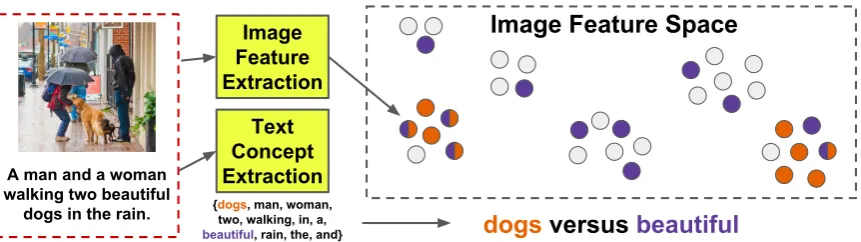
In contrast, we introduce an adaptive algorithm for characterizing the visual concreteness of all the concepts indexed textually (e.g., “dog”) in a given multimodal dataset. Our approach is to leverage the geometry of image/text space. Intuitively, a visually concrete concept is one associated with more locally similar sets of images; for example, images associated with “dog” will likely contain dogs, whereas images associated with “beautiful” may contain flowers, sunsets, weddings, or an
abun-dance of other possibilities — see Fig.1.
Allowing concreteness to be dataset-specific is an important innovation because concreteness is contextual. For example, in one dataset we work with, our method scores “London” as highly con-crete because of a preponderance of iconic London images in it, such as Big Ben and double-decker buses; whereas for a separate dataset, “London” is used as a geotag for diverse images, so the same word scores as highly non-concrete.
In addition to being dataset-specific, our method readily scales, does not depend on an external search engine, and is compatible with both dis-crete and continuous textual concepts (e.g., topic distributions).
Dataset-specific visual concreteness scores en-able a variety of purposes. In this paper, we
Image Feature Extraction
Image Feature Space
dogs
versus
beautiful
Text Concept Extraction {dogs, man, woman,
two, walking, in, a, beautiful, rain, the, and}
A man and a woman walking two beautiful
[image:2.595.85.516.61.182.2]dogs in the rain.
Figure 1: Demonstration of visual concreteness estimation on an example from the COCO dataset. The degree of visual clustering of textual concepts is measured using a nearest neighbor technique. The concreteness of “dogs” is greater than the concreteness of “beautiful” because images associated with
“dogs” are packed tightly into two clusters, while images associated with “beautiful” are spread evenly.1
focus on using them to: 1) explore multimodal datasets; and 2) predict how easily concepts will be learned in a machine learning setting. We ap-ply our method to four large multimodal datasets, ranging from image captions to image/text data
scraped from Wikipedia,2to examine the
relation-ship between concreteness scores and the perfor-mance of machine learning algorithms. Specifi-cally, we consider the cross-modal retrieval prob-lem, and examine a number of NLP, vision, and retrieval algorithms. Across all 320 significantly
different experimental settings (= 4 datasets ×
2 image-representation algorithms × 5
textual-representation algorithms×4 text/image alignment
algorithms ×2 feature pre-processing schemes),
we find that more concrete instances are easier to retrieve, and that different algorithms have sim-ilar failure cases. Interestingly, the relationship between concreteness and retrievability varies sig-nificantly based on dataset: some datasets appear to have a linear relationship between the two, whereas others exhibit a concreteness threshold beyond which retrieval becomes much easier.
We believe that our work can have a positive
im-pact on future multimodal research.§8gives more
detail, but in brief, we see implications in (1) eval-uation — more credit should perhaps be assigned to performance on non-concrete concepts; (2) cre-ating or augmenting multimodal datasets, where
one might a priori consider the desired relative
proportion of concrete vs. non-concrete concepts;
and (3)curriculum learning(Bengio et al.,2009),
1Image copyright information is provided in the
supple-mentary material.
2 We release our Wikipedia and British Library
data at http://www.cs.cornell.edu/˜jhessel/
concreteness/concreteness.html
where ordering of training examples could take concreteness levels into account.
2 Related Work
Applying machine learning to understand visual-textual relationships has enabled a number of new applications, e.g., better accessibility via
auto-matic generation of alt text (Garcia et al.,2016),
cheaper training-data acquisition for computer
vi-sion (Joulin et al., 2016;Veit et al., 2017), and
cross-modal retrieval systems, e.g.,Rasiwasia et al.
(2010);Costa Pereira et al.(2014).
Multimodal datasets often have substantially dif-fering characteristics, and are used for different
tasks (Baltruˇsaitis et al.,2017). Some commonly
used datasets couple images with a handful of
un-ordered tags (Barnard et al.,2003;Cusano et al.,
2004; Grangier and Bengio, 2008; Chen et al.,
2013, inter alia) or short, literal natural language
captions (Farhadi et al.,2010;Ord´o˜nez et al.,2011;
Kulkarni et al.,2013;Fang et al.,2015, inter alia). In other cross-modal retrieval settings, images are paired with long, only loosely thematically-related
documents. (Khan et al.,2009;Socher and Fei-Fei,
2010;Jia et al., 2011;Zhuang et al., 2013, inter alia). We provide experimental results on both types of data.
Concreteness in datasets has been previously
studied in either text-only cases (Turney et al.,
2011;Hill et al.,2013) or by incorporating human
judgments of perception into models (Silberer and
Lapata,2012;Hill and Korhonen,2014a). Other work has quantified characteristics of
concrete-ness in multimodal datasets (Young et al., 2014;
Lazari-dou et al., 2015;Silberer et al., 2016; Lu et al.,
2017;Bhaskar et al., 2017). Most related to our
work is that of Kiela et al. (2014); the authors use
Google image search to collect 50 images each for a variety of words and compute the average co-sine similarity between vector representations of returned images. In contrast, our method can be tuned to specific datasets without reliance on an ex-ternal search engine. Other algorithmic advantages of our method include that: it more readily scales than previous solutions, it makes relatively few as-sumptions regarding the distribution of images/text, it normalizes for word frequency in a principled fashion, and it can produce confidence intervals. Finally, the method we propose can be applied to both discrete and continuous concepts like topic distributions.
3 Quantifying Visual Concreteness
To compute visual concreteness scores, we adopt
the same general approach asKiela et al.(2014):
for a fixed text concept (i.e., a word or topic), we measure the variance in the corresponding visual
features. The method is summarized in Figure1.
3.1 Concreteness of discrete words
We assume as input a multimodal dataset ofn
im-ages represented in a space where nearest neigh-bors may be computed. Additionally, each image is associated with a set of discrete words/tags. We
writewv for the set of words/tags associated with
image v, and Vw for the set of all images
asso-ciated with a word w. For example, if the vth
image is of a dog playing frisbee, wv might be
{frisbee,dog,in,park}, andv∈Vpark.
Our goal is to measure how “clustered” a word is in image feature space. Specifically, we ask:
for each imagev ∈Vw, how often arev’s nearest
neighbors also associated withw? We thus
com-pute the expected value ofMNIkw, the number of
mutually neighboring images of wordw:
EPdata[MNI
k w] =
1
|Vw|
X
v∈Vw
|NNk(v)∩Vw|, (1)
where NNk(v) denotes the set of v’s k nearest
neighbors in image space.
While Equation 1 measures clusteredness, it
does not properly normalize for frequency. Con-sider a word like “and”; we expect it to have low concreteness, but its associated images will share
neighbors simply because “and” is a frequent
un-igram. To correct for this, we compute the
con-cretenessof a word as the ratio ofE[MNIkw]under
the true distribution of the image data to a random distribution of the image data:
concreteness(w) = EPdata[MNI
k w]
EPrandom[MNI
k w]
(2)
While the denominator of this expression can be computed in closed form, we use
EPrandom[MNI
k
w] ≈ k|Vnw|; this approximation is
faster to compute and is negligibly different from the true expectation in practice.
3.2 Extension to continuous topics
We extend the definition of concreteness to con-tinuous concepts, so that our work applies also to topic model outputs; this extension is needed
because the intersection in Equation1cannot be
di-rectly applied to real values. Assume we are given
a set of topics T and an image-by-topic matrix
Y ∈Rn×|T|, where thevthrow3is a topic
distri-bution for the text associated with image v, i.e.,
Yij = P(topicj|imagei). For each topic t, we
compute the average topic weight for each image
v’s neighbors, and take a weighted average as:
concreteness(t) = k
n·
Pn
v=1[Yvt
P
j∈NNk(v)Yjt]
Pn
v=1Yvt
(3)
Note that Equations 1and3 are computations
of means. Therefore, confidence intervals can be computed in both cases either using a normality assumption or bootstrapping.
4 Datasets
We consider four datasets that span a vari-ety of multimodal settings. Two are publicly available and widely used (COCO/Flickr); we collected and preprocessed the other two (Wiki/BL). The Wikipedia and British Library
sets are available for download at http:
//www.cs.cornell.edu/˜jhessel/
concreteness/concreteness.html.
Dataset statistics are given in Table 1, and
summarized as follows:
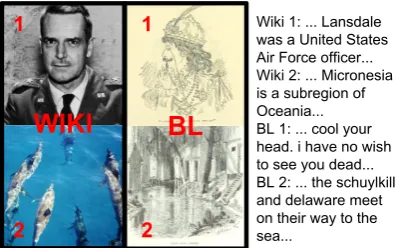
Wikipedia (Wiki). We collected a dataset consist-ing of 192K articles from the English Wikipedia, along with the 549K images contained in those
3 The construction is necessarily different for different
Edward Geary Lansdale (February 6, 1908 – February 23, 1987)[1] was a United States Air Force officer who served in the Office of Strategic Services and the Central Intelligence Agency (CIA). He rose to the rank of Major General and was awarded the Distinguished Service Medal in 1963. He was an early proponent of more aggressive U.S. actions in the Cold War. Lansdale was born in Detroit, Michigan and died in McLean, Virginia.
Micronesia (from Greek: μικρός, mikrós, "small" + Greek: νῆσος, nêsos, "island") is a subregion of Oceania, comprising thousands of small islands in the western Pacific Ocean. It has a shared cultural history with two other island regions, Polynesia to the east and Melanesia to the south.
The region has a tropical marine climate, and is part of the Oceania ecozone. There are four main archipelagos along with numerous outlying islands.
A small pizza covered in tomatoes, fresh basil and shredded cheese.
A skier participates in a competitive event at night.
...while still farther away, where the schuylkill and delaware meet on their way to the sea, low and dark on the horizon lies league island the navy-yard of the future. if, now, he turn his back on the river,...
keep still your sword, keep cool your head. i have no wish to see you dead, nor
oockscombe either i shall try your skill in something different (pauses. eglantine looks at her inquiringly). i'll try you both. (archly) the king shall say which is the cleverest, his protege or mine. stencil streetart banksy pasted unusualimage eastend london graffiti (courtesy unusualimage) 1020mm columbus downtown hdr
bridge nikon skyline d40x ohio river sigma (courtesy Julian Rosario)
WIKI
BL
1
2 1
2
Wiki 1: ... Lansdale was a United States Air Force officer... Wiki 2: ... Micronesia is a subregion of Oceania... BL 1: ... cool your head. i have no wish to see you dead... BL 2: ... the schuylkill and delaware meet on their way to the sea...
Figure 2: Examples of text and images from our new Wiki/BL datasets.
# Images Mean Len Train/Test
Wiki 549K 1397.8 177K/10K
BL 405K 2269.6 69K/ 5K
COCO 123K 10.5 568K/10K
[image:4.595.78.280.63.187.2]Flickr 754K 9.0 744K/10K
Table 1: Dataset statistics: total number of im-ages, average text length in words, and size of the
train/test splits we use in§6.
articles. Following Wilson’s popularity filtering
technique,4 we selected this subset of Wikipedia
by identifying articles that received at least 50
views on March 5th, 2016.5 To our knowledge,
the previous largest publicly available multimodal Wikipedia dataset comes from ImageCLEF’s 2011
retrieval task (Popescu et al.,2010), which consists
of 137K images associated with English articles. Images often appear on multiple pages: an image of the Eiffel tower might appear on pages for Paris, for Gustave Eiffel, and for the tower itself.
Historical Books from British Library (BL). The British Library has released a set of digitized
books (British Library Labs,2016) consisting of
25M pages of OCRed text, alongside 500K+ im-ages scraped from those pim-ages of text. The re-lease splits images into four categories; we ignore “bound covers” and “embellishments” and use
im-ages identified as “plates” and “medium sized.” We associated images with all text within a 3-page win-dow.
This raw data collection is noisy. Many books are not in English, some books contain far more images than others, and the images themselves are of varying size and rotation. To combat these issues
4https://goo.gl/B11yyO
5The articles were extracted from an early March, 2016
data dump.
we only keep books that have identifiably English text; for each cross-validation split in our
machine-learning experiments (§6) we sample at most 10
images from each book; and we use book-level
holdout so that no images/text in the test set are from books in the training set.
Captions and Tags. We also examine two popular
existing datasets: Microsoft COCO (captions) (Lin
et al.,2014) (COCO) and MIRFLICKR-1M (tags) (Huiskes et al.,2010) (Flickr). For COCO, we con-struct our own training/validation splits from the 123K images, each of which has 5 captions. For Flickr, as an initial preprocessing step we only con-sider the 7.3K tags that appear at least 200 times, and the 754K images that are associated with at least 3 of the 7.3K valid tags.
5 Validation of Concreteness Scoring
We apply our concreteness measure to the four datasets. For COCO and Flickr, we use unigrams as concepts, while for Wiki and BL, we extract 256-dimensional topic distributions using Latent
Dirichlet Allocation (LDA) (Blei et al.,2003). For
BL, topic distributions are derived from text in the aforementioned 3 page window; for Wiki, for each image, we compute the mean topic distribution of all articles that image appears in; for Flickr, we associate images with all of their tags; for COCO, we concatenate all captions for a given image. For computing concreteness scores for COCO/Flickr, we only consider unigrams associated with at least 100 images, so as to ensure the stability of MNI as
defined in Equation1.
We extract image features from the pre-softmax layer of a deep convolutional neural network,
ResNet50 (He et al., 2016), pretrained for the
ImageNet classification task (Deng et al.,2009);
this method is known to be a strong baseline (Sharif Razavian et al.,2014).6 For nearest
neigh-bor search, we use the Annoy library,7 which
computes approximate kNN efficiently. We use
k= 50nearest neighbors, though the results
pre-sented are stable for reasonable choices ofk, e.g.,
k= 25,100.
5.1 Concreteness and human judgments
Following Kiela et al. (2014), we borrow a dataset
of human judgments to validate our concreteness
6We explore different image/text representations in later
sections.
Most
Concrete
Least
Concrete
Wiki (Topics) MSCOCO (Unigrams) Flickr (Unigrams)
[image:5.595.79.522.62.202.2]1.11 1.09 1.06 0.89 0.75 0.59 0.52 0.45 0.40 0.22 image appears weird appear photographed thing interesting possibly somewhere caption 296 247 166 160 157 154 150 147 146 137 polar ben stir contents steam magnets sailboats wing airlines marina 1647 1629 1605 1600 1588 1586 1544 1542 1520 1484 écureuil cheetah rongeur pampaargentino sciuridae pampaargentina rodentia bodybuilding bodybuilder sanantoniodeareco 2.16 2.11 2.03 1.92 1.88 1.86 1.75 1.57 1.57 1.55 2007 activeassnmntwkly artisticexpression geotagged 2008 explored 2009 nikon canon explore australia mexico police law male names community history time months linguistics hockey tennis nintendo guns baseball wrestling1 wrestling2 software auto racing currency 170.2 148.9 86.3 81.9 80.9 76.7 71.4 70.4 60.9 58.8 1.95 1.81 1.73 1.71 1.65 1.58 1.52 1.47 1.43 1.29 bodybuilder canon geotagged cheetah magnets caption weird ben software lingustics australia hockey
Figure 3: Examples of the most and least concrete words/topics from Wiki, COCO, and Flickr, along with
example images associated with eachhighlightedword/topic.
computation method.8 The concreteness of words
is a topic of interest in psychology because con-creteness relates to a variety of aspects of human behavior, e.g., language acquisition, memory, etc.
Schwanenflugel and Shoben(1983);Paivio(1991);
Walker and Hulme(1999);De Groot and Keijzer
(2000).
We compare against the human-gathered uni-gram concreteness judgments provided in the USF
Norms dataset (USF) (Nelson et al.,2004); for each
unigram, raters provided judgments of its concrete-ness on a 1-7 scale. For Flickr/COCO, we com-pute Spearman correlation using these per-unigram scores (the vocabulary overlap between USF and Flickr/COCO is 1.3K/1.6K), and for Wiki/BL, we compute topic-level human judgment scores via a simple average amongst the top 100 most probable words in the topic.
As a null hypothesis, we consider the possibility that our concreteness measure is simply mirroring
frequency information.9 We measure frequency for
each dataset by measuring how often a particular word/topic appears in it. A useful concreteness measure should correlate with USF more than a simple frequency baseline does.
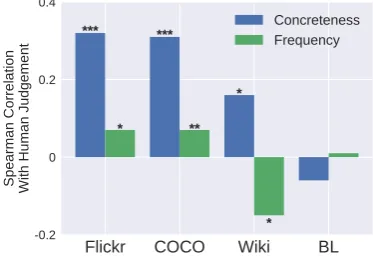
For COCO/Flickr/Wiki, concreteness scores out-put by our method positively correlate with hu-man judgments of concreteness more than
fre-quency does (see Figure4). For COCO, this
pat-tern holds even when controlling for part-of-speech
8Note that because concreteness of words/topics varies
from dataset to dataset, we don’t expect one set of human judgments to correlate perfectly with our concreteness scores. However, partial correlation with human judgment offers a common-sense “reality check.”
9We return to this hypothesis in§6.1as well; there, too,
we find that concreteness and frequency capture different in-formation.
(not shown), whereas Flickr adjectives are not cor-related with USF. For BL, neither frequency nor our concreteness scores are significantly correlated with USF. Thus, in three of our four datasets, our measure tends to predict human concreteness judg-ments better than frequency.
Flickr COCO Wiki BL
0.2 0 0.2 0.4 Spearman Correlation With Human Judgement *** *** * * ** * Concreteness Frequency
Figure 4: Spearman correlations between hu-man judgment (USF) and our algorithm’s
out-puts, and dataset frequency. In the case of
Flickr/COCO/WIKI our concreteness scores corre-late with human judgement to a greater extent than frequency. For BL, neither frequency nor our con-creteness measure is correlated with human
judge-ment. ***/**/* :=p < .001/.01/.05
Concreteness and frequency. While concrete-ness measures correlate with human judgment
better than frequency, we do expect some
cor-relation between a word’s frequency and its
concreteness (Gorman, 1961). In all cases,
we observe a moderate-to-strong positive cor-relation between infrequency and concreteness (ρwiki, ρcoco, ρf lickr, ρbl = .06, .35, .40, .71)
[image:5.595.322.509.355.484.2]properties of words.
5.2 Concreteness within datasets
Figure3 gives examples from Wiki, COCO, and
Flickr illustrating the concepts associated with the smallest and largest concreteness scores according
to our method.10 The scores often align with
intu-ition, e.g., for Wiki, sports topics are often concrete, whereas country-based or abstract-idea-based
top-ics are not.11 For COCO,polar(because of polar
bears) andben(because of Big Ben) are concrete;
whereas somewhere and possibly are associated
with a wide variety of images.
Concreteness scores form a continuum, making
explicit not only the extrema (as in Figure3) but
also the middle ground, e.g., in COCO, “wilder-ness” (rank 479) is more visually concrete than “outside” (rank 2012). Also, dataset-specific
intri-cacies that are not obviousa prioriare highlighted,
e.g., in COCO, 150/151 references to “magnets” (rank 6) are in the visual context of a refrigerator (making “magnets” visually concrete) though the converse is not true, as both “refrigerator” (rank 329) and “fridge” (rank 272) often appear without magnets; 61 captions in COCO are exactly “There
is no image here to provide acaptionfor,” and this
dataset error is made explicit through concreteness score computations.
5.3 Concreteness varies across datasets
To what extent are the concreteness scores dataset-specific? To investigate this question, we com-pute the correlation between Flickr and COCO un-igram concreteness scores for 1129 overlapping terms. While the two are positively correlated (ρ = .48, p < .01) there are many exceptions
that highlight the utility of computing dataset-independent scores. For instance, “London” is ex-tremely concrete in COCO (rank 9) as compared to in Flickr (rank 1110). In COCO, images of Lon-don tend to be iconic (i.e., Big Ben, double decker buses); in contrast, “London” often serves as a geotag for a wider variety of images in Flickr. Con-versely, “watch” in Flickr is concrete (rank 196) as it tends to refer to the timepiece, whereas “watch” is not concrete in COCO (rank 958) as it tends to refer to the verb; while these relationships are
10The BL results are less interpretable and are omitted for
space reasons.
11Perhaps fittingly, the “linguistics” topic (top words: term,
word, common, list, names, called, form, refer, meaning) is the least visually concrete of all 256 topics.
not obviousa priori, our concreteness method has
helped to highlight these usage differences between the image tagging and captioning datasets.
6 Learning Image/Text Correspondences
Previous work suggests that incorporating visual features for less concrete concepts can be
harm-ful in word similarity tasks (Hill and Korhonen,
2014b;Kiela et al.,2014;Kiela and Bottou,2014;
Hill et al.,2014). However, it is less clear if this intuition applies to more practical tasks (e.g., re-trieval), or if this problem can be overcome simply by applying the “right” machine learning algorithm. We aim to tackle these questions in this section.
The learning task. The task we consider is the construction of a joint embedding of images and text into a shared vector space. Truly correspond-ing image/text pairs (e.g., if the text is a caption of that image) should be placed close together in the new space relative to image/text pairs that do not match. This task is a good representative of multimodal learning because computing a joint em-bedding of text and images is often a “first step” for downstream tasks, e.g., cross-modal retrieval (Rasiwasia et al.,2010), image tagging (Chen et al.,
2013), and caption generation (Kiros et al.,2015).
Evaluations. Following previous work in cross-modal retrieval, we measure performance using
the top-k%hit rate (also called recall-at-k-percent,
R@k%; higher is better). Cross-modal retrieval
can be applied in either direction, i.e., searching for an image given a body of text, or vice-versa. We examine both the image-search-text and text-search-image cases. For simplicity, we average retrieval performance from both directions,
produc-ing a sproduc-ingle metric;12higher is better.
Visual Representations. Echoing Wei et al.
(2016), we find that features extracted from
con-volutional neural networks (CNNs) outperform classical computer vision descriptors (e.g., color histograms) for multimodal retrieval. We con-sider two different CNNs pretrained on different datasets: ResNet50 features trained on the
Ima-geNet classification task (RN-Imagenet), and
In-ceptionV3 (Szegedy et al., 2015) trained on the
OpenImages (Krasin et al.,2017) image tagging
task (I3-OpenImages).
12Averaging is done for ease of presentation; the
Concreteness (wiki) .3
.45 .6
Retrievability
tfidfdcca pvdcca
ldadcca NP LS NS DCCA
BTM 14.1 19.8 20.7 27.9
LDA 19.8 36.2 33.1 37.0
PV 22.0 30.8 29.4 37.1
uni 17.3 29.3 30.2 36.3
tfidf 18.1 35.2 33.2 38.7
(a) Wikipedia
Concreteness (bl) .12
.2 .28
Retrievability
pvdcca ldals
ldadcca BTM NP6.7 7.3LS NS7.2 DCCA9.5
LDA 10.2 17.1 13.8 16.4
PV 12.6 14.1 14.1 17.8
uni 11.0 13.2 12.4 15.6
tfidf 10.9 15.1 13.5 15.5
(b) British Library
Concreteness (coco) .65
.73 .8
Retrievability
unidcca tfidfdcca
unils NP LS NS DCCA
BTM 27.3 39.9 52.5 58.6
LDA 23.2 51.6 51.9 51.8
PV 14.1 28.4 25.7 33.5
uni 28.7 74.6 72.5 75.0
tfidf 32.9 74.0 74.1 74.9
(c) COCO
Concreteness (flickr) .5
.65 .8
Retrievability
tfidfns unils
unins NP LS NS DCCA
BTM 23.9 19.1 31.0 32.4
LDA 18.4 32.2 34.4 34.7
PV 13.9 21.3 20.0 26.6
uni 34.7 62.5 62.0 59.6
tfidf 35.1 61.6 63.9 60.2
[image:7.595.68.520.63.248.2](d) Flickr
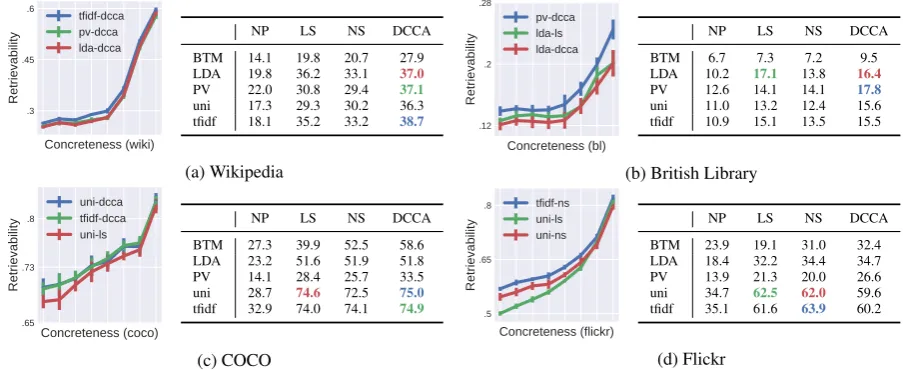
Figure 5: Concreteness scores versus retrievability (plotted) for each dataset, along with Recall at 1% (in tables, higher is better) for each algorithm combination. Tables give average retrieval performance
over 10-fold cross-validation for each combination of NLP/alignment algorithm; thebest,second best,
andthird bestperforming combinations are bolded and colored. The concreteness versus retrievability curves are plotted for the top-3 performing algorithms, though similar results hold for all algorithms. Our concreteness scores and performance are positively correlated, though the shape of the relationship between the two differs from dataset to dataset (note the differing scales of the y-axes). All results are for RN-ImageNet; the similar I3-OpenImages results are omitted for space reasons.
Text Representations. We consider sparse uni-gram and tfidf indicator vectors. In both cases, we limit the vocabulary size to 7.5K. We next con-sider latent-variable bag-of-words models,
includ-ing LDA (Blei et al.,2003) (256 topics, trained with
Mallet (McCallum, 2002)) a specialized biterm
topic model (BTM) (Yan et al., 2013) for short
texts (30 topics), and paragraph vectors (PV) (Le
and Mikolov,2014) (PV-DBOW version, 256
di-mensions, trained with Gensim (ˇReh˚uˇrek and
So-jka,2010)).13
Alignment of Text and Images. We explore four algorithms for learning correspondences between image and text vectors. We first compare against
Hodosh et al. (2013)’s nonparametric baseline
(NP), which is akin to a nearest-neighbor search.
This algorithm is related to the concreteness score algorithm we previously introduced in that it ex-ploits the geometry of the image/text spaces using nearest-neighbor techniques. In general, perfor-mance metrics for this algorithm provide an esti-mate of how “easy” a particular task is in terms of the initial image/text representations.
1.7% (std. dev=2%).
13We also ran experiments encoding text using order-aware
recurrent neural networks, but we did not observe significant performance differences. Those results are omitted for space reasons.
We next map image features to text features via
a simple linear transformation. Let(ti, vi) be a
text/image pair in the dataset. We learn a linear
transformationW that minimizes
X
i
kW fimage(vi)−ftext(ti)k22+λkWkF (4)
for feature extraction functionsfimageandftext, e.g.,
RN-ImageNet/LDA. It is possible to map images
onto text as in Equation4, or map text onto images
in an analogous fashion. We find that the direc-tionality of the mapping is important. We train models in both directions, and combine their
best-performing results into a single least-squares (LS)
model.
Next we consider Negative Sampling (NS),
which balances two objectives: true image/text pairs should be close in the shared latent space, while randomly combined image/text pairs should
be far apart. For a text/image pair (ti, vi), let
s(ti, vi)be the cosine similarity of the pair in the
shared space. The loss for a single positive example
(ti, vi)given a negative sample(t0i, v0i)is
h s(ti, vi), s(ti, vi0)
+h s(ti, vi), s(t0i, vi)
(5)
for the hinge functionh(p, n) = max{0, α−p+n}.
Finally, we consider Canonical Correlation Anal-ysis (CCA), which projects image and text repre-sentations down to independent dimensions of high multimodal correlation. CCA-based methods are popular within the IR community for learning
mul-timodal embeddings (Costa Pereira et al., 2014;
Gong et al.,2014). We useWang et al.(2015b)’s
stochastic method for training deep CCA (Andrew
et al.,2013) (DCCA), a method that is competitive
with traditional kernel CCA (Wang et al.,2015a)
but less memory-intensive to train.
Training details. LS, NS, and DCCA were
imple-mented using Keras (Chollet et al.,2015).14 In
to-tal, we examine all combinations of: four datasets, five NLP algorithms, two vision algorithms, four cross-modal alignment algorithms, and two feature preprocessing settings; each combination was run using 10-fold cross-validation.
Absolute retrieval quality. The tables in Figure5
contain the retrieval results for RN-ImageNet im-age features across each dataset, alignment algo-rithm, and text representation scheme. We show
results for R@1%, but R@5% and R@10% are
similar. I3-OpenImages image features underper-form relative to RN-ImageNet and are omitted for space reasons, though the results are similar.
The BL corpus is the most difficult of the datasets we consider, yielding the lowest retrieval scores. The highly-curated COCO dataset appears to be the easiest, followed by Flickr and then Wikipedia. No single algorithm combination is “best” in all cases.
6.1 Concreteness scores and performance
We now examine the relationship between retrieval performance and concreteness scores. Because con-creteness scores are on the word/topic level, we
define aretrievabilitymetric that summarizes an
algorithm’s performance on a given concept; for
example, we might expect that retrievability(dog)
is greater than retrievability(beautiful).
Borrowing theR@1%metric from the previous
section, we let I[ri < 1%] be an indicator
vari-able indicating that test instance iwas retrieved
correctly, i.e.,I[ri < 1%]is 1 if the the average
14We used Adam (Kingma and Ba,2015), batch
normaliza-tion (Ioffe and Szegedy,2015), and ReLU activations. Regular-ization and architectures (e.g., number of layers in DCCA/NS, regularization parameter in LS) were chosen over a valida-tion set separately for each cross-validavalida-tion split. Training is stopped when retrieval metrics decline over the validation set. All models were trained twice, using both raw features and zero-mean/unit-variance features.
rankriof the image-search-text/text-search-image
directions is better than1%, and 0 otherwise. Let
sicbe the affinity of test instanceito conceptc. In
the case of topic distributions,sicis the proportion
of topiccin instancei; in the case of unigrams,sic
is the length-normalized count of unigramcon
in-stancei. Retrievability is defined using a weighted
average over test instancesias:
retrievability(c) =
P
isicP·I[ri<1%] isic (6)
The retrievability of cwill be higher if instances
more associated withcare more easily retrieved by
the algorithm.
Retrievability vs. Concreteness. The graphs in
Figure 5 plot our concreteness scores versus
re-trievability of the top 3 performing NLP/alignment algorithm combinations for all 4 datasets. In all cases, there is a strong positive correlation between concreteness and retrievability, which provides ev-idence that more concrete concepts are easier to retrieve.
The shape of the concreteness-retrievability curve appears to vary between datasets more than between algorithms. In COCO, the relationship be-tween the two appears to smoothly increase. In Wiki, on the other hand, there appears to be a concreteness threshold, beyond which retrieval be-comes much easier.
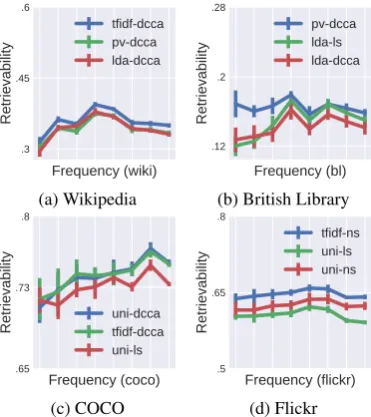
There is little relationship between retrievabil-ity and frequency, further suggesting that our con-creteness measure is not simply mirroring
fre-quency. We re-made the plots in Figure 5,
ex-cept we swapped the x-axis from concreteness to
frequency; the resulting plots, given in Figure6,
are much flatter, indicating that retrievability and frequency are mostly uncorrelated. Additional re-gression analyses reveal that for the top-3 perform-ing algorithms on Flickr/Wiki/BL/COCO, concrete-ness explains 33%/64%/11%/15% of the variance in retrievability, respectively. In contrast, for all datasets, frequency explained less than 1% of the variance in retrievability.
7 Beyond Cross-Modal Retrieval
Frequency (wiki) .3
.45 .6
Retrievability
tfidfdcca pvdcca ldadcca
(a) Wikipedia
Frequency (bl) .12
.2 .28
Retrievability
pvdcca ldals ldadcca
(b) British Library
Frequency (coco) .65
.73 .8
Retrievability unidccatfidfdcca unils
(c) COCO
Frequency (flickr) .5
.65 .8
Retrievability
tfidfns unils unins
[image:9.595.88.274.61.270.2](d) Flickr
Figure 6: Correlation between word/topic fre-quency and retrievability for each of the four datasets. Compared to our concreteness measure
(see Figure5; note that the while x-axes are
differ-ent, the y-axes are the same) frequency explains relatively little variance in retrievability.
Flickr/COCO computed in§3to derive
concrete-ness scores for the ImageNet classes.15We find that
for both classification and localization, for all 10 top performing entries, and for both Flickr/COCO, there exists a moderate-to-strong Spearman correla-tion between concreteness and performance among the classes for which concreteness scores were available (nflickr, ncoco= 171,288;.18< ρ < .44;
p < .003in all cases). This result suggests that
concrete concepts may tend to be easier on tasks other than retrieval, as well.
8 Future Directions
At present, it remains unclear if abstract concepts should be viewed as noise to be discarded (as in
Kiela et al. (2014)), or more difficult, but
learn-able, signal. Because large datasets (e.g., social media) increasingly mix modalities using ambigu-ous, abstract language, researchers will need to tackle this question going forward. We hope that visual concreteness scores can guide investigations of the trickiest aspects of multimodal tasks. Our work suggests the following future directions:
Evaluating algorithms: Because concreteness scores are able to predict performance prior to
train-15There are 1K classes in both ImageNet tasks, but we were
only able to compute concreteness scores for a subset, due to vocabulary differences.
ing, evaluations could be reported over concrete and abstract instances separately, as opposed to aggregating into a single performance metric. A new algorithm that consistently performs well on non-concrete concepts, even at the expense of per-formance on concrete concepts, would represent a significant advance in multimodal learning.
Designing datasets: When constructing a new multimodal dataset, or augmenting an existing one, concreteness scores can offer insights regarding how resources should be allocated. Most directly, these scores enable focusing on “concrete visual
concepts” (Huiskes et al.,2010;Chen et al.,2015),
by issuing image-search queries could be issued exclusively for concrete concepts during dataset construction. The opposite approach could also be employed, by prioritizing less concrete concepts.
Curriculum learning:During training, instances could be up/down-weighted in the training process in accordance with concreteness scores. It is not clear if placing more weight on the trickier cases (down-weighting concreteness), or giving up on the harder instances (up-weighting concreteness) would lead to better performance, or differing algo-rithm behavior.
9 Acknowledgments
This work was supported in part by NSF grants SES-1741441/IIS-1652536/IIS-1526155, a Yahoo Faculty Research and Engagement Program grant, the Alfred P. Sloan Foundation, and a Cornell Li-brary Grant. Any opinions, findings, and conclu-sions or recommendations expressed in this mate-rial are those of the authors and do not necessarily reflect the views of the NSF, Sloan Foundation, Ya-hoo, or other sponsors. Nvidia kindly provided the Titan X GPU used in this work.
We would additionally like to thank Maria Anto-niak, Amit Bahl, Bharath Hariharan, Arzoo Katiyar, Vlad Niculae, Xanda Schofield, Laure Thompson, Shaomei Wu, and the anonymous reviewers for their constructive comments.
References
Galen Andrew, Raman Arora, Jeff A. Bilmes, and Karen Livescu. 2013. Deep canonical correlation analysis. InICML.
Kobus Barnard, Pinar Duygulu, David Forsyth, Nando De Freitas, David M. Blei, and Michael I. Jordan. 2003. Matching words and pictures. JMLR.
Yoshua Bengio, J´erˆome Louradour, Ronan Collobert, and Jason Weston. 2009. Curriculum learning. In ICML.
Sai Abishek Bhaskar, Maximilian K¨oper, Sabine Schulte im Walde, and Diego Frassinelli. 2017. Exploring multi-modal text+image models to distinguish between abstract and concrete nouns. InIWCS Workshop on Foundations of Situated and Multimodal Communication.
David M. Blei, Andrew Y. Ng, and Michael I. Jordan. 2003. Latent Dirichlet allocation. JMLR.
British Library Labs. 2016. Digitised books. https:
//data.bl.uk/digbks/.
Minmin Chen, Alice X. Zheng, and Kilian Q. Wein-berger. 2013. Fast image tagging. InICML.
Xinlei Chen, Hao Fang, Tsung-Yi Lin, Rama-krishna Vedantam, Saurabh Gupta, Piotr Doll´ar, and C. Lawrence Zitnick. 2015. Microsoft COCO cap-tions: Data collection and evaluation server. arXiv preprint arXiv:1504.00325.
Franc¸ois Chollet et al. 2015. Keras. https://
github.com/fchollet/keras.
Jose Costa Pereira, Emanuele Coviello, Gabriel Doyle, Nikhil Rasiwasia, Gert R.G. Lanckriet, Roger Levy, and Nuno Vasconcelos. 2014. On the role of cor-relation and abstraction in cross-modal multimedia retrieval. TPAMI.
Claudio Cusano, Gianluigi Ciocca, and Raimondo Schettini. 2004. Image annotation using SVM. In Electronic Imaging.
Annette De Groot and Rineke Keijzer. 2000. What is hard to learn is easy to forget: The roles of word concreteness, cognate status, and word frequency in foreign-language vocabulary learning and forgetting. Language Learning, 50(1):1–56.
Jia Deng, Wei Dong, Richard Socher, Li-Jia Li, Kai Li, and Li Fei-Fei. 2009. ImageNet: A large-scale hierarchical image database. InCVPR.
Hao Fang, Saurabh Gupta, Forrest Iandola, Rupesh K. Srivastava, Li Deng, Piotr Doll´ar, Jianfeng Gao, Xiaodong He, Margaret Mitchell, John C. Platt, C. Lawrence Zitnick, and Geoffrey Zweig. 2015. From captions to visual concepts and back. InCVPR.
Ali Farhadi, Mohsen Hejrati, Mohammad Amin Sadeghi, Peter Young, Cyrus Rashtchian, Julia Hock-enmaier, and David Forsyth. 2010. Every picture tells a story: Generating sentences from images. In ECCV.
Dario Garcia Garcia, Manohar Paluri, and Shaomei Wu. 2016. Under the hood: Building acces-sibility tools for the visually impaired on facebook. https://code.facebook. com/posts/457605107772545/under- the-hood-building-accessibility-
tools-for-the-visually-impaired-on-facebook/.
Yunchao Gong, Qifa Ke, Michael Isard, and Svetlana Lazebnik. 2014. A multi-view embedding space for modeling internet images, tags, and their semantics. IJCV.
Aloysia M. Gorman. 1961. Recognition memory for nouns as a function of abstractness and frequency. Journal of Experimental Psychology, 61(1):23–29. David Grangier and Samy Bengio. 2008. A
discrimina-tive kernel-based approach to rank images from text queries. TPAMI.
Kaiming He, Xiangyu Zhang, Shaoqing Ren, and Jian Sun. 2016. Deep residual learning for image recogni-tion. InCVPR.
Felix Hill, Douwe Kiela, and Anna Korhonen. 2013. Concreteness and corpora: A theoretical and practical analysis. InWorkshop on Cognitive Modeling and Computational Linguistics.
Felix Hill and Anna Korhonen. 2014a. Concreteness and subjectivity as dimensions of lexical meaning. In ACL, pages 725–731.
Felix Hill and Anna Korhonen. 2014b. Learning ab-stract concept embeddings from multi-modal data: Since you probably can’t see what I mean. In EMNLP.
Felix Hill, Roi Reichart, and Anna Korhonen. 2014. Multi-modal models for concrete and abstract con-cept meaning.TACL.
Micah Hodosh, Peter Young, and Julia Hockenmaier. 2013. Framing image description as a ranking task: Data, models and evaluation metrics. JAIR.
Mark J. Huiskes, Bart Thomee, and Michael S. Lew. 2010. New trends and ideas in visual concept detec-tion: the MIR flickr retrieval evaluation initiative. In ACM MIR.
Sergey Ioffe and Christian Szegedy. 2015. Batch nor-malization: Accelerating deep network training by reducing internal covariate shift.JMLR.
Mainak Jas and Devi Parikh. 2015. Image specificity. InCVPR.
Yangqing Jia, Mathieu Salzmann, and Trevor Darrell. 2011. Learning cross-modality similarity for multi-nomial data. InICCV.
Inayatullah Khan, Amir Saffari, and Horst Bischof. 2009. TVGraz: Multi-modal learning of object cate-gories by combining textual and visual features. In Workshop of the Austrian Association for Pattern Recognition.
Douwe Kiela and L´eon Bottou. 2014. Learning image embeddings using convolutional neural networks for improved multi-modal semantics. InEMNLP.
Douwe Kiela, Felix Hill, Anna Korhonen, and Stephen Clark. 2014. Improving multi-modal representations using image dispersion: Why less is sometimes more. InACL.
Diederik Kingma and Jimmy Ba. 2015. Adam: A method for stochastic optimization. InICLR.
Ryan Kiros, Ruslan Salakhutdinov, and Richard S. Zemel. 2015. Unifying visual-semantic embeddings with multimodal neural language models.TACL.
Ivan Krasin, Tom Duerig, Neil Alldrin, Vittorio Ferrari, Sami Abu-El-Haija, Alina Kuznetsova, Hassan Rom, Jasper Uijlings, Stefan Popov, Andreas Veit, Serge Belongie, Victor Gomes, Abhinav Gupta, Chen Sun, Gal Chechik, David Cai, Zheyun Feng, Dhyanesh Narayanan, and Kevin Murphy. 2017. OpenImages: A public dataset for large-scale label and multi-class image multi-classification. Dataset available from https://github.com/openimages.
Girish Kulkarni, Visruth Premraj, Vicente Ord´o˜nez, Sag-nik Dhar, Siming Li, Yejin Choi, Alexander C. Berg, and Tamara L. Berg. 2013. Babytalk: Understanding and generating simple image descriptions. TPAMI.
Angeliki Lazaridou, Nghia The Pham, and Marco Ba-roni. 2015. Combining language and vision with a multimodal skip-gram model. InNAACL.
Quoc V. Le and Tomas Mikolov. 2014. Distributed rep-resentations of sentences and documents. InICML.
Tsung-Yi Lin, Michael Maire, Serge Belongie, James Hays, Pietro Perona, Deva Ramanan, Piotr Doll´ar, and C. Lawrence Zitnick. 2014. Microsoft COCO: Common objects in context. InECCV.
Jiasen Lu, Caiming Xiong, Devi Parikh, and Richard Socher. 2017. Knowing when to look: Adaptive attention via a visual sentinel for image captioning.
Andrew Kachites McCallum. 2002. Mallet: A machine learning for language toolkit. http://mallet.
cs.umass.edu.
Douglas L. Nelson, Cathy L. McEvoy, and Thomas A. Schreiber. 2004. The University of South Florida free association, rhyme, and word fragment norms. Behavior Research Methods, Instruments, & Comput-ers, 36(3):402–407.
Vicente Ord´o˜nez, Girish Kulkarni, and Tamara L. Berg. 2011. Im2text: Describing images using 1 million captioned photographs. InNIPS.
Allan Paivio. 1991. Dual coding theory: Retrospect and current status.Canadian Journal of Psychology, 45(3):255–287.
Adrian Popescu, Theodora Tsikrika, and Jana Kludas. 2010. Overview of the Wikipedia retrieval task at ImageCLEF 2010. InCLEF.
Nikhil Rasiwasia, Jose Costa Pereira, Emanuele Coviello, Gabriel Doyle, Gert R.G. Lanckriet, Roger Levy, and Nuno Vasconcelos. 2010. A new approach to cross-modal multimedia retrieval. InACM MM.
Radim ˇReh˚uˇrek and Petr Sojka. 2010. Software frame-work for topic modelling with large corpora. In LREC Workshop on NLP Frameworks.
Paula J. Schwanenflugel and Edward J. Shoben. 1983. Differential context effects in the comprehension of abstract and concrete verbal materials. Journal of Experimental Psychology: Learning, Memory, and Cognition, 9(1):82–102.
Ali Sharif Razavian, Hossein Azizpour, Josephine Sul-livan, and Stefan Carlsson. 2014. CNN features off-the-shelf: an astounding baseline for recognition. In CVPR Workshop.
Carina Silberer, Vittorio Ferrari, and Mirella Lapata. 2016. Visually grounded meaning representations. TPAMI.
Carina Silberer and Mirella Lapata. 2012. Grounded models of semantic representation. InEMNLP.
Richard Socher and Li Fei-Fei. 2010. Connecting modalities: Semi-supervised segmentation and an-notation of images using unaligned text corpora. In CVPR.
Christian Szegedy, Wei Liu, Yangqing Jia, Pierre Ser-manet, Scott Reed, Dragomir Anguelov, Dumitru Erhan, Vincent Vanhoucke, and Andrew Rabinovich. 2015. Going deeper with convolutions. InCVPR.
Peter D. Turney, Yair Neuman, Dan Assaf, and Yohai Cohen. 2011. Literal and metaphorical sense iden-tification through concrete and abstract context. In EMNLP.
Andreas Veit, Neil Alldrin, Gal Chechik, Ivan Krasin, Abhinav Gupta, and Serge Belongie. 2017. Learning from noisy large-scale datasets with minimal super-vision. InCVPR.
Ian Walker and Charles Hulme. 1999. Concrete words are easier to recall than abstract words: Evidence for a semantic contribution to short-term serial re-call. Journal of Experimental Psychology: Learning, Memory, and Cognition, 25(5):1256–1271.
Weiran Wang, Raman Arora, Karen Livescu, and Nathan Srebro. 2015b. Stochastic optimization for deep cca via nonlinear orthogonal iterations. In Com-munication, Control, and Computing.
Yunchao Wei, Yao Zhao, Canyi Lu, Shikui Wei, Luoqi Liu, Zhenfeng Zhu, and Shuicheng Yan. 2016. Cross-modal retrieval with cnn visual features: A new base-line. Transactions on Cybernetics.
Xiaohui Yan, Jiafeng Guo, Yanyan Lan, and Xueqi Cheng. 2013. A biterm topic model for short texts. InWWW.
Peter Young, Alice Lai, Micah Hodosh, and Julia Hock-enmaier. 2014. From image descriptions to visual denotations: New similarity metrics for semantic in-ference over event descriptions. TACL.