Proceedings of NAACL-HLT 2018, pages 113–117
Humor recognition using deep learning
Peng-Yu Chen
National Tsing Hua University Hsinchu, Taiwan [email protected]
Von-Wun Soo
National Tsing Hua University Hsinchu, Taiwan [email protected]
Abstract
Humor is an essential but most fascinating el-ement in personal communication. How to build computational models to discover the structures of humor, recognize humor and even generate humor remains a challenge and there have been yet few attempts on it. In this pa-per, we construct and collect four datasets with distinct joke types in both English and Chi-nese and conduct learning experiments on hu-mor recognition. We implement a Convolu-tional Neural Network (CNN) with extensive filter size, number and Highway Networks to increase the depth of networks. Results show that our model outperforms in recognition of different types of humor with benchmarks col-lected in both English and Chinese languages on accuracy, precision, and recall in compari-son to previous works.
1 Introduction
Humor, a highly intelligent communicative ac-tivity, provokes laughter or provides amusement. The role that humor plays in life can be viewed as a sociological phenomenon and function. Proper use of it can help eliminate embarrassment, estab-lish social relationships, create positive affection in human social interactions. If computers can un-derstand humor to some extent, it would facilitate predicting human’s intention in human conversa-tion, and thereby enhance the proficiency of many machine-human interaction systems.
However, to automate the humor recognition is also a very challenging research topic in natural language understanding. The extent to which a person may sense humor depends on his/her per-sonal background. For example, young children may favor cartoons while the grownups may feel the humor in cartoons boring. Also, many types of humor require substantial such external knowl-edge as irony, wordplay, metaphor and sarcasm.
These factors make the task of automated humor recognition difficult.
Recently, with the advance of deep learning that allows end-to-end training with big data with-out human intervention of feature selection, hu-mor recognition becomes promising. In this work, we propose a convolutional neural network (CNN) with augmentation of both the filter sizes and fil-ter numbers. We use the architecture called high-way network to implement a much more proficient model for humor recognition. The performance on many benchmarks shows a significant improve-ment in detecting different humor context genre.
2 Related Work
The task of automatic humor recognition refers to deciding whether a given sentence expresses a certain degree of humor. In early studies, most of them are formulated as a binary classification, based on selection on linguistic features. Puran-dare and Litman analyzed humorous spoken con-versations from a classic comedy television show. They used standard supervised learning classifiers to identify humorous speech (Purandare and Lit-man, 2006). Taylor and Marlack focused on a spe-cific type of humor, wordplays. Their algorithm of the study was based on the extraction of structural patterns and peculiar structure of jokes (Taylor and Mazlack, 2004). Later, Yang et al. (2015) for-mulated a classifier to distinguish between humor-ous and non-humorhumor-ous instances, and also created computational models to discover the latent se-mantic structure behind humor from four perspec-tives: incongruity, ambiguity, interpersonal effect and phonetic style.
Recently, with the rise of artificial neural net-works, many studies utilize the methods for hu-mor recognition. Luke and Alfredo applied re-current neural network (RNN) to humor
tion from reviews in Yelp dataset. In addition, they also applied convolutional neural networks (CNNs) to train a model and the work shows that the model trained with CNNs has more ac-curate humor recognition (de Oliveira and Ro-drigo, 2015). In other research (Bertero and Fung, 2016), CNNs were found to be a better sentence encoder for humor recognition as well. In a recent work, Chen and Lee predicted audience’s laugh-ter also using convolutional neural network. Their work gets higher detection accuracy and is able to learn essential feature automatically (Chen and Lee, 2017). However, there are still some limita-tions: (a) they focused on only a specific humor type in TED data, that is puns. (b) the datasets in most studies are English corpus. (c) the evalua-tions are isolated from other research.
In our work, we build the humor recognizer by using CNNs with extensive filter size and number, and the result shows higher accuracy from previ-ous CNNs models. We conducted experiments on two different dataset, which were used in the pre-vious studies. One is Pun of the Day (Yang et al., 2015), and the other is 16000 One-Liners (Mihal-cea and Strapparava, 2005). In addition, we con-structed a Chinese dataset to evaluate the general-ity of the method performance on humor recogni-tion against different languages.
3 Data
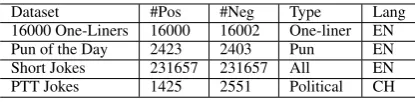
To fairly evaluate the performance on humor recognition, we need the dataset to consist of both humorous (positive) and non-humorous (negative) samples. The datasets we use to construct hu-mor recognition experiments includes four parts: Pun of the Day (Yang et al., 2015), 16000 One-Liners (Mihalcea and Strapparava, 2005), Short Jokes dataset and PTT jokes. The four datasets have different joke types, sentence lengths, data sizes and languages that allow us to conduct more comprehensive and comparative experiments. We would like to thank Yang and Mihalcea for their kindly provision of two former datasets. And we depict how we collect the latter two datasets in the following subsections. Table 1 shows the statistics of four datasets.
3.1 16000 One-Liners
16000 One-Liners dataset collected humorous samples from daily joke websites while using for-mal writing resources (e.g., news titles) to obtain
[image:2.595.312.520.61.112.2]Dataset #Pos #Neg Type Lang 16000 One-Liners 16000 16002 One-liner EN Pun of the Day 2423 2403 Pun EN Short Jokes 231657 231657 All EN PTT Jokes 1425 2551 Political CH
Table 1: Statistics of four datasets
non-humorous samples. A one-liner is a joke that usually has very few words in a single sentence with comic effects and interesting linguistic struc-ture. While longer jokes can have a relatively com-plex linguistic structure, a one-liner must produce the humorous effect with very few words.
3.2 Pun of the Day
Pun of the Day dataset was constructed from the Pun of the Day website. The pun, also called paronomasia, is a form of wordplay that ex-ploits multiple meanings of a term, or of similar-sounding words, for an intended humorous or rhetorical effect. The negative samples of this dataset are sampled from news website.
3.3 Short Jokes Dataset
Short Jokes dataset, which collected the most amount of jokes among four datasets, are from an open database on a Kaggle project1. It con-tains 231,657 short jokes with no restriction on joke types scraped from various joke websites and length ranging from 10 to 200 characters. We use it as our positive samples. For the negative sam-ples, we choose WMT162 English news crawl as our non-humorous data resource. However, sim-ply treating sentences from the resource as nega-tive samples could result in decepnega-tively high per-formance of classification due to the domain dif-ferences between positive and negative data. So we try to minimize such domain differences by se-lecting negative samples whose words all appear in the positive samples and whose average text length being close to the humorous ones.
3.4 PTT Jokes
PTT Bulletin Board System (PTT, Chinese: 批
踢踢, telnet://ptt.cc) is the largest terminal-based
bulletin board system (BBS) in Taiwan. It has more than 1.5 million registered users and over 20,000 boards covering a multitude of topics. Ev-ery day more than 20,000 articles and 500,000 comments are posted. Additionally, there is a
board called joke that we could acquire large amount of Chinese humor samples. Thus, we use some political-related words to extract polit-ical jokes from PTT and treat them as the posi-tive samples. For the negaposi-tive samples, we use Yahoo News in politics and select the samples by the same method we use in Short Jokes dataset to prevent from the problem of domain difference.
4 Method
In this section, we describe how we design our model for humor recognition.
4.1 CNN
Convolutional neural network (CNN) is a neu-ral network architecture designed to extract local features in high dimensional data such as image or speech signal. When it comes to natural lan-guage processing (NLP), CNN also shows suc-cesses in several text categorization tasks (Johnson and Zhang, 2015). The input of most NLP tasks, such as a sentence or a document could be rep-resented as a 2D structure with word embedding (Mikolov et al., 2013). In the input 2D matrix, each row is a vector of a word, a word segment or even a character that depends on the embed-ding methods. And typically we make the window width of the filters the same as the embedding di-mension. Thus, the filter size varies according to a sliding window size we decide.
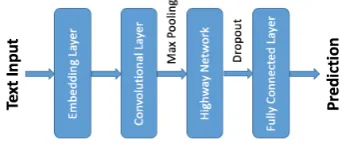
Figure 1: Network Architecture
4.2 Model Setting
In this paper, our CNN model’s setup follows the Kim (2014) for the task of text classification. Fig-ure 1 depicts the model’s details. We firstly con-vert tokenized input sentence (length L) with word vector (dimension d) to a 2D matrix (L x d) by utilization of the GloVe embedding vectors (Pen-nington et al., 2014) which trained on 6B tokens and 400K vocabulary words of Wikipedia 2014 + Gigaword 5 as our embedding layer. Next, accord-ing to the average sentence length in the dataset, we tried different filter sizes with a range from 3
to 20. For each filter size, 100-200 filters are ap-plied to the model. After convolutional layer, we exploit max pooling and then flatten the output. Assume we totally have n filters, eventually it will lead to a flatten 1D vector with dimension n at the prediction output.
4.3 Highway Layer
To improve the performance we usually can con-nect the flattened output with a fully concon-nected layer and predict labels. In this paper, we would like to evaluate the performance improvement as we increase the network depth. However, the training of deeper networks becomes more diffi-cult with increasing depth. So we use the con-cept of highway network (Srivastava et al., 2015) to help improve our model. The highway network allows shortcut connections with gate functions. These gates are data-dependent with parameters. It allows information unimpeded to flow through several layers in information highways. The archi-tecture is characterized by the gate units that learn to regulate the flow of information through a net-work. With this architecture, we could train much deeper nets. In the end, we also use dropout and connect the results to the output layer.
5 Experiment
[image:3.595.93.267.495.567.2]In this section, we describe how we formulate hu-mor recognition as a text classification problem and conduct experiments on four datasets which we mentioned in Section 3. We validate the per-formance of different network structure with 10 fold cross validation and compare with the perfor-mance of previous work.
16000 One-Liners Pun of the Day
Accuracy Precision Recall F1 Accuracy Precision Recall F1 Previous Work
Word2Vec+HCF 0.854 0.834 0.888 0.859 0.797 0.776 0.836 0.705
CNN 0.861 0.857 0.864 0.864
Our Methods
CNN 0.877 0.899 0.856 0.877 0.867 0.880 0.859 0.869
CNN+F 0.892 0.896 0.928 0.898 0.892 0.886 0.907 0.896
CNN+HN 0.885 0.877 0.902 0.889 0.892 0.889 0.903 0.896
[image:4.595.97.503.61.167.2]CNN+F+HN 0.897 0.872 0.936 0.903 0.894 0.866 0.940 0.901
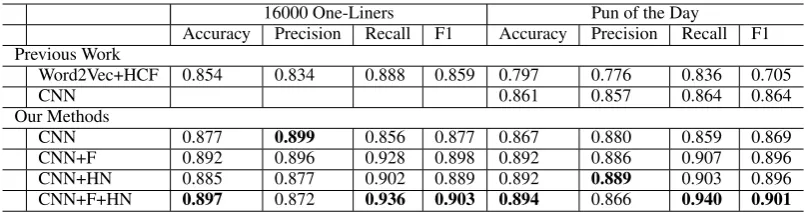
Table 2: Comparison of Different Methods of Humor Recognition
HN our model gives the best performance on both accuracy and F1-Score and this conclusion is con-sistent across two datasets. The results show that our model helps increase F1-Score from 0.859 to 0.903 on 16000 One-Liners and from 0.705, 0.864 to 0.901 on Pun of the Day compared to previous work
Dataset Accuracy Precision Recall F1 Short Jokes 0.906 0.902 0.946 0.924 PTT Jokes 0.957 0.927 0.959 0.943
Table 3: Result of Short Jokes and PTT Jokes datasets
Table 3 presents the result of Short Jokes and PTT Jokes datasets. As we can see, for the datasets was construed, it achieve 0.924 on Short Jokes and 0.943 on PTT Jokes in terms of F1 score respec-tively. It shows that the deep learning model can, to some extent learn the humorous meaning and structure embedded in the text automatically with-out human selection of features.
6 Discussion
In this section, we show a sample in each cat-egory (true positive, false positive, true negative and false negative) to get a sense of what kinds of sentences are predicted correctly and incorrectly. The sentences are shown in the table 4.
Sentence
TP when he gave his wife a necklace he got a chain reaction TN the barking of a dog does not disturb the man on a camel FP rats know the way of rats
FN it’s a fact taller people sleep longer in bed
Table 4: Example Sentences
The TP sentence ”when he gave his wife a neck-lace he got a chain reaction” shows that our model seems to be able to catch not only the literal mean-ing between the ”necklace” and ”got a chain re-action”. Besides, the TN sentence ”the barking of a dog does not disturb the man on a camel” means that if you’re lucky enough to own your
own camel, a little thing like a barking dog won’t bother you. The example is a proverb but not a joke and our model correctly recognizes it as a non-humor one. Model misclassifies certain in-stances such as the FP sentence ”rats know the way of rats” is actually derived from a Chinese proverb and the model predict it as humor. In addition, the FN sentence ”it’s a fact taller people sleep longer in bed” is obviously a joke but it is not considered as a humor by the model. To deal with more sub-tle humor/non-humor, the model has room to be improved.
7 Conclusion
References
Dario Bertero and Pascale Fung. 2016. A long short-term memory framework for predicting humor in di-alogues. In NAACL HLT 2016, The 2016 Confer-ence of the North American Chapter of the Associ-ation for ComputAssoci-ational Linguistics: Human Lan-guage Technologies, San Diego California, USA, June 12-17, 2016, pages 130–135.
Lei Chen and Chong MIn Lee. 2017. Predicting Au-dience’s Laughter Using Convolutional Neural Net-work. ArXiv e-prints:1702.02584.
Rie Johnson and Tong Zhang. 2015. Effective use of word order for text categorization with convolu-tional neural networks. InNAACL HLT 2015, The 2015 Conference of the North American Chapter of the Association for Computational Linguistics: Human Language Technologies, Denver, Colorado, USA, May 31 - June 5, 2015, pages 103–112.
Yoon Kim. 2014. Convolutional neural networks for sentence classification. InProceedings of the 2014 Conference on Empirical Methods in Natural Lan-guage Processing, EMNLP 2014, October 25-29, 2014, Doha, Qatar, A meeting of SIGDAT, a Special Interest Group of the ACL, pages 1746–1751.
Rada Mihalcea and Carlo Strapparava. 2005. Making computers laugh: Investigations in automatic humor recognition. In HLT/EMNLP 2005, Human Lan-guage Technology Conference and Conference on Empirical Methods in Natural Language Process-ing, Proceedings of the Conference, 6-8 October 2005, Vancouver, British Columbia, Canada, pages 531–538.
Tomas Mikolov, Ilya Sutskever, Kai Chen, Greg S Cor-rado, and Jeff Dean. 2013. Distributed representa-tions of words and phrases and their composition-ality. In C. J. C. Burges, L. Bottou, M. Welling, Z. Ghahramani, and K. Q. Weinberger, editors, Ad-vances in Neural Information Processing Systems 26, pages 3111–3119. Curran Associates, Inc.
Luke de Oliveira and Alfredo Lainez Rodrigo. 2015. Humor detection in yelp reviews.
Jeffrey Pennington, Richard Socher, and Christo-pher D. Manning. 2014. Glove: Global vectors for word representation. InEmpirical Methods in Nat-ural Language Processing (EMNLP), pages 1532– 1543.
Amruta Purandare and Diane J. Litman. 2006. Hu-mor: Prosody analysis and automatic recognition for f*r*i*e*n*d*s*. InEMNLP 2007, Proceedings of the 2006 Conference on Empirical Methods in Nat-ural Language Processing, 22-23 July 2006, Sydney, Australia, pages 208–215.
Rupesh Kumar Srivastava, Klaus Greff, and J¨urgen Schmidhuber. 2015. Training very deep networks. InAdvances in Neural Information Processing Sys-tems 28: Annual Conference on Neural Information
Processing Systems 2015, December 7-12, 2015, Montreal, Quebec, Canada, pages 2377–2385.
Julia M. Taylor and Lawrence J. Mazlack. 2004. Com-putationally recognizing wordplay in jokes. In In Proceedings of CogSci 2004.