The Context-dependent Additive Recurrent Neural Net
Quan Hung Tran1,2 Tuan Manh Lai2 Gholamreza Haffari1 Ingrid Zukerman1 Trung Bui2 Hung Bui3
1Monash University, Clayton, Australia 2Adobe Research, San Jose, CA 3DeepMind, Mountain View, CA
Abstract
Contextual sequence mapping is one of the fundamental problems in Natural Language Processing. Instead of relying solely on the information presented in a text, the learning agents have access to a strong external signal given to assist the learning process. In this pa-per, we propose a novel family of Recurrent Neural Network unit: theContext-dependent Additive Recurrent Neural Network(CARNN) that is designed specifically to leverage this ex-ternal signal. The experimental results on pub-lic datasets in the dialog problem (Babi dialog Task 6 and Frame), contextual language model (Switchboard and Penn Discourse Tree Bank) and question answering (TrecQA) show that our novel CARNN-based architectures outper-form previous methods.
1 Introduction
Sequence mapping is one of the most prominent class of problems in Natural Language Processing (NLP). This is due to the fact that written language is sequential in nature. In English, a word is a se-quence of characters, a sentence is a sese-quence of words, a paragraph is a sequence of sentences, and so on. However, understanding a piece of text may require far more than just extracting the informa-tion from that piece itself. If the piece of text is a paragraph of a document, the reader may have to consider it together with other paragraphs in the document and the topic of the document. To un-derstand an utterance in a conversation, the utter-ance has to be put into the context of the conver-sation, which includes the goals of the participants and the dialog history. Hence the notion of context is an intrinsic component of language understand-ing.
Inspired by recent works in dialog systems (Seo et al., 2017; Liu and Perez, 2017), we formal-ize the contextual sequence mapping problem as
a sequence mapping problem with a strong con-trolling contextual element that regulates the flow of information. The system has two sources of signals: (i) the main text input, for example, the history utterance sequence in dialog systems or the sequence of words in language modelling; and (ii)the context signal, e.g., the previous utterance in a dialog system, the discourse information in contextual language modelling or the question in question answering.
Our contribution in this work is two-fold. First, we propose a new family of recurrent unit, theContext-dependent Additive Recurrent Neural Network (CARNN), specifically constructed for contextual sequence mapping. Second, we de-sign novel neural network architectures based on CARNN for dialog systems and contextual lan-guage modelling, and enhance the state of the art architecture (IWAN (Shen et al., 2017)) on question answering. Our novel building block, the CARNN, draws inspiration from the Recur-rent Additive Network (Lee et al., 2017), which showed that most of the non-linearity in the suc-cessful Long Short Term Memory (LSTM) net-work (Hochreiter and Schmidhuber, 1997) is not necessary. In the same spirit, our CARNN unit minimizes the use of non-linearity in the model to facilitate the ease of gradient flow. We also seek to keep the number of parameters to a minimum to improve trainability.
We experiment with our models on a broad range of problems: dialog systems, contextual lan-guage modelling and question answering. Our systems outperform previous methods on sev-eral public datasets, which include the Babi Task 6 (Bordes and Weston, 2017) and the Frame dataset (Asri et al.,2017) for dialog, the Switch-board (Jurafsky et al., 1997) and Penn Dis-course Tree Bank (Miltsakaki et al., 2004) for contextual language modelling, and the TrecQA
dataset (Wang et al., 2007) for question answer-ing. We propose a different architecture for each task, but all models share the basic building block, the CARNN.
2 Background and Notation
Notation.As our paper describes several architec-tures with vastly different setups and input types, we introduce the following notation to maintain consistency and improve readability. First, them
-th input to -the recurrent unit will be denotedem. In language modelling,emis the embedding of the
m-th word; while in dialog, it is the embedding
of them-th utterance (which is a combination of
the embedding of the words inside the utterance,
xm
1 . . .xmMm). All the gates are denoted by g, all
the hidden vectors (outputs of the RNN) are de-noted byh.Wsandbsare the RNN’s parameters,
σ denotes the sigmoid activation function, and
denotes the element-wise product.
LSTM. The Long Short Term Memory
(LSTM) (Hochreiter and Schmidhuber, 1997) is arguably one of the most popular building blocks for RNN. The main components of the LSTM are three gates: an input gate gi
m to regulate the in-formation flow from the input to the memory cell
cm, a forget gate gfm to regulate the information flow from the previous time step’s memory cell
cm−1, and an output gate gom that regulates how the model produces the outputs (hidden statehm) from the memory cell ct. The computations of LSTM are as follows:
˜cm=tanh(Wchhm−1+Wcxem+bc)
gi
m=σ(Wihhm−1+Wixem+bi)
gf
m=σ(Wfhhm−1+Wfxem+bf)
go
m=σ(Wohhm−1+Woxem+bo)
cm=gim˜cm+gfmcm−1 hm=gomtanh(cm)
(1)
RAN. The Recurrent Additive Neural Network (RAN) (Lee et al.,2017) is an improvement over the traditional LSTM. However, there are three major differences between the two. First, RAN simplifies the output computations by removing the output gate. Second, RAN simplifies the mem-ory cell computations by removing the direct de-pendency between the candidate update memory cell˜cmand the previous hidden vectorhm−1.
Fi-nally, RAN removes the non-linearity from the
transition dynamic of RNN by removing thetanh
non-linearity from the˜cm. The equations for RAN are as follows:
˜
cm =Wcxem
gi
m =σ(Wihhm−1+Wixem+bi)
gf
m =σ(Wfhhm−1+Wfxem+bf)
cm =gim˜cm+gfmcm−1 hm =s(cm)
(2)
wherescan be an identity function (identity RAN)
or thetanhactivation function (tanhRAN).
As shown in (Lee et al., 2017), RAN’s mem-ory cells cm can be decomposed into a weighted sum of the inputs. Their experimental results show that RAN performs as well as LSTM for language modelling, while having significantly fewer pa-rameters.
3 The Context-dependent Additive Recurrent Neural Net (CARNN)
In this section, we describe our novel recurrent units for the context-dependent sequence mapping problem.
Our RNN units use a different gate arrangement than that used by RAN. However, if we consider a broader definition of identity RAN, i.e., an RNN where hidden unit outputs can be decomposed into a weighted sum of inputs, where the weights are functions of the gates, then our first CARNN unit (nCARNN) can be viewed as an extension of iden-tity RAN with additional controlling context.
The next two CARNN units (iCARNN and sCARNN) further simplify the nCARNN unit to improve trainability.
3.1 Non-independent gate CARNN (nCARNN)
The main components of our recurrent units are the two gates (an update gategu and a reset gate
gf), which jointly regulate the information from the input. The input vector, after being pushed through an affine transformation, is added into the previous hidden vector hm−1. The computations
of the unit are as follows:
gu
m=σ(Wcuc+Whuhm−1+Weuem+bu)
gf
m=σ(Wcfc+Whfhm−1+Wefem+bf) ¯em=We¯em+be¯
hm=gum(gfme¯m) + (1−gum)hm−1
Figure 1: Context Dependent Additive Recurrent Neu-ral Network. Note that only nCARNN has the previous hidden statehm−1 in its gate computation, iCARNN
and sCARNN do not.
wherecis the representation of the global context. Apart from the non-linearity in the gates, our model is a linear function of the inputs. Hence, the final hidden layer of our RNN, denoted ashM, is a weighted sum of the inputs and a bias termBi (Equation4), where the weights are functions of the gates andW¯eis a dimension reduction matrix.
hM =guM gfM e¯M+ (1−guM)hM−1
= M
X
i=1
(gui gfi M
Y
j=i+1
(1−guj))¯ei
= M
X
i=1
[(gui gfi M
Y
j=i+1
(1−guj))W¯eei+Bi]
(4)
From the decomposition in Equation4, it seems that the outputs of an RNN with the nCARNN unit can be efficiently computed in parallel. That is, we can compute the weight for each input in parallel, and take their weighted sum to produce any de-sired hidden vector output. However, there is one obstacle: since the gates are functions of the pre-vious hidden states, they still need to be computed sequentially. But if we assume that the external controlling contextcis strong enough to regulate the flow of information, we can remove the pre-vious hidden state (local contexthm−1) from the
gate computations, and make the RNN computa-tions parallel. The next two variants of CARNN implement this idea by removing the local context from gate computations.
3.2 Independent gate CARNN (iCARNN)
The Gated Recurrent Unit (GRU) (Chung et al., 2014) and LSTM networks use a local context (the previous hidden statehm−1) and the current input
to regulate the flow of information. In contrast, our model, relies on the global controlling context
cat every step, and thus, might not need the local contexthm−1 at all. Removing the local context
can reduce the computational complexity of the model, but it may result in a loss of local sequen-tial information. To test the effectiveness of this trade-off, we propose another variant of our unit, the independent gate CARNN (iCARNN), where the gate computations are simplified, and the gates are functions of the controlling context and the in-puts. This formulation of CARNN is formally de-fined as follows.
gu
m=σ(Wcuc+Weuem+bu)
gf
m=σ(Wcfc+Wefem+bf) ¯em=We¯em+be¯
hm=gum(gfm¯em) + (1−gum)hm−1
(5) Compared to the traditional RNN, iCARNN’s gates computations do not take into account the sequence context, i.e., the previous hidden vector computations, and the gates at all time steps can be computed in parallel. However, iCARNN, unlike memory network models (Sukhbaatar et al.,2015; Liu and Perez, 2017), still retains the sequential nature of RNN. This is because even though the gates at different time steps do not depend on each other, the hidden vector output at the m-th time
stephmdepends on the previous gate (gum−1), and
hence on the previous input.
3.3 Simplified candidate CARNN (sCARNN)
current input (Equation6). We call this variation thesimplified candidate CARNN (sCARNN). The combination of lower gate computational com-plexity and the parallel-ability allow the paralleled sCARNN version to be 30% faster (30% lower training time for each epoch) than nCARNN in the question answering and dialog experiments, and 15% faster in the language model experiment. The sCARNN is formally defined as follows.
gu
m =σ(Wcuc+Weuem+bu)
gf
m =σ(Wcfc+Wefem+bf)
hm =gum(gfmem) + (1−gum)hm−1
(6)
sCARNN can still be decomposed into a weighted sum of the sequence of input elements, and retains the parallel computation capability of the iCARNN.
hM =guM gfM em+ (1−guM)hM−1
= M
X
i=1
(gui gfi M
Y
j=i+1
(1−guj))ei
(7)
4 CARNN-based models for NLP problems
In this section, we explain the details of our CARNN-based architectures for end-to-end dia-log, language modelling and question answering. In each of these applications, one of the main de-sign concerns is the choice of contextual informa-tion. As we will demonstrate in this section, the controlling contextccan be derived from various sources: a sequence of words (dialog and question answering), a class variable (language modelling). Virtually any sources of strong information that can be encoded into vectors can be used as con-trolling context.
4.1 End-to-end dialog
To produce a response, we first encode the whole dialog history into a real vector representation
hhis. To this effect, we perform two steps: first, we encode each utterance (sequence of words) into a real vector, and next, we encode this sequence of real vector representations intohhis. We employ the Position Encoder (Bordes and Weston,2017) for the first step, and CARNNs for the second step.
Summarizing individual utterances. Let’s de-note the sequence of word-embeddings in them
-th utterancexm
1 , . . .xmNm. These word embeddings
are jointly trained with the model. Following previous work in end-to-end dialog systems, we opt to use the Position Encoder (Liu and Perez, 2017;Bordes and Weston,2017) for encoding ut-terances.
The Position Encoder is an improvement over the average embedding of bag of words, as it takes into account the position of the words in a sequence. This encoder has been empirically shown to perform well on the Babi dialog task (Liu and Perez, 2017; Bordes and Weston, 2017); more details about the Position Encoder can be found in (Sukhbaatar et al., 2015). Let’s denote the the embeddings of a sequence of utterances
e1, . . .eM−1.
Summarizing the dialog history. The CARNN models take the embeddings of the sequence of ut-terances and produce the final representationhhis. We further enhance the output of the CARNN by adding the residual connection to the input (He et al., 2016; Tran et al., 2017), and the attention mechanism (Bahdanau et al.,2015) over the his-tory.
h1, ..hM−1 =CARN N(e1, ..eM−1,c)
∀m∈[1..M−1] : ˜hm=hm+em
α1..αM−1 =sof tmax(˜h
T
1c, ..,˜h
T M−1c)
hhis= MX−1
m=1 αmh˜m
(8)
whereαare the attention weights,hmis them-th output of the base CARNN,em is the embedding of the m-th input utterance, and c = eM is the context embedding.
Figure 2: CARNN for dialog.
responses as shown in Figure2, which depicts our architecture of CARNN for dialog.
∀l∈[1..L] :el=P osition Encoder(ycl) (9) We then put a distribution over the candidate responses conditioned on the summarized dialog historyhhis(Equation10).
P(y) =sof tmax(hThisey1, ...,hThiseyL) (10)
4.2 Contextual language model
Typically, language models operate at the sentence level, i.e., the sentences are treated independently. Several researchers have explored inter-sentence and inter-document level contextual information for language modelling (Ji et al., 2016a,b; Tran et al.,2016;Lau et al.,2017).
FollowingJi et al.(2016a,b), we investigate two types of contextual information: (i) the previous sentence context; and (ii) a latent variable captur-ing the connection information between sentences, such as discourse relation in the Penn Discourse Tree Bank dataset or Dialog Acts in the Switch-board dataset.
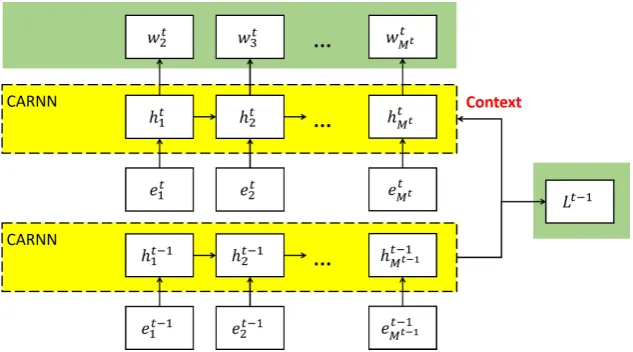
Previous sentence context. The previous sen-tence (time-stept−1) contextual information is
encoded by a simplified version of the nCARNN, where the global context is absent. The final hid-den vector of this sequence is then fed into the current recurrent computation (time-stept) as the context for that sequence. Equation11shows this procedure.
ct−1←−nCARN N(et−1
1 , ..etM−t1−1)
ht
1, ..htMt−1 =CARN N(et1, ..etMt,ct−1) wtm+1∼sof tmax(W(l)htm+b(l))
(11)
Latent variable context. Ji et al. (2016b) pro-posed to embed the predicted latent variables us-ing an embeddus-ing matrix, and use this real vector as the contextual information. In our work, we de-sign a multi-task learning scenario where the pre-vious sentence context encoder has additional su-pervised information obtained from the annotated latent variable (Lt−1). This additional information
from the latent variable is only used to train the previous sentence encoder, and enhance the con-textct−1 (Equation12). During test time, the
lan-guage model uses the same computation steps as the previous sentence context version.
P(Lt−1) =sof tmax(W(c)ct−1+b(c)) Lt−1
l ∼P(Lt−1)
(12)
During training, the total loss function (Lt l,w) is the linear combination of the average log-loss from the current sentence’s words (Lt
w) and the log-loss from the previous latent variable (Lt−1
l ).
Lt
l,w=αLtw+ (1−α)Ltl−1 (13)
whereα is a linear mixing parameter. In our
ex-periments, tuningαdoes not yield significant
im-provements, hence we setα= 0.5.
4.3 Question answering
Answer selection is an important component of a typical question answering system. This task can be briefly described as follows: Given a questionq
Figure 3: CARNN for context-dependent language model.
et al.,2016;Wang et al., 2017;Bian et al.,2017; Shen et al.,2017;Tay et al.,2017;He et al.,2015). Below is an example from the answer selection TrecQA corpus:
Question: Who established the Nobel prize awards?
Positive answer: The Nobel Prize was estab-lished in the will of Alfred Nobel, a Swede who invented dynamite and died in 1896.
Negative answer: The awards aren’t given in specific categories.
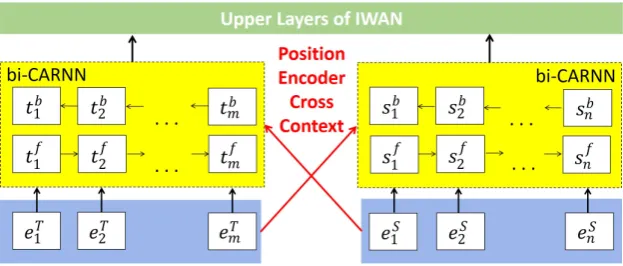
The IWAN model proposed in (Shen et al., 2017) achieves state-of-the-art performance on the Clean version TrecQA dataset (Wang et al.,2007) for answer selection. In general, given two sen-tences, the model aims to calculate a score to mea-sure their similarity. For each sentence, the model first uses a bidirectional LSTM to obtain a context-aware representation for each position in the sen-tence. The representations will later be utilized by the model to compute similarity score of the two sentences according to the degree of their align-ment (Shen et al.,2017).
The original IWAN model employed LSTM to encode the sentence pair into sequences of real vector representations. However, these sequences are independent, and do not take into account the information from the other sentence. In or-der to overcome this limitation, we enhance the IWAN model with a “cross context CARNN-based sentence encoder” that replaces the bidirectional LSTM. When the cross context CARNN sentence encoder processes a sentence, it takes the encod-ing of the other sentence, encoded by a Position Encoder, as the controlling context (Figure4).
5 Experiments
5.1 End-to-end dialog
Datasets. For the dialog experiments, we fo-cus on two popular datasets for dialog: the Babi dataset (Bordes and Weston, 2017) and the Mal-luba Frame dataset (Asri et al.,2017).1
In our main set of experiments for dialog, we use the original Babi task 6 dataset, and test on the end-to-end dialog setting (the same setting used by Seo et al.(2017);Bordes and Weston(2017);Liu and Perez (2017)). That is, the systems have to produce complete responses and learn the dialog behaviour solely from the ground truth responses without help from manual features, rules or tem-plates. Apart from this main set of experiments, we apply our end-to-end systems as dialog man-agers and test on a slightly different setting in the next two sets of experiments.
In the second set of experiments, we use our end-to-end systems as “dialog managers”. The only difference compared to the end-to-end dialog setting is that the systems produce templatized re-sponses instead of complete rere-sponses. Our moti-vation for this dialog manager setting is that in our preliminary experiments with the Babi dataset, we found out that many of the classification errors are due to very closely related responses, all of which fit the corresponding context. We argue that if we treat the systems as dialog managers, then we can delexicalize and group similar responses. Thus following Williams et al. (2017), we construct a templatized set of responses. For example, all the
1Among the Babi tasks, we focus mainly on task 6, which
Figure 4: CARNN for Question Answering.
responses similar to “india house is in the west
part of town”will be grouped into“ name is in the loc part of town”. The set of responses is re-duced to 75 templatized responses. We call this new dataset “Babi reduced”.2
The third set of experiments is conducted on the Frame dataset. The general theme in this dataset is similar to that of the Babi task 6, but the re-sponses in the Frame dataset are generally in free form, rather than being sourced from a limited set. Thus, we define a dialog task on the Frame data set similar to the Babi reduced dialog task by simpli-fying and grouping the responses.3 The final set of
responses consists of 129 response classes. For the experiments on the Frame dataset, we randomly choose 80% of the conversations as the training set, and 10% each for testing and development.
Baselines. In the dialog experiments, we focus on the existing published results with end-to-end settings, namely the Memory Network (MN) (Bor-des and Weston, 2017), the Gated Memory Net-work (GMN) (Liu and Perez,2017) and the Query Reduction Network (QRN) (Seo et al.,2017).4 For
the Frame and Babi reduced datasets, we use the publicly available implementation of the QRN,5
and our implementation of the GMN with hyper parameters similar to those reported by Liu and
2We do not have access toWilliams et al.(2017)’s
tem-plate set, thus the results in Babi reduced are not comparable to those obtained byWilliams et al.(2017).
3We use only one of the annotated“Dialog acts”and its
first slot key as a template for the response.
4Williams et al.(2017) and Liu and Lane(2017) reported
very strong performances (55.6% and 52.8% respectively) for the Babi dataset. However, these systems do not learn dia-log behaviour solely from Babi’s ground truth responses, and thus do not have end-to-end dialog setups. As stated in their papers, Williamset al.use hand-coded rules and task-specific templates, while Liuet al.employ the external users’ goal an-notations that are outside the Babi dataset.
5https://github.com/uwnlp/qrn
Model Babi Babi reduced Frame
nCARNN 51.3%* 55.8%* 27.4%*
iCARNN 52.0%* 55.2%* 28.5%*
sCARNN 50.9%* 55.9%* 25.7%*
CARNN voting 53.2%* 56.9%* 29.1%*
QRN (2017) 46.8% 54.7% 24.0%
GMN (2017) 47.4% 54.1% 23.6%
[image:7.595.312.517.237.321.2]MN (2017) 41.1% – –
Table 1: Dialog accuracy on Babi and Frame among end-to-end systems. * indicates statistical significance withp <0.1compared to QRN.
Perez(2017);Seo et al.(2017). Note that the orig-inal results presented bySeo et al.(2017), take into account partial matches (matching only a portion of the ground truth response), and hence cannot be directly translated into the standard response accu-racy reported by other researchers (we have con-firmed this with Seoet al.). For a direct compari-son with the QRN, we use the evaluation settings employed in other papers (Liu and Perez, 2017; Sukhbaatar et al.,2015).
U: im looking for acheap restaurant S: ... What type of food do you want?? ...5 dialog turns...
S: Could you please repeat that?
U: vietnamese food
CARNN action: api call vietnamese R locationcheap QRN action: api call vietnamese R locationR price GMN action: api call vietnamese R locationR price
Figure 5: Sample dialog from our system compared to the baselines. Only CARNN’s predicted action takes into account the originalcheap restaurantrequest and matches the ground truth action (in the systems’ api calls, “R price” denotes “any price”).
to the ease of training, CARNN models summa-rize the dialog history better, and allow for longer information dependency.
The CARNN units are originally designed in the dialog context. During model calibration, we also tested in the dialog experiments two other CARNN versions with both higher and lower complexity. The lower complexity CARNN ver-sion resembles sCARNN without the forget gate, and the higher complexity CARNN version resem-bles the LSTM unit with all three gates (forget, update and output), with the gates being modified from the original LSTM gates to be functions of the external contextual information. Both of these versions do not perform as well as the three main CARNN versions (48.7% and 48.6% for the high-and low-complexity versions respectively in the Babi task).
5.2 Contextual language model
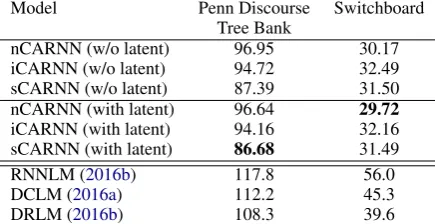
Datasets. We employ two datasets for the exper-iments with the contextual language model: the Switchboard Dialog Act corpus and the Penn Dis-course Tree Bank corpus. There are 1155 tele-phone conversations in the Switchboard corpus, where each conversation has an average of 176 ut-terances. There were originally 226 Dialog Act (DA) labels in the corpus, but they are usually clustered into 42 labels. The Penn Tree Bank corpus provides discourse relation annotation be-tween the spans of text. We used the preprocessed data by Ji et al. (2016b), where the explicit dis-course relations are mapped into a dummy rela-tion. Our data splits are the same as those de-scribed in the baselines (Ji et al.,2016a,b).
Baselines. We compare our system with the Re-current Neural Net (RNNLM) with LSTM unit (Ji et al., 2016a), the Document Contextual
Lan-Model Penn Discourse Switchboard Tree Bank
nCARNN (w/o latent) 96.95 30.17 iCARNN (w/o latent) 94.72 32.49 sCARNN (w/o latent) 87.39 31.50 nCARNN (with latent) 96.64 29.72
iCARNN (with latent) 94.16 32.16 sCARNN (with latent) 86.68 31.49
RNNLM (2016b) 117.8 56.0
DCLM (2016a) 112.2 45.3
[image:8.595.308.526.63.175.2]DRLM (2016b) 108.3 39.6
Table 2: Perplexity on Switchboard and Penn Dis-course Tree Bank.
Model MAP MRR
IWAN (our implementation) + nCARNN* 0.827 0.889 IWAN (our implementation) + iCARNN* 0.826 0.907
IWAN (our implementation) + sCARNN* 0.829 0.875 IWAN (our implementation) 0.794 0.879
IWAN (2017) 0.822 0.889
Compare-Aggregate (2017) 0.821 0.899
BiMPM (2017) 0.802 0.875
NCE-CNN (2016) 0.801 0.877
HyperQA (2017) 0.784 0.865
Table 3: MAP and MRR for question answering. * indicates statistical significance withα <0.05in t-test compared to IWAN (our implementation).
guage Model (DCLM) (Ji et al., 2016a) and the Discourse Relation Language Model (DRLM) (Ji et al., 2016b). The RNNLM’s architecture is the same as that described in (Mikolov et al., 2013) with sigmoid non-linearity replaced by LSTM. The DCLM exploits the inter-sentences context by concatenating the representation of the pre-vious sentence with the input vector (context-to-context) or the hidden vector (context-to-output). The DRLM introduces the latent variable contex-tual models using a generative architecture that treats Dialog Acts or discourse relations as latent variables.
5.3 Question answering
Datasets. The TrecQA dataset (Wang et al., 2007) is a widely-used benchmark for answer selection. There are two versions of TrecQA: original and clean. The original TrecQA con-sists of 1,229 training questions, 82 development questions, and 100 test questions. Recently, re-searchers (Rao et al., 2016; Shen et al., 2017) developed a clean version, where they removed questions in the development and test sets with no answers or only positive/negative answers. This reduced the development and test set’s sizes to 65 and 68 questions respectively.
Baselines. We compare the performance of our models with that of the state-of-the-art models on the clean version of the TREC-QA dataset (Shen et al.,2017;Bian et al., 2017;Wang et al.,2017; Rao et al.,2016;Tay et al.,2017). We do not have access to the original implementation of IWAN, hence we use our implementation of the IWAN model as the basis for our models.
Results and discussion. Table 3 shows the MAP (Mean Average Precision) and MRR (Mean Reciprocal Rank) of our systems and the base-lines. To the best of our knowledge, our systems outperform all previous systems on this dataset. Enhancing IWAN with cross-context CARNN statistically significantly improves performance. Among the variants, the iCARNN is the most con-sistent in both MAP and MRR. During our error analysis, we noted that the top answer returned by IWAN models with either LSTM or CARNNs are usually good. However, in many cases, lower ranked answers returned by the LSTM model are not as good as those produced by the CARNN models. We show an example of this in Table4.
6 Conclusion and future work
In this paper, we propose a novel family of RNN units which are particularly useful for the contextual sequence mapping problem: the CARNNs. Together with our neural net archi-tectures, CARNN-based systems outperform pre-vious methods on several public datasets for di-alog (Frame and Babi Task 6), question answer-ing (TrecQA) and contextual language modellanswer-ing (Switchboard and Penn Discourse Tree Bank). In the future, we plan to investigate the effective-ness of CARNN units in other sequence modelling tasks.
Question:During what war did Nimitz serve?
IWAN-LSTM IWAN-iCARNN
Since the museum opened in 1983, Fredericksburg has become a haven for retired military service-men who come to trace Nimitz’s career and the events of World War II.
Since the museum opened in 1983, Fredericksburg has become a haven for retired military service-men who come to trace Nimitz’s career and the events of World War II. Bill McCain, who
grad-uated from West Point, chased Pancho Villa with Gen. Blackjack Pershing, served as an artillery of-ficer during World War I and attained the rank of brigadier general.
Indeed, the ancestors of Chester W. Nimitz, the U.S. naval commander in chief of the Pacific in World War II, were among the first German pioneers to settle the area.
There was his grandfather, Admiral John “Slew” Mc-Cain, Class of 1906, a grizzled old sea dog who commanded aircraft carri-ers in the Pacific during World War II.
[image:9.595.308.524.62.327.2]Slew McCain’s peers at the Naval Academy were Chester Nimitz and William “Bull” Halsey, who would become major commanders during World War II.
Table 4: Top three answers produced by CARNN and LSTM.Bluecolored answers are correct andredones are incorrect.
References
Mart´ın Abadi, Ashish Agarwal, Paul Barham, Eugene Brevdo, Zhifeng Chen, Craig Citro, Greg S. Cor-rado, Andy Davis, Jeffrey Dean, Matthieu Devin, Sanjay Ghemawat, Ian Goodfellow, Andrew Harp, Geoffrey Irving, Michael Isard, Yangqing Jia, Rafal Jozefowicz, Lukasz Kaiser, Manjunath Kudlur, Josh Levenberg, Dan Man´e, Rajat Monga, Sherry Moore, Derek Murray, Chris Olah, Mike Schuster, Jonathon Shlens, Benoit Steiner, Ilya Sutskever, Kunal Tal-war, Paul Tucker, Vincent Vanhoucke, Vijay Vasude-van, Fernanda Vi´egas, Oriol Vinyals, Pete Warden, Martin Wattenberg, Martin Wicke, Yuan Yu, and Xi-aoqiang Zheng. 2015. TensorFlow: Large-scale ma-chine learning on heterogeneous systems. Software available from tensorflow.org.
Layla El Asri, Hannes Schulz, Shikhar Sharma, Jeremie Zumer, Justin Harris, Emery Fine, Rahul Mehrotra, and Kaheer Suleman. 2017. Frames: A corpus for adding memory to goal-oriented dialogue systems. arXiv preprint arXiv:1704.00057. Dzmitry Bahdanau, Kyunghyun Cho, and Yoshua
Ben-gio. 2015. Neural machine translation by jointly learning to align and translate. InICLR.
Antoine Bordes and Jason Weston. 2017. Learning end-to-end goal-oriented dialog. InICLR 2017. Junyoung Chung, Caglar Gulcehre, KyungHyun Cho,
and Yoshua Bengio. 2014. Empirical evaluation of gated recurrent neural networks on sequence model-ing. arXiv preprint arXiv:1412.3555.
Hua He, Kevin Gimpel, and Jimmy J Lin. 2015. Multi-perspective sentence similarity modeling with convolutional neural networks. In EMNLP. pages 1576–1586.
Kaiming He, Xiangyu Zhang, Shaoqing Ren, and Jian Sun. 2016. Deep residual learning for image recog-nition. In Proceedings of the IEEE conference on computer vision and pattern recognition. pages 770– 778.
Sepp Hochreiter and J¨urgen Schmidhuber. 1997. Long short-term memory. Neural computation
9(8):1735–1780.
Yangfeng Ji, Trevor Cohn, Lingpeng Kong, Chris Dyer, and Jacob Eisenstein. 2016a. Document context lan-guage models. InICLR (Workshop track).
Yangfeng Ji, Gholamreza Haffari, and Jacob Eisen-stein. 2016b. A latent variable recurrent neural net-work for discourse-driven language models. In Pro-ceedings of the 2016 Conference of the North Amer-ican Chapter of the Association for Computational Linguistics: Human Language Technologies. Asso-ciation for Computational Linguistics, San Diego, California, pages 332–342.
Daniel Jurafsky, Elizabeth Shriberg, and Debra Bi-asca. 1997. Switchboard SWBD-DAMSL Shallow-Discourse-Function Annotation Coders Manual, Draft 13. Technical report, University of Colorado. Jey Han Lau, Timothy Baldwin, and Trevor Cohn.
2017. Topically driven neural language model. In
Proceedings of the 55th Annual Meeting of the As-sociation for Computational Linguistics (Volume 1: Long Papers). Association for Computational Lin-guistics, pages 355–365.
Kenton Lee, Omer Levy, and Luke Zettlemoyer. 2017. Recurrent additive networks. arXiv preprint arXiv:1705.07393.
Bing Liu and Ian Lane. 2017. An end-to-end trainable neural network model with belief tracking for task-oriented dialog. InInterspeech 2017.
Fei Liu and Julien Perez. 2017. Gated end-to-end memory networks. InProceedings of the 15th Con-ference of the European Chapter of the Associa-tion for ComputaAssocia-tional Linguistics: Volume 1, Long Papers. Association for Computational Linguistics, Valencia, Spain, pages 1–10.
Tomas Mikolov, Ilya Sutskever, Kai Chen, Greg S Cor-rado, and Jeff Dean. 2013. Distributed representa-tions of words and phrases and their compositional-ity. InAdvances in neural information processing systems. pages 3111–3119.
Eleni Miltsakaki, Rashmi Prasad, Aravind K Joshi, and Bonnie L Webber. 2004. The penn discourse tree-bank. InLREC.
Jinfeng Rao, Hua He, and Jimmy Lin. 2016. Noise-contrastive estimation for answer selection with deep neural networks. In Proceedings of the 25th ACM International on Conference on Information and Knowledge Management. ACM, pages 1913– 1916.
Minjoon Seo, Sewon Min, Ali Farhadi, and Hannaneh Hajishirzi. 2017. Query-regression networks for machine comprehension. InICLR.
Gehui Shen, Yunlun Yang, and Zhi-Hong Deng. 2017. Inter-weighted alignment network for sentence pair modeling. InProceedings of the 2017 Conference on Empirical Methods in Natural Language Pro-cessing. pages 1190–1200.
Sainbayar Sukhbaatar, Jason Weston, Rob Fergus, et al. 2015. End-to-end memory networks. InAdvances in neural information processing systems. pages 2440–2448.
Yi Tay, Anh Tuan Luu, and Siu Cheung Hui. 2017. En-abling efficient question answer retrieval via hyper-bolic neural networks. CoRRabs/1707.07847.
Quan Tran, Andrew MacKinlay, and Antonio Jimeno Yepes. 2017. Named entity recognition with stack residual lstm and trainable bias decoding. In Pro-ceedings of the Eighth International Joint Confer-ence on Natural Language Processing (Volume 1: Long Papers). volume 1, pages 566–575.
Quan Hung Tran, Ingrid Zukerman, and Gholamreza Haffari. 2016. Inter-document contextual language model. In Proceedings of the 2016 Conference of the North American Chapter of the Association for Computational Linguistics: Human Language Tech-nologies. Association for Computational Linguis-tics, San Diego, California, pages 762–766.
Mengqiu Wang, Noah A Smith, and Teruko Mita-mura. 2007. What is the jeopardy model? a quasi-synchronous grammar for qa. In EMNLP-CoNLL. volume 7, pages 22–32.
Zhiguo Wang, Wael Hamza, and Radu Florian. 2017. Bilateral multi-perspective matching for natural lan-guage sentences. arXiv preprint arXiv:1702.03814
.