Proceedings of NAACL-HLT 2018, pages 266–270
Modeling Inter-Aspect Dependencies for Aspect-Based Sentiment Analysis
Devamanyu Hazarika∗
School of Computing, National University of Singapore
Soujanya Poria∗ Artificial Intelligence Initiative,
A*STAR, Singapore [email protected]
Prateek Vij
Department of Computer Science and Engineering, IIT, Guwahati
Gangeshwar Krishnamurthy Artificial Intelligence Initiative,
A*STAR, Singapore
Erik Cambria
School of Computer Science and Engineering, NTU, Singapore
Roger Zimmermann School of Computing, National University of Singapore
Abstract
Aspect-based Sentiment Analysis is a fine-grained task of sentiment classification for multiple aspects in a sentence. Present neural-based models exploit aspect and its contextual information in the sentence but largely ignore the inter-aspect dependencies. In this paper, we incorporate this pattern by simultaneous classification of all aspects in a sentence along with temporal dependency processing of their corresponding sentence representations using recurrent networks. Results on the benchmark SemEval 2014 dataset suggest the effective-ness of our proposed approach.
1 Introduction
Aspect-based Sentiment Analysis (ABSA) is a fine-grained task of sentiment classification. Sen-timentally involved sentences in reviews, debates, etc., often comprise of multiple aspects that have varied sentiment polarities. An important sub-task of ABSA is aspect or aspect-term classifi-cation which involves predicting sentiment of as-pects embodied in a sentence (Young et al.,2017). Present works in the literature approach this task by analyzing associations between aspects and their contexts provided in the sentence. In this work, we argue that to classify an aspect into sen-timent categories, knowledge of surrounding as-pects, their sentiment orientation, and resulting inter-dependencies, is beneficial.
Inter-aspect dependencies abound in sentences with multiple aspects. Largely ignored in present
∗⋆means authors contributed equally.
literature, these dependencies may reveal them-selves in many forms, such as a) Incomplete in-formation, where a certain aspect does not contain enough contextual information to convey the sen-timent. In such cases, the surrounding aspects and their sentiment tone become crucial to fill the con-textual gap. As an example, in the sentence The menu is very limited - I think we counted 4 or 5 entries., the subsentenceI think ... entries contain-ing aspect entries does not provide the required sentiment unless considered with the aspectmenu. Here, the negative sentiment ofmenu induces en-triesto have the same sentiment. b)Sentiment in-fluence in conjunctions, in which, the sentiment of an aspect in a sentence influences the succeeding aspects due to the presence of conjunctions. In particular, for sentences containing conjunctions likeand, not only, also, but, however, though,etc., aspects tend to share/contrast their sentiments. In the sentenceFood is usually very good, though I wonder about freshness of raw vegetables, the
as-pect raw vegetablesdoes not have any sentiment
marker linked to it. However, the positive senti-ment offood due to the wordgoodand presence of conjunctionthoughdetermines the sentiment of
raw vegetablesto be negative. Thus, aspects when arranged as a sequence, reveal high correlation and interplay of sentiments.
In this paper, we facilitate such phenomena by proposing a neural network where the information is shared among the aspects by means of a Long Short-Term Memory (LSTM) network ( Hochre-iter and Schmidhuber, 1997). In other words, we model the sequential relationship between the aspects as per their occurrence in the sentence.
Specifically, our model first takes a sentence along with all of its aspect-terms and then generates the sentential representations relative to each as-pect to get better asas-pect-oriented features (Tang et al., 2016a). This is done using an attention-based LSTM network, where the attention mech-anism enables the model to focus on key parts of the sentence that modulate the sentiment of the aspects. To further guide the attention pro-cess the model incorporates aspect information at the word-level by concatenating aspect repre-sentations with each word (Wang et al., 2016). Finally, to capture the inter-aspect dependencies, the aspect-based sentential representations are or-dered as a sequence and temporally modeled using another LSTM. Each timestep of this LSTM corre-sponds to a particular aspect. The hidden state out-put for each timestep is then projected to a dense layer and fed to a softmax classifier to predict the polarities of the corresponding aspect. To the best of our knowledge, use of inter-aspect dependen-cies in neural models is unprecedented and fills a significant gap in the literature.
In the remaining paper, Section2first provides a summary of existing works; Section3 then de-scribes the proposed approach in detail; Section4
gives training and dataset details followed by re-sults and a qualitative case study. Finally, Sec-tion5concludes the paper.
2 Related Works
Traditional methods in this field leveraged sen-timent lexicons to solve this task (Rao and Ravichandran, 2009; Perez-Rosas et al., 2012) whereas present methods have transitioned to neural-based approaches. Tang et al. 2016a intro-duced the idea of aspect-based sentential represen-tations which generates a custom representation of the sentence based on the aspect. This approach has been heavily adapted by modern works.Wang et al. 2016built on this framework and introduced attention mechanism for generating these senten-tial features. They also incorporated aspect infor-mation into the attention module by concatenat-ing them with the words. More recently,Ma et al. 2017proposed a model where both context and as-pect representations interact with each other’s at-tention mechanism to generate the overall repre-sentation. Tay et al. 2017 proposed word-aspect associations using circular correlation as an im-provement over Wang et al.’s work. ABSA has
also been approached from a question-answering perspective where memory networks have played a major role (Tang et al.,2016b;Li et al.,2017). Our work is different from all these works since we train all aspects of a particular sentence to-gether and capitalize on inter-aspect dependency modeling which they ignore.
3 Proposed Approach
Let us take a sentence S = [w1, ..., wn] having n words. Each word is represented as a low-dimensional real-valued vector of sizedem, called
word embedding. To get the embeddings, we use the pre-trained Glove vectors (Pennington et al.,
2014) havingdem=300. We can thus representS
as a matrix of dimensionsRdem×n.
The sentence S also contains m aspect-terms (or aspects), where for each i ∈ [1, m], as-pect Ai is a multi-word subsequence of S, i.e.,
∃j ∈ [1, n], such that,Ai = [wj, ..., wj+∣Ai∣−1] ∈
Rdem×∣Ai∣. All the aspectsA
1, ..., Amare
enumer-ated as per their order of occurrence in the sen-tence. The goal is to determine the sentiment label for each of thesemaspects belonging toS.
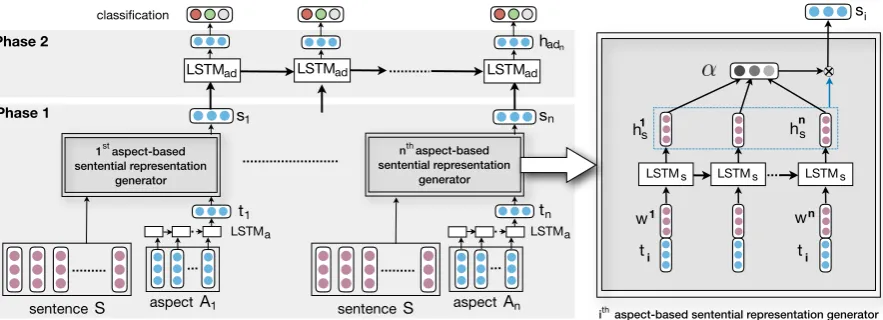
The proposed model comprises two distinct phases (Figure 1). The first phase involves the generation of aspect-based sentential representa-tionss1, ..., sm, where, vectorsiis created by
cou-pling aspectAiwith sentenceS. The second phase
models the inter-aspect dependencies in a sentence using an LSTM which is followed by the senti-ment prediction for all the aspects.
3.1 Phase 1: Aspect-based sentential representations
Below, we describe the methodology to generate the ith aspect-based sentential representation si
for aspectAi and sentenceS.
Given sentenceSand aspect-termAi, the model
first generates the aspect representation ti. This
is done by passingAi through an LSTM, named LSTMa, having internal dimension da. LSTMa’s
final hidden state vectorh∣Ai∣
a ∈Rda is taken to be
this representation, i.e.,ti=h∣aAi∣.
Following this, an attention-based LSTM model is used to create si using S andti (Wang et al., 2016). First, each word vector wj in S is con-catenated with aspecttito create a comprehensive
feature vector xji = (wj;ti) ∈ R(dem+da), where
;is the concatenation operator. We then take this
1 aspect-based sentential representation
generator
aspectA1
sentenceS
t1 tn
aspectAn
sentenceS
Phase 1 Phase 2
s1 sn
classification
hadn
LSTMad
n aspect-based sentential representation
generator th st
LSTMad LSTMad
i aspect-based sentential representation generatorth si
ti ti
w1 wn
hns h1s
LSTMs LSTMs LSTMs
[image:3.595.79.521.62.222.2]LSTMa LSTMa
Figure 1: Overall architecture of the proposed method. Theaspect-based sentential representation generatoris
described in the right end of the figure.
apply an LSTM, named LST Ms with dimension
ds, to model the long-term temporal
dependen-cies within the sentence. The hidden state mem-ory vectors across allntimesteps result in matrix Hi= [h1s, ..., hns] ∈Rds×n.
Attention: Attention mechanism is applied on Hi to get an attention vector α, which is in
turn used to generate a weighted representation ofHi. We use this weighted representation to be
the ith aspect’s sentential representation si.
Pre-vious concatenations of words with the aspect-representations infuse aspect information into the attention process. This enables the attention mech-anism to focus on relevant segments in the sen-tence with respect to the aspect. The overall atten-tion mechanism to generatesiis summarized as:
M =tanh(Hi.Wh) (1)
α=sof tmax(MT.Wb) (2)
si=H.αT (3)
where,Wh ∈Rn×1 andWb ∈Rds×nare
projec-tion parameters to be learnt during training andds
is the dimension of the final sentence vector, i.e., si∈Rds.
The overall process described above is individ-ually applied to allmaspects to get sentential rep-resentationss1, ..., sm.
3.2 Phase 2: Inter-aspect relationship
To capture the implicit inter-aspect dependencies, we model the sentential representations as a se-quence[s1, ..., sm], following the order of
occur-rence of their corresponding aspect-terms in
sen-tenceS. An LSTM, named LSTMadwith
dimen-sion dad is then applied on this sequence and at
each of the ith timestep, its hidden state is pro-jected to another vector having dimensions equal to the number of classes to predict. Finally, soft-max operation is applied on this vector to get the prediction probabilities for the sentiment of this ithaspect-term for sentenceS. The transitions are as follows:
[had1, ..., hadm] =LST Mad([s1, ..., sm]) (4) ˆ
yi=sof tmax(Wad.hadi) (5)
Here, yˆi ∈ RC is the predicted probability
distri-bution for theithaspect of sentenceSwhereCis the number of sentiment classes.Wad∈RC×dadis
a parameter andsof tmax(xi) =exi/ ∑jexj. Loss Function: We use categorical cross-entropy as the loss function which is averaged over all aspects for a sentence. Thus, stochastic loss for sentenceSis calculated as:
Loss= −1 m
m
∑
i=1 C
∑
j=1
yi,j log2(yˆi,j) +λ∣∣θ∣∣2 (6)
Here, m is the number of aspects for a sentence andC is the number of sentiment categories. yi
is the one-hot vector ground truth ofithaspect of
sentenceS andyˆi,j is its predicted probability of
belonging to sentiment classj. λis the L2 -
reg-ularization term and θ is the parameter set, i.e., θ = {W[h,b,ad], LST M[t,s,ad]}, where LST M[]
represents the internal parameters of that LSTM.
4 Experimentation
the training set randomly in the ratio9 ∶ 1to get a held-out validation set. For optimization, we use the Adam optimizer (Kingma and Ba,2014) hav-ing learnhav-ing rate0.01. Embedding dimensions are set as follows, da = 100, ds and dad = 300. To
facilitate batch processing, we attach dummy as-pects in sentences with lesser asas-pects and also pro-vide masking schemes. For termination, we use the early-stopping procedure with a patience value of10that is monitored on the validation loss.
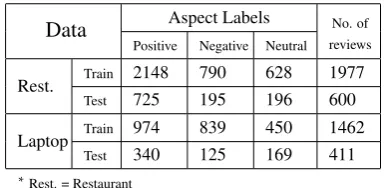
Dataset: We conduct our experiments using the dataset for SemEval 2014 Task 4 containing cus-tomer reviews on restaurants and laptops. Each review has one or more aspects with their corre-sponding polarities. The polarity of an aspect can be positive, negative, neutral or conflict; however, we consider the first three labels for classification. Table1contains the statistics for the dataset.
4.1 Results
Table2presents the results of our proposed model along with state-of-the-art methods. Our model significantly surpasses the performance of ATAE-LSTM (Wang et al., 2016). Given that ATAE’s architecture has a strong correlation to our aspect-based sentential generator (see Figure 1), their work can be categorized as a baseline to our model. This reinforces our hypothesis that a model capable of capturing inter-aspect dependencies in-deed performs better. We also compare our model to the recently proposed IAN (Ma et al.,2017). On both datasets, our model performs competitively with IAN and produces nominal improvement. Given that IAN explores the inter-dependencies of aspects with their contexts, while we try to model inter-dependencies between aspects, an interesting direction would be to explore the IAN modeled in our proposed setting (Phase 2 of Figure1). We set this path as an option for future research.
Table1also presents variations of our proposed
Data Aspect Labels No. of reviews Positive Negative Neutral
Rest. Train 2148 790 628 1977
Test 725 195 196 600
Laptop Train 974 839 450 1462
Test 340 125 169 411
∗Rest. = Restaurant
Table 1: Labels and review statistics for the dataset Se-mEval 2014.
Models Attn. Fusion 3-way classification Rest. Laptop
LSTM 7 - 74.3 66.5
AE-LSTM 3 Concat 76.6 68.9
ATAE-LSTM 3 Concat 77.2 68.7
IAN 3 - 78.6 72.1
Our Model 3 Hadamard 73.42 63.7
Our Model 7 Concat 74.5 69.6
Our Model 3 Concat 79.0 72.5
[image:4.595.307.527.62.196.2]* Attn. = Attention, Rest. = Restaurant
Table 2: Accuracies for three-way classification on the Restaurant and Laptop SemEval 2014 dataset.
model. Specifically, we try out variants (a) With-out attention: in this setting, we omit the attention mechanism while generating aspect-based senten-tial representationsi (Equation1-3). Instead, we
definesi to behns, i.e., the last hidden state
vec-tor of LSTMswith inputS andAi. However,
re-moving attention brings degradation in the perfor-mance of our model on the Restaurant and Laptop dataset by 4%and 3%, respectively. This
signi-fies the importance of an attention mechanism to derive the aspect-based sentential representations.
(b) With hadamard fusion: instead of
concate-nation ofwj and ti, we use the hadamard
prod-uct which is the element wise multiplication of the vectors. Although this variation reduces the total parameter sizes of the network, it still does not benefit the model and gives a poorer perfor-mance to simple concatenation. Numerous other fusion methods such as tensor fusion (Zadeh et al.,
2017), compact bilinear pooling (Gao et al.,2016), attention-based fusion (Poria et al., 2017; Haz-arika et al.,2018), etc. are applicable, whose anal-yses, however, is not the focus of this paper.
4.2 Case Study
A qualitative study on the test set classifications by our model reveals its capability to learn inter-aspect dependencies (Section1). For the sentence
I love the keyboard and the screen, the model cor-rectly identifies the sentiment ofscreenas positive which is hinted by positive aspect keyboard and conjunctionand. In another case, for the sentence
The best thing about this laptop is the price along with some of the newer features, aspect features
[image:4.595.83.276.635.729.2]clas-sifying joint aspects having conjunctions. For the slightly harder case of tackling incomplete infor-mation, our model fares well in sentences having this pattern. For example, one of the sentenceBoot up slowed significantly after all windows updates
were installed has aspectwindows updatewhich
does not have a clear sentiment orientation but is implicitly dependent on the aspect boot up hav-ing a negative sentiment. This was also correctly classified by our model. Moreover, the above ex-amples were incorrectly classified by ATAE. This reaffirms our hypothesis that the ability to learn inter-aspect dependencies is a crucial factor in the task of ABSA.
5 Conclusion
In this paper, we present a way to incorporate inter-aspect dependencies in the task of Aspect-based Sentiment Analysis. Our results suggest that capturing such information indeed improves the task of prediction. Through this work, we hope that future attempts by researchers include this idea in their methods.
6 Acknowledgement
This research was supported in part by the Na-tional Natural Science Foundation of China under Grant no. 61472266 and by the National Univer-sity of Singapore (Suzhou) Research Institute, 377 Lin Quan Street, Suzhou Industrial Park, Jiang Su, People’s Republic of China, 215123. We would also like to thank the anonymous reviewers for their valuable feedback.
References
Yang Gao, Oscar Beijbom, Ning Zhang, and Trevor
Darrell. 2016. Compact bilinear pooling. In
Pro-ceedings of the IEEE Conference on Computer Vi-sion and Pattern Recognition, pages 317–326.
Devamanyu Hazarika, Sruthi Gorantla, Soujanya Po-ria, and Roger Zimmermann. 2018. Self-attentive feature-level fusion for multimodal emotion detec-tion.
Sepp Hochreiter and J¨urgen Schmidhuber. 1997.
Long short-term memory. Neural computation,
9(8):1735–1780.
Diederik Kingma and Jimmy Ba. 2014. Adam: A
method for stochastic optimization. arXiv preprint
arXiv:1412.6980.
Cheng Li, Xiaoxiao Guo, and Qiaozhu Mei. 2017. Deep memory networks for attitude identification.
InProceedings of the Tenth ACM International
Con-ference on Web Search and Data Mining, pages 671– 680. ACM.
Dehong Ma, Sujian Li, Xiaodong Zhang, and Houfeng
Wang. 2017. Interactive attention networks for
aspect-level sentiment classification. arXiv preprint arXiv:1709.00893.
Jeffrey Pennington, Richard Socher, and Christopher Manning. 2014. Glove: Global vectors for word
representation. InProceedings of the 2014
confer-ence on empirical methods in natural language pro-cessing (EMNLP), pages 1532–1543.
Veronica Perez-Rosas, Carmen Banea, and Rada Mi-halcea. 2012. Learning sentiment lexicons in
span-ish. InLREC, volume 12, page 73.
Soujanya Poria, Erik Cambria, Devamanyu Haz-arika, Navonil Mazumder, Amir Zadeh, and Louis-Philippe Morency. 2017. Multi-level multiple at-tentions for contextual multimodal sentiment
analy-sis. In2017 IEEE International Conference on Data
Mining (ICDM), pages 1033–1038. IEEE.
Delip Rao and Deepak Ravichandran. 2009.
Semi-supervised polarity lexicon induction. In
Proceed-ings of the 12th Conference of the European Chap-ter of the Association for Computational Linguistics, pages 675–682. Association for Computational Lin-guistics.
Duyu Tang, Bing Qin, Xiaocheng Feng, and Ting Liu. 2016a. Effective lstms for target-dependent
sen-timent classification. In Proceedings of COLING
2016, the 26th International Conference on Compu-tational Linguistics: Technical Papers, pages 3298– 3307.
Duyu Tang, Bing Qin, and Ting Liu. 2016b. Aspect level sentiment classification with deep memory
net-work. arXiv preprint arXiv:1605.08900.
Yi Tay, Anh Tuan Luu, and Siu Cheung Hui. 2017. Learning to attend via word-aspect associative
fu-sion for aspect-based sentiment analysis. arXiv
preprint arXiv:1712.05403.
Yequan Wang, Minlie Huang, Xiaoyan Zhu, and Li Zhao. 2016. Attention-based lstm for aspect-level
sentiment classification. In EMNLP, pages 606–
615.
Tom Young, Devamanyu Hazarika, Soujanya Poria, and Erik Cambria. 2017. Recent trends in deep
learning based natural language processing. arXiv
preprint arXiv:1708.02709.
Amir Zadeh, Minghai Chen, Soujanya Poria, Erik Cambria, and Louis-Philippe Morency. 2017. Ten-sor fusion network for multimodal sentiment
analy-sis. InProceedings of the 2017 Conference on