Automatically Labeling Semantic Classes
Patrick Pantel and Deepak Ravichandran
Information Sciences Institute
University of Southern California
4676 Admiralty Way
Marina del Rey, CA 90292
{pantel,ravichan}@isi.edu
Abstract
Systems that automatically discover semantic classes have emerged in part to address the limitations of broad-coverage lexical re-sources such as WordNet and Cyc. The cur-rent state of the art discovers many semantic classes but fails to label their concepts. We propose an algorithm labeling semantic classes and for leveraging them to extract is-a relationships using a top-down approach.
1
Introduction
The natural language literature is rich in theories of se-mantics (Barwise and Perry 1985; Schank and Abelson 1977). However, WordNet (Miller 1990) and Cyc (Le-nat 1995) aside, the community has had little success in actually building large semantic repositories. Such broad-coverage lexical resources are extremely useful in applications such as word sense disambiguation (Lea-cock, Chodorow and Miller 1998) and question answer-ing (Pasca and Harabagiu 2001).
Current manually constructed ontologies such as WordNet and Cyc have important limitations. First, they often contain rare senses. For example, WordNet in-cludes a rare sense of computer that means ‘the person who computes’. Using WordNet to expand queries to an information retrieval system, the expansion of computer will include words like estimator and reckoner. Also, the words dog, computer and company all have a sense that is a hyponym of person. Such rare senses make it difficult for a coreference resolution system to use WordNet to enforce the constraint that personal pro-nouns (e.g. he or she) must refer to a person. The second problem with these lexicons is that they miss many
do-main specific senses. For example, WordNet misses the user-interface-object sense of the word dialog (as often used in software manuals). WordNet also contains a very poor coverage of proper nouns.
There is a need for (semi-) automatic approaches to building and extending ontologies as well as for validat-ing the structure and content of existvalidat-ing ones. With the advent of the Web, we have access to enormous amounts of text. The future of ontology growing lies in leveraging this data by harvesting it for concepts and semantic relationships. Moreover, once such knowledge is discovered, mechanisms must be in place to enrich current ontologies with this new knowledge.
To address some of the coverage and specificity problems in WordNet and Cyc, Pantel and Lin (2002) proposed and algorithm, called CBC, for automatically extracting semantic classes. Their classes consist of clustered instances like the three shown below:
(A)multiple sclerosis, diabetes,
osteoporosis, cardiovascular disease, Parkinson's, rheumatoid arthritis, heart disease, asthma, cancer, hypertension, lupus, high blood pressure, arthritis, emphysema, epilepsy, cystic fibrosis, leukemia, hemophilia, Alzheimer, myeloma, glaucoma, schizophrenia, ...
(B) Mike Richter, Tommy Salo, John Vanbiesbrouck, Curtis Joseph, Chris Osgood, Steve Shields, Tom Barrasso, Guy Hebert, Arturs Irbe, Byron Dafoe, Patrick Roy, Bill Ranford, Ed Belfour, Grant Fuhr, Dominik Hasek, Martin Brodeur, Mike Vernon, Ron Tugnutt, Sean Burke, Zach Thornton, Jocelyn Thibault, Kevin Hartman, Felix Potvin, ...
A limitation of these concepts is that CBC does not discover their actual names. That is, CBC discovers a semantic class of Canadian provinces such as Manitoba, Alberta, and Ontario, but stops short of labeling the concept as Canadian Provinces. Some applications such as question answering would benefit from class labels. For example, given the concept list (B) and a label goalie/goaltender, a QA system could look for answers to the question “Which goaltender won the most Hart Trophys?” in the concept.
In this paper, we propose an algorithm for automati-cally inducing names for semantic classes and for find-ing instance/concept (is-a) relationships. Using concept signatures (templates describing the prototypical syntac-tic behavior of instances of a concept), we extract con-cept names by searching for simple syntactic patterns such as “concept apposition-of instance”. Searching concept signatures is more robust than searching the syntactic features of individual instances since many instances suffer from sparse features or multiple senses.
Once labels are assigned to concepts, we can extract a hyponym relationship between each instance of a con-cept and its label. For example, once our system labels list (C) as color, we may extract relationships such as: pink is a color, red is a color, turquoise is a color, etc. Our results show that of the 159,000 hyponyms we ex-tract using this simple method, 68% are correct. Of the 65,000 proper name hyponyms we discover, 81.5% are correct.
The remainder of this paper is organized as follows. In the next section, we review previous algorithms for extracting semantic classes and hyponym relationships. Section 3 describes our algorithm for labeling concepts and for extracting hyponym relationships. Experimental results are presented in Section 4 and finally, we con-clude with a discussion and future work.
2
Previous Work
There have been several approaches to automatically discovering lexico-semantic information from text (Hearst 1992; Riloff and Shepherd 1997; Riloff and Jones 1999; Berland and Charniak 1999; Pantel and Lin 2002; Fleischman et al. 2003; Girju et al. 2003). One approach constructs automatic thesauri by computing the similarity between words based on their distribution in a corpus (Hindle 1990; Lin 1998). The output of these programs is a ranked list of similar words to each word. For example, Lin’s approach outputs the follow-ing top-20 similar words of orange:
(D) peach, grapefruit, yellow, lemon, pink, avocado, tangerine, banana, purple, Santa Ana, strawberry, tomato, red, pineapple, pear, Apricot, apple, green, citrus, mango
A common problem of such lists is that they do not discriminate between the senses of polysemous words.
For example, in (D), the color and fruit senses of orange are mixed up.
Lin and Pantel (2001) proposed a clustering algo-rithm, UNICON, which generates similar lists but discriminates between senses of words. Later, Pantel and Lin (2002) improved the precision and recall of UNICON clusters with CBC (Clustering by Commit-tee). Using sets of representative elements called com-mittees, CBC discovers cluster centroids that unambiguously describe the members of a possible class. The algorithm initially discovers committees that are well scattered in the similarity space. It then pro-ceeds by assigning elements to their most similar com-mittees. After assigning an element to a cluster, CBC removes their overlapping features from the element before assigning it to another cluster. This allows CBC to discover the less frequent senses of a word and to avoid discovering duplicate senses.
CBC discovered both the color sense of orange, as shown in list (C) of Section 1, and the fruit sense shown below:
(E) peach, pear, apricot, strawberry, ba-nana, mango, melon, apple, pineapple, cherry, plum, lemon, grapefruit, orange, berry, raspberry, blueberry, kiwi, ...
There have also been several approaches to discov-ering hyponym (is-a) relationships from text. Hearst (1992) used seven lexico-syntactic patterns, for example “such NP as {NP,}*{(or|and)} NP” and “NP {, NP}*{,} or other NP”. Berland and Charniak (1999) used similar pattern-based techniques and other heuristics to extract meronymy (part-whole) relations. They reported an accuracy of about 55% precision on a corpus of 100,000 words. Girju, Badulescu and Moldovan (2003) improved upon this work by using a machine learning filter. Mann (2002) and Fleischman et al. (2003) used part of speech patterns to extract a subset of hyponym relations involing proper nouns.
3
Labeling Classes
The research discussed above on discovering hyponym relationships all take a bottom up approach. That is, they use patterns to independently discover semantic relationships of words. However, for infrequent words, these patterns do not match or, worse yet, generate in-correct relationships.
disease not because it necessarily occurs in any particu-lar syntactic relationship with disease, but because it belongs to the class of instances that does.
The input to our labeling algorithm is a list of se-mantic classes, in the form of clusters of words, which may be generated from any source. In our experiments, we used the clustering outputs of CBC (Pantel and Lin 2002). The output of the system is a ranked list of con-cept names for each semantic class.
In the first phase of the algorithm, we extract feature vectors for each word that occurs in a semantic class. Phase II then uses these features to compute grammati-cal signatures of concepts using the CBC algorithm. Finally, we use simple syntactic patterns to discover class names from each class’ signature. Below, we de-scribe these phases in detail.
3.1 Phase I
We represent each word (concept instance) by a feature vector. Each feature corresponds to a context in which the word occurs. For example, “catch __” is a verb-object context. If the word wave occurred in this con-text, then the context is a feature of wave.
We first construct a frequency count vector C(e) = (ce1, ce2, …, cem), where m is the total number of features
and cef is the frequency count of feature f occurring in
word e. Here, cef is the number of times word e occurred
in a grammatical context f. For example, if the word wave occurred 217 times as the object of the verb catch, then the feature vector for wave will have value 217 for its “object-of catch” feature. In Section 4.1, we describe how we obtain these features.
We then construct a mutual information vector MI(e) = (mie1, mie2, …, miem) for each word e, where mief
is the pointwise mutual information between word e and feature f, which is defined as:
N c N c N c ef m j ej n i if ef
mi
∑ ∑ = =×
=
1 1log
(1)where n is the number of words and N = ∑ ∑
= =
n
i m
j cij
1 1 is the
total frequency count of all features of all words.
Mutual information is commonly used to measure the association strength between two words (Church and Hanks 1989). A well-known problem is that mutual information is biased towards infrequent ele-ments/features. We therefore multiply mief with the
fol-lowing discounting factor:
1 , min , min 1 1 1 1 1 + × +
∑
∑
∑
∑
= = = = m j jf n i ei m j jf n i ei ef ef c c c c cc (2)
3.2 Phase II
Following (Pantel and Lin 2002), we construct a com-mittee for each semantic class. A comcom-mittee is a set of representative elements that unambiguously describe the members of a possible class.
For each class c, we construct a matrix containing the similarity between each pair of words ei and ej in c
using the cosine coefficient of their mutual information vectors (Salton and McGill 1983):
( )
∑
∑
∑
× × = f f e f f e f f e f e j i j i j i mi mi mi mi e e sim 2 2, (3)
For each word e, we then cluster its most similar in-stances using group-average clustering (Han and Kam-ber 2001) and we store as a candidate committee the highest scoring cluster c' according to the following metric:
| c'| × avgsim(c') (4) where |c'| is the number of elements in c' and avgsim(c')
is the average pairwise similarity between words in c'. The assumption is that the best representative for a con-cept is a large set of very similar instances. The commit-tee for class c is then the highest scoring candidate committee containing only words from c. For example, below are the committee members discovered for the semantic classes (A), (B), and (C) from Section 1:
1) cardiovascular disease, diabetes, multiple sclerosis, osteoporosis, Parkinson's, rheumatoid arthritis
2) Curtis Joseph, John Vanbiesbrouck, Mike Richter, Tommy Salo
3) blue, pink, red, yellow
3.3 Phase III
“-V:subj:N:sprawl” feature indicates a subject-verb re-lationship between the concept and the verb sprawl while “N:appo:N:goaltender” indicates an apposition relationship between the concept and the noun goal-tender. The (-) in a relationship means that the right hand side of the relationship is the head (e.g. sprawl is the head of the subject-verb relationship). The two col-umns of numbers indicate the frequency and mutual information score for each feature respectively.
In order to discover the characteristics of human naming conventions, we manually named 50 concepts discovered by CBC. For each concept, we extracted the relationships between the concept committee and the assigned label. We then added the mutual information scores for each extracted relationship among the 50 concepts. The top-4 highest scoring relationships are:
• Apposition (N:appo:N)
e.g. ... Oracle, a company known for its progressive employment policies, ...
• Nominal subject (-N:subj:N)
e.g. ... Apple was a hot young com-pany, with Steve Jobs in charge.
• Such as (-N:such as:N)
e.g. ... companies such as IBM must be weary ...
• Like (-N:like:N)
e.g. ... companies like Sun Micro-systems do no shy away from such challenges, ...
To name a class, we simply search for these syntac-tic relationships in the signature of a concept. We sum up the mutual information scores for each term that oc-curs in these relationships with a committee of a class. The highest scoring term is the name of the class. For example, the top-5 scoring terms that occurred in these relationships with the signature of the concept repre-sented by the committee {Curtis Joseph, John Vanbiesbrouck, Mike Richter, Tommy Salo} are:
1) goalie 40.37 2) goaltender 33.64 3) goalkeeper 19.22 4) player 14.55 5) backup 9.40
The numbers are the total mutual information scores of each name in the four syntactic relationships.
4
Evaluation
In this section, we present an evaluation of the class labeling algorithm and of the hyponym relationships discovered by our system.
4.1 Experimental Setup
We used Minipar (Lin 1994), a broad coverage parser, to parse 3GB of newspaper text from the Aquaint (TREC-9) collection. We collected the frequency counts of the grammatical relationships (contexts) output by Minipar and used them to compute the pointwise mutual information vectors described in Section 3.1.
We used the 1432 noun clusters extracted by CBC1 as the list of concepts to name. For each concept, we then used our algorithm described in Section 3 to extract the top-20 names for each concept.
1 Available at http://www.isi.edu/~pantel/demos.htm
{Curtis Joseph, John Vanbiesbrouck, Mike Richter, Tommy Salo}
-N:gen:N
pad 57 11.19 backup 29 9.95 crease 7 9.69 glove 52 9.57 stick 20 9.15 shutout 17 8.80 -N:conj:N
Hasek 15 12.36 Martin Brodeur 12 12.26 Belfour 13 12.22 Patrick Roy 10 11.90 Dominik Hasek 7 11.20 Roy 6 10.01 -V:subj:N
sprawl 11 6.69 misplay 6 6.55 smother 10 6.54 skate 28 6.43 turn back 10 6.28 stop 453 6.19 N:appo:N
goaltender 449 10.79 goalie 1641 10.76 netminder 57 10.39 goalkeeper 487 9.69 N:conj:N
[image:4.612.324.539.71.241.2]Martin Brodeur 11 12.49 Dominik Hasek 11 12.33 Ed Belfour 10 12.04 Curtis Joseph 7 11.46 Tom Barrasso 5 10.85 Byron Dafoe 5 10.80 Chris Osgood 4 10.25
4.2 Labeling Precision
Out of the 1432 noun concepts, we were unable to name 21 (1.5%) of them. This occurs when a concept’s com-mittee members do not occur in any of the four syntactic relationships described in Section 0. We performed a manual evaluation of the remaining 1411 concepts.
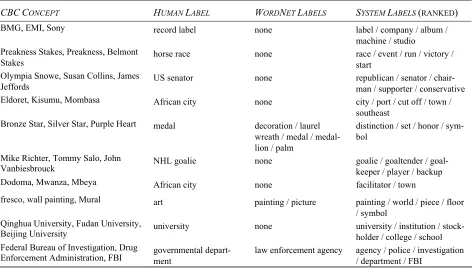
We randomly selected 125 concepts and their top-5 highest ranking names according to our algorithm. Ta-ble 1 shows the first 10 randomly selected concepts (each concept is represented by three of its committee members).
For each concept, we added to the list of names a human generated name (obtained from an annotator looking at only the concept instances). We also ap-pended concept names extracted from WordNet. For each concept that contains at least five instances in the WordNet hierarchy, we named the concept with the most frequent common ancestor of each pair of in-stances. Up to five names were generated by WordNet for each concept. Because of the low coverage of proper nouns in WordNet, only 33 of the 125 concepts we evaluated had WordNet generated labels.
We presented to three human judges the 125 ran-domly selected concepts together with the system, hu-man, and WordNet generated names randomly ordered. That way, there was no way for a judge to know the
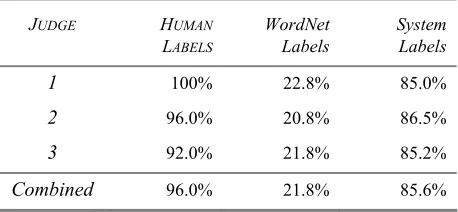
source of a label nor the system’s ranking of the labels. For each name, we asked the judges to assign a score of correct, partially correct, or incorrect. We then com-puted the mean reciprocal rank (MRR) of the system, human, and WordNet labels. For each concept, a nam-ing scheme receives a score of 1 / M where M is the rank of the first name judged correct. Table 2 shows the results. Table 3 shows similar results for a more lenient evaluation where M is the rank of the first name judged correct or partially correct.
Our system achieved an overall MRR score of 77.1%. We performed much better than the baseline WordNet (19.9%) because of the lack of coverage (mostly proper nouns) in the hierarchy. For the 33 con-cepts that WordNet named, it achieved a score of 75.3% and a lenient score of 82.7%, which is high considering the simple algorithm we used to extract labels using WordNet.
The Kappa statistic (Siegel and Castellan Jr. 1988) measures the agreements between a set of judges’ as-sessments correcting for chance agreements:
( ) ( )
( )
E PE P A P K
− − =
1 (5)
[image:5.612.77.550.87.356.2]where P(A) is the probability of agreement between the judges and P(E) is the probability that the judges agree Table 1. Labels assigned to 10 randomly selected concepts (each represented by three committee members.
CBCCONCEPT HUMAN LABEL WORDNET LABELS SYSTEM LABELS(RANKED)
BMG, EMI, Sony record label none label / company / album / machine / studio Preakness Stakes, Preakness, Belmont
Stakes horse race none race / event / run / victory / start Olympia Snowe, Susan Collins, James
Jeffords US senator none republican / senator / chair-man / supporter / conservative Eldoret, Kisumu, Mombasa African city none city / port / cut off / town /
southeast Bronze Star, Silver Star, Purple Heart medal decoration / laurel
wreath / medal / medal-lion / palm
distinction / set / honor / sym-bol
Mike Richter, Tommy Salo, John
Vanbiesbrouck NHL goalie none goalie / goaltender / goal-keeper / player / backup Dodoma, Mwanza, Mbeya African city none facilitator / town
fresco, wall painting, Mural art painting / picture painting / world / piece / floor / symbol
Qinghua University, Fudan University,
Beijing University university none university holder / college / school / institution / stock-Federal Bureau of Investigation, Drug
by chance on an assessment. An experiment with K ≥
0.8 is generally viewed as reliable and 0.67 < K < 0.8 allows tentative conclusions. The Kappa statistic for our experiment is K = 0.72.
The human labeling is at a disadvantage since only one label was generated per concept. Therefore, the human scores either 1 or 0 for each concept. Our sys-tem’s highest ranking name was correct 72% of the time. Table 4 shows the percentage of semantic classes with a correct label in the top 1-5 ranks returned by our system.
Overall, 41.8% of the top-5 names extracted by our system were judged correct. The overall accuracy for the top-4, top-3, top-2, and top-1 names are 44.4%, 48.8%, 58.5%, and 72% respectively. Hence, the name ranking of our algorithm is effective.
4.3 Hyponym Precision
The 1432 CBC concepts contain 18,000 unique words. For each concept to which a word belongs, we extracted up to 3 hyponyms, one for each of the top-3 labels for the concept. The result was 159,000 hyponym relation-ships. 24 are shown in the Appendix.
Two judges annotated two random samples of 100 relationships: one from all 159,000 hyponyms and one from the subset of 65,000 proper nouns. For each in-stance, the judges were asked to decide whether the hyponym relationship was correct, partially correct or
incorrect. Table 5 shows the results. The strict measure counts a score of 1 for each correctly judged instance and 0 otherwise. The lenient measure also gives a score of 0.5 for each instance judged partially correct.
Many of the CBC concepts contain noise. For ex-ample, the wine cluster:
Zinfandel, merlot, Pinot noir, Chardonnay, Cabernet Sauvignon, cabernet, riesling, Sauvignon blanc, Chenin blanc, sangiovese, syrah, Grape, Chianti ...
contains some incorrect instances such as grape, appe-lation, and milk chocolate. Each of these instances will generate incorrect hyponyms such as grape is wine and milk chocolate is wine. This hyponym extraction task would likely serve well for evaluating the accuracy of lists of semantic classes.
Table 5 shows that the hyponyms involving proper nouns are much more reliable than common nouns. Since WordNet contains poor coverage of proper nouns, these relationships could be useful to enrich it.
4.4 Recall
[image:6.612.314.543.98.204.2]Semantic extraction tasks are notoriously difficult to evaluate for recall. To approximate recall, we conducted two question answering (QA) tasks: answering definition questions and performing QA information retrieval.
Table 2. MRR scores for the human evaluation of naming 125 random concepts.
JUDGE HUMAN
LABELS
WordNet Labels
System Labels
1 100% 18.1% 74.4%
2 91.2% 20.0% 78.1%
3 89.6% 21.6% 78.8%
Combined 93.6% 19.9% 77.1%
Table 3. Lenient MRR scores for the human evaluation of naming 125 random concepts.
JUDGE HUMAN
LABELS
WordNet Labels
System Labels
1 100% 22.8% 85.0%
2 96.0% 20.8% 86.5%
3 92.0% 21.8% 85.2%
[image:6.612.72.299.99.205.2]Combined 96.0% 21.8% 85.6%
Table 4. Percentage of concepts with a correct name in the top-5 ranks returned by our system.
JUDGE TOP-1 TOP-2 TOP-3 TOP-4 TOP-5
1 68.8% 75.2% 78.4% 83.2% 84.0%
2 73.6% 80.0% 81.6% 83.2% 84.8%
3 73.6% 80.0% 82.4% 84.0% 88.8%
[image:6.612.315.541.260.355.2]Combined 72.0% 78.4% 80.8% 83.5% 85.6%
Table 5. Accuracy of 159,000 extracted hyponyms and a sub-set of 65,000 proper noun hyponyms.
JUDGE All Nouns Proper Nouns
Strict Lenient Strict Lenient
1 62.0% 68.0% 79.0% 82.0%
2 74.0% 76.5% 84.0% 85.5%
[image:6.612.72.298.261.354.2]Definition Questions
We chose the 50 definition questions that appeared in the QA track of TREC2003 (Voorhees, 2003). For ex-ample: “Who is Aaron Copland?” and “What is the Kama Sutra?” For each question we looked for at most five corresponding concepts in our hyponym list. For example, for Aaron Copland, we found the following hypernyms: composer, music, and gift. We compared our system with the concepts in WordNet and Fleisch-man et al.’s instance/concept relations (FleischFleisch-man et al. 2003). Table 6 shows the percentage of correct answers in the top-1 and top-5 returned answers from each sys-tem. All systems seem to have similar performance on the top-1 answers, but our system has many more an-swers in the top-5. This shows that our system has com-paratively higher recall for this task.
Information (Passage) Retrieval
Passage retrieval is used in QA to supply relevant in-formation to an answer pinpointing module. The higher the performance of the passage retrieval module, the higher will be the performance of the answer pinpoint-ing module.
The passage retrieval module can make use of the hyponym relationships that are discovered by our sys-tem. Given a question such as “What color …”, the like-lihood of a correct answer being present in a retrieved passage is greatly increased if we know the set of all possible colors and index them in the document collec-tion appropriately.
We used the hyponym relations learned by our sys-tem to perform semantic indexing on a QA passage re-trieval task. We selected the 179 questions from the QA track of TREC-2003 that had an explicit semantic an-swer type (e.g. “What band was Jerry Garcia with?” and “What color is the top stripe on the U.S. flag?”). For each expected semantic answer type corresponding to a given question (e.g. band and color), we indexed the entire TREC-2002 IR collection with our system’s hyponyms.
We compared the passages returned by the passage retrieval module with and without the semantic index-ing. We counted how many of the 179 questions had a correct answer returned in the top-1 and top-100 pas-sages. Table 7 shows the results.
Our system shows small gains in the performance of the IR output. In the top-1 category, the performance improved by 20%. This may lead to better answer selec-tions.
5
Conclusions and Future Work
Current state of the art concept discovery algorithms generate lists of instances of semantic classes but stop short of labeling the classes with concept names. Class labels would serve useful in applications such as ques-tion answering to map a quesques-tion concept into a seman-tic class and then search for answers within that class. We propose here an algorithm for automatically label-ing concepts that searches for syntactic patterns within a grammatical template for a class. Of the 1432 noun con-cepts discovered by CBC, our system labelled 98.5% of them with an MRR score of 77.1% in a human evalua-tion.
Hyponym relationships were then easily extracted, one for each instance/concept label pair. We extracted 159,000 hyponyms and achieved a precision of 68%. On a subset of 65,000 proper names, our performance was 81.5%.
[image:7.612.70.297.98.191.2]This work forms an important attempt to building large-scale semantic knowledge bases. Without being able to automatically name a cluster and extract hypo-nym/hypernym relationships, the utility of automatically generated clusters or manually compiled lists of terms is limited. Of course, it is a serious open question how many names each cluster (concept) should have, and how good each name is. Our method begins to address this thorny issue by quantifying the name assigned to a class and by simultaneously assigning a number that can be interpreted to reflect the strength of membership of each element to the class. This is potentially a signifi-cant step away from traditional all-or-nothing seman-tic/ontology representations to a concept representation Table 6. Percentage of correct answers in the Top-1 and
Top-5 returned answers on 50 definition questions.
SYSTEM Top-1 Top-5
Strict Lenient Strict Lenient
WordNet 38% 38% 38% 38%
Fleischman 36% 40% 42% 44%
[image:7.612.314.542.110.193.2]Our System 36% 44% 60% 62%
Table 7. Percentage of questions where the passage retrieval module returns a correct answer in the Top-1 and Top-100 ranked passages (with and without semantic indexing).
CORRECT TOP-1 Correct Top-100
With semantic indexing
43 / 179 134 / 179
Without semantic indexing
scheme that is more nuanced and admits multiple names and graded set memberships.
Acknowledgements
The authors wish to thank the reviewers for their helpful comments. This research was partly supported by NSF grant #EIA-0205111.
References
Barwise, J. and Perry, J. 1985. Semantic innocence and un-compromising situations. In: Martinich, A. P. (ed.) The Philosophy of Language. New York: Oxford University Press. pp. 401–413.
Berland, M. and E. Charniak, 1999. Finding parts in very large corpora. In ACL-1999. pp. 57–64. College Park, MD. Church, K. and Hanks, P. 1989. Word association norms,
mu-tual information, and lexicography. In Proceedings of ACL-89. pp. 76–83. Vancouver, Canada.
Fleischman, M.; Hovy, E.; and Echihabi, A. 2003. Offline strategies for online question answering: Answering ques-tions before they are asked. In Proceedings of ACL-03. pp. 1–7. Sapporo, Japan.
Girju, R.; Badulescu, A.; and Moldovan, D. 2003. Learning semantic constraints for the automatic discovery of part-whole relations. In Proceedings of HLT/NAACL-03. pp. 80–87. Edmonton, Canada.
Han, J. and Kamber, M. 2001. Data Mining – Concepts and
Techniques. Morgan Kaufmann.
Hearst, M. 1992. Automatic acquisition of hyponyms from large text corpora. In COLING-92. pp. 539–545. Nantes, France.
Hindle, D. 1990. Noun classification from predicate-argument structures. In Proceedings of ACL-90. pp. 268–275. Pitts-burgh, PA.
Leacock, C.; Chodorow, M.; and Miller; G. A. 1998. Using corpus statistics and WordNet relations for sense identifica-tion. Computational Linguistics, 24(1):147–165.
Lenat, D. 1995. CYC: A large-scale investment in knowledge infrastructure. Communications of the ACM, 38(11):33–38. Lin, D. 1994. Principar - an efficient, broad-coverage, princi-ple-based parser. Proceedings of COLING-94. pp. 42–48. Kyoto, Japan.
Lin, D. 1998. Automatic retrieval and clustering of similar words. In Proceedings of COLING/ACL-98. pp. 768–774. Montreal, Canada.
Lin, D. and Pantel, P. 2001. Induction of semantic classes from natural language text. In Proceedings of SIGKDD-01. pp. 317–322. San Francisco, CA.
Mann, G. S. 2002. Fine-Grained Proper Noun Ontologies for Question Answering. SemaNet’ 02: Building and
Using Semantic Networks, Taipei, Taiwan.
Miller, G. 1990. WordNet: An online lexical database.
Inter-national Journal of Lexicography, 3(4).
Pasca, M. and Harabagiu, S. 2001. The informative role of WordNet in Open-Domain Question Answering. In Pro-ceedings of NAACL-01 Workshop on WordNet and Other
Lexical Resources. pp. 138–143. Pittsburgh, PA.
Pantel, P. and Lin, D. 2002. Discovering Word Senses from Text. In Proceedings of SIGKDD-02. pp. 613–619. Edmon-ton, Canada.
Riloff, E. and Shepherd, J. 1997. A corpus-based approach for building semantic lexicons. In Proceedings of
EMNLP-1997.
Riloff, E. and Jones, R. 1999. Learning dictionaries for infor-mation extraction by multi-level bootstrapping. In
Proceed-ings of AAAI-99. pp. 474–479. Orlando, FL.
Salton, G. and McGill, M. J. 1983. Introduction to Modern
Information Retrieval. McGraw Hill
Schank, R. and Abelson, R. 1977. Scripts, Plans, Goals and Understanding: An Inquiry into Human Knowledge Struc-tures. Lawrence Erlbaum Associates.
Siegel, S. and Castellan Jr., N. J. 1988. Nonparametric Statis-tics for the Behavioral Sciences. McGraw-Hill.
Voorhees, E. 2003. Overview of the question answering track. To appear in Proceedings of TREC-12 Conference. NIST, Gaithersburg, MD.
Appendix. Sample hyponyms discovered by our system.
INSTANCE CONCEPT INSTANCE CONCEPT
actor hero price support benefit
Ameritrade brokerage republican politician
Arthur Rhodes
pitcher Royal Air Force
force
bebop MUSIC Rwanda city
Buccaneer team Santa Ana city
Congressional Research Service
agency shot-blocker player
Cuba country slavery issue
Dan Petrescu midfielder spa facility
Hercules aircraft taxi vehicle
Moscow city Terrence Malick
director
Nokia COMPANY verbena tree