Understanding Temporal Expressions in Emails
Benjamin Han, Donna Gates and Lori Levin Language Technologies Institute
Carnegie Mellon University 5000 Forbes Ave, Pittsburgh PA 15213
{benhdj|dmg|lsl}@cs.cmu.edu
Abstract
Recent years have seen increasing re-search on extracting and using temporal information in natural language applica-tions. However most of the works found in the literature have focused on identi-fying and understanding temporal expres-sions in newswire texts. In this paper we report our work onanchoring tempo-ral expressions in a novel genre, emails. The highly under-specified nature of these expressions fits well with our constraint-based representation of time, Time Cal-culus for Natural Language(TCNL). We have developed and evaluated a Tempo-ral Expression Anchoror (TEA), and the result shows that it performs significantly better than the baseline, and compares fa-vorably with some of the closely related work.
1 Introduction
With increasing demand from ever more sophisti-cated NLP applications, interest in extracting and understanding temporal information from texts has seen much growth in recent years. Several works have addressed the problems of representing tem-poral information in natural language (Setzer, 2001; Hobbs and Pan, 2004; Saur´ı et al., 2006), extracting and/or anchoring (normalizing) temporal and event related expressions (Wiebe et al., 1998; Mani and Wilson, 2000; Schilder and Habel, 2001; Vazov,
2001; Filatova and Hovy, 2001), and discovering the ordering of events (Mani et al., 2003). Most of these works have focused on capturing temporal informa-tion contained innewswire texts, and whenever both recognitionandnormalizationtasks of temporal ex-pressions were attempted, the latter almost always fell far behind from the former in terms of perfor-mance.
In this paper we will focus on a different combi-nation of the problems: anchoring temporal expres-sions in scheduling-related emails. In our project work of building personal agents capable of schedul-ing meetschedul-ings among different users1,
understand-ing temporal expressions is a crucial step. We have therefore developed and evaluated our system Tem-poral Expression Anchorer (TEA) that is capable of normalizing such expressions in texts. As input TEA takes English text with temporal expressions al-ready identified, and transduces the expressions into their representations using Time Calculus for Nat-ural Language(TCNL) (Han and Kohlhase, 2003). These representations, or TCNL formulae, are then evaluated by incorporating the contextual informa-tion to give the final normalized output. TCNL has the following characteristics: (1) a human calendar (e.g., the Gregorian calendar) is explicitly modeled as a constraint system to deal with the highly under-specified nature of many temporal expressions, and it allows easy extension to include new temporal primitives; (2) a set of NL-motivated operators with a granularity-enriched type system facilitates the representation of theintensionalmeaning of a
tem-1Project RADAR,
http://www.radar.cs.cmu.edu/external.asp
poral expression in a compositional way; and (3) the use of temporal references such as “focus” in the representation cleanly separates the core meaning of an expression from its contextual dependency.
The rest of this paper is organized as follows. Sec. 2 first surveys the characteristics of temporal expressions in emails compared to those in newswire texts, and motivates the design of our representation. Sec 3 then introduces the formalism TCNL. The sys-tem TEA and the anchoring process is detailed in Sec. 4, and the evaluation of the system is reported in Sec. 5. Finally Sec. 6 concludes this paper and outlines the future work.
2 Temporal Expressions in Emails
The extent of temporal expressions considered in this paper includes most of the expressions using temporal terms such as 2005, summer, evening, 1:30pm, tomorrow, etc. These expressions can be classified into the following categories:
• Explicit: These expressions can be immedi-ately anchored, i.e., positioned on a timeline. E.g.,June 2005,1998 Summer, etc.
• Deictic: These expressions form a specific re-lation with the speech time (timestamp of an email). E.g., tomorrow, last year, two weeks from today.
• Relative: These include the other expressions
that form a specific relation with atemporal fo-cus, i.e., the implicit time central to the discus-sion. E.g.,from 5 to 7,on Wednesday, etc. Dif-ferent from the speech time, a temporal focus can shift freely during the discourse.
• Durational: These are the expressions that de-scribe certain length in time. E.g., for about an hour, less than 20 minutes. This is differ-ent from an interval expression where both the starting point and the ending point are given (e.g., from 5 to 7). Most durational sions are used to build more complex expres-sions, e.g.,for the next 20-30 minutes.
It is worth emphasizing the crucial difference be-tween deictic expressions and relative expressions: anchoring the former only relies on the fixed speech
time while normalizing the latter requires the usually hidden focus. As illustrated below the latter task can be much more challenging:
“I’m free next week. Let’s meet on Wednesday.”
“Are you freeon Wednesday?”
In the first example the “Wednesday” denotes a dif-ferent date since the first sentence sets up a difdif-ferent focus. To make things even more interesting, ver-bal tense can also play a role, e.g., “He finished the reporton Wednesday.”
There are other types of temporal expressions such asrecurrence (“every Tuesday”) and rate ex-pressions (“twice on Wednesday”) that are not sup-ported in our system, although they are planned in our future work (Sec. 6).
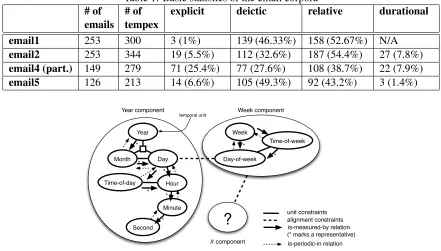
To appreciate the different nature of emails as a genre, an interesting observation can be made by comparing the distributions of temporal expressions in emails and in newswire texts. The email cor-pora we used for development and testing were col-lected from MBA students of Carnegie Mellon Uni-versity over the year 1997 and 1998. The 277 stu-dents, organized in approximately 50 teams of 4 to 6 members, were participating in a 14-week course and running simulated companies in a variety of market scenarios (Kraut et al., 2004). The original dataset, the CSpace email corpus, contains approx-imately 15,000 emails. We manually picked 1,196 emails that are related to scheduling - these include scheduling meetings, presentations, or general plan-ning for the groups. The emails are then randomly divided into five sets (email1 toemail5), and only four of them are used in this work:email1was used to establish our baseline, email2 and email5 were used for development, and part ofemail4was used for testing. Table 1 shows some basic statistics of these three datasets2, and an edited sample email is
shown in Fig. 1 (names altered). The most appar-ent difference comparing these emails to newswire texts is in the percentage of explicit expressions oc-curring in the two different genres. In (Mani et al., 2003) it was reported that the proportion of such ex-pressions is about 25% in the newswire corpus they
2The percentages in some rows do not add up to 100%
Date:Thu, 11 Sep 1997 00:14:36 -0500
I have put an outline out in the n10f1 OpReview directory... (omitted)
We have very little time for this. Please call meThursday nightto get clarification. I will need graphs and prose in filesby Saturday Noon.
– Mary
ps. Mark and John , I waited until AFTER midnightto send this .
Figure 1: A sample email (edited)
used3. In contrast, explicit expressions on average
only account for around 9.5% in the three email datasets. This is not surprising given that people tend to use under-specified expressions in emails for economic reasons. Another thing to note is that there are roughly the same number of relative expressions and non-relative expressions. Since non-relative ex-pressions (including deictic exex-pressions) can be an-chored without tracking the temporal focus over a discourse and therefore can be dealt with in a fairly straightforward way, we may assign 50% as a some-what generous baseline performance of any anchor-ing system4.
Another difference between emails and newswire texts is that the former is a medium for communi-cation: an email can be used as a reply, or can be attached within another email, or even be used to address to multiple recipients. All of this compli-cates a great deal of our task. Other notable dif-ferences are that in emails hour ambiguity tend to appear more often (“I’ll be home at 2.”), and peo-ple tend to be more creative when they compose short messages such as using tables (e.g., an entire column of numbers to denote the number of min-utes alloted for each presenter), bullet lists, abbrevi-ations, and different month/day formats (“1/9” can mean January 9orSeptember 1), etc. Emails also contain more “human errors” such as misspellings (“Thusday” to meanThursday) and confusion about dates (e.g., using “tomorrow” when sending emails
3Using the North American News Corpus.
4This is a bit generous since solving simple calendric
arith-metics such as anchoringlast summerstill requires a non-trivial modeling of human calendars; see Sec. 3.
around midnight), etc. Overall it is very difficult to recover from this type of errors.
3 Representing Times in Natural Language
This section provides a concise overview of TCNL; readers are referred to (Han and Kohlhase, 2003; Han et al., 2006) for more detail.
TCNL has two major components: a constraint-based model for human calendars and a represen-tational language built on top of the model. Dif-ferent from the other representations such as Zeit-Gram (Stede and Haas, 1998), TOP (Androut-sopoulos, 1999), and TimeML/Timex3 (Saur´ı et al., 2006), the language component of TCNL is essen-tially “calendar-agnostic” - anytemporal unitcan be plugged in a formula once it is defined in the cal-endar model, i.e., the calcal-endar model serves as the lexicon for the TCNL language.
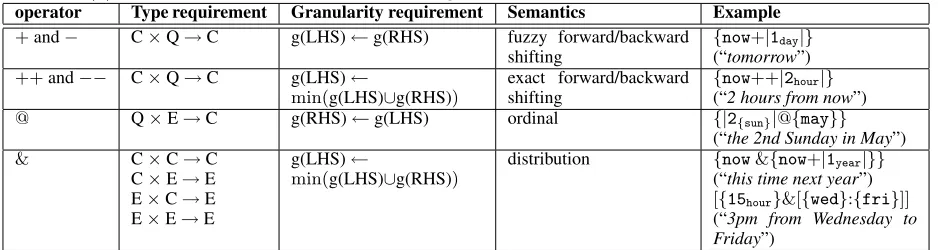
Fig. 2 shows a partial model for the Gregorian cal-endar used in TEA. The entire calcal-endar model is ba-sically a constraint graph withpartial ordering. The nodes labeled with “year” etc. represent temporal units (or variables when viewed as a constraint sat-isfaction problem (CSP) (Ruttkay, 1998)), and each unit can take on a set of possible values. The undi-rected edges represent constraints among the units, e.g., the constraint betweenmonth andday man-dates that February cannot have more than 29 days. A temporal expression in NL is then viewed as if it assigns values to some of the units, e.g., “Friday the 13th” assigns values to only units dow (day-of-week) and day. An interval-based AC-3 algo-rithm with a chronological backtracking mechanism is used to derive at the consistent assignments to the other units, therefore allowing us to iterate to any one of the possibleFriday the 13th.
Table 1: Basic statistics of the email corpora
# of
emails # oftempex explicit deictic relative durational email1 253 300 3 (1%) 139 (46.33%) 158 (52.67%) N/A
email2 253 344 19 (5.5%) 112 (32.6%) 187 (54.4%) 27 (7.8%)
email4 (part.) 149 279 71 (25.4%) 77 (27.6%) 108 (38.7%) 22 (7.9%)
email5 126 213 14 (6.6%) 105 (49.3%) 92 (43.2%) 3 (1.4%)
Year
Month Day
Hour
Minute
Second
Week
Day-of-week
Time-of-day
Time-of-week Year component Week component
?
X component
unit constraints alignment constraints is-measured-by relation
is-periodic-in relation *
* *
*
*
* *
(* marks a representative) *
temporal unit
Figure 2: A partial model of the Gregorian calendar
designate the first 10 days (31/3) as the “early” part of July.
Internally the calendar model is further parti-tioned into severalcomponents, and different com-ponents are aligned using non-binary constraints (e.g., in Fig. 2 theyear component and theweek
component are aligned at the day anddow units). This is necessary because the top units in these com-ponent are not periodic within one another. All of the operations are then extended to deal with multi-ple calendar components.
Built on top of the calendar model is the typed TCNL language. The three major types are coor-dinates (time points; e.g., {sep,6day} for Septem-ber 6), quantities (durations; e.g., |1hour| for one hour) and enumerations (sets of points, including intervals; e.g., [{wed},{fri}] for Wednesday and Friday). More complex expressions can be rep-resented by using various operators, relations and temporal references; e.g., {now−|1day|} for yes-terday, {|1mon|@{>= }} for the coming Monday (or the first coming Monday in the future; the ‘ ’ represents the temporal focus), |<|1hour|| for less than one hour, [{wed}:{fri}] for
Wednes-day to FriWednes-day, [f{sat,noon}] for by Saturday noon5, and[[{15
hour}:{17hour}]&{wed}]for3-5pm on Wednesday. The TCNL language is designed in such a way that syntactically different formu-lae can be evaluated to denote the same date; e.g.,{tue,now+|1week|}(“Tuesday next week”) and
{now+|1tue|}(“next Tuesday”) can denote the same date.
Associated with the operators are type and granu-larity requirements. For example, when a focus is specified down to second granularity, the formula
{now+|1day|} will return a coordinate at the day granularity - essentially stripping away information finer than day. This is because the operator ‘+’ (calledfuzzy forward shifting) requires the left-hand side operand to have the same granularity as that of the right-hand side operand. Type coercion can also happen automatically if it is required by an operator. For example, the operator ‘@’ (ordinal selection) re-quires that the right-hand side operand to be of type enumeration. When presenting a coordinate such as
{>= }(some point in the future), it will be coerced
5Thefdenotes the relation “finishes” (Allen, 1984); the
Table 2: Summary of operators in TCNL; LHS/RHS is the left/right operand, g(e) returns the granularity of eandmin(s)returns the set of minimal units amongs.
operator Type requirement Granularity requirement Semantics Example
+and− C×Q→C g(LHS)←g(RHS) fuzzy forward/backward
shifting {(“tomorrow”)now+|1day|}
++and−− C×Q→C g(LHS)←
min(g(LHS)∪g(RHS))
exact forward/backward
shifting {(“2 hours from now”)now++|2hour|}
@ Q×E→C g(RHS)←g(LHS) ordinal {|2{sun}|@{may}}
(“the 2nd Sunday in May”)
& C×C→C
C×E→E E×C→E E×E→E
g(LHS)←
min(g(LHS)∪g(RHS))
distribution {now&{now+|1year|}} (“this time next year”)
[{15hour}&[{wed}:{fri}]]
(“3pm from Wednesday to Friday”)
into an enumeration so that the ordinal operator can select a requested element out of it. These designs make granularity change and re-interpretation part of a transparent process. Table 2 lists the operators in the TCNL language.
Most of under-specified temporal expressions still lack necessary information in themselves in order to be anchored. For example, it is not clear what to make out of “on Wednesday” with no context. In TCNL more information can be supplied by using one of the coordinate prefixes: the ‘+’/‘−’ prefix signifies the relation of a coordinate with the fo-cus (after/before the fofo-cus), and the ‘f’/‘p’ indicates the relation of a coordinate with the speech time (future/past). For example, the Wednesday in “the company will announce on Wednesday” is repre-sented as+f{wed}, while “the company announced on Wednesday” is represented as−p{wed}. When evaluating these formulae, TEA will rewrite the for-mer into{|1wed|@{>= , >=now}}and the latter into {−|1wed|@{<= , <=now}} if necessary, es-sentially trying to find the nearest Wednesday ei-ther in the future or in the past. Since TCNL for-mulae can be embedded, prefixed coordinates can also appear inside a more complex formula; e.g.,
{{|2{sun}|@f{may}}+|2day|}represents “2 days af-ter a future Mother’s day”6.
Note that TCNL itself does not provide a mecha-nism to instantiate the temporal focus (‘ ’). The re-sponsibility of shifting a focus whenever necessary (focus tracking) is up to TEA, which is described in the next section.
6This denotes a possible range of dates, but it is still different
from an enumeration.
4 TEA: Temporal Expression Anchorer The input to our system TEA is English texts with temporal expression markups, and the output is a time string for each temporal expression. The format of a time string is similar to the ISO 8601 scheme: for a time point the format isYYYYMMDDTHHMMSS
(Tis a separator), for an interval it is a pair of points separated by ‘/’ (slash). Also whenever there are slots that lack information, we use ‘?’ (question mark) in its place. If a points can reside at any place between two bounds, we use (lower..upper)
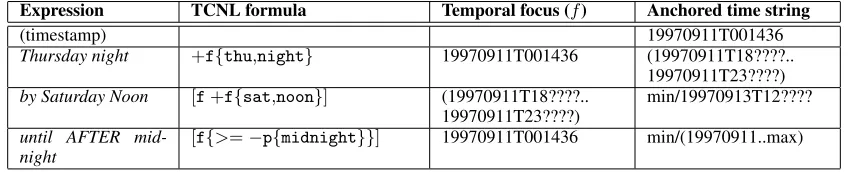
to represent it. Table. 3 shows the TEA output over the example email given in Fig. 1 (minandmaxare the minimal and the maximal time points TEA can reason with).
TEA uses the following procedure to anchor each temporal expression:
1. The speech time (variablenow) and the focus (‘ ’) is first assigned to a timestamp (e.g., the received date of an email).
2. For each temporal expression, its nearest verb chunk is identified using the part-of-speech tags of the sentence. Expressions associated with a verb of past tense or present imperfective will be given prefix “−p” to its TCNL formula, otherwise it is given “+f”7.
3. A finite-state parser is then used to transduce an expression into its TCNL formula. At the pars-ing stage the tense and granularity information is available to the parser.
7This is of course a simplification; future work needs to be
Table 3: Anchoring example for the email in Fig. 1
Expression TCNL formula Temporal focus (f) Anchored time string
(timestamp) 19970911T001436
Thursday night +f{thu,night} 19970911T001436 (19970911T18????.. 19970911T23????) by Saturday Noon [f+f{sat,noon}] (19970911T18????..
19970911T23????) min/19970913T12???? until AFTER
mid-night [f{>=−p{midnight}}] 19970911T001436 min/(19970911..max)
4. The produced TCNL formula (or formulae when ambiguity arises) is then evaluated with the speech time and the current focus. In case of ambiguity, one formula will be chosen based on certain heuristics (below). The result of the evaluation is the final output for the expression. 5. Recency-basedfocus tracking: we use the fol-lowing procedure to determine if the result ob-tained above can replace the current focus (be-low). In cases where the result is an ambigu-ous coordinate (i.e., it denotes a possible range of points), if one of the bounds isminormax, we use the other to be the new focus; if it is not possible, we choose to keep the focus un-changed. On the other hand, if the result is an enumeration, we go through a similar pro-cedure to avoid using an enumeration with a
min/max bound as the new focus. Finally no quantity can become a focus.
Note that in Step 3 the decision to make partial semantics of a temporal expression available to our parser is based on the following observation: con-sider the two expressions below
”Tuesday before Christmas” ={tue, <{|25day|@{dec}}} ”Tuesday before 6pm”
={<{tue,18hour},de{tue}}
Both expressions share the same “XbeforeY”
pat-tern, but their interpretations are different8. The key
to discriminate the two is to compare the granulari-ties ofXandY: ifY if at a coarser granularity then
the first interpretation should be adopted.
In Step 4 we use the following procedure to dis-ambiguate the result:
8dedenotes a relation “during or equal” (Allen, 1984).
1. Remove any candidate that resulted in an in-consistency when solving for a solution in the calendar CSP.
2. If the result is meant to be a coordinate, pick the one that is closest to the focus.
3. If the result is supposed to be an enumeration, pick the one whose starting point is closest to the focus, and whose length is the shortest one.
4. Otherwise pick the first one as the result.
For example, if the current time is 2:00 pm, for ex-pression “at 3” with a present/future tense, the best answer is 15:00. For expression “from 3 to 5”, the best answer is from 3 pm to 5 pm.
When deciding whether a temporal expression can become the next focus, we use simple heuris-tics to rule out any expression that behaves like a noun modifier. This is motivated by the following example (timestamp:19970919T103315):
IT basically analyses the breakdown on labor costs and compares our1998labor costs with their demands for1999-2000. ...
I will check mailon Sunday and see any feedback.
Table 4: Development and testing results
Accuracy Parsing errors Human errors Anchoring errors
email2 (dev) 78.2% 10.47% 1.7% 9.63%
email5 (dev) 85.45% 5.16% 1% 8.39%
email4
(test-ing) 76.34% 17.92%
<1% 5.74%
5 Evaluation
The temporal expressions in all of the datasets were initially tagged using rules developed for Minor-Third9, and subsequently corrected manually by two
of the authors. We then developed a prototype sys-tem and established our baseline overemail1(50%). The system at that time did not have any focus track-ing mechanism (i.e., it always used the timestamp as the focus), and it did not use any tense infor-mation. The result confirms our estimate given in Sec. 2. We then gradually developed TEA to its cur-rent form using email1, email2 and email5. Dur-ing the four-month development we added the focus tracking mechanism, incorporating the tense infor-mation into each TCNL formula via the coordinate prefixes, and introduced several representational im-provements. Finally we tested the system on the un-seen datasetemail4, and obtained the results shown in Table 4. Note that the percentages reported in the table are accuracies, i.e., the number of cor-rectly anchored expressions over the total number of temporal expressions over a dataset, since we are assuming correct tagging of all of the expressions. Our best result was achieved in the dev set email5
(85.45%), and the accuracy over the test setemail4
was 76.34%.
Table 4 also lists the types of the errors made by our system. The parsing errors are mistakes made at transducing temporal expressions using the finite-state parser into their TCNL formulae, the human errors are described in Sec. 2, and the rest are the anchoring errors. The accuracy numbers are all compared favorably to the baseline (50%). To put this performance in perspective, in (Wiebe et al., 1998) a similar task was performed over transcribed scheduling-related phone conversations. They re-ported an average accuracy 80.9% over the CMU
9http://minorthird.sourceforge.net/
test set and 68.9% over the NMSU test set. Although strictly speaking the two results cannot be compared due to differences in the nature of the corpora (tran-scription vs. typing), we nevertheless believe it rep-resents a closer match compared to the other works done on newswire genre.
It should also be noted that we adopted a simi-lar recency-based focus model as in (Wiebe et al., 1998). Although simple to implement, this naive approach proved to be one major contributor to the anchoring errors in our experiments. An example is given below (the anchored times are shown in sub-script):
This research can not proceed until the trade-offs are knownon Monday19970818. ...
Mary will perform this by
Friday(min..19970822) using the data from Monday19970825.
The last expression received an incorrect date: it should be the same date the expression “on Mon-day” refers to. Our system made this error because it blindly used the most recently mentioned time
((min..19970822)) as the focus to anchor the
formula+f{mon}. This error later also propagated to the anchoring of the subsequent expressions.
6 Conclusion and Future Work
arithe-maticsare encapsulated in its type system and oper-ators. The performance of our anchoring system is significantly better than baseline, and compares fa-vorably with some of the closely related work.
In the future we will re-examine our focus track-ing mechanism (betrack-ing the most significant source of errors), and possibly treat it as a classification prob-lem (similar to (Mani et al., 2003)). We also need to investigate the disambiguation procedure and pos-sibly migrate the functionality into a separate dis-course module. In addition, the co-referencing ten-dency of noun-modifying expressions could lead to a better way to anchoring this particular type of tem-poral expressions. Finally we would like to ex-pand our coverage of temporal expressions to in-clude other types of expressions such as recurrence expressions10.
Acknowledgments
This material is based upon work supported by the Defense Advanced Research Projects Agency (DARPA) under Contract No. NBCHD030010.
Any opinions, findings and conclusions or recom-mendations expressed in this material are those of the author(s) and do not necessarily reflect the views of the Defense Advanced Research Projects Agency (DARPA), or the Department of Interior-National Business Center (DOI-NBC).
References
J. F. Allen. 1984. Towards a General Theory of Action and Time.Artificial Intelligence, 23:123–154.
I. Androutsopoulos. 1999. Temporal Meaning Rep-resentations in a Natural Language Front-end. In M. Gergatsoulis and P. Rondogiannis, editors, Inten-sional Programming II (Proceedings of the 12th In-ternational Symposium on Languages for Intensional Programming, Athens, Greece.
E. Filatova and E. Hovy. 2001. Assigning Time-Stamps To Event-Clauses. In Proceedings of ACL-2001: Workshop on Temporal and Spatial Information Processing, Toulouse, France, 7.
10The current design of TCNL allows for a more restricted
type of recurrence: e.g., “3pm from Wednesday to Friday” is represented as[{15hour}&[{wed}:{fri}]]. However this is
in-sufficient to represent expressions such as “every 4 years”.
Benjamin Han and Michael Kohlhase. 2003. A Time Calculus for Natural Language. In The 4th Work-shop on Inference in Computational Semantics, Nancy, France, September.
B. Han, D. Gates, and L. Levin. 2006. From Language to Time: A Temporal Expression Anchorer. In Proceed-ings of the 13th International Symposium on Tempo-ral Representation and Reasoning (TIME 2006), Bu-dapest, Hungary.
J. R. Hobbs and Feng. Pan. 2004. An ontology of time for the semantic web. TALIP Special Issue on Spa-tial and Temporal Information Processing, 3(1):66– 85, March.
R. E. Kraut, S. R. Fussell, F. J. Lerch, and A Espinosa. 2004. Coordination in teams: Evidence from a sim-ulated management game. Journal of Organizational Behavior, to appear.
I. Mani and G. Wilson. 2000. Robust Temporal Process-ing of News. InProceedings of ACL-2000.
I. Mani, B. Schiffman, and J. Zhang. 2003. Inferring Temporal Ordering of Events in News. InProceedings of the Human Language Technology Conference (HLT-NAACL’03).
Zs´ofia Ruttkay. 1998. Constraint Satisfaction - a Survey. Technical Report 11(2-3), CWI.
Roser Saur´ı, Jessica Littman, Bob Knippen, Robert Gaizauskas, Andrea Setzer, and James Pustejovsky, 2006. TimeML Annotation Guidelines, Version 1.2.1, January 31.
F. Schilder and C. Habel. 2001. From Temporal Expres-sions To Temporal Information: Semantic Tagging Of News Messages. InProceedings of ACL-2001: Work-shop on Temporal and Spatial Information Processing, Toulouse, France, 7.
Andrea Setzer. 2001.Temporal Information in Newswire Articles: an Annotation Scheme and Corpus Study. Ph.D. thesis, University of Sheffield.
M. Stede and S. Haas. 1998. Understanding and track-ing temporal descriptions in dialogue. In B. Schr¨oder, W. Lenders, W. Hess, and T. Portele, editors, Proceed-ings of the 4th Conference on Natural Language Pro-cessing - KONVENS ’98.
N. Vazov. 2001. A System for Extraction of Tempo-ral Expressions from French Texts Based on Syntac-tic and SemanSyntac-tic Constraints. InProceedings of ACL-2001: Workshop on Temporal and Spatial Information Processing, Toulouse, France, 7.