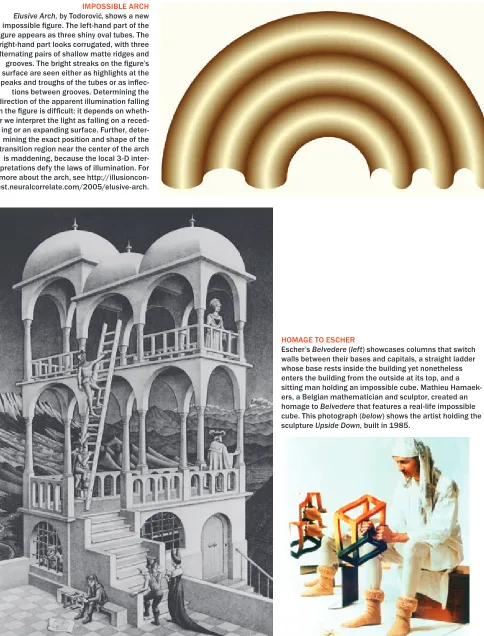
169 BEST ILLUSIONS
SPECIAL ISSUE:
169 BEST ILLUSIONS
M
BEHAVIOR
•
BRAIN SCIENCE
IND
•
INSIGHTS
You won’t believe your eyes
w w w.ScientificAmerican.com/Mind
Display until July 12, 2010
Illusory
Motion
“Impossible”
Figures
Ghostly
Visions
Morphing
Colors
>
Illusory
Motion
How It
Arises
“Impossible”
Figures
From Real
Sculptures
Ghostly
Visions
Effects of
Afterimages
Morphing
Colors
Hues That
Shift and
Spread
>
THE SCIENCE OF
Nature
marks the anniversary of the publication of Charles Darwin’s
On
The Origin Of Species
150 years ago, with a special issue on biodiversity. Access an extensive collection of news, features and
comment commemorating Darwin’s life, his science and his legacy, with selected content available free
online at: www.nature.com/darwin
Gain access to the latest research, landmark specials, videos, podcasts and Insights.
Subscribe to
Nature
and receive a special 30% discount.
www.nature.com/SciAmdiscount
T
he Natur
al History Museum, L
ondon/
ar
tw
ork b
y Nik Spenc
er
Special issue
(f
rom the editor
)
M
behavior • braiN SCieNCeInd
• iNSightSMariette DiChristina
Editor in Chief
[email protected]
C
o
v
E
R
I
M
A
g
E
C
o
u
R
T
E
S
y
o
F
A
k
Iy
o
S
h
I
k
IT
A
o
k
A
R
it
s
u
mei
k
a
n
U
n
iv
er
s
it
y
EDIToR IN ChIEF: Mariette DiChristina
ISSuE EDIToR:Dawn Stover
ART DIRECToR: Patricia Nemoto
ISSuE phoTogRAphy EDIToR:
Smitha Alampur
Copy DIRECToR: Maria-Christina Keller
EDIToRIAL ADMINISTRAToR: Avonelle Wing
SENIoR SECRETARy: Maya Harty
CoNTRIbuTINg RESEARChERS: Kenneth Silber, Kevin Singer
Copy AND pRoDuCTIoN, NATuRE pubLIShINg gRoup: SENIoR Copy EDIToR, Npg:
Daniel C. Schlenoff
MANAgINg pRoDuCTIoN EDIToR, Npg:
Richard Hunt
SENIoR pRoDuCTIoN EDIToR, Npg:
Michelle Wright
vICE pRESIDENT AND pubLIShER:
Bruce Brandfon
vICE pRESIDENT, MARkETINg AND SALES DEvELopMENT: Michael Voss
DIRECToR, gLobAL MEDIA SoLuTIoNS: Jeremy A. Abbate
MANAgER, INTEgRATED MEDIA SALES: Stan Schmidt
SALES DEvELopMENT MANAgER: David Tirpack pRoMoTIoN MANAgER: Diane Schube
MARkETINg RESEARCh DIRECToR: Rick Simone
SALES REpRESENTATIvES: Jeffrey Crennan, Chantel Arroyo
vICE pRESIDENT, FINANCE AND buSINESS DEvELopMENT: Michael Florek
buSINESS MANAgER: Marie Maher
MANAgINg DIRECToR, CoNSuMER MARkETINg:
Christian Dorbandt
ASSoCIATE DIRECToR, CoNSuMER MARkETINg:
Anne Marie O’Keefe
SENIoR MARkETINg MANAgER/RETENTIoN:
Catherine Bussey
SENIoR MARkETINg MANAgER/ACquISITIoN:
Patricia Elliott
DIRECToR, ANCILLARy pRoDuCTS:
Diane McGarvey
pRESIDENT: Steven Inchcoombe
vICE pRESIDENT, opERATIoNS AND ADMINISTRATIoN: Frances Newburg
pRoDuCTIoN MANAgER: Christina Hippeli
ADvERTISINg pRoDuCTIoN MANAgER:
Carl Cherebin
pREpRESS AND quALITy MANAgER:
Silvia De Santis
CuSToM pubLIShINg MANAgER:
Madelyn Keyes-Milch
pRoDuCTIoN CooRDINAToR, Npg:
Lisa Headley
Now See This
Who says science isn’t fun? Visual illusions, such as the dozens you will find in this spe-cial issue, make great eye candy. But they also serve a serious purpose for researchers. How? Illusions push the mysterious and wondrous brain into revealing its secrets.
From the confusing and fragmentary inputs gathered by our senses, our brains create our seemingly fluid conscious perceptions and a sensible narrative of the world around us. Brains do not, however, talk to us about how they perform those impres-sive tasks. Scientists can learn a lot by using imaging equipment and by making other observations. But sometimes they also have to “trick” brains, the better to probe perception. That’s where illusions come in.
“It is a fact of neuroscience that everything we experience is actually a figment of our imagination,” write Susana Martinez-Conde, director of the Laboratory of Visual Neuroscience at the Barrow Neurological Institute in Phoenix, and Stephen L. Macknik, director of the Laboratory of Behavioral Neurophysiology at Barrow, in “The Neuroscience of Illusion,” starting on page 4. “Although our sensations feel accurate and truthful, they do not necessarily reproduce the physical reality of the outside world.” Martinez-Conde and Macknik, whose articles fill this special edi-tion, study these disconnects between reality and perception for clues about the brain’s operations. On the following pages you will learn, among other things, about “impossible” figures, 3-D visualization and kinetic illusions in op art.
1
>>
From the Editor
FOuNdATIONS OF
MISpERCEpTION
4
>>
The Neuroscience
of Illusion
How tricking the eye reveals the inner workings of the brain.
By SuSANA MARTINEZ-CONdE ANd STEpHEN L. MACkNIk
8
>>
A Perspective on
3-D Visual Illusions
What the leaning tower and related illusions reveal about how your brain constructs 3-d images.By STEpHEN L. MACkNIk ANd SuSANA MARTINEZ-CONdE
12
>>
The Neuroscience of
Yorick’s Ghost and
Other Afterimages
Staring at images can temporarily reset retinal cells and cause ghostly visions.By STEpHEN L. MACkNIk ANd SuSANA MARTINEZ-CONdE
16
>>
Colors Out of Space
Colors can change withtheir surroundings and spread beyond the lines.
By STEpHEN L. MACkNIk ANd SuSANA MARTINEZ-CONdE
(c
ontents
)
Articles in this special edition are updated from Mind Matters, an expert-written online section of Scientifi c American Mind.
4
Volume 20, Number 1, Summer 2010
16
GA ZING AT E ACH OTHER
26
>>
What’s in a Face?
The human brain is good at identifying faces, but illusions can fool our “face sense.”
By SuSANA MARTINEZ-CONdE ANd STEpHEN L. MACkNIk
36
>>
The Eyes Have It
Eye gaze is critically important to social primates such as humans. Maybe that is why illusions involving eyes are so compelling.
By SuSANA MARTINEZ-CONdE ANd STEpHEN L. MACkNIk
42
>>
The Illusions of Love
How do we fool thee? Let us count the ways that illusions play with our hearts and minds.
By STEpHEN L. MACkNIk ANd SuSANA MARTINEZ-CONdE
ART ANd ILLuSION
48
>>
Art as Visual Research:
Kinetic Illusions in Op Art
Art and neuroscience combine to create fascinating examples of illusory motion.By SuSANA MARTINEZ-CONdE ANd STEpHEN L. MACkNIk
56
>>
Sculpting the Impossible: Solid
Renditions of Visual Illusions
Artists find mind-bending ways to bring impossible figures into 3-d reality.By STEpHEN L. MACkNIk ANd SuSANA MARTINEZ-CONdE
64
>>
Food for Thought: Visual
Illusions Good Enough to Eat
Face or food? The brain recognizes edible artwork on multiple levels.By SuSANA MARTINEZ-CONdE ANd STEpHEN L. MACkNIk
Scientific American Special (ISSN 1936-1513), Volume 20, Number 1, Summer 2010, published by Scientific American, a division of Nature America, Inc., 75 Varick Street, 9th Floor, New york, Ny 10013-1917. Canadian BN No. 127387652RT; QST No. Q1015332537. To purchase additional quantities: u.S., $10.95 each; elsewhere, $13.95 each. Send payment to Scientific American, dept. IL2010, 75 Varick Street, 9th Floor, New york, Ny 10013-1917. Inquiries: fax 212-355-0408 or telephone 212-451-8442. printed in u.S.A.
Copyright © 2010 Scientific American, a division of Nature America, Inc. All rights reserved.
56
36
4
e
D
W
a
r
D
H
.
a
D
e
L
s
o
n
M
.I
.T
.
I
t is a fact of neuroscience that everything we experience is actually a figment of our imagination. Although our sensa-tions feel accurate and truthful, they do not necessarily re-produce the physical reality of the outside world. Of course, many experiences in daily life reflect the physical stimuli that send signals to the brain. But the same neural machinery that interprets inputs from our eyes, ears and other sensory or-gans is also responsible for our dreams, delusions and failings of memory. In other words, the real and the imagined share a physical source in the brain. So take a lesson from Socrates: “All I know is that I know nothing.”One of the most important tools used by neuroscientists to understand how the brain creates its sense of reality is the visu-al illusion. Historicvisu-ally, artists as well as illusionists have used illusions to gain insights into the inner workings of the visual system. Long before scientists were studying the properties of neurons, artists had devised a series of techniques to deceive the brain into thinking that a flat canvas was three-dimensional or that a series of brushstrokes was indeed a still life.
Visual illusions are defined by the dissociation between the physical reality and the subjective perception of an object or event. When we experience a visual illusion, we may see some-thing that is not there or fail to see somesome-thing that is there. Be-cause of this disconnect between perception and reality, visual illusions demonstrate the ways in which the brain can fail to re-create the physical world. By studying these failings, we can learn about the computational methods used by the brain to construct visual experience.
Brightness, color, shading, eye movement and other factors can have powerful effects on what we “see.” In this series of im-ages, we showcase several basic categories of visual illusions and what they can teach us about perception in the brain.
SUSANA MARTINEZ-CONDE and STEPHEN L. MACKNIK are laboratory directors at the Barrow Neurological Institute in Phoenix. They are authors of the book Sleights of Mind: What the Neuroscience of Magic Reveals about Our Everyday Deceptions, with Sandra Blakeslee (http://sleightsofmind.com), to be published in November 2010.
BrigHtness iLLusions
in this illusion, created by vision scientist edward H. adel son of the massachusetts institute of technology, squares
a and b are the same shade of gray. (if you don’t believe it, cut out the two squares and place them side by side.) this trick of the eye occurs because our brain does not directly perceive the true colors and brightness of objects in the world but instead compares the color and brightness of a given item with others in its vicinity. for instance, the same gray square will look lighter when surrounded by black than when it is surrounded by white.
another example: when you read printed text on a page under indoor lighting, the amount of light reflected by the white space on the page is lower than the amount of light that would be reflected by the black letters in direct sunlight. Your brain doesn’t really care about actual light levels, though, and instead interprets the letters as black because they remain darker than the rest of the page, no matter the lighting conditions. in other words, every news paper is also a visual illusion!
The Neuroscience
of Illusion
How tricking the eye reveals the inner workings of the brain
5
c
o
u
r
t
e
s
Y
o
f
a
K
iY
o
s
H
i
K
it
a
o
K
a
R
it
s
u
mei
k
a
n
U
n
iv
er
s
it
y
(
s
n
a
ke
s
);
B
e
a
u
L
o
t
t
o
a
n
D
D
a
L
e
p
u
r
V
e
s
D
u
k
e
U
n
iv
e
rs
it
y
(
c
ub
e
)
coLor in context this illusion, created by Beau Lotto and Dale purves of Duke university, is another example of how the brain can perceive the same color differently when viewed in a different context. the central brown square on the top of the cube is exactly the same color as the central orange square on the side of the cube facing the viewer. the latter square looks orange because the lighting and surrounding squares make it appear brighter than the brown square in the mind’s eye.
iLLusorY motion
some stationary patterns generate the illusory perception of motion. this unsettling effect is usually stronger if you move your eyes around the figure. for instance, in this illusion created by akiyoshi Kitaoka, a professor of psychology at ritsumeikan university in Japan, the “snakes” appear to rotate. But nothing is really moving other than your eyes!
6
r
ic
H
a
r
D
g
r
e
g
o
r
Y
(
c
af
é
a
n
d
c
af
é
w
a
ll
i
llu
s
ion
);
c
o
u
r
t
e
s
Y
o
f
a
K
iY
o
s
H
i K
it
a
o
K
a
(
b
u
lge
)
amBiguous figures
this bunch of violets contains the faces of napoleon Bonaparte, marie Louise of austria and their son. can you find them among the flowers? napoleon’s admiring troops gave him the name of “PetitCaporal,” or “Little corporal”: their leader’s short stature had not prevented him from defeating four armies larger than his own during his very first campaign. Years later, when Bona parte was banished to the isle of elba, he told his friends he would return with the violets, thus earning the nickname of “corporal Violet, the little flower that returns with spring.” When he broke his imposed exile to return to france, women support ers assembled to sell violets. they would ask passersby, “Do you like violets?” answering “oui” indicated that the person was not a confederate; “eh bien” signaled that the respondent adhered to napoleon’s cause. napoleon’s supporters distributed reproduc tions of this 1815 engraving.
in ambiguous illusions such as this one, the brain interprets the same picture in two different ways, with the two interpreta tions being mutually exclusive. You can see one of two possible images, but not both at the same time.
these socalled ambiguous figures are especially powerful tools to dissociate the subjective perception from the physical world. the physical object never changes, yet our perception alternates between two (or more) possible interpretations. for this reason, ambiguous illusions are used by many laboratories in the search for the neural correlates of consciousness.
sHape Distortion
the visual oddity above, known as the café wall illusion, was discovered on the exterior of a small restaurant near richard gregory’s psychology laboratory in Bristol, england. (the photograph, taken a few months ago, shows gregory outside the café.) steve simpson, a member of gregory’s lab at the time, noticed that the parallel grout lines between the green and white tiles on the wall appeared to be tilted, even though the tiles were actually straight.
scientists use a simplified blackand white version of the café wall illusion (above,
center) to demonstrate how objects or patterns can appear to take on shapes that are different from their true physical form. the illusion works only when the contrasting black and white “tiles” are offset and when every tile is surrounded by a border of gray “grout.” Because different types of neurons in the brain react to the dark and light shades of the tiles, the grout appears to be dimmer in some places and brighter in others—and the brain interprets this con trast as a sloping line.
as with brightness and color illusions, shape distortion effects are produced by the
interaction between the actual shape of the object and the shapes of nearby figures. for the brain, perception is very often dependent on context.
7
r
É
u
n
io
n
D
e
s
m
u
s
É
e
s
n
a
t
io
n
a
u
x
/a
r
t
r
e
s
o
u
r
c
e
,
n
Y
(
t
h
e
a
tt
ri
b
u
te
s o
f t
h
e
p
a
in
te
r)
;
s
c
a
L
a
/a
r
t
r
e
s
o
u
r
c
e
,
n
Y
(
c
up
o
la
);
a
n
D
r
e
a
J
e
mo
L
o
C
orb
is
(
P
a
la
zzo
S
p
ad
a
)
3D iLLusions
Visual artists often try to imitate reality closely. painters convey the illusion of reality, volume or distance by making intuitive use of perspective, color, lighting and shadow. When they are success ful, the artwork is sometimes difficult to distinguish from the subject itself.
pliny the elder, in his Natural History encyclopedia, narrated the legendary competition between two renowned painters in ancient greece: Zeuxis and parrhasius. each of the artists brought a covered painting to the contest. Zeuxis uncovered his work: he had painted grapes so realistic that birds flew from the sky to peck at them. convinced of his victory, Zeuxis tried to uncover parrhasius’s painting to confirm the superiority of his work. He was defeated, however, because the curtain he tried to pull back was parrhasius’s painting itself.
such techniques were carried to the limit in trompe l’oeil, a french term that means “to trick the eye.” this style of photo graphic realism first appeared in the renaissance and flourished in the 17th century in the netherlands. the lifelike pictures some times appeared to literally jump from the frame. in The Attributes of the Painter, a 17thcentury work by cornelius n. gysbrechts, a painting appears to curl off the artist’s easel (above, left).
the cupola of the st. ignatius of Loyola church in rome (above, right) is a great example of Baroque illusionism. the architect of the church, orazio grassi, had originally planned to build a cupola but died before finishing the church, and the money was used for something else. thirty years later, in 1685, Jesuit artist andrea pozzo was asked to paint a fake dome on the ceiling over the altar. although pozzo was already considered a master in the art of perspective, the results he accomplished could hardly be believed. even today many visitors to the church are amazed to find out that the spectacular cupola is not real but an illusion.
a D r ia n a o L m o s ; f r o m “ t H e L e a n in G t o W e r i L L U s io n : a n e W i L L U s io n o f p e r s p e c t iV e ,” B Y f. a .a . K in G D o m , a . Y o o n e s s i a n D e . G H e o r G H iU , in P ER C EP T IO N , V o L . 3 6 ; 2 0 0 7
H
ow could we have missed it? Hundreds, perhapsthousands, of visual scientists, psychologists, neuroscientists, visual artists, architects, engi-neers and biologists all missed it—until three years ago. The “it” in question is the leaning tower illusion, discovered by Frederick Kingdom, Ali Yoon-essi and Elena Gheorghiu of McGill University. In this illu-sion, two identical side-by-side images of the same tilted and receding object appear to be leaning at two different angles. This incredible effect was first noticed in images of the famed Leaning Tower of Pisa, but it also works with paired images of other receding objects.
The leaning tower illusion is one of the simplest visual tricks one can produce, but it is also one of the most profound in relation to our understanding of depth perception. This fact is why vision scientists are shaking their heads in disbe-lief that they did not notice the illusion earlier. Kingdom and his colleagues announced the illusion at the 2007 Best Illu-sion of the Year Contest, where it won first prize.
The annual contest, which we organize and which is host-ed by the Neural Correlate Society, celebrates the ingenuity and creativity of the world’s premier creators of visual illu-sions, both artists and scientists. Contestants submit novel visual illusions (that is, unpublished or published no earlier than the previous year). An international panel of impartial judges conducts the initial review and narrows the dozens of submissions down to the 10 best entries. The top 10 creators then compete in Naples, Fla., during a gala celebration, in which the au dience chooses the top three winners. First, sec-ond and third prizes take home the coveted “Guido” (a three-dimensional illusion sculpture that was created by renowned Italian sculptor Guido Moretti).
STEPHEN L. MACKNIK and SUSANA MARTINEZ-CONDE are labora-tory directors at the Barrow Neurological Institute in Phoenix. They are authors of the book Sleights of Mind: What the Neuroscience of Magic Reveals about Our Everyday Deceptions, with Sandra Blakeslee (http://sleightsofmind.com), to be published in No-vember 2010.
A Perspective on
3-D Visual Illusions
tWin toWers?
in the leaning tower illusion, the tower on the right appears to be leaning more than the tower on the left. Yet these two photographs of the Leaning tower of pisa are duplicates.
the illusion reveals the way in which the human visual system uses perspective to help construct our perception of 3-D objects. We say “construct” because the visual system has no direct access to 3-D information about the world. our perception of depth results from neural calculations based on a set of rules.
these rules include the following: perspective (parallel lines appear to converge in the distance); stereopsis (our left and right eyes receive horizontally displaced images of the same object, resulting in the perception of depth); occlusion (objects near us occlude objects farther away); chiaroscuro (the contrast of an object as a function of the position of the light source); and sfumato (the feeling of depth that one gets from the interplay of in- and out-of-focus elements in an image, as well as from the level of transparency of the atmo-sphere itself). Because the towers pictured in these paired images do not converge as they recede, the brain mistakenly perceives them as nonparallel and diverging.
to learn more about this illusion, go to http://illusioncontest. neuralcorrelate.com/2007/the-leaning-tower-illusion.
What the leaning tower and related illusions reveal about
how your brain constructs 3-D images
t H oma s H a Lt n e r ( P e tr o n a s ); c o U r t e s Y o f B . m ic K L e t H W a it , p U B L is H e D in P ER C EP T IO N , V o L . 3 6 ; 2 0 0 7 , B Y p ion L im it e D , L on D on ( tr a c k s ); c o U r t e s Y o f a K iY o s H i K it a o K a R it s u mei k a n U n iv er s it y (m a n g a g irl s )
BreaKinG tHe rULes
further analysis of similar images reveals subtleties in the way our visual system processes the perception of depth and perspective. for instance, the leaning tower illusion also works with paired images of train tracks, violating the classical rules of perspective. it is hard to believe, but these are actually identical images of parallel train tracks. although the angles are the same in both images, the brain perceives them as being quite different.
LacKinG DeptH
the leaning tower illusion does not occur when viewing two leaning Japanese manga
girls, even though the two cartoon images are tilted. the reason is that the cartoon girls do not appear to recede in depth, so
our brain does not expect that they would converge in the distance. this
phenomenon demonstrates that the brain applies its depth-
perception tool kit only in specific situations. cominG toGetHer
10
tHinKinG insiDe tHe Box the leaning tower illusion is such a fundamental feature of our visual system that it works even if one draws a 3-D solid object as it recedes into the distance. the parallel lines give the illusion
of diverging in the distance. that is, the box appears wider at the back than it does at the front, when it fact the back and front are precisely the same width on the retina.
c
o
U
r
t
e
s
Y
of
f
r
e
D
e
r
ic
K
K
in
GD
om
(
re
c
e
din
g
b
ox
);
W
a
r
n
e
r
B
r
o
s
/
t
H
e
K
o
B
a
L
c
o
L
L
e
c
t
ion
(
t
h
e
m
a
tr
ix
)
WHat is reaL?
Just as the painter creates the illusion of depth on a flat canvas, our brain creates the illusion of depth based on information arriving from our essentially 2-D retinas. Visual illusions show us that depth, color, brightness and shape are not absolute terms but are subjective, relative experiences actively created by complicated brain circuits. this is true not only of visual experiences but of any sensation. Whether we experience the feeling of “redness,” the appearance of “squareness,” or emotions such as love and hate, these are the results of the electrical activity of neurons in our brain.
11
anamorpHic art thanks to the brain’s rules of
perspective, artists can fool the brain into perceiving two-dimensional drawings as three-dimensional. artist Kurt Wenner’s 3-D pavement paintings—such as Muses in Lucerne, switzerland—are anamorphic illusions that create an impression of three dimensions when seen from one particular viewpoint (above). from the “wrong” side, however, you can see the distortions that Wenner uses to create the 3-D effect (right). the word “anamorphic” comes from the Greek
mean-ing “formed again.”
K
U
r
t
W
e
nne
12
li
v
e
w
ir
e
pu
z
z
le
s
(
w
w
w
.pu
z
z
le
s
.c
a
)
Alas, Poor Yorick! I knew him, Horatio; a fellow of in-finite jest, of most excellent fancy; he hath borne me on his back a thousand times; and now, how abhorred in my afterimage he is!
W
ell … that’s what William Shakespeare’s Hamlet might have said, had he been looking at a vintage Pears’ Soap advertisement bear-ing court jester Yorick’s skull, rather than holding an exhumed and rotting Danish cra-nium. Stare long enough at the skull in the ad, and it will be “burned” into your vision even after you look away.Afterimages such as Yorick’s skull help us understand how neurons in various areas of the brain adapt to the visual
envi-ronment. Adaptation, in this case, is the process by which neu-rons habituate to, and eventually cease responding to, an un-changing stimulus. Once neurons have adapted, it takes a while for them to reset to their previous, responsive state: it is during this period that we see illusory afterimages. We see such images every day: after briefly looking at the sun or at a bright lightbulb or after being momentarily blinded by a camera flash, we per-ceive a temporary dark spot in our field of vision.
STEPHEN L. MACKNIK and SUSANA MARTINEZ-CONDE are laboratory directors at the Barrow Neurological Institute in Phoenix. They are authors of the book Sleights of Mind: What the Neuroscience of Magic Reveals about Our Everyday Deceptions, with Sandra Blakeslee (http://sleightsofmind.com), to be published in November 2010.
The Neuroscience
of Yorick’s Ghost and
Other Afterimages
to see or not to see ...
to experience this antique illusion (left), stare at the X in Yorick’s left eye socket for about 30 seconds. then look away at a flat surface such as a piece of paper, wall, ceiling or sky, and you will see Yorick’s afterimage as a ghostly apparition.
vision scientists believe that the adapta-tion effect producing poor Yorick’s ghost largely takes place in the neurons of the retina. How can we know? close your right eye and stare at the X again. then look at the wall again to see the afterimage, but this time switch back and forth between closing one eye and the other. only the left eye—
which was open during the adaptation peri-od—will reveal Yorick’s ghost. this means that the adaptation must have taken place only in neurons responding to stimulation from the left eye. if the adaptation had occurred in the binocular neurons of the brain (in the primary visual cortex and higher visual areas), you would see Yorick’s ghost with either eye.
Staring at images can temporarily reset retinal cells
and cause ghostly visions
13
r
o
b
Je
n
k
in
s
U
n
iv
e
rs
it
y
o
f
Gl
a
s
g
o
w
an
d
r
ic
H
ar
d
w
is
e
m
an
U
n
iv
er
s
it
y
o
f
H
er
tf
o
rd
s
h
ir
e
(
D
a
rw
in
a
nd
mo
n
k
e
y
s
im
a
g
e
);
©
2
0
0
2
g
.
s
a
r
c
o
n
e
(
c
o
w
a
n
d
f
ly
i
m
a
g
e
s
)
evolution and adaptation in celebration of the 200th anniversary of charles darwin’s birth, psychologists rob Jenkins of the university of glasgow in scotland and richard wiseman of the university of Hertfordshire in england created an illusory homage to darwin’s
evolu-tionary roots. stare at the center of the image for 30 seconds, then look away at a white surface. the two monkeys turn into an afterimage of darwin’s portrait! an afterimage is never as sharp as the original. Jenkins and wiseman took ad- vantage of this difference in resolution to create an image that looks one way in “normal” high-resolution vision and a different way as a lower-resolution afterimage.
bovine flY
this illusion shows the interaction between color perception and after-images. first, notice that the left image has a color imbalance to the right and left of the fly: the left side is bluish, and the right side has too much yellow. now fixate your gaze on the fly in the right image for 30 seconds: this staring will make the neurons in your retina adapt to a blue hue on the left and yellow on the right. as a result, your left visual field will become less sensitive to blue and your right visual field less sensitive to yellow. then look back at the fly on the cow’s nose, and the image will appear to have a perfect color balance.
14
e X p l or a t or iu m ( w w w .e X p l or a t or iu m .e d u ) ( b ir d s i n c a g e ); Y u v a l b a r k a n a n d H e d v a s p it z e r Te l A vi v U n iv e rs it y ( fl y in g b ir d s ); c o u r t e s Y o f a k iY o s H i k it a o k a R it s u mei k a n U n iv er s it y ( re d a n d y e ll o w b e a d s )red and Yellow beads gaze at the cross between the upper and lower squares for about 30 seconds. then look immediately at the cross on the right, and you should see 18 colored beads: nine red beads above the cross and nine yellow beads below the cross. the beads are all gray in the image itself, but the surrounding colors induce colored afterimages. a bird of a different featHer
positive afterimages can be captured from a complemen-tary surrounding color, as in this demonstration of an uncolored bird that captures the reddish color of its background. stare for about 30 seconds at the “target” on the bird in the left panel. then look immediately at the same spot on the bird in the right panel.
in this illusion, created by vision scientists Yuval barkan and Hedva spitzer of tel aviv university in israel, the red background in the left panel causes the bird to fill in with a complementary blue-green color, which gives rise to a surprisingly strong and long-lasting red afterim-age of the bird once the red background is removed.
this illusion won second prize in the 2009 best illu-sion of the Year contest. to experience an even more striking version of this illusion with a “flying” bird, visit http://illusioncontest.neuralcorrelate.com/2009/ color-dove-illusion
birds in a cage
when you stare at a color image, its afterimage takes on a shade of its own. for example, stare at the eye of the red parrot for 30 seconds, then immediately look at the center of the empty birdcage. You should see a ghostly blue-green parrot inside. try the same thing with the green cardinal, and you should see a pink bird. this illusion is part of an exhibit at the exploratorium museum in san francisco.
gazing at any colored surface can induce a vivid afterimage of the complementary color. for example, staring at the color red induces a blue-green afterimage because the cells in
your retina that respond to red light adapt to the red environment by reducing their activity—to save energy and to prepare themselves for detecting any future changes in redness. when you look away to a
15
Jo H n s ado w sk i ( c a s tl e i mag e s ); f r o m “f il l in g -i n a f t e r im a g e c o l o r s b e t w e e n t H e l in e s ,” b Y r . v a n l ie r , m . v e r g e e r a n d s . a n s t is , in c U R R e n T b io lo G y , v o l . 1 9 , n o . 8 ; 2 0 0 9 ( s ta r a ft erim a g e s ); f r o m “ m e ta m e r ic i n t r a n s it iv it Y ,” b Y a . e . H u a n g , a . J. H o n , c . w . t Y l e r a n d e . l . a lt s c H u l e r , in A T T en T io n , P e R c e P T io n & P S y c H o P H y S ic S ( in p r e s s ) ( le tte rs ); Jo H n bo r t ni a k n o A A ( S o u th P ol e imag e s )tHe spanisH inquisition
this incredible afterimage illusion shows just how power-ful a little color can be. first, fixate your gaze on the tiny black spot in the center of the left image. notice that no contours are present in the image, just splotches of pure color. once you have adapted your retina for about 30 seconds, look at the black-and-white image of the manzanares el real castle, near madrid, spain, on the right (again, fixate on the black spot in the center). ¡olé! the spanish castle has gone from black-and-white to glorious color.
this illusion demonstrates that the brain can assign color to monochromatic objects, even when the color is from an afterimage. the illusion is effective only when the afterimage lines up perfectly
with the actual image—otherwise the actual image dominates, and the color is suppressed. the neural details of this complex process are largely unknown.
sHape-specific afterimages
in this illusion a single colored image produces two afterimages of different colors, depending on the shapes you look at afterward. fixate your gaze on the black dot between the colored stars in the middle panel and stare at it for 30 seconds without moving your eyes. then look at the empty outlines in the top panel. the left one fills in with a ghostly blue-green, and the right one looks reddish. when you look at the bottom panel, the colors are reversed.
How does one image produce two afterimages of different colors? and how does the shape of the outline determine the filled-in color? the creators of this illusion, rob van lier and mark vergeer of radboud university nijmegen in the netherlands, suggest that patches of an afterimage can spread and merge to fill the contours of an outlined shape. the shape at the upper right takes on a reddish hue because it has the same outline as the complementa-ry blue-green patches in the original color image. likewise, the blue-green-tinged shape on the upper left matches the red patches in the color image.
tHe least colorful place on eartH afterimage color assignment works very well with objects to which humans are exquisitely well tuned, such as faces. gaze for 30 sec-onds at this reverse-color portrait of John bortniak, commander in the national ocean-ic and atmospherocean-ic administration corps, at the south pole (left) and then look at the image on the right to see it in color. notHing is tHe same
these incredible illusions by abigail e. Huang, alice J. Hon, christopher w. tyler and eric l. altschuler of new Jersey medical school and the smith-kettlewell eye institute show that objects of the same apparent color can look like different colors in an afterimage and that differently colored objects can appear to be the same color in an afterimage. gaze at the white spot between the yellow letters M and P in the upper image. Hold your gaze for 30 seconds and then look at a white wall. You will see an afterimage of the letters, which are now magenta (M) and purple (P).
in the lower image there are two Y’s, one blue and one purple. look at the white spot between them for 30 seconds and then move your eyes to a white wall. You will now see that the Y’s are the same shade of yellow in the afterimage. in fact, the M and P in the upper image are different colors that only look the same shade of yellow because of the effect of the red and black backgrounds. in the
c
o
U
r
t
e
s
Y
o
f
a
K
iY
o
s
H
i
K
it
a
o
K
a
R
it
s
u
mei
k
a
n
U
n
iv
er
s
it
y
It was just a colour out of space—a frightful messenger from unformed realms of infinity beyond all Nature as we know it; from realms whose mere existence stuns the brain and numbs us with the black extra-cosmic gulfs it throws open before our frenzied eyes.
S
cience-fiction author H. P. Lovecraft consideredThe Colour Out of Space his best story. In this 1927 classic tale of cosmic horror, a small Massa-chusetts farming community faces unspeakable evil from the outer reaches of the universe. The ex-traterrestrial villain is not a face-hugging or chest-bursting alien but something far more terrifying: a weird color.
Slowly but surely the otherworldly color mutates and de-stroys crops, insects, wild animals and livestock. It impregnates
the land and the water. The unfortunate farmers who encoun-ter the bizarre hue fall prey to insanity and untimely death.
And you thought vision research was for wimps.
This article features some of the most spectacular color phe-nomena this side of the galaxy. You won’t see any extraterres-trials, but many strange illusions arise from taking colors out of place and putting them in an unusual context. Use caution: the peculiar shades and tints you are about to experience could blow your mind.
STEPHEN L. MACKNIK and SUSANA MARTINEZ-CONDE are laboratory directors at the Barrow Neurological Institute in Phoenix. They are authors of the book Sleights of Mind: What the Neuroscience of Magic Reveals about Our Everyday Deceptions, with Sandra Blakeslee (http://sleightsofmind.com), to be published in No vember 2010.
Colors Out of Space
Yellow moon and BlUe moon Here we have two moons out of space. one yellow and one blue. or are they? actually both moons are exactly the same color in this illusion by psychologist akiyoshi Kitaoka of ritsumeikan Univer-sity in Japan; only the
surrounding colors are different. if you don’t believe it, cut out the two moons—
you’ll find them to be identical. the
appear-ance of colors is all about their context.
colors can change with their surroundings and spread beyond the lines
ad
a
p
t
e
d
f
r
om
w
w
w
.mo
il
l
U
s
ion
s
.c
om
(
do
g
s
);
d
a
l
e
p
U
r
V
e
s
D
u
k
e
U
n
iv
e
rs
it
y
(
c
ub
e
s
);
c
o
U
r
t
e
s
Y
o
f
a
K
iY
o
s
H
i K
it
a
o
K
a
(
e
ye
s
h
a
d
ow
)
eYe sHadow it looks like this Japanese manga girl has one blue eye and one gray eye. in fact, both eyes are exactly the same shade of gray. the girl’s right eye only looks the same as the turquoise hair clip because of the reddish context. part of the process of seeing color is that three different kinds of photoreceptors in the eye are tuned to three overlapping families of color: red, green and blue (which are activated by visible light of long,
medi-um and short wavelengths). these signals are then instantaneously compared with signals from nearby regions in the same scene. as the signals are passed along to higher and higher processing centers in the brain, they continue to be compared with larger and larger swaths of the surrounding scene. this “opponent process,” as
scien-tists call it, means that color and brightness are always relative. rUBiK’s follY
rubik’s cube is a three-dimensional puzzle in which the player ro-tates the tiled faces of a cube until each face shows the same color on all nine tiles. sound easy? only if the lighting conditions are stable. as this illusion by Beau lotto and dale purves of duke Univer-sity shows, if the lighting changes, it can be hard to know which color is which. the masked version of the illusion (above, right) reveals that
the blue squares on the left and the yellow squares on the right are actually all gray when viewed under white light. color perception is not based strictly on the wavelengths of the light that strikes your retina; instead the brain assigns colors based on the lighting conditions and uses the wavelengths only as a guideline to determine which objects are redder or bluer than other objects in the same scene.
rex and fido
legend has it that rome was founded by warring twin brothers, romulus and remus, born to a vestal virgin named rhea silvia and fathered by mars, the god of war. Vestal virgins, as it turns out, are not supposed to conceive children, even if the father is a god. the family shame was too much for rhea’s father, who killed her and then condemned the twin baby boys to
mUlticolored rings Here is another example of how the brain determines color depending on the context. in the bull’s-eye structures in the left checkerboard, the center rings look either green or blue, but they are all the same color (turquoise). the center rings in the right checkerboard are all the same shade of yellow. Unlike the previous images, this type of color illusion is difficult to explain by an opponent process because the apparent color of the rings is more similar than dissimilar to the background.
c
o
U
r
t
e
s
Y
of
a
K
iY
o
s
H
i
K
it
a
o
K
a
red rings
this image by Kitaoka contains a number of blue-green circular structures. the red rings are purely a creation of your brain.
a process called color con-stancy makes an object look the same under different lighting conditions, even though the color of the light reflecting from the object is physically different. color constancy is an incredibly important process that allows us to recognize objects, friends and family both in the firelight of the cave and in the bright sun of the savanna.
Because the rings here are drawn in shades of blue, the brain mistakenly assumes that the image is illuminated by blue light and that the physically gray rings inside the blue structures must therefore be reddish. the visual system subtracts the blue “ambient lighting” from the gray rings, and gray minus blue results in a pastel red color.
ficKle Hearts
d
a
le
p
U
r
V
e
s
(
c
ub
e
s
);
c
o
U
r
t
e
s
Y
o
f
a
K
iY
o
s
H
i K
it
a
o
K
a
(
fo
u
r
c
o
lo
rs
an
d
W
h
it
e
’s
e
ff
e
c
t
)
foUr wrong colors we see four differently colored squares on a gray back-ground, right? wrong. the gray is actually a mixture of little blue and yellow pixels. Because the pixels are so small, they blend together and do not activate the opponent processes that would create contrast. this is how a color television creates different colors from just a few differently colored pixels (hold a magnifying glass to your tV and prove it to yourself). the turquoise and chartreuse squares are actually little green pixels mixing with either the blue background pixels (turquoise) or the yellow background pixels (char-treuse). mixing red pixels with either the yellow or blue pixels
in the background creates the orange and purple. rUBiK’s confUsion
we have seen that the same colors can look different from each other, depend-ing on context. this illusion shows that context can also make different colors look similar. check out the red tiles on the top face of the left and right rubik’s cubes. they look more or less like the same color. if we mask the rest of the tiles with white (above, right), you can see that the tiles on the left cube are actually orange and that the tiles on the right are purple.
wHite’s effect
n
e
U
r
a
l
c
o
r
r
e
l
a
t
e
s
o
c
ie
t
Y
(
lo
go
s
);
c
o
U
r
t
e
s
Y
o
f
a
K
iY
o
s
H
i K
it
a
o
K
a
(
s
ap
p
hi
re
s
an
d
s
p
ir
a
ls
)
illUsion of tHe Year
white’s effect also affects the way colors look. the logo for the Best illusion of the Year contest is a combination of white’s effect (the vase appears to be different colors behind the two curtains) and the famous face-vase illusion (in which the “vase” is a trophy for the winner). see more color combinations at http://illusioncontest.neuralcorrelate.com.
Unreal spirals
these spirals, created by Kitaoka, are particular-ly strong examples of white’s effect as applied to color. the green and cream-colored spirals (bottom) are made from stripes that are physi-cally yellow. in the other two examples above, the stripes are physically red and cyan, rather than purple, orange, blue and green. sparKling color
in Light of Sapphires, the blue dots appear to scintillate as you move your eyes around the image. But when you focus on one dot, the scintillation stops. the blue color appears more saturated for the dot in focus than for dots in the visual periphery. this effect is a colorful variant of the scintillating grid illusion discovered in 1994 by elke lingelbach of the institute for optometry aalen in germany and her colleagues mi-chael schrauf, Bernd lingelbach and eugene wist.
c
o
U
r
t
e
s
Y
o
f
a
K
iY
o
s
H
i K
it
a
o
K
a
(
to
p
le
ft
,
m
id
d
le
ri
g
h
t
an
d
b
ot
tom
r
ig
ht
);
B
a
ingi
o
p
in
na
U
n
iv
e
rs
it
y o
f S
a
s
s
a
ri
(
m
idd
le
lef
t
)
neon color spreading
the colors from the small crosses appear to spread onto the white expanse surrounding each intersection. the effect resembles the glare from a neon light. this illusion was reported in 1971 by dario Varin of the Univer-sity of milan in italy and a few years later by Harrie van tuijl of the University of nijmegen in the netherlands. its neural causes are currently unknown.
cHromatic pincUsHion grid Here the neon color spreading produces a rectilinear grid of north-south and east-west streets on the map—but only in the periphery of your vision. it is absent from whichever intersection you happen to be staring at.
colored raY in this neon color spread-ing illusion, the yellow spreads in a direction that is perpen-dicular to the black bars.
tHe watercolor effect
in this illusion by italian vision scientist Baingio pinna, a thin, orange contour adjacent to a darker purple contour casts an orange tint over long distances—as though a watery paint was filling in the gaps between the orange lines [see “illusory color and the Brain,” by John s. werner, Baingio pinna and lothar spillmann; Scientific AmericAn,
B
a
ingi
o
p
in
na
(
to
p
);
c
o
U
r
t
e
s
Y
o
f
a
K
iY
o
s
H
i K
it
a
o
K
a
,
f
r
o
m
“
a
w
a
V
e
-l
in
e
c
o
l
o
U
r
i
l
l
U
s
io
n
,”
B
Y
s
.
s
o
H
m
iY
a
,
in
P
ER
C
EP
T
IO
N
,
V
o
l
. 3
6
; 2
0
0
7
(
m
idd
le
);
c
o
U
r
t
e
s
Y
o
f
a
K
iY
o
s
H
i K
it
a
o
K
a
(
b
ot
tom
)
waVe-line illUsion the watercolor effect inspired the wave-line
illusion by Japanese vision scientist seiyu sohmiya. in this version by Kitaoka, the white background behind the pattern is tinged by the color of the waves.
cHinese rUg
the red color behind the blue lines ap-pears to be magenta, whereas the same red color behind the yellow lines appears to be orange. this “color assimilation” illusion shows that colors can blend with each other in some situations, rather than contrasting with each other.
s c a l a /a r t r e s o U r c e , n Y , © 2 0 1 0 e s ta t e o f p a B l o p ic a s s o /a r s , n e w Y o r K ( to p ); m . c . e s c H e r ’s T O W ER O F B ABEL , © 2 0 1 0 t H e m . c . e s c H e r c o m p a n Y -H o l l a n d . a l l r ig H t s r e s e r V e d . w w w .m c e s c H e r .c o m ( b ot tom )
picasso’s BlUe period during his blue period, pablo picasso painted everything—including shadows and gradations of sunlight—in shades of blue (left). How do we recognize the people if they are all the wrong color? margaret s. livingstone of Harvard medical school has shown that although picasso used blue, he was careful to maintain the luminance relations—contrasts in lighting within the scene [see “art, illusion and the Visual system,” by marga-ret s. livingstone; Scientif
-ic AmericAn, January 1988]. those luminance relations, which we use to make sense of the image, are apparent in a grayscale version of the painting (right). this is why color-blind people see just fine in almost every way— some-times they do not even know they have a deficit.
escHer’s color tower
©
2
0
1
0
e
s
ta
t
e
o
f
p
a
B
l
o
p
ic
a
s
s
o
/a
r
s
,
n
e
w
Y
o
r
K
matisse’s mUlti- colored face a group of 20th-century
european artists led by Henri matisse and andré derain used such vivid, unusual colors in their paintings that one critic dubbed these works les Fauves (“wild beasts”). this style became known as fauvism. derain’s 1905 portrait of matisse (left) is characteristic of this style. Using a grayscale version (right) of a similar painting, livingstone showed that the weird colors work because they have the correct luminance.
picasso’s color spreading this painting by picasso shows that coloring within the lines is unnecessary. our brain assigns the colors to the correct shapes even though the shapes are depict-ed minimally with sparsely drawn lines.
Pablo Picasso, Spanish, 1881–1973
Mother and Child, 1922 Oil on canvas 39-3/8 x 31-7/8 in (100 x 81 cm)
The Baltimore Museum of Art: The Cone Collection, formed by Dr. Claribel Cone and Miss Etta Cone of Baltimore, Maryland BMA 1950.279
ta
t
e
,
l
ondon
/a
r
t
r
e
s
o
U
r
c
e
,
n
Y
,
©
2
0
1
0
a
r
s
,
n
e
w
Y
o
r
K
/a
d
a
g
p
,
p
a
r
is
red
red
red
red
red
red
red
red
blue
blue
blue
blue
blue
blue
blue
green
green
green
green
green
green
orange
orange
orange
orange
orange
orange
purple
purple
purple
purple
purple
discomBoBUlating colorHere is a great cognitive visual illusion that involves a confl ict between the syntactic and symbolic processing systems in your brain. look at the words one after the other without stopping or slowing, but instead of reading each word, just say its color out loud. it’s hard, isn’t it? You are experiencing the stroop effect, named after psychologist John ridley stroop. even if you try not to read the words, you cannot keep the con-tent of the words from confl icting with their color.
color Blindness test
Japanese ophthalmologist shinobu ishihara developed 38 color plates, including the two above, to test patients for color blindness. each plate is a circle fi lled with dots of different sizes and colors. people with the most common types of color blindness fi nd it diffi cult or impossible to see the numbers hidden within the patterns shown here.
tHe mccolloUgH effect
discovered by vision researcher celeste mccollough, this illusion demonstrates that the interactions between color perception and form perception can be surprisingly long-lasting. the effect takes discipline, though, so suck it up before you try it, soldier! we can’t make you do it, of course, but it won’t work correctly unless you do, and we promise it will be worth the effort.
look at the black dot at the center of the vertical magenta-striped grating for one full minute. (one minute will seem like forever, but trust us on this.) then fi xate on the dot in the horizon-tal green grating for one minute. then shift back to the vertical magenta grating and then back to the green, for one minute apiece. repeat another cycle. okay, now you’re ready. after six minutes of alternating between the two gratings, look back and forth between the uncolored patched gratings below. You will see that the horizontal patches are tinged magenta and that the vertical patches are tinged green.
this illusion shows that adaptation, the process by which neurons in the brain become less responsive to unchanging stimuli, can be simultaneously selective for both color and orien-tation of edges. that is, you have neurons that are attuned to both magenta and vertical orientations, and when you stared at the vertical magenta grating for minutes on end, that allowed the horizontal-detecting neurons that are sensitive to magenta to seem more responsive. so when you are presented with a hori-zontal white grating after the adaptation, it looks tinged with magenta. the same is true for the green adaptation, for the opposite orientations.
mccollough’s illusion was the fi rst to show that adaptation can last a long time. if you come back in an hour and look at the white gratings, you will still see an effect, albeit weaker.
a
U
D
e
o
L
iV
a
M
.I
.T
.
a
n
D
p
H
iL
ip
p
e
G
.
s
c
H
Y
n
s
U
n
iv
e
rs
it
y
o
f
Gl
as
g
o
w
O
ur brains are exquisitely tuned to perceive, recog-nize and remember faces. We can easily find a friend’s face among dozens or hundreds of unfa-miliar faces in a busy street. We look at each oth-er’s facial expressions for signs of appreciation and disapproval, love and contempt. And even after we have corresponded or spoken on the phone with somebody for a long time, we are often relieved when we meet him or her in person and are able to put “a face to the name.”The neurons responsible for our refined “face sense” lie in a brain region called the fusiform gyrus. Trauma or lesions to
this brain area result in a rare neurological condition called prosopagnosia, or face blindness. Prosopagnostics fail to iden-tify celebrities, close relatives and even themselves in the mir-ror. But even those of us with normal face-recognition skills are subject to many illusions and biases in face perception.
SUSANA MARTINEZ-CONDE and STEPHEN L. MACKNIK are laboratory directors at the Barrow Neurological Institute in Phoenix. They are authors of the book Sleights of Mind: What the Neuroscience of Magic Reveals about Our Everyday Deceptions, with Sandra Blakeslee (http://sleightsofmind.com), to be published in November 2010.
Dr. anGrY anD mr. caLm
massachusetts institute of technology vision scientist aude oliva and University of Glasgow researcher philippe G. schyns created this illusion by producing hybrids of two images. the left picture shows Dr. angry, and the picture on the right is mr. calm. But if you step away from this page, you will see that appearances can be deceiving. nice mr. calm becomes Dr. angry, and nasty Dr. angry turns out to be a pretty decent fellow after all.
fine details become blurred at a distance, leaving you with only the
overall shapes and shadings of the images: what vision scientists refer to as the low-spatial-frequency content of an image. When you move closer, the images are once again dominated by their fine details, which are referred to as high spatial frequencies. the illusion works because the face on the left is composed of a high-spatial-frequency angry face combined with a calm face in low spatial frequencies. the right face is exactly the opposite: a low-spatial-frequency angry face with a high-spatial-frequency calm face. When the images are blurred (by stepping away), the different layers of the hybrid are revealed.
What’s in a Face?
The human brain is good at identifying faces, but illusions
can fool our “face sense”
L o U V r e , p a r is /G ir a U D on / t H e B r iDG e ma n a r t L iB r a r Y ( m o n a L is a ); ma r K sc H or na K , m ic H a e L H ic K ma n , s U s a na ma r t in e Z -c on D e a n D s t e p H e n L . m a c K n iK B a rr o w N eur o lo g ic a l In s ti tu te ( re ti n a ); m a r G a r e t s . L iV in G s t o n e H ar var d M e d ic al S c h o o l ( b lu rri n g a nd d eb lu rrin g )
tHe Da Vinci coDe of perception
mona Lisa’s smile can be explained by the fact that images are blurred in the periphery of our vision, so that her smile is only seen when blurred. Livingstone solved this mystery by simulating how the visual system sees mona Lisa’s smile in the far periphery, the near periphery, and the center of our gaze (above, left to right). the simula-tion was done in adobe photoshop by simply blurring and deblurring the painting to simulate the change in resolution from the center of
vision to the far periphery. the smile appears on the left and center panels (far and near visual periphery) but is gone on the right panel (center of gaze). the effect is similar to the hybrid images of Dr. angry and mr. calm and is likewise explained by the fact that different retinal neurons are tuned to different spatial frequencies. in a sense, Leonardo da Vinci painted the mona Lisa as a hybrid, with a happy mona Lisa superimposed on a sad one, each having different spatial-frequency content.
“mona Lisa” smiLe
mona Lisa’s captivating smile (left) is perhaps the most renowned art mystery of all time. margaret Livingstone, a neurobiologist at Harvard medical school, showed that mona Lisa’s smile appears and disappears owing to different visual processes used by the brain to perceive infor-mation in the center versus the periphery of our vision.
Look directly at mona Lisa’s lips and notice that her smile is very subtle, virtually absent. now look at her eyes or at the part in her hair, while paying attention to her mouth. Her smile is now much wider. the movement of our eyes as we gaze around mona Lisa’s face makes her smile come alive, flickering on and off as our perception of it changes.
the center and periphery of the visual field have this differential effect on perception because the neurons at the center of our vision see a very small portion of the world, giving us high-resolution vision. con-versely, the neurons in the periphery see much larger pieces of the visual scene and thus have lower resolution.
28
m U s e o D a L Í/ t H e B r iD G e m a n a r t L iB r a r Y , © 2 0 1 0 s a LV a D o r D a L Í, G a L a -s a LV a D o r D a L Í f o U n D a t io n /a r s , n e W Y o r K ( to p ); r ic H a r D r U s s e L L G et ty s b u rg C o lle ge ( m idd le ); a U D e o L iV a M .I .T . ( b ot tom )iLLUsion of sex
this illusion, created by psychologist richard russell, won third prize in the 2009 Best illusion of the Year contest. the side-by-side faces are perceived as female (left) and male (right). Yet both are versions of the same androgynous face (see http://illusioncontest.neuralcorrelate.com/2009/the- illusion-of-sex). the two images are identical, except that the contrast between the eyes and mouth and the rest of the face is higher for the face on the left than for the face on the right.
this illusion shows that contrast is an important cue for determining the sex of a face, with low-contrast faces ap-pearing male and high-contrast faces apap-pearing female. it may also explain why females in many cultures darken their eyes and mouths with cosmetics: a made-up face looks more feminine than a fresh face.
Honest aBe surrealist painter salvador Dalí also experiment-ed with combining high- and low-spatial-frequency
content in a single image (right). the title of the painting says it all: Gala Contemplating the
Mediter-ranean Sea, which atTwenty Meters Becomes the Portrait of Abraham Lincoln (Homage to Rothko). the finer details of the painting, such as the edges of the colored blocks, blur when you view the painting from a distance or squint your eyes—and you can then see the low-spatial-frequency shapes and shading that make up Lincoln’s face.
feLine face Cat Woman (right), created at aude oliva’s m.i.t. laboratory, is a hybrid image of a woman (left) and a cat. at close range, Cat Woman has a cat’s face. But at a distance, coarse features obscure the whiskers, fur texture and other details. simply
super-imposing a transparent cat’s face on a woman’s face would not produce the same effect; this illusion works only by com-bining two images that differ in