
Ames Laboratory Conference Papers, Posters, and
Presentations
Ames Laboratory
6-1-2004
Magnetostriction and elasticity of body centered
cubic Fe100−xBex alloys
A. E. Clark
Clark AssociatesM. Wun-Fogle
United States NavyJ. B. Restorff
United States NavyThomas A. Lograsso
Iowa State University, [email protected]
G. Petculescu
University of MississippiFollow this and additional works at:
http://lib.dr.iastate.edu/ameslab_conf
Part of the
Condensed Matter Physics Commons
, and the
Metallurgy Commons
This Conference Proceeding is brought to you for free and open access by the Ames Laboratory at Iowa State University Digital Repository. It has been accepted for inclusion in Ames Laboratory Conference Papers, Posters, and Presentations by an authorized administrator of Iowa State University Digital Repository. For more information, please [email protected].
Recommended Citation
Clark, A. E.; Wun-Fogle, M.; Restorff, J. B.; Lograsso, Thomas A.; and Petculescu, G., "Magnetostriction and elasticity of body centered cubic Fe100−xBex alloys" (2004).Ames Laboratory Conference Papers, Posters, and Presentations. 34.
Magnetostriction and elasticity of body centered cubic Fe100−xBex alloys
Abstract
Magnetostriction measurements from 77 K to room temperature on oriented (100) and (110) disk samples of
Fe
93.9Be
6.1and Fe
88.7Be
11.3reveal substantial increases in
λ
100compared to iron. For the 11.3% alloy,
λ
100=110 ppm, a sixfold increase above that of α-Fe. For the 6.1% alloy,
λ
100=81 ppm,
∼
40% and
∼
170%
greater than
λ
100of comparable Fe–Ga and Fe–Al alloys, respectively, for
H
=15 kOe. Large differences exist
between the values of
λ
100and
λ
111(
λ
100>0,
λ
111<0) and their temperature dependencies. Elastic constants,
c
11,
c
12, and
c
44, from 4 to 300 K were obtained on the same Fe–Be alloys. From these measurements, the
magnetoelastic energy coefficients
b
1and
b
2were calculated. While the magnitudes of the magnetostrictions
λ
100and
λ
111are widely different, the magnitudes of
b
1and
b
2are within a factor of 2. The Fe–Be alloys are
highly anisotropic magnetostrictively, elastically, and magnetoelastically. For Fe
88.7Be
11.3at room
temperature
λ
100/
λ
111, 2
c
44/(
c
11−
c
12), and
b
1/
b
2are −6.6, 3.55, and −1.86, respectively.
Keywords
iron alloys, beryllium alloys, magnetostriction, magnetoelastic effects, elastic constants, magnetic anisotropy
Disciplines
Condensed Matter Physics | Metallurgy
Comments
The following article appeared in
Journal of Applied Physics
95 (2004): 6942 and may be found at
http://dx.doi.org/10.1063/1.1688676
.
Magnetostriction and elasticity of body centered cubic
Fe
100ÀxBe
xalloys
A. E. Clark
Clark Associates, Adelphi, Maryland 20783
M. Wun-Foglea)and J. B. Restorff
Naval Surface Warfare Center, Carderock Division, West Bethesda, Maryland 20817
T. A. Lograsso
Ames Laboratory, Ames, Iowa 50011
G. Petculescu
University of Mississippi, University, Mississippi 38677-1848
共Presented on 8 January 2004兲
Magnetostriction measurements from 77 K to room temperature on oriented 共100兲 and共110兲disk samples of Fe93.9Be6.1and Fe88.7Be11.3reveal substantial increases in100compared to iron. For the 11.3% alloy, 100⫽110 ppm, a sixfold increase above that of ␣-Fe. For the 6.1% alloy, 100 ⫽81 ppm, ⬃40% and ⬃170% greater than 100 of comparable Fe–Ga and Fe–Al alloys, respectively, for H⫽15 kOe. Large differences exist between the values of 100 and111 (100 ⬎0,111⬍0) and their temperature dependencies. Elastic constants, c11, c12, and c44, from 4 to
300 K were obtained on the same Fe–Be alloys. From these measurements, the magnetoelastic energy coefficients b1and b2 were calculated. While the magnitudes of the magnetostrictions100
and111are widely different, the magnitudes of b1and b2are within a factor of 2. The Fe–Be alloys
are highly anisotropic magnetostrictively, elastically, and magnetoelastically. For Fe88.7Be11.3 at
room temperature100/111, 2c44/(c11⫺c12), and b1/b2are⫺6.6, 3.55, and⫺1.86, respectively.
© 2004 American Institute of Physics. 关DOI: 10.1063/1.1688676兴
I. INTRODUCTION
It was recently shown that the substitution of nonmag-netic Ga into common body centered cubic 共bcc兲 Fe en-hanced the tetragonal magnetostriction constant 100 over tenfold, while at the same time leaving the rhombohedral constant111nearly unchanged.1Initial results in a thesis by Gersdorf decades ago revealed the possibility of a similar large enhancement for Fe–Be alloys.2 These dependencies are reminiscent of that observed long ago in Fe–Al alloys by Hall.3The object of this article is to measure the magneto-striction and elastic constants of Fe93.9Be6.1and Fe88.7Be11.3,
calculate their magnetoelastic energy coefficients, and com-pare the results to those of Fe100⫺xGax and Fe100⫺xAlx (x ⬍17). For this study, the magnetostrictions, 100and111,
and the elastic constants, c11, c12 and c44, were measured
from cryogenic temperatures to room temperature.
II. EXPERIMENTAL PROCEDURE
Single crystals of Fe93.9Be6.1 and Fe88.7Be11.3 were
pre-pared by Bridgman growth of arc-cast ingots of electrolytic Fe 共99.999% pure兲 and Be 共99.9% pure兲 in alumina cru-cibles. The ingots were stabilized in the crucible for 1 h at 1600 °C and lowered at a rate of 4 mm/h. Following growth, the ingots were heat treated at 1000 °C for 168 h and cooled at a rate of 10 °C/h. Although the equilibrium condition of
these alloys below ⬃700 °C contains the hexagonal FeBe2 Laves phase, this phase was not present in the x-ray diffrac-tion patterns following heat treatment. While the diffracdiffrac-tion patterns confirmed the bcc structures, the local ordering of Be and Fe on the bcc lattice is not known. 共100兲 and共110兲 oriented single crystal disks (⬃0.3 cm⫻0.6 cm diameter) were cut from the boule by EDM machining for magneto-striction and magnetization measurements. Oriented parallel-epipeds (0.1 cm⫻0.2 cm⫻0.3 cm) with perpendicular兵001其 faces were cut for resonant ultrasonic spectroscopy 共RUS兲 elastic constant measurements. Chemistry of the samples was measured by inductively coupled plasma–optical emis-sion spectroscopy on adjacent pieces to the measurements samples.
Magnetostriction measurements of 100 and 111 were
obtained from 77 K to room temperature using nonmagneto-strictive Kyowa KFL-1-120-C1-11 strain gauges. Tempera-ture dependencies of the magnetizations were obtained using ⬃20 turn No. 36 gauge wire coils. All reported magnetostric-tions were taken at a field of 15 kOe. The RUS method was used to obtain elastic constants from 4 K to room tempera-ture. The first 23 free-body resonant frequencies of the single-crystal parallelepipeds with 兵100其 faces were re-corded. Using normal mode frequency analysis, density, and sample dimensions, c11, c12, and c44 were calculated.
a兲Author to whom correspondence should be addressed; electronic mail:
JOURNAL OF APPLIED PHYSICS VOLUME 95, NUMBER 11 1 JUNE 2004
6942
0021-8979/2004/95(11)/6942/3/$22.00 © 2004 American Institute of Physics
III. MAGNETOSTRICTION AND ELASTIC CONSTANTS
A. Tetragonal strains
Common bcc Fe exhibits a small positive 100⬵20 ⫻10⫺6which changes little from room temperature to
cryo-genic temperatures.4A three- to sixfold larger magnetostric-tion is found for the Fe93.9Be6.1and Fe88.7Be11.3alloys. How-ever, like Fe, the temperature dependencies are extremely small. Fig. 1 shows the maximum Joule magnetostriction (3/2)100versus temperature. The lower concentration 6.1%
Be sample retains the slight anomalous 共positive兲 tempera-ture dependence of Fe,4 whereas the 11.3% sample exhibits the normal small decrease of magnetostriction with tempera-ture. A conventional decrease with temperature of the mag-netization occurs for both alloys over this temperature range. For Fe, the elastic constant c
⬘
(⬅1/2(c11⫺c12)) ⬵48 GPa.5 For Fe100⫺xBex, at room temperature, c⬘
de-creases almost linearly from that of Fe according to c⬘
⫽48 ⫺1.3x, where c⬘
is in GPa. Similar decreases have alsopre-viously been observed in the Fe100⫺xAlx
6
and Fe100⫺xGax
1,7
alloys. Figure 1 displays the values of c
⬘
for Fe93.9Be6.1andFe88.7Be11.3 from 4 K to room temperature.
B. Rhombohedral strains
Figure 2 illustrates the magnetostriction and elastic con-stants for the rhombohedral distortions. Unlike the tetragonal case, (3/2)111displays almost no change in either magne-tostriction or its temperature dependence with Be concentra-tion. There is a striking similarity between these temperature dependencies and that of Fe itself.4For Fe, Fe93.9Be6.1, and
Fe88.7Be11.3, (3/2)111is negative and increases⬃40% from
77 K to room temperature. Like (3/2)111, c44at room
tem-perature changes little with Be concentration. Table I lists the elastic constants at room temperature for Fe and the 6.1% and 11.3% Be alloys.
C. Angular dependence of the magnetostriction
For Fe88.7Be11.3 we examined the dependence of the
magnetostriction,储⫺⬜, for strain measurement directions in the (11¯ 0) plane.共Here储⫺⬜denotes the strain resulting from rotation of a magnetic field⬜to储to the measurement direction.兲Whenever the magnetostriction is anisotropic, 储
⫺⬜ depends upon the direction of the strain measurement. For rotation of cubic crystals in兵110其planes
储⫺⬜⫽共3/4兲100共1⫺5 cos2⫹6 cos4兲
⫹共3/4兲111共1⫹5 cos2⫺6 cos4兲. 共1兲
FIG. 1. (3/2)100and elastic constant c⬘as a function of temperature for
Fe93.9Be6.1共䊏兲and Fe88.7Be11.3共䊐兲.
FIG. 2. (3/2)111and elastic constant c44as a function of temperature for
[image:4.612.54.296.51.242.2]Fe93.9Be6.1共䊏兲and Fe88.7Be11.3共䊐兲 共Note the expanded scales兲.
FIG. 3. Angular dependence of储⫺⬜in the (11¯ 0) plane for Fe88.7Be11.3
calculated from Eq.共1兲 共䊐兲and experimentally measured共䉱兲. TABLE I. Elastic constants of Fe, Fe93.9Be6.1, and Fe88.7Be11.3.
c11
共GPa兲
c12
共GPa兲
c44
共GPa兲
c⬘ 共GPa兲
B 共GPa兲
Fe5 237 141 116 48 173
Fe93.9Be6.1 215 138 121.10 38.83 164
Fe88.7Be11.3 195 128 118.94 33.50 150
6943
[image:4.612.314.562.64.133.2] [image:4.612.316.556.517.731.2] [image:4.612.60.290.542.733.2]Here denotes the angle of the measurement direction with respect to the关001兴direction.8Substituting into Eq.共1兲, one finds a value of (3/2)100at⫽0°, (3/2)111at⫽54.7°,
and (3/4)(100⫹111) at⫽90°. Evidence of the
applicabil-ity of this equation to Fe88.7Be11.3 is illustrated by the good
agreement in Fig. 3.
IV. DISCUSSION
Previous studies have shown that the additions of Al, Ga, and small amounts of Be increases the small (3/2)100value
of Fe, although none of these elements are magnetic.1–3 Fig-ure 4 compares their concentration dependencies up to 17%. 共At higher concentrations, the simple bcc structure of Fe is not always retained and the magnetostrictions vary greatly.兲 Both Fe–Be and Fe–Ga alloys have comparable increases up to⬃11% solute, while the Fe–Al increase is much smaller. This is somewhat surprising since Be is a smaller atom than Fe, while both Ga and Al atoms are larger than Fe.
The magnetoelastic energy, which couples the strains with the magnetization directions, can be written
Eme⫽b1共␣x
2
exx⫹␣y2ey y⫹␣z2ezz兲⫹b2共␣x␣yexy
⫹␣y␣zey z⫹␣z␣xezx兲, 共2兲 where b1and b2are magnetoelastic coupling coefficients, ei j are the Cartesian strains, and␣i j are the direction cosines of the magnetization with respect to the Cartesian axes.9 This leads to:
⫺b1⫽共3/2兲100共c11⫺c12兲,
and
[image:5.612.64.286.50.230.2]⫺b2⫽3111c44. 共3兲
Figure 5 depicts the dependence of the magnetoelastic con-stants on temperature from 77 to 300 K. Because of the moderating influence of the elastic constants, the temperature dependencies are smaller than those of the magnetostrictions. In fact, although the magnetostriction (3/2)100 of
Fe93.9Be6.1exhibits small anomalous positive temperature de-pendence over this range, the temperature dede-pendence of the magnetoelastic constant 兩b1兩 is negative and normal. Even
though the magnitudes of the magnetostrictions100and111
differ by more than a factor of 6, the magnitudes of the magnetoelastic constants b1and b2 differ by less than a
fac-tor of 2. Clearly, the Fe100⫺xBex alloys are highly aniso-tropic:共1兲magnetostrictively,共2兲, elastically and共3兲 magne-toelastically. Table II compares the anisotropies of these alloys with those of Fe.
ACKNOWLEDGMENTS
This work was supported by the U.S. Office of Naval Research, the Carderock Division of the Naval Surface War-fare Center, and the Office of Basic Energy Sciences, Mate-rials Sciences Division of the U.S. Department of Energy. The authors also thank Jenny Lichter of MIT, Boston, MA.
1A. E. Clark, K. B. Hathaway, M. Wun-Fogle, J. B. Restorff, T. A.
Lograsso, V. M. Keppins, G. Petculescu, and R. A. Taylor, J. Appl. Phys. 93, 8621共2003兲.
2R. Gersdorf, Ph.D. thesis, Univ. of Amsterdam, The Netherlands, 1961. 3
R. C. Hall, J. Appl. Phys. 30, 816共1960兲.
4E. Tatsumoto and T. Okamoto, J. Phys. Soc. Jpn. 14, 1588共1959兲. 5See W. P. Mason, Physical Acoustics and the Properties of Solids共Van
Nostrand, Princeton, N.J., 1958兲, p. 358.
6
H. J. Leamy, E. D. Gibson, and F. X. Kayser, Acta Metall. 18, 1827
共1967兲.
7M. Wuttig, L. Dai, and J. Cullen, Appl. Phys. Lett. 80, 1135共2002兲. 8J. P. Teter, A. E. Clark, and O. D. McMasters, J. Appl. Phys. 61, 3787
共1987兲.
9
See, for example, C. Kittel, Rev. Mod. Phys. 21, 541共1949兲. FIG. 4. (3/2)100for Fe100⫺xXx(X⫽Be,Ga,Al). Note the measured
mag-netostriction of Fe93.9Be6.1appears noticeably high and may reflect
differ-ences in composition between the measured sample and chemistry sample.
TABLE II. Magnetostrictive, elastic, and magnetoelastic anisotropies for Fe100⫺xBexalloys at room temperature.
100/111 2c44/(c11⫺c12) b1/b2
Fe ⫺1.04 2.425 ⫺0.41
Fe93.9Be6.1 ⫺4.65 3.12 ⫺1.49
Fe88.7Be11.3 ⫺6.60 3.55 ⫺1.86
FIG. 5. ⫺b1for共⽧兲Fe88.7Be11.3and共䊏兲Fe93.9Be6.1and⫺b2for共䉱兲for
Fe88.7Be11.3and共⫻兲Fe93.9Be6.1.
6944 J. Appl. Phys., Vol. 95, No. 11, Part 2, 1 June 2004 Clarket al.
[image:5.612.313.561.76.132.2] [image:5.612.322.552.532.716.2]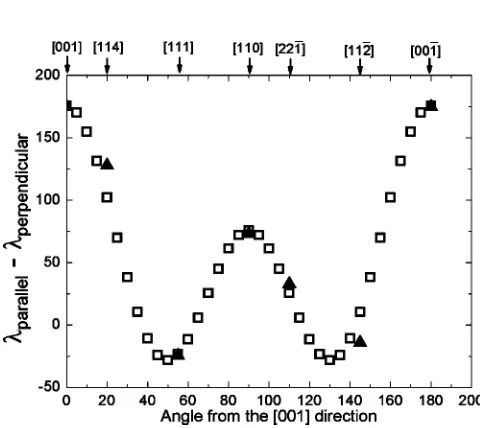

![1 [(E) Anthracen 9 ylmethylidene] 2 (2,4 dinitrophenyl)hydrazine](data:image/gif;base64,R0lGODlhAQABAIAAAP///wAAACH5BAEAAAAALAAAAAABAAEAAAICRAEAOw==)