JANUAR11984
JOURflPIL O f
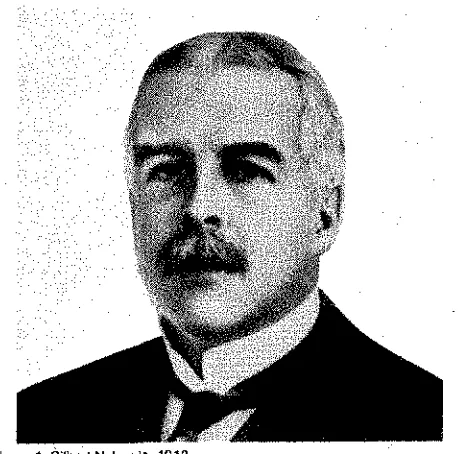
Gilbert Newlon Lewis
1875-1946
s an instructor who has
class-tested the McQuarrie/Rock manuscript, I can say
that these authors have produced a text that should
be considered by all who teach a mainstream
chemistry course. This text will be well-received by
students. It is complete, orderly, and interesting to
read. More importantly, it obviously approaches
general chemistry after very careful assessment of
the priorities of chemical education at this level. The
factual foundation on which principles and theories
rest is emphasized by way of the descriptive
Interchapters. T h e authors have very successfully
done what many claim; that is, smoothly and
concisely integrated descriptive chemistry. I
certainly recommend this text to those who
teach students who are predominantly in
science, engineering, and technical curricula.
—Forrest C. Hentz, Jr., Ph.D.
North Carolina Stale University
BRING YOUR STUDENTS FACE-TO-FACE WITH
THE VISUAL DRAMA OF CHEMISTRY
e
m
e
r
a
l
h
e
m
i
s
t
r
y
Donald McQuarrie and Peter Rock
University of California, Davis
For the first time, students in the mainstream chemistry
course can see chemical events rarely captured in the
introductory iab.
McQuarrie and Rock's GENERAL CHEMISTRY is
filled with color photographs that do much more than
adorn the text; these pictures, photographed by
Smithsonian scientific photographer Chip Clark, were
commissioned specifically to enhance the pedagogical
value of GENERAL CHEMISTRY.
The result?
A unique illustration program that teaches chemistry in a
way no other text can.
Find out what all ihe excitement is about. If you haven't requested
your examination copy already, send your request on school letterhead
lo our Marketing Department at the address below. Be sure to include
your course number, enrollment per year, and present text.
February 198* ISBN G-7167-1499-X
Study Guide, Instructor's Manual, and Laboratory Guide with
Instructor's Manual Available.
CiJCts No. 20 on BaaOara' inquiry Card
Today's academic laboratory is a m o d e r n
facility t h a t t r a i n s s t u d e n t s
for c a r e e r s in t h e high
tech-nology job m a r k e t . Such a
laboratory needs equipment
a n d supplies t h a t a r e as
sophisticated as t h e laboratories t h a t
will one day employ these students. Matheson
h a s a complete selection of g a s e s a n d equipment
for t h e m o d e r n laboratory. W e h a v e m o r e t h a n
80 different g a s e s a n d p r e p a r e g a s m i x t u r e s to
your specifications. No m a t t e r which g a s or
m i x t u r e you use, Matheson h a s regulators,
W
h
o
S
a
y
s I t ' s
a
n
I
v
o
r
y
T
o
w
e
r
?
flowmeters, a n d other equipment
t o control t h e m properly.
Safety in t h e laboratory is
important. To aid you in t h e
safe handling and s t o r a g e
of g a s e s , w e have flash
a r r e s t o r s , toxic g a s detector systems, hand
t r u c k s a n d cylinder stands. W e also have a
system for buying back e m p t y lecture bottles
so t h a t you won't b e stuck with a disposal
problem. Keep y o u r s t u d e n t s in t h e forefront
of technology. Send for a catalog describing
our products, prices a n d specifications.
M a t h e s o n b e l o n g s i n t h e m o d e r n l a b o r a t o r y .
Ugatheson
• • G a s Products
The New MeWerAEIOO. Just the
capacity I need at what I can afford.
Now there's a Jvletiler electronic analyti-cal balance for weighing 100 grams or less. The new AE100 joins the higher capacity AE163 and AE160 analytical introduced last year, It has the same big features of the other Metiler AE's-And at a smaller price, just $1995. Greater productivity with less effort. The AE's foolproof single control bar design makes it easy to operate, A sim-ple touch on the bar does most of the work for you. From locking in tare to cal-ibration. And the exclusive OeitaDisplay*> automatically adjusts itself to your
pouring speed until the target weight is reached.
Because it's so easy to use, weighing on an AE goes three or four times faster than on a mechanical balance. And with much more accuracy. It even adjusts itself to environmental changes that would throw off other balances. Data processing. Another
big advantage.
The AE has another great advantage over mechanicals. The ability to inter-face with computers and other peri-pherals. Just snap on a Mettier data
CilCie No. 26 on Readers' Inquiry Card
AE balances interface will co-npts!ers using iEEE-488, JO mA nurranl loon, ilS232C or BCD -parallel slantlatds
output option and your AE is ready to transfer information.
Scaled down price.
J. J. LAGOWSKt, Editor University of Texas at Austin Austin, Texas 76712
Assistant Editor: Debora Ann Bittaker
Editorial Assistants Linda Davis Kyle George V. Olivet Rebecca Chambers Marie S. Stephens
JAMES V. DEROSE Publications Coordinator ADVERTISING MANAGEMENT CENTCOM, LTD.
P.O. Box 231 25 Sylvan Road South Wesiport, Connecticut 06BB1 (203)226-7131
(For list of offices, see page AS)
NEW PRODUCTS Shirley Sleratzkt
Journal of Chemical EOucaiion Centcom. Ltd.
60 East 42nd St. New York, N.Y. 10165 (212)973-9660
Subscription Fulfillment Department 20ih S Northampton Sts
Easton, Pa. 18042
SECONDARY SCHOOL EDITOR Mickey Sarquis
Miami Unlversity-Middietown Middietown, OH 45042
ASSOCIATIONS EDITORS VasuDev
California Association ot Chemistry Teachers Percy Ehrlich
New England Association of Chemistry Teachers
BOARD OF PUBLICATION Division of Chemical Education J. A. Bell
D. W. Brooks W. B. Cook G. A. Crosby D. A. Davenport M. H. Gardner D. Koto W. J. Stfatton
JANUARY 1984 Volume 61, Number 1
JOURflflL OF
Chemical Education
Owned ana Published by the DIVISION OF CHEMICAL EDUCATION OF THE AMERICAN CHEMICAL SOCIETYArticles in this Issue
The G. N. Lewis Symposium
2
3
5
11
14
Gilbert Newton Lewis: 1875-1946 Derek A. Davenport A Pioneer Spirit from a Pioneer Family Richard N. Lewis G. N. Lewis: The Disciplinary Setting John W. Servos The College of Chemistry in the G. N. Lewis Era: 1912-1946
Melvin Calvin and Glenn T. Seaborg Gilbert Newion Lewis; His Influence on Physical-Organic Chemists at
Berkeley Melvin Calvin
Articles of General Interest
22 Enduring Distributions that Deny Boltzmann Leonard K. Nash
51 Single-Pan Balances, Buoyancy, and Gravity or "A Mass of Confusion" Robin Battino and Arthur G. Williamson
Features
The Cover
This month's cover portrait of G, H. Lewis Introduces the publication of the sympo-sium which was held in his honor al the Las Vegas ACS meeting in March 1982. The proceedings will begin in this Issue and be completed in the subsequent two issues.
1 Editorially Speaking
26 Computer Series, 48: Will Computers Replace TA's? Professors? Labs? Should They?—A Symposium Report edited by John W. Moore 48 2YC3 Viewpoint: Coping with Shifting Student Expectations
Tamar Y. Susskind 89 Letters
A13 Safety In the Chemical Laboratory edited by Malcolm A. Renfrew Good Practices lor Hood Use
William G. Mikell and William C. Drinkard
A16 Out of the Editor's Basket edited by James A. Goldman
A27 Book Reviews
Secondary School Chemistry
36 Chem I Supplement: Geochemica) Exploration ol the Moon
Isidore Adler
William G. Lamb J. Arthur Campbell George B. Powers 40 Goals
Why Teach Kinetics to High School Students? Kinetics—Rates and Mechanisms
43 A High School Biochemistry Course
44 Implementation ol the Thai High School Chemistry Curriculum
Nida Sapianchai and Thongchai Chewprecha 47 Thumbnail Sketches: Metal Substitutions in Wartime Coinages
Hugh A. Akers
49 Safety Tips: Risk Assessment Miriam C. Nagel
58 Profiles in Chemistry: Jean Rey: Unsung Prophet? Sidney Rosen
68 Filtrates and Residues: Analysis of Alcohols
Brother Thomas McCulSough
T h e
P a r r 1 3 4 1
P l a i n
J a c k e t
O x y g e n
B o m b
C a l o r i m e t e r
A reliable calorimeter in a
plain insulated jacket for
measuring heats of
combus-tion of any solid or liquid fuel
For Occasional Calorific Tests
For users whose work load does not justify t h e purchase of a more elaborate automatic m o d -el, t h e Parr 1 3 4 1 Plain Calori-meter is a reltabie instrument that will determine the calorific value of solid or liquid fuels a n d foodstuffs with a precision c o m -parable to that of other P a n calorimeters, but at a slower s p e e d a n d with considerably less invested in e q u i p m e n t It requires n o permanent con-nections and can b e set u p a n d ready to operate in a few minutes. W h e n not in use, it is easily disassembled for storage.
For Student Instruction
In addition to its general applications, the 1341 Calori-meter has equally important uses in college a n d university labora-tories where instruction in heat measurement techniques is an essential part of f he basic training for all fields of science a n d engineering. «. For details, I write or p h o n e : , | .
PARR
INSTRUMENT
COMPANY
2! 1 Fifty-third Slreel, Moline, !L 61265 309-762-7716
73 80 88
Something New from the Past edited by Joseph S. Schmuckler Inventory Control edited by David L. Byrum
What's Happening In Your Part of the Country?
Laboratory Experiments
53 Qualitative Analysis, with Periodicity, for "Real" Solutions
Ronald L. Rich
60 Qualitative Determination of Nitrate with Triphenylbenzylphosphortlum Chloride Donna A. Berry and Jerry J . Cole 62 Qualitative Analysis by Gas Chroroatography: GC versus the Nose in
Formulating Artificial Frutt Flavors P. W. Rasmussen 70 Performance Characterization of an Instrument Eric D. Salin 74 The Density and Apparent Molecular Weight of Air: A Simple
Introductory Experiment Arlo D. Harris 76 Solution Calorlmetry In the Advanced Laboratory: A Study Guide of
Glycine Proton-Transfer Enthalpies R. W. Rameite 78 Reactions of Thiocyanate Ions with Acid: A Laboratory Experiment
Christopher Gfldeweli, James S. McKechnie, and Peter J. Pogorzelec
83 Electrode Potential Diagrams and their Use in the HIII-Bendali
or Z-Scheme for Photosynthesis Peter Sorrel! and Denis T. Dlxon 87 The Prototype Compound for Oral Anticoagulants:
3,3'-Methylene bfs(4-hydroxycoumarin) Rodney C. Hayward
Notes
4 The Southwest Chemistry Lecture Exchange Program A. G. Pirtkus 42 Use of Photocopying (or Non-Destructive Leaf Area Measurements
Marian L. Lyman, Donald E. Campbell, and J. Corse
68 An Addendum on Measuring the Entropy of Mixing of a Two-Ion System
J. D. Pulfer
77 A Kugeirohr Oven from a Rotary Evaporator R. Somanathan and I , Hellberg 82 A Convenient Glassware Cleaning Bath
Tom Lyons Fisher and Phyllis M. McGinnis
r>[a, laboratory 9"oraseSv fectitfe <femon5tiaiioi>5 and other dflscnplfona ol the use ol cfcerrhvcate, appa-raius aod ^nsliumenis ate presented in THfS JOURNAL as slkigirafive cJ ngw, novei 01 imp'ovetf l<^flas 0* twiceprs in chemiatr^ maliucilcwL and ^ e dlrectud aiqualff ied Jeachera Alihowgh evwy effort is made lo assure and encoipagesaTepracliOesafnisafe use of ctieniicafc, (he JOURNAL OFC^EMICAL EDUCATIONcanrvtt assume reBporcslolrty lor uses made ol NIS publJ&hedmaleti-^ a W e s publJ&hedmaleti-^ o n publJ&hedmaleti-^ y urge publJ&hedmaleti-^ 1 lpublJ&hedmaleti-^iose planniiig to use maienafe liom cu/ pages lo moke choices a"ti to davatop fnocetiuies fot 'abinaiQ-ry and flaasoon. safely jn ecoar(teiKa with tocel rionds K H !
srtuahtms-Manuscripts To" publication, books lor review, and corresporaJence regardirio. papers, proofe. and otdere lor reprints should be sent to the office 0+ the Editor: J. J . Lagow&fci, journal ol Chemicat EouclLtLGft, Dap"- ol Chemistry. Urfuergky • ! Texas. Austin, Tex. 78?12-Manuscripts lor the Secondary School Section can lie sent tfractiy to: Ms, MicKey Sarahs, W&n SGhool ErJtd. Journal o l Chemical Education, Miami. l*W«srlyJ*ii]letawn.4S0O ^ U n i v e r s i t y Blvd., » * a « a t ^
19BI, pa^e 1036 for correcl format and style auldelirws.
Subscrlpllsn pries for Individuate: U.8.A. $20.00 par year, all ottwj countries $25.00 osr year. Subscripiton price J «
Bbrarles, hwlHultons and wmpanfes; U.S.A. $40.00 per year, aii other countries $45.00 per year. Single copiss $6.00
US, $6.40 Foreign. Votaris £12 copies lor a cafeodar year) $55.00. Single copies o l Issues available lor the preceding 15 years orrly. Orders !or Subscriptions, single copies, remittances and changes o l address should be sent to Journal of
Chemical Education, EubSHiptJon and Book Ordei Department, 20m and Northampton Sts., East™, Pa. 13042. Subscribers
requesting an address change musl give E weeks notice, submit label with old address, and submit new address with zip Code. Foreign remittances must be made by internstioaal money order, bank oYaft payabTe at a U.S. barrk, or UNESCO coupons.
rJo claims lor copies ot Journals lost in a * malls can be allowed unless such claims are received within sixty (60) days of the data at Issue; rio claims can be allowed lor issues lost as a result ot iraulflclBnt notice 01 change o l ad&eas. Second-Class postage pale] at Uedja. Pa. end addlilanaF mailing. oHLce.
Three cumulative iratoes are available; 25-Year Cumufallve tndBx, Volumes 1 to 25:10-Year Cumutallve index, Volumes 36-35; lO-Yeai Cumulaltve Indai, Volumes 36-45. The selling price of each cumulative Index, Including postage and handling costs. Is $9.50 US and $9.90 foreign. Prepaid oxters should be addressed to Subscription and Book Outer
De-partmarrl. Journal o l Chemical Education, 20lh and NortriampTorT Streets. £astorr, PA 16042.
© Copyright T9B4 by Otvislon of Chemical Education. AjnerJcan Chemical Society Circle No. 27 on Readers' Inquiry Card
YOU CHALLENGED US TO
MAKE A BETTER TEXTBOOK...
WE MET THE
CHALLENGE.
Brady & Holum's FUNDAMENTALS OF CHEMISTRY is "one of the most improved Second Editions I've seen during 20 years of reviewing first-year chemistry text-books..^ remarkable effort that has resulted in an interesting text with a mainstream content."
—John DeKorte
North Arizona University
Brady & Hof urn's FUNDAMENTALS OF CHEMISTRY, Second Edition provides a more thorough, challenging and stimulating approach to general chemistry for science majors than ever before. Yet it's as readable and accessible as ever.
A Better How of Topits
• Two new, logically developed chapters on chemical reactions—the first, on ionic reactions in aqueous solu-tion; the second, on redox reactions of various kinds • Former Chapter 2 on gases has now been moved back
to Chapter 9
• The new sequence of thermodynamics, kinetics and equilibrium allows for more iogica! thematic develop-ment and permits the linkage of equilibrium to A G in Chapter 16 on equilibrium
A More Challenging Level of Material
• More quantitative material, including bond energies andheats of reaction, integrated rate Saws for first and sec-ond order reactions, temperature dependence of rate constants, calculating activation energies, ionization of polyprotfc acids, determination of ion concentrations from ceff potential measurements, and more
• New and more challenging in-chapter worked examples, practice exercises following the examples, and end-of-chapter review exercises
Two New Pedagogical Approathes
• A progressive approach toward problem solving thatfeatures five strategically placed sets of review exer-cises, entitled Integration of Concepts, which tie together concepts discussed in groups of related chapters
• Chemicals in Use—An innovative addition to topics in descriptive chemistry, featuring 19 two-page discus-sions of major chemicals and chemical processes located between chapters
A Complete learning Padtage
Teachers Manual, Solution Manual, Student Study Guide, Laboratory Manual, Teacher's Laboratory Manual, Transparency Masters, plus an ail-new Microcomputer-ized Test Generator for the Apple li Pius/Me and IBM PC, which offers 500 multiple-choice questions
Valuable computer-aided supplements designed to help students review chemical concepts and hone their problem solving skills: Computer-Aided Instruction for General Chemistry by William Butler & Raymond Hough (both of the University of Michigan) and The Chemistry Tutor: Balancing Equations and Stoi-chiometry by Frank R Rinehart (College of the Virgin Islands}
To be considered for complimentary copies, write to Clayton Gordon, Dept. 4-1285, or contact your local Wiiey
representative. For CAI information, write to Bill Rosen, Dept. 4-1285. Please include address, course title, present enrollment, and current text arid supplements.
JOHN WILEY & SONS, Inc.
605 Third Avenue, New York, N.Y. 10158 In Canada1 22 Vluvchestn, Rosa
Rexdaie. Onlario M9W l u
4-1285
T
h
e
c
h
e
m
i
s
t
r
y
i
s
r
i
g
h
t
For a d o p t i o n c o n s i d e r a t i o n , r e q u e s t
a n e x a m i n a t i o n p a c k a g e f r o m y o u r
r e g i o n a l H o u g h t o n Mifflin office.
G
e
n
e
r
a
l
C
h
e
m
i
s
t
r
y
D
a
r
r
e
l
l
D
.
M
a
r
k S .
E
b
b
i
n
g
W
r
i
g
h
t
o
n
W a y n e S t a t e U n i v e r s i t y C o n s u l t i n g E d i t o r
M a s s a c h u s e t t s
I n s t i t u t e of
T e c h n o l o g y
A b o u t 9 2 8 p a g e s
S t u d y G u i d e
L a b o r a t o r y M a n u a l
S o l u t i o n s M a n u a l
I n s t r u c t o r ' s M a n u a l
T r a n s p a r e n c i e s
C o m p u t e r - A s s i s t e d
B l a c k b o a r d ®
J u s t p u b l i s h e d
Houghton Mifflin
13400 Mi
dway Road, Dallas, Texas 75234 Penni
ngtnn-HopeweH Road, Hopeweii
, Ne
w Jersey 08525
Advertising in this issue
The companies listed below
evidence their interest in chemical education by their presence as advertisers. This advertising brings to our subscribers information about new books, new and established laboratory equipment, and apparatus and instruments for both teaching and research. Get acquainted with the advertisers in your Journal. Do not hestitate to write for their catalogs and literature. Use the Readers' Inquiry Cards found on the white insert at the back of this issue. When contacting advertisers by letter or phone, be sure to mention the Journal of Chemical Education.
ON COUPONS IN ADS Readers who do not want io damage their issue by cutting out coupons found in some advertisements are requested to make a photo copy of the coupon for use in inquiring about items mentioned in the ad.
INDEX TO ADVERTISERS IN THIS ISSUE
CIRCLE
INQUIRY 140. ADVERTISERS PAGE NO.
18 Brinkmann Instruments OBC Uvey/Wotff/Swift, Inc.
1 Burgess Publishing Company A13
Burgess-Beckwith
2 Carolina Biological Supply Company A9
21 Floating Point Systems, tnc A12
20 W. H. Freeman and Company tFC
Flamm Advertising, Inc.
3 D. C. Heath and Company A10-A11
x« Houghton Mifllin Company A6-A7, A19, A26 Houghton Advertising
29 Institute lor Scientific information A23 Greene Towne Associates, inc.
24-25 Instrument for Research S Industry A H , A30
Kenyon Hoag Associates
xx JSS Software A30
xx Kenn-Wort A30
xx Klinger Educational Products Corp A30
31 Laboratory Devices A15 Robert W, Lesieur & Associates
9 Lab Safety Suppiy Co A15 Janesvllle Ad Agency
19 Matheson A1 Kenyon Hoag Associates
26 Mettler Instrument Corporation AS McKinney, Inc.
10 Ohaus Scale Corp IBC Jarmart, Spiteer S Felix, Inc.
27-28 Parr Instrument Co A4, A18
USA Chicago, Inc.
11 Random House A17
22 Sensorex A20 10346 Agency
xx Shapety Molecules A30
A8 Journal of Chemical Education
CIRCLE
INQUIRY HO. ADVERTISERS PAGE NO.
xx Spectrex Corporation A30
xx Thom Smith, Incorporated A30
Powder River Associates
14 Wadsworth Publishing CO., inc A1S
15-17 John Wiley & Sons, Inc A5, A21, A26 605 Advertising Group
Advertising Management lor the Journal of Chemical Education
CENTCOM, LTD. Thomas N, J, Koerwer, President
James A. Byrne, Vice President Aifred L. Gregory, Vice President
Clay S. Holden, Vice President Benjamin W. Jones, Vice President
Robert L Voepel, Vice President Joseph P. Sfenza, Production Director
25 Sylvan Road South P.O. Box 231
Westport, Connecticut 06881 (Area Code 203) 226-7131 Tetex No. 643310
ADVERTISING SALES MANAGER James A, Byrne
ADVERTISING PRODUCTION MANAGER Joseph P. Stenza
SALES REPRESENTATIVES
NEW YORK: John F. Raftery, Centcom, Ltd.. 60 East 42nd St., New YorK, N.V. 10165. Telephone: 212-972-9660.
PENNSYLVANIA; John F. Raftery, Centcom, Ltd, GSB Bldfi- S««a 425. 1 Bel-mont Ave., Bala Cynwyd. PA. 19004. Telephone: 215-667-9666. CONNECTICUT: John F. Raftery, Centcom, Ltd., 25 Sylvan Road South, P.O.
Box 231, Westport, CT 06861. Telephone: 203-226-7131 Telex No. 643310.
OHtO: John F. Raftery, Centcom, Ltd., 325 Front Street, Suite 2, Berea, OH. 44017, Telephone: 216-234-1333.
ILLINOIS: John F. Raftery, Centcom, Ltd., 540 Frontage Rd., Northfield, IL. 60093. Teiephone: 3)2-441-6363.
SAN FRANCISCO: Paul M. Butts, Centcom, Ltd., Suite 112, 1498 Bayshore Highway, Burlingame, CA 94010. Telephone: 415-692-1218. LOS ANGELES; Clay S. Holden, Centcom, Ltd., Newton Pacific Center. 3142
Pacific Coast Highway, Suite 200, Torrance, CA. 90505. Telephone: 213-325-1903.
UNITED KINGDOM: Reading, England—Malcolm Thiele, Techonmedia, Ltd., Wood Cottage, Shurlock Row, Reading RG10 0OE, Berkshire, England. Telephone: 0734-343302.
Lancashire, England—Technomedla, Ltd., c/o Meconomlcs Ltd., Meconomics House, 31 Old Street, Ashton Under Lyne, Lancashire, England. Tetephone: 061-308-3025.
CONTINENTAL EUROPE: International Communications Inc., Rue Matlar 1.4800 Verviers, Belgium. Telephone: (087) 22-53-85. Telex No. 49263. ASIA: Shuji Tanaka, International Media Representatives Lid., 2-29 Toranomor
B e f o r e y o u o r d e r c h e m i c a l s a g a i n ,
s t o p a n d t h i n k .
I f you've been ordering from the same chemical
suppliers for years, stop and think about it. You could
be getting better quality and much more reliable
service at a better price.
Carolina has been supplying chemicals to the
scientific community for over 30 years. We keep
thousands of chemical products in stock year-round,
so you're assured of getting what you need, and at
competitive prices. And our professional staff has the
experience and dedication to make sure you get what
you need when you need it—our service is
unsurpassed.
We carry over 25,000 catalog items in addition to
chemicals, so we're aiso your best "one-stop" source
for other science teaching products as well. So when
you put together your next chemical order, start a new
habit—the Carolina habit.
Want more information? Write us or call our Customer
Service Department at 919 584-0381.
G e t t h e C a r o l i n a h a b i t .
Carolina Biological Supply company
2700 York Road
Burlington, North Carolina 27215
Ctrd» No. 3 on Readers' Inquiry Card
COLLEGE CHEMISTRY
WITH QUALITATIVE ANALYSIS
Seventh Edition
1984 Cloth 996 pages
GENERAL CHEMISTRY
Seventh Edition
1984 Cloth 932 pages
Henry F. Holtzclaw, Jr., University of Nebraska
William R. Robinson, Purdue University
William H. Nebergall
Lincoln
The Seventh Edition of College Chemistry and General Chemistry offers the most
read-able and the most effective introduction to chemistry a student will ever need. Along
with clear, solid coverage of modern chemical principles, this text carefully blends
descriptive and theoretical chemistry in a way that many texts have emulated but never
have quite equalled. Clear, step-by-step explanations guide students through even the
most difficult of concepts. And along with the extensive supplement package ~—
com-plete with software — there's just no comparison when it comes to individualized
stu-dent guidance and dependable teaching aids.
NEW! A software package specia&y correlated to College Chemistry and Genera! Chemistry.
INTRODUCTION TO GENERAL CHEMISTRY
by Professor Stanley Smith, University of Illinois;
Dr. Ruth Chabay; and Dr. Elizabeth Kean, University of Wisconsin
D. C. Heath is pleased to announce a unique new computer software package featuring the
integra-tion of page references to the Hoteclaw, Robinson, and Nebergall The computer software is
avail-able by special arrangement with COMPress, Inc. to adopters of the Seventh Edition. The software
package consists of approximately 14 self-documenting diskettes compatible with the Apple® II Plus
and Apple® lie microcomputers. Color graphics and animation help to develop an intuitive feeling
for chemical concepts.
Introducing the most comprehensive
chemistry supplement program available —
THE HOLTZCLAW CHEMISTRY PACKAGE!
INSTRUCTOR'S GUIDE FOR
COLLEGE CHEMISTRY AND
GENERAL CHEMISTRY
Seventh Edftion
Norman £. Griswold,
Nebraska Wesleyan University
1984 Paper 221 pages
STUDY GUIDE FOR
COLLEGE CHEMISTRY AND
GENERAL CHEMISTRY
Seventh Edition
Norman E. Griswold,
Nebraska Wesleyan University
1984 Paper 313 pages
PROBLEMS A N D
SOLUTIONS FOR
COLLEGE CHEMISTRY AND
GENERAL CHEMISTRY
Seventh Edition
J.H. Meiser, Ball State University
F.K. Aalt, Ball State University
H.F.Holtzclaw,Jr.,
University of Nebraska — Lincoln
W.R. Robinson, Purdue University
1984 Paper 277 pages
PROBLEMS A N D
SOLUTIONS
SUPPLEMENT FOR
COLLEGE CHEMISTRY AND
GENERAL CHEMISTRY
Seventh Edition
II.F. Holtzclaw, Jr.,
University of Nebraska — Lincoln
1984 Paper 120 pages est.
BASIC LABORATORY STUDIES
IN COLLEGE CHEMISTRY WITH
SEMIMICRO QUALITATIVE
ANALYSIS
Seventh Edition
Grace R. Hered,
City Colleges of Chicago
1984 Paper 341 pages
For details or sample copies,
call us toll free: 800-225-1388
In Massachusetts, call collect:
617-863-1948
Providing a well-balanced and systematic
introduc-tion to organic chemistry through a skillful blend of
theory, mechanism, and synthesis.
O R G A N I C
C H E M I S T R Y
Seyhan N. Ege,
The University of Michigan
1984 Cloth 1163 pages
This student oriented and highly
motivational text, accompanied
by an innovative microcomputer
software program, makes the
study of a traditionally difficult
subject both relevant and
fasci-nating for science, pre-imed, and chemistry students. The text
pro-vides direct and immediate exposure to basic concepts through
acid base chemistry while emphasizing the relationship between
structure and reactivity of organic compounds. A systematic topic
presentation features detailed use of mechanisms in structural
formulas, equations, and problems for immediate reinforcement.
Extensive use is made of the chemical properties and synthesis of
natural products chemistry which are integrated throughout the
text and in examples and problems. Outstanding problem sets,
offering over 1400 problems, derived from the most recent
litera-ture, provide extensive and well-inlegrated applications.
Three valuable supplements that add an exciting new
dimension to the study.
INTRODUCTION TO ORGANIC CHEMISTRY
Stanley G. Smith, University of Illinois
This unique computer software package features an integration of
chapter and page references to the Ege Organic Chemistry text.
Possibly the most ambitious series of programs yet written for the
microcomputer, this eighMisk series is compatible with Apple® II
Plus and Apple® lie and will be available by special arrangement
with COMPress, Inc. to adopters of the text. The software
includes programs on Alkanes and Alkenes, Substitution
Reac-tions, IR and NMR Spectroscopy, Arenes, Alcohols, Aldehydes and
Ketones, Carboxylic Acids, and Chemrain (a chemistry game for
improving knowledge of organic reactions.)
STUDY GUIDE FOR ORGANIC CHEMISTRY
Seyhan N. Ege, Roberta Klehiiuan, and
Marjorie L.C. Carter
1984 Paper 1100 pages est.
An important aid to learning, the Study Guide contains detailed
solutions to all the problems along with explanations of concepts
used in arriving at the answers.
TRANSPARENCIES
A complete set of 8V2 x 11 acetate transparencies, reproduced in
2-colors directly from the main text artwork, will be provided to
adopters of Organic Chemistry free of charge.
D. C. HEATH AND COMPANY
College Division
125 Spring Street
H
o
w
m
u
c
h
c
o
m
p
u
t
i
n
g
p
o
w
e
r
w
i
l
l a
p
e
n
n
y
b
u
y
t
h
e
s
e
d
a
y
s
?
You c a n g e t e n o u g h to
d i a g o n a l i z e a 100 x 100
H a m i l t o n i a n i n 1.8 s e c o n d s .
You can also compute a million spin
updates in a second on a 3-D Ising
model or solve a tridiagonal system of
300,000 equations in one second.
The FPS-164 Scientific Computer
from Floating Point Systems gives you
(hat kind of computing power for a
fraction of the cost of a large
main-frame or supercomputer. Its 64-bit,
parallel, pipelined architecture, 58
megabytes of memory and speeds of
up to 12-million floating-poini
opera-tions per second gives you the
capability needed for solving very
large problems.
FORTRAN m a d e
e a s y .
You can take full
advantage of the
archi-tecture of the FPS-164
with the powerful
soft-ware available for it.
Topping the list is the
FORTRAN 77
Optimiz-ing Compiler. It lets you
write code that reflects
the way you understand
the problem. You don't
have to understand
the architecture of fhe
FPS-164. The compiler
adapts the code to
the parallel, pipelined
architecture to give you
performance from 5 to
30 times faster than a
super minicomputer.
The portability of
ANSI standard
FOR-TRAN code to me
FPS-164 also eliminates
the need for complex
program conversion.
The new
FORTRAN-callable FMSLIB (Fast
Matrix Solution Library}
is ideal for solving large
linear systems of equations. Sparse,
disk-resident matrices with up to
several billion non-zero entries can be
factored at speeds of over 10-million
floating-point operations per second.
A 2,000 x 2,000 symmetric matrix can
be factored in less than 11 seconds.
Amath iibrarywith more than 400
highly-optimized subroutines for basic
and advanced mathematical
opera-tions is also available.
P r o v e n R e l i a b i l i t y a n d
S u p p o r t .
Floating Poini Systems has
estab-lished an impressive record for
prod-uct reliability and service. Customers
can use service facilities located at key
locations throughout the world and
take advantage of remote diagnostic
capabilities, comprehensive
docu-mentation and software support.
To l e a r n m o r e .
Call us, or write to find out how
cost-effective scientific computing is
on an FPS-164. Our toll free number
is(800) 547-1445.
FLOATING POINT
SYSTEMS, INC.
RO. Box 23469 Portland, OR 97223 (503] 641-3151
TLX: 360470 FLOATPOIN BEAV
FPS Sales and Savice World-wide. U.S.: CA Laguna Hills, Los Angeles, Mountain View CO Laliewood, CT Simsbury f t Winter Park. GAAfianratL Schaumburg, IA New Orteans, MD RockviBe, MA Dedham. HI Red Bank. NM Corroles, » Devon, IX Grand Prairie, Houston, W Bellevue. IMTHBJW1ONAL Canada, Calgary Montreal Ottawa; England. Bracfcnetl. Sertishire: franco, Rungis; Japan, Tokyo; Netherlands, Gouda; West Germany, Hoar. DISTRIBUTORS; Argentina, Buenos Aires (Coasin Com-putacion. S. A}; Australia and New Zealand, MilsonsPoint-N.S.W, Mebaume-Victorta, Canberra-ACT (Techway Piy. Ltd.); Austria Vienna (Olhmar lackner Efektronische Bouelemente Una1 GertMe); Denmark, Copenhagen PIT Ageniurer AiS); Finland, HelslnM £OV Emmett AB); India. Bombay (Hlndllron
CompvilersPVH, Ltd,); Un»l, Tel Avsv (Eostrontes. Lid.); Hxea. Seoul p t o t d Business Machine, Inc.); 5' (Hong Kong, Brunei, Indonesia and Malaysia), Singapore (Sdentek Engineering Co.): Southern Africa, Johannesburg fflnker Data Systems): Sweden and Noway, Wxholm (Fre Konsiite! AB): lalwan. Taipei (Soientek Corporatiaii; United Arab Emirates. Rashiava, Dubai (Albwardy !«), Abu Dhabi S«O«.),
©Roofing Point Systems, Inc. 1983
Bgenenergies ol Methyl Fluoride
/Qfety in the
chemical laboratory
edited by MALCOLM M. RENFREW University of tdaho Moscow, Idaho 83843
Good Practices for Hood Use
William G. Mlkell and William C. Drinkard
Central Research and Development Department, E. I. du Pont de Nemours, Experimental Station, Wilmington, DE 19898
Laboratory fume hoods are important
safety devices. They are provided to protect
personnel from chemicals that are being
handled or stored which are potentially
in-jurious to health. In addition to protection
from chemical fumes they provide some
de-gree of protection from fires and explosions.
Hoods, however, are secondary or "back-up"
safety devices. Training of personnel, proper
design of experiments, and careful operation
of equipment are the primary controls. Even
the best hoods cannot overcome poor work
practices by the user. Studies U, 2) have
shows that when good work practices are
employed with a properly installed and
functioning hood, the user is protected. The
purpose of this brief article is to outline these
good practices for hood use.
Assumptions on Hood Design and Performance
A properly designed, installed, and
func-tioning laboratory hood is a complex device
which requires many design and operating
compromises such as size, opening, materials
of construction, fire and explosion protection,
location in lab, air Oow, air distribution,
ser-vices, convenience, cost of operation. To
stress some design parameters or to overlook
others may seriously affect the performance
of tiie installation. For example, there is a
great tendency among hood users to place
primary emphasis on face air velocity (or face
velocity) as being ihe single most important
(Continued on page A14)
WilHam MikeH is the Environmental Control Manager at the du Pont Experimental Station (n Wilmington. Delaware. He served with Hie Nations! Research Council Committees which developed the reports on "Prudent Practices tor Handling Hazard-ous Chemicals In Laboratories" and "Prudent Practices tor Disposal ot Chemicals From Labora-tories."
W. C. Orlrtkard joined du.Pont In 1960 and Is ourreniiy Manager, Facilities and Safety in the Central Research and Development Department a! the Experimental Station In Wilmington, Dela-ware.
BRINGS CHEMISTRY
To the Liberal Arts . . .
Available January, 1984. the fourth edition of ihis popular text
has been updated and revised to reflect the changing issues and
interests of today's chemical world. Incorporating a more effective
format, additional topics such as "Sports, the Ghemical
Connection" and "The Risks and Benefits of Science and
Technology" are discussed.
Supplements include an Instructor's Guide, Test Ban* and
Student Study Guide.
The Laboratory manual. Chemical Investigations for Changing
Times, not only complements the text but can also be used on its
own to supplement whatever text you may prefer
C'lwmittry For Changing Time\. Fourth Edition, John W. Hill, Cnivetmy of
\\'i<k-mt\in-River Falls. January, 19/14. 57ft jip, highly illuvmitfd, tHitth. ISRS;
0 7 3 8
To College Prep . . .
Designed for the student with little background in chemistry,
this unique text ts written in an informal style, conveying facts and
theories in a non-threatening manner. The contems and
organization are reinforced by over 250 diagrams, graphs, and
charts and lend themselves to a flexible presentation to fit
individual lesson plans.
Supplemental material available includes a Student Study
Guide instructor's Guide, Test Bank, and free Transparency
Masters to adopters
Introduction to Chrmfctiy. /' fiuwetl Hardwkk, Inhervty of Catiftmiia, lot
Angela, February, I9S4. 654pages. ?"•" x 9'-;', doth, iltutfrared, ttro color. ISB\:
0-X087-4740-1.
Tc. ruquest -l uunpi-mo'ttary copy of any of these ti'ies <O' adoption consider&uan, Otoase write ni Department JCFJ3* Bur/jess Publishing Coivpany Please i yaw cow so }<tte btrf eiirjtityeni present text, and txiok n,^wiSif'on riafo
\ Burgess Publishing Company
j7108OhmsLane
Minneapolis MN 55345 {612) 831-1344
COLUMN GONE DRY?
Keep AIR out of
Liquid Chromatography
C o l u m n s . . . Justus© a THERM-O-WATCH Controller...
clip its sensing head onto the plaslic tubing carrying liquid to the column . . . plug your pump and other a c c e s s o r i e s into the THERM-O-WATCH am-plifier.
Now, if your reservoir runs dry and air enters trie tubing, THERM-O-WATCH will turn off power to the pump, fraction col-lector and other ac-cessories before air can reach the col-umn.
Result: iroubta-free operation, no
repack-ing necessary.
Write lot lii«ra!ufe To-dav!
i > instruments lor
Research and industry
10* Franklin kit., CheltenHam. Pa, 19C112Circle No. 24 on Readers' Inquiry Card
Easiest way
to control
temperature
Clip Sensing head onto your thermometer
littsrt thermometer into your apparatus
Plug your heater into the "Therm-O-Watch" Controller. It's that simple.
in less than 2 minuses your apparatus is under control! Therm-0-Watch can control tfis temperature of re-actions, baths, distillations as weil as other operations (titjuld level control, etc.).
Send lor Bulletin T100.
£> instruments for
Research and Industry
101 Franklin »•>.. Cheltenham, Pa. 19012Circle Ho< 2 5 on R e a d e r s ' Fnquiry Card
A14 journal of Chemical Education
/afety
parameter. There
m
a
y be other design or
operating parameters of equal or greater
importance such as the room air distribution
to the laboratory. The hood's ulti
mate
per-formance is judged by the protection it
pro-vides the user not by
h
o
w rapidly the air
m
a
y
be movi
ng over the bench top.
M
u
h exists in
c
the literature (2-5) on this subject. It is as-
sumed, however, that in discussing safe work
practices that the chemist has available a
satisfactorily installed and Wei
l-performi
ng
hood.
Preparation for Work
Before beginning work, the user should make sure that all of the sashes are in place and movable as required. The need for any additional safety shields to be used within the hood should be anticipated and they should be obtained.
Users are responsible for hood operation and should be aiert to signs of malfunctions such as unusual sounds or reduced draft. Any suspected inadequacy should be checked immediately. Hoods can be checked by a smoke test, a bit of yarn on a wand, or by observing an air flow gauge if the hood is equipped with one. The user should be alert for any air flow changes or shift in operation and stop work to check it out should either occur.
A plan of action should be prepared for a ventilation or power failure; time may be critical in preventing a serious incident.
Hood Practices
Efficient and safe operation in a well-con-structed hood requires good work practices. At ali times during operation in the hood sash openings should be kept to a minimum. This is important to minimize operator exposure. In addition, all sources of emission should be kept as far back in the hood as possible (6 in. from the plane of the sash is a good rule of thumb). Recent studies!/, 2) have confirmed the importance of this rule; the degree of protection provided the user has been shown to improve by orders of magnitude when emission sources are placed into the hood away from the plane of the sash. In addition, the user's face should be kept outside the hood while performing chemical operations. Leaning into the hood to adjust equipment when it is operating can result in a significant air turbulaace with a corresponding loss in protection.
A sufficient volume of nonturbulent air should flow through the hood at all times. Thus, storage of chemicals and equipment in the hood should be kept to a minimum, and items should not be placed so that they block exhaust ports from the hood. Since air must be supplied to the hood for proper operation it is important that make-up air vents in the laboratory not be blocked by furniture or equipment of any kind, in addition, pedes-trian traffic in front of the hood should be minimized and laboratory doors kept closed to reduce air turbulence.
Materials, such as paper, entering the ex-haust ducts can lodge in the ducts or fan and reduce hood efficiency. For example, when trouble shooting a poorly performing hood, it is not unusual to find paper towels and/or tissues in the airducts and on the fan.
Traps, scrubbers, or incinerators should be used as primary devices to prevent toxic and/or noxious material from being vented into the hood. This is particularly true when working with highly toxic or odiferous ma-terials such as earciMgens and environmental pollutants.
!rt conclusion, it is worth repeating that laboratory hoods are secondary safety devices whose effectiveness can be compromised by improper or poor work practices. Primary attention should be focused on the funda-mentals of training personnel, proper design of experiments and careful operating tech-niques.
Literature Cited
(1) Mitell, W. G., and Honbs, L. R, "Laboratory Hood Studies," J. CHEM. EDUC., S*. A165 (1981). (21 Fuller, P. H., and Ettheila, A. W., ""toe Rating of
Lab-oratory Hood Performance," ASHRAE Journal, (October 1979).
(3) Chamberiin, RI., and Leahy, J.E.. "LaboratoryFume Hood Standard," Recommended for V3- Environ-mental Protection Agency, Contract No. 68-4)1-4661, January 1978.
(4) Hiigbes, D., "A Literature Survey and Design Study of Fumecapboards and Fume-Dispersal Systems," Oc-cupational Hygiene Monograph No. 4, Science Re-views Ltd, London, November 1980.
{5) Csplan, K. J., and Knutson, G. W.. "Development of Criteria for Design, Selection and Jn-place Testing of Laboratory Fume Hoods and Laboratory Room Ventilation Air Supply: Final Report," ASHRAB RP-70, March 1978.
Good Hood Practices
Sash openings should be fiept to a minimum. Sources of emission should be kept at least 6 in.
inside the hood.
Users should keep their laces outside the plans of the hood sash.
Storage In the hood should be kept to a min-imum,
Exhaust ports from hood and supply air vents to room should not be blocked.
Traps, scrubbers or incinerators should be used to prevent toxic and noxious materials from being vented into the hood exhaust system. Remain alert to changes in air How.
Prepare a plan of action in case of an emergency, e.g., powei failure.
CATALOG
OF SAFETY
EQUIPMENT
& SUPPLIES
The nation's most complete source of safety equipment and supplies for the protection of people, facilities and the environment. Let our experts help you seiect the products to meet your safety needs and regulatory requirements.
To get your free copy,
circle the reader's service number or call
1-608-754-2345
Circle No. 9 an Readers' Inquiry Card
MEbTEMP
8
The Best Melting Point
Apparatus for Less
MEL-TEMP* is an integrated capillary melting point apparatus wilh heating rate continuously controiled by vari-able transformer. Excellent viewing provided by built-in light and 6-power tens. Attractive siivertone base is 4"x 5" and includes 6-(oot grounded power cord.Heats to 500°C. • Accepts One to Three Samples • Rapid Heating and Cooling • No Heat Transfer Fluids
only^" I W l * "Plus Shipping Does noi include m.p. capillaries or thermometer.
ACCESSORIES
O-4QO°C thermometer in'°C graduations, 76iran.imm. .512.00 irjO-50G°Cttie[morrteterirt1!'C
graduations. borosiNcate glass, nitrogen filfed, 76mra. (mm. S15.OD Vsai oi 100 tJorosiHcate glass m.p. capillaries, 100mm. long, sealed one end S3.00
Write tor bulletin BOA
LABORATORY DEVICES
R O, Box 68, Cambridge, MA 02139
Circle Ho. 31 on Readers1 inquiry Card
F o r t h e t w o - t e r m c o u r s e
f o r s c i e n c e m a j o r s :
M o r t i m e r ' s
C H E M I S T R Y ,
5 t h E d i t i o n
"Mortimer's texts have all been good, but this seems to be the best yet." (Charles Howard, University of Texas at San Antonio) T h e g e n e r a l c h e m i s
-t r y -t e x -t -t h a -t p r o v i d e s b o -t h a c c u r a c y a n d c l a r i t y . S u p e r b l y o r g a n i z e d a n d w r i t t e n , w i t h m o r e t h a n 1 . 1 0 0 e n d - o f - c h a p t e r p r o b l e m s ,
plus t h e m o s t c o m p l e t e " p a c k a g e " o f
a n c i l l a r i e s y o u ' l l find a v a i l a b l e w i t h a n y t e x t f o r t h e g e n e r a l c h e m i s t r y c o u r s e .
758pages. 8x10. Casebound.
S t u d e n t S e l f - S t u d y G u i d e . S o l u t i o n s M a n u a l . A n s w e r B o o k l e t . Test-I t e m F i l e . T i a n s p a r e n c i e s . C o m p u t e r S o f t w a r e .
AVAILAB1M NOW.'
For t h e o n e - t e r m c o u r s e for n o n s c i e n c e majors:
M i l l e r ' s
C H E M I S T R Y : A B A S I C
I N T R O D U C T I O N ,
3 r d E d i t i o n
More than 100,000 students use Miller's books each year at 850 colleges and universities. A f r i e n d l y , d i r e c t , a n d
a c c u r a t e t e x t f o r y o u r p r e p c o u r s e . O f f e r i n g a flexible f o r m a t t o s u i t y o u r c o u r s e p l a n , a n d a n o p p o r t u n i t y t o s t a r t m e a n i n g f u l l a b w o r k e a r l y . C o m m e n t s f r o m 1 0 0 p r o f e s s o r s g u i d e d t h e r e f i n e m e n t s i n o r g a n i z a t i o n , c o n t e n t , a n d p e d a -g o -g y y o u ' l l find i n t h i s c a r e f u l r e v i s i o n o f a p o p u l a r t e x t .
656pages. 7%x9'A Casebound. S t u d y G u i d e S o l u t i o n s M a n u a l .
I n s t r u c t o r ' s M a n u a l o f T e s t Q u e s t i o n s . L a b o r a t o r y M a n u a l . A n s w e r B o o k f o r l a b M a n u a l . T r a n s p a r e n c y M a s t e r s . C o m p u t e r P r o g r a m s .
AVAIIABU! FEliUVARY 1984'
F o r m o r e i n f o r m a t i o n o n t h e s e t e x t s , w r i t e : J a c k C a r e y , C h e m i s t r y E d i t o r , B o x J C E - 1 8 4 :
W A D S W O R T H P U B L I S H I N G C O M P A N Y ^ J f T e n D a v i s D r i v e * B e l m o n t • C a l i f o r n i a • 9 4 0 0 2
out of the
editor V bo/ket
JAMES A. GOLDMAN
New Apparatus and Equipment
Amino Acids in Protein Hydrolyzates
Accurate high-sensitlvlty determinations of amino acids can be made with Amino Acid Anafysfs Modules available Irom Perkin-Eimer. Separate modules are available for analysis using the cfassical nlnhydrin chemistry or the newer more sensitive OPA |ortho-phthalal-dehyde) chemistry. A flexible, moderately priced amino acid analysis system can be easily configured by employing either module with a Perfcin-Elmer Series 4 Solvent Delivery System and a suitable data handling system. For laboratories with a large work-load, the configuration of choice can provide totally automated operation from injection to data handling with pprogrammed column re-generation, start-up, shutdown and over-pressurization safety protection. For chro-matographers with an occasional need to termine amino acids, the modular system de-sign and microprocessor-controlled pumping system provide operational flexibility without sacrificing reliability and convenience. The amino acid analysis system can be set-up in minutes and just as easily reconfigured for general LC applications. The reaction modules can also be easily adapted to other post-col-umn reaction chemistries.
Circle #41 on Readers' Inquiry Card
Dual-purpose, Fused-sNlca Columns
A rugged and highly retentive dual-purpose column has been introduced by Hewlett-Packard Co. The HP Series 530 y, can be used in bom capillary and packed-column gas-chromatograph analyses. Packed columns have been a tradition in the science of chro-maiography since its beginning. The need for a column to provide solutions to more com-piex, multi-component samples resulted in HP's introduction of the fused-silica capillary columns in 1978. Many analyses done with capillary can be handled with the HP Series 530 fi column. A high sample capacity and ease~of~use make trie duaf-piapose column a practical alternative for packed-column chromatography. The HP Series 530 n has a stationary-phase film thickness of 1.5 to 3 microns, providing adequate capacity for one-microlitre injections of solutions that normally are analyzed on a 3 to 5% packed column. The use of quality phases and inert fused-slllca tubing results in a tower bleed than the corresponding packing, permitting high-temperature analyses like simulated distillation with little need for matched-column compen-sation. When operated under packed-column conditions, the new column allows the chro-matographer to use a technique previously restricted to capillary operation. Two r#" Series 530 n columns can be installed in the same packed injection port with their exit ends connected to two separate detectors. This "50/50-split" technique will provide significant time-saving benefits in qualitative analyses. HP chemists believe.
Circle #42 on Readers' Inquiry Card
X-ray Diffraction System
The Scintag PAD V x-ray diffraction system includes the iatest in computer technology to provide for rapid and highly interactive
col-lection of data from an unlimited range of materials. The qualitative and quantitative determination of compounds, whether they be metals, powders or solids, is made easier by the PAD V's incorporation of a new generation of software, hardware and system concepts. With its voice synthesizer for output com-mands, full high-resolution color graphics, and ability to deconvolve diffraction profiles the Scintag PAD V is recognized as the easiest, most completely user-oriented system avail-able.
Circle #43 on Readers' Inquiry Card
High Performance Spectrophotometer
A low cost, compact spectrophotometer that features 8mm bandwidth and convenient digital readout in Concentration, Factor, Absorbance and Transmission has been introduced by Sequoia-Turner Corp. The instrument may be standardized by dialing in the concentration of the standard or a factor from 1 to 19,990. The Model 390 Spectrophotometer has a contin-uous wavelength range of 330 nm to 1000 nm to cover all routine UV and colorimetric tests. This range can be extended to 210 nm with an easily Installed Far UV accessory. This wide range is achieved by a monochromator having a ptane diffraction grating in an f7 Ebert mounting. The monochromator utilizes a single casting to maintain alignment of the optics, sample, and solid state detector. Four controls simplify operation and a large 3'/2 digit LED
display provides easy readability. Readout is selectable in four modes: Concentration, Factor, Absorbance and Percent Transmit-tance. In addition, the decimal point is settabie by the user. The Model 390 has exceptional photometric linearity of better than 1 % as a result of the combined narrow bandwidth {8 nm) and low (less than 0.5%) stray light. Per-formance is further enhanced with a wave-length repeatability of better than 0.5 nm and a wavelength accuracy within 2 nm over the full range.
Circle #44 on Readers' Inquiry Card
{Continued on page A18)
MISTRY
SECOND EDITION RAYMOND CHANG
WilliamsColiege
What is Chemistry in Action?
• it's the reorganization of the Table ol Dontontl to reflect ihe topic order prelerred by mosi instructors: —Inorganic nomenclature and
stoichiometry are introduced early io coordinate with laboratory work (Chs 2 & 35
—Gases are discussed early (Ch 4) —Bonding 15 divided into 2 chapters
(Chs 7 & 8), in which the basics are discussed first and more detailed, in-depth material follows
—An entire chapter is devoted to thermochemistry (Ch 9) —An entire chapter is devoted io
REDOX reactions {Ch. 12) —Acids & Bases are discussed in 2
consecutive chapters (Chs. 15 & 16) —A separate chapter on solubility
equilibrium is inducted (Ch 17) —Inorganic Descriptive Chemistry is
located in one integrated series ot chapters (Chs 20-23)
—A new chapter on metallurgy is included (Ch. 21)
—Organic Chemistry has been moved back in the text (Ch 24), immediately, preceding biochemistry.
• it's the pedagogical featurat your students need io learn efficiently and effectively:
—Hundreds of worked-out examples with all algebraic steps included. —Over 1400 end-of-chapter exercises
grouped by topic.
—SI units used consistently throughout the text.
—Important terms in bold face type ior easy reference.
—End-of-cha0ier lists of key terms, including page numbers.
—End-of-chapter numbered summaries —Chapter opening remarks connect
topics and explain the relevance of
CHEMISTRY
IN ACTION
—End-of-book glossary
—CHEMISTRY IN ACTION BOXES illustrate how chemicai principles apply to everyday experience —Biographical footnotes oi chemists
discussed in the text. —Color Plates
• it's t h e ! • « ! and approach instruc tors need to teach a mainstream general chemistry course to today's students:
—Difficult topics such as entropy are explained in stmpte terms
—All advanced topics have detailed, low-level introductions in earlier chapters. (See how thermochemistry, Ch. 9, provides the basis for ther-modynamics, Ch. 18, and how REDOX reactions, Ch. 12, lays a firm foundation for Electrochemistry, Ch. 19)
—Interesting asides, cautions, and cross-references are included in the margins
—Important topics such as stoichiometry that relate to
laboratory work are introduced early and clearly
—Formal charge is used in writing Lewis structures
• it's the ancillary package you need today, complete with a microcomputer floppy disk system for your students' tutorial use:
STUDENT STUDY GUIDE INSTRUCTOR'S MANUAL SOLUTIONS MANUAL TRANSPARENCY ACETATES "INTRODUCTION TO GENERAL CHEMISTRY/' by Professor Stanley Smith (University of Illinois), Dr. Ruth Chabay, and Dr. Elizabeth Kean (Univer-sity of Wisconsin), a U-diSk program covering a complete range of topics in General Chemistry, available January, 1984. ("Introduction to Genera! Chemistry," is available through a special arrangement with COMPress, Inc., a division of Van Nostrand Reinhold). For more information regar-ding this program, please call Heidi
Udell at 212-572^2453.
To receive your comphmentaty copy of Charsg's Chemistry, please write to:
Random Home
College Review Desk 400 Hahn Road
t Westminister, Maryland 21157
Chang, Chsmistry. ssccnB editsoru1 August. 1983J
oidor code *329fl3-X
Circle No. n unfiedd&rs' Inquiry Card
T h e
P a r r 1 4 5 1
S o l u t i o n
C a l o r i m e t e r
A convenient bench-top
instru-ment for measuring enthalpy
changes produced by chemical
reactions in solution, with
provision for conversion to a
semimicro bomb calorimeter.
A Multi-Purpose
Calorimeter
Utilizing a unique rotating
sample cell and a sensitive
electronic thermometer, the
1451 Solution Calorimeter
pro-vides a moderately priced and
easily operated instrument for
measuring:
• Heats of Reaction
• Heats of Solution
* Heats of Mixing
• Heats of Dilution
• Heats of Wetting
with a precision adequate for
most analytical and exploratory
research applications. Energy
changes ranging from 2 to 1000
calories in either liquid-liquid
or liquid-solid systems can be
measured in a straightforward
manner with results plotted on a
strip chart for easy interpretation.
Convertible to a Semimicro
Bomb Calorimeter
Taking advantage of its
com-pact case and precise electronic
thermometer, the 1451
calori-meter is easily converted to a
Parr 1421 Semimicro Bomb
Calorimeter for measuring heats
of combustion of small samples.
The semimicro bomb and ail
parts needed for this conversion
are provided in a 1425
Conver-sion Set.
For details,write or phone:
PARR
INSTRUMENT
COMPANY
211 Fifty-third Slteeu MoHne, IL 61265 309-762-7716
out of the
editor> ba/ket
Multidimentional Gas Chromatography
ES Industries, the exclusive U.S. representa-tive for Siemens Gas Chromatographs, has announced the availability of the Siemens Si-Chromat 2 Gas Si-Chromatograph. According to a company spokesman, the SiChromat 2 is a double oven S.C. which features a patented vaiveless "live" column switching system. With this system, multidimentional chroma-tographic procedures such as heart cutting sample components for transfer to a second column and bat*flushing the precolumn can improve resolution and save valuable analysis time. Valveless means the sample does not come into contact with any valves and the 'live" principle means that the switching times can be determined directly.
Circle #45 on Readers' Inquiry Card
fR Gas Anafyzer
The Binos Infrared Gaa Analyzer makes pre-cise and accurate determinations of changes in CO2 and H2O vapor levels in plant
cham-bers. A measurement range of ±25 ppm CO? at a nominal reference point value of 330 ppm CO2 is possible with this equipment. The
in-strument also measures absolute CO2 (typi-cally 0 to 600 ppmj as well as absolute and differential HSO {typically 0 to 1 % as an
ab-solute range and 0 to 5000 ppm as a differ-ential range). Four standard models of the BfNOS Infrared Gas Analyzer are available from Tekmar Co., and all have appropriate infrared optics to maximize accuracy anil sensitivity for their specific applications. Each model is portable and works on 12 V dc or 120 V ac; heated optics are not required. These models feature analog or digital display of the measured component and provide a 0 to 1 voit recorder output signal over the measured range.
Circle #46 on Readers' inquiry Card
Autosampler for AA
Instrumentation Laboratory (\L) is offering a 6-page report on the )L FAST AC (I pler. The FASTAC II is the only AA autosam-pler which employs aerosol deposition of the sample for furance atomlzation. Because It is a nebulizer based system, the FASTAC II provides automated analyses for both flame and furance atomization. This dual capability minimizes purchase cost, space requirements, and changeover time. Unlike any other furnace autosampier, the FASTAC ii converts the sample to an aerosol and deposits it Into the furnace cuvette, where it dries immediately on contact. This technique has many advantages: 1. It saves time and simplifies methods de-velopment by eliminating the lengthy and complex furnace drying step. 2. It works equally well with aqueous and organic sol-vents. 3. tt eliminates many analytical inter-ferences. 4. It simplifies preparation of stan-dard solutions. 5. It can be set to produce al-most any desired analytical sensitivity. 6. it can be used with samples that are too viscous to pipette. 7. The same system is usable for flame and furance. fn comparison to the pre-viously offered IL FASTAC autosampler, the FASTAC II offers approximately 10X higher sampling efficiency, and is easier to use.
Circle #47 on Readers' Inquiry Card
Zimmermann Cell Fusion System
The Zimmermann Cell Fusion system that electrically fuses cells, including fusing hy-bridomas for monoclonal antibody production and fusing cells for plant genetics, yeast transformations and other biotechnology and cell research applications, is now available
from GCA/Precision Scientific Group. With the Zimmermann Ceil Fusion system, ce!!s are exposed to a low level electrical field, orienting the ceils end to end. Alignment voltages can be varied from zero to 40 voits at a frequency of 10KHz to 5MHz. A short, direct current pulse is then applied, which opens micropores ir> adjoining call membranes, allowing mixing of
{Continued on page A20)
Circle No. 28 on Readers' Inquiry Card
F
o
r
m
u
l
a
f
o
r
s
u
c
c
e
s
s
.
B a s i c C o n c e p t s o f C h e m i s t r y
T h i r d E d i t i o n
A l a n S h e r m a n , S h a r o n J . S h e r m a n , a n d
L e o n a r d R u s s i k o f f
All o f M i d d l e s e x C o u n t y C o l l e g e
A b o u t 5 7 6 p a g e s • c l o t h • S t u d y G u i d e b y J a m e s R .
B r a u n , C l a y t o n J u n i o r C o l l e g e • L a b o r a t o r y M a n u a l
I n s t r u c t o r ' s M a n u a l • T r a n s p a r e n c y M a s t e r s
J u s t p u b l i s h e d
A c l e a r n a r r a t i v e s t y l e a n d a s u p p o r t i v e a p p r o a c h m a k e
t h e S h e r m a n / S h e r m a n / R u s s i k o f f t e x t h i g h l y w o r k a b l e f o r
s t u d e n t s w i t h little o r n o b a c k g r o u n d i n c h e m i s t r y a n d
m a t h e m a t i c s . T h e T h i r d E d i t i o n f e a t u r e s a n e x p a n d e d
p r o b l e m - s o l v i n g p r o g r a m : t h e n u m e r o u s w o r k e d - o u t
e x a m p l e s a r e f o l l o w e d i m m e d i a t e l y w i t h p r a c t i c e e x e r
-c i s e s f o r t h e s t u d e n t t o s o l v e . A n d t h e e n d - o f - -c h a p t e r
self-t e s self-t e x e r c i s e s h a v e b e e n d o u b l e d self-t o p r o v i d e a n a v e r a g e
of 6 5 p r o b l e m s p e r c h a p t e r .
A n e w c h a p t e r o n k i n e t i c s a n d e q u i l i b r i u m r o u n d s o u t a
c o m p l e t e c o v e r a g e of t o p i c s f o r t h e i n t r o d u c t o r y
c h e m i s t r y c o u r s e .
For adoption consideration, request an examination package from your regional
Houghton rttfUin office.
Houghton Mifflin
out of the
editor)" bo/het
cellular contents and resulting in their fusion. Each electrical pulse can be precisely con-trolled from zero to 250 volts. Up to nine sep-arate pulses can be applied, with durations to 99.9 microseconds. By providing a number of separate small pulses, the Zimmerman Cell Fusion system gives the biologist precise control over the cell fusion technique and is less destructive to the celis than other fusion techniques. The benchtop Zimmermann Cell Fusion system is also designed to be user-friendty. Major process parameters are con-trolled by large, easily accessible dials with digital LED readouts of their values. In addition to the power supply and an assortment of fu-sion chambers, the system includes art ex-tensive protocol manual. The manual, which is based on the work of Dr, Ulrich Zimmer-mann and his colleagues at the Nuclear Re-search Center of West Germany and by GCA biotechnology scientists, details sample pro-tocols for fusing yeast cells, plant cells, erythrocytes and hybrldomas. A technical description of the Zimmermann Ce!i Fusion process is also provided.
Circle #48 on Readers' Inquiry Card
Porosimeter
Mlcromerilics' Pore Steer 9305 porosimeter features an RS232 port that allows automailc acquisition, reduction and reporting of porosity
data. The Instruments Include a demonstration program listing for the IBM PC at no additional charge. Now data can be presented in tabular and graphic formats. Analysis data can be stored and retrieved for analysis comparison. Sample pore size distributions, total pore area, median pore volume and area, average pore diameter, bulk and apparent density can be stored and manipulated to suit individual lab-oratory requirements. The Pore Slzer Is de-signed to measure the porosity of powder or solid samples, Trie data from porosity analyses represents the intrusion and extrusion of a non-wetting liquid (mercury) into sample void volumes under pressures that are ramped to 30,000 psi.
Circle #49 on Readers' Inquiry Card
Mercury Pressure Porosimeter
Erba Instruments, the U.S. safes and service organization of Carlo Erba Strumentazione of Italy, provides a detailed analysis of their au-tomatic Mercury Pressure Porosimeter—2000 Series. The 8-page brochure details and il-lustrates the complete, fully-programmable
p H E L E C T R O D E
S T U D E N T P R O O F ?
. . . W E L L , A L M O S T !
I T S p H R E S P O N S I V E G L A S S BULB I S R E C E S S E D INTO I T S 1 / 1 6 " T H I C K E P O X Y BODY S O BREAKAGE I S MINIMIZED.
ITS SEALED, GEL-FILLED R E F E R E N C E NEVER N E E D S REFILLING.
NO PERFORMANCE SACRIFICE; FAST FULL RANGE NERSTIAN RESPONSE.
M O D E L S 2 0 0 C COMBINATION pH ELECTRODE
12mm D1A BY 150mra LONG
$ 4 0 When ordering,
specify type of connector 01 make and model
of pH merer
U 6fil Seaboaid Circle
Station. Catifomta 90680 USA 714-895-4344 TELEX- 183123
A20
Circle Mo. 22 on Readers' Inquiry Card Journal of Chemical Education
automatic system for determining pore size, volume, surface area, bulk density and particle size. Six examples demonstrate the Porosi-meter's results reported In the field of cata-lysts, ceramics and cements. Also included is information pertaining to ink-bottle pores and ultramacro porosity.
Circle #50 on Readers' inquiry Card
Multipoint Ambient Air Monitoring System
"Hie Miran 981 Multipoint Ambient Air Moni-toring System, that helps to ensure protection of personnel by monitoring the concentration in air of up to 5 gases or vapors at up to 24 remote locations, is featured in a 6-page data sheet recently published by The Foxboro Co. The Miran 981 can monitqr more than 200 of the approximately 400 gases declared haz-ardous by the Occupational Safety and Health Administration (OSHA). This system can be used to monitor air quality in hospitals and medical supply manufacturing plants, power plant control rooms, industrial environments, and other locations as far as 300 m {1000 ft.) from its enclosure. The operating principle of the Miran 981, cjiscussed in the data sheet, is based on infrared speotroscopy. The system's microprocessor controls the infrared spec-trometer, signal averages the infrared trans-mission measurements at each programmed wavelength, calculates absorbance, and uses a stored coefficient matrix to determine the concentrations of components in the air sample. This microprocessor-based system provides a printed report with eight hour and monthly time weighted averages (TWA) of the toxic gas concentrations in parts per million (ppm) and alarm conditiqns at each remote location. An Interactive keyboard combined with user oriented programs makes the oper-ation of the 981 simple and virtually error free.
Circle #51 on Reactors' Inquiry Card
UV-Vis Absorbance Delector
The Spectroflow 757, available from Kratos Analytical Instruments, is a logical alternative to single wavelength detectors because of its price and sensitivity. It is ideally suited for use with analytical scale HPLC, "fast LC", prep and mlcrobore. A touch-sensitive membrane pane! operates instrument functions, while a rear panel connector permits comprehensive computer control using an