DYNAMIC MATERIAL
PROPERTIES
LOS ALAMOS DATA CENTER
FOR DYNAMIC MATERIAL PROPERTIES
TECHNICAL COMMITTEE
Charles L. Mader Terry R. Gibbs Charles E. Morris Stanley P. Marsh Alphonse Popolato Martha S. Hoyt Kasha V. Thayer Sharon L. Crane
John F. Barnes Richard D. Dick John W. Hopson, Jr. James N. Johnson Elisabeth Marshall Timothy R. Neal
Program Manager Explosive Data Editor Shock Wave Profile Editor Equation of State Editor Explosive Data Editor
Computer Applications Analyst Technical Editor
LASL EXPLOSIVE
PROPERTY
DATA
Editors - Terry R. Gibbs
Alphonse Popolato
CONTRIBUTORS John F. Baytos Bobby G. Craig Arthur W. Campbell William E. Deal Jerry J. Dick Robert H. Dinegar Raymond P. Engelke Thomas E. Larson Elisabeth Marshall John B. Ramsay Raymond N. Rogers Diane Soran
Manuel J. Urizar Jerry D. Wackerle
UNIVERSITY OF CALIFORNIA PRESS
Berkeley and Los Angeles, California University of California Press, Ltd. London, England
Copyright @ 1980 by
The Regents of the University of California ISBN o-520-040 12-O
Series ISBN O-520-04007-4
Library of Congress Catalog Card Number: 80-53635 Printed in the United States of America
PART I. EXPLOSIVES PROPERTIES BY EXPLOSIVES ... 1
Baratol ... 3
Composition B ... 11
Cyclotol ... 24
DATB ... 34
HMX ... 42
Nitroguanidine ... 52
Octal ... 61
PBX 9011 ... 72
PBX 9404 ... 84
PBX 9407 ... 99
PBX 9501 ... 109
PBX 9502 ... 120
PETN ... 130
RDX ... 141
TATB ... 152
Tetryl ... 163
TNT. .... :‘. ... 172
XTX 8003 ... 188
1. Chemical Properties ... 2. Thermal Properties ...
2.1 Heat Capacity Determination ... 2.2 Thermal Conductivity ... 2.3 Coefficient of Thermal Expansion ... 2.4 Thermal Decomposition Kinetics ... 2.5 Heats of Combustion and Formation ... 2.6 Differential Thermal Analysis and Pyrolysis Test ... 2.7 Time-to-Explosion Test ...
3. Detonation Properties ...
3.1 Detonation Velocity and Diameter Effect. ... 3.2 Cylinder Test Performance ...
3.3 Detonation Pressure Determined from Initial Free-Surface Velocity ... 3.4 Plate Dent Test ... 3.5 Detonation Failure Thickness ... 4. Shock Initiation Properties ...
4.1Wedge Test Data ...
4.2 Small- and Large-Scale Gap Tests ...
204 216 216 217 218 219 221 223 231 234 234 249
258 280 289 291 293 425
4.3 Minimum Primary Charge ... 433
4.4 Rifle Bullet Tests ... 434
4.5 Miscellaneous Tests ... 440
5. Sensitivity Tests ... 446
5.1 Drop Weight Impact Test ... 446
This volume of the Los Alamos Series on Dynamic Materials Properties is designed to provide a single source of reliable data on high explosives in use or formerly used at the Los Alamos National Scientific Laboratory (LASL). These are the best LASL data available and, as revisions are made, new or better data will be added.
The volume is divided into two major parts for the user’s convenience. Part I pre- sents in one place the properties of explosives by explosive and summarizes all the property data and the results of various tests generally used to characterize ex- plosives. It covers only pure explosives and explosive formulations that have been well characterized. However, for many of these materials there are some properties or test results that have not been determined and in those cases the section normal- ly used to list the property or test result has been omitted. Part 11,presents the properties of explosives by property or method of determination It covers many more materials, often those for which only one property has been determined. Part II permits ready comparison of explosives and, for a number of properties, contains detailed data that permit use of other data reduction methods, such as the user’s own fitting techniques.
Because many explosives properties depend upon the exact details of charge preparation, and their determination depends upon the exact details of the testing procedures, many of the test procedures used in gathering these data are described. References on the test procedures and data are cited where possible; however, much of the data has been taken from unpublished internal LASL reports. If more than one group of data or conflicting data were available, we selected the most credible. Also, because almost all of these explosives are heterogeneous polycrystalline materials, some of their properties, especially initiation by strong shocks, depend upon such factors as charge density, the particle size distribution of the crystals, and the degree of crystal perfection. Therefore, Part II includes detailed descrip- tions of the test explosives wherever possible.
plosives, alphabetically by major explosive constituent; and, finally, propellants. An explosives table gives the composition of each material covered in this volume, and a glossary defines acronyms and unusual terms.
1. Baratol . . . , . . . 3
2. Composition B . . . ..*...*....*..*...*... 11
3. Cyclotol . . . , . . . * . * .I...,... 24
4. DATB . . . ..I... 34
5. HMX . . . ..*...*...**.*...*....** ..*...*....*....,... 42
6. Nitroguanidine ,... 52
7. Octal ,....,...,....,...,... 61
8. PBX 9011 . . . 72
9. PBX 9404 . , . . . , . . . ...*...*...**. 84
10. PBX 9407 , . . . , . ,...,...,...,...,,... 99
11. PBX 9501 . , . . . ..I... ,.*...*....*.... 109
12.PBX 9502 . . . ..s... . . . 120
13. PETN . . . ..I... 130
14.RDX . . . ..,...,....L...,... 141
15. TATB . . . ..*...*...*... 152
16. Tetryl... . . . ..*...*....*... 163
17. TNT. . , . . . , . . . 172
18. XTX 8003 . . . + . . . ..*.*...*.*...*... 188
1. GENERAL PROPERTIES
1.1 Chemical and Physical Description. Baratol, a mixture of barium nitrate, Ba(NO,),, and TNT, C,HsNBOB, is off-white to gray.
1.2 Common Use. During World War II, the British developed baratols that con- tained about 20 wt% barium nitrate to replace TNT. The United States used baratols that contained slightly more barium nitrate in depth charges and other limited munitions. Baratols that contain up to 76 wt% barium nitrate are now used as the low detonation velocity explosive in waveshaping devices such as plane-wave lenses.
1.3 Toxicity.’ Barium nitrate can irritate skin and mucous membranes.
2. MANUFACTURE AND PROCUREMENT
2.1 Manufacture. Finely ground barium nitrate is added to molten TNT to form a castable slurry. To lower the slurry viscosity, which increases with the percentage of barium nitrate, about 0.1 wt% of nitrocellulose (11.8-12.2 wt% nitrogen, 18-25 centipoise) is added to the TNT before the addition of the barium nitrate. After the barium nitrate is added, just before vacuum is applied to the’melt, 0.05-0.1 wt% of either decylgallophenone or stearoxyacetic acid is added to prevent cracking. Vacuum is applied to the melt just before casting to remove dissolved and occluded gas and to provide higher, more uniform density. Carefully controlled cooling of the casting also promotes uniform density and composition.
’ 2.2 Procurement. There are no purchase specifications for baratol. It is
2.3 Shipping.2 Baratol is shipped as a Class A explosive, as defined by the Code of Federal Regulations.
2.4 Storage.8 Baratol is stored in Compatibility Group D, Storage Class 1.1, as required by US Army Materiel Command regulation.
3. CHEMICAL PROPERTIES
3.1 Composition. Unless otherwise specified, the properties given are for the fol- lowing composition.
Constituent Weight Percent
Barium nitrate 76.0
TNT 2410
Volume Percent 62.8 37.2
3.2 Molecular Weight.
Constituent -- Structure Molecular Weight
Barium nitrate 261.38
TNT
O2N NO2
227.13
/ I
NO,
GH,N,O,
3.3 Solubility. Barium nitrate solubility in water is given. Temperature
(“Cl
Solubility (g/100 ml of solvent)
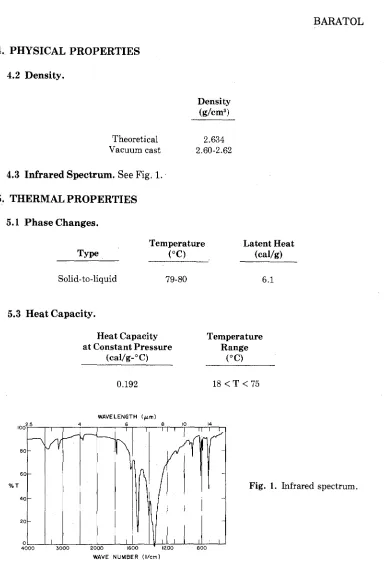
4. PHYSICAL PROPERTIES 4.2 Density.
Density (g/cm”)
Theoretical 2.634
Vacuum cast 2.60-2.62
4.3 Infrared Spectrum. See Fig. 1.. 5. THERMAL PROPERTIES
5.1 Phase Changes.
Type Solid-to-liquid
Temperature (“(3 79-80
Latent Heat b-J/g)
6.3
5.3 Heat Capacity.
Heat Capacity at Constant Pressure
(Cal/g-“C)
Temperature Range
(“C) 0.192 18 < T < 75
WAVELENGTH (/un)
Fig. 1. Infrared spectrum.
[image:13.510.77.462.52.627.2]5.4 Thermal Conductivity.
Conductivity (Cal/s-cm-%)
11.84 X lo-” /’
5.5 Coefficient of Thermal Expansion.
Coefficient of Expansion (l/co)
Temperature Range
(“C) 18 < T < 75
Temperature Range
CC) 3.4 x 1O-6 + 2.8 x lo-’ T -40 < T < 60
5.6 Heats of Combustion and Formation.4
Constituent
AH: (kcal/mole)
AH; (kcal/mole)
TNT B4NCMZ
-817.2 -12.0
--- -238.23
5.8 Other Thermal Stability Test Results.
Test Results
Vacuum
DTA and pyrolysis
,-
Fig. 2. Raratol DTA and pyrolysis test results. 6. DETONATION PROPERTIES
6.1 Detonation Velocity. The composition of baratol cast to approximately 97% of its theoretical density affects its detonation velocity as follows.
Effect of Composition
Weight Percent Detonation Velocity
WNO& (mm/b4
70 5.12
72 5.03
74 4.95
6.2 Detonation Pressure.
Weight Percent Density
WNOa), (g/cm*)
Detonation Velocity (mdm)
76 2:61 4.925 14
6.4 Plate Dent Test Results.
Charge Diameter (mm)
41.3
Density Dent Depth
(g/cm”) (mm)
2.61 3.21
7. SHOCK INITIATION PROPERTIES 7.1 Gap Test Results.
Weight Percent Density G,O LX
Noah g/cm”) (mm) (mm)
Pressure (GW
Charge Height (mm) 203
Large Scale
76 2.597 27.3 0.20
Small Scale
No data because sample was below failure diameter. 7.2 Wedge Test Results.
Density k/ma)
Distance, x*, and Time, t*, to Detonation
(mm and rs)
7.3 Shock Hugoniots.6
Density Shock Hugoniot
Wcma) (mdd
Particle Velocity Range (mm/d
2.611 U, = 2.40 + 1.66 U,, 0 <up < 0.75 U, = 1.50 + 2.16 U,, 0.75 < u, < 1.2
2.63 u, = 2.79 + 1.25 u,, O<U,<l
where U, = shock velocity and U, = particle velocity. 8. SENSITIVITY
8.1 Drop Weight Impact Height.
Tool Type
H,O (cm)
12 110
12R 140
9. MECHANICAL PROPERTIES 9.2 Tensile Strength and Modulus.
Ultimate Tensile Strength
(Psi) 380-450
9.3 Compressive Strength and Modulus. Ultimate
Compressive Strength (Psi)
Compressive Modulus (Psi)
BARATOL
REFERENCES
1. N. I. Sax, Dangerous Properties of Industrial Materials, 4th Ed. (Van Nostrand Reinhold Company, New York, 1975).
2. Code of Federal Regulations, 49, Transportation Parts 100-199, Rev. 12-1-76 (Of- fice of the Federal Register, General Services Administration, Washington, DC, 1976).
3. US Army Materiel Command, Regulation No. AMCR 385-100 (1977).
4. Prince E. Rouse, Jr., Journal of Chemical and Engineering Data 21, 16-20 (1976).
5. V. M. Boyle, R. L. Jameson, and M. Sultanoff, Proceedings-Fourth Sym- posium (International) on Detonation, White Oak, Maryland, October 12-15,
1. GENERAL PROPERTIES
1.1 Chemical and Physical Description. Composition B (Comp B), a mixture of 60 wt% RDX and 40 wt% TNT, with or without a wax desensitizer, is yellow- brown. Mixtures of RDX and TNT are generally called cyclotols in the United States, Hexolite in France, Fullpulver in Germany, Tritolite in Italy, Tritolita in Spain, and Hexotol in Sweden.
Comp B desensitized with 1 wt% wax is available in grades A and B. Grade A is more fluid than Grade B when molten. Comp B-3 contains no desensitizer. It is more viscous than Grade A or B when molten because its median RDX particle diameter is smaller.
1.2 Common Use. Comp B is used as the explosive fill in almost all types of ex- plosive ordnance.
1.3 Toxicity.’ The toxicity of Comp B is like that of RDX and TNT.
Workers who inhaled RDX dust for several months have become unconscious and have suffered loss of reflexes. The suggested maximum permissible airborne con- centration is 1.5 mg/ma.
Inhaled TNT vapor or dust may irritate mucous membranes and cause sneezing, coughing, and sore throat. TNT may produce toxic hepatitis and aplastic anemia, and it yellows the exposed skin, hair, and nails of workers. Dermatitis, erythema, papules, and itchy eczema can be severe. Ingestion of l-2 g of TNT is estimated to be an acute fatal dose to humans. The suggested maximum permissible airborne dust concentration is 0.5 mg/ma.
2. MANUFACTURE AND PROCUREMENT
slowly. Heating and stirring are continued until most of the water is evaporated. The appropriate desensitizing wax or other additive is then thoroughly mixed with the other ingredients. After cooling to satisfactory fluidity, the Comp B is cast into strips or chips. The chips are shipped to an ordnance plant, remelted, and cast into ammunition or into desired shapes. During this melting, other additives may be in- troduced. To increase the density of cast charges, a vacuum may be applied to the molten Comp B before casting.
2.2 Procurement. Comp B is purchased from the US Army Armament Readiness Command under military specification MIL-C-401C, dated May 15, 1968, or, as Comp B-3, under MIL-C-45113, dated June 19, 1958.
2.3 Shipping.2 Comp B is shipped as a Class A explosive.
2.4 Storage.* Comp B is stored in Compatibility Group D, Storage Class 1.1.
3. CHEMICAL PROPERTIES 3.1 Composition.
Constituent RDX TNT Wax
Comp B, Grades A and B Comp B-3 I
Weight Volume Weight Volume
Percent Percent Percent Percent
59.5 56.9 60.0 57.8
39.5 41.2 40.0 42.2
3.2 Molecular Weight.
Constituent Structure
Molecular Weight
RDX H
I2 222.13
ON 2 ,N/c\N, ’ NO
2
I I
CH3 OzN
9
No20
IjO,
C&NO,
Wax CH,(CH,l, CH,
227.13
3.3 Solubility.‘The solubility is that of the component’s RDX and TNT.
Solvent
-
Acetic acid 99.6% 71.0% Acetone Isoamyl alcohol Benzene Chlorobenzene Cyclohexanone Dimethylformamide Ethanol
Methyl acetate Methylcyclohexanone Methyl ethyl ketone Toluene Trichloroethylene Water Solvent - Acetone Benzene
Butyl carbinol acetate Carbon disulfide Carbon tetrachloride Chlorobenzene Chloroform Diethyl ether Ethanol (95%) Ethylene chloride Hexane
Methyl acetate Toluene
Grams of RDX Dissolved/100 g of Solvent
20°C 40°C 60°C
0.46 0.56 1.22
0.22 0.37 0.74
6.81 10.34 __-.
0.026 0.060 0.210
0.045 0.085 0.195
0.33 0.554 __-
4.94 9.20 13.9
___ 41.5 60.6
0.12 0.24 0.58
2.9 4.1 __-
6.81 10.34 -_-
3.23 ___ __-
0.020 0.050 0.125
0.20 0.24 __-
0.005 0.0127 0.03
Grams of TNT Dissolved/100 g of Solvent
20°C 40°C 60°C
109.0 228.0 600.0
67.0 180.0 478.0
24.0 ___ __-
0.48 1.53 -_-
0.65 1.75 6.90
33.9 ___ __-
19.0 66.0 302.
3.29 ___ __-
1.23 2.92 8.36
18.7 .___ .__-
0.16 ___ __-.
72.1 ___ ___.
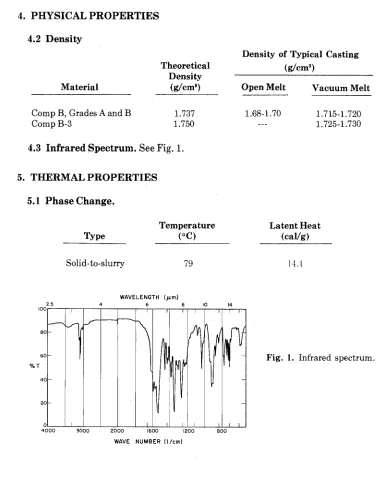
4. PHYSICAL PROPERTIES 4.2 Density
Theoretical Density
Material (fibma)
Comp B, Grades A and B 1.737
Comp B-3 1.750
4.3 Infrared Spectrum. See Fig. 1.
Density of Typical Casting k/cm”)
Open Melt Vacuum Melt
1.68-1.70 1.715-1.720
_-_ 1.725-1.730
5. THERMAL PROPERTIES 5.1 Phase Change.
Type
Temperature Latent Heat
(“0 (talk)
Solid-to-slurry 79 14.1
2.5 100
60 % T
40 80
20 0 LI
4000 3000
WAVELENGTH (urn)
F
Fig. 1. Infrared spectrum.
[image:23.498.50.436.86.584.2]5.3 Heat Capacity.
Heat Capacity at Constant Pressure Temperature Range
(Cal/g-“C) (“(3
0.234 + 1.03 x D3 T 5.4 Thermal Conductivity.
7<T<76
Density Wcma)
Conductivity (Cal/s-cm-‘C)
1.730 5.23 x lo-’ 5.5 Coefficient of Thermal Expansion.
Coefficient of Expansion (WC)
Temperature Range (“C) 5.46 x 1O-5 6<T<25
5.6 Heats of Combustion and Formation.6
Constituent
AH: (kcal/mole)
AH; (kcal/mole)
TNT -817.2 -12.0
RDX -501.8 14.7
5.7 Thermal Decomposition Kinetics.6
TNT RDX
Decomposition energy Activation energy
300 Cal/g 34.4 kcal/mole
5.8 Other Thermal Stability Test Results.
Test Results
Vacuum 0.2-0.6 ml/g of gas evolved
after 48 h at 120°C DTA and pyrolysis
Critical temperature, Tm Charge radius, a
See Fig. 2 214°C 3.0 mm
6. DETONATION PROPERTIES 6.1 Detonation Velocity.’
Effect of Charge Radius
Charge radius affects the detonation velocity of unconfined Grade A Comp B, cast to a density of 1.700 g/cm*, as follows.
D(R) = 7.859[(1 - 2.84 X 10-“/R) - 5.51 X lo-VR(R - 1.94)], where D = detonation velocity in millimeters per microsecond
and R = charge radius in millimeters.
The experimentally determined failure diameter is 4.28 mm.
6.2 Detonation Pressure.’ Grade A Comp B (Weight Percent RDX)
Density WcmY
Detonation Detonation
Velocity Pressure
(mm/d (GPa)
64.0 1.713 8.018 29.22
6.3 Cylinder Test Results.
Detonation Density” Velocity
k/cmS) (mm/d
1.700b 7.915
1.715 I.911
---
“Grade A Comp R.
“Scaled from a -I-in.-diam shot.
Cylinder Wall Velocity (mm/ps) at
R-R, = 5 mm R-R,, = 19mm
1.377 1.625
1.378 1.628
6.4 Plate Dent Test Results.e Charge
Diameter (mm)
Weight Percent RDX
Density khm3)
Dent Depth (mm)
Charge Height (mm)
41:3 6017 1.730 8:64 203
7. SHOCK INITIATION PROPERTIES 7.1 Gap Test Results.l”
Type
Density Weight Percent GO L
k/cm* ) RDX (mm) (mm)
Large Scale
Comp R-3 1.727 60.0 50.34 0.81
Grade A Comp R 1.710 64.0 45.69 0.45
Grade A Comp R 1.714 64.0 45.18 0:08
Small Scale
Comp R-3 1.720 60.0 1.22 ___
Grade A Comp R 1.710 __- 1.5 0.08
7.2 Wedge Test Results.” Density
(g/cm?
Distance, x*, to Detonation (mm)
Pressure Range* (kbar)
1.72 2100 P-1.34, 40 < P < 100
where P = pressure in kilobars.
*Users should note that this is the only wedge data fit in this volume where pressure is in units of kilobars.
7.3 Shock Hugoniots.12J8
Comp B-3 Density Shock Hugoniot
k/cm? (mm/m)
1.680 u, = 2.71 + 1.86 u,,
Particle Velocity Range (mm/m)
0 < u, < 1.0
1.70 u, = 3.03 + 1.73 u,,
where U, = shock velocity and U, = particle velocity.
c! < u, < 1.0
7.4 Minimum Priming Charge.lO Density
k/cmS)
W60 (mg of XTX 8003)
1.727” 245 0.070
1.72E1~ 623 0.027
---_-- BComp R-3.
bGrade A Comp R. 7.5 Detonation Failure Thickness.‘O
LO, (A log md
Density (g/cm?
Failure Thickness (mm)
LO, (mm)
1.729” 0.785 0.086
1.729” 0.881 0.297
1.727* 0.805 0.081
1.727” 0.813 0.051
1.713b 1.42 0.07
8. SENSITIVITY
8.1 Drop Weight Impact Height
Tool Type
12 12R 8.2 Large-Scale Drop Test Height.
Density 60
k/cm3) (ft)
1.725 8.3 Skid Test Results.
Impact
Density Angle
Wma) (degrees)
1.727 15
8.4 Susan Test Results.14
85 Partial
Target
Surface
HSO
Sand and epoxy
w
9.8 HSO (cm)
59 109
Reaction
(Psi)
< 0.5
Projectile Relative
Impact Velocity Energy Release
M/s) @Jo)
600 0
800 5
1000 20
1200 30
9. MECHANICAL PROPERTIES 9.2 Tensile Strength and Modulus.
Ultimate Tensile Strength (psi)
135-150 9.3 Compressive Strength and Modulus.
Temperature (“C)
Ultimate Compressive Strength
(Psi)
CompressiveModulus (psi x 10-O)
50 1400 rt96 0.63 f 0.1
0 1860 f 200 2.40 f 0.3
REFERENCES
1. C. R. Buck and S. E. Wilson, Jr., US Army report USEHA-32-049 (1975).
2. Code of Federal Regulations, 49, Transportation Parts 100-199, Rev. 12-1-76 (Office of the Federal Register, General Services Administration, Washington, DC, 1976).
3. US Army Materiel Command, Regulation No. AMCR 385-100 (1977).
4. A. Seidell, Solubilities of Organic Compounds, 3rd Ed., Vol. II, (D. Van Nostrand Co., Inc., New York, 1941).
5. Prince E. Rouse, Jr., Journal of Chemical Engineering Data 21, 16-20 (1976).
6. R. N. Rogers, Thermochimica Acta 11,131-139 (1975).
7. A. W. Campbell and Ray Engelke, Proceedings-Sixth Symposium (Inter- national) on Detonation, Coronado, California, August 24-27, 1976 (Office of Naval Research, Department of the Navy, ACR-221,1976), pp. 642-652.
8. W. E. Deal, Journal of Chemical Physics 27,796-800 (1957).
9. L. C. Smith, Explosivstoffe 15, 106-130 (1967).
10. Manuel J. Urizar, Suzanne W. Peterson, and Louis C. Smith, Los Alamos Scientific Laboratory report LA-7193-MS (April 1978).
11. J. B. Ramsay and A. Popolato, Proceedings-Fourth Symposium (Inter- national) on Detonation, White Oak, Maryland, October 12-15, 1965 (Office of Naval Research, Department of the Navy, ACR-126,1965), pp. 233-238.
12. N. L. Coleburn and T. P. Liddiard, Journal of Chemical Physics 44, 1929-1936 (1966).
13. V. M. Boyle, R. L. Jameson, and M. Sultanoff, Proceedings-Fourth Sym- posium (International) on Detonation, White Oak, Maryland, October 12-15,
2965 (Office of Naval Research, Department of the Navy, ACR-126, 1965), pp. 241-247.
1. GENERAL PROPERTIES
1.1 Chemical and Physical Description. Cyclotol is the generic term for mix- tures of TNT and RDX. In the United States, the term is used for mixtures of 75 wt% RDX and 25 wt% TNT (Type I) or 70 wt% RDX and 30 wt% TNT (Type II), also called Cyclotol 75/25 and Cyclotol 70/30. Neither mixture contains a desen- sitizer. To improve the flow of the molten form, a bimodal distribution of RDX crystals generally is used.
1.2 Common Use. Cyclotol is generally used as an explosive fill in military ap- plications that require slightly more energy than Comp B can provide.
1.3 T0xicity.l Cyclotol toxicity is like that of RDX and TNT.
Workers who inhaled RDX dust for several months have become unconscious and have suffered loss of reflexes. The suggested maximum permissible airborne con- centration of RDX is 1.5 mg/ms.
2. MANUFACTURE AND PROCUREMENT
2.1 Manufacture. Cyclotols are manufactured from TNT and water-wet RDX. The TNT is melted in a steam-jacketed kettle equipped with a stirrer and is brought to about 100°C. The wet RDX is added slowly, and heating and stirring are continued until the water is evaporated. Upon cooling to satisfactory fluidity, the cyclotol is cast into strips or chips. The chips are shipped to an ordnance plant, remelted, and cast into ammunition or into desired shapes. During this melting, other additives may be introduced. To increase the density of cast charges, a vacuum may be applied to the molten cyclotol before casting.
2.2 Procurement. Cyclotol is purchased from the US Army Armament Readiness Command under military specification MIL-C-13477A, dated March 31, 1965.
2.3 Shipping.* Cyclotol is shipped as a Class A explosive.
2.4 Storage.a Cyclotol is stored in Compatibility Group D, Storage Class 1.1.
3. CHEMICAL PROPERTIES 3.1 Composition.
Constituent
‘Me 1
Type IIWeight ‘Volume Weight Volume
Percent Percent Percent Percent
RDX 75:o 73.2 70.0 68:O
3.2 Molecular Weight.
Constituent Structure Molecular Weight
RDX t-12 222.13
O*N, /Cl /No2
N
I “;
H /c\N/c\
2
ho,
H2
C,H,N,O,
TNT 227.13
3.3 Solubility.4 The solubility is that of the components, RDX and TNT.
Solvent
Acetic acid 99.6% 71.0% Acetone Benzene Chlorobenzene Cyclohexanone Dimethylformamide Ethanol
Grams of RDX Dissolved/100 g of Solvent
20°C 40°C 60°C
Grams of TNT Dissolved/100 g of Solvent
Solvent 20°C
Acetone 109.0
Benzene 67.0
Butyl carbinol acetate 24.0
.Carbon disulfide 0.48
Carbon tetrachloride 0.65
Chlorobenzene 33.9
Chloroform 19.0
Diethyl ether 3.29
Ethanol (95%) 1.23
Ethylene chloride 18.7
Hexane 0.16
Methyl acetate 72.1
Toluene 55.0
Trichloroethylene 3.04
Water 0.013:
-
40” c 60°C
228.0 600.0
180.0 478.0
__- _--
1.53 _--
1.75 6.90
___ ---
66.0 302.0
--- __-
2.92 8.30
___ ---
___ __-
___ ---
130.0 367.0
___ _--
0.0285 0.0675
4. PHYSICAL PROPERTIES 4.2 Density.
Density of Theoretical Typical Casting (g/ems)
Density Open Vacuum
Material (g/cmY Melt Melt
-
Cyclotol75125 1.776 --- 1.74-1.75
Type II,
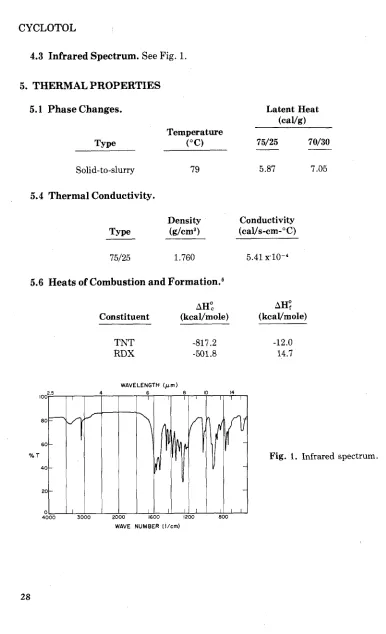
4.3 Infrared Spectrum. See Fig. 1.
5. THERMAL PROPERTIES 5.1 Phase Changes.
Temperature
Latent Heat W/g)
Type 7w 75/25 70/30
Solid-to-slurry 79 5.81 7.05
5.4 Thermal Conductivity.
Type
Density Conductivity
khm3) (eal/s-cm-%)
75125 1.760 5.41 x,10-’
5.6 Heats of Combustion and Formationn6 AH”, Constituent (kcal/mole)
TNT -817.2
RDX -501.8
WAVELENGTH (urn)
% T
AH: (kcal/mole)
-12.0 14.7
[image:36.508.71.457.50.684.2]5.7 Thermal Decomposition Kinetics.6
TNT RDX
Decomposition energy Activation energy Pre-exponential factor
300 Cal/g 34.4 kcal/mole 2.51 X lO”/s
500 Cal/g 47.1 kcal/mole 2.02 x 10% 5.8 Other Thermal Stability Test Results.
Test Results
Vacuum 0.4-0.5 ml/g of gas evolved
after 48 h at 120°C
DTA and.pyrolysis See Fig. 2
Critical temperature, Tm 208°C
Charge radius, a 3.5 mm
6. DETONATION PROPERTIES 6.1 Detonation Velocity.’
Effect of Charge Radius
Charge radius affects the detonation velocity of unconfined Cyclotol75/25 cast to a density of 1.740 g/cm8 as follows.
D(R) = 8.210[(1 - 4.89 x 1O-2/R) - O.llWR(R -
2.4411,
where D = detonation velocity in millimeters per microsecond,
and R = charge radius in millimeters.
The experimentally determined failure diameter is 6.0 mm.
6.2 Detonation Pressure.*
Weight Percent Density
RDX k/cm3)
Detonation Detonation
Velocity Pressure
(mm/d (GPa)
77.0 1.743 8.252 31.25
6.4 Plate Dent Test Resu1ts.O (See Part II for additional data.)
Charge Weight
Diameter Percent
(mm) RDX
Density (g/cd
Dent Charge
Depth Height
(mm) (mm)
41.3 77 1.200 5.38 203
41.3 77 1.743 9.24 203
7. SHOCK INITIATION PROPERTIES 7.1 Gap Test Results.l”
Density k/cmS)
Weight Percent RDX
Large Scale
1.756 1.757 1.744 1.750
77.0 76.1 77.3
77.9
Small Scale
42.85 0.23
43.15 0.15
44.93 0.08
7.3 Shock Hugoniot
Density Shock Hugoniot Particle Velocity Range
k/cm3) (mm/m) (mdd
1.752 U, = 2.63 + 1.85 U, 0 < up < 1.0 where U, = shock velocity
and U, = particle velocity. 7.4 Minimum Priming Charge.lo
Density Weight Percent ’
(g/cm9 RDX
W,O LO,
(mg of XTX 8003) (* log mg)
1.749 75
1.739 70
7.5 Detonation Failure Thickness.‘O Density Weight Percent
(g/cm”) RDX
1.752 77
8. SENSITIVITY
8.1 Drop Weight Impact Height.
Tool Type
785 0.054
898 0.024
Failure Thickness (mm)
1.51
LO, (mm) 0.11
60 (cm)
12 36
12R 108
8.2 Large-Scale Drop Test Height.‘l
Density H.50
(g/cm3 ) vt) Reaction
8.3 Skid Test Results. Density Wcma) Weight Percent RDX Impact Angle (degrees) Target Surface J&O (W -
Overpressure (Psi)
1.758 77 15 Sand and epoxy 4 < 1.0
8.4 Susan Test Results.1z Projectile Impact Velocity
Ws)
Relative Energy Release
W)
- 200 5
500 25
1000 50
I 8.5 Spark Sensitivity.
Lead Foil Occurrence of
Thickness Sample Size Energy Explosion
Electrode (mils) bg) (J) (So)
Brass 3 27 0.38 23
Brass 10 27 3.29 23
’ 9. MECHANICAL PROPERTIES
9.3 Compressive Strength and Modulus.
Temperature (“C)
Ultimate Compressive Strength
(psi)
Compressive Modulus (psi x IO- “)
REFERENCES
1. C. R. Buck and S. E. Wilson, Jr., US Army report USEHA-32-049 (1975).
2. Code of Federal Regulations, 49, Transportation Parts 100-199, Rev. 12-1-76 (Office of the Federal Register, General Services Administration, Washington, DC, 1976).
3. US Army Materiel Command, Regulation No. AMCR 385100 (1977).
4. A. Seidell, Solubilities of Organic Compounds, 3rd Ed., Vol. II (D. Van Nostrand Co., Inc., New York, 1941).
5. Prince E. Rouse, Jr., Journal of Chemical and Engineering Data 21, 16-20 (1976).
6. R. N. Rogers, Thermochimica Acta 11,131-139 (1975).
7. A. W. Campbell and Ray Engelke, Proceedings-Sixth Symposium (Inter- national) on Detonation, Coronado, California, August 24-27, 1976 (Office of Naval Research, Department of the Navy, ACR-221, 1976), pp. 642-652.
8. W. E. Deal, Journal of Chemical Physics 27,796-800 (1957).
9. L. C. Smith, Explosivstoffe l&106-130 (1967).
10. Manuel J. Urizar, Suzanne W. Peterson, and Louis C. Smith, Los Alamos Scientific Laboratory report LA-7193-MS (April 1978).
11. A. Popolato, Proceedings of the International Conference on Sensitivity and Hazards of Explosives, Ministry of Aviation, Waltham Abbey, Essex (October 1963).
1. GENERAL PROPERTIES
1.1 Chemical and Physical Description. DATB (1,3-diamino-2,4,6- trinitrobenzene), C,H,N,OB, is a yellow crystalline solid.
1.2 Common Use. DATB is a relatively insensitive, temperature-resistant high explosive of limited military application. To be used effectively, it must be coated with a plastic (plastic-bonded explosive) or be mixed with liquid ingredients.
1.3 Toxicity. Industrial health data on DATB toxicity are virtually nil. Animal exposure indicated no immediate hazard even at 80°C. Although DATB is relative- ly safe, it is from a homologous group that has caused skin sensitivity, cancer, and internal physical damage.
2. MANUFACTURE AND PROCUREMENT
2.2 Procurement. There is no dedicated DOD facility for DATB manufacture. It can be procured, on special order, from a few US chemical companies that have facilities for synthesizing energetic materials.
2.3 Shipping.l DATB is shipped as a Class A explosive.
2.4 Storage.2DATB is stored dry in Compatibility Group D, Storage Class 1.1.
3. CHEMICAL PROPERTIES 3.1 Structural Formula.
3.2 Molecular Weight. 243.14 3.3 Solubility.
Grams Dissolved/100 g of Solvent Solvent
Acetic anhydride y-Rutyrolactone Cyclohexanone Dimethylformamide Dimethylsulfoxide Formamide‘ Nitromethane Sulfuric acid
40°C 60°C
0.492 ___
0.810 ___
0.355 _--
2.96 4.88
4.56 8.15
0.282 ___
0.362 ___
4. PHYSICAL PROPERTIES
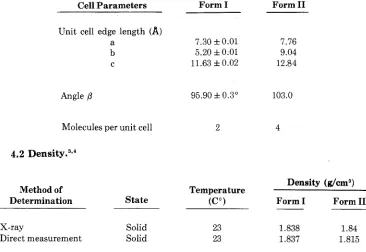
4.1 Crystal Structure. 8,4 Two crystalline polymorphs of DATB have been iden- tified. The cell parameters of Form I, stable to 217’C, and of Form II are given.
Cell Parameters
Unit cell edge length (ft) ;
C
Angle P
Molecules per unit cell
4.2 Density.s*4
Method of
Determination State
X-ray
Direct measurement
Solid 23
Solid 23
Form I Form II
7.30 f 0.01 7.76 5.20 f 0~01 9.04 11.63 f 0.02 12.84
95.90 f 0.3”
2
Temperature (CO)
103.0
4
Density (g/ems) Form I
1.838 1.837
Form II
1.84 1.815 DATB powder can be pressed into pellets. No quantitative pressing data is available.
4.3 Infrared Spectrum. See Fig. 1.
[image:44.497.87.453.158.410.2]5. THERMAL PROPERTIES 5.1 Phase Changes.8-6
‘be
Temperature Latent Heat
v-3 (kcal/mole)
Solid-to-solid
Form I to Form II Solid-to-liquid
Solid-to-gas Form I
217 ___
286 __-
--_ 33.47”
---
“Computed from vapor pressure data presented in Sec. 5.2.
5.2 Vapor Pressure.6
Temperature (“Cl
Vapor Pressure, (mm Hg X 10’)
62.6 0.081
78.2 0.879
85.3 2.09-2.36
97.6 9.12-9.80
108.1 34
A least squares fit to these data gives
log,, P(mm Hg) = 13.73 - 33 470/4.576 T(K)
5.3 Heat Capacity.
Heat Capacity at Constant Pressure (Cal/g-‘C)
5.4 Thermal Conductivity,
Conductivity (Cal/s-cm-%)
6.19 x lo-”
5.6 Heats of Combustion and Formatioh at 25”C6
AH; AH;
(kcal/mole) (kcal/mole)
-711.5 -23.6
5.7 Thermal Decomposition Kinetics.7
Decomposition energy 300 Cal/g Activation energy 46.3 kcal/mole Pre-exponential factor 1.17 X 10¹⁶/s 5.8 Other Thermal Stability Test Results.
Test Results
Vacuum
DTA and pyrolysis Critical temperature, Tm Charge radius, a
Density, p
O.l-0;3 ml/g of gas evolved after 48 hat 120°C See Fig. 2
322 “C 3.5 mm 1.74 g/cm3
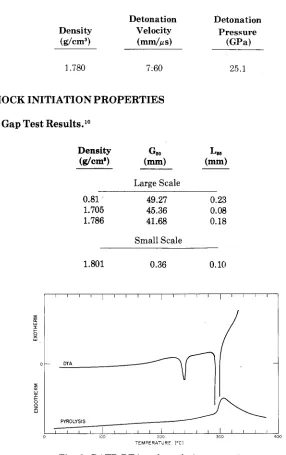
The failure diameter of unconfined DATB pressed to a density of 1.816 g/cm” is approximately 5.3 mm.
6.2 Detonation Pressure.
Detonation
Density Velocity
(d--W b-/m)
1.780 7:60
7. SHOCK INITIATION PROPERTIES
Detonation Pressure
(GPa)
25.1
7.1 Gap Test Results.l”
Density (g/cm”)
0.81’ 1.705 1.786
GO (mm) Large Scale
49.27 45.36 41.68 Small Scale
L (mm)
0.23 0.08 0.18
1.801 0.36 0.10
r I I I I , I I I I , I, I , I 1 I
PYRoLYsls
1
I I I I ICO f I I I,, 200 I I I I I1 x0 TEMPEwxT”RE PC1
[image:47.498.102.388.142.597.2]7.3 Shock Hugoniot.9 Density
k/cm”) 1.780
Shock Hugoniot (mdw)
u, = (2.449 f 0.043) + (1.892 * 0.058) u,, where U, = shock velocity
and U, = particle velocity. 7.4 Minimum Priming Charge.
Density WSO
k/cm*) (mg of XTX 8003)
1.783 57.1 0.108
7.5 Detonation Failure Thickness. Density
(g/cm*)
Failure Thickness (mm)
1.708 0.630 0.069
1.724 0.732 0.145
8. SENSITIVITY
8.1 Drop Weight Impact Height.
Tool Type
H.50 (4
L
(k logmd
L
(mm)
12 >320
REFERENCES
1. Code of Federal Regulations, 49, Transportation Parts 100-199, Rev. 12-1-76 (Office of the Federal Register, General Services Administration, Washington, DC, 1976).
2. US Army Materiel Command, Regulation No. AMCR-385-100 (1977).
3. J. R. Holden, Acta Crystallographica 22,545-550 (1967).
4. J. R. Holden, A. H. Rosen, and J. M. Rosen, Naval Ordnance Laboratory, private communication (March 1959).
5. J. M. Rosen and C. Dickenson, Naval Ordnance Laboratory report NOLTR-69- 67 (April 1969).
6. Prince E. Rouse, Jr., Journal of Chemical and Engineering Data 21, 16-20 (1976).
7. R. N. Rogers, Thermochimica Acta 11,131-139 (1975).
8. N. L. Coleburn, B. E. Drimmer, and T. P. Liddiard, Naval Ordnance Laboratory, private communication (October 1960).
9. N. L. Coleburn and T. P. Liddiard, Jr., Journal of Chemical Physics 44, 1929- 1936 (1966).
1. GENERAL PROPERTIES
1.1 Chemical and Physical Description. HMX, an explosive similar to RDX, was a byproduct in the production of RDX by the process that W. E. Bachmann and J. E. Sheehan developed. It has a higher density and much higher melting point than RDX. It was named HMX for High Melting explosive.
HMX, C,H,N,O,, is a colorless polycrystalline material. It is also known as’ octahydro-1,3,5,7-tetranitro-1,3,5,7-tetrazocine, cyclotetramethylene- tetrani- tramine, and Octogen.
1.2 Common Use. Because of its higher density, HMX has replaced RDX in ex- plosive applications for which energy and volume are important. It is used in castable TNT-based binary explosives called Octols; as the main ingredient in high-performance plastic-bonded explosives, and in high-performance solid propellants.
1.3 Toxicity.’ The suggested maximum concentration of HMX in air is 1.5 mg/ma.
2. MANUFACTURE AND PROCUREMENT
2.1 Manufacture. A modified Bachmann batch process is used to produce HMX. Solutions of hexamine in acetic acid and ammonium nitrate in nitric acid are added to a base of acetic acid, acetic anhydride, and paraformaldehyde. A first period of continuous addition is followed by 15 minutes of aging, and a second period of continuous addition is followed by 1 hour of aging. Then the reaction mix- ture is diluted with hot water and heated to boiling to destroy all linear compounds. Cooling, filtering, and water washing complete preparation of the product. The crude HMX is purified by recrystallization from acetone solution to give a final product that is up to 99% beta HMX.
2.2 Procurement. HMX is purchased from the US Army Armament Readiness Command under Military Specification MIL-H-45448, Amendment 1, dated July 15.1975.
2.3 Shipping.2 HMX is shipped as a Class A explosive and must be shipped wet with not less than 10% water.
2.4 Storage.* HMX may be stored dry in Compatibility Group A or wet in Com- patibility Group D. Either wet or dry, it is in Storage Class 1.1.
3.2 Molecular Weight. 296.17 3.3 Solubility.
Grams Dissolved/100 g of Solvent
Solvent 20°C 40°C 60” C
Acetic acid Glacial 70%
Acetic anhydride Acetone Anhydrous 70% Acetonitrile Cyclohexanone Dimethylformamide Dimethylsulfoxide
0.037 0.044 0.090
-__ 0.033 0.103
-_- 1.29 1.94
2.4 3.4 ___
0.66 1.20 --_
__- 3.07 4.34
__- 5.91 7.17
__- 6.1 11.1
_-- 45.5 47.2
4. PHYSICAL PROPERTIES
4.1 Crystal Structure.4-6 The cell parameters of the four polymorphic forms of HMX are given.
Cell Parameters
Unit cell edge length (A)
;
C
Angle p
Molecules per unit cell
a
23.89 15.14
5.91
---
8
P Y 6
11.05 6.54 10.95 7.93 7.66 ___
7.37 14.61 32.49
102.8” 119.4” ___
4.2 Density.’
Density (g/cm”) Method of
Determination State a
P - Y __ 6
X-ray Solid 1.838 1.902 1.78 1.786
Direct measurement Solid 1.84 1.905 1.76 1.80
HMX cannot be consolidated into charges by conventional pressing. Obtaining large pieces of polycrystalline HMX requires solvent pressing techniques.
4.3 Infrared Spectrum. See Fig. 1.
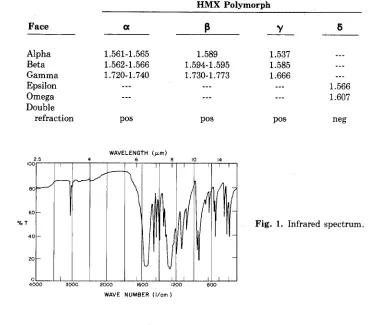
4.4 Refractive Index.’ The refractive indices of the four polymorphs in sodium light are shown.
HMX Polymorph
Face a B
Alpha 1.561-1.565 1.589
Beta 1.562-1.566 1.594-1.595
Gamma 1.720-1.740 1.730-1.773
Epsilon Omega Double refraction __- ___ Pas 2.5
WAVELI ENGTH 6
li 16OC
I (pm) 6
___ ___
Pas
14
Y 6
1.537 _-_
1.585 _-_
1.666 __-
___ 1.566
_-_ 1.607
Pas neg
Fig. 1. Infrared spectrum.
[image:53.500.66.441.312.637.2]5. THERMAL PROPERTIES 5.1 Phase Changes.6-8
r Latent Heat
Temperaturea
‘be w W/d (kcal/mole)
Solid-to-solid Bba atoy ato6 Solid-to-liquid
a* ;
Solid-to-gas
102-104
Metastable 160-164
2.0 0.6
--_ ___
7.8 2.3
256-257 _-_ --_
246-247 50.0 17.0
279-280 _-_ __-
280-281 --_ ---
--- 141.4 41.8gb
---
“There is some controversy about the temperature stability ranges of the four HMX
polymorphs. These data are from Ref. 8.
Vomputed from the vapor pressure data presented in Sec. 5.2.
5.2 Vapor Pressure.B
Temperature Vapor Pressure
(“(2 (mm Hg x 10’)
97.6 0.032
108.2 0.164
115.6 0.385-0.419
129.3 2.830-2.870
A least squares fit to these data gives
5.3 Heat Capacity.
Heat Capacity at Constant Pressure
(Cal/g-“C)
0.231 + 5.5 X 1O-4 T 5.4 Thermal Conductivity.l”
Conductivity (Cal/s-cm-“C)
Temperature Range
(“C) 37 < T < 167
Temperature (“C)
1.2 x 10-a 25
9.7 x 10-d 160
5.6 Heats of Combustion and Formation at 25%k11
AH; AH;
kcal/mole kcal/mole
-660.7 11.3
5.7 Thermal Decomposition Kinetics.l*.
Decomposition energy 500 Cal/g
Activation energy 52.7 kcal/mole
Pre-exponential factor 5 x 10lg/s
5.8 Other Thermal Stability Test Results.
Test Results
Vacuum 0: l-O.4 ml/g of gas evolved
after 48 h at 120°C DTA and pyrolysis See Fig. 2
Critical temperature, Tm 253°C
Charge radius, a 3.3 mm
Fig. 2. HMX DTA and pyrolysis test results.
6. DETONATION PROPERTIES 6.1 Detonation Velocity.la
Density (g/cm”)
Detonation Velocity * (mdfis)
1.89 9.110
“Because HMX is a high-density version of RDX, their detonation
velocities should be identical if
they are compared at the same
density.
6.2 Detonation Pressure.ls
Density (dcmS)
Computed Detonation Pressure
6.3 Cylinder Test Results.‘”
Density k/cmS) 1.891
Cylinder Wall Velocity (mm/m) at
R-R,,= 5mm R-R,,= 19mm
1.65 1.86
7. SHOCK INITIATION 7.1 Gap Test Results.
Density k/ems)
GO (mm) Large Scale
1.07 70.68
Small Scale
0.71
1.20 8.53 0.05
1.79 4.23 0.10
1.83 4.04 0.13
7.2 Wedge Test Results.
Density Distance, x*, to Detonation
WcmS) (mm)
Pressure Range (GPa)
1.891 log P = (1.18tO.O2)-(0.59kO.03) log x*, where P = pressure in gigapascals.
7.3 Shock Hugoniots.”
Density Shock Hugoniot
(g/cm3 ) (rnd~s)
Particle Velocity Range (mm/ps) .-
1.903
1.89
U, = 2.74 + 2.6 Up,*
u, = (2.901 3~ 0.407) + (2.058 zb 0.490) U,, where U, = shock velocity
0.59 < u, < 1.04
and U, = particle velocity.
*Computed from isothermal compression data,
U,, = 2.67 + 2.6 UPt,
where the subscripts “st” and “pt” indicate the shock and particle velocities, respectively, at
constant temperature.
8. SENSITIVITY
8.1 Drop Weight Impact Height.
Tool Type (cm)
KX
12 26
12R 37
8.5 Spark Sensitivity.
Lead Foil Sample Thickness Size
Electrode (mils) bg)
Rrass 3 66.9
Rrass 10 66.9
Steel 1 75.0
Steel 10 75.0
Energy
(J)
0.2 50
1.03 50
0.12 50
0.87 50
Occurrence of Explosion
REFERENCES
1. Committee on Threshold Limit Values: Documentation of Threshold Limit VaEues, 3rd Ed. (American Conference of Governmental Industrial Hygienists, 1014 Broadway, Cincinnati, Ohio, 1971).
2. Code of Federal Regulations, 49, Transportation Parts 100-199, Rev. 12-1-76 (Office of the Federal Register, General Services Administration, Washington, DC, 1976).
3. US Army Materiel Command, Regulation No. AMCR-385100 (1977).
4. H. H. Cady, A. C. Larson, and D. T. Cromer, Acta Crystallographica 16, 617- 623 (1963).
5. W. C. McCrone, Analytical Chemistry 22, 12251226 (1950).
6. Anna S. Teetsov and W. C. McCrone, Microscope 15,13-29 (1965).
7. W. E. Beatty and B. Gilbert, Explosives Research and Development Establish- ment report ERDE 7/R/59 (October 1959).
8. Howard H. Cady and Louis C. ‘smith, Los Alamos Scientific Laboratory report LAMS-2652 (1961).
9. J. M. Rosen and C. Dickenson, Naval Ordnance Laboratory report NOLTR-69- 67 (April 1969).
10. C. M. Tarver, Lawrence Livermore Laboratory report UCID-17272-78-4 (September 1978).
11. 0. H. Johnson, Naval Ordnance Laboratory report NAVORD-4371 (October 1956).
12. R. N. Rogers, Thermochimica Acta 11,131-139 (1975).
13. C. L. Mader, Los Alamos Scientific Laboratory report LA-2900 (July 1963).
14. J. W. Kury, H. C. Hornig, E. L. Lee, J. L. McDonnel, D. L. Ornellas, M. Finger, F. M. Strange, and M. L. Wilkins, Proceedings-Fourth Symposium (Inter- national) on Detonation, White Oak, Maryland, October 12-15, 1965 (Office of Naval Research, Department of the Navy, ACR-126,1965), pp. 3-12.
1. GENERAL PROPERTIES
1.1 Chemical and Physical Description. Nitroguanidine (NQ), CH,N,02, is a colorless polycrystalline material, generally in the form of a low-density matted structure. It is also known as Picrite.
1.2 Common Use. NQ is used extensively as an ingredient in gun propellants, because the combustion products of such propellants are less erosive than those of other propellants of equivalent energy.
2. MANUFACTURE AND PROCUREMENT
2.1 Manufacture.‘v2 The procedures used to produce NQ are the British aqueous fusion (BAF) and the urea/ammonium nitrate processes. The United States uses a modified BAF process. Calcium carbide is reacted with nitrogen to form calcium cyanamide. The calcium cyanamide is reacted with carbon dioxide and water to form cyanamide, This is reacted with ammonium nitrate to form guanidine nitrate (GUN). GUN is reacted with 40 wt% oleum to form nitroguanidine. Final purifica- tion of the NQ is by crystallization from water.
3. CHEMICAL PROPERTIES 3.1 Structural Formula.6*6
HzN \ / C=N-NO,
“ZN
3.2 Molecular Weight. 104.1 3.3 Solubility.
Grams Dissolved/100 g of Solvent
Solvent 20°C
Water
Dimethyl sulfoxide Dimethyl formamide Methanol
Methyl ethyl ketone Rutyl acetate n-octane
0.36 0.75 1.6
24 25 28
14 -__ 20
0.3 0.6 ___
0.13 0.20 ___
0.07 0.08 0.1
0.003 0.008 ___
40°C 60°C
4. PHYSICAL PROPERTIES
4.1 Crystal Structure.7~8 Only one polymorph of NQ has been observed. The orthorhombic unit cell parameters are given.
Cell Parameters
Length of unit cell edge (A)
t ,
17.58 24.84
C 3.58
4.2 Density.’
Crystal
Method of
Determination State
Temperature Density
(“(2 k/cm”)
X-ray
Direct measurement
Solid ___
-_- 1.78
25 1.77
Pressed
NQ can be pressed to a density of 1.70 g/cma at a pressure of 20 000 psi.
4.3 Infrared Spectrum. See Fig. 1. 4.4 Refractive Index.’
Refractive Index in 5893-A Light
a 1.526
P 1.694
Y 1.81
WAVELENGTH I urn)
5. THERMAL PROPERTIES 5.1 Phase Change.
,
Type Temperature
(“Cl
Solid-to-liquid 245-250*
--- .
“Melting is usually preceded by decomposi-
tion, which is very rapid in the liquid
phase.
5.3 Heat Capacity.
Material
Heat Capacity at Constant Pressure
W/g-T)
Temperature Range PC)
LBD NQ” 0.242 + 0:OOll T(“C) 37 < T < 167
HBD NQb (3.269 + 0.0007 T( “C) 37 < T < 167
“Low-bulk density, in accordance with material specif’ication MU,-N-494A.
bHigh-bulk density NQ recrystallized f’rom water, median particle diameier -300 pm.
5.4 Thermal Conductivity.
Material
Density Conductivity (s/cm*) (cal/cm-s-°C)
Temperature Range (W
LBD NQ 1.65 10.1 x 10⁻⁴ 25 < T < 50
5.6 Heats of Combustion and Formation at 25’XLe AH;
(kcal/mole)
-210.4
AH; (kcal/mole)
-20.29 5.7 Thermal Decomposition Kinetics.loJ1
Source
Ref. 10 Ref. 11
Decomposition energy 500 Cal/g Activation energy 20.9 kcal/mole Pre-exponential factor 2.84 x lO’/s 5.8 Other Thermal Stability Test Results.
___ 57.1 kcal/mole
8.75 x 10²²/s
Test Results
Vacuum Gas evolved after 48 h
at 120°C (ml/g)
NQ per MIL-N-494A
Water recrystallized HBD NQ DMF recrystallized HBD NQ DTA and pyrolysis
Critical temperature, Tm Charge radius, a
Density, p
1 1
$’
r
I,.
1 L
_
1 / / I II,, 1 , I,, I 0 m zco 300
TEMPER4T”RE (“Cl
Fig. 2. NQ DTA and pyrolysis test results.
m
6. DETONATION PROPERTIES 6.1 Detonation Velocity.12
Effect of Density
The effect of density on the infinite-diameter detonation velocity is given by D, = 1.44 + 4.015 p,, for 0.3 < p0 < 1.78,
where D m = infinite-diameter detonation velocity in millimeters per microse- cond,
and p. = density in grams per cubic centimeter. Failure Diameter
The LBD NQ failure diameter as a function of charge density is shown.
Charge Density (g/cm*)
Charge Diameter 6-1
Detonates Fails
1.0 25.4 __-
1.21 15.9 14.3
6.2 Detonation Pressure. There are no experimental data on NQ detonation pressure. However, there is one data point from a mixture of 95 wt% NQ and 5 wt% Estane. The results are as follows.
Material
Density k/cm?
Detonation Detonation
Velocity Pressure
(mm/cLs) (GW
95 wt% NQ/
5 wt% Estane
1.704 8.28 26.8
6.4 Plate Dent Test Results.
Charge Diameter Density Dent Depth Charge Height
(mm) (g/cm*) (mm) (mm)
12.7 0.25 0.56 76.2
12.7 0.40 0.79 76.2
7. SHOCK INITIATION PROPERTIES 7.1 Gap Test Results.
Density Go L6
k/cm”) (mm) (mm)
Large Scale
7.2 Wedge Test Results.
Density khma)
Distance, x*, and Time, t*, to Detonation
(mm and ps)
Pressure Range (GM
1.659 to log P = (1.44&0.07)-(0.15*0.08) logx”
1.723’ log P = (1.32&0:03)-(0.15lO.07) log t*
13.35 < P < 26.28
1.688b IogP = (1.51f0.02)-(0.26f0.03) logx* 21.2 < P < 27.1
“N$ median particle diameter, 300 pm, as cubic crystals.
bNQ as long needle crystals with a needle diameter of’ a Ikw micrometers.
7.3 Shock Hugoniots. Density
(dad)
Shock Hugoniots (mdk4
Particle Velocity Range hdps)
1.659 to B U,=(3.544&0.524)+(1.459&0.276) U,, 1.337 < u, <2.220 1.723
1.688b U,=(3.048f0.254)+(1.725~0.135) U,, 1.172 < U, < 2.336 where U, = shock velocity
and U, = particle velocity.
“NQ median particle diameter, 300 pm, as cubic crystals.
8. SENSITIVITY
8.1 Drop Weight Impact Height.
Tool Type
H&O
(cm)
12 >320
12B >320
REFERENCES
1. C. H. Nichols, Picatinny Arsenal Technical report PA-TR-4566 (May 1974).
2. G. Cowan, US Army Armament Materiel Command, private communication (1977).
3. Code of Federal Regulations, 49, Transportation Parts 100-199, Rev. 12-1-76 (Office of the Federal Register, General Services Administration, Washington, DC, 1976).
4. US Army Armament Materiel Command, Regulation No. AMCR 385-100
(1977).
5. W. D. Kumler and P. P. T. Sah, Journal of Organic Chemistry 18, 669-675 (1953).
6. W. D. Kumler, Journal of the American Chemical Society 76,814-816 (1954).
7. W. C. McCrone, Analytical Chemistry 23,205-206 (1951).
8. J. Donohue and J. H. Bryden, Acta Crystallographica 8,314-316 (1955).
9. L. Medard and M. T. Thomas, Memorial des Poudres 31,173-196 (1949).
1. GENERAL PROPERTIES
1.1 Chemical and Physical Description. Octal is the generic term for mixtures of TNT and HMX. In the United States, the mixtures consist of 75 wt% HMX and 25 wt% TNT (Type I) or 70 wt% HMX and 30 wt% TNT (Type II), also called Octal 75/25 and Octal 70/30. Neither mixture contains a desensitizer. To improve the flow characteristics of the molten form, a bimodal distribution of HMX crystals general- ly is used.
1.2 Common Use. Octal is often used as an explosive fill in military applications that require more energy than either Comp B or Type I Cyclotol can provide.
1.3 Toxicity.l*a Octal toxicity is like that of HMX and TNT.
The suggested maximum concentration of HMX in air is 1.5 mg/m”.
Inhaled TNT vapor or dust may irritate mucous membranes and cause sneezing, coughing, and sore throat. TNT may produce toxic hepatitis and aplastic anemia. TNT yellows the exposed skin, hair, and nails of workers. Dermatitis, erythema, papules, and itchy eczema can be severe. Ingestion of 1-2 g of TNT is estimated to be an acute fatal dose to humans. The suggested maximum permissible airborne dust concentration is 0.5 mg/ma.
2. MANUFACTURE AND PROCUREMENT
These are shipped to an ordnance plant. remelted. and cast into ammunition or into other desired shapes. During this melting, other additives may be introduced. To increase the density of the cast charges, a vacuum may be applied to the molten octal before casting.
2.2 Procurement. Octal is purchased from the US Army Armament Command under military specification ML0455446A, dated September :30.1962.
2.3 Shipping.’ Octal is shipped as a Class A explosive.
2.4 Storage.’ Octal is stored in Compatibility Group D. Storage Class 1.1.
3.CHEMICALPROPERTIE9 3.1 C4mposidon.
Type1 Type II
Constituent
Weight Volume
percent Percent
Weight Percent
Volume Percent
HMS 76 :2..3 70 66.5
3.2 Molecular Weight.
Constituent Structure Molecular Weight
HMX 296.17
O2V
H2
I
N-C--N ,NO2
I 1
H2S-C c-n,
I 1
O2N
/N--;:-NNN02
H2
TNT 227.13
CH3
k0,
3.3 Solubility.6 The solubility is that of the components, HMX and TNT.
Grams of HMX Dissolved/100 g of Solvent Solvent
Acetic acid Glacial 70%
Acetic anhydride Acetone Anhydrous 70% Acetonitrile Cyclohexanone Dimethylformamide Dimethylsulfoxide Solvent Acetone Benzene
Butyl carbinol acetate Carbon disulfide Carbon tetrachloride Chlorobenzene Chloroform Diethyl ether Ethanol (95%) Ethylene chloride Hexane
Methyl acetate Toluene Trichloroethylene Water
20°C 40°C 60°C
0.037 0.044
-__ 0.033
--- 1.29
2.4 3.4
0.66 1.20
___ 3.07
___ 5.91
___ 6.1
__- 45.5
0.090 0.103 1.94 ___ 4.34 7.17 11.1 47.2
Grams of TNT Dissolved/100 g Solvent
20°C 40” c 60°C
109.0 228.0 600.0
67.0 180.0 478.0
24.0 ___ _-_
0.48 1.53 ___
0.65 1.75 6.90
33.9 ___ ___
19.0 66.0 302.0
3.29 ___ ___
1.23 2.92 8.30
18.7 ___ ___
0.16 ___ ___
72.1 ___ ___
55.0 130.0 367.0
3.04 -__ ___
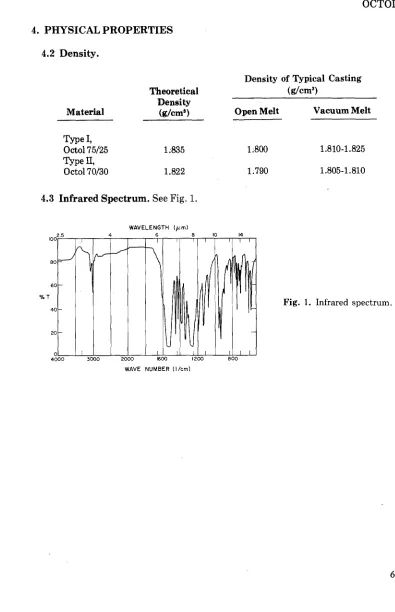
4. PHYSICAL PROPERTIES 4.2 Density.
Material
Theoretical Density
(f&m*)
Density of Typical Casting (f&ma)
Open Melt Vacuum Melt
Tw 1,
Octal 75/25 1;835
Type J&
Octal 70/30 1.822
1.800 1.810-1.825
1.790 1.805-1.810
4.3 Infrared Spectrum. See Fig. 1.
WAVELENGTH L~rn)
Fig. 1. Infrared spectrum.
[image:73.504.46.441.77.689.2]5. THERMAL PROPERTIES 5.1 Phase Changes.
5w
Temperature m
Latent Heat (Cal/g)
75/25 70/30
Solid-to-slurry 79 5.87 7.05
5.6 Heats of Combustion and Formation.g
Constituent
AH: (kcal/mole)
AH; (kcal/mole)
TNT -817.2 -12.2
HMX -660.7 11.3
5.7 Thermal Decomposition Kinetics.’ , /
TNT HMX
Decomposition energy Activation energy Pre-exponential factor
300 Cal/g 34.4 kcal/mnle 2.5 x loll/s
500 Cal/g 52.7 kcal/mole 5 x lO’S/s 5.8 Other Thermal Stability Test Results.
Test Results
Vacuum 0.1-0.4 ml/g of gas evolved
after 48 h at 120°C DTA and pyrolysis
Critical temperature, Tm
Fig. 2. Octal DTA and pyrolysis test results.
6. DETONATION PROPERTIES 6.1 Detonation Velocity.B
Effect of Charge Radius
Charge radius affects the detonation velocity of unconfined Octal 77/23 cast to a density of 1.814 g/cm* as follows.
D(R) = 8.481[(1 - 6.9 X lO+R) - (9.25 X 10⁻²)/R(R - 1.34)] ,
where D = detonation velocity in millimeters per microsecond
and R = charge radius in millimeters.
The experimentally determined failure diameter is <6.4 mm.
6.2 Detonation Pressure.
Weight Percent Density
HMX k/cm*)
Detonation Velocity (mm/w)
Detonation Pressure
Wa)
6.4 Plate Dent Test Results.
Charge Weight
Diameter Percent
(mm) HMX
41.3 76.3
41.3 76.4
Density WcmS)
1.809
1.802
Dent Depth (mm) lo:06
9.99
Charge Height
(mm)
203 127
7. SHOCK INITIATION PROPERTIES 7.1 dap Test Results.g
Weight Percent Density G&O L%
HMX k/cm”) (mm) (mm)
Large Scale
76.0 1.822 49;45 0.2
a 1.726 48.59 0.41
a 1.795 43.56 0.46
Small Scale
76.0 1.803 0.71 0.08
76.0 1.810 0.58 ---
78.6 1.800b 0.56 0.06
: 1.775 1.791 0.36 0.41 0;05 0.05
---
“UK EDC-1 nominal 75 wt% HMX with some RDX. “With 1 wt% wax.
‘UK EDC-1 cast in the United Kingdom. dUK EDC-1 vacuum cast in the United States.
7.3 Shock Hugoniots.‘O /
Density Weight Percent Shock Hugoniot Particle Velocity Range
7.4 Minimum Priming Charge.9 Density Weight Percent
k/cm* ) HMX
1.818 75
7.5 Detonation Failure Thickness.9
W60 (mg of XTX 8003)
292
Density Weight Percent
(g/cm*) HMX
1.791 75
8. SENSITIVITY
8.1 Drop Weight Impact Height.
Failure Thickness L*
(mm) (mm)
Tool Type
HE&
(cm)
12 38
12l3 93
8.2 Large-Scale Drop Test Height.” Density Weight Percent
(g/cm*) HMX
1.310 75
1.805 758
1.766 b
---
“Octal 75/25 with 1 wt% wax.
WK EDC-1 cast in the United Kingdom.
1.43
L9,
(A log mg)
0.028
0.21
Reaction -
45 Low-order partial
-150 Low-order partial
8.3 Skid Test Results. Weight Percent HMX Impact Angle (degrees)
1.810 75
1.805 a
__---
“Cast with 1 wt% wax.
45 45 Target Surface Reaction Overpressure (Psi)
Sand and epoxy -75 0.1
Sand and epoxy > 150 ---
8.4 Susan Test Results.12
Projectile Impact Velocity Relative Energy Release
(ft/s) e/o)
200 0
.400 20
1000 60
8.5 Spark Sensitivity.
Electrode
Lead Foil Sample Thickness Size
(mils) bg)
Energy (J)
Occurrence of Explosion
(%)
Rrass 3 29 0.82 17
&ass 10 29 4.36 17
9. MECHANICAL PROPERTIES
9.3 Compressive Strength and Modulus.
Temperature Density
(“C) k/cm*)
Weight Percent
HMX
Ultimate Compressive Strength
(Psi)
REFERENCES
1. Commitee on Threshold Limit Values, Documentation of Threshold Limit Values, 3rd Ed. (American Conference of Governmental Industrial Hygien- ists, 1014 Broadway, Cincinnati, Ohio, 1971).
2. C. R. Buck and S. E. Wilson, Jr., US Army report USEHA-32-049 (1975).
3. Code of Federal Regulations, 49, Transportation Parts 100-199, Rev. 12-1-76 (Office of the Federal Register, General Services Administration, Washington, DC, 1976).
4. US Army Materiel Command, Regulation No. AMCR 385-100 (1977).
5. A. Seidell, Solubilities of Organic Compounds, 3rd Ed., Vol II, (D. Van Nostrand Co., Inc., New York, 1941).
6. Prince E. Rouse, Jr., Journal of Chemical and Engineering Data 21, 16-20 (1976).
7. R. N. Rogers, Thermochimica Acta 11, 131-139 (1975).
8. A. W. Campbell and Ray Engelke, Proceedings-Sixth Symposium (Inter- national) on Detonation, Coronado, California, August 24-27, 1976 (Office of Naval Research, Department of the Navy, ACR-221,1976), pp. 642-652.
9. Manuel J. Urizar, Suzanne W. Peterson, and Louis C. Smith, Los Alamos Scientific Laboratory report LA-7193-MS (April 1978).
10. V. M. Boyle, R. L. Jameson, and M. Sultanoff, Proceedings-Fourth Sym- posium (International) on Detonation, White Oak, Maryland, October 12-15, 1965 (Office of Naval Research, Department of the Navy, ACR-126, 1965), pp. 241-247.