Development of Novel Thiol-ene Ligation Strategies for Thiosugar and
Peptide Synthesis
Lauren McSweeney, B.A. (Mod) April 2019
Trinity College Dublin The University of Dublin
Based on research carried out under the supervision of Prof. Eoin Scanlan
Declaration
I declare that this thesis has not been submitted as an exercise for a degree at this or any other university and it is entirely my own work, other than where acknowledged.
I agree to deposit this thesis in the University’s open access institutional repository or
allow the library to do so on my behalf, subject to Irish Copyright Legislation and Trinity College Library conditions of use and acknowledgement.
____________________________
Abstract
This thesis, entitled “Novel Thiol-ene Ligation Strategies for Thiosugar and Peptide Synthesis”, is composed of 6 Chapters. The first chapter gives an overview of the
radical-mediated thiol-ene and thiol-yne addition reactions, including a brief outline of thiyl radicals, intra- and intermolecular addition and the applications of these reactions in chemistry, biochemistry and other areas of research. Chapter 1 also explores the area of peptide ligation, including solid phase peptide synthesis and the advances that have been made to this field since the emergence of Native Chemical Ligation. In this section, some alternative routes to ligated peptides are discussed; such as desulfurisation, auxiliary mediated ligation, kinetically controlled ligation and expressed protein ligation. Following this, S,N-acyl transfer, the formation of an amide from a thioester through acyl migration, is detailed. Aspects of this acyl migration such as applications in nature, synthetic applications, the reversibility of the shift and the importance of the size of the cyclic intermediate are all covered. Lastly, this Chapter deals with the topic of thioacids; their synthesis and applications in peptide and protein chemistry. This chapter concludes with a brief outline of the work described within this thesis.
The first part of this work, presented Chapter 2, details the intramolecular thiol-yne cyclisation of arabinose derivatives; a novel route to thiosugars bearing both endo
and exo alkenes. This work involves the ring opening of O-benzyl-protected arabinose and installation of both alkyne and free thiol at either end of the open chain sugar. The methodology for this process was previously carried out in the Scanlan lab on D-arabinose and this work focuses on the same principle utilising the L-arabinose derivative. The results, which vary greatly from D- to L-glycal, depict an interesting new methodology for thioglycal synthesis, centred on the intramolecular thiol-yne coupling reaction.
onto terminal alkene moieties attached to peptides through Ser/Thr esterification. Attempts to subsequently provide a native peptide linkage are thoroughly discussed in this section. Chapter 4 explores the utilisation of dehydroalanine for TEMPLE, employing both ionic and radical-mediated pathways to provide thioether-linked isopeptides. This part of the work aims to prepare the small protein GLP-1 via
TEMPLE from small fragments synthesised by SPPS.
Chapter 5 concludes the work presented in this thesis and gives a brief outline of future work possible for this project.
Abbreviations
Ac2O acetic anhydride
Ace acetone
Ala alanine
AML auxiliary mediated ligation
app apparent
aq. aqueous
Ar aromatic
Arg arginine
Asn asparagine
Asp aspartic acid AuNP gold nanoparticle
BDE bond dissociation energy
Bn benzyl
Boc tert-butyloxycarbonyl bs broad singlet
BSA bovine serum albumin
C-NCA L-cysteine-N-carboxyanhydrides calcd. calculated
cat. catalytic
CCTP catalytic chain transfer polymerisation CD cyclodextrin
CDI 1,1’-carbonyldiimidazole CO2 carbon dioxide
conv. conversion
CPE cysteine-proline ester CSP chiral stationary phase
CuAAC copper-catalysed azide-alkyne cycloaddition
Cys cysteine
DBU 1,8-Diazabicyclo[5.4.0]undec-7-ene DCC N,N’-dicyclohexylcarbodiimide dd doublet of doublets
Dhp dehydroproline Dhv dehydrovaline
DIC N,N’-diispropylcarbodiimide DIPEA N,N-diisopropylethylamine DIU N,N’-diisopropylurea DLP dilauroyl peroxide
DMAP 4-(dimethylamino)pyridine DMF N,N’-dimethylformamide
Dmmb 2-mercapto-4,5-dimethoxybenzyl DMP 2,2-dimethoxypropane
DNA deoxyribonucleic acid
DPAP 2,2-dimethoxy-2-acetophenone DUB deubiquitinating enzymes
EDCIHCl N-(3-dimethylaminopropyl)-N’-ethylcarbodiimide hydrochloride EPL expressed protein ligation
eq. equivalents
ESI electrospray ionisation EtOAc ethyl acetate
Fm 9-fluorenylmethyl
Fmoc 9-fluorenylmethyloxycarbonyl
FRET fluorescence resonance energy transfer
g gram
Gln glutamine
GLP-1 glucagon-like peptide-1 Glu glutamic acid
Gly glycine
GOPAL genetically encoded orthogonal protection and activated ligation GSH glutathione
h hour
HATU hexafluorophosphate azabenzotriazole tetramethyluronium HCTU O-(1H-6-chlorobenzotriazole-1-yl)-1,1,3,3-tetramethyluronium
hexafluorophosphate
Hex hexane
HIV human immunodeficiency virus HMPSA hot-melt pressure-sensitive adhesives HOBt 1-hydroxy-1H-benzotriazole
hOGT human O-GlcNAc transferase
HPLC high performance liquid chromatography HRMS high resolution mass spectrometry IL-8 interleukin-8
Ile isoleucine
IPN interpenetrating networks
IR infrared
J coupling constant
K2CO3 potassium carbonate
KCL kinetically controlled ligation KSAc potassium thioacetate
L-Hag L-homoallylglycine LDA lithium diisopropylamide
Leu leucine
LiOH lithium hydroxide
Lys lysine
M mass ion or molarity (as relevant)
m multiplet
m.p. melting point m/z mass to charge ratio
MALDI matrix assisted laser desorption ionisation MAP 4-methylacetophenone
MBP 2-methylbenzophenone MeLi methyl lithium
MesNa sodium 2-mecaptoethylsulfonate
Met methionine
mg milligram
MHz megahertz
min minute
ml millilitre
Mpa α-methylphenacyl
MsCl methanesulfonyl chloride Na2S sodium sulfide
NaHCO3 sodium bicarbonate
NaOH sodium hydroxide NCAs N-carboxyanhydrides NCL Native Chemical Ligation NEt3 triethylamine
nm nanometre
NMM 4-methylmorpholine
NMR nuclear magnetic resonance PCET proton coupled electron transfer PEG poly(ethylene glycol)
Phe phenylalanine
POSS polyhedral oligosilsesquioxane ppm parts per million
Pro proline
PTM post-translational modification PVMS poly(vinylmethylsiloxane)
PyBOP benzotriazol-1-yl-oxytripyrrolidinophosphonium hexafluorophosphate
pyr pyridine
q quartet
Q-TOF quadruple time-of-flight qC quaternary carbon
RAFT reversible addition-fragmentation chain transfer refl. reflux
Rf retention factor
RNRs ribonucleotide reductases ROP ring opening polymerisation ROS reactive oxygen species rt room temperature
s singlet
SEA bis(2-sulfanylethyl)amine
Ser serine
SPPS solid phase peptide synthesis SUMO small ubiquitin-related modifier
t triplet
t-BuSH tert-butyl mercaptan
TCEP tris(2-carboxyethyl)phosphine TEC thiol-ene coupling
TEMPLE Thiol-ene Mediated Peptide Ligation and Elimination TES triethylsilane
TFA trifluoroacetic acid TFET 2,2,2-trifluoroethanethiol TGs Transglutaminase enzymes THF tetrahydrofuran
Thr threonine
TLC thin layer chromatography Tmob 2,4,6-trimethoxybenzyl thiol TMP tris(hydroxymethyl)propane TMS trimethylsilane
TOF time of flight
Trp tryptophan
Trt trityl
TS transition state TYC thiol-yne coupling
Tyr tyrosine
Ub ubiquitin
UDP uridine diphosphate UV ultraviolet
UV-vis ultraviolet-visible
VA-044 2,2’-azobis[2-(2-imidazolin-2-yl)propane]dihydrochloride
Val valine
XBPO phenylbis(2,4,6-trimethyl benzoyl)phosphine oxide μCP microcontact printing
Acknowledgements
I would very much like to thank my supervisor Prof. Eoin Scanlan for giving me the opportunity to work in this research group and for his continued enthusiasm, support and motivation throughout my time in the lab and writing this thesis. I would also like to acknowledge the School of Chemistry, Trinity College Dublin for the funding that enabled this research to be undertaken.
I would like to express my appreciation to the technical staff of the School of Chemistry, in particular to Dr. John O’Brien and Dr. Manuel Ruether for the endless assistance with all things NMR related. I would also like to thank Dr. Martin Feeney and Dr. Gary Hessman who provided an abundance of HRMS support.
I have had the privilege to work in the Scanlan group for over 4 years and I could not have hoped for a better group. Helen and Moss, past group members who had so much knowledge to give me, a sincere thank you. All of the current members of the group, especially Rita and Pierre (PD1 and PD2), Josh, Katie and Dylan, you have all been such great friends and colleagues and I would like to express my appreciation for everything you’ve done to support me. A special thanks to Rita and Katie for all the
laughs in the lab to get through stressful moments.
To Danielle and Aaron, I’ve shared most of this journey with you two and your
friendship has been incredible. From all the tea breaks, lunches and walks to the Chemistry building, when research was threatening to overwhelm me, you always offered the best advice and encouragement and I thank you both so much for that.
Publications
Corcé, V., McSweeney, L., Malone A., Scanlan, E.M., “Intramolecular Thiol-yne
Cyclisation as a Novel Strategy for Thioglycal Synthesis”, Chem. Commun., 2015, 51
(41), 8672-8674.
McSweeney, L., Dénès, F., Scanlan, E.M., “Thiyl-Radical Reactions in Carbohydrate Chemistry: From Thiosugars to Glycoconjugate Synthesis”, Eur. J. Org. Chem., 2016,
12, 2080-2095.
Contents
Abstract………...………...…………..i
Abbreviations………..………...……...iii
Acknowledgements………viii
Publications………..ix
Chapter 1 – Introduction 1.0Introduction……….………1
1.1Thiol-ene coupling……….….……...1
1.1.1 Thiyl radicals……….………...1
1.1.2 Intramolecular addition………..6
1.1.2.1Intramolecular addition onto alkenes………..6
1.1.2.2Intramolecular addition onto alkynes………..9
1.1.3 Intermolecular addition………10
1.1.3.1Intermolecular addition onto alkenes………...10
1.1.3.2Intermolecular addition onto alkynes………21
1.2Peptide ligation………..25
1.2.1 Solid phase peptide ligation……….25
1.2.2 Native Chemical Ligation………28
1.2.3 Alternative approaches to NCL………...29
1.2.3.1Desulfurisation………..29
1.2.3.2Auxiliary mediated ligation………...31
1.2.3.3Kinetically controlled ligation………...32
1.2.3.4Expressed protein ligation……….33
1.3S,N-acyl transfer………35
1.3.1 Applications in nature………..35
1.3.2 Reversibility of the S,N-acyl transfer………...37
1.3.3 Ring size of cyclic intermediates……….38
1.3.4 Synthetic applications………..40
1.4Thioacids………...42
1.4.2 Applications of thioacids in peptide/protein chemistry………45
1.5 Work described within this thesis……….47
Chapter 2 – Intramolecular cyclisation of an L-arabinose derivative 2.0Introduction………...50
2.1Previous work on intramolecular thiol-ene chemistry in the Scanlan lab………….50
2.2Aims of this work………..53
2.3Synthesis of (2R,3S,4R)-1,3,4-tris(benzyloxy)hex-5-yne-2-thiol 51………55
2.3.1 Synthesis of the alkyne terminal………..55
2.3.2 Synthesis of the free thiol……….57
2.4Intramolecular thiyl radical cyclisation of arabinose derivatives………..59
2.5Conclusion..………...60
Chapter 3 – Intermolecular thiol-ene coupling towards peptide ligation 3.0Introduction………...63
3.1Peptide ligation……….….63
3.1.1 Intramolecular S,N-acyl transfer and the size of the cyclic intermediate.…64 3.2Aims of this work……….……….64
3.3Synthesis and preliminary TEC of dipeptide acceptor……….……….67
3.4Thioacid synthesis……….………69
3.4.1 Synthesis of thioacids using Na2S and CDI……….…………70
3.4.2 Synthesis of S-trityl protected thioacids……….………..71
3.5TEC of thioalanine and alkenyl dipeptide……….………72
3.5.1 Thiol-ene ligation of thioalanine and alkenyl dipeptide…….………..72
3.5.2 Driving the S,N-acyl transfer to furnish a tripeptide………75
3.6Synthesis of tripeptide alkene acceptor……….78
3.6.1 Driving the S,N-acyl transfer to furnish a tetrapeptide………80
3.7Building peptidyl thioesters through thiol-ene ligation……….85
3.7.1 Synthesis of S-trityl-protected thioacid donors ………...85
3.7.2 Synthesis of the precursors of compounds 128-131……….87
3.8β,γ-Unsaturated acceptors………..93
3.9Conclusions………...96
Chapter 4 – Employing dehydroalanine for peptide ligation 4.0Introduction………...99
4.1Previous work on Dha in the Scanlan lab………100
4.2Aims of this work………104
4.3Synthesis and TEC of azido-Dha………106
4.4Synthesis and TEC of N,N’-bis-Boc-Dha………108
4.4.1 Synthesis of bis-Boc-Dha from Cys………...108
4.4.2 Synthesis of bis-Boc-Dha from Ser………110
4.4.3 Radical mediated thiol-ene ligation of Dha………115
4.4.4 Ionic α,β-C,S-Thia-Michael addition onto Dha………..118
4.5Ionic α,β-C,S-Thia-Michael addition towards the synthesis of GLP-1…………...120
4.6Conclucsions………121
Chapter 5 – Overall conclusions 5.0Overall conclusions and future work………...124
Chapter 6 – Experimental 6.0Experimental details………128
6.1General experimental details………...128
6.2General experimental procedures………129
6.3Experimental details for Chapter 2………..132
6.4Experimental details for Chapter 3………..136
6.5Experimental details for Chapter 4………..195
1.0 Introduction
Thiol-ene coupling (TEC) and the analogous thiol-yne coupling (TYC) have been extensively investigated and have found broad applications in many fields of research, such as chemical synthesis, bioconjugation, surface modification, polymer and supramolecular chemistry. The attraction of this “click” reaction stems mainly from the
mild conditions required, tolerance of aqueous conditions, the regioselectivity of the coupling and the versatility of systems to which it can be applied.
New methods for peptide ligation have seen a significant emergence since the discovery of Native Chemical Ligation (NCL) in 1994.1 Thioacids and thioesters have been employed to furnish isopeptides bonds, followed by acyl shift mechanisms that furnish native bonds. This chemistry has seen wide utility in protein/peptide and glycoprotein/glycopeptide ligation over the past couple of decades. This chapter will outline the basic concepts and applications associated with TEC and TYC, as well as provide an insight into the methodology and advancements that surround peptide ligation.
1.1 Thiol-ene coupling 1.1.1 Thiyl radicals
Sulfur is a ubiquitous element in human biology and maintains important interactions in drug design and therapeutic activity. Its valuable properties in heterocyclic structures as well as thioethers, thioesters and disulfides have been extensively reviewed within medicinal chemistry.2 Thiyl radicals are highly reactive, versatile intermediates with a wide array of synthetic applications, primarily spanning the fields of chemistry and chemical biology. For these reasons, thiyl radicals have been widely implemented in synthetic chemistry for the preparation of biologically relevant compounds and analogues. A detailed discussion of the reactivity of thiyl radicals and their utility in chemistry and related fields is beyond the scope of thesis, however the reader is directed to recent reviews on the topic.3, 4 This section will focus on the main
than that of the S-H bond. Bond dissociation energies vary with different types of thiols, however, a common alkyl thiol (RSH) has a bond dissociation energy of ca. 87 kcal mol-1, which is notably lower than the C-H BDE of approximately 100 kcal mol-1 depending on the particular carbon chain.5 Alkane thiols with varying alkyl substituents all bear similar bond dissociation energies, with the exception of cysteine, which has a weak S-H bond of 86 kcal mol-1 and disulfides which have weak S-S bond energies of 50 kcal mol-1 and 65 kcal mol-1 for diaryl- and dialkyldisulfides, respectively. On the
other hand, hydrogen disulfide has a relatively high value of 91 kcal mol-1.6 The
resonance stabilisation of thiyl radical formed from thiophenol (BDE 79 kcal mol-1) makes this reagent a particularly good hydrogen atom donor, however this is dependent on the substituents on the ring.7 The transfer of hydrogen atoms between thiols and alkyl radicals is dependent on the activation energy and enthalpy of the transfer, in addition to steric and polar factors, and the interaction of neighbouring -systems within
the transition state.5 As a result, alkyl thiols can serve as more efficient hydrogen donors to alkyl radicals than some widely used hydrogen donors with weaker X-H bonds, such a tributyltin hydrides (BDE of 79 kcal mol-1).8
Scheme 1.1: Generation of thiyl radical by hydrogen abstraction from carbon centred radical (top) and by homolytic cleavage of a disulfide (bottom).
Thiyl radical generation (Scheme 1.1) is often initiated by hydrogen transfer to an alkoxy or alkyl radical, such as typical radical initiators under light irradiation. Single-electron oxidants such as Mn(III) compounds can also generate thiyl radicals, as well as the autoxidation of thiolates in the presence of oxygen.9 Homolytic cleavage and
For the forward reaction of hydrogen abstraction of a thiol by an alkyl radical, primary alkyl radicals and -alkoxy radicals react much more readily than secondary or
tertiary species. However, for the reverse reaction, thiyl radical will abstract a hydrogen atom from a tertiary alkyl species faster than that of a secondary or primary.4, 13 Roberts
and co-workers have extensively explored the equilibrium of the C-H bond hydrogen abstraction by thiyl radicals and their ability to act as polarity-reversal catalysts.14 Thiyl
radicals, being electrophilic, can catalyse ‘slow’ radical chain reactions, such as
decarbonylation,15 as they satisfy the polar effects when nucleophilic carbon-based radicals are involved. This property of thiyl radicals has seen its utility in the catalysis of many radical reactions, including desulfurisation,16-18 deoxygenation of methoxymethyl ether (MOM)-protected alcohols via -fragmentation, silane addition
onto alkenes and many more examples.4, 19, 20
The generation of silyl radical reactions via thiyl radicals encompasses many more opportunities in organic chemistry. Common alkylsilanes contain a strong Si-H bond that cannot undergo hydrogen abstraction by a carbon-centred radicals, with the exception of some silyl compounds such as tris(trimethylsilyl)silane ((TMS)3SiH),
which is frequently used in such reactions.21-24 However, hydrogen abstraction from silanes by thiyl radicals have been shown to be effective in promoting radical-mediated reactions of silanes, particularly in hydrosilylation reaction of alkenes, where the use of an excess of silane can suppress the competing addition reaction of the thiyl radical onto the alkene.20 Roberts and co-workers have also shown that dehalogenation by trialkylsilyl radicals can be promoted by the addition of a thiol to the reaction, with the possibility of the utilisation of a wide range of thiols, silanes and silanethiols (Scheme 1.2).25, 26 Similarly, reductive alkylation of alkenes using alkylhalides was demonstrated via silyl radicals generated by hydrogen abstraction from silanes by thiyl radicals.27-29
Scheme 1.2: Thiyl radical catalysis of dehalogenation of alkylhalides by alkylsilyl radicals.
Thiyl radicals are proficient catalysts in decarbonylation reactions due to their ability to abstract hydrogen atoms from the weak C-H bond in aldehydes.15, 30, 31 This results in the release of CO and the formation of a carbon-centred radical capable of accepting a hydrogen atom from the newly formed thiol, thereby regenerating the thiyl radical catalyst which will propagate the reaction by hydrogen abstraction from the aldehyde. Decarboxylation is an additional feature of thiyl radicals through the use of a thiohydroxamic ester, a process known as the Barton decarboxylation.32, 33 During this reaction, the thiyl radical adds to the C=S bond causing cleavage of the weak hydroxamic N-O bond and subsequent release of CO2 to furnish the decarboxylated
product (Scheme 1.3). Barton decarboxylation has been applied to numerous biomolecules including amino acid derivatives, peptides and carbohydrates.34-40
Scheme 1.3: General scheme for the Barton decarboxylation using thiohydroxamic ester.
authors employed the reagent to facilitate silyl radical addition onto alkenes, as previously mentioned.
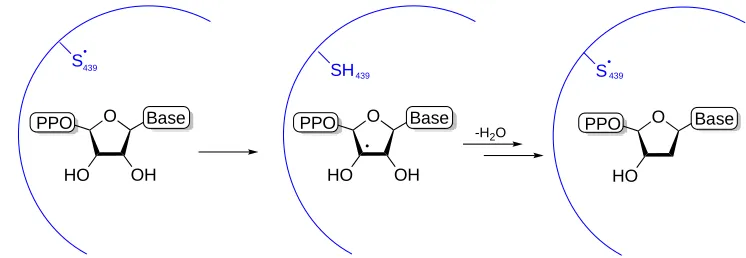
The thiyl radical, however, is most established in biology in the family of enzymes responsible for deoxygenating ribonucleotides; ribonucleotase reductases (RNRs).42, 43 The radical generation begins with a tyrosyl radical, located in one of the
two subunits of a class I RNR. Proton coupled electron transfer (PCET) then occurs between this radical and Cys439 in the other subunit, which provides the thiyl radical.
Hydrogen abstraction from the ribonucleotide 3’-hydrogen allows for deoxgygenation through the release of H2O to follow (Figure 1.1).44, 45 Class II and III RNRs proceed
through similar pathways, however the thiyl radical generation at Cys is provided by an adenosyl radical in class II and a formate molecule in class III.46
Figure 1.1: The deoxygenation of ribonucleotides by RNRs via thiyl radical generated in one of the enzyme’s subunits.
Thiyl radicals also play a significant role in oxidative damage to DNA caused by
O-centred radicals. Reactive oxygen species (ROS) such as OH· are reduced by endogenous thiols in Cys and Cys-containing biomolecules such as glutathione (GSH), assisting in the prevention of excessive oxidative damage by ROS.47 However, the thiyl radical in turn can cause damage itself, often in proteins causing backbone cleavage by
attacking the -carbon centre.48, 49, 50 Glycine, forming a secondary -carbon centred radical due to the absence of a side group, is the most prone to attack from thiyl radicals, both intra- and intermolecularly.51 In addition, thiyl radicals can evade their
usual “repair” processes and result in addition reactions or other hydrogen atom
transfers to cause mutagenesis.52 O Base PPO HO OH S O Base PPO HO OH SH O Base PPO HO S
-H2O 439
[image:21.595.122.495.321.450.2]Despite the many associations thiyl radicals have in chemistry and related fields, the most established application of thiyl radicals, particularly in synthetic chemistry, is the addition onto unsaturated C-C bonds.
1.1.2 Intramolecular addition
1.1.2.1 Intramolecular addition onto alkenes
The intramolecular addition of thiyl radicals onto alkenes represents a fast and efficient route to sulfur-containing heterocycles. The regioselectivity of these cyclisation reactions has been thoroughly investigated by Surzur et al.,53-56 where the authors determined that when a mixture of 5-exo-trig and 6-endo-trig products are formed, the reaction will have preference for the 6-membered ring. Moreover, it was shown that temperature can affect regioselectivity of the 6- or 7-membered cyclisation, where at high temperatures the 6-membered ring is preferred and by cooling the reaction to -65 C, the 7-membered rings are the major product. The authors also found that using a
mercaptan with a second heteroatom (S or O) could alter the ratio of regioisomers, without switching the result to the alternative ring size, however with a slight decrease in yield. In a similar study by the same group, the intramolecular thiyl radical addition onto a cyclic alkene almost exclusively produced thia-6-bicylco[3.2.1]octane over the alternative bicyclic structure forming two 6-memebered rings.57 Tanaka and co-workers demonstrated a similar cyclisation with the dimerization product of an allyl mercaptan to yield 1,4-dithians in 79:21 ratio of trans:cis.58
Recently, Xu and co-workers have reported the synthesis of cyclobrassinin via
intramolecular thiyl radical addition of dithiocarbamates.59 Previous work by the same group demonstrated the synthesis of (2-alkylthiothiazolin-5-yl)-methyl dodecanoates from dithiocarbamates and using dilauroyl peroxide (DLP) as radical initiator where the 5-exo-trig cyclisation product was preferred over the corresponding 6-endo-trig.60
The synthesis of penicillin derivatives has been carried out using intramolecular thiol-ene coupling in an attempted synthesis of cephalosporins. Initial studies by Maki and Sako61, 62 detailed the formation of a mixture of endocyclic and exocyclic alkenes
1.2). It was reported that the thiyl radical 1 produced from the homolytic cleavage of the disulfide was likely to have firstly added onto the terminal alkene, which allowed for the 5-exo-trig cyclisation through a carbon-centred radical. The cyclisation of the desired product 3 was proposed to have gone through 6-endo-cyclisation after thiyl radical generation. However, it was later reported by Gordon and Cabri that the likely mechanism for the cyclisation is initially through 5-exo-trig cyclisation and subsequent rearrangement to form both 5- and 6-membered rings.63 Gordon and co-workers also
[image:23.595.125.499.352.613.2]investigated different solvents for the reactions and found that by using a better hydrogen-donating solvent, such as MeOH, the products of the reaction included the reduced form of the penicillin derivative. Cabri et al. explored the metal-mediated catalysis of this reaction and reported several methods employing Mn(III), Fe(III) and Cu(II) based catalysts to carry out the radical-mediated cycloaddition.64-66
Figure 1.2: Intramolecular TEC in the synthesis of penicillin and cephalopsporin derivatives by Maki and Sako. 2 is formed through the radical reaction in high concentrations and 3 and 4 are formed in low concentration.
succeeded in preparing both thiofuranose and thiopyranose products with superior control over regioselectivity from a single derivative of a commercially available sugar.
O-benzyl protected arabinose was ring-opened, converted to the thiol 5 and functionalised with a terminal alkene. Under TEC conditions in a UV oven, the free thiol readily underwent thiol-ene addition to furnish the heterocycles 6 and 7 via either a 5-exo or 6-endo cyclisation. Using an unsubstituted terminal alkene, the thiopyranose 7 was obtained as the major product with both C-5 epimers.68 The regioselectivity can be
attributed to the stability of the carbon-centred radical formed after addition of the thiyl radical. With 6-endo cyclisation, this alkyl radical intermediate is secondary and is therefore favoured over the alternative primary alkyl radical formed in the 5-exo
process. Subsequently, substituted thioglycosyl derivatives were employed in the same reaction in an attempt to drive the regioselectivity to the 5-exo-thiofuranose product.69 Through the introduction of an isopropylidene group onto the arabinose scaffold, the cyclisation reaction of 8 was successfully directed to yield the thiofuranoside 11 exclusively, with the 1,2-trans product formed preferentially. In this case, in addition to steric hindrance, a tertiary carbon-centred radical provides a more stable intermediate than the alternative secondary radical intermediate and thus, the 6-endo heterocycle is not observed. Similar experiments with a phenyl substituent 9 and methyl benzoate substituent 10 on the alkene terminus both promoted the 5-exo cyclisation products 12 and 13, but with varying degrees of diastereoselectivity. In each case the 1,2-trans
product was observed as the major product, however, to a different degree depending on the stereochemistry of the C-5 epimer. When the L-sugar was used for cyclisation of 12, the diastereoselectivity for 1,2-trans was greatly enhanced in comparison to that of the D-sugar. These findings can be rationalised in terms of this 1,2-trans transition state providing the most stable conformation of the thiyl radical intermediate; either “chair-like” or “boat-“chair-like”. Thus, C-1 substitution bears a significant impact on the
Scheme 1.4: Synthesis of thiosugars via intermolecular thiol-ene coupling.
1.1.2.2 Intramolecular addition onto alkynes
The corresponding intramolecular thiyl radical addition onto alkynes, TYC, has seen less interest than the alkene equivalent. First demonstrated by Surzur,70 the ring closing reaction of pent-4-yne-1-thiol yielded both 5-exo and 6-endo cyclisation products, with the major product being the 6-membered ring, similar to previous examples by Surzur. The Scanlan group further investigated the intramolecular thiol-yne reaction as a novel route to thioglycals.71 Similar to the previous work done by the group, O-benzyl protected arabinose was converted to the alkyne-glycosyl thiol derivative and cyclised under radical conditions. The results were in contrast to previous reports where the 6-membered ring was formed preferentially. For the thiol-yne cyclisation the 5-exo-dig reaction was favoured for both C-5 epimers, and in the case of the D-sugar, the 6-endo -dig cyclisation was not observed at all. A detailed discussion on this work is reported in Chapter 2.
The third and final literature example of intramolecular thiol-yne coupling is the cyclisation reaction of stapled peptides, reported by Li and co-workers.72 Stapled peptides overcome many of the issues surrounding therapeutic applications of peptides and proteins, such as solubility, proteolytic degradation and therapeutic availability.73-76 Altering the structural complexity of proteins by introducing rigidity and stabilizing
peptide backbone.78 However, the cross-link scaffold can have a significant impact on the bioavailability of the stapled peptide. While many varieties of cross-links exist in the literature, hydrocarbon-based links allow for increased lipophilicity for the penetration of the peptide into the cell membrane and the cell.79, 80 This is often achieved by olefin metathesis,81, 82 however the ruthenium catalyst required for this
[image:26.595.117.443.460.519.2]reaction is not always compatible with biological applications. Li and co-workers endeavoured to design a stapled peptide without the use of metals and that would incorporate slightly more polarity than other all-hydrocarbon links in order to avoid membrane toxicity from lipophilic aggregation (Figure 1.3).83 Thus, stapled peptides were developed and optimised through thiol-yne coupling of short helical peptides, where the Z-isomer was favoured over the E-isomer and most products were furnished in high yields. In addition to HPLC traces at different time intervals, the reaction progress was monitored by 1H NMR, where the appearance of vinyl sulfide peaks was observed. The structural helicity, cellular uptake abilities and membrane toxicity were evaluated and found to be favourable for the stapled peptides with vinyl sulfide cross-links. These compounds also display potential for tandem thiol-yne/thiol-ene functionalization of stapled peptides with biotags, a concept that will be further discussed in Section 1.1.3.2.
Figure 1.3: General scheme of peptide stapling via intramolecular thiol-yne addition.
1.1.3 Intermolecular addition
1.1.3.1 Intermolecular addition onto alkenes
The most prevalent use of thiyl radical chemistry is the intermolecular thiol-ene coupling reaction between a thiol and an alkene, an efficient and rapid strategy in keeping with the characteristics of ‘click’ chemistry. Intermolecular thiol-ene coupling
is utilised across many disciplines of chemistry, proving to be extremely valuable in polymer chemistry, surface chemistry, chemical biology and synthetic chemistry.4 The
radical-mediated addition furnishes a robust thioether linkage which can be
Peptide
HS
n
Peptide
S
advantageous in overcoming issues associated with solubility and reactivity.84 This section will include a brief overview of the main applications of intermolecular thiyl radical addition onto alkenes, however the reader is directed to a number of recent reviews for further reading.85-94
Initiation of the thiyl radical “donor” by conventional methods, such as UV light irradiation, is followed by anti-Markovnikov addition onto the least substituted carbon of the alkene “acceptor” (Scheme 1.5). The carbon-centred radical subsequently
abstracts a hydrogen atom from another molecule of thiol, propagating the chain reaction. Many termination routes are possible, some resulting in disulfide formation or hydrogen atom transfer from another C-H bond, however the general high yields obtained with this strategy suggest that most termination options do not interfere with formation of the thioether product.
Scheme 1.5: General radical cycle of thiol-ene coupling.
Carbohydrates. The utility of TEC for the functionalization of carbohydrates and the burgeoning interest in applications for glycoconjugate chemistry has grown significantly in recent years.86 Through both exocyclic and endocyclic glycals, a wide range of thiosugars have been synthesised via the fast and effective thiyl radical addition of thiols. The applications towards the addition of thiosugar to olefin have also been exploited, including the formation of S-linked disaccharides through TEC.95-97
substituent at the C-2 position (Scheme 1.6).99 With this strategy, the thiosugars 14 and 15 were prepared in high yield and with complete α-selectivity. Borbás and co-workers also investigated TEC with 1,2-glycals with C-2 substituents, using in one instance a thiol-containing peptide, which resulted in exquisite 1,2-cis selectivity.100 The authors explored the directing effects of the C-6 group, where bulky groups such as methyl or acetoxymethyl on the β-face to the carbohydrate backbone allowed for stereoselective
1,2-cis addition.96 This effect was also observed when O-benzyl group protecting
strategy was employed for the C-6 substituent. The extensive study by the same authors encompassed the TEC of glycosyl thiols onto 2,3-glycals, utilising an unsaturated N -acetylneuraminic acid derivative to deliver a C-3 S-linked disaccharide.
Scheme 1.6: Examples of intermolecular TEC used in carbohydrate chemistry for endo- and exoglycals.
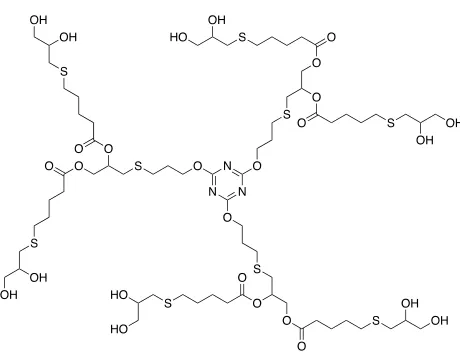
Glycodendrimer synthesis is emerging as a useful application for intramolecular TEC.86 Multivalent glycoclusters were developed by Marra, Dondoni et al. from a
tris(hydroxymethyl)propane (TMP) through allyl-functionalisation and subsequent thiol-ene “click” reactions.104 This methodology was also carried out on propargyl-functionalised TMP scaffolds, which will be further discussed in the following section. The use of TEC for the synthesis of cyclodextrin (CD) dendrimer development has been of increasing interest in recent years. Stoddart and co-workers applied the thiyl radical addition of glycosyl thiols onto CDs with repeating allyl moieties.105, 106 By using a 42-fold excess of the thiol, the authors were successful in functionalising both CD faces and in a later study, the authors managed to effectively increase the complexity of the CD dendrimers through TEC of anomeric thiodisaccharides.107 Another level of complexity within this topic was achieved by Leydet et al. with the synthesis of O -perallylated CDs which following TEC, allowed three thiol substrates (3-mercaptopropanoic acid) per sugar molecule.108 In addition to the anionic substrates, zwitterionic thiols were employed through the use of boroxazolidone-protected cysteine (Scheme 1.7). These dendrimers were applied to research into carbohydrate-based HIV therapeutics using anionic CDs. A range of thiols, including hydrophilic and fluorinated substrates, were applied to this same strategy, where mono-, di- or tri-functionalised sugars made up the CD macromolecule.109 Contributions to analytical chemistry have also been made through the use of TEC for CDs in the synthesis of a chiral stationary phase (CSP) for the enantioselective purification of oppositely charged analytes.110
form branched thioether linkages displaying a terminal alcohol, which was further functionalised with a monosaccharide unit.111, 112 The branched glycodendrimer was used as a biomimetic for the glycocalyx, the outermost layer of the cell membrane.113 Dondoni et al. have reported the use of TEC, together with copper-catalysed azide-alkyne cycloaddition (CuAAC), to prepare glycosylated calix[4]arene scaffolds.114 In
this report, the authors showed that the single and dual ligation on the upper and lower rims of the scaffold was possible with high yields and without distortion of the calix[4]arene cone conformation. Another scaffold that lead to glycodendrimers through TEC was the polyhedral oligosilsesquioxane (POSS), demonstrated by Dondoni and co-workers, a synthesis that lead to a remarkable glycoclusters effect discovered through inhibition of a specific lectin.115
Scheme 1.7: Functionalisation of CDs via TEC to afford polyzwitterionic CDs.
glycosides.117 These reactions furnished the thioether products in > 99% conversion rate, which is a testament to the effectiveness of the thiol-ene coupling, considering the readiness of silyl radical generation from thiyl radicals (see Section 1.1.1). The Ravoo group pioneered an interesting and novel methodology to carry out microcontact printing (μCP) on an olefin-rich surface of self-assembled monolayers (SAMs) using glycosyl thiols as the “ink” which was attached to a stamp.118 The group also carried out
the reaction using thiol-functionalised SAMs and the olefin on the stamp.119 This
unusual application of thiol-ene chemistry highlights the versatility of the ligation reaction. Glycosurfactants containing a thioether linkage have been synthesised through thiol-ene chemistry as well as thiol-yne chemistry.120 The glycosyl unit was esterified at
the C-6 position with mercaptopropanoic acid, which was subjected to UV irradiation with long alkyl chains containing one or more alkene. In polymer chemistry, TEC has a substantial variety of applications (see further in this section; Polymers). Within the field of glycochemistry, Schubert and co-workers developed bio-responsive polymers through TEC to study binding interactions to the lectin Ricinus communis agglutinin 120 (RCA120).121 The methodology was developed by the installation of an olefin on the
monomer to be polymerised and the resulting polymer was subjected to TEC.
Glycoconjugation of peptides and proteins through thiol-ene click chemistry has been well demonstrated as a neat source of S-linked bioconjugates. Lee and co-workers first reported it for the synthesis of glycosides with thioether spacer arms.122 This research was succeeded by more reports of TEC-mediated introduction of spacers, encompassing more complex sugar molecules and a wider range of thiol attachments.123,
124 These developments led to the conjugation of cysteamine onto allylated
oligosaccharides, which furnished biomimics that were recognised and transamidated by transglutaminase.125 In anti-cancer research, vaccines have been synthesised through
the TEC of glycopeptides and carrier proteins.126 The carrier protein and synthetic
glycopeptide were functionalised with either thiol or alkene (both strategies were demonstrated) and linked through UV irradiation. Another notable example of TEC in protein modification is the “tag-modify” approach reported by Davis and co-workers.127
lab have reported a sequential NCL-TEC process, whereby a non-native linkage between L-Hag and a cysteine-containing dipeptide was established through TEC (Scheme 1.8).128 Furthermore, the group extended this study to build a fluorescein-tagged glycopeptide through iterative NCL-TEC steps. Following glycosylation of cysteine in dipeptide 19 with glycosyl alkene 20 using TEC, the resulting peptide 21 was elongated to a tetrapeptide through NCL and subsequent desulfurisation to furnish Ala. An additional NCL step furnished the peptide 22, with a second cysteine residue. This cysteine was subjected to radical-mediated addition of 5-azidopent-1-ene to provide an azide handle on 23, which was functionalised with a fluorescein tag through CuAAC. Dondoni and co-workers have contributed greatly to research into glycopeptide/protein synthesis via TEC.
Scheme 1.8: Iterative NCL-TEC process developed by the Scanlan group. Following initial TEC of dipeptide 19 and glycoside 20, the glycopeptide 21 was elongated via NCL and desulfurisation to provide
22, which was subjected to another TEC to provide an azide handle for fluorescein tagging.
Anomeric allyl sugars were conjugated onto cysteine and cysteine-containing peptides such as glutathione (GSH).129 This methodology was extended to demonstrate
radical-mediated ligation to form the thioether linkage was carried out to furnish the monomer to be used for SPPS. A similar strategy was also carried out by the same authors in a one-pot, two-step approach using S-alkylation of GSH to attach a suitable alkene for subsequent hydrothiolation with a glycosyl thiol.130 Deming et al. reported glycosylated L-cysteine-N-carboxyanhydride (glyco-C-NCAs) through thiol-ene ligation of an allyl-glycoside with N-protected cysteine, which was converted to the carboxyanhydride and incorporated into a glycopeptide.131 The resulting peptides were subjected to a
conformational switch from α-helix to a coil structure in order to drive water-solubility
for the development of biomedical applications. In another biologically relevant example, in vivo cartilage regeneration has been probed by the introduction of carbohydrates onto collagen through radical thiol-ene addition, mimicking the extracellular matrix breakdown and repair mechanism via glycosylation of collagen.132
Peptides/proteins. Many examples of peptide and protein conjugation using thiol-ene click reactions have been explored, either using non-natural olefin-containing amino acids or thiol-containing amino acids (Cys) or both. Factors affecting the efficiency of thiol-ene chemistry in buffered conditions appropriate for biological studies are the size of the molecule, the thiyl radical donor and pKa of the corresponding thiol, the pH of the solution and composition of the reaction medium and the structure of the alkene acceptor molecule.133
enzyme that is essential for embryonic development.135, 136 Another recent publication outlined the lipidation of peptides through thiol-ene click chemistry using a radical initiator with either UV light, reflux conditions or microwave irradiation.137, 138 The authors furnished S-palmitoylated peptides through the radical-mediated addition of cysteine or cysteine-containing peptides onto vinyl palmitate. Non-native isopeptide S-linkages have been reported by Strieter and co-workers to synthesise ubiquitin (Ub)-conjugated proteins, in which dimeric and trimeric Ub-conjugates were developed through TEC of multiple Cys sites on one Ub unit.139
Figure 1.4: Antigen carrier BSA conjugated to tumour-associated glycopeptides for the synthesis of vaccines. The thioether linkage was forged though the alkene substituent on the protein and the thiol moiety on the glycopeptide, and vice versa.
The click-like properties of TEC provide a useful platform for the conjugation of peptides and proteins onto polymers.140 Catalytic chain transfer polymerisation (CCTP) has been employed for the co-polymerisation of methyacrylates to provide a polymer with multiple alkene moieties.141 An end-polymer alkene was conjugated onto the available Cys residues of α-keratin in human hair using radical-mediated addition. A
branched alkene was subsequently ligated onto a thiol-containing fluorescent dye, furnishing fluorescently labelled human hair through the bioconjugation of polymers via
[image:34.595.73.496.268.420.2]peptide-polymer conjugates for the inhibition of HIV-1 entry into the host cell by blocking the CD4 binding site on gp120.144 The same year, the synthesis of hydrogels saw the benefit of the thiyl radical click reaction in the example of Lin et al., where thiol-ene cross-links established in the polymer showed significant effect on the degradation of the hydrogel, which was further tuned by the introduction of peptide cross-links, put in place by thiol-ene click reactions with the polymer.145 Anseth and co-workers have introduced TEC to hydrogels to accomplish cytocompatible pattering of peptides within the hydrogel.146 In materials chemistry, microarrays and surfaces have
also been functionalised with biologically relevant molecules such as peptides and proteins through thiyl radical additions to alkenes.147
Polymers. Polymer synthesis and post-polymerisation modification has seen a major surge in the use of the intermolecular thiol-ene reaction, owing to its compatibility with many materials and fast, effective ligation under UV light.4, 89 In particular, TEC has become popular for the formation of thioether cross-links in polymer chemistry.85 As previously mentioned, Lin and co-workers used peptidyl cross-links for degradation studies, however the initial hydrogels were synthesised with alkyl thiol linkages.145 Kim and co-workers developed thioether cross-links through the UV-mediated addition in order to produce hot-melt pressure-sensitive adhesives (HMPSAs).148 The authors found that different photoinitiators and photo-cross-linkers furnished polymers with varying thermal stability and hence these variables were tested against important adhesion properties. In the synthesis of photonic crystals, a metallopolymer network was synthesised by Ozin et al. with thioether cross-linking of a multifunctional thiol and alkenes on a polyferrocenylsilane core.149 Caruso and co-workers reported the functionalisation of silica nanoparticles with polymer multilayers bearing an alkene, which were further functionalised through TEC to introduce cross-linking.150 In this
Figure 1.5: 4th generation dendrimer synthesised from the functionalisation of polymer using TEC to
construct the backbone and the chain ends.
Dendrimer synthesis has utilised the radical thiol-ene addition to build the core and to modify the chain ends in the synthesis of a 4th generation dendrimer (Figure 1.5).151 Hawker et al. have undertaken comprehensive research into polymerisation techniques using thiol-ene chemistry, including photochemical and thermal mediated reactions.152 Using reversible addition-fragmentation chain transfer (RAFT) polymerisation, amongst other methods of polymerisation, the preparation of polymers functionalised with alkene moieties, which were subsequently subjected to TEC produced the resulting polymers in high yields using both thermal and photochemical radical initiation. Additionally, the sequential thiol-ene/CuAAC to polystyrene was carried out to furnish telechelic materials. The same authors have investigated the application of TEC in the preparation of stamps based on PEG and polysiloxane motifs.153
In dental science, ester-free resins for tooth restorative materials have been synthesised using thiol-ene step-growth reactions. The thioether linkage employed is superior to any preceding ester-linked oligomers due to their susceptibility to hydrolysis in the presence of acids/bases and certain enzymes and to swelling in aqueous environments.154, 155
Surface modification. Patterning of surfaces through thiol-ene chemistry is often approached through a “grafting” process, which involves the radical-mediated (or often
[image:36.595.168.398.66.242.2]alkene can be located on either the surface or the substrate.85, 89 Thiol-ene polymerisation has been developed for forming patterned nanostructures through imprint lithography.156 The authors used UV light irradiation to produce thiyl radicals from the thiol moieties located on the surface and carried out ligation with alkene-containing polymers. Crowe and co-workers have demonstrated the opposite ligation for the adjustment of the wettability of a surface, functionalising a poly(vinylmethylsiloxane) (PVMS) surface with a number of thiol alkanes of varying chain lengths.157 In addition to the example with carbohydrate applications, SAMs have
been subjected to thiol-ene coupling with polymers.158, 159 Bowman and co-workers developed a gradient thiol-ene polymerised SAM through the attachment of an ultrathin film with a gradient of thiol onto the surface.158 Hydrophobic SAMs have been prepared for microfluid devices using TEC of alkenes and thiols presented on the surface of silica or glass.159 Buriak et al. have reported the molecular layer deposition of multiple layers of dithiols and dienes to create a sequential TEC process of adding layers onto three different surfaces, hydride-terminated silicon, silicon oxide and germanium (Scheme 1.9).160
Scheme 1.9: General schematic representation of iterative TEC reactions to furnish a molecular layer deposition of multiple layers onto a silicon-based surface.
1.1.3.2 Intermolecular addition onto alkynes
are exploited in a vast array of applications which is beyond the scope of this thesis and so the reader is directed to reviews on the topic.3, 161-163
In glycoconjugation TYC is a very attractive route to functionalised macromolecules. Borbás and co-workers reported the sequential TYC-TEC reactions on N-acetyl-neuraminic acid derivatives.164 An O-propargyl galactose derivative was
subjected to UV irradiation in the presence of photoiniator and sialic acid with an anomeric thiol. Unfortunately, the intended bis-sialic acid glycoside was not favoured, likely due to steric limitations, and the major product formed was a mixture of E/Z
Scheme 1.10: Dual functionalisation of BSA Cys sites with i) a glycoside 24 and ii) a fluorophore. The initial TYC with the alkynyl sugar provided an alkene handle for TEC with the fluorophore.
As mentioned previously, glycosylation of dendritic clusters has been carried out using TEC, however Dondoni et al. have included thiol-yne chemistry in this process to furnish a higher degree of glycosylation on the scaffolds.104 Perrier and co-workers described the co-polymerisation of alkyne acrylate monomer, which was further subjected to TYC to afford highly ordered branched glycopolymers.167 Stenzel and
co-workers used a similar method to develop co-polymeric dendritic and linear glycoconjugates which self-assembled in water due to the amphiphilic structure.168 TYC
of glycosides has been investigated for μCP by the Ravoo group in a similar fashion and in the same report as their example of TEC to prepare SAMs.118
quantitative conversion to a mixture of diastereoisomers.170 The study was subsequently extended to include peptides and proteins, where the authors delivered a range of alkynes to disulfide bonds in peptides cyclised by the disulfide bond present.171 Impressively, the authors also delivered an alkyne payload to the Fab fragment of an antibody to demonstrate the potential this methodology could have in the synthesis of antibody drug conjugates. Site-specific dual labelling of a protein through thiol-yne addition was carried out by the Li group to dually functionalise the HdeA protein with two fluorescent tags.172 The protein, bearing an alkyne-functionalised Lys residue, was
subjected to radical addition of a fluorescent disulfide, N,N’-bis(dansyl)cystamine.
In polymer and materials science, intermolecular TYC has enabled seminal contributions to the field.161 Polymerisation through the thiol-yne click reaction has been reported by several groups, with the first literature example reported by Fairbanks and co-workers, where the authors detailed the comparison of the step-growth polymerisation of the thiyl radical addition of alkynes to that of alkenes.173 A more recent example involves the synthesis of interpenetrating networks (IPNs) in the form of hydrogels by the polymerization of gelatin through the radical thiyl addition onto both alkenes and alkynes.174 Post-polymerization modifications are often carried out through the use of thiol-yne chemistry. Huynh and co-workers, towards the development of polymer-bound Pt drug release, reported one such example.175 The RAFT polymerisation of methylacrylates followed by functionalisation of the repeating unit with an alkyne provided the polymer with the TYC handle in place. The alkyne was subsequently subjected to radical thiol-yne addition of 2-mercaptosuccinic acid, which was complexed to cis-diamminediaqua Pt (II). Surface modifications via TYC are also widespread in the literature, usually involving polymer synthesis. Gold nanoparticles (AuNPs) were immobilised onto a polymer motif through linkages forged by TYC.176
Scheme 1.11: Immobilisation of gold nanoparticles (AuNPs) onto a polymer surface through linkers furnished by TYC.
1.2 Peptide ligation
Peptide ligation centres on the regioselective formation of an amide bond between a C -terminal carboxylic acid and an N-terminal amine. Many routes to amide bond synthesis have been explored over the course of a number of years,178 however the same strategies employing activating agents and coupling reagents in the presence of a suitable base continue to be used across the board in peptide chemistry.179, 180 Amide bond formation is extremely prevalent in industrial pharmaceutical development and accounts for 16% of all reactions carried out in the industry.178, 181 Peptide synthesis itself has become a major focus in the pharmaceutical industry since the emergence of peptides as drug targets.182-184
1.2.1 Solid phase peptide synthesis
Peptides, due to their polymeric nature, have limited possibilities in standard solution phase synthesis, where orthogonally protected amino acids or peptide segments are coupled in organic solvents. The solubility of such peptides becomes troublesome when sequence reaches a length that is incompatible with organic solvents, with the length of the sequences compatible being dependent on the residue-specific side chain. Moreover, extensive purification steps are required with each coupling and the entire process is considerably time consuming. Solid phase peptide synthesis (SPPS) addresses these issues in a multitude of ways, and allows polypeptides of up to 50 residues long to be prepared.185
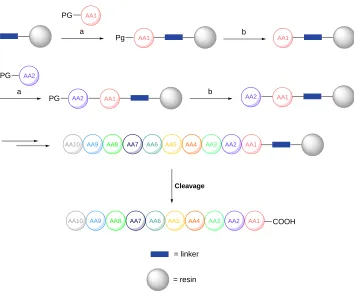
process, depicted in Figure 1.6, begins with the coupling of the first N-protected amino acid in the sequence (going from C- to N-terminals) to the resin that will be used throughout the coupling, employing the activating agent, coupling reagent and base suitable for the reaction. Resins are commercially available in many different varieties with a wide range of chemical composition and linkers. The N-protecting group is subsequently cleaved and the coupling step is repeated with the next amino acid in the sequence. These steps are repeated until the entire sequence required is built onto the resin, with serial washing steps after each reaction using solvent to clear the resin of remaining reagents. When the sequence is finished cleavage of the C-terminal from the resin is carried out to deliver the peptide. The cleavage step is usually designed to universally deprotect the entire peptide from side-chain protecting groups.187, 188
Figure 1.6: Reiterative process of solid phase peptide synthesis (SPPS). The N-protected amino acid (AA1) is coupled to the resin using an activating agent, coupling reagent, base and organic solvent (a). Deprotecting conditions (b) are employed to remove the protecting group and allow for another coupling of the second amino acid (AA2). These step are repeated until the entire sequence has been attached to the resin from C- to N-terminus, followed by cleavage of the peptide off the resin to furnish the globally deprotected peptide.
AA1
a
AA1
Pg b
AA2
a
AA1 AA2 PG
PG
PG b AA2
AA10 AA9 AA8 AA7 AA6 AA5 AA4 AA3 AA2 AA1
Cleavage
AA10 AA9 AA8 AA7 AA6 AA5 AA4 AA3 AA2 AA1 COOH
= linker
= resin
AA1
[image:42.595.107.461.329.622.2]High concentrations of coupling reagents in respect to each amino acid drive the coupling reactions to achieve high yields and allows for a shorter reaction time than solution phase peptide coupling. However, the isolated peptide furnished is often in combination with many impurities due to the restriction of purification at each step to washes with solvent. In standard solution phase synthesis the resulting peptide could have a high purity, owing to the opportunity to carry out column chromatography after each coupling, however this leads to a significantly longer overall preparation time for the peptide.185 In SPPS, deletion sequences are often present with the final peptide,
which comprise of shorter fragments of the peptide that did not undergo coupling at one stage and are lacking one or more residues. There are various resolutions to this problem, such as dyes that show beads of resin that bear a free amine, i.e. did not undergo coupling, indicating the requirement for double-coupling of an amino acid.189,
190 Another technique used known as “capping” involves an additional acetylation step
to N-acetyl-protect any sequences with a free amine so they do not participate in further coupling reactions, which would render them difficult to separate from the desired peptide at the end.191
The SPPS method chosen is usually dependent on the protecting group required for the synthesis. Two SPPS strategies that are most commonly used are tert -butyloxycarbonyl (Boc)-protecting group SPPS and 9-fluorenylmethyloxycarbonyl (Fmoc)-protecting group SPPS. The appropriate resin, deprotection reagents and cleavage cocktail are determined by the choice of protecting group. The Boc protocol typically uses trifluoroacetic acid (TFA) to remove each Boc group, however the conditions to cleave from the resin usually involve very strong acid such as HF. The Fmoc-protecting group protocol is much more widely used for SPPS due its superior orthogonality, since a piperidine/DMF solution can be employed for deprotecting Fmoc groups and thus, many acid-labile protecting groups can be exploited for the side-chains of the amino acids used. Moreover, less harsh conditions required for cleaving from the resin can be employed.192, 193
such as in-built microwave reactors to improve coupling and UV-vis monitoring of cleaved Fmoc molecules to gauge the efficiency of couplings.194
1.2.2 Native Chemical Ligation
Native Chemical Ligation (NCL) is a methodology first reported by Kent et al. in 1994 to deliver long peptide chains through the chemical ligation of two peptides.1 It has since been applied across the board in peptide chemistry to access polypeptides and proteins of macromolecular scale.195 The first peptide synthesis via NCL was employed
to prepare interleukin-8 (IL-8) protein, a chemokine produced by macrophages comprising of 72-amino acid residues. Two IL-8 segments, a 33-amino acid and a 39-amino acid peptide, were successfully coupled through NCL, utilising a total of eighteen different natural amino acids including four cysteine residues. The properties of the resulting molecule (IL-8) were consistent with those of the natural protein and regular structural events, such as oxidation, disulfide bridge formation and folding, were observed. Moreover, little to no racemisation occurred during the regioselective reaction.
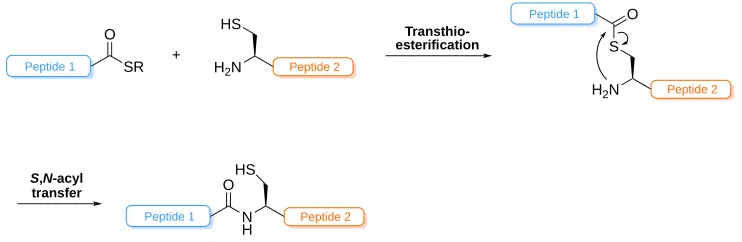
Figure 1.7: General scheme of NCL. Step 1: Transthioesterification to link peptides through thioester linkage. Step 2: S,N-acyl transfer to furnish peptide bond.
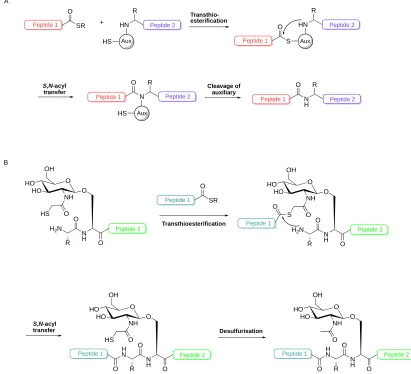
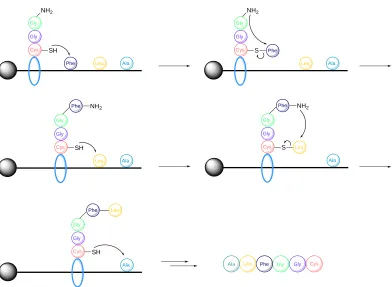
The ligation reaction, depicted in Figure 1.7, occurs between a C-terminal thioester and N-terminal cysteine residue. The first step is transthioesterification, targeting the thiol moiety on Cys to furnish an S-linked isopeptide and serves to introduce the thioester adjacent to a reactive amine. A spontaneous S,N-acyl transfer via
a 5-membered cyclic transition state follows, shifting the original C-terminal carbonyl
SR O
Peptide 1 H2N
HS
Peptide 2 +
[image:44.595.99.470.455.576.2]onto the N-terminal amine and forming a native peptide bond.1 This rapid shift is the cornerstone of NCL and its utility in peptide synthesis. The C-terminal thioester can determine the success of the first step, with alkyl thioesters, although straightforward to prepare by SPPS, proceeding sluggishly over a time frame of 24-48 h. It has been shown, however, that the utilisation of an aryl thiol additive in the reaction can improve the rate by reacting with the alkyl thiol first, providing a more reactive C-terminal thioester for transthioesterification with Cys thiol.196, 197 Moreover, the choice of amino
acid bearing the thioester can also affect the rate according to the steric bulk of the residue, where less hindered amino acids such as Gly or Ala allow the reaction to proceed at a faster rate. Dawson and co-workers investigated the steric limitations of different C-terminal amino acids and found that all 20 natural amino acids can partake in transthioesterification, however the reaction was significantly slower with the more hindered residues; Ile, Val and Pro.198 This limitation of sterically hindered side-chains is typical in many aspects of peptide chemistry, however NCL carries a more restricting feature, which is the requirement for Cys at the ligation site. Cys has a particularly low abundance in nature (3.3%199); therefore, peptides or proteins with Cys at a suitable ligation site are not plentiful. With this limitation NCL remains a superior process, however not very applicable to most substrates. Fortunately, a vast amount of research has been focused on alternative approaches to NCL to encompass amino acids that have a higher frequency in nature.
1.2.3 Alternative approaches to NCL 1.2.3.1 Desulfurisation
One noteworthy innovation in peptide ligation after NCL was the desulfurisation technique reported by Yan and Dawson in 2001.200 The methodology involves the
ligation at a N-terminal Cys and a C-terminal thioester, as in NCL, however after the
S,N-acyl shift occurs the resulting Cys residue is reduced to Ala, which is a more abundant amino acid.201 The possibility of ligation at Ala allows NCL-desulfurisation to
the reduction of all thiol, thioethers and thioesters and the need for large quantities of Raney nickel remain a disadvantage in some circumstances.202 Hence, alternative radical-mediated approaches to desulfurisation were explored.
The first report of a desulfurisation reaction was that of Hoffman and co-workers and was carried out under thermal and photochemical conditions between a mercaptan and a trialkylphosphite derivative.203 Following this, Walling and Rabinowitz described a proposed mechanism for the desulfurisation (Scheme 1.12), where an alkylthiyl radical is generated and undergoes reversible addition onto the phosphite, leading to a phosphoranyl radical intermediate.204 Cleavage of the alkyl-sulfur bond allows for formation of an alkyl radical, which is quenched by the hydrogen abstraction from the thiol, propagating the reaction. Danishefsky et al. investigated the desulfurisation via radical conditions using the radical initiator 2,2’-azobis[2-(2-imidazolin-2-yl)propane]dihydrochloride (VA-044) and tris(2-carboxyethyl)phosphine) (TCEP) as the source of phosphine.205 As shown in Scheme 1.12, the thiyl radical 26, generated by the decomposition of the initiator, reversibly adds onto the phosphine 27 to generate the phosphoranyl radical 28, which allows for cleavage of the C-S bond. Addition of a thiol additive such as t-butyl mercaptan (t-BuSH) to facilitate hydrogen abstraction gave the products as disulfides in yields of > 80%. The authors showed that the method was compatible with a variety of protecting groups and functionalities that were reduced by the methods reported by Yan and Dawson. This route has since been utilised by many research groups to provide peptides and bioconjugates by incorporating mercapto amino acids into NCL and desulfurising to afford a non-Cys ligation site.206-208