Comprehensive Distributed Garbage Collection by Tracking Causal
Dependencies
of Relevant Mutator Events.
Sylvain R.Y. Louboutin*
Vinny Cahillt
Distributed Systems Group!
Department of Computer Science! Trinity College, Dublin 2 , Ireland
Abstract
Comprehensive distributed garbage collection an object- oriented distributed systems has mostly been addressed via distributed versions of graph-tracing algorithms, a legacy of centralised garbage collection techniques. Two features jeopardise the scalability of these ap- proaches: the bottleneck associated with having t o reach a global consensus before any resource can actually be reclaimed, and the overhead of eager log-keeping. This paper describes an alternative approach to comprehen- save distributed garbage collection that entails comput- ing the vector-time characterising the causal history of
some relevant events of the mutator processes compu- tations. Knowing the causal histories of these events makes it possible to identify garbage objects that are not identifiable b y means of per-site garbage collection alone. Computing the vector-times necessary to iden- tify garbage is possible without the unbounded space overheads usually associated with dynamically recon- structing vector-times of arbitrary events of distributed computations. Our approach integrates a lazy log- keeping mechanism and therefore tackles both of the aforementioned stumbling blocks of distributed garbage collection,
Keywords: comprehensive global garbage detec- tion, causal dependencies, mutator events, lazy log- keeping, scalability, robustness.
1
Introduction
Automated garbage collection in object-oriented sys- tems is often advertised as a means of obviating the burden and hazard of explicit resource management, i.e., as a lesser evil or expensive convenience, which
'Email: Sy1vain.LouboutinOdsg.cs.tcd.ie
t E-mail: [email protected] iURL: http://www.dsg.cs.tcd.ie/
Ifax: (+353-1) 6772204
could nevertheless be avoided altogether under ap- propriate circumstances. This might be true in the context of a centralised system where each thread of control independently manages its own private object graph, i.e., where the visibility, accessibility, and lifes- pan of objects does not extend beyond the scope of the thread that created them. However, we contend that
automated distributed - or global - garbage collec-
tion is necessary and unavoidable in a distributed sys- tem featuring persistent and shared objects [13, 141.
In this case, objects may outlive the thread(s) that created them and may be shared by threads that can- not have an up-to-date, consistent, and comprehensive view of the overall object graph spanning a number of disjoint address spaces scattered among autonomous processors.
Traditional global garbage collection algorithms based on the iterative graph tracing approach are com- prehensive, i.e.
,
inherently able t o detect all garbage, including distributed cycles of garbage, but make it necessary t o account for all live objects in the system before garbage objects can be detected and their re- sources reclaimed. Garbage is detected in at most, but no sooner than, one iteration of the algorithm. In par- ticular, distributed global garbage collection requires t h a t every site in the system eventually participates in every iteration. This drawback, inherent t o all graph tracing based global garbage collection algorithms and referred t o as the consensus bottleneck, as well as the overhead of eager log-keepzng (see §2.3), jeopardises the scalability of these approaches.This paper describes a new approach to global garbage collection that entails reconstructing the vector-times that characterize the causal history of
some relevant events of the mutator processes com- putation. These events are those that result in mod- ifications t o the inter-site paths in the global object graph. It will be shown that knowing the causal history of these events makes it possible to identify
garbage objects t h at are not identifiable by means of per-site garbage collection alone. This algorithm is intrinsically comprehensive, although it is not based on a graph-tracing algorithm, and hence its scalabil- ity is not hampered by the aforementioned consensus bottleneck. Its message complexity depends on the number of garbage objects, rather than the number of live objects, as is the case for graph tracing based approaches. Moreover, its underlying lazy log-keeping m e c h a n i s m , does not require additional control mes- sages, even in the case of third party exchanges of ref- erences, guaranteeing the robustness of the algorithm.
Loss of messages cannot cause erroneous identification of live objects as being garbage, i.e., message loss does not compromise the safety of the algorithm. Instead, loss of messages can only cause residual garbage t o remain undetected.
We proceed as follow: $2 lays the background for this paper by discussing how global garbage collection algorithms address the issues of partitioned address spaces and distribution by decoupling local and dis- tributed aspects of garbage collection. The ritle of log-keeping is introduced leading t o a short survey of traditional comprehensive global garbage collection algorithms outlining the main flaws of these graph- tracing approaches. $ 3 introducing our alternative ap- proach, explaining how garbage can be identified from the causal histories of some of the events of the muta- tor processes computation, and introduces the way in which our algorithm computes the vector-times char- acterising these causal histories, using an underlying lazy log-keeping mechanism.
$4
details how our ap- proach compares wi+,h a related algorithm, proposed by Schelvis [16], that relies on an eager log-keeping mechanism, which compromises its scalability and ro-bustness. $5 summarises the contribution of this pa- per.
2
Background
An object is a contiguous portion of address space and
a container of references t o other objects. Objects are the vertices and references the edges of a directed graph. Some objects known as roots, constitute the “entry points” for the application processes that ac-
cess and modify the object graph. An object that is not reachable from any of these roots, i.e., when there is no longer a directed path along the edges of the ob- ject graph, from any root t o the object, is garbage.
Garbage objects must be collected in order t o reclaim their resources. In a distributed system, this object graph is partitioned over a number of independent ad- dress spaces - or sites - themselves distributed over a set of autonomous physical hosts. Edges of the ob-
Local
Objects
-
Figure 1: Root set used for local garbage collection.
ject graph may or may not cross site boundaries. In
a loosely-coupled distributed system, each site inde- pendently manages its own resources. Thus, distribu- tion demands some degree of decoupling between local garbage collection and what we later define as global garbage detection.
2.1
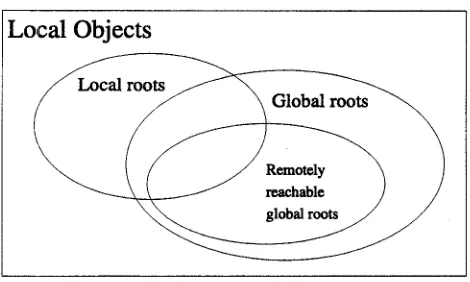
An approach inspired by Bishop [3] t o scavenging a partitioned address space can be generalised t o de- scribe all decentralised global garbage collection algo- rithms, i.e., algorithms that allow autonomous local garbage collectors t o proceed concurrently. In this ap- proach, per-site garbage collection is performed locally and independently of any other site. Th e root set used for local garbage collection consists of some local roots - tlhe local root set - i.e., objects arbitrarily desig- nated as roots, plus some global roots
-
the global root set-
i.e., local objects that are alleged t o be referenced from other (possibly remote) sites.(Once a reference t o some object crosses its site boundary, it is not possible t o determine locally whether or not it is still reachable from any root. The local garbage collector must therefore conservatively consider it t o be a global root. Until proven otherwise, all local objects reachable from this root are consid- ered t o be live, as are any objects reachable from local roots. Figure 1 shows the different root sets.
‘The union of the local root set and global root set is a superset of the actual root s e t . The actual root set of a given site contains only the roots from which all the live objects, and only the live objects of that site, can be reached. T he actual root set of a site is the union of the local root set and the set of remotely reachable global roots. Only global garbage detection can determine whether or not a given global root is still remotely referenced.
[image:2.614.312.547.82.223.2]Taking full advantage of the decentralised nature of a distributed system entails maintaining a conser- vative approximation of the actual root set for each individual site locally, and progressively ridding it of objects that are n o longer remotely referenced. We refer t o the process of maintaining this conservative approximation t o the actual root set as log-keeping. The process of removing objects that are no longer re- motely referenced from the global root set is known as
Global Garbage Deteciion (GGD).
2.2 The Global Root Graph
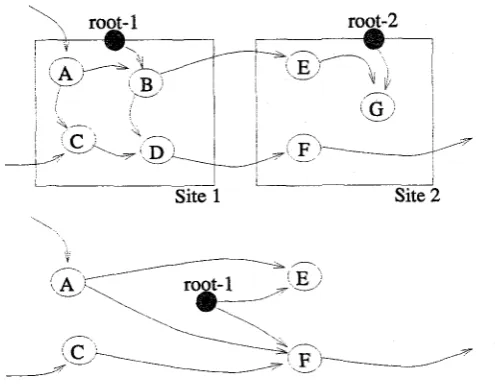
[image:3.630.324.572.87.279.2]The global roots of each individual site taken together form a distributed graph known as the global root graph. A vertex of the object graph that has had at least one incoming edge that crosses its site boundary is a global root and becomes a vertex of the global root graph. Every outgoing path from a global root, which crosses its site boundary (via some vertices of the object graph collocated on the same site), becomes a single edge in the global root graph. A root of the global root graph is a root of the object graph that has such an outgoing path from it that crosses its site boundary.
Figure 2 depicts an object graph in its upper por- tion and the corresponding global root graph in its lower portion. As every edge of the global root graph crosses some site boundary, these boundaries become implicit and hence need not be represented.
As the distributed object graph evolves, a global root on some site may no longer be remotely reachable. This means that there is no longer a path from any root to this object along the edges of the global root graph. Such an object can be discarded from the set of global roots of its site, narrowing the root set of that site down to a better approximation of its actual root set. GGD can therefore be described as performing garbage collection of the global root graph. A global root discarded by GGD may however remain reachable from some local root, i.e., it is up t o local garbage collection to detect and collect actual garbage.
2.3 Log-keeping
Log-keeping is essentially the task that application processes - or mutators - must perform in addi-
tion t o their own computation, in support of GGD. Log-keeping serves two purposes:
1. It keeps track of objects t o which references have crossed their site boundary, i.e., log-keeping iden- tifies global roots.
2. Log-keeping also contributes to maintaining ad- ditional information depending on the choice of
’ %
-Site 1 Site 2
-,
\
Figure 2: An object graph and its global root graph.
GGD strategy. For instance the contents of the logs may consist of a “weight” as in “weighted reference counting” schemes
[a,
19, 61 or the iden- tity of the recipient of a reference as in “reference listing” schemes [15].These logs, which may be either centralised or dis- tributed, together constitute a consistent, although not necessarily complete, snapshot of the object graph. The logs are consastent if they reflect a consistent cut of the distributed mutator computation [l]. This means t h a t if the occurrence of some event of the mu- tator computation is recorded in these logs, then all events t ha t causally precede it have also been recorded. Such a snapshot may be built incrementally by the mutator processes as the overall object graph evolves and remains consistent provided that there are no race conditions between control messages necessary for log- keeping. T he logs may form an incomplete snapshot because log-keeping alone is not necessarily sufficient t o identify garbage.
We distinguish two strategies for log-keeping: ea- ger and lazy. The former may require additional con- trol messages t o be sent by the mutator processes, while the latter does not.
When an object reference crosses a site boundary, an eager log-keeping mechanism attempts t o immedi- ately update the log maintained for the target object. If this log is collocated with the corresponding object,
or maintained by some centralised service, this may in- volve additional control messages when exchanging ref- erences t o some third-party remote object. This may in turn lead t o race conditions between these control
messages and control messages used t o signify the de- struction of edges in the global root graph. This race condition could jeopardise the consistency of the logs and ultimately can compromise the safety of
GGD.
Ensuring the consistency of these logs under such con- ditions, i.e., when eager log-keeping is used, can be rather costly and compromise the robustness ofGGD
as explained in $3.
Lazy log-keeping prevents this race condition from occurring by postponing the delivery of control mes- sages used to signify the creation of new edges in the global root graph until they become necessary, as ex- plained in $3.4.
2.4 Pitfalls of Distributed Graph Tracing
Comprehensive
GGD
has mostly been addressed via distributed versions of graph-tracing [7] based algo- rithms. Two phases can usually be identified in theseGGD
algorithms [lo, 9, 41. The first phase involves detecting live objects, while the second phase makes sure t h at the first one is complete.These algorithms are better described as live ob- ject detection rather than genuine garbage collection
algorithms because garbage is characterised as being everything that is not alive. Live objects may be ei- ther detected directly by colouring the object graph in situ [lo, 91, or indirectly from the logs maintained by the log-keeping mechanism. The contents of these logs may be used t o reconstruct consistent representations of the overall object graph th at can be traced locally, either by a conceptually centralised service [ll], or by each site that is participating in
G G D
[4].Once it has been determined t h a t all live objects have been accounted for, or that enough information has been collected t o reconstruct a consistent represen- tation of the object graph, garbage objects can then be safely identified and their resources reclaimed, This termination detection is often performed as a distinct phase [lo, 9, 41, although using a conceptually cen- tralised log-keeping service obviates an explicit termi- nation detection phase [ l l ] . Moreover Tel has also shown how these two phases can be superimposed [18,
To increase concurrency, multiple
G G D
iterations may overlap and proceed concurrently, e.g., an ap- proach using time-stamps [9] makes it possible to inter- leave any (bounded) number of iterations. However, all sites in the system are still required t o eventually participate in completing any givenGGD
“iteration” and must reach some kind of consensus.In summary, two features of graph-tracing based
GGD
approaches jeopardise their scalability: on one hand the bottleneck associated with having to reach pp.193-2261.global consensus before any resource can actually be reclaimed, i.e., the “consensus bottleneck.” On the 0the.r hand, these
GGD
algorithms must either rely on eage.r log-keeping in order t o benefit from the flexibil- ity amd increased parallelism of autonomous per-site garbage collector or must use exhaustive in situ global graph tracing.3
An Alternative t o Graph Tracing
Comprehensive approaches are therefore generally be- lieved to be necessarily unscalable [15]. As a con- sequence, comprehensiveness has often been traded-
off for scalability under the assumptions that dis- tributed cycles are relatively rare, and that only grap h-tracing algorithms can be intrinsically compre- hensiive [6, 2, 191. Instead, in the absence of empirical evidence to the contrary, we contend that distributed cycles of garbage are as likely t o occur as local cycles, and that intrinsically comprehensive
GGD
algorithms can, in fact, be scalable as well.Our alternative to graph-tracing consists in an- alyzing the mutator processes computatzon, focusing on those aspects directly relevant t o
GGD,
and sub- sequently referred to as “log-keeping events.” Re- constructing the causal history of a given log-keeping event, using known techniques, e.g., [8], might require that each site or object maintains a rather large local history of events. We show however that it is possi- ble t o do so with reasonable space overhead because log-keeping events are not events of an arbitrary com- putation (see $3.3).3.1 Log-keeping Events
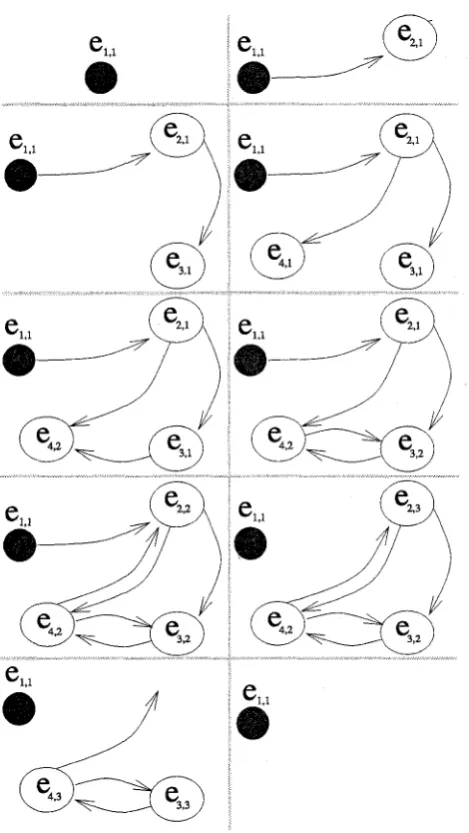
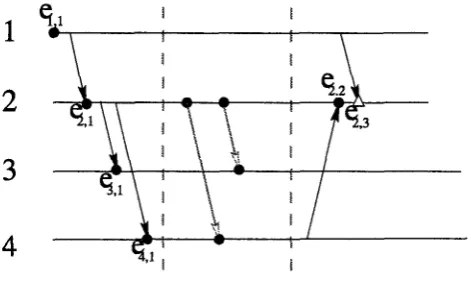
The execution of the mutator computation can be rep- resented as a space-time diagram where each global root appears as a process exchanging log-keeping con- trol messages with other global roots. An event num- ber j for a process i is denoted e i , J .
There are two kinds of log-keeping control mes- sages, indicating respectively the creation or the de- struction of an edge in the global root graph. When- ever a new edge is created, or an existing edge is re- moved, from some global root t o another one, a log- keeping control message is conceptually sent from the former to the latter. A log-keepzng event corresponds to receiving a log-keeping control message. There are two lkinds of log-keeping events that correspond re- spectively to the creation or destruction of an edge t o the corresponding global root. These events are re- ferred to respectively as edge creatzon events and edge
destructzon events.
illustrate our algorithm. Figure
4
shows the corre- sponding space-time diagram. In this particular ex- ample, each object is assumed t o be located on its own site, and as a result, the actual object graph is identical to its corresponding global root graph. This graph evolves according t o the following scenario: aroot object 1 creates an object 2 (event e 2 , 1 ) . Object 2 creates object 3 (event e 3 , 1 ) and then object 4 (event e 4 , l ) . Object 2 subsequently sends object 4 a message
containing a reference to object 3, creating an edge from object
4
t o object 3 (event e 3 , 2 ) . Similarly, ob- ject 2 sends object 3 a message containing a reference t o object4
hence creating an edge from object 3 t o object 4 (event e 4 , ~ ) . Object 2 then sends a reference denoting itself t o object 4 creating an edge from object 4 t o object 2 (event e2,2). Th e last modification t o theglobal root graph by the mutator process represented in Figure 3 is the destruction of the edge from the root t o object 2 (event e 2 , ~ ) . Subsequent modifications t o this global root graph are due t o GGD as explained later on.
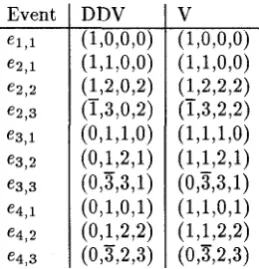
T h e log-keeping mechanism contributes t o main- taining a direct dependency vector (DDV) similar t o what Fowler & Zwaenepoel [SI describe. Log- keeping events are numbered sequentially, i.e., time- stamped, at each process with a monotonically increas- ing counter. The DDV of an event is derived from the DDV of its local predecessor by including its own time-stamp, and the time-stamp of its direct remote predecessor.
The value 0 in a dependency vector indicates that no log-keeping message has yet been received from the corresponding global root. On the other hand, E rep- resents the time-stamp of the direct remote predeces-
sor of an edge destruction event, i.e., it indicates that the last log-keeping control message received from the corresponding global root was an edge destruction log- keeping control message. Edge creation events and edge destruction events are represented as black dots or white triangles respectively in Figure 4.
3.2 Characterization of Garbage
Unlike the DDV that the log-keeping mechanism con-
tributes to maintaining, the full vector-time of an event takes the transitive closure of causal dependen- cies into account, and fully characterises the causal history of the corresponding event,
T h e DDV of event e3,1 in Figure 4, denoted D D V ( e 3 , 1 ) , is (0 , 1, 1 ,0 ) . It indicates th at the events
directly (and causally) preceding e3,l are e 2 , l and e g , ~
[image:5.622.331.566.87.504.2]itself. On the other hand, the full vector-time char- acterising the causal history of event e 3 , l , denoted V ( e 3 , 1 ) , is (1,1, 1 , 0) (see Figure 5).
Figure 3: Evolution of a global root graph.
Schwarz & Mattern [17] demonstrate that if two events a and b of a distributed computation are causally related, i.e., a 4 b , then V ( a )
<
V ( b ) . This partial order relation between vector-times U and v of dimension m is defined as follow (from [17]):1. u I v i f f u [ l c ] I v [ k ] f o r k = l , . . . , m
2. U
< v
iff U5
v and U#
vOur approach is based on the idea that it is possible to construct a vector-time that characterises the events responsible for the creation of all the paths t o a global root that actually exist when some event occurs, and no other events, and, in turn, makes it possible t o iden- tify garbage in the global root graph. For instance, in
2
3
[image:6.620.52.284.84.232.2] [image:6.620.104.234.298.433.2]4
Figure
4:
Space-time diagram corresponding t o the scenario of Figure 3.Event
e1,1 e2,1 e 2 , 2 e2,3 e 3 , l e3,2 e3,3 e 4 , l e4,2 e4,3
Figure 5: Dependency vectors of the log-keeping events of Figure 4.
Figure
4,
the global root 2 is reachable from global root 4 in the global root graph when event e 2 , 2 occurs, because e4,2 4 e 2 , 2 in the execution graph. This canbe shown by comparing their respective vector-times:
V ( e 4 , ~ )
<
V(e2,2), i.e., ( 1 , 1 , 2 , 2 )<
( 1 , 2 , 2 , 2 ) . On the other hand when event e2,3 occurs, it is possible t odetermine directly from the vector-time of this event
- which is ( T , 3 , 2 , 2), see Figure 5 - that global root 2 is no longer reachable. The vector-time of event
e3,2 however does not yet reflect the fact that object
3 has also ceased to be reachable. (When compar- ing vectors-times, the time-stamp of the direct remote predecessor of an edge destruction event, indicating t h a t there is no longer an edge in the global root graph via the corresponding global root, is treated as if no edge creation event had ever been sent from this global root, i.e., as 0.) Detecting the absence of a live path to this object requires additional edge-destruction con- trol messages t o be sent by the GGD algorithm as part
of the finalisation of those garbage objects already de- tected.
However, these vector-times cannot be used to char,acterise the existence or the absence of a path between two global roots in the global root graph if
both kinds of log-keeping events are undifferentiated. Whenever a path is created in the global root graph, there is a corresponding path of causally related edge creation events in the execution graph. When an ex- isting path in the global root graph is broken as the result of the destruction of some edges in the object graph, there is a corresponding edge destruction event in the execution graph. Edge-creation events that re- flect the creation of paths to the object that receives an edge-destruction control message via the object that sent it, must therefore not be taken into account when comlputing the full vector-time of the edge-destruction event. The full vector-time must therefore be recon- structed dynamically and cannot be incrementally up- dated by piggy-packing some kind of vector-time t o each message exchanged between mutator processes.
3.3 Algorithm
An algorithm that illustrates quite intuitively how vector-times characterising the causal history of an event can be dynamically reconstructed from partial information gathered locally by each process is the al- gorithm proposed by Fowler & Zwaenepoel
[$I.
This algorithm, proceeds by recursively gathering the DDVs of the causal predecessors of the event, and therefore assumes the existence of some backward pointer from each event to its direct remote predecessor [l?, 81. It also requires an unbounded space overhead t o cope with keeping the DDVs of every past event as far back as might be needed.Our algorithm similarly gathers partial informa- tion logged locally, but takes advantage of fact that the imodel introduced in $3.1 does not describe an ar- bitrary distributed computation, but only the creation and destruction of edges in the global root graph. This provides us with forward pointers t o all remote causal successors of an event by following the actual edges of the global root graph. Knowing these forward point- ers, one may incrementally reconstruct the causal his- tories of log-keeping events, or rather the dependency vectlors characterizing them, by repeatedly circulat- ing increasingly accurate approximations of these de- pendency vectors, along the paths of the global root graph, until the complete transitive closure, i.e., the full vector-time, has been determined.
The initial approximation of the vector-time of some event ei,j is similar t o the DDV mentioned in
index of each of the predecessors of event e i , j , i.e., characterising the event itself, all of its local predeces-
sors, and all of the direct remote predecessors of these events. This vector can be transitively merged with the dependency vectors of its causal predecessors un- til the full vector-time is obtained. This is the case, when the only difference between the vector-time re- ceived from the direct remote predecessor of ei,j and
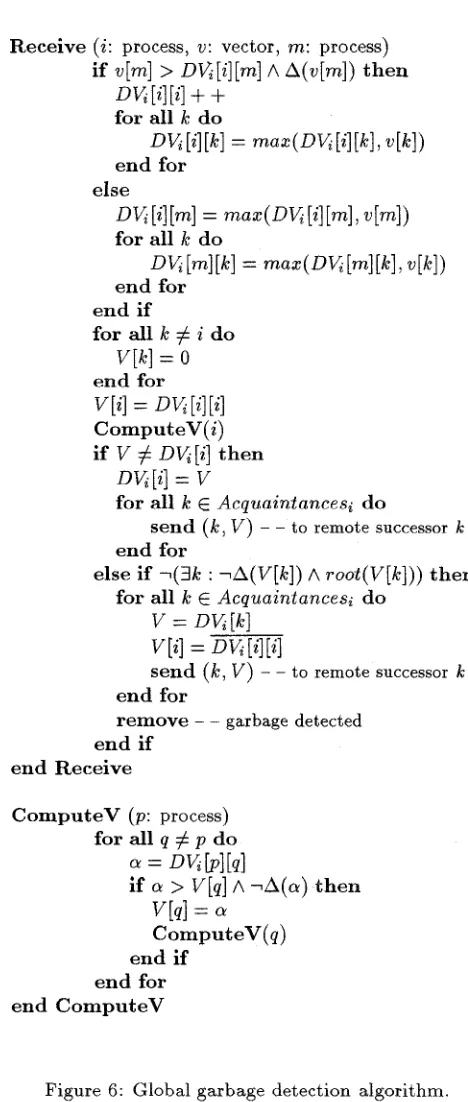
D V ( e i , j ) itself, lies in ei,j’s own index j. The result- ing algorithm shown in Figure 6 can be summarized as follow:
1. Each vertex i in the global root graph maintains a
log D E . Each entry in this log is a vector contain- ing the best locally held approximation for the de- pendency vector of the latest known log-keeping event of the corresponding global root.
2. Whenever a global root receives a dependency vector from another global root adjacent t o it, the received vector is merged with the corresponding log entry. A new approximation of the vector- time for the latest log-keeping event can then be computed from the updated contents of the log. If this newly computed dependency vector is the ac- tual full vector-time and indicates that the global root is no longer reachable from an actual root, the global root is removed from the global root graph.
3. This new dependency vector is in turn sent along the out-bound edges of the global root graph t o each adjacent global root.
The pseudo-code of our algorithm is shown in Fig- ure 6. For the purposes of illustration, an algorithm similar t o the algorithm of Fowler & Zwaenepoel [8]
is used (procedure ComputeV). This procedure is how- ever applied t o a strictly local structure, i.e., recursive invocations do not involve any remote invocation. T he test of the predicate i A ( a ) in the recursive procedure
C o m p u t e V stops the recursion if the time-stamp of the
direct remote predecessor of an edge-destruction event is encountered. This predicate therefore evaluates t o true for either a null time-stamp, i.e., A(0) is true, or
the tirne-stamp of the direct remote predecessor of an edge-destruction event, i.e., A(E) is true. The proce- dure Receive corresponds t o the code executed when a
dependency vector w is received by a global root i from an adjacent global root m. The vector m may be the contents of an edge-destruction control message which is the case when A(w[m]) is true, this vector may there- fore contain the time-stamps of delayed edge-creation
events as explained in 53.4.
Receive (i: process, v: vector, m: process)
if v [ m ]
>
D E [ i ] [ m ] A A(w[m]) then D K [ i ] [ i ]+ +
for all k do
end for
D K [ i ] [ k ] = m a z ( D K [ i ] [ k ] , w [ k ] )
else
D K [ i ] [ m ] = m a z ( D K [ i ] [ m ] ,
v[m])
for all k do
end for
D K [ m ] [ k ] = m a z ( D K [ m ] [ k ] , w [ k ] )
end if
for all IC
#
i doend for
ComputeV( i ) if V
#
D K [ i ] thenV [ k ] = 0
V [ i ] = D K [ i ] [ i ]
D K [ i ] =
v
for all k
E
Acquaintancesi doend for
for all k E Acquaintancesi do
send ( k , V ) - - to remote successor k
else if l ( 3 k : -A(V[k]) A r u u t ( V [ k ] ) ) then
v
= D K [ k ] V [ i ] = D K [ i ] [ i ]send ( k , V ) - - t o remote successor k
end for
remove - - garbage detected end if
end Receive
ComputeV ( p : process)
for all p
#
p docx =
DK
bl
[ql%I
=if
a>
V[q] A -A(a) thenComputeV( q )
[image:7.614.320.554.88.639.2]end if end for end ComputeV
Figure 6: Global garbage detection algorithm.
3.4 Lazy Log-keeping
The model described in 53.1 assumes some kind of log- keeping mechanism that is somehow able t o immedi- ately react t o the creation of an edge in the global root graph, even though this edge may have been created
Figure 7: Lazy log-keeping.
by an exchange of messages involving some third party (remote) object, and in such a way that there can- not be any race conditions between log-keeping control messages.
Each vertex i of the global root graph maintains a two-dimensional log of dependency vectors, noted OK. Conceptually, as explained in $2.3, whenever an incoming edge (to this vertex) in the global root graph is either created or destroyed, the vector D K [ i ] (one of the entries of the log maintained by i ) is updated, with the latest event index of the remote vertex from which the edge is pointing. D K [ i ] would therefore be equivalent to the dependency vector described by Fowler & Zwaenepoel [8].
Such an eager log-keeping mechanism would in- volve exchanging additional control messages, e.g., when a message containing a reference denoting
k
is sent fromi
to j, some control message must somehow be sent t ok
as well. However, race conditions be- tween log-keeping control messages must be avoided. Although it is possible to implement such an eager log-keeping mechanism (see §4), additional log-keeping control messages compromise the scalability and ro-bustness of the whole GGD. Instead, we adopt a lazy log-keeping approach that avoids the problem alto- gether [12]. Our lazy log-keeping mechanism updates the logs as follows:
Whenever an object i sends a copy of its own ref- erence object j, the log D E is updated as follows:
- D K [ i ] [ j ] = D K [ i ] [ j ]
+
1 - Dvi[i][i] = D X [ i ] [ i ]+
1Whenever an object i sends to an object j a copy of a reference denoting an object
k,
the log DK(and not DVk) is updated as follows:
- D K [ k ] [ j ] = D K [ k ] [ j ]
+
1On receiving the reference, the recipient, i.e., ob- ject j , updates its own log as follows:
-
Dqlil[.il
= Dv;.lil[jl+ 1In other words, whenever some object i sends a refer- ence across a site boundary, only the logs of the objects involved in the exchange are updated, and not the log of the target (third party) object. Our lazy log-keeping mechanism makes it possible to adequately update the logs without requiring any additional control messages to be sent, hence avoiding race conditions altogether. This is illustrated in Figure 7 where the messages actu- ally carrying the copy of the reference are represented
as liight grey arrows.
There can be more entries in the log D K than the number of inbound edges towards i in the global root graph, i.e., entries logged on behalf of remote third party objects. Such an entry is eventually sent to this third party object as part of the edge-destruction con- troll message, when the edge from i to
k
is destroyed, i.e.! multiple edge-creation control messages can be bundled with an edge-destruction control message inone atomic delivery.
An edge-destruction control message is sent by the local garbage collector when the last reference to
a remote object is destroyed locally, i.e., when the proxy for that remote object is collected. An edge- destruction control message sent from an object
i
toa remote obiect
k
essentially contains the contents of the vector i E [ k ] maintained by object i on behalf of objectk,
where D K [ k ] [ i ] is replaced by D K [ i ] [ i ] .3.5 Granularity and Clustering
l O . O . l . 0 ) I
I
Figure 8: Evolution of the logs of the objects shown in Figure 3 according to the algorithm listed in Figure 6.
3.6 Example
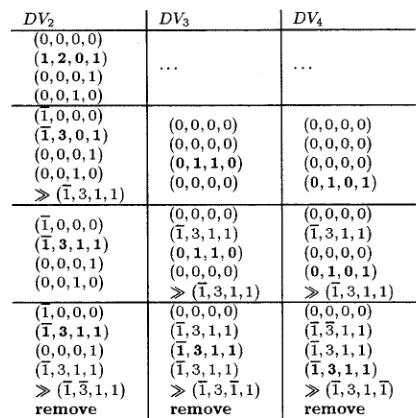
Figure 8 depicts the evolution of the logs of each of the global roots already illustrated in Figure 3 and Fig- ure 7.
GGD
is only triggered when the edge between 1 (the actual root) and 2 is removed.Figure 8 is made of three columns, one for each global root, except 1 which never changes because it is an actual root. Reading from the top of each column, each box represents the state of the log of the corre- sponding global root, one box for every modification of the log, starting just one stage before initiating
GGD,
i.e., just before DvZ merges the vector(T,O,
0,O) sent from 1. Therefore, the first row shows the state of the different logs as updated by the lazy log-keeping mechanism described in 93.4. The sign>>
is used t o indicate the dependency vector sent to successors.4
Related
Work
Schelvis [ 161 previously proposed a comprehensive al-
ternative to graph-tracing GGD, that proceeds by
analysing the mutator processes computation graph, although the author describes his own algorithm as
an incremental graph-tracing algorithm. It is there- fore not surprising that this algorithm has often later been either overlooked or misidentified in the litera- ture [4, 151.
Schelvis’s algorithm entails determining for each global root, the potential existence or absence of open paths t o t h at root, by constructing tame-stamp pack-
e t s from its local logs. A time-stamp packet is a form of dependency vector characterizing the causal his- tory of some log-keeping events. An eager log-keeping mechanism keeps track of the creation and destruc- tion of edges between any two global roots, as the graph evolves. Whenever an edge in the global root graph is either created or destroyed, packets are re- peatedly propagated down the paths th a t are poten- tially affected by this modification, until each global root along these paths has determined whether or not it remains potentially reachable from an actual root.
Unlike the approach described in this paper, time- stamp packets characterise the potential existence or absence of paths t o a global root via only one of the global roots adjacent t o it. Schelvis’ approach actu- ally consists in a depth first tracing of the mutator processes computation graph. As a result, it suffers from a worse message complexity than our own algo- rithm when processing recursive data structures such
ils double linked lists, or any cyclic structure contain-
ing subcycles. For instance, identifying the ik elements of a double linked list t ha t becomes disconnected from the object graph as garbage, requires O(iks) messages using Schelvis’ algorithm, while our approach requires only O ( k ) messages.
5
Conclusion
This paper describes a novel approach t o
GGD
t ha t entails computing the vector-time characterizing the causal history of some relevant events of the mutator computation, i.e., log-keeping events. This algorithm evaluates whether or not an object is garbage directly from knowledge of the mutator computation instead of examining its by-product, i.e., the object graph.Algorithms similar t o the aforementioned Fowler
& Zwaenepoel’s algorithm [8] require t h a t each process stores the dependency vectors of all its previous events. Our algorithm avoids the space overhead that could be expected from a method dynamically reconstruct- ing causal dependencies, because it is not necessary for the purposes of
GGD
t o compute the vector-time of every log-keeping event of the mutator computa- tion. In other words, this algorithm may not be ableto compute V(ei,,) for all j , but eventually comes up
with V ( e i , k ) where ik
> j
which is sufficient to deter- mine whether the corresponding vertex i has become garbage (because garbage is a stable property).Th e major drawbacks of our approach are its unbounded detection latency, and a space overhead greater than that of a graph tracing approach. How- ever, unlike other algorithms that dynamically recon- struct vector-times, this algorithm does not require any form of “back pointer” to (causally) preceding
events, and does not make it necessary to maintain dependency vectors for all events of the distributed computation, which would lead t o unbounded space overhead. It takes advantage of the fact that the vector-times of interest characterise the causal his- tory of non-arbitrary events of the mutator processes. These events are those related to the creation or de- struction of paths in the object graph.
Contrary to popular belief, comprehensive GGD is therefore not necessarily based on an object graph- tracing approach and intrinsically comprehensive al- ternatives t o traditional graph tracing based GGD are possible. Combined with a lazy-log keeping mecha- nism, this makes it possible to tackle the two problems that jeopardise the scalability of GGD, namely the overhead of eager log-keeping and what we described as the consensus bottleneck. Additionally, messages exchanged for GGD are idempotent, which contributes to the robustness of our approach as neither loss nor duplication of messages compromise the safety of the algorithm.
References
[l] 0. Babaoglu and K. Marzullo. Consistent
global states of distributed systems: Fundamen-
tal concepts and mechanisms. Tech. Report
UBLCS-93-1, University of Bologna (UBLCS), (Italy), Jan. 93.
[2] D.I. Bevan. Distributed Garbage Collection using Reference Counting. In PARLE’87, pp. 176-187, Jun. 87. LNCS, No.258/259.
[3] P. B. Bishop. Computer systems with a very large address space and garbage collection. PhD
thesis, MIT, (USA), May 77. Tech. Report
MIT/LCS/TR-178.
[4] A. Bjornerstedt. Secondary Storage Garbage Col- lection f o r Decentralized Object-Based Systems.
PhD thesis, The Royal Institute of Technology and Stockholm University, (Sweden), Jun. 90. Tech. Report 77.
[5] V. Cahill, S. Baker, C. Horn, and G. Starovic. The Amadeus GRT - Generic Support for Dis-
tributed Persistent Programming. In OOF-
SLA’93, pp. 144-161, Sep. 93. Tech. Report TCD-CS-93-37.
[6] P. W. Dickman. Distributed Object Management in a Non-Small Graph of Autonomous Networks with Few Failures. PhD thesis, Darwin College, Cambridge University (UK), Sep. 91.
[7] E. W. Dijkstra, L. Lamport, A. J . Martin, C. S. Scholten, and E. F. M. Steffens. On-the-Fly Garbage Collection: An Exercise in Cooperation.
[8] J . Fowler and W. Zwaenepoel. Causal Distributed Breakpoints. In ICDCS’90, pp. 134-141, May 90.
[9] J . Hughes. A Distributed Garbage Collection Al- gorithm. In FPLCA’85, pp. 256-272, Sep. 85.
LNCS, No.201.
CACM, 21(11):966-975, NOV. 78.
[lo] N. C. Juul. Comprehensive, Concurrent, and Robust Garbage Collection in the Distributed, Object-Based System Emerald. PhD thesis,
DIKU, (Denmark), Feb. 93. Tech. Report
Nr.93/ 1.
Ell] R. Ladin and B. Liskov. Garbage collection of a distributed heap. In ICDCS’92, pp. 708-715, Jun. 92.
[12] S. Louboutin and V. Cahill. A lazy log-keeping mechanism for comprehensive global garbage de- tection on Amadeus. In OOIS’95, pp. 118-132, Dec. 95. Tech. Report TCD-CS-95-13.
[13] S. Louboutin and V. Cahill. On Compre-
hensive Global Garbage Detection. In ER-
SADS’95, pp. 208-213, Apr. 95. Tech. Report TCD-CS-95-11.
[14] S. Louboutin. A Reactive Approach to Compre- hensive Global Garbage Detection. PhD thesis, Trinity College, Dublin (Ireland), in preparation.
[15] D. Plainfossk. Distributed Garbage Collection and Referencing Management in the Soul Object Sup- port System. PhD thesis, Universitk Pierre &
Marie Curie - Paris VI (France), Jun. 94.
[l6] M. Schelvis. Incremental Distribution of Times- tamp Packets: A New Approach To Distributed Garbage Collection. In OOPSLA ’89, pp. 37-48, Oct. 89.
[17] R. Schwarz and F. Mattern. Detecting causal relationships in distributed computations: In search of the holy grail. Distributed Computing,
7(3):149-174, 1994.
[l8] G. Tel. Topics in Distributed Algorithms. Cam- bridge International Series on Parallel Computa- tion, 1991. ISBN 0-521-40376-6.