Abstract— In this paper, we present an algorithm of the
homotopy analysis method (HAM) to obtain symbolic approximate solutions for linear and nonlinear differential equations of fractional order. We show that the HAM is different from all analytical methods; it provides us with a simple way to adjust and control the convergence region of the series solution by introducing the auxiliary parameter ℏ, the auxiliary function 𝑯 𝒕 , the initial guess 𝒚𝟎(𝒕) and the auxiliary linear operator . Three examples, the fractional oscillation equation, the fractional Riccati equation and the fractional Lane-Emden equation, are tested using the modified algorithm. The obtained results show that the Adomain decomposition method, Variational iteration method and homotopy perturbation method are special cases of homotopy analysis method. The modified algorithm can be widely implemented to solve both ordinary and partial differential equations of fractional order.
Index Terms—Adomian decomposition method, Caputo
derivative, Fractional Lane-Emden equation, Fractional oscillation equation, Fractional Riccati equation, Homotopy analysis method.
I. INTRODUCTION
Fractional differential equations have gained importance and popularity during the past three decades or so, mainly due to its demonstrated applications in numerous seemingly diverse fields of science and engineering. For example, the nonlinear oscillation of earthquake can be modeled with fractional derivatives, and the fluid-dynamic traffic model with fractional derivatives can eliminate the deficiency arising from the assumption of continuum traffic flow. The differential equations with fractional order have recently proved to be valuable tools to the modeling of many physical phenomena [1-8]. This is because of the fact that the realistic modeling of a physical phenomenon does not depend only on the instant time, but also on the history of the previous time which can also be successfully achieved by using fractional
1
Department of Mathematics, Zarqa Private University, Zarqa 1311, Jordan, (email: [email protected])
2
Prince Abdullah Bin Ghazi Faculty of Science and IT, Al-Balqa' Applied University, Salt 19117, Jordan, (email: [email protected]) 3
Department of Mathematics, Mutah University, P. O. Box 7, Al-Karak, Jordan, (email: [email protected])
4
Department of Mathematics, University of Jordan, Amman 11942, Jordan, (email: [email protected])
*
Corresponding author. Email addresses: [email protected]; [email protected], Tel. +962-5-3532519, Fax. +962-5-3530462.
calculus. Most nonlinear fractional equations do not have exact analytic solutions, so approximation and numerical techniques must be used. The Adomain decomposition method (ADM) [9-14], the homotopy perturbation method (HPM) [15-25], the variational iteration method (VIM) [26-28] and other methods have been used to provide analytical approximation to linear and nonlinear problems. However, the convergence region of the corresponding results is rather small as shown in [9-28]. The homotopy analysis method (HAM) is proposed first by Liao [29-33] for solving linear and nonlinear differential and integral equations. Different from perturbation techniques; the HAM doesn't depend upon any small or large parameter. This method has been successfully applied to solve many types of nonlinear differential equations, such as projectile motion with the quadratic resistance law [34], Klein-Gordon equation [35], solitary waves with discontinuity [36], the generalized Hirota-Satsuma coupled KdV equation [37], heat radiation equations [38], MHD flows of an Oldroyd 8-constant fluid [39], Vakhnenko equation [40], unsteady boundary-layer flows [41]. Recently, Song and Zhang [42] used the HAM to solve fractional KdV-Burgers-Kuramoto equation, Cang and his co-authors [43] constructed a series solution of non-linear Riccati differential equations with fractional order using HAM. They proved that the Adomian decomposition method is a special case of HAM, and we can adjust and control the convergence region of solution series by choosing the auxiliary parameter ℏ closed to zero.
The objective of the present paper is to modify the HAM to provide symbolic approximate solutions for linear and nonlinear differential equations of fractional order. Our modification is implemented on the fractional oscillation equation, the fractional Riccati equation and the fractional Lane-Emden equation. By choosing suitable values of the auxiliary parameter ℏ, the auxiliary function 𝐻 𝑡 , the initial guess 𝑦0(𝑡) and the auxiliary linear operator we can adjust and control the convergence region of solution series. Moreover, we illustrated for several examples that the Adomain decomposition, Variational iteration and homotopy perturbation solutions are special cases of homotopy analysis solution.
II. DEFINITIONS
For the concept of fractional derivative we will adopt Caputo‟s definition [7] which is a modification of the Riemann-Liouville definition and has the advantage of dealing properly with initial value problems in which the
Construction of Analytical Solutions to
Fractional Differential Equations Using
Homotopy Analysis Method
Ahmad El-Ajou
1, Zaid Odibat
2*, Shaher Momani
3, Ahmad Alawneh
4IAENG International Journal of Applied Mathematics, 40:2, IJAM_40_2_01
initial conditions are given in terms of the field variables and their integer order which is the case in most physical processes [4].
Definition 1. A real function 𝑓(𝑥), 𝑥 > 0, is said to be in the space 𝐶𝜇 , 𝜇 ∈ ℝ if there exists a real number 𝑝 , such that 𝑓 𝑥 = 𝑥𝑝𝑓1 𝑥 , where 𝑓1 𝑥 ∈ 𝐶 0, ∞ and it is said to be in the space 𝐶𝜇𝑛 iff 𝑓 𝑛 𝑥 ∈ 𝐶𝜇, 𝑛 ∈ ℕ.
Definition 2. The Riemann-Liouville fractional integral operator of order 𝛼 > 0 , of a function 𝑓 𝑥 ∈ 𝐶𝜇, 𝜇 ≥ −1,
is defined as:
𝐽𝛼𝑓 𝑥 = 1
𝛤 𝛼 𝑥 − 𝑡 𝛼−1
𝑥 0
𝑓 𝑡 𝑑𝑡 ,
𝛼 > 0 , 𝑥 > 0 ,
(1)
𝐽0𝑓 𝑥 = 𝑓 𝑥 . (2)
Properties of the operator 𝐽𝛼 can be found in [5-8], we mention only the following:
For 𝑓 ∈ 𝐶𝜇, 𝜇 ≥ −1, 𝛼, 𝛽 ≥ 0 and 𝛾 ≥ −1
𝐽𝛼𝐽𝛽𝑓 𝑥 = 𝐽𝛼+𝛽𝑓 𝑥 = 𝐽𝛽𝐽𝛼𝑓(𝑥) , (3)
𝐽𝛼𝑥𝛾 = 𝛤(𝛾 + 1)
𝛤(𝛼 + 𝛾 + 1)𝑥𝛼+𝛾 . (4)
Definition 3. The fractional derivative of 𝑓(𝑥) in the Caputo sense is defined as:
𝐷∗𝛼𝑓 𝑥 = 𝐽𝑛−𝛼𝐷𝑛𝑓 𝑥
= 1
𝛤 𝑛 − 𝛼 𝑥 − 𝑡 𝑥−𝛼−1
𝑥
0 𝑓
(𝑛) 𝑡 𝑑𝑡 , (5)
for 𝑛 − 1 < 𝛼 ≤ 𝑛 , 𝑛 ∈ ℕ , 𝑥 > 0 , 𝑓 ∈ 𝐶−1𝑛 .
Lemma 1. If 𝑛 − 1 < 𝛼 ≤ 𝑛, 𝑛 ∈ ℕ and 𝑓 ∈ 𝐶𝜇𝑛, 𝜇 ≥ −1,
then
𝐷∗𝛼𝐽𝛼𝑓 𝑥 = 𝑓 𝑥 , (6)
𝐽𝛼𝐷
∗𝛼𝑓 𝑥 = 𝑓 𝑥 − 𝑓 𝑘 0+ 𝑘!𝑥 , 𝑥 > 0 𝑛−1
𝑘=0
. (7)
III. HOMOTOPY ANALYSIS METHOD
The principles of the HAM and its applicability for various kinds of differential equations are given in [29-43]. For convenience of the reader, we will present a review of the HAM [29, 38]. To achieve our goal, we consider the nonlinear differential equation.
𝑁 𝑦 𝑡 = 0 , 𝑡 ≥ 0 , (8)
where N is a nonlinear differential operator, and 𝑦(𝑡) is unknown function of the independent variable 𝑡.
A. Zeroth- order Deformation Equation
Liao [29] constructs the so-called zeroth-order deformation equation:
1 − 𝑞 𝜙 𝑡; 𝑞 − 𝑦0 𝑡 = 𝑞ℏ𝐻 𝑡 𝑁 𝜙 𝑡; 𝑞 , (9)
where 𝑞 ∈ 0,1 is an embedding parameter, ℏ ≠ 0 is an auxiliary parameter, 𝐻 𝑡 ≠ 0 is an auxiliary function, is an auxiliary linear operator, 𝑁 is nonlinear differential operator, 𝜙 𝑡; 𝑞 is an unknown function, and 𝑦0 𝑡 is an initial guess of 𝑦(𝑡), which satisfies the initial conditions. It should be emphasized that one has great freedom to choose the initial guess 𝑦0 𝑡 , the auxiliary linear operator , the auxiliary parameter ℏ and the auxiliary function 𝐻 𝑡 .
According to the auxiliary linear operator and the suitable initial conditions, when 𝑞 = 0, we have
𝜙 𝑡; 0 = 𝑦0 𝑡 , (10)
and when 𝑞 = 1 , since ℏ ≠ 0 and 𝐻 𝑡 ≠ 0 , the zeroth-order deformation equation (9) is equivalent to (8), hence
𝜙 𝑡; 1 = 𝑦 𝑡 . (11)
Thus, as 𝑞 increasing from 0 to 1, the solution 𝜙 𝑡; 𝑞 various from 𝑦0 𝑡 to 𝑦(𝑡).
Define
𝑦𝑚 𝑡 =
1 𝑚!
𝜕𝑚𝜙 𝑡; 𝑞
𝜕𝑞𝑚 𝑞=0
. (12)
Expanding 𝜙 𝑡; 𝑞 in a Taylor series with respect to the embedding parameter 𝑞, by using (10) and (12), we have:
𝜙 𝑡; 𝑞 = 𝑦0 𝑡 + 𝑦𝑚 𝑡 𝑞𝑚 ∞
𝑚 =1
. (13)
Assume that the auxiliary parameter ℏ, the auxiliary function 𝐻 𝑡 , the initial approximation 𝑦0(𝑡) and the
auxiliary linear operator are properly chosen so that the series (13) converges at 𝑞 = 1. Then at 𝑞 = 1, from (11), the series solution (13) becomes
𝑦 𝑡 = 𝑦0 𝑡 + 𝑦𝑚 𝑡 ∞ 𝑚=1
. (14)
B. High-order Deformation Equation
Define the vector:
𝑦 𝑛 = 𝑦0 𝑡 , 𝑦1 𝑡 , 𝑦2 𝑡 , … , 𝑦𝑛(𝑡) . (15)
Differentiating equation (9) m-times with respect to embedding parameter 𝑞, then setting 𝑞 = 0 and dividing them by 𝑚! , we have, using (12), the so-called mth-order deformation equation
𝑦𝑚 𝑡 − 𝜒𝑚𝑦𝑚 −1 𝑡 = ℏ𝐻 𝑡 𝑅𝑚 𝑦 𝑚−1 𝑡 ,
𝑚 = 1,2, … , 𝑛 , (16)
IAENG International Journal of Applied Mathematics, 40:2, IJAM_40_2_01
where
𝑅𝑚 𝑦 𝑚 −1 =
1 (𝑚 − 1)!
𝜕𝑚 −1𝑁[𝜙 𝑡; 𝑞 ]
𝜕𝑞𝑚−1
𝑞=0
, (17)
and
𝜒𝑚 = 1 , 𝑚 > 1 0 , 𝑚 ≤ 1 . (18)
The so-called mth-order deformation equation (16) is a linear which can be easily solved using Mathematica package.
IV. AN ALGORITHM OF HOMOTOPY ANALYSIS METHOD The HAM has been extended in [42,43] to solve some fractional differential equations. They use the auxiliary linear operator to be 𝑑/𝑑𝑡 or 𝐷∗𝛼, where 0 < 𝛼 ≤ 1. Also they
fix the auxiliary function 𝐻 𝑡 to be 1. In this section, we present an efficient algorithm of the HAM. This algorithm can be established based on the assumptions that the nonlinear operator can involve fractional derivatives, the auxiliary function 𝐻 𝑡 can be freely selected and the auxiliary linear operator can be considered as = 𝐷∗𝛽,
𝛽 > 0 . To illustrate its basic ideas, we consider the following fractional initial value problem
𝑁𝛼 𝑦 𝑡 = 0 , 𝑡 ≥ 0 , (19)
where 𝑁𝛼 is a nonlinear differential operator that may
involves fractional derivatives, where the highest order derivative is 𝑛 , subject to the initial conditions
𝑦 𝑘 0 = 𝑐
𝑘 , 𝑘 = 0,1,2, … , 𝑛 − 1 . (20)
The so-called zeroth-order deformation equation can be defined as
1 − 𝑞 𝐷∗𝛽 𝜙 𝑡; 𝑞 − 𝑦0 𝑡 = 𝑞ℏ𝐻 𝑡 𝑁 𝜙 𝑡; 𝑞 ,
𝛽 > 0 , (21)
subject to the initial conditions
𝜙 𝑘 0; 𝑞 = 𝑐
𝑘 , 𝑘 = 0,1,2, … , 𝑛 − 1 . (22)
Obviously, when 𝑞 = 0, since 𝑦0 𝑡 satisfies the initial conditions (20) and = 𝐷∗𝛽, 𝛽 > 0, we have
𝜙 𝑡; 0 = 𝑦0 𝑡 , (23)
and, the so-called mth-order deformation equation can be constructed as
𝐷∗𝛽 𝑦𝑚 𝑡 − 𝜒𝑚𝑦𝑚 −1 𝑡 = ℏ𝐻 𝑡 𝑅𝑚 𝑦 𝑚 −1 𝑡 ,
𝛽 > 0 , (24)
subject to the initial conditions
𝑦𝑚(𝑘) 0 = 0 , 𝑘 = 0,1,2, … , 𝑛 − 1. (25)
Operating 𝐽𝛽, 𝛽 > 0 on both sides of (24) gives the
mth-order deformation equation in the form:
𝑦𝑚 𝑡 = 𝜒𝑚𝑦𝑚 −1 𝑡 + ℏ 𝐽𝛽 𝐻 𝑡 𝑅𝑚 𝑦 𝑚 −1 𝑡 . (26)
V. EXAMPLES
In this section we employ our algorithm of the homotopy analysis method to find out series solutions for some fractional initial value problems.
Example 1. Consider the composite fractional oscillation equation [18]
𝑑2𝑦
𝑑𝑡2− 𝑎𝐷∗𝛼𝑦 𝑡 − 𝑏𝑦 𝑡 − 8 = 0 , 𝑡 ≥ 0 ,
𝑛 − 1 < 𝛼 ≤ 𝑛 , 𝑛 = 1,2 ,
(27)
subject to the initial conditions
𝑦 0 = 0 , 𝑦′ 0 = 0 . (28)
First, if we set 𝛼 = 1 , 𝑎 = 𝑏 = −1 , then the equation (27) becomes linear differential equation of second order which has the following exact solution
𝑦 𝑡 = 8 − 8𝑒−𝑡/2 cos 3
2 𝑡 + 1 3sin
3
2 𝑡 . (29)
Since, 𝑁𝛼 𝑦 𝑡 =𝑑2𝑦
𝑑𝑡2− 𝑎𝐷∗𝛼𝑦 𝑡 − 𝑏𝑦 𝑡 − 8, according
to (12) and (17), we have
𝑅𝑚 𝑦 𝑚 −1 = 𝑦𝑚 −1′′ 𝑡 − 𝑎𝐷∗𝛼𝑦𝑚 −1 𝑡 − 𝑏𝑦𝑚 −1 𝑡
−8 1 − 𝜒𝑚 .
(30)
If we take the auxiliary function 𝐻 𝑡 = 1, and the parameter 𝛽 = 2, then the auxiliary linear operator becomes
= 𝑑2 𝑑𝑡2 , (31)
and
𝑦𝑚 𝑡 = 𝜒𝑚𝑦𝑚 −1 𝑡 + ℏ 𝐽2 𝑅𝑚 𝑦 𝑚 −1 𝑡 , (32)
subject to the initial conditions
𝑦𝑚 0 = 𝑦𝑚′ 0 = 0 . (33)
(I) If we choose the initial guess approximation
𝑦0 𝑡 = 0 , (34)
then we have
𝑦1= −4ℏ𝑡2 , (35)
IAENG International Journal of Applied Mathematics, 40:2, IJAM_40_2_01
𝑦2= −4ℏ 1 + ℏ 𝑡2+
ℏ2𝑏
3 𝑡4+ 8ℏ2𝑎
𝛤(5 − 𝛼)𝑡4−𝛼 ,
𝑦3= −4ℏ 1 + ℏ 2𝑡2+
2ℏ2 1 + ℏ 𝑏
3 𝑡4−
ℏ3𝑏2
90 𝑡6 +16ℏ
2 1 + ℏ 𝑎
𝛤 5 − 𝛼 𝑡4−𝛼−
16ℏ3𝑎𝑏
𝛤(7 − 𝛼)𝑡6−𝛼
− 8ℏ
3𝑎2
𝛤(7 − 2𝛼)𝑡6−2𝛼 .
Moreover, if we set the auxiliary parameter ℏ = −1, then the result is the Variational iteration solution obtained by Momani and Odibat in [18] and the same homotopy perturbation solution obtained by Odibat in [21].
(II) If we take the initial guess
𝑦0= 4𝑡2 , (36)
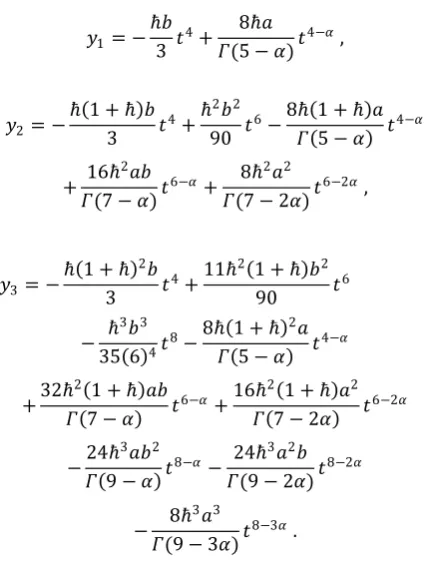
then we will get the approximations
𝑦1= −
ℏ𝑏 3 𝑡4+
8ℏ𝑎
𝛤(5 − 𝛼)𝑡4−𝛼 ,
(37)
𝑦2= −
ℏ 1 + ℏ 𝑏
3 𝑡4+
ℏ2𝑏2
90 𝑡6−
8ℏ 1 + ℏ 𝑎 𝛤 5 − 𝛼 𝑡4−𝛼
+ 16ℏ
2𝑎𝑏
𝛤(7 − 𝛼)𝑡6−𝛼+
8ℏ2𝑎2
𝛤(7 − 2𝛼)𝑡6−2𝛼 ,
𝑦3= −
ℏ 1 + ℏ 2𝑏
3 𝑡4+
11ℏ2 1 + ℏ 𝑏2
90 𝑡6
− ℏ
3𝑏3
35 6 4𝑡8−
8ℏ 1 + ℏ 2𝑎
𝛤 5 − 𝛼 𝑡4−𝛼 +32ℏ
2 1 + ℏ 𝑎𝑏
𝛤 7 − 𝛼 𝑡6−𝛼+
16ℏ2 1 + ℏ 𝑎2
𝛤 7 − 2𝛼 𝑡6−2𝛼 −24ℏ3𝑎𝑏2
𝛤 9 − 𝛼 𝑡8−𝛼−
24ℏ3𝑎2𝑏
𝛤(9 − 2𝛼)𝑡8−2𝛼
− 8ℏ
3𝑎3
𝛤(9 − 3𝛼)𝑡8−3𝛼 .
Here, if we put ℏ = −1 in (37), then we will get the Adomian decomposition solution obtained by Momani and Odibat in [18].
(III) If we take the initial guess
𝑦0= 3𝑡2 , (38)
then we will get the approximations
𝑦1= −ℏ𝑡2−
ℏ𝑏 4 𝑡4−
6ℏ𝑎
𝛤(5 − 𝛼)𝑡4−𝛼 ,
(39)
𝑦2 = −ℏ𝑡2−
ℏ𝑏 4 𝑡4−
6ℏ𝑎 𝛤 5 − 𝛼 𝑡4−𝛼
+ℏ2𝑡2−2𝛼 360𝑎2𝛤 7 − 𝛼 𝑡4+ ⋯ .
(VI) If we replace 𝐻 𝑡 = 1 by 𝐻 𝑡 = 𝑡1/2in (III), then we have
𝑦1= −
8ℏ 15𝑡
5 2−4ℏ𝑏
21 𝑡
9 2
− 24ℏ𝑎
9 − 2𝛼 (7 − 2𝛼)𝛤(3 − 𝛼)𝑡
9 2−𝛼 ,
𝑦2= −
8ℏ 15𝑡
5 2−4ℏ𝑏
21 𝑡
9 2
− 24ℏ𝑎
9 − 2𝛼 7 − 2𝛼 𝛤 3 − 𝛼 𝑡
9
2−𝛼+ ℏ 2
(4)1+3𝛼𝑡3−2𝛼 … .
By means of the so-called ℏ-curves [29], Fig.1 shows that the valid region of ℏ is the horizontal line segment. Thus, the valid regions of ℏ for the HAM of Eq. (27) at different values of 𝛼 are shown in Fig.1.
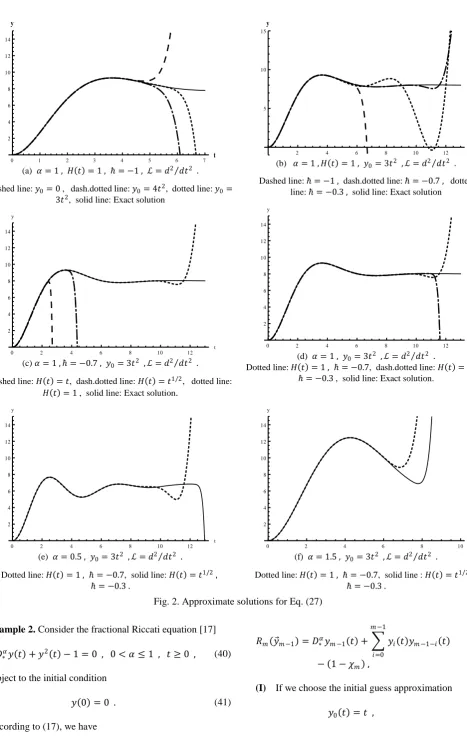
Fig. 2.(a)~(f) shows the approximate solutions for Eq. (27) obtained for different values of 𝛼 , ℏ , 𝐻 𝑡 and𝑦0(𝑡)using HAM. Fig. 2.(a) shows that the best solution results when we use the initial guess 𝑦0= 3𝑡2. Fig. 2.(b) shows that the best solution results when we use the auxiliary parameter ℏ =
−0.7. Fig. 2.(c) shows that the best solution results when we use the auxiliary function 𝐻 𝑡 = 1. In Fig. 2.(d)~(f), we compare the approximate solutions for different values of ℏ and 𝐻 𝑡 . As shown in Fig. 2.(a)~(f), we can observe that by choosing a proper value of the auxiliary parameter ℏ, the auxiliary function 𝐻 𝑡 , the auxiliary linear operator and the initial guess 𝑦0(𝑡) we can adjust and control convergence
[image:4.595.47.268.319.601.2]region of the series solutions. Moreover, we can observe that convergence region increases as ℏ goes to left end point of the valid region of ℏ , but this may decreases the agreement with the exact solution. Choosing a suitable auxiliary function 𝐻 𝑡 with the left end point of the valid region of ℏ scrimps the disagreement with the exact solution. Fig.3. show the „residual error‟ for 15th order approximation for Eq. (27) at 𝛼 = 1 obtained for different values of ℏ and 𝐻 𝑡 .
Fig.1. The ℏ-curves of 𝑦′ which are corresponding to the15th-order approximate HAM solution of Eq.(27) when 𝐻 𝑡 = 𝑡1/2 ,
𝑦0= 3𝑡2 , ℒ = 𝑑2 𝑑𝑡2. Dotted line: 𝛼 = 0.5, dash.dotted line: 𝛼 = 1, solid line: 𝛼 = 1.5.
2.5 2.0 1.5 1.0 0.5 0.0 h
0.5 1.0 1.5 2.0 2.5 3.0 3.5
y'
IAENG International Journal of Applied Mathematics, 40:2, IJAM_40_2_01
(a) 𝛼 = 1 , 𝐻 𝑡 = 1 , ℏ = −1 , ℒ = 𝑑2 𝑑𝑡2 .
Dashed line: 𝑦0= 0 , dash.dotted line: 𝑦0= 4𝑡2, dotted line: 𝑦0= 3𝑡2, solid line: Exact solution
(b) 𝛼 = 1 , 𝐻 𝑡 = 1 , 𝑦0= 3𝑡2 , ℒ = 𝑑2 𝑑𝑡2 .
Dashed line: ℏ = −1 , dash.dotted line: ℏ = −0.7 , dotted line: ℏ = −0.3 , solid line: Exact solution
(c) 𝛼 = 1 , ℏ = −0.7 , 𝑦0= 3𝑡2 , ℒ = 𝑑2 𝑑𝑡2 .
Dashed line: 𝐻 𝑡 = 𝑡, dash.dotted line: 𝐻 𝑡 = 𝑡1/2, dotted line: 𝐻 𝑡 = 1 , solid line: Exact solution.
(d) 𝛼 = 1 , 𝑦0= 3𝑡2 , ℒ = 𝑑2 𝑑𝑡2 .
Dotted line: 𝐻 𝑡 = 1 , ℏ = −0.7, dash.dotted line: 𝐻 𝑡 = 𝑡1/2 , ℏ = −0.3 , solid line: Exact solution.
(e) 𝛼 = 0.5 , 𝑦0= 3𝑡2 , ℒ = 𝑑2 𝑑𝑡2 .
Dotted line: 𝐻 𝑡 = 1 , ℏ = −0.7, solid line: 𝐻 𝑡 = 𝑡1/2 , ℏ = −0.3 .
(f) 𝛼 = 1.5 , 𝑦0= 3𝑡2 , ℒ = 𝑑2 𝑑𝑡2 .
[image:5.595.59.527.51.794.2]Dotted line: 𝐻 𝑡 = 1 , ℏ = −0.7, solid line : 𝐻 𝑡 = 𝑡1/2 , ℏ = −0.3 .
Fig. 2. Approximate solutions for Eq. (27)
Example 2. Consider the fractional Riccati equation [17]
𝐷∗𝛼𝑦 𝑡 + 𝑦2 𝑡 − 1 = 0 , 0 < 𝛼 ≤ 1 , 𝑡 ≥ 0 , (40)
subject to the initial condition
𝑦 0 = 0 . (41)
According to (17), we have
𝑅𝑚 𝑦 𝑚−1 = 𝐷∗𝛼𝑦𝑚 −1 𝑡 + 𝑦𝑖 𝑡 𝑦𝑚 −1−𝑖 𝑡 𝑚−1
𝑖=0
− 1 − 𝜒𝑚 ,
(42)
(I) If we choose the initial guess approximation
𝑦0 𝑡 = 𝑡 , (43)
0 1 2 3 4 5 6 7 t
2 4 6 8 10 12 14 y
2 4 6 8 10 12 t
5 10 15 y
0 2 4 6 8 10 12
t 2
4 6 8 10 12 14 y
0 2 4 6 8 10 12
t 2
4 6 8 10 12 14 y
0 2 4 6 8 10 12
t 2
4 6 8 10 12 14 y
0 2 4 6 8 10
t 2
4 6 8 10 12 14 y
IAENG International Journal of Applied Mathematics, 40:2, IJAM_40_2_01
Fig. 3. The residual error for Eq. (27) when 𝛼 = 1 , 𝑦0= 3𝑡2, ℒ = 𝑑2 𝑑𝑡2 . Solid line: 𝐻 𝑡 = 1 , ℏ = −0.7 , dotted
line: 𝐻 𝑡 = 𝑡1/2 , ℏ = −0.3 .
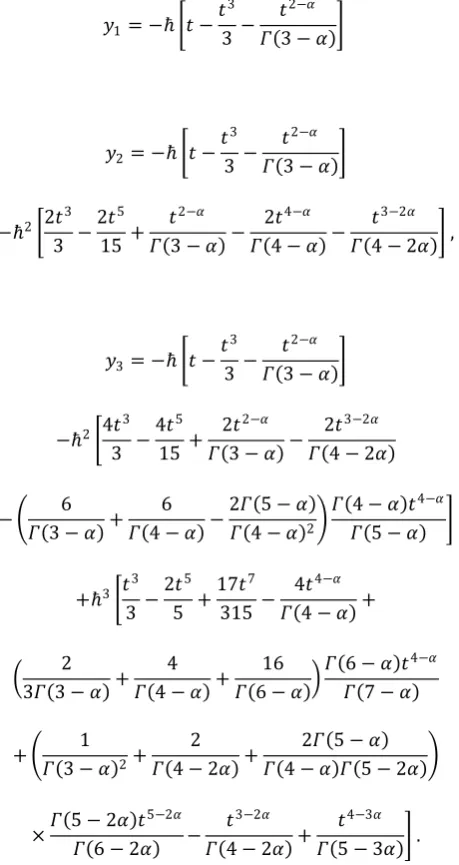
the parameter 𝛽 = 1 and 𝐻 𝑡 = 1, then according to (26) we find
𝑦1= −ℏ 𝑡 −
𝑡3
3 −
𝑡2−𝛼
𝛤 3 − 𝛼
𝑦2= −ℏ 𝑡 −
𝑡3
3 −
𝑡2−𝛼
𝛤 3 − 𝛼
−ℏ2 2𝑡3
3 −
2𝑡5
15+ 𝑡2−𝛼
𝛤 3 − 𝛼 − 2𝑡4−𝛼
𝛤 4 − 𝛼 −
𝑡3−2𝛼
𝛤 4 − 2𝛼 ,
𝑦3= −ℏ 𝑡 −
𝑡3
3 −
𝑡2−𝛼
𝛤 3 − 𝛼
−ℏ2 4𝑡3
3 −
4𝑡5
15+ 2𝑡2−𝛼
𝛤 3 − 𝛼 −
2𝑡3−2𝛼
𝛤 4 − 2𝛼
− 6
𝛤 3 − 𝛼 + 6 𝛤 4 − 𝛼 −
2𝛤 5 − 𝛼 𝛤 4 − 𝛼 2
𝛤 4 − 𝛼 𝑡4−𝛼
𝛤 5 − 𝛼
+ℏ3 𝑡3
3 −
2𝑡5
5 +
17𝑡7
315 −
4𝑡4−𝛼
𝛤 4 − 𝛼 +
2 3𝛤 3 − 𝛼 +
4 𝛤 4 − 𝛼 +
16 𝛤 6 − 𝛼
𝛤 6 − 𝛼 𝑡4−𝛼
𝛤 7 − 𝛼
+ 1
𝛤 3 − 𝛼 2+
2 𝛤 4 − 2𝛼 +
2𝛤 5 − 𝛼 𝛤 4 − 𝛼 𝛤 5 − 2𝛼
×𝛤 5 − 2𝛼 𝑡
5−2𝛼
𝛤 6 − 2𝛼 −
𝑡3−2𝛼
𝛤 4 − 2𝛼 +
𝑡4−3𝛼
𝛤 5 − 3𝛼 .
Now, if we take ℏ = −1, then we have the homotopy perturbation solution obtained by Odibat and Momani in [17].
(II) If we chose the initial guess approximation
𝑦0 𝑡 = 𝑡1/2 , (44)
the auxiliary linear operator
ℒ = 𝐷∗𝛽 , 𝛽 > 0 , (45)
and the auxiliary function
𝐻 𝑡 = 𝑡𝛾 , 𝛾 > −1 , (46)
then (26) gives
𝑦1= ℏ𝑡𝛽+𝛾 −
𝛤 1 + 𝛾 𝛤 1 + 𝛾 + 𝛽 +
𝛤 2 + 𝛾 𝑡 𝛤 2 + 𝛾 + 𝛽
+ 𝜋𝛤
3
2 + 𝛾 − 𝛼 𝑡
1 2−𝛼
2𝛤 32 − 𝛼 𝛤 32 + 𝛾 − 𝛼 + 𝛽 ,
𝑦2= ℏ𝑡𝛽 +𝛾 −
𝛤 1 + 𝛾 𝛤 1 + 𝛾 + 𝛽 +
𝛤 2 + 𝛾 𝑡 𝛤 2 + 𝛾 + 𝛽
+ 𝜋𝛤
3
2 + 𝛾 − 𝛼 𝑡
1 2−𝛼
2𝛤 32 − 𝛼 𝛤 32 + 𝛾 − 𝛼 + 𝛽 +
ℏ2𝑡2𝛽+2𝛾−1
2 … ,
⋮
and so on. As pointed above, the valid region of ℏ is a horizontal line segment. Thus, the valid region of ℏ for the
HAM solution of Eq. (40) at 𝛼 = 0.5 , 𝛾 = −0.5 , 𝛽 = 1 is
−1.15 < ℏ < −0.1 as shown in Fig. 4.
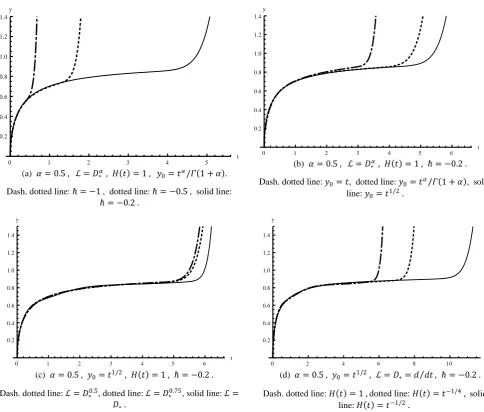
Fig. 5.(a)~(d) show the approximate solution for Eq. (40) obtained for different values of ℏ, 𝛽, 𝐻(𝑡) and𝑦0(𝑡)using
HAM. As observed in Fig. 2.(a)~(f), we can notice that the convergence region can be adjusted and controlled by choosing proper values of the auxiliary parameter ℏ, the auxiliary function 𝐻 𝑡 , the auxiliary linear operator and the initial guess 𝑦0(𝑡).
Fig. 4. The ℏ-curves of 𝑦′ & 𝑦′′ which are corresponding to the HAM solution of Eq. (40) when 𝛼 = 0.5 , 𝑦0= 𝑡1/2 , 𝛾 = −0.5 ,
𝛽 = 1 . Dotted curve: 15th-order approximation of 𝑦′, solid line: 15th-order approximation of 𝑦′′.
0 2 4 6 8 10
0.03 0.02 0.01 0.00 0.01
1.5 1.0 0.5
h
20
10 10 20
y',y"
IAENG International Journal of Applied Mathematics, 40:2, IJAM_40_2_01
[image:6.595.307.547.581.738.2](a) 𝛼 = 0.5 , ℒ = 𝐷∗𝛼 , 𝐻 𝑡 = 1 , 𝑦0= 𝑡𝛼/𝛤 1 + 𝛼 .
Dash. dotted line: ℏ = −1 , dotted line: ℏ = −0.5 , solid line: ℏ = −0.2 .
(b) 𝛼 = 0.5 , ℒ = 𝐷∗𝛼 , 𝐻 𝑡 = 1 , ℏ = −0.2 .
Dash. dotted line: 𝑦0= 𝑡, dotted line: 𝑦0= 𝑡𝛼/𝛤 1 + 𝛼 , solid line: 𝑦0= 𝑡1/2 .
(c) 𝛼 = 0.5 , 𝑦0= 𝑡1/2 , 𝐻 𝑡 = 1 , ℏ = −0.2 .
Dash. dotted line: ℒ = 𝐷∗0.5, dotted line: ℒ = 𝐷∗0.75, solid line: ℒ = 𝐷∗ .
(d) 𝛼 = 0.5 , 𝑦0= 𝑡1/2 , ℒ = 𝐷∗= 𝑑 𝑑𝑡 , ℏ = −0.2 .
[image:7.595.50.535.65.477.2]Dash. dotted line: 𝐻 𝑡 = 1 , dotted line: 𝐻 𝑡 = 𝑡−1/4 , solid line: 𝐻 𝑡 = 𝑡−1/2 .
Fig. 5. Approximate solutions for Eq. (40)
Example 3. Consider the Lane-Emden fractional differential equation [13, 21
𝐷∗𝛼𝑦 +
2
𝑡𝑦′+ 𝑦3− 6 + 𝑡6 = 0 , 𝑡 ≥ 0 , 𝑛 − 1 < 𝛼 ≤ 𝑛 , 𝑛 = 1,2 ,
(47) subject to initial conditions
𝑦 0 = 0 , 𝑦′ 0 = 0 . (48)
Hence, according to (17), we have
𝑅𝑚 𝑦 𝑚 −1 = 𝐷∗𝛼𝑦𝑚 −1 𝑡 +2𝑡𝑦𝑚 −1′ 𝑡
+ 𝑦𝑚 −1−𝑖 𝑡 𝑦𝑗 𝑡 𝑦𝑖−𝑗 𝑡 𝑖
𝑗 =0 𝑚−1
𝑖=0
− 6 + 𝑡6 1 − 𝜒 𝑚 .
(49)
In view of the modified homotopy analysis method, if we set
𝑦0= 0 , 𝐻 𝑡 = 1 , 𝛽 = 2 , (50)
then the mth-order deformation equation (26) gives
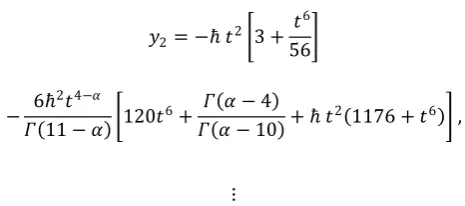
𝑦1 = −ℏ 𝑡2 3 +
𝑡6
56 ,
Fig. 6. The ℏ-curves of 𝑦′′which are corresponding to the 5th-order approximate HAM solution of Eq. (47) for different values of 𝛼 . Dash dotted line: 𝛼 = 2, dotted line: 𝛼 = 1.75 , solid
line: 𝛼 = 1.5 .
0 1 2 3 4 5
t 0.2
0.4 0.6 0.8 1.0 1.2 1.4 y
0 1 2 3 4 5 6
t 0.2
0.4 0.6 0.8 1.0 1.2 1.4 y
0 1 2 3 4 5 6
t 0.2
0.4 0.6 0.8 1.0 1.2 1.4 y
0 2 4 6 8 10
t 0.2
0.4 0.6 0.8 1.0 1.2 1.4 y
1.0 0.8 0.6 0.4 0.2 0.0 h
0.5 1.0 1.5 2.0 2.5 3.0 y"
IAENG International Journal of Applied Mathematics, 40:2, IJAM_40_2_01
[image:7.595.302.533.541.744.2](a) 𝛼 = 2 , 𝑦0= 0 , 𝐻 𝑡 = 1 , 𝛽 = 2.
Dotted line: ℏ = −0.5, dash.dotted line: ℏ = −0.35, dash.dot dotted line: ℏ = −0.1, solid line: exact solution.
[image:8.595.51.542.52.224.2](b) 𝑦0= 0 , 𝐻 𝑡 = 1 , 𝛽 = 2 , ℏ = −0.35. Dash. dotted line: 𝛼 = 1.5 , dotted line: 𝛼 = 1.75, solid line: 𝛼 = 2 .
Fig. 7. Approximate solutions for Eq. (47)
𝑦2= −ℏ 𝑡2 3 +
𝑡6
56
− 6ℏ
2𝑡4−𝛼
𝛤 11 − 𝛼 120𝑡6+
𝛤 𝛼 − 4
𝛤 𝛼 − 10 + ℏ 𝑡2 1176 + 𝑡6 ,
⋮
and so on. Moreover, if we replace the initial guess
𝑦0= 0 by 𝑦0= 𝑡2, then we have 𝑦𝑚 = 0, ∀ 𝑚 ≥ 1, hence,
𝑦 𝑡 = 𝑡2 is the exact solution.
The valid region of ℏ for the HAM solution of Eq. (47) at
𝛼 = 2 is −0.6 < ℏ < −0.15 , at 𝛼 = 1.75 is −0.6 < ℏ <
−0.15 and at 𝛼 = 1.5 is −0.6 < ℏ < −0.15 as shown in Fig. 6.
Fig.7.(a) shows the approximate solution for Eq. (47) at
𝛼 = 2 obtained for different values of ℏ using HAM. As the previous examples, the convergence region of the series solution increases as ℏ goes to the left end point of its valid region. Fig. 7.(b) shows the HAM solution for Eq. (47) at different values of 𝛼 obtained for ℏ = −0.35.
VI. DISCUSSION AND CONCLUSIONS
In this work, we carefully proposed an efficient algorithm of the HAM which introduces an efficient tool for solving linear and nonlinear differential equations of fractional order. The modified algorithm has been successfully implemented to find approximate solutions for many problems. The work emphasized our belief that the method is a reliable technique to handle nonlinear differential equations of fractional order. As an advantage of this method over the other analytical methods, such as ADM and HPM, in this method we can choose a proper value for the auxiliary parameter ℏ, the auxiliary function 𝐻 𝑡 , the auxiliary linear operator and the initial guess 𝑦0 to adjust and control convergence region
of the series solutions.
There are some important points to make here. First, we can observe that the convergence region of the series solution
increases as ℏ tends to zero. Second, choosing a suitable auxiliary function 𝐻 𝑡 or initial approximation 𝑦0 𝑡 may
accelerate the rapid convergence of the series solution and may increase the agreement with the exact solution. Third, for a certain value of ℏ , choosing a suitable auxiliary linear operator ℒ = 𝐷∗𝛽 , 𝛽 > 0 may increase the convergence region. Finally, generally speaking, the proposed approach can be further implemented to solve other nonlinear problems in fractional calculus field.
REFERENCES
[1] G. O. Young, “Definition of physical consistent damping laws with fractional derivatives,” Z. Angew. Math. Mech, vol. 75, 1995, pp. 623-35.
[2] J. H. He, “Some applications of nonlinear fractional differential equations and their approximations,” Bull. Sci. Technol., vol. 15(2), 1999, pp. 86-90.
[3] J. H. He, “Approximate analytic solution for seepage flow with fractional derivatives in porous media,” Comput. Methods Appl. Mech. Eng., vol. 167, 1998, pp. 57-68.
[4] F. Mainardi, Fractional calculus: 'Some basic problems in continuum and statistical mechanics, in Fractals and Fractional calculus in Continuum Mechanics, A. carpenter and F. Mainardi, Eds., New York: Springer-Verlag, 1997, pp. 291-348.
[5] I. Podlubny, Fractional Differential Equations. New York: Academic Press, 1999.
[6] K. S. Miller, and B. Ross, An introduction to the fractional calculus and fractional differential equations. New York: John Willy and Sons, Inc., 1993.
[7] M. Caputo, “Linear models of dissipation whose Q is almost frequency independent,” Part II. J. Roy Austral Soc. vol. 13, 1967, pp. 529-539. [8] K. B. Oldham, and J. Spanier, The Fractional calculus. New York:
Academic Press, 1974.
[9] G. Adomian, “Nonlinear stochastic differential equations,” J. Math. Anal. Appl., vol. 55, 1976, pp. 441-452.
[10] G. Adomian, “A review of the decomposition method in applied mathematics,” J. Math. Anal. Appl., vol. 135, 1988, pp. 501-544. [11] G. Adomian, Solving Frontier Problems of physics: the decomposition
method. Boston: Kluewr Academic Publishers, 1994.
[12] N. T. Shawagfeh, “The decomposition method for fractional differential equations,” J. Frac. Calc., vol. 16, 1999, pp. 27-33. [13] A. M. Wazwaz, “The modified decomposition method for analytic
treatment of differential equations,” Appl. Math. Comp., vol. 173, 2006, pp. 165-176.
0.0 0.5 1.0 1.5 2.0 2.5
t 2
4 6 8 y
0.0 0.5 1.0 1.5 2.0 2.5 3.0
t 2
4 6 8 10 12 y
IAENG International Journal of Applied Mathematics, 40:2, IJAM_40_2_01
[image:8.595.51.284.267.370.2][14] S. Momani, and N. T. Shawagfeh, “Decomposition method for solving fractional Riccati differential equations,” Appl. Math. Comput, vol. 182, 2006, pp. 1083-1092.
[15] S. Abbasbandy, “Homotopy perturbation method for quadratic Riccati differential equation and comparison with Adomian's decomposition method,” Appl. Math. Comp., vol. 173, 2006, pp. 493-500.
[16] Z. Odibat, and S. Momani, “A reliable treatment of homotopy perturbation method for Klein-Gordan equations,” Physics Letters A, vol. 365 (5-6), 2007, pp. 351-357.
[17] Z. Odibat, and S. Momani, “Modified homotopy perturbation method: Application to quadratic Riccati differential equation of fractional order,” Chaos, Solitons and Fractals, vol. 36 (1), 2008, pp. 167-174. [18] S. Momani, and Z. Odibat, “Numerical comparison of methods for
solving linear differential equations of fractional order,” Chaos, Solitons and Fractals, vol. 31, 2007, pp. 1248-1255.
[19] Z. Odibat, and S. Momani, “Numerical methods for nonlinear partial differential equations of fractional order,” Applied Mathematical Modeling, vol. 32 (1), 2008, pp. 28-39.
[20] S. Momani, and Z. Odibat, “Numerical approach to differential equations of fractional order,” J. of Comput. Appl. Math., vol. 207, 2007, pp. 96-110.
[21] Z. Odibat, “A new modification of the homotopy perturbation method for linear and nonlinear operators,” Appl. Math. Comput., vol. 189 (1), 2007, pp. 746-753.
[22] J. H. He, “Homotopy perturbation technique,” Comput. Meth. Appl. Eng., vol. 178, 1999, pp. 257-262.
[23] J. H. He, “Application of homotopy perturbation method to nonlinear wave equations,” Chaos, Solitons & Fractals, vol. 26 (3), 2005, pp. 695-700.
[24] J. H. He, “The homotopy perturbation method for nonlinear oscillators with discontinuities,” Appl. Math. Comp., vol. 151, 2004, pp. 287-292.
[25] J. H. He, “Homotopy perturbation method for bifurcation of nonlinear problems,” Int. J. nonlin. Sci. Numer. Simulat. Vol. 6(2), 2005, pp. 207-208.
[26] Z. Odibat, and S. Momani, “Application of variation iteration method to nonlinear differential equations of fractional order,” Int. J . Nonlin. Sci. Numer. Simulat., vol. 1(7), 2006, pp. 15-27.
[27] J. H. He, “Variational iteration method - a kind of non-linear analytic technique: some examples,” Int. J. Nonlin. Mech., vol. 34, 1999, pp. 699-708.
[28] J. H. He, “Variational iteration method for autonomous ordinary differential systems,” Appl. Math. Comput., vol. 114, 2000, pp. 115-23.
[29] S. J. Liao, Beyond Perturbation: Introduction to the Homotopy Analysis Methods, Boca Raton: Chapman and Hall/CRC Press, , 2003. [30] S. J. Liao, “On the homotopy analysis method for nonlinear problems,”
Appl. Math. Comput., vol. 147, 2004, pp. 499-513.
[31] S. J. Liao, “Comparison between the homotopy analysis method and homotopy perturbation method,” Appl. Math. Comput., vol. 169, 2005, pp. 1186-1194.
[32] S. J. Liao, “Homotopy analysis method: A new analytic method for nonlinear problems,” Appl. Math. and Mech., vol. 19, 1998, 957-962. [33] S. J. Liao, “An approximate solution Technique which does not depend upon small parameter: a special example,” Int. J. Nonlin. Mech., vol. 30, 1995, pp. 371-380.
[34] K.Yabushita et al, “An analytic solution of projection motion with the quadratic resistance law,” Journal of Physics A: Mathematical and theoretical, vol. 40, 2007, pp. 8403-8416.
[35] Q. Sun, “Solving the Klein-Gordon equation by means of the homotopy analysis method,” Appl. Math. and Comput., vol. 169, 2005, pp. 355-365.
[36] W. Wu, and S. J. Liao, “Solving solitary waves with discontinuity by means of the homotopy analysis method,” Chaos, Solitons and Fractals, vol. 26, 2005, pp. 177-185.
[37] S. Abbasbandy, “The application of homotopy analysis method to solve a generalized Hirota-Satsuma coupled KdV equation,” Physics Letters A, vol. 361, 2007, pp. 478-483.
[38] S. Abbasbandy, “Homotopy analysis method for heat radiation equations,” International Communications in Heat and Mass Transfer, vol. 34(3), 2007, pp.380-87.
[39] S. Abbasbandy, “Soliton solutions for the Fitzhugh-Nagumo equation with the homotopy analysis method,” Appl. Math. Model, vol. 32, 2008, pp. 2706-2714.
[40] S. Abbasbandy, “Approximate solution for the nonlinear model of diffusion and reaction in porous catalysts by means of the homotopy analysis method,” Chem. Eng. J., vol. 136, 2008, pp. 144-150. [41] Hayat T, Khan M, and Asghar S. “Homotopy analysis of MHD flows
of an oldroyd 8-constant fluid,” Acta Mech., vol. 168, 2004, pp. 213-232.
[42] Y. Wu, C. Wang, and S. Liao, “Solving the one-loop soliton solution of the Vakhnenko equation by means of the homotopy analysis method,” Chaos, Solitons and Fractals, vol. 23, 2005, pp. 1733-1740.
[43] S. J. Liao, “Series solutions of unsteady boundary-layer flows over a stretching flat plate,” Studies in Appl. Math., vol. 117(3), 2006, pp. 239-263.
[44] L. Song, H. Zhang, “Application of homotopy analysis method to fractional KdV-Burgers-Kuramoto equation,” Physics Letters A, vol. 367, 2007, pp. 88-94.
[45] J. Cang et al., “Series solutions of non-linear Riccati differential equations with fractional order,” Chaos, solitons & Fractals, to be published.