Ion-pair Chromatography; Ligand Exchange Chromatog-raphy; Liquid ChromatogChromatog-raphy; Molecular Imprints as Stationary Phases; Protein Stationary Phases; Super-critical Fluid Chromatography; Synthetic Multiple Interac-tion (‘Pirkle’) StaInterac-tionary Phases; Thin-Layer (Planar) Chromatography.
Further Reading
Allenmark S (1991)Chromatographic Enantioseparation, Methods and Applications, 2nd edn. London: Ellis Horwood.
Beesley TE and Scott RPW (1998)Chiral Chromatography. Chichester: Wiley.
Hesse G and Hagel R (1973) A complete separation of a racemic mixture by elution chromatography on cellu-lose triacetate.Chromatographia6: 277}283.
Johns DM (1989) Binding to cellulose derivatives. In Lough WJ (ed.) Chiral Liquid Chromatography, pp. 166}175. Glasgow: Blackie.
Shibata T and Mori K (1989) In KrstulovicH (ed.) Polysac-charide Phases in Chiral Separations by HPLC, Applica-tions to Pharmaceutical Compounds, pp. 336}398. Chichester: Ellis Horwood.
Chiral Derivatization
S. GoKroKg, Chemical Works of Gedeon, Richter Ltd, Budapest, Hungary
Copyright^ 2000 Academic Press
Introduction
The Importance of Enantiomeric Separations
The separation of enantiomers of chiral compounds by chromatographic methods and related techniques is one of the important tasks in modern analytical chemistry, especially in the analysis of compounds of biological and pharmaceutical interest. However, analysis of this kind is also required in food analy-sis and the analyanaly-sis of pesticides, Savours and fragrances. The reasons for this are as follows:
E As a consequence of the existing or potential differ-ences between the biological}pharmacological ac-tivities of the antipodes of racemic drugs, analytical methods are required for their simultaneous deter-mination in biological samples, thus enabling one to follow the fate of the enantiomers of the admin-istered drug (candidate) in the animal or human organism.
E Asymmetrical syntheses are in the focus of interest in variousRelds of organic chemistry especially in the synthesis of drugs administered as the pure enantiomer. In these cases and also if the prepara-tion of the enantiomers is carried out by classical resolution techniques, analytical methods are necessary for the determination of their enantio-meric purity.
Possibilities for Enantiomeric Separations
Since in achiral environment the physicochemical properties of the antipodes of racemates are identical, their separation is not possible if the generally used, achiral separation systems } ordinary
high-perfor-mance liquid chromatography (HPLC) and gas chromatography (GC) columns, thin-layer chromato-graphy (TLC) plates, capillary electrophoresis (CE) capillaries, etc., with ordinary mobile phases } are used. The main possibilities for the separation of enantiomers are:
E Transformation of the enantiomers to covalently bonded diastereomeric derivatives by reacting them with homochiral derivatizing reagents prior to their chromatographic separation using achiral stationary phases or and mobile phases. The de-tailed description of this general method, which is often referred to as an indirect method, is described here.
E Incorporation of the chiral reagent in the mobile phase for the dynamic formation of diastereomeric adducts, ion pairs or complexes with the enantio-mers to be separated during the chromatographic run. In this case also, achiral stationary phases are used.
E Separation of the enantiomers on chiral stationary phases (HPLC, GC and TLC). Although in prin-ciple this general method does not require derivat-ization, the separation can be improved in many cases by modifying the enantiomers using pre-column achiral derivatization. These aspects are also brieSy discussed here.
Covalent Chiral Derivatization of
Enantiomers and Separation of the
Diastereomeric Derivatives on
Achiral Columns
Introductory Remarks: the Role of Covalent Chiral Derivatization in Enantiomeric Separations
separable on achiral GC or HPLC columns or TLC plates was theRrst, widely used general method in the chiral analysis of drugs and related materials. After the introduction of newer chromatographic and cap-illary electrophoretic techniques brieSy mentioned above, the importance of enantioseparations based on covalent chiral derivatization has naturally de-creased to some extent. However, this general method is still a method of choice widely used espe-cially in HPLC. The reasons for this are the large number of commercially available homochiral re-agents and well-established reactions enabling dias-tereomeric derivatives with excellent separation and detection possibilities to be formed and the possibility of tailor-made separations using inexpensive, achiral columns, i.e. being in possession of the R- and S -forms of the reagent, it is possible to have the peak of the enantiomeric impurity eluting before the main peak.
The importance of covalent chiral derivatization can be characterized by the large number of publica-tions (above 300) from the early 1970s up to the present time. References to the most important publi-cations from this Reld can be found in chapters in books and review papers listed in Further Reading which cover the literature until 1993. The relatively large number of papers published after 1993 describ-ing new applications of previously described derivat-ization reagents, moreover the introduction of new reagents is an indication that this branch of chiral analysis has retained some of its importance to the present day (seeRgure legends).
Important Features of Chiral Derivatization Reactions and Reagents
The presence of a suitable functional group in the molecule of the analyte The prerequisite of the use of any kind of enantioseparation based on covalent, chiral derivatization is the presence of at least one functional group (amino, hydroxyl, carboxyl, epoxy, thiol, etc.) in the molecule of the chiral compound which is capable of reaction with the reactive group of the derivatizing reagent.
Good chromatographic properties of the derivatives The optimization of the chromatographic parameters of retention time, peak shape and separability of the enantiomers from other components of the complex mixture by proper selection of the column (usually reversed-phase but in some cases normal phase col-umns), and the composition and pH of the eluent is done in the usual ways for achiral HPLC.
SufVcient separation of the diastereomers formed This is also inSuenced by the above-mentioned
sol-vent composition and column selection, but in this case it is even more important to select a proper derivatizating reagent enabling diastereomers to be formed with sufRciently different molecular Rne structures for their chromatographic separation. If the number of the chiral centres in the analyte is more than one, the reagent should enable the separation of all stereoisomers. An example for this is the separ-ation of (S,R), (R,S), (S,S) and (R,R) nadolol in Figure 1.
The structural features which inSuence the separ-ation of the diastereomers are:
E The distance between the two chiral centres. In the majority of cases this is two to four atoms but there are many exceptions to this rule.
E Conformational rigidity of the diastereomers fa-vours resolution. Bulky groups in the vicinity of one of the chiral centres or the incorporation of one of them into a ring system are especially advantage-ous. For example, in the case of one of the most widely used chiral derivatizing reagent, GITC (2,3,4,6-tetra-O-acetyl--D-glucopyrasonyl iso-thiocyanate, see later) the chiral centres of the reagent are in the pyrane ring. The exchange of the acetyl groups to the bulkier benzoyl groups im-proves the resolution. The position and bulkiness of the remote functional groups also inSuences the separation of the diastereomers. In these instances, however, the direction of the inSuence is difRcult to predict. As an example, the investigation lead-ing to the highly efRcient derivatizing agent for the amino group (#)-2-methyl-2 -naphthyl-1,3-ben-zodioxole-4-carboxylic acid chloride is mentioned. It was found that the difference between the bulki-ness of the two substituents at C-2 favourably inSuences the separation and with the isomeric 5-carboxylic acids only poor separation is achiev-able.
E The formation of hydrogen bonds. For example, in the case of propranolol the secondary amino group of the molecule is transformed by chiral isocyan-ates or isothiocyanisocyan-ates to diastereomeric urea or thiourea derivatives. The formation of a hydrogen bond between the carbonyl or thiocarbonyl group of the latter and the free hydroxyl group of pro-pranolol plays an important role in the separation: the resolution deteriorates with etheriRcation of the hydroxyl group.
proper chromatographic system (normal- or reversed-phase) has to be selected; it is even more advantage-ous to select a derivatizing agent that is available in both theRandSforms. Curves a and b inFigure 2 demonstrate this: the elution order of amino acids changes upon changing fromRtoSreagent in their derivatization with the o-phthalaldehyde-N -butyryl-cysteine reagent.
Unidirectional derivatization reaction taking place under mild conditions The most widely used reac-tions are completed at room temperature within 1 h and the reaction mixture can be injected directly into the chromatograph. The necessity of heating or extraction of the reaction mixture does not preclude a reaction being used and nor does the occurrence of side reactions, provided that their products do not interfere with the detection and quantiRcation of the peaks of the main products and the side reactions do not show stereospeciRcity.
Enantiomeric purity and stability of the derivatizing reagent The enantiomeric purity of the reagent is one of the most important factors determining the success of the determination of the enantiomeric purity of the analyte. It is evident that when using a homochiral reagent containing its antipode as an impurity, the latter also reacts with the main compon-ent of the analyte. This results in a diastereomeric derivative which has the same retention time as that originating from the reaction of the main component of the reagent and the impurity of the analyte. It is therefore difRcult to estimate if the satellite peak originates from the impurity of the reagent or from that of the analyte. If the aim of the study is the determination of the enantiomeric purity of a drug administered as pure enantiomer and the test limit for the antipode is 0.5%, the enantiomeric purity of the reagent should be at least 99.9%. If the require-ment for the enantiomeric purity of the drug is higher, the purity of the reagent should be even higher. If the aim is the determination of commensurable amounts of enantiomers (e.g. in biological samples), 1}2% of the enantiomeric impurity in the reagent is tolerable.
The enantiomeric purity of the reagent can be checked if the enantiomers of the analyte (or at least one of them) are available in enantiomerically pure form. The relative peak area of the diastereomeric impurity after the reaction with the reagent will be characteristic of enantiomeric impurity of the re-agent.
The enantiomeric stability of the reagent is also an important prerequisite to obtain reliable results. For
example,N-triSuoroacetyl-(S)-(!)-prolyl chloride or anhydride, were found to racemize upon storage. Reagents which are available commercially at the present time fulRl this requirement.
The absence of kinetic resolution and racemization The absence of kinetic resolution, e.g. difference be-tween the reaction rates of the two enantiomers with the reagent and the enantiomeric stability of the analyte and its diastereomeric derivative are impor-tant prerequisites of the applicability of a reagent to a given purpose. These can be checked by comparing the peak areas of the diastereomers during and after the reaction with a racemate. The peak area should be close to unity.
Good chromophoric or Wuorophoric properties of the reagent Although the primary aim of derivatiz-ation in chiral chromatography is the formderivatiz-ation of easy to separate diastereomeric derivatives it is advantageous if, at the same time, the reagent im-proves the detectability of the separated enantiomers by introducing chromophoric orSuorophoric groups into their molecules. A typical example for such ‘dual-purpose’ Suorophoric reagents is (! )-2-[4-(1-aminoethyl)phenyl]-6-methoxybenzoxazole. The de-tection limit for the enantiomers of 2-phenyl-propionic acid after derivatization with this reagent is as low as 10 fmol (1.5 pg). Many more examples of this type are presented in the next section.
It is important to note that the UV orSuorescence characteristics of the diastereomers formed are not necessarily equal and therefore have to be checked during the validation of a new method by compar-ing the spectra and band intensities of the dias-tereomers.
Covalent Enantiomeric Derivatization of Some Important Functional Groups
Derivatization of amines The reagents suitable for the chiral derivatization of amines can be categorized as follows:
phorocyanidate, N-[4-(6-methoxy-2-benzoxazolyl)] benzoyl-L-phenylalanine or -proline, activated by 2,2Y-dipyridyl disulRde/triethylphosphine, N -ben-zyloxycarbonyl-L-phenylalanine, activated by acetic anhydride(#)-2-methyl-2 -naphthyl-1,3-benzo-dioxole-4-carboxylic acid chloride, (S)-(#)-naproxen chloride, (S)-(#)-Sunoxaprofen chloride, (S)-(# )-be-noxaprofen chloride, etc. Their strong Suorescence enables the enantiomers of chiral drugs such as tranylcypromine, tocainide, carvedilol, baclofen and propranolol to be determined. (The isocyanate, isothiocyanate and chloroformate derivative of these compounds have also been introduced as chiral de-rivatizing agents as shown in the subsequent sections.) An on-line solid-phase derivatization reagent is Suorenylmethyloxycarbonyl-L-proline (FMOC-L -proline), bonded to beads of a styrene-divinylbenzene copolymer as the active ester of a 4-hydroxy-3-nitrobenzophenone moiety. By positioning the HPLC column after the reaction column, the transformation of chiral amines (e.g. amphetamine) to their highly Suorescent diastereomeric FMOC-L-prolyl deriva-tives and their separation was achieved.
Chloroformates The above-mentioned FMOC group has been incorporated into another types of chiral reagents: (#)-1-(9-Suorenyl)ethyl chlorofor-mate is one of the most widely used derivatization reagents for the chiral HPLC of amino acids, -blockers, to form the corresponding carbamate derivatives.
An interesting feature of another widely used re-agent of the chloroformate type, (!)-menthyl
chloro-formate is that it is suitable for the derivatization of the tertiary amine promethazine via demethylation of the dimethylamino moiety.
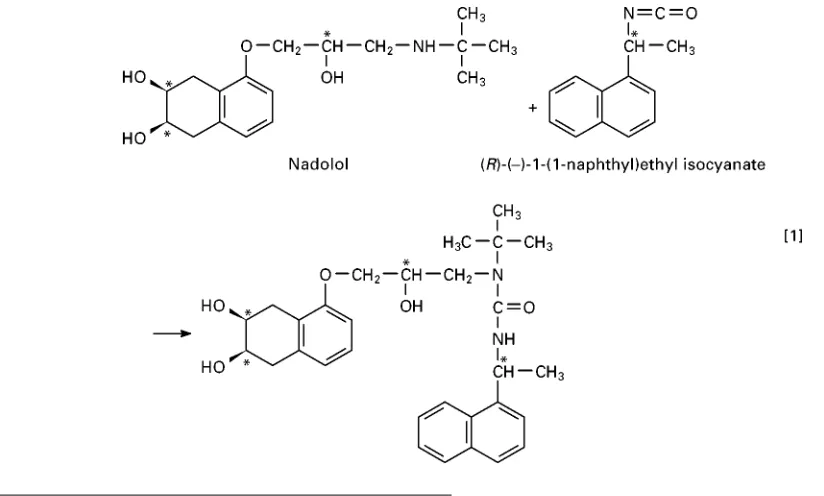
[image:6.568.52.464.340.588.2]Isocyanates These reagents form diastereomeric urea derivatives with chiral primary and secondary amines. (R)-(!)- and (S)-(#)-1-(1-naphthyl)ethyl isocyanate and (R)--methylbenzyl isocyanate are among the classical chiral derivatizing reagents. Isocyanate derivatives of the drugs mentioned in one of the previous sections as the carboxylic chlorides and (R)-N-3,5-dinitrobenzoyl)phenyl glycine have also been used for the derivatization of -blockers and other amines. Eqn [1] shows the reaction be-tween nadolol and (R)-(!)-1-(1-naphthyl)ethyl isocyanate, while the separation of the four dias-tereomers of the two racemates is depicted in Figure 1. It is remarkable that by selecting a suit-able reagent and proper chromatographic conditions not only can the four diastereomers be separated but the interference from dog plasma can also be elimi-nated.
-[(2-isothio-cyanato)cyclohexyl]-3,5-dinitrobenzoylamide, which excels with the high chemical stability, high UV activity and the excellent separability of the dia-stereomeric derivatives. The equation of the reaction of GITC and DDITC with the-blocker metoprolol and the separation of the derivatives are depicted in eqn [2] andFigure 3, respectively.
N-Haloarylamino acid derivatives Marfey’s reagent (1-Suoro-2,4-dinitrophenyl-5-L-alaninamide) is one of the most generally used reagents in the analytical control of racemization during peptide synthesis. The peptides are split either by hydrochloric acid or en-zymatically. The nucleophyllic attack of the-amino group of the amino acids on the C}F bond activated by the two nitro groups on the aromatic ring results in a smooth reaction to form diastereomeric aniline de-rivatives with good UV detectability (see eqn [4]). The
valinamide analogue of the Marfey reagent gives even better resolution.
o-Phthalaldehyde#chiral thiols This dual derivat-ization reaction leading toSuorimetrically highly ac-tive isoindole derivaac-tives is another generally used method in the chiral analysis of amino acids (see eqn
Enzymatic deamination Chiral HPLC of a mixture of amino acid enantiomers with and without selective oxidative deamination ofD-amino acids with the aid of the enzymes D-amino acid oxidase and catalase enablesD-amino acids to be identiRed in the mixture.
Derivatization of the carboxyl group
EsteriTcation with chiral alcohols (#)- or (! )-2-octanol, (#)-1-phenylethanol, (!)-menthol, (#)- or (!)-2-butanol are the classical reagents for the chiral analysis of carboxylic acids. The reactions usually require harsh conditions and for this reason the danger of racemization should be taken into consid-eration.
Amidation with chiral amines Prior to their reac-tions with chiral amines the carboxyl group should
be activated. Possibilities for this are, e.g. reaction with thionyl chloride to form carboxylic chlor-ides, with chloroformates to form mixed anhydrchlor-ides, with 1,1-carbonyldiimidazole to form reactive N -acylimidazoles and with the classical coupling agent dicyclohexylcarbodiimide to form the reactive N -acylurea derivatives. The classical but still widely used amine reagent is (S)-(!)--methylbenzylamine, but several others with excellent separation power,
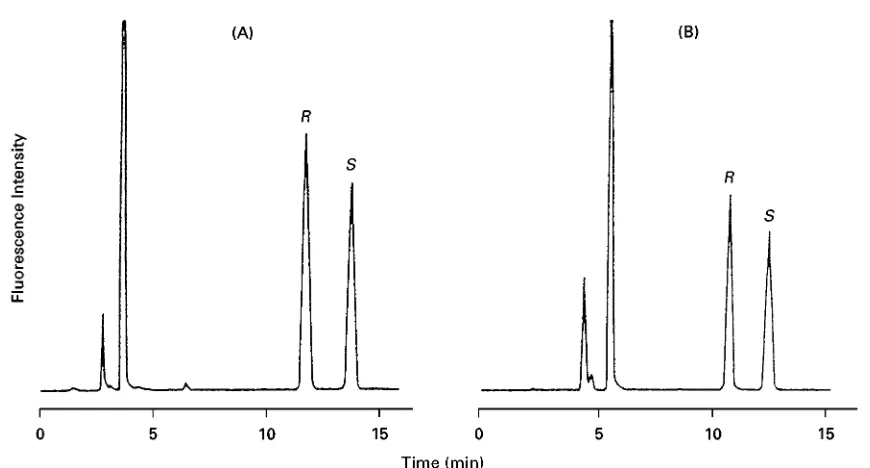
UV or Suorometric properties are also in use, e.g. (R)--methyl-4-nitrobenzylamine, (R)-(# )-1-(1-naphthyl)ethylamine, (!)-1-(1-anthryl)ethylamine, R-(!)- and (S)-(#)-amphetamine, (1R,2R)-(!)- or (1S,2S)-(# )-2-amino-(4-nitrophenyl)-1,3-pro-panediol,L-leucinamide, L-alanine--naphthylamide, L- or D-O-(4-nitrobenzyl)tyrosine methyl ester, (! )-2-[4-(1-aminoethyl)-phenyl]-6-methoxybenzoxazole and other related derivatives where the 1-aminoethyl group is replaced by L-leucyl or D-phenylglycyl groups, drug-related amines (Sunoxaprofen amine, benoxaprofen amine and naproxen amine), (R)- and (S)-1-(4-dansylaminophenyl)ethylamine, etc. The re-action of ibuprofen and pranoprofen with the last reagent and the separation of the diastereomeric car-boxamide derivatives are shown in eqn [4] and Figure 4, respectively.
Figure 4 Resolution of (A) (R,S)-ibuprofen and (B) (R,S)-pranoprofen as the carboxamides formed with (S)-1-(4-dan-sylaminophenyl)ethylamine. Column ODS-80TM(150;4.6 mm, 5m); mobile phase: 50 m
[image:9.568.68.503.432.666.2]Msodium acetate (pH 6.5)Iacetonitrile (A) 30 : 70, v/v and (B) 45 : 55, v/v, and flow rate 1 mL min\1; fluorescence detection, 338 nm excitation, 535 nm emission. Reproduced with permission from Iwaki K, Bunrin T, Kameda Y and Yamazaki M (1994)Journal of Chromatography A 662: 87, copyright Elsevier.
Figure 3 Resolution of (R,S)-metoprolol derivatized as (R,R)-DDITC- and GITC-thioureas. Column, Hypersil ODS (125; 4 mm, 5m); mobile phase, acetonitrile-20 mMammonium acet-ate 55:45, v/v; flow rate 1 mL min\1detection at 254 nm. Repro-duced with permission from Kleidernigg OP, Posch K and Lindner W (1996) Journal of Chromatography A 729: 33, copyright Elsevier.
separation with UV detection and (!)-(1S,2R,4R )-endo-1,4, 6,7,7-hexachlorobicyclo[2.2.1]-hept-5-ene-2-carboxylic acid and (S)-(# )-2-tert-butyl-2-methyl-1,3-benzodioxolo-4-carboxylic acid for HPLC separation with Suorimetric detection, etc. Dicyclohexylcarbodiimide can be used as the coup-ling agent, but the use ofin situtransformation of the acids to their chlorides by the addition of thionyl chloride is more widespread. The direct enzymatic D-(#)-glucuronidation reaction of phenols has also been described.
Acyl chlorides, anhydrides and acyl cyanides can be used directly. For example (!)-camphanic acid, R(#)--methoxy-(triSuoromethyl)phenylacetyl chloride, -naphthylsulfonyl-L-prolyl chloride,
Sunoxaprofen chloride, (R,R)-O,O-diacetyl- (or di-p-toluoyl-) tartaric anhydride and (!)-2-methyl (or methoxy)-1,1-binaphthalene-2-carbonyl cyanide lead to well-separable, UV or Suorimetrically active diastereomeric ester derivatives with chiral alcohols.
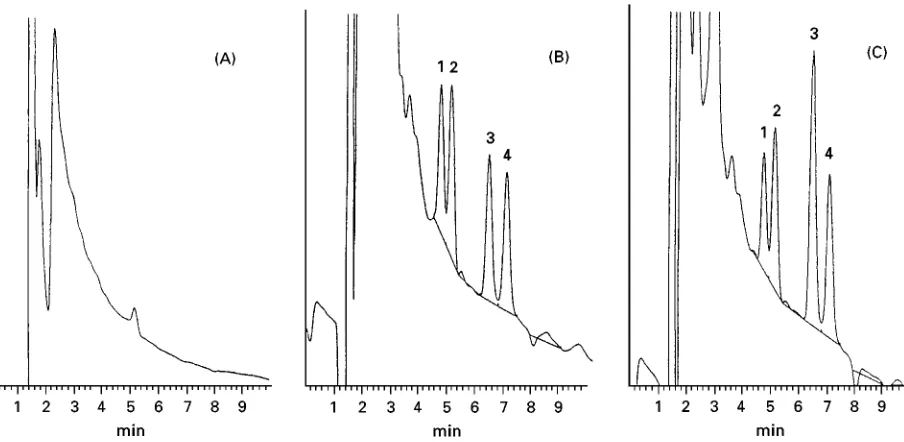
Figure 5 Resolution of (!)- and (#)-delmopinol (peaks 1 and 2) and (!)- and (#)-internal standard (peaks 3 and 4) and their determination in human plasma extracts. Derivatization with (R,R)-O,O-di-p-toluoyl tartaric acid anhydride to form the esters. (A) Blank plasma; (B) plasma spiked with 6 ng of each enantiomer; (C) authentic plasma sample. Column, Hypersil ODS (125;4 mm, 5m); mobile phase, 100 mM ammonium acetate}acetonitrile 35 : 65, v/v, pH 5.7; flow rate, 0.8 mL min\1; electrochemical detection. Reproduced with permission from Egginger G, Blaschke E, Lindner W and Olsson A-M (1994)Journal of Chromatography A 666: 275, copyright Elsevier.
Further derivatization reactions include the use of (R)-1-(1-naphthyl)ethyl isocyanate for the derivatization of, e.g. diacylglycerol derivatives to form the corresponding carbamates. The lower reac-tivity of the hydroxyl group compared with the
Derivatization of the aldehyde group The import-ance of this kind of chiral derivatization react-ions is much smaller than those described for amines, carboxylic acids and alcohols. For example, aldoses can be transformed with L-cysteine methyl ester to diastereomeric thiazolidine derivatives which can be separated by GC after trimethyl-silylation. The two aldehyde groups of gossypol were transformed with (R)-(!)-2-amino-1-propanol to the diastereomeric Schiff’s bases separable by HPLC.
Derivatization of epoxides The oxirane ring of chiral epoxides is opened by sodium sulRde to form a vicinal hydroxythiol derivative. In the second step of the derivatization reaction the thiol group reacts with o-phthalaldehyde and a chiral amino acid to form the diastereomeric isoindole derivative men-tioned in the section dealing with the derivatization of the amino group. Another ring-opening reagent is 2-propylamine. The secondary amino group of the 1,2-amino alcohol is then reacted with 2,3,4,6-tetra-O-acetyl (or benzoyl)--D-glucopyranosyl iso-thiocyanate to form the diastereomeric thiourea de-rivatives.
Derivatization of the thiol group The formation of diastereomeric isoindole derivatives from chiral amino acids, chiral thiols ando-phthalaldehyde (al-ready mentioned in the section dealing with the de-rivatization of the amino group; see eqn [4]) can also be used for the enantioseparation of thiols. Reagents of other types are (R,R )-dinitrobenzoyldiamino-cyclohexyl isothiocyanate and N -[(2-isothiocyanato)-cyclohexyl]-pivalinoyl amide which transform the thiol compound to their diastereomeric dithiocarba-mate derivatives.
Derivatization of Enantiomers
With Achiral Reagents to Improve
Their Chromatographic Properties
and Their Separation on Chiral
Columns
Introductory Remarks
Chiral columns enable the direct separation of enan-tiomers. In many cases the chromatographic proper-ties of the enantiomers can be improved by trans-forming them to suitable derivatives using achiral reagents.
Pirkle-Type Chiral Columns
The purposes of using pre-column derivatization are:
E Blocking of the polar groups of the analyte (amino, carboxyl, hydroxyl groups) to avoid strong interac-tions with the polar groups of the chiral selector thus improving the separation.
E The introduction of aromatic rings into the analyte to enable } interactions to take place between the aromatic moieties of the chiral selector and the analyte which play a dominant role in the resolu-tion of the enantiomers.
E Improve UV detectability.
To fulRl these requirements amino groups in the analyte are usually transformed to aromatic acyl de-rivatives by 4-nitro- or 3,5-dinitrobenzoyl chloride or to aromatic urea or thiourea derivatives by means of phenyl-, 4-Suorophenyl-, 4-methoxyphenyl-, 3,5-dinitrophenyl- or 1-naphthyl-isocyanates and iso-thiocyanates. Carboxyl derivatives are derivatized after activation with thionyl chloride or carbodiim-ides to form anilcarbodiim-ides, 3,5-dimethylanilcarbodiim-ides, 3,5-dinit-roanilides, naphthylmethylamides, etc. The derivatiz-ing agents for the hydroxyl group are benzoyl chlor-ide, 3,5-dinitrobenzoyl chlorchlor-ide, 1-naphthyl chloride to form ester derivatives and 1-naphthyl- or 3,5-dinit-rophenyl isocyanates to form the corresponding car-bamates.
Cyclodextrin-Bonded Phases
In the case of enantiomeric HPLC separations on cyclodextrin-bonded stationary phases the necessity of pre-column achiral derivatization is not as general as with the Pirkle-type phases. The introduction of the aromatic ring into analytes often improves their separation. Amino acids are usually derivatized with dansyl chloride, 3,4-dinitrobenzoyl chloride, o-phthalaldehyde/2-mercaptoethanol, etc., or with highlySuorescent reagents such as 9-Suorenylmethyl chloroformate, 9-Suorenylmethoxycarbonylglycine chloride, 6-aminoquinolyl-N-hydroxysuccinimidyl carbamate. etc.
1-Acid Glycoprotein Column
In most instances no derivatization is necessary to obtain good enantioseparation. In the case of car-boxylic acids, separation is improved by the addition of ion pairing agents to the eluent. For some basic drugs anionic reagents in the eluent also improves the column efRciency, peak symmetry and resolution.
with 2-propanol have been found in some instances to improve the separation.
Functionalized Cellulose Phases
In the overwhelming majority of cases enantiomers can be separated on these columns without derivatiz-ation. In a few instances esteriRcation of the carboxyl group and the introduction of a benzoyl group into the molecule have been found advantageous.
Conclusions and Future Trends
It is indisputable that the direct chromatographic enantioseparations based on chiral stationary phases has greatly surpassed the importance of indirect sep-arations based on covalent chiral derivatization. The fact that the overwhelming majority of papers report-ing on the development and application of chiral separations are from theseRelds does not necessarily reSect the real of the contribution of covalent chiral derivatization in the solution of practical problems in pharmaceutical and biomedical analysis. In some areas (e.g. the determination of small concentrations ofD-amino acids in various biological samples, etc.) the well-established classical methods are still in use. It is also remarkable that the combination of chiral derivatization with the use of chiral stationary phases has proved to be suitable for the solution of very delicate problems (separation of several enantio-mers and diastereoenantio-mers of drugs with more than one chiral centre). It should also be noted that the combi-nation of chiral chromatography with Suorescence derivatization enables the limit of detection of enan-tiomeric impurities to be decreased to the 10 ppm. level. These tendencies are expected to continue in the near future.
See also: II/Chromatography: Liquid: Derivatization. III/Chiral Separations: Amino Acids and Derivatives;
Capillary Electrophoresis; Cellulose and Cellulose Derived Phases; Chiral Derivatization; Countercurrent Chromato-graphy; Cyclodextrins and Other Inclusion Complexation Approaches; Gas Chromatography; Ion-Pair Chromato-graphy; Ligand Exchange Chromatography; Liquid Chromatography; Molecular Imprints as Stationary Phases; Protein Stationary Phases; Supercritical Fluid Chromatography; Synthetic Multiple Interaction (‘Pirkle’) Stationary Phases; Thin-Layer (Planar) Chromatography.
Further Reading
Ahnoff M and Einarsson S (1989) Chiral derivatization. In: Lough WJ (ed.), Chiral Liquid Chromatography, pp. 39}80. Glasgow: Blackie.
Allenmark SG (1989)Chromatographic Enantioseparation: Methods and Application. Chichester: Ellis Horwood. Arvidsson E, Jansson SO and Schill G (1991) Enantiomeric
derivatization. In: Ahuja S (ed.)Chiral Separations by Liquid Chromatography, pp. 126}140. Washington: Americal Chemical Society.
Gal J (1993)Indirect methods for the chromatographic separation of drug enantiomers. In: Wainer IW (ed.), Drug Stereochemistry.Analytical Methods and Pharma-cology, pp. 65}106. New York: Marcel Dekker. GoKroKg S (1990) Enantiomeric derivatization. In: Lingeman
H and Underberg WJM (eds), Detection-Oriented Derivatization Techniques in Liquid Chromatography, pp. 193}216. New York: Marcel Dekker.
GoKroKg S and Gazdag M (1994) Enantiomeric derivatization for biomedical chromatography.Journal of Chromato-graphy B659, 51}84.
Skidmore MW (1993) Derivatization for chromatographic resolution of optically active compounds. In: Blau K and Halket J (eds), Handbook of Derivatives for Chromatography, pp. 215}252. Chichester: Wiley. Souter RW (1985) Chromatographic Separation of
Stereoisomers. Boca Raton: CRC Press.
Stevenson D and Wilson ID (eds) (1989) Chiral Separ-ations. New York: Plenum Press.
Zief M and Crane LJ (eds) (1987)Chromatographic Chiral Separations. New York: Marcel Dekker.
Countercurrent Chromatography
Y. Ma and Y. Ito,
National Institutes of Health, Bethesda, MD, USA
Copyright^ 2000 Academic Press
Introduction
Countercurrent chromatography (CCC) is a generic term for support-free liquid/liquid partition