The term ”soil quality” has quite different mean-ings to different soil scientists (Blum 1998;
Wan-der et al. 2002; Schjonning et al. 2004). The term
soil quality encompasses both the productive and environmental capabilities of the soil (Warkentin 1992; Wander et al. 2002) as well the capacity to resist and recover from degradation (Blum 1998). Schjonning et al. (2004) state that the soil quality as a term should be used when related to sustainability concerns such as the soil
produc-tivity, impact on the environment, and effect on human health.
It seems that the concepts of all soil functions (productive and environmental) are not sufficiently evaluated in the socio-economic situation, rural development, influence of soil on climate, and soil protection. The contributions or possible nega-tive consequences that arise from an insufficient evaluation of environmental soil functions are still only generally estimated.
The paper was presented at The International Conference of the European Society for Soil Conservation (ESSC), Průhonice, the Czech Republic, June 22–25, 2009. Supported by the Ministry of Agriculture of the Czech Republic, Project No. QH 82089.
Assessment of the Soil Quality as a Complex of Productive
and Environmental Soil Function Potentials
Pavel NOVÁK, Jan VOPRAVIL and Jitka LAGOVÁ
Research Institute for Soil and Water Conservation, Prague, Czech Republic
Abstract: Soil quality is a measure of the ability of soil to carry out particular ecological and plant productive func-tions. It reflects the combination of chemical, physical, and biological properties. Some of the soil properties are relatively more important than the others and unchangeable. Others can be significantly changed by human activity. Nowadays, three groups of soil functions are usually defined: soil utility function (productive function, infrastructure area, source of materials); functions of soil in the environment (non-productive functions such as: water infiltration and water retention, transport of matter, buffering and sanitary functions); soil cultural function (history of nature and humans). The cultural function is, from our point of view, different from the others. The complex assessment of the soil quality is the topic of this paper and includes both the productive and environmental functions. The produc-tive function (producproduc-tive potential) of Czech soils has been long studied and is ± known. It is expressed by means of a one-hundred-point scale in the Czech Land Evaluation System. Its point values depend on different soil and local characteristics together with the natural conditions and their influence on the plant production. A similar principle was used for the assessment of the non-productive soil functions. The importance of the individual soil characteristics is defined. The values of the environmental soil function potentials are determined from the common soil charac-teristics and are compared with the values of the soil productive potential. Total soil quality can be then expressed as the average or as the sum of the points for all individual functions. Some selected function can be preferred by increasing its value coefficient for a specific land use area (for example, an area for obtaining underground water). Three texturally different forms of Chernozem (middle textured, clayic, arenic) which correspond to the Main Soil Units of the Czech Land Evaluation System are given as an example of the assessment. The evaluation of the total soil quality would then involve not only the agricultural and locality determined financial values but also an assessment of all environmental functions of the soil.
The soil and the land have been historically thought of as a medium for ensuring a number of human needs. Soil, of course, also has a large set of environmental functions which maintain the stability of global ecosystems. The stability of the environment is maintained through natu-ral cycles of energy, water, and matter. Soil is a filtration medium for groundwater and its qual-ity, and is a huge retention space for water. Great amounts of carbon, nitrogen, phosphorus, and sulphur are contained in soil organic matter. Soil is a transformation milieu in which the decon-tamination, decomposition, and re-synthesis of different substances take place. Soil is therefore the basic medium for life on land. It is essential for each human society (Blum et al. 2006).
The proposed concept of the soil value and its implementation consists of a set of different soil functions (soil multifunctionality). The concept of the soil quality is probably best expressed as "the ability to ensure its ecological function in line with a particular use" or "fulfilling its most important function without threatening any other function" (Warkentin 1992; Doran & Parkin 1994; Olson et al. 1996).
The assessment of the productive and non-pro-ductive (ecological, environmental) soil functions is always complicated due to many influences and factors affecting it, but soil multifunctionality has to be evaluated in some way. Whereas soil fertil-ity and its function in an area have always been appreciated, its ecological functions are not yet always properly appreciated.
The following functions are generally indicated as the soil ecological functions (Doran & Parkin 1996; Blum 2002):
– Retention function, that is the accumulation of organic matter and nutrients but in particular the retention of water. Water retention in the soil profile can be at present apparently best evaluated and quantified.
– Infiltration function which means entering and percolating of water through the soil profile. It ensures the purity of groundwater and water sources.
– Buffering soil function suppresses the oscillation of dynamics of soil characteristics, especially the changes of the soil reaction and soil tem-perature.
– Transformation and sanitation functions provide the transformation of matters in their cycles: their breakdown, mineralisation, and
re-syn-thesis of new matters. Disturbances of these functions can have consequences with regard to pollution, contamination, nutrient regime, or human hygienic conditions.
– Transport function is connected mostly with the movement of water because soil water serves as the most frequent transport medium. The transport and movement of water can be realised not only in vertical direction (down or up), but also in lateral direction.
– Biodiversity function, the milieu for organisms and genetic reserve. Human interference with soil can, as a rule, aggravate this function. All these soil ecological functions are intercon-nected and any disturbance of one of them restricts the others, inclusive the soil productive function (Doran & Parkin 1996; Blum 1998).
Each soil function must be evaluated separately because some functions can be in conflict with each other (for example the infiltration – percolation and water retention functions). The soil quality can depend on the function determined by the human use. It may be the agricultural or forestry use or the function of land for recreation, infra-structure, obtaining water, landscape protection etc. (Blum et al. 2006).
The assessment of the productive function of Czech agricultural soils has a long history from the stable land registry (that was established in the 18th cen- tury) to the modern concept of Evaluated Soil-Ecological Units (Mašát et al. 1983, 2002; Novák
et al. 1995), where the soil productive potential is
expressed on a one-hundred-point scale. For the ecological soil function assessment, so far only one experimental work has been carried out in the Czech or Slovak Republic (Bujnovský & Juráni 1999; Novák et al. 2007). The evaluation of all soil functions has to be performed on the basis of similar basic data on soil parametres and characteristics such as the evaluation of the productive potential. A similar access has been used in works of Bouma (1989), Arshad and Coen (1992), Doran-Parkin (1994, 1996), Karlen and Stott (1994), Karlen et al. (1997), Manrique and Jones (2001). In the case of the productive potential, the assessment must of course compare also the climatic, economic, and other local data (terrain relief, skeleton content, soil water regime etc.).
The available soil characteristics primary data could also be a problem:
– they can be transformed for a given purpose if need be,
– they are not too variable in time and space, – they contain possible heterogenity within one
soil classification unit (Bujnovský & Juráni 1999).
The assessment of each soil function (soil function potential) can be performed either for units of the Soil Taxonomic Classification System (Němeček
et al. 2001) or (in the Czech Republic) for Units of
the Land Evaluation System (Mašát et al. 2002), which is specific to the Czech Republic. Both have some advantages and disadvantages, but the clas-sification system has a wider use. In some cases the units of both systems can merge.
MATERIAL AND METHODS
The environmental soil functions are defined in the works of Blum (1988, 1990), Bouma (1989), Bedrna and Dlapa (1995), Doran and Parkin (1996). Specific adaptation and modification of their conclusions were carried out for this pres-entation: firstly, the function of biodiversity could not be evaluated due to the insufficient basic data
about soil edafon. Secondly, the transformation, pufration, and decontamination soil functions have been merged together into one ecological-stabilisation function. The following ecological functions (or their potentials to be precise) have been thus assessed in this paper:
– Water retention capacity potential;
– Infiltration, percolation, and transport ability potential;
– Potential of ecological-stabilisation function (transformation, pufration, decontamination). The values of these potentials of the non-pro-ductive soil functions were determined with the use of the data about soil chemical and physical characteristics and parameters. The collection of the data usually comes from the data bases. The data were either used directly or were adapted for these purposes (Novák & Vopravil 2007; Vopravil et al. 1995–2008).
[image:3.595.66.533.475.745.2]In the evaluation of the soil characteristic col-lection, it is essential to respect their variability in space and time. A similar access was used by Karlen and Stott (1994) and Karlen et al. (1997). The parameters used were divided (ac-cording to Novák et al. 2007 and Bujnovsky & Vilček 2008) into:
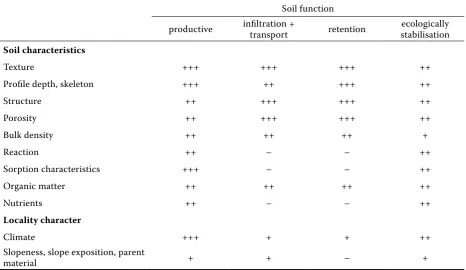
Table 1. Significance of soil characteristics for the assessment of the potential of productive and environmental soil functions
Soil function
productive infiltration + transport retention stabilisationecologically
Soil characteristics
Texture +++ +++ +++ ++
Profile depth, skeleton +++ ++ +++ ++
Structure ++ +++ +++ ++
Porosity ++ +++ +++ ++
Bulk density ++ ++ ++ +
Reaction ++ – – ++
Sorption characteristics +++ – – ++
Organic matter ++ ++ ++ ++
Nutrients ++ – – ++
Locality character
Climate +++ + + ++
Slopeness, slope exposition, parent
material + + – +
– Stable soil characteristics (soil texture compo-sition, depth of soil profiles, parent material, skeleton content);
– Relatively stable characteristics (humus content and its quality, sorption characteristics, physi-cal soil parameter – retention water capacity, porosity, bulk density, infiltration rate, erodi-bility coefficient).
These characteristics predominantely affect the behaviour and subsequent evaluation of soil. Rela-tively dynamic characteristics of the soil reaction, nutrient content, and dynamic ones (momental water content) are connected with short-term changes in soil. The influence of climate and local-ity can be taken into account only if a defined area is evaluated. The potential of each soil function then depends on the significance, combination, and mutual relations between all characteristics and parameters.
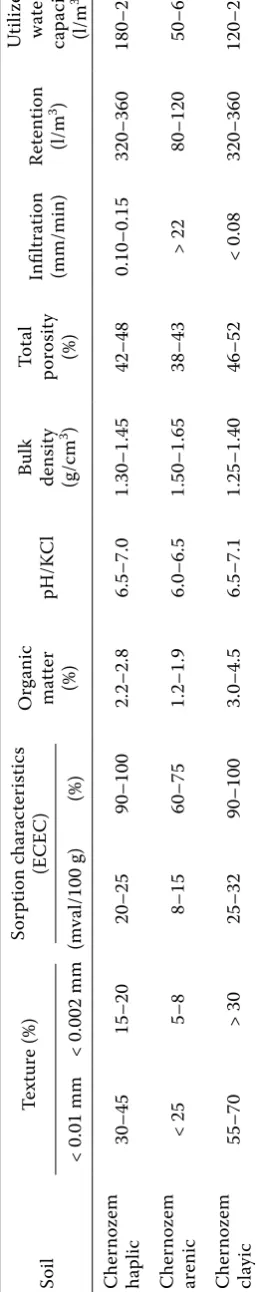
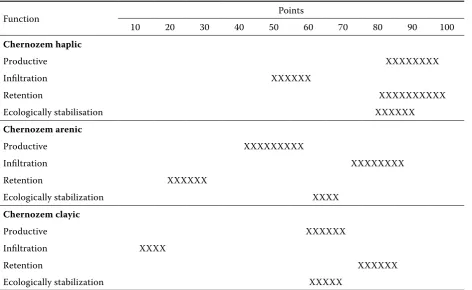
The significance of the individual soil charac-teristics is illustrated in Table 1. The values of the individual soil function potentials are evaluated on a one-hundred-point scale from the basic or adapted data. Similarly, the productive potential is expressed in this way. The assessment of the three different subtypes of Chernozem (haplic, arenic, clayic) formed on different parent materi-als (and corresponding to the three different Main Soil Units of the Czech Land Evaluation System) was carried out as an example for this presenta-tion. The basic introductory soil characteristics data are given in Table 2. A graphic illustration of the range of individual soil function potentials is shown in Table 3.
RESULTS AND DISCUSSION
From Table 1 is it clear which soil character-istics are important for the different individual soil functions: hydric function (water retention, infiltration, and transport of matter by water) mostly depends on physical soil chracteristics. The ecological stabilisation function depends on chemical ones. In the soil productive potential all the soil characteristics combine, qualify one another and bring together all the influences of all soil characteristics and parameters. Texture composition dominates over the other soil char-acteristics and affects, directly or indirectly, the
rest of them. This is, of course, well known. Tabl
[image:4.595.340.470.105.753.2]The assessment of the above mentioned environ-mental functions is performed on the example of three texturally diferentiated subtypes of Chernozem (haplic, arenic, clayic – WRB 2006) formed on dif-ferent parent materials (loess, calcareceous sand, marl). This assessment is compared with the well known older point-based assessments of their pro-ductive potential (propro-ductive function). The range of the values of the environmental soil function potentials was derived from the soil characteristics or from the range of their values (Table 2). They are compared with the available and known values of the productive potential (Table 3).
In Table 3 the plotted lines of the point-values are given on the linear scale. Their general range fluctuates from the lowest ascertained value for the initial poor soil (5 points) up to the maximum value of 100 points.
Universal soil quality potential can be then expressed as the average of all individual point values or as the sum of the point values for each potential of the soil function. Each function has equal status. However, if any soil function has to be preferred in a particular land area, then the point value of this function will be simply multiplied by a coefficient.
[image:5.595.66.539.101.391.2]As mentioned, there are relations between the potentials of the individual soil functions and pos-sibilities of their assessment. The evaluation of the financial value of the soil functions is more difficult. Whereas the soil productive function can be quite simply financially implied, in the case of the environ-mental functions it is not easy to assess their values on the market economy. A possible assessment of the soil function value can be illustrated on an example of the soil ability to accumulate water, thus on its soil water retention capacity (Novák et al. 2007). Soil can be thought of as an accumulation water reservoir. According to some authors (Bujnovský & Vilček 2008), the costs for the construction of simple man-made water reservoirs are about 2.5 EUR for the accumulation of 1m3 of water. If the good, deep loamy Chernozem has the retention water capacity about 350 l/m3 of the soil volume, then the area of 1 ha Chernozem soil has an potential ability to collect approximately 3500 m3 of water. From this point of view, 1 ha of Chernozem soil corresponds to the value of up to 8000 EUR/ha. This is only a debatable “qualified appraisal”, but it comes from real basis and illustrates well the next future procedure for the evaluation of the environmental soil functions and their quantification.
Table 3. Point values range of the productive and environmental functions potentials
Function Points
10 20 30 40 50 60 70 80 90 100
Chernozem haplic
Productive XXXXXXXX
Infiltration XXXXXX
Retention XXXXXXXXXX
Ecologically stabilisation XXXXXX
Chernozem arenic
Productive XXXXXXXXX
Infiltration XXXXXXXX
Retention XXXXXX
Ecologically stabilization XXXX
Chernozem clayic
Productive XXXXXX
Infiltration XXXX
Retention XXXXXX
Without a comprehensive data base system con-taining a rich data collection for each individual soil characteristic and for each specific soil unit, it is quite impossible to determine any relation between soil characteristics and any particular soil function potential.
CONCLUSIONS
Soil as a non-renewable natural resource has a fundamental importance for the land ecosystems and for human society. The quality of soil has therefore to be looked at from different points of view covering all soil functions. The value of the soil quality potential would then be classified not only from the economic view of its present or future use, but also as based on the value of soil in the natural cycles on which we all depend.
References
Arshad M.A., Coen G.M. (1992): Characterization of soil quality. Physical and chemical criteria. American Journal of Alternative Agriculture, 7: 25–31.
Bedrna Z., Dlapa P. (1995): Environmental properties of soil. Acta Environmentalica Universitastis Come-nianae (Bratislava), 4–5: 95–103.
Blum W.H. (1988): Problems of soil conservation. Nature and Environment Series, No. 39, Strassburg.
Blum W.H. (1990): Soil protection in Europe. Environ-ment Conservation, 17: 72–75.
Blum W.H. (1998): Basic Concepts: Methods for Assess-ment of Soil Degradation. Advances in Soil Science. CRC Press, Boka Raton, 1–17.
Blum W.E.H. (2002): The role of soils in sustaining society and the environment: realities and challenges for the 21st century. In: 17th World Congress of Soil Science. August 2002, Bangkok, Keynote Lectures, IUSS, 66–86
Blum W.E.H., Warkentin B.P., Frossard E. (2006): Soil, human society and the environment. In: Frossard E., Blum W.E.H., Warkentin B.P. (eds): Function of Soils for Human Societies and the Environment. Geological Society, London, Special Publications No. 266, 1–8. Bouma J. (1989): Using soil survey data for
quanti-tative land evaluation. Advances in Soil Science, 9: 177–183.
Bujnovský R., Juráni B. (1999): On the problem of soil quality evaluation. Vědecká práce VÚPOP Bratislava, 25–32.
Bujnovský R., Vilček J. (2008): Legal, Economic and Et-nical Aspects of Agricultural Soil Protection. In: Proc. 5th Soil-Science Days in Slovakia, Sielnica, 69–76. Doran J.W., Parkin T.B. (1994): Defining and assessing
soil quality. In: Doran J.W., Coleman D.C., Bezdicek D.F., Stewart B.A. (eds): Defining Soil Quality for a Sustainable Environment. SSSA Special Publication No. 35, 3–21.
Doran J.W., Parkin T.B. (1996): Quantitative indicators of soil quality: A minimum data set. In: Doran J.W., Jones A.J. (eds): Methods for Assessing Soil Quality. SSSA Special Publication No. 49, 25–37.
Karlen D.L., Stott D.E. (1994): A framework for evaluating physical and chemical indicators of soil quality. In: Doran J.W., Coleman D.C., Bezdicek D.F., Stewart B.A. (eds): Defining Soil Quality for a Sustainable Environment. SSSA Special Publication No. 35, 53–72.
Karlen D.L., Mausbach M.J., Doran J.W., Cline R.G. (1997): Soil Quality: A concept, definition and frame-work for evaluation. Soil Science Society of America Journal, 61: 4–10.
Manrique L.A., Jones C.A. (2001): Bulk density of soils in relation to soil physical and chemical prop-erties. Soil Science Society of America Journal, 65: 476–481.
Mašát K., Džatko M., Němeček J. (1983): Productive potential of Soils of the Czech Republic. Rostlinná výroba, 29: 1011–1021.
Mašát K. et al. (2002): Methodics of Delimitation and Mapping of Evaluated Soil-ecological Units. Ministry of Agricultutre – RISWC, Prague. (in Czech) Němeček J. et al. (2001): Taxonomic Classification
Sys-tem of Soils of the Czech Republic. Czech Agricultural University, Prague. (in Czech)
Novák P. et al. (1995): Methodics of point of soil qual-ity determination. [Report of Project No. 093095002.] RISWC, Prague. (in Czech)
Novák P., Vopravil J. et al. (2007): Analyse and map-ping of soil infiltration ability and water retention ca-pacity in the Czech Republic. [Final Report of Project No. VaV 1D/1/5/05, .] RISWC, Prague. (in Czech) Olson B.M., Janzen H.H., Larney F.J., Selinger L.J.
(1996): A proposed method for measuring the effect of soil quality on soil productivity. Agronomy Journal,
88: 497–500.
Schjonning P., Elmholt S., Christensen B.T. (2004): Managing Soil Quality: Challenges in Modern Agricul-ture. CABI Publishing, Wallingford, 315–333. Vopravil J., Novák P. et al. (1995–2008): Soil
Wander M.M., Walter G.L., Nissen T.M., Bollero G.A., Andrews S.S. (2002): Soil Quality: Science and Progress. Agronomy Journal, 94: 23–32.
Warkentin B.P. (1992): Soil science for environmental quality – how do we know what we know. Journal of Environmental Quality, 21: 163–166.
WRB (2006): World Reference Base for Soil Resources. ISRIC – FAO, Rome.
Received for publication September 22, 2009 Accepted after corrections February 11, 2010
Corresponding author:
Ing. Pavel Novák, CSc., Research Institute for Soil and Water Conservation, Žabovřeská 250, 156 27 Praha 5-Zbraslav, Česká republika
Mánesova 75, 120 56 Prague 2, Czech Republic
Tel.: + 420 222 000 111, Fax: + 420 227 010 116, E-mail: [email protected]
Account No. 86335-011/0100 KB
IBAN – CZ2201000000000086335011; SWIFT address – KOMBCZPPXXX
In this institute scientific journals dealing with the problems of agriculture and related sciences are published on behalf of the Czech Academy of Agricultural Sciences. The periodicals are published in English.
Number Yearly subscription
Journal of issues per year in USD
Plant, Soil and Environment 12 540
Czech Journal of Animal Science 12 660
Agricultural Economics (Zemědělská ekonomika) 12 540
Journal of Forest Science 12 480
Veterinární medicína (Veterinary Medicine – Czech) 12 720
Czech Journal of Food Sciences 6 420
Plant Protection Science 4 140
Czech Journal of Genetics and Plant Breeding 4 160
Horticultural Science 4 160
Research in Agricultural Engineering 4 140
Soil and Water Research 4 140