MANAGEMENT INFORMATION SYSTEMS – ACTIVITIES AND ELEMENTS
IN DECISION PROCESS
Oana Andreea CĂLIN∗
Abstract. The information technologies could help and also to improve the decision process in different organizational environments. In this context, the paper intends to present a new approach for a management information system integrated in decision field. The proposed approach will illustrate the connection between decision process and specific activities and elements.
Keywords: decision process, management information system, production.
1. Introduction
The management information systems represent an important point of interest in decision processes. First of all a management information system is an information system which processes data and provides information required for different activities fields. In time the management information system concept has known many definitions and changes. The new technologies in decision field requested new challenges and approaches in management information systems development. The use of new technologies could change in the future the interaction between a management information systems and decision field and could offer new development opportunities. In this context, it is interesting to study a management information system using different definitions and to understand its role in decision problem.
The aim of this paper is to illustrate how a management information system could improve the decision process in organizational environments.
It is well known that a management information system is a complex entity developed in a competitiveness environment and recently researches identify news benefits in decision field. Different authors define and describe the management information system concept in various ways. For example the management information system is defined as a computational system of equipments, procedures and human resources for providing the
∗
information to achieve decision making process within organization (Iliescu, et al., 2006). Also a management information system is a real time system and supports the organization management levels and helps planning, control and decisions functions (Militaru, 2004).
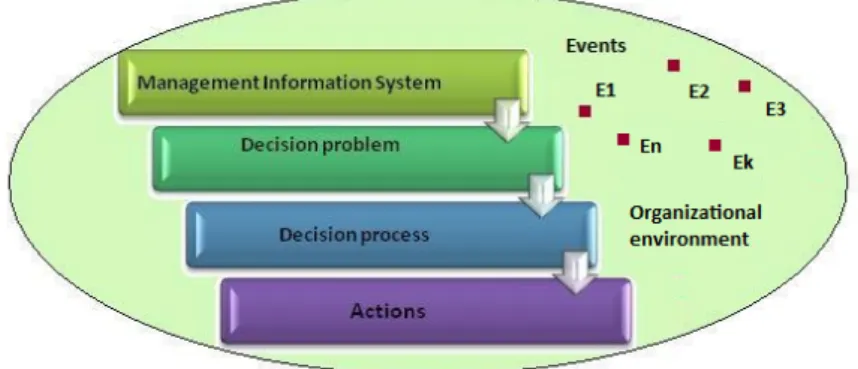
The figure 1 presents the interaction between a management information system and decision field within organizational environment.
Figure 1. Decision context.
Taking into account the management information system integration within organizational environment figure 1 also illustrate the main steps to solve a decision problem. A decision determines the necessary actions to be performed in order to solve a specific problem (Armaş, 2015) for organization needs. It is important to underline the information regarding the organizational environment and actions relatively to different types of decisions.
The management information system provided data has as its main goal to solve decision problems as actions to evens occurred in organizational environments. It could be noticed a continuous information flow between the management information system and process decision in solving the decision problem and determine specific actions.
From this point of view the management information system could be defined as a real time system which generates information for decision processes integrated in different environments. Also it could be noticed that the management information system supports the decision process in organizational environments.
2. Specific activities and elements
A management information system is a complex structure designed to manage all type of data and to improve the information flows in
organizational environments. The paper intends to present an abstract three-dimensional approach for developing a management information system in terms of elements, activities and specific decisions.
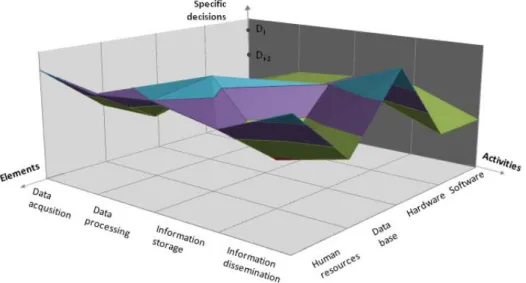
Figure 2 will illustrate an integrated and abstract representation that gathered the main activities and elements for a management information system associated with decisions making process. This approach includes structural elements such as hardware, software or the database and also the informatics activities (i.e. data acquisition or information storage).
Figure 2. The proposed approach.
Figure 2 presents a three-dimensional approach for a management information system integrated in decision process. The proposed approach presented in figure 2 shares the system development in three distinct but cooperating parts. The structural elements and activities could provide important data for decision process and generate specific decisions. From this point of view management information system must be associated with decision process.
Specific decisions belong to different occupational fields such as medicine, industry or economy. Also the system could support the organization to make efficient decisions by providing coherent information and performing specific activities. For example in a production environment a decision is concerned with the manufacturing resource sharing or with eventual bottlenecks that could appear. As well as the main attention it is given to establish a coherent and functioning structure for decision process using different criteria. Also the management information
system must support the decision making to achieve the manufacturing goals and the proposed production objectives.
3. Discussion
According to the above approach the following discussion aims to illustrate the benefits of management information system integration in a production environment. It will be underlined how management information system data could improve decision process for manufacturing resources, workstations or production costs. An important challenge raised by the role of management information system is how to use efficiently the processed data according to the proposed decision problem. Another challenge is related to the existence of different types of information regarding the all production activities. For example the management information system could provide different types of data for decision process such as stocks reports, production reports, products quality or average waiting times.
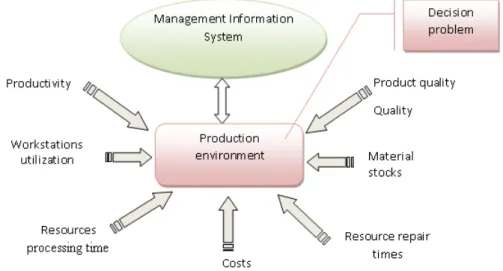
Figure 3 presents an example of integrated structure based on the interaction between a management information system and a computer integrated production environment. The production environment could associate a collection of information parameters (i.e. productivity, costs or material stocks) to solve a decision problem.
Figure 3. The integrated structure.
The management information system has an important influence on the production environment. A data analysis process could estimate,
evaluate and compare the consequences for every made decision.
Decisions based on management information system could help the industrial environment to achieve significant benefits. The management information system must also have the capacity to manage, store and share information related to decision process embedded in production environment. The data generated by the management information system may be used for better manufacturing resources utilization, improving the production efficiency or reducing the industrial storage space. From the management level point of view, the management information system data base could offer support for new developing trends in production environment. Also the decision analyses could help the production environment to identify optimization strategies for planning and management control.
4. Conclusion
This paper intended to illustrate the integration of management information system in decision processes.From this point of view the paper presented an abstract representation for a management information system based on activities, elements and specific decisions. Also the management information system integration in different types of environments it is an important aid in decision processes and could help the organizations to achieve important benefits.
REFERENCES
[1] Armaş, I., Econobotics – a new framework for the enterprises development, Bucharest, Hyperion International Journal of Econophysics & New Economy, Volume 8, Issue 2, 2015, Bucharest, pp. 293-303, ISSN 2069-3508.
[2] Iliescu, S., Făgărăşean, I., Pupăză, D., System analysis in industrial informatics (in Romanian), Editor AGIR, Bucharest, 2006.
[3] Militaru, G., Management information systems (in Romanian), Editor All, Bucharest, 2004.