Alternariol
David Siegel,a* Sergey Troyanov,bJohannes Noack,b Franziska Emmerlingaand Irene Nehlsa
a
Bundesanstalt fur Materialforschung und -pru¨fung, Abteilung Analytische Chemie; Referenzmaterialien, Richard-Willsta¨tter-Strasse 11, D-12489 Berlin-Adlershof, Germany, andb
Humboldt-Universita¨t zu Berlin, Department of Chemistry, Brook-Taylor-Strasse 2, 12489 Berlin, Germany
Correspondence e-mail: [email protected]
Received 10 May 2010; accepted 12 May 2010
Key indicators: single-crystal X-ray study;T= 150 K; mean(C–C) = 0.004 A˚; Rfactor = 0.035;wRfactor = 0.069; data-to-parameter ratio = 7.0.
In the title compound (systematic name: 3,7,9-trihydroxy-1-methyl-6H-benzo[c]chromen-6-one), C14H10O5, the methyl
group is shifted out of the molecular plane due to a steric collision, thus causing a slight twist of the benzene rings. The molecular structure is stabilized by an intramolecular O— H O hydrogen bond, generating anS(6) ring. In the crystal, molecules are connected by intermolecular O—H O hydrogen bonds into a three-dimensional network.
Related literature
Alternariol is a mycotoxin (toxic secondary fungal metabolite) produced by ubiquitousAlternariamoulds. For information on occurence and toxicity, see: Weidenbo¨rner (2001); Bruggeret al. (2006); Wollenhaupt et al. (2008); Fehret al. (2009). For crystallization, alternariol was obtained by total synthesis according to Kochet al.(2005). For a comparable structure, (2-chloro-7-hydroxy-8-methyl-6H-benzo[c]chromen-6-one), see: Appelet al.(2006).
Experimental
Crystal data
C14H10O5 Mr= 258.22 Orthorhombic,Pca21 a= 18.969 (3) A˚
b= 3.7244 (6) A˚
c= 15.235 (3) A˚
V= 1076.3 (3) A˚3 Z= 4
MoKradiation
= 0.12 mm1 T= 150 K
0.400.100.02 mm
Data collection
Stoe IPDS diffractometer 6072 measured reflections 1338 independent reflections
1053 reflections withI> 2(I)
Rint= 0.067
Refinement
R[F2> 2(F2)] = 0.035
wR(F2) = 0.069 S= 0.99 1338 reflections 191 parameters 1 restraint
H atoms treated by a mixture of independent and constrained refinement
max= 0.16 e A˚
3 min=0.23 e A˚
3
Table 1
Hydrogen-bond geometry (A˚ ,).
D—H A D—H H A D A D—H A
O3—H3 O2 0.86 (3) 1.82 (3) 2.605 (3) 152 (3) O4—H4 O2i 0.91 (3) 1.81 (3) 2.685 (3) 162 (3) O5—H5 O4ii
0.84 1.97 2.809 (2) 175
Symmetry codes: (i)xþ1;y;z1 2; (ii)xþ
3 2;yþ1;zþ
1 2.
Data collection:X-AREA(Stoe & Cie, 2006); cell refinement: X-AREA; data reduction:X-AREA; program(s) used to solve structure:
SHELXS97(Sheldrick, 2008); program(s) used to refine structure:
SHELXL97 (Sheldrick, 2008); molecular graphics: DIAMOND
(Brandenburg, 2010) and ORTEPIII (Burnett & Johnson, 1996); software used to prepare material for publication: SHELXTL
(Sheldrick, 2008).
Supplementary data and figures for this paper are available from the IUCr electronic archives (Reference: BT5266).
References
Appel, B., Saleh, N. N. R. & Langer, P. (2006).Chem. Eur. J.12, 1221–1236. Brandenburg, K. (2010).DIAMOND. Crystal Impact GbR, Bonn, Germany. Brugger, E. M., Wagner, J., Schumacher, D. M., Koch, K., Podlech, J., Metzler,
M. & Lehmann, L. (2006).Toxicol. Lett.164, 221–230.
Burnett, M. N. & Johnson, C. K. (1996).ORTEPIII. Report ORNL-6895. Oak Ridge National Laboratory, Tennessee, USA.
Fehr, M., Pahlke, G., Fritz, J., Christensen, M. O., Boege, F., Altemoller, M., Podlech, J. & Marko, D. (2009).Mol. Nutr. Food Res.53, 441–451. Koch, K., Podlech, J., Pfeiffer, E. & Metzler, M. (2005).J. Org. Chem.70, 3275–
3276.
Sheldrick, G. M. (2008).Acta Cryst.A64, 112–122.
Stoe & Cie (2006).X-AREA. Stoe & Cie, Darmstadt, Germany.
Weidenbo¨rner, M. (2001).Encyclopedia of Food Mycotoxins, 1st ed. Berlin: Springer.
Wollenhaupt, K., Schneider, F. & Tiemann, U. (2008).Toxicol. Lett.182, 57–62.
Acta Crystallographica Section E
Structure Reports Online
supporting information
Acta Cryst. (2010). E66, o1366 [https://doi.org/10.1107/S1600536810017502]
Alternariol
David Siegel, Sergey Troyanov, Johannes Noack, Franziska Emmerling and Irene Nehls
S1. Comment
Alternariol is a cytotoxic, fetotoxic, teratogenic (Weidenbörner, 2001), mutagenic (Brugger et al., 2006, Wollenhaupt et
al., 2008) and genotoxic (Fehr et al., 2009) mycotoxin produced by ubiquitous Alternaria fungi. It naturally occurs on
fruits, vegetables and cereals like apples, tomatoes or wheat (Weidenbörner, 2001) and has also been obtained by total
synthesis (Koch et al., 2005). The molecular structure of the title compound and the atom-labeling scheme are shown in
Fig. 1. It is noteworthy that the benzene rings are not fully coplanar. This phenomenon is not observed for the
benzo[c]chromen-6-one analogue 2-chloro-7-hydroxy-8-methyl-6H-benzo[c]chromen-6-one (Appel et al., 2006). Hence,
the lacking planarity of the alternariol molecule may be attributed to a steric effect caused by the proximity of the H6A
hydrogen to the C14 methyl group, which is not present in the planar analogue. This explanation is corroborated by the
fact that the C8—C13—C14 angle is increased to 124.93 (17)°. The absolute configuration cannot be derived confidently
since the molecule is a weak anomalous scatterer, which is documented by a large s.u. value for the Flack X parameter.
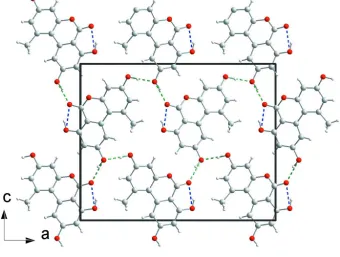
Besides the intramolecular hydrogen bonds between O3—H3 and O2 (see dashed blue bonds in fig. 2), each molecule is
connected to four adjacent molecules via intermolecular hydrogen bonds (see dashed green bonds in fig. 2). As a result
undulated layers in the the ac plane are formed.
S2. Experimental
Alternariol was supplied by the workgroup of Prof. R. Faust (University of Kassel, Germany) by total synthesis according
to a literature procedure (Koch et al., 2005). Alternariol crystals were grown by sublimation in argon atmosphere. To do
so, 100 mg of crude alternariol were heated to 380 °C for 2.5 h under a slow argon flow (atmospheric pressure). After
cooling to room temperature, colourless needles could be collected from the water cooled compartment of the reaction
vessel.
S3. Refinement
In the absence of anomalous scatterers, the absolute structure cannot be determined therefore Friedel pairs were merged
prior to refinement. The hydrogen atoms were located in difference maps and refined with Uiso(H) set to 1.2 Ueq of the
Figure 1
ORTEP representation of the title compound with atomic labeling shown with 30% probability displacement ellipsoids.
Figure 2
[image:3.610.135.475.394.651.2]3,7,9-trihydroxy-1-methyl-6H-benzo[c]chromen-6-one
Crystal data
C14H10O5
Mr = 258.22
Orthorhombic, Pca21 Hall symbol: P 2c -2ac a = 18.969 (3) Å b = 3.7244 (6) Å c = 15.235 (3) Å V = 1076.3 (3) Å3
Z = 4
F(000) = 536 Dx = 1.594 Mg m−3
Mo Kα radiation, λ = 0.71073 Å Cell parameters from 1894 reflections θ = 5–26°
µ = 0.12 mm−1
T = 150 K Needle, colourless 0.40 × 0.10 × 0.02 mm
Data collection
Stoe IPDS diffractometer
Radiation source: fine-focus sealed tube Graphite monochromator
rotation method scans 6072 measured reflections 1338 independent reflections
1053 reflections with I > 2σ(I) Rint = 0.067
θmax = 28.1°, θmin = 2.5°
h = −24→22 k = −4→4 l = −20→20
Refinement
Refinement on F2 Least-squares matrix: full R[F2 > 2σ(F2)] = 0.035
wR(F2) = 0.069
S = 0.99 1338 reflections 191 parameters 1 restraint
Primary atom site location: structure-invariant direct methods
Secondary atom site location: difference Fourier map
Hydrogen site location: inferred from neighbouring sites
H atoms treated by a mixture of independent and constrained refinement
w = 1/[σ2(F
o2) + (0.0314P)2] where P = (Fo2 + 2Fc2)/3 (Δ/σ)max < 0.001
Δρmax = 0.16 e Å−3 Δρmin = −0.23 e Å−3
Special details
Geometry. All esds (except the esd in the dihedral angle between two l.s. planes) are estimated using the full covariance matrix. The cell esds are taken into account individually in the estimation of esds in distances, angles and torsion angles; correlations between esds in cell parameters are only used when they are defined by crystal symmetry. An approximate (isotropic) treatment of cell esds is used for estimating esds involving l.s. planes.
Refinement. Refinement of F2 against ALL reflections. The weighted R-factor wR and goodness of fit S are based on F2, conventional R-factors R are based on F, with F set to zero for negative F2. The threshold expression of F2 > σ(F2) is used only for calculating R-factors(gt) etc. and is not relevant to the choice of reflections for refinement. R-factors based on F2 are statistically about twice as large as those based on F, and R- factors based on ALL data will be even larger.
Fractional atomic coordinates and isotropic or equivalent isotropic displacement parameters (Å2)
x y z Uiso*/Ueq
O1 0.54295 (9) 0.3728 (6) 0.78417 (11) 0.0213 (4)
O2 0.44464 (9) 0.1215 (6) 0.74006 (11) 0.0272 (5)
O3 0.42666 (9) −0.0612 (6) 0.57652 (13) 0.0277 (5)
H4 0.5946 (18) 0.002 (10) 0.344 (2) 0.033*
O5 0.74389 (10) 0.8553 (6) 0.91670 (10) 0.0260 (5)
H5 0.7843 0.9307 0.9038 0.031*
C1 0.50516 (13) 0.2203 (8) 0.71956 (16) 0.0193 (6)
C2 0.53589 (13) 0.1856 (8) 0.63425 (15) 0.0167 (6)
C3 0.49365 (13) 0.0493 (8) 0.56447 (16) 0.0192 (6)
C4 0.52045 (14) 0.0246 (8) 0.48049 (17) 0.0194 (6)
H4A 0.4917 (15) −0.072 (8) 0.4295 (19) 0.023*
C5 0.58935 (13) 0.1357 (9) 0.46651 (15) 0.0183 (6)
C6 0.63205 (15) 0.2688 (8) 0.53304 (15) 0.0178 (6)
H6A 0.6788 (15) 0.341 (8) 0.5183 (18) 0.021*
C7 0.60688 (12) 0.2911 (7) 0.61830 (15) 0.0135 (5)
C8 0.64850 (13) 0.4228 (7) 0.69286 (14) 0.0141 (5)
C9 0.61339 (12) 0.4710 (8) 0.77287 (16) 0.0166 (6)
C10 0.64335 (14) 0.6136 (8) 0.84775 (16) 0.0194 (6)
H10 0.6189 (14) 0.644 (8) 0.9006 (18) 0.023*
C11 0.71326 (13) 0.7093 (8) 0.84418 (16) 0.0186 (6)
C12 0.75199 (13) 0.6479 (8) 0.76803 (16) 0.0159 (5)
H12 0.7968 (16) 0.696 (8) 0.7685 (17) 0.019*
C13 0.72187 (13) 0.5072 (7) 0.69300 (15) 0.0146 (5)
C14 0.77182 (13) 0.4380 (8) 0.61791 (16) 0.0198 (6)
H14A 0.8205 0.4683 0.6382 0.030*
H14B 0.7622 0.6083 0.5704 0.030*
H14C 0.7652 0.1923 0.5964 0.030*
Atomic displacement parameters (Å2)
U11 U22 U33 U12 U13 U23
O1 0.0154 (8) 0.0343 (13) 0.0141 (8) −0.0028 (8) 0.0031 (6) −0.0013 (9)
O2 0.0164 (9) 0.0475 (14) 0.0177 (8) −0.0068 (9) 0.0028 (7) 0.0060 (9)
O3 0.0125 (9) 0.0439 (14) 0.0268 (10) −0.0096 (9) 0.0011 (8) −0.0021 (11)
O4 0.0164 (9) 0.0518 (15) 0.0143 (9) −0.0034 (10) −0.0002 (7) −0.0092 (9)
O5 0.0244 (10) 0.0405 (13) 0.0131 (8) −0.0053 (9) −0.0034 (7) −0.0063 (9)
C1 0.0152 (13) 0.0243 (18) 0.0183 (13) −0.0006 (11) −0.0013 (9) 0.0027 (11)
C2 0.0139 (12) 0.0187 (16) 0.0176 (12) 0.0002 (10) 0.0010 (9) 0.0038 (11)
C3 0.0113 (12) 0.0239 (17) 0.0222 (13) −0.0027 (11) −0.0021 (10) 0.0012 (12)
C4 0.0166 (13) 0.0218 (17) 0.0200 (12) 0.0027 (11) −0.0052 (10) −0.0022 (11)
C5 0.0149 (13) 0.0277 (17) 0.0123 (11) 0.0025 (12) 0.0021 (9) −0.0019 (12)
C6 0.0134 (12) 0.0226 (17) 0.0175 (12) 0.0001 (10) 0.0012 (9) −0.0003 (11)
C7 0.0124 (11) 0.0153 (15) 0.0127 (11) 0.0024 (9) 0.0007 (9) 0.0026 (11)
C8 0.0170 (12) 0.0150 (14) 0.0102 (10) 0.0036 (10) −0.0006 (9) −0.0001 (10)
C9 0.0129 (11) 0.0216 (17) 0.0153 (10) 0.0008 (10) −0.0006 (10) 0.0035 (11)
C10 0.0207 (14) 0.0257 (17) 0.0117 (11) 0.0037 (11) 0.0030 (9) 0.0001 (11)
C11 0.0205 (13) 0.0227 (17) 0.0125 (11) 0.0014 (11) −0.0061 (10) −0.0013 (11)
C12 0.0124 (11) 0.0191 (15) 0.0163 (11) 0.0014 (10) −0.0020 (9) 0.0014 (11)
C13 0.0166 (12) 0.0139 (15) 0.0133 (10) 0.0023 (10) 0.0015 (9) 0.0030 (10)
Geometric parameters (Å, º)
O1—C1 1.343 (3) C6—C7 1.386 (3)
O1—C9 1.396 (3) C6—H6A 0.95 (3)
O2—C1 1.245 (3) C7—C8 1.468 (3)
O3—C3 1.348 (3) C8—C9 1.401 (3)
O3—H3 0.86 (3) C8—C13 1.427 (4)
O4—C5 1.367 (3) C9—C10 1.381 (4)
O4—H4 0.91 (4) C10—C11 1.374 (4)
O5—C11 1.362 (3) C10—H10 0.94 (3)
O5—H5 0.8400 C11—C12 1.392 (4)
C1—C2 1.430 (3) C12—C13 1.381 (4)
C2—C7 1.424 (3) C12—H12 0.87 (3)
C2—C3 1.425 (4) C13—C14 1.508 (3)
C3—C4 1.380 (3) C14—H14A 0.9800
C4—C5 1.387 (4) C14—H14B 0.9800
C4—H4A 1.01 (3) C14—H14C 0.9800
C5—C6 1.389 (4)
C1—O1—C9 122.07 (19) C9—C8—C13 115.7 (2)
C3—O3—H3 105 (2) C9—C8—C7 117.4 (2)
C5—O4—H4 115 (2) C13—C8—C7 126.8 (2)
C11—O5—H5 109.5 C10—C9—O1 113.1 (2)
O2—C1—O1 115.6 (2) C10—C9—C8 124.9 (2)
O2—C1—C2 125.2 (2) O1—C9—C8 121.9 (2)
O1—C1—C2 119.1 (2) C11—C10—C9 117.7 (2)
C7—C2—C3 120.2 (2) C11—C10—H10 118.7 (17)
C7—C2—C1 121.0 (2) C9—C10—H10 123.6 (17)
C3—C2—C1 118.8 (2) O5—C11—C10 118.9 (2)
O3—C3—C4 116.9 (2) O5—C11—C12 121.1 (2)
O3—C3—C2 122.5 (2) C10—C11—C12 120.0 (2)
C4—C3—C2 120.6 (2) C13—C12—C11 122.2 (2)
C3—C4—C5 118.0 (2) C13—C12—H12 119.3 (18)
C3—C4—H4A 122.4 (16) C11—C12—H12 118.4 (18)
C5—C4—H4A 119.6 (16) C12—C13—C8 119.2 (2)
O4—C5—C4 121.7 (2) C12—C13—C14 115.6 (2)
O4—C5—C6 115.4 (2) C8—C13—C14 125.1 (2)
C4—C5—C6 122.9 (2) C13—C14—H14A 109.5
C7—C6—C5 120.3 (2) C13—C14—H14B 109.5
C7—C6—H6A 121.6 (17) H14A—C14—H14B 109.5
C5—C6—H6A 118.1 (17) C13—C14—H14C 109.5
C6—C7—C2 118.0 (2) H14A—C14—H14C 109.5
C6—C7—C8 124.1 (2) H14B—C14—H14C 109.5
C2—C7—C8 118.0 (2)
C9—O1—C1—O2 174.9 (2) C6—C7—C8—C9 172.4 (3)
C9—O1—C1—C2 −5.6 (4) C2—C7—C8—C9 −6.5 (4)
O1—C1—C2—C7 3.6 (4) C2—C7—C8—C13 173.3 (3)
O2—C1—C2—C3 4.3 (4) C1—O1—C9—C10 −178.2 (3)
O1—C1—C2—C3 −175.2 (3) C1—O1—C9—C8 1.3 (4)
C7—C2—C3—O3 178.6 (3) C13—C8—C9—C10 4.5 (4)
C1—C2—C3—O3 −2.6 (4) C7—C8—C9—C10 −175.7 (3)
C7—C2—C3—C4 −1.3 (4) C13—C8—C9—O1 −174.9 (2)
C1—C2—C3—C4 177.5 (3) C7—C8—C9—O1 4.8 (4)
O3—C3—C4—C5 −179.8 (3) O1—C9—C10—C11 178.2 (3)
C2—C3—C4—C5 0.1 (4) C8—C9—C10—C11 −1.3 (4)
C3—C4—C5—O4 −179.9 (3) C9—C10—C11—O5 179.1 (2)
C3—C4—C5—C6 0.1 (5) C9—C10—C11—C12 −2.6 (4)
O4—C5—C6—C7 −179.1 (3) O5—C11—C12—C13 −178.6 (3)
C4—C5—C6—C7 0.9 (5) C10—C11—C12—C13 3.1 (4)
C5—C6—C7—C2 −2.1 (4) C11—C12—C13—C8 0.3 (4)
C5—C6—C7—C8 179.1 (3) C11—C12—C13—C14 −176.7 (3)
C3—C2—C7—C6 2.3 (4) C9—C8—C13—C12 −3.9 (4)
C1—C2—C7—C6 −176.5 (3) C7—C8—C13—C12 176.4 (3)
C3—C2—C7—C8 −178.8 (3) C9—C8—C13—C14 172.9 (3)
C1—C2—C7—C8 2.5 (4) C7—C8—C13—C14 −6.8 (4)
Hydrogen-bond geometry (Å, º)
D—H···A D—H H···A D···A D—H···A
O3—H3···O2 0.86 (3) 1.82 (3) 2.605 (3) 152 (3)
O4—H4···O2i 0.91 (3) 1.81 (3) 2.685 (3) 162 (3)
O5—H5···O4ii 0.84 1.97 2.809 (2) 175