Aziza Seifullina*, Ahmet Er*, Simon Peter Nadeem**, Jose Arturo Garza-Reyes**, Vikas Kumar***
*Unviersity of Warwick, Coventry, CV4 7AL, United Kingdom (e-mail: [email protected]; [email protected])
**University of Derby, Derby, DE22 1GB, United Kingdom (e-mail: [email protected]; [email protected])
*** University of the West England, Bristol, BS16 1QY,United Kingdom, (e-mail: [email protected])
Abstract: The adoption of Lean concepts beyond the manufacturing sector has been increasing recently.
In this line, its scope has been expanded to the mining industry under the realisation of the need for productivity improvements and a leverage for efficient operations. Limited research exists regarding Lean implementation in the mining industry in a comprehensive and structured way. This paper therefore follows a systematic approach to review the current literature to identify Lean implementation patterns in the mining sector, its scope, challenges, and limitations. The results reveal the limited utilisation of Lean in the mining sector, and that there is a lack of coherent and conceptual models to guide the implementation of Lean in this industry. Hence, the research proposes a framework for Lean implementation in the mining industry.
Keywords: Lean Concept, Lean Implementation, Lean Mining, Mining Industry, Operational Improvement.
1. INTRODUCTION
Increased global competition and a constantly changing environment requires businesses to transform their operations in order to cope with the complex and heterogeneous business environment (Garza-Reyes 2015; Nadeem et al.
2017). For this purpose, businesses need to streamline their resources/processes in an effective and efficient manner to deliver quality products/services in a cost effective, and efficient manner. To assist businesses in doing so, multiple models/approaches have been developed, e.g. Six Sigma, Agile, Business Process Reengineering, etc., with their distinguishing features to help businesses of various industrial sectors, e.g. automotive, IT, Healthcare, Electronics, etc. (Flynn and Vlok 2015). This paper explores the research and implementation of the Lean manufacturing approach within the context of the mining industry.
The process of extracting minerals and resources is referred to as mining (Newman et al. 2010; Pooe and Mathu 2011). The mining industry has played a significant role in the global economy (King et al. 2017) since ancient times until now; for instance, production of a modern computer requires more than 65 various minerals (Department of Energy 2017). Presently, more than 700 mining companies are active across 100 countries (ASX 2017). Moreover, the industry is a supplier of raw materials to other sectors such as utilities, metal manufacturing, construction, electronics, etc., and attracts the attention of society and businesses in regards to the way in which it operates. A mining lifecycle consists of 5 stages (Newman et al. 2010), namely: prospecting, exploration, development, exploitation, and reclamation; and
lasts for 10-30 years (King et al. 2017). Industry inputs are characterised by variable quality of deposits and their gradual depletion (Hilson and Basu 2003; Mudd 2007).
A study conducted by Damotte and Sharman (2016) highlights that global mining executives expect a growth of 63%, and 45% of the respondents were confident about the economic growth of the industry by 2018. Consequently, the industry executives regard cost and performance management as a high priority, in the past 67% of them while nowadays 77% (Damotte and Sharman 2016). Since the industry has no control over the market prices of its product (Hattingh and Keys 2010), there is a strong push to constantly seek productivity improvements and efficient operations to maximise outputs. Therefore, the application of Lean in mining operations is of high importance and relevance.
The novelty of this paper is defined by its scope of proposing a systematic framework to implement Lean principles in the mining industry. The proposed framework may be used by operations managers in the mining sector to guide their efforts towards the effective implementation of Lean. It also intends to promote further research in this area and industrial sector.
2. SYSTEMATIC LITERATURE REVIEW
[image:2.595.307.555.94.229.2]For the purpose of an in-depth analysis of peer reviewed academic publications and official reports, the SLR approach was adapted from that followed by Garza-Reyes (2015). The stages of SLR and their descriptions are presented in Table 1.
Table 1. Systematic Literature Review phases
SLR Phases Method Tools
1 Scope Formulation
Formulating the scope of research
2 Locating Studies
Electronic databases
IEEE Xpolore, Elsevier (Science Direct), Emerald, Taylor & Francis, Google Scholar, ISI Web of Science, EBSCO Search period 2000 – 2017
3 Study Selection and Evaluations
Definition & use of inclusion/ exclusion criteria
Inclusion: Lean,
Operations Improvement, Lean Six Sigma, Mining Industry, Mineral Industry.
Exclusion: Data mining, CSR, Product design and development.
Definition & use of search strings
Lean in mining Industry, Operations improvement in mining industry
4 Analysis and Synthesis
Synthesis/ analysis for qualitative research
Thematic Synthesis
Coding of data NVivo computer software 5 Reporting
and Using the Results
Reporting of findings
2.1 Scope formulation
The core essence of the research was to explore the current approaches of Lean implementation in the mining industry, and how practitioners in this industrial sector may effectively implement Lean. With this scope, the objectives of the present research were to:
Identify current research patterns of Lean implementation in the mining industry;
Propose a Lean implementation framework for the mining industry.
2.2 Studies location, selection and evaluation
Secondary data, published between 2000-2017, was collected using search strings that included ‘Lean in mining Industry’ and ‘Operations improvement in mining industry’; utilising Boolean operators (i.e. and/or), from various electronic databases such as IEEE Xplore, Elsevier (Science Direct), Emerald, Taylor&Francis, Google Scholar, ISI Web of Science, and EBSCO. The research excluded any articles with themes not directly related to the mining industry, e.g. Data mining, CSR, Product design and development.
2.2.1 Data screening
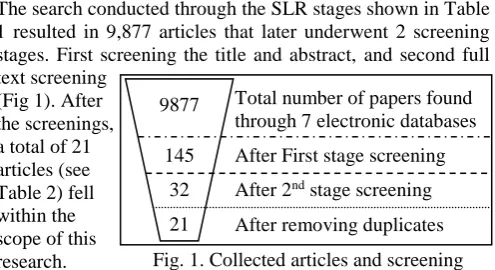
The search conducted through the SLR stages shown in Table 1 resulted in 9,877 articles that later underwent 2 screening stages. First screening the title and abstract, and second full text screening
(Fig 1). After the screenings, a total of 21 articles (see Table 2) fell within the scope of this research.
2.2.2 Quality assessment
[image:2.595.42.302.164.495.2]The 21 articles were then analysed for their quality and relevance using the three dimensions classification proposed by Dresch et al. (2015), see Table 2.
Table 2. Consolidation of Quality assessment
Assessment Dimensions No Author/s Quality
of study
Relevance to the question
Relevance to the focus
Study Asses sment 1 (Ade and
Deshpande 2012)
Low Low Med Low
2 (Boateng‐Okrah and Appiah Fening 2012)
High Low Med Low
3 (Castillo et al.
2015)
High High Med Med
4 (Chlebus et al.
2015)
High High High High
5 (Claassen 2016) High Low High Low 6 (Duin et al.
2008)
Low Low Med Low
7 (Dunstan et al.
2006)
Med High High Med
8 (Flynn and Vlok 2015)
Med Med High Med
9 (Garza-Reyes et al. 2016)
High Med High Med
10 (Helman 2012) Low Med High Low 11 (Indrawati and
Ridwansyah 2015)
Med Med High Med
12 (Klippel et al.
2008a)
Med Med High Med
13 (Klippel et al.
2008b)
Low Med High Low
14 (Mishra et al.
2013)
Med Low High Low
15 (Mottola et al.
2011)
High Low High Low
16 (Nekoufar 2011) Med Low Med Low 17 (Oware et al.
2015)
Med High High Med 9877
145 32 21
Total number of papers found through 7 electronic databases After First stage screening After 2nd stage screening
After removing duplicates Fig. 1. Collected articles and screening
[image:2.595.305.554.325.769.2]18 (Sanda et al.
2011)
High Low Med Low
19 (Wijaya et al.
2009)
Low Med Med Low
20 (Yingling et al.
2000)
Low Med High Low
21 (Zuniga et al.
2015)
High Low Med Low
2.3 Analysis and synthesis
The quality assessment led to a further filtering of the 21 articles, by assessing them based on three dimensions, i.e. quality of the study, relevance to the research objectives, and relevance to the research focus. Only eight research papers, i.e. 3, 4, 7, 8, 9, 11, 12, and 17 from Table 2 and highlighted in grey, qualified the above quality assessment for further data extraction and thematic synthesis. The approach (see Fig. 2), adapted from Heyvaert et al. (2017), permitted a detailed assessment of each study’s characteristics through line-by-line or free coding using NVivo software, and then grouping them into descriptive themes as clusters of codes. At the next stage, descriptive themes were arranged into 21 clusters to form analytical themes. At the stage of analytical themes synthesis, the review went beyond of primary data (Heyvaert et al. 2017) as analytical themes were highly integrated to the review questions. Thus, they generated additional concepts and findings of a subject of the review. This method was appropriate for deployment within this study as eventually primary data of the review should be integrated to the conceptual framework of the research.
Fig. 2. Thematic synthesis stages (adapted from Heyvaert et al. 2017)
For the purpose of formulating analytical themes in a structural interrelated manner and aligned with the research objectives, an extended version of the ‘PICO’ model (Boland
et al. 2017) was adapted, PICO being; Population (mining industry, mining sector businesses), Phenomena of Interest (Lean adaptation), and the Context (Lean adaptation results, outcomes, limitation, etc. in the mining sector), whereas addressing the questions: Who? Why? What? How? And When?. This was the core essence of the review as it reflected research evidence, outcomes, implications and limitations as well as traced patterns for future research. This would allow the readers to more easily navigate within the research and understand complex phenomena in a conceptually easy way.
2.4 Reporting and using the results
The detail review of the eight selected papers indicated that differences between the automotive and mining industries may pose pitfalls (Dunstan et al. 2006), difficulties (Flynn and Vlok 2015), challenges and limitations for the adaptation (Gustavo et al. 2015) of Lean in mining sector. However, the intersection of these two sectors and possibility of adopting
and benefiting from the Lean application in the mining sector is also highlighted by some scholars (Dunstan et al. 2006; Chlebus et al. 2015; Flynn and Vlok 2015). Therefore, the scope of their interaction seems realistic.
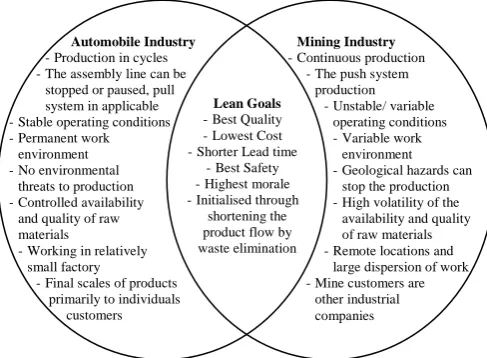
[image:3.595.40.292.70.169.2]The mining and automotive sectors intersect, as the first typically comprises individual and stand-alone business units that seek business improvement methods to pursue a reduction of operating costs, increase productivity and efficiency (Klippel et al. 2008a; Chlebus et al. 2015), achieve process optimisation (Castillo et al. 2015), meeting targets and plans (Dunstan et al. 2006), improve internal communications (Castillo et al. 2015), and customers satisfaction (Garza-Reyes et al. 2016). Fig. 3 illustrates the overlapping elements of the automotive and mining industries. Thus, the analysis of the eight papers indicates the fact that mining companies aiming to initiate the deployment of Lean methods should focus on the ultimate goals of its principles, i.e. waste elimination.
Fig. 3: Lean goals in the automotive and mining industries
2.4.1 Lean’s 8 wastes in the mining sector
Based on the intersecting features of the automotive and mining sectors illustrated by Fig.3, it becomes ideal to categorise wasteful activities occurring in the mining industry and their classification as per Lean’s eight wastes. Table 3 summarises these wastes
Table 3: Lean’s 8 wastes in Mining Industry
Waste and its occurrence form
Overproduction: (Flynn and Vlok 2015), due to mining capacity to outstrip ore processing (Dunstan et al. 2006), continuous production with push system (Dunstan et al.
2006; Chlebus et al. 2015)
Waiting: Inappropriate conditions/working environment, e.g. lack of ventilation for dust and gases removal (Klippel
et al. 2008a), due to unavailability of machines and spare parts (Dunstan et al. 2006; Chlebus et al. 2015), equipment breakdowns and plant downtime (Dunstan et al.
2006; Oware et al. 2015), maintenance downtime and unscheduled shutdowns (Indrawati and Ridwansyah 2015), equipment failures (Dunstan et al. 2006).
Lean Goals - Best Quality - Lowest Cost - Shorter Lead time
- Best Safety - Highest morale - Initialised through
shortening the product flow by waste elimination
Mining Industry - Continuous production
- The push system production
- Unstable/ variable operating conditions - Variable work
environment - Geological hazards can
stop the production - High volatility of the
availability and quality of raw materials - Remote locations and
large dispersion of work - Mine customers are
other industrial companies
Automobile Industry - Production in cycles - The assembly line can be
stopped or paused, pull system in applicable - Stable operating conditions - Permanent work
environment
- No environmental threats to production
- Controlled availability and quality of raw materials
- Working in relatively small factory
[image:3.595.305.549.294.473.2]Unnecessary transport and conveyance: Inefficient layout for transportation (Garza-Reyes et al. 2016), stockpile material transportation (Indrawati and Ridwansyah 2015), inefficient movement of extracted ore until it reaches final destination (Dunstan et al. 2006), long distances (Flynn and Vlok 2015).
Over processing or incorrect processing: Performance
of tasks by one employee instead of parallel operation for higher value adding time, auxiliary equipment preparation (e.g. drill sharpening, cleaning operations), process method (e.g. dry drilling taking more time for processing compared with wet drilling) (Klippel et al. 2008a), incorrect processing due to equipment breakdowns (Oware
et al. 2015) or equipment failures (Dunstan et al. 2006), inefficient use of materials (Indrawati and Ridwansyah 2015), over processing to better grade ore than the customer willing to pay (Dunstan et al. 2006).
Excess inventory: High inventory of spare parts (Chlebus
et al. 2015; Flynn and Vlok 2015), inefficient inventory management (stockpiles/ shortages) (Dunstan et al. 2006)
Un-necessary Movement: Interruptions due to inefficient
location of instruments (Dunstan et al. 2006; Klippel et al.
2008a), transport material unavailability, non-compliance of workers (Indrawati and Ridwansyah 2015), walking of operators (Dunstan et al. 2006; Flynn and Vlok 2015).
Defects: Rework/repair (Dunstan et al. 2006; Oware et al.
2015), quality of raw materials (Indrawati and Ridwansyah 2015), equipment failures (e.g. fluid leaks) (Dunstan et al.
2006), physical material waste (Flynn and Vlok 2015)
People: Unskilled labour (Indrawati and Ridwansyah
2015; Oware et al. 2015), inefficient shift schedule (Indrawati and Ridwansyah 2015), absenteeism (Dunstan
et al. 2006), incorrect assignment of people to tasks (Klippel et al. 2008a), lack of proper communication (Castillo et al. 2015; Flynn and Vlok 2015)
2.4.2 Current Lean approaches in the mining industry
The classification of wasteful activities in the mining sector, as per Lean (summarised in Table 3) further affirms that a systematic approach to waste elimination and promoting a continuous improvement culture are the key traits and main drivers for Lean implementation in mining industry. The most significant needs of the industry are those which are associated to the fact that natural resources are limited. Additionally, many of the natural resources are non-renewable and hence circular economy elements are not applicable to the sector. Given these aspects, for businesses operating in the mining sector it is crucial to deploy an optimum strategy for operations in order to generate greater economic benefits.
Typically, Lean experts (academics/consultants) first build a theoretical foundation for a possibility of adapting Lean in order to provide practical solutions to specific industry needs. Then, based on these specific needs of the industry business units and on broad academic knowledge, they propose a possible adaptation of the approaches for Lean implementation. This is significantly valid for the study of Chlebus et al. (2015) in which a Lean framework was
designed to improve maintenance operation practices of a mining company in Poland.
Similarly, Lean maintenance operations improvement approaches have been tested in a Ghanaian mining company (Oware et al. 2015). Thus, the studies under review have shown the development of various theoretical frameworks for practical utilisation of Lean principles and tools in mining operations. Since these studies reported positive outcomes of the adaptation of the proposed frameworks and Lean methodologies, it is not an uncommon practice to approach the development of Lean frameworks based on the Lean literature and theory.
On the other hand, the frameworks are sometimes highly authentic and closely aligned to organisation’s specific issues, which make them difficult to be generalised. More importantly, a few academics in the studies under review paid close attention to critical-to-satisfaction factors of their clients. These factors reflect a need for the voice of the customer (Garza-Reyes et al. 2016) to be captured as organisational inputs and interpreted for business improvement outputs by Lean practices. A study by Castillo
et al. (2015) clearly shows that parameters for the study were elaborated in accordance to the goal, identified by the mining organisation-client. Thus, these practices demonstrate the customer-oriented focus of Lean experts on creating Lean adaptation frameworks for mining organisations. Consequently, this customer-oriented focus of Lean experts developing Lean frameworks for the mining industry entails to a diversity of Lean implementation frameworks. Thus, this research does not specify various characteristics of each framework proposed by the different studies under review, but has highlighted common practices reported to solve mining industry issues.
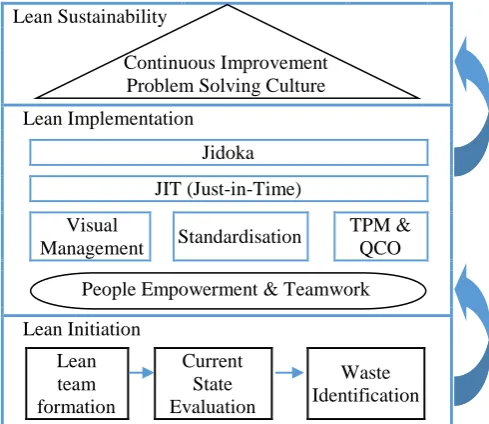
3. LEAN FRAMEWORK FOR THE MINING INDUSTRY Despite the fact that the mining industry can benefit from Lean principles, the industry still lacks a coherent and general framework to initiate Lean for organisations operating in this sector. Therefore, this research proposes a Lean implementation framework applicable to mining companies. A visual representation of the proposed framework is illustrated in Fig. 4. The proposed framework is consistent with the major Lean implementation trends and practices in mining organisations, therefore it is of direct practical relevance to them.
The framework consists of three main ‘blocks’ corresponding to three Lean implementation phases as follows:
• Lean initiation • Lean implementation • Lean sustainability
The implementation phase has the waste identified in the previous phase as an input. At this stage, the initial steps to build a Lean culture should be taken through training in order to empower people and communication programmes in order to enhance teamwork. Organisations will need to ensure commitment to the Lean culture and regular practice of the people empowerment. Next, standardisation for baseline procedures and activities is necessary and should be done regularly by challenging current practices through kaizen meetings and problem-solving sessions. This will promote the establishment of a continuous improvement culture.
Lean Sustainability
Continuous Improvement Problem Solving Culture Lean Implementation
Jidoka
JIT (Just-in-Time)
Visual
Management Standardisation
TPM & QCO
People Empowerment & Teamwork
Lean Initiation Lean team formation
Current State Evaluation
[image:5.595.46.291.208.420.2]Waste Identification
Fig. 4. Lean Framework for Mining Industry
As technology plays a crucial role in mining organisations, Total Productive Maintenance (TPM) and Quick Changeover (QCO) approaches should be deployed to improve maintenance services and operations. In addition, an application of these tools should switch employees’ culture from ‘fire-fighting’ to a preventive maintenance culture. TPM and QCO should be followed by Just-in-Time (JIT) and Jidoka. In the studies reviewed, these two methods have somehow been neglected by Lean adopters in the mining industry. The most likely cause for this could be the fact that JIT’s utilisation requires a highly integrated supply chain. However, supply chain integration in the mining industry is a complex process, subsequently making the implementation of JIT an also complex task. In addition, prior to JIT implementation, it is strongly suggested to establish a solid Lean culture by using other Lean tools first. This would contribute to a smooth and successful implementation of JIT.
Jidoka faces similar scenario as with the utilisation of JIT. Its feasibility has not been discussed within the studies reviewed. Nevertheless, it has a potential application in the mining industry, provided that technological advancements are brought to the industry by innovative solutions.
The current proposed model only suggests the adoption of 5 Lean tools for the mining industry (see Fig. 4). However, this should not be considered as a limiting factor. In this regard, the framework is flexible in adding or removing tools for the
convenience of the users. The implementers are strongly recommended to build a continuous improvement culture to bring Lean sustainability in their mining organisations.
4. CONCLUSIONS
Lean manufacturing has been greatly appraised and adopted in a wide range of different businesses and industries. With its scope not being limited to the automotive industry only and the potential to be contextualised in other sectors, it can greatly benefit the mining sector. However, this industry lacks of specifically adapted frameworks to facilitate its implementation in this sector. This research is an igniting step and has developed a framework after systematically reviewing the research in the given area. The framework is girded in a detailed analysis of current practices and models. Testing of this framework, followed by any amendments/ modifications would greatly benefit both further research and its practice in the mining sector.
Due to the time constraints the proposed framework has not been tested in a real-life situation. However, this does not undermine its practical relevance, given the fact that a thorough study has been done before its development, and in a similar way other frameworks have been developed based upon literature reviews. For the purpose to establish a continuous improvement culture, further research is highly recommended and can be done by practicing problem-solving sessions in a regular manner at practitioners level and academic research.
REFERENCES
Ade, M., Deshpande, V.S. (2012). Lean manufacturing and productivity improvement in coal mining industry.
International Journal of Engineering Research and Development, 2(10), 35–43.
ASX (2017) Metals & Mineral Sector Profile, available: http://www.asx.com.au/documents/products/asx-metals-and-mining-sectorprofile.%0APDF [accessed 31 Jul 2017]. Boateng‐Okrah, E., Appiah Fening, F. (2012). TQM implementation: A case of a mining company in Ghana.
Benchmarking: An International Journal, 19(6), 743–759. Boland, A., Cherry, M.G., Dickson, R. (2017) Doing a
Systematic Review: A Student’s Guide, Sage Publications Ltd.: London.
Castillo, G., Alarcón, L.F., González, V.A. (2015). Implementing Lean Production in Copper Mining Development Projects: Case Study. Journal of Construction Engineering and Management, 141(1), 5014013.
Chlebus, E., Helman, J., Olejarczyk, M., Rosienkiewicz, M. (2015). A new approach on implementing TPM in a mine - A case study. Archives of Civil and Mechanical Engineering, 15(4), 873–884.
Claassen, J.O. (2016). Application of manufacturing management and improvement methodologies in the southern African mining industry. Journal of the Southern African Institute of Mining and Metallurgy, 139–148. Damotte, E., Sharman, R. (2016) Global Metals and Mining
Outlook 2016: Making the Best of a Challenging
https://assets.kpmg.com/content/dam/kpmg/xx/pdf/2016/08 /kpmg-metalsmining-%0Aoutlook-2016.pdf.
Department of Energy (2017) Mining Industry Profile [online], available: https://energy.gov/eere/amo/mining-industry-profile [accessed 30 Jul 2017].
Dresch, A., Lacerda, D.P., Antunes, J.A.V. (2015). Systematic Literature Review. Design Science Research: A Method for Science and Technology Advancement, 129– 158.
Duin, S. Van, Cook, C.D., Lukey, C.A., Spinks, G.M., Porter, I. (2008). Multidisciplinary expertise applied to underground coal mining R and D projects with emphasis on adoption of lean automation techniques. in International Symposium on Modern Mining and Safety Technology Proceedings, Coal Industry Publishing: China, 10–14. Dunstan, K., Lavin, B., Sanford, R. (2006). The application
of lean manufacturing in a mining environment. in
International Mine Management Conference, 16–18. Flynn, J.R., Vlok, P.J. (2015). Lean Approaches in Asset
Management Within the Mining Industry. in Amadi-Echendu, J., Hoohlo, C. and Mathew, J., eds., 9th WCEAM Research Papers: Volume 1 Proceedings of 2014 World Congress on Engineering Asset Management, Springer International Publishing: Cham, 101–118.
Garza-Reyes, J.A. (2015). Lean and green - a systematic review of the state of the art literature. Journal of Cleaner Production, 102, 18–29.
Garza-Reyes, J.A., Al-Balushi, M., Antony, J., Kumar, V. (2016). A Lean Six Sigma framework for the reduction of ship loading commercial time in the iron ore pelletising industry. Production Planning and Control, 27(13), 1092– 1111.
Gustavo, C., F., A.L., A., G.V. (2015). Implementing Lean Production in Copper Mining Development Projects: Case Study. Journal of Construction Engineering and Management, 141(1), 5014013.
Hattingh, T.S., Keys, O.T. (2010). How applicable is industrial engineering in mining?. in The 4th International Platinum Conference, Platinum in Transition ‘Boom or Bust’, The Southern African Institute of Mining and Metallurgy, 205–210.
Helman, J. (2012). Analysis of the potentials of adapting elements of Lean methodology to the unstable conditions in the mining industry. AGH Journal of Mining and Geoengineering, 36(3), 151–157.
Heyvaert, M., Hannes, K., Onghena, P. (2017). Using Mixed Methods Research Synthesis for Literature Reviews, Sage Publications Ltd.: Los Angeles.
Hilson, G., Basu, A.J. (2003). Devising indicators of sustainable development for the mining and minerals industry: An analysis of critical background issues.
International Journal of Sustainable Development & World Ecology, 10(4), 319–331.
Indrawati, S., Ridwansyah, M. (2015). Manufacturing Continuous Improvement Using Lean Six Sigma: An Iron Ores Industry Case Application. Procedia Manufacturing, 4, 528–534.
King, B., Goycoolea, M., Newman, A. (2017). Optimizing the open pit-to-underground mining transition. European Journal of Operational Research, 257(1), 297–309.
Klippel, A.F., Petter, C.O., Antunes, J.A. V (2008a). Lean management implementation in mining industries. Dyna, 75(154), 81–89.
Klippel, A.F., Petter, C.O., Antunes, J.A. V (2008b). Management Innovation, a way for mining companies to survive in a globalized world. Utilities Policy, 16(4), 332– 333.
Mishra, D.P., Sugla, M., Singha, P. (2013). Productivity Improvement in Underground Coal Mines - A Case Study.
Journal of Sustainable Mining, 12(3), 48–53.
Mottola, L., Scoble, M., Lipsett, G. (2011). Machine monitoring and automation as enablers of lean mining. in
Second International Future Mining Conference 2011, The Australasian Institute of Mining and Metallurgy: Melbourne, 81–86.
Mudd, G.M. (2007). Global trends in gold mining: Towards quantifying environmental and resource sustainability.
Resources Policy, 32(1–2), 42–56.
Nadeem, S.P., Garza-reyes, J.A., Leung, S., Cherra, A., Anosike, A.I., Lim, M.K. (2017). Lean Manufacturing and Environmental Performance – Exploring the Impact and Relationship. IFIP International Federation for Information Processing, 514, 331–340.
Nekoufar, S. (2011). Standardization of large scale industrial project in multi projects environment. International Journal of Management Science and Engineering Management, 6(4), 260–266.
Newman, A.M., Rubio, E., Caro, R., Weintraub, A., Eurek, K. (2010). A review of operations research in mine planning. Interfaces, 40(3), 222–245.
Oware, K.M., Samanhyia, S., Ampong, G.O.A. (2015). Elimination of waste and inefficiencies through lean maintenance management in mining industries, Ghana.
International Journal of Economics, Commerce and Management, 3(10), 836–845.
Pooe, D., Mathu, K. (2011). The south african coal mining industry: a need for a more efficient and collaborative supply chain. Journal of Transport and Supply Chain Management, 5(1), 316–336.
Sanda, M.A., Johansson, J., Johansson, B. (2011). Miners’ tacit knowledge: A unique resource for developing human-oriented lean mining culture in deep mines. in IEEE International Conference on Industrial Engineering and Engineering Management, 399–404.
Wijaya, R., Kumar, R., Kumar, R. (2009). Implementing lean principle into mining industry issues and challenges. in
18th International Symposium on Mine Planning and Equipment Selection, 1–9.
Yingling, J.C., Detty, R.B., Sottile, J. (2000). Lean manufacturing principles and their applicability to the mining industry. Mineral Resources Engineering, 9(2), 215–238.