1. Introduction
Diseases and infections of domestic animal herds are becoming a more and more serious concern. Many new diseases have appeared and old condi-tions have returned which do not only greatly affect the health and productivity of animals, but also cause directly economic losses and indirectly affect consumer health. In recent years, Bird-flu and blue-ear diseases have rapidly spread on a large scale, es-pecially in some Asian countries (China, Thailand, and Vietnam, etc.). Pathogens may generate variant DNA/RNA structural types/strains within a short time. Therefore, disease prevention using specific
vaccines have not been as successful as expected with little or no effects on some diseases.
Mycoplasma pneumonia caused by Mycoplasma hyopneumoniae (Mh) is a highly contagious and chronic disease affecting pigs with a significant re-duction in the growing performance of animals and estimated economic losses of $ 0.2 to 1 billion per year in the USA (Clark et al. 1991). Mh is spread worldwide and present in almost pig herds (Minion 2002) because antibiotics cannot completely re-move the pathogen. Vaccines have been found to reduce the severity of the disease but do not pre-vent the disease from occurring in infected pigs (Haesebrouck et al. 2004). Unluckily, the immune
Structural homology and expression tendency of the
natural immune response of the terminal complement
components to inoculations in pigs: a review
D.V.A. Khoa
College of Agriculture and Applied Biology, Can Tho University, Vietnam
ABSTRACT: The transmission of infectious agents from domestic animals to humans is a matter of particular concern at present. Inoculation can enhance the defences of each individual animal but only in the short term. Certainly, it will be of immense benefit if biotechnology and genetic techniques are applied to farm animal breed-ing and selection programs to improve productivity, performance and health status as well as for the construc-tion of sustainable animal producconstruc-tion systems and promoconstruc-tion of animal welfare. In recent years, efforts to drive candidate genes like cytokines, haptoglobin, complement system, C-reactive protein, a 2-macroglobulin, retinol binding protein, transcortin, etc. associated with immune traits have successfully been studied in human and dif-ferent animal species. Here, we compared the molecular structure and evaluated the expression tendency of the haemolytic complement activity (HCA) of porcine candidate genes encoding the terminal complement components (TCC) C6–9. The results suggested that (1) high homology of complement genes among mammalian species may open new ways in cure/ treatment of disease; (2) Muong Khuong animals (Vietnamese potbelly pig) have a great genetic potential to improve the health status of pigs; and (3) HCA in the classical pathway can be developed further by different activation modes, with the potential improvement of animal health.
Keywords: pigs; terminal complement genes; homology; genetic variation; and haemolytic complement activity
Contents
1. Introduction
2. Structural homology 3. Chromosomal localisation
response in Mh-infected pigs is slow and ineffective (Minion 2002). Additionally, producers like using antibiotics to treat illnesses and/or to improve the feed-using efficiency, whereas vaccines are used to prevent the spread of disease. All these interven-tions are to ensure economic objectives. However, the use of antibiotics in the long term may influence the treatment of both animal and human diseases due to the development of medical resistance.
With the development of biotechnology, molecu-lar immunological and genetic methods have been applied to animal breeding and selection programs. These developments have gradually improved the health status and disease resistance of animals lead-ing to higher product quality, a reduction in the transmission of infectious agents or traces of antibi-otics, and slight increases in production efficiency. It has been demonstrated that disease reduction by genetic means has certain advantages through cumulative and permanent effects.
The mechanism of complement activation and its role in immune responses for fighting pathogens have been studied in humans and animals. The ac-tivation of the complement cascades allows the kill-ing of microbes and the regulation of other immune processes. Many studies have indicated deficiencies in complement components with effects on human/ animal health, for instance, bacterial meningitis infec-tion of hosts (Eng 1980; Haeney et al. 1980; Ross and Densen 1984; Inai et al. 1989; Fukumori and Horiuchi 1998; Zhu et al. 2000; Vazquez-Bermudez et al. 2003). These authors have also demonstrated that most defi-ciencies are associated with polymorphisms present in the molecular structure of at least one comple-ment component. Vissher et al. (2002) drew the im-portant conclusion that there is the possibility for genetic improvement of the immune capacity and response to pathogens. In subsequent years, genetic variation of the C3, C5, MBL1 and MBL2 associated with haemolytic complement activity (HCA) were also investigated (Phatsara et al. 2007; Kumar et al. 2004; Wimmers et al. 2003). Consequently, in this study, we strongly focused on the porcine terminal complement components C6, C7, C8A, C8B, and C9 using the same experimental materials, statistical ana-lytical methods and study objectives.
2. Structural homology
The architecture of the porcine candidate genes encoding the TCC was identified and analysed.
A high similarity was found between human and pig for cDNA (65–86%) and protein (67–83%) se-quences. Compared to human protein sequences, the porcine C6, C8A, and C8B are 1, 5, and 20 amino acids longer, respectively. The C9 is 16 amino acids shorter, whereas the C7 and C8G are of the same length. In other words, the C6 is the largest, and the C8G is the smallest. The porcine proteins all show 22–30% similarity to each other except for C8G. In fact, homology was found between the amino ter-mini of the C6 and C7 and the mature form of C8A, C8B and C9. The carboxyl terminus of the C6 and C7 are only extended fragments and therefore they also show high identity to each other. It seems, therefore, that the last molecules of the complement system originate from a common ancestral gene.
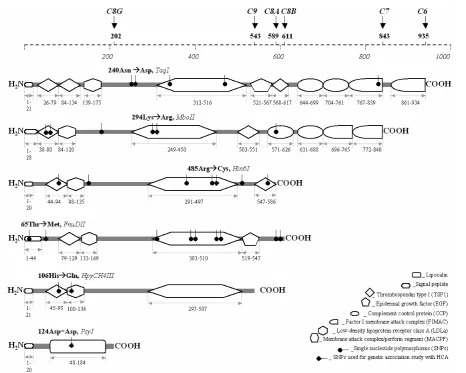
In general, the C6, C7, C8A, C8B and C9 are mo-saic proteins constructed from smaller cysteine-rich domains like TSP1, LDLa, EGF, CCP, FIMAC and MACPF. The C8G individually is comprised of a lipocalin domain (Figure 1). Interestingly, 58, 45, 17, 18, 3 and 13 of the total of 64, 56, 31, 27, 3, 19 cysteines found in the C6, C7, C8A, C8B, C8G and C9 proteins are located in these functional protein domains, respectively. Each CCP contains four cysteines of which two are at the first and two at the last positions of the sequence. Six cysteines were found in each LDLa segment. In both human and pigs, the amino terminus of C6 has a tandem repetition of TSP1, while the carboxyl termini of C6 and C7 have a tandem of CCP and FIMAC. Each of the five terminal complement mosaic proteins has a MACPF motif in the central area of the se-quence. According to Rosado et al. (2007), proteins containing MACPF domains play important roles in vertebrate immunity, embryonic development, and neural-cell migration. The MACPF domain structure is similar to pore-forming cholesterol-dependent cy-tolysins (CDCs) from gram-positive bacteria. These lytic MACPF proteins may use a CDC-like mecha-nism to form pores and disrupt cell membranes. The CCP modules mediate specific protein-protein and protein-carbohydrate interactions that are keys to the biological function of the regulators of comple-ment activation and paradoxically, provide binding sites for numerous pathogens (O’Leary et al. 2004). The TSP1 conserved sequence motif has been sug-gested to play an essential role in mechanisms by which malaria parasites avoid host defences medi-ated by complement (Goundis and Reid 1988).
bind-ing proteins to each other. The C6 FIMAC module promotes the interaction of C6 with C5 enabling a more efficient bimolecular coupling ultimately leading to the formation of the C5b-6 complex (DiScipio et al. 1999) and binding of C7 FIMAC to the C345C domain in C5 is essential for incor-poration of C7 into C5b-6 (Thai and Ogata 2005). The principal binding site for C9 lies within the MACPF domain of C8A (Slade et al. 2006), while the binding specificity between C8B and C8A-G subunits is determined by a cooperative interac-tion of the asparaginyl-terminal TSP1 module and MACPF (Musingarimi et al. 2002). Site-specific antibodies directed to the LDLa homology unit in C9 cross-reacted with C6 and C7 (Tschopp et
[image:3.595.58.525.82.455.2]C8A and C8B genes have correspondingly similar roles in MAC-mediated lysis of erythrocytes and bacterial killing, and C8G is not required for the expression of C8 activity (Schreck et al. 1998) and for complement-mediated killing of gram-negative bacteria (Parker and Sodetz 2002). The pore-like characteristic appearance of the MAC is attributed to the association of as many as 12–18 C9 molecules that self-polymerise to form a circular structure in the membrane (Tschopp 1984). The individual com-ponents are hydrophilic proteins; however, when combined they form an amphipathic complex that is capable of binding to and disrupting local membrane organisation (McCloskey et al. 1989). The increase in membrane permeability leads to osmotic lysis of simple cells such as erythrocytes or the initiation of a variety of intracellular signalling events in the case of nucleated cells (Mold 1998). In bacteria, the MAC disrupts the outer membrane, thereby increas-ing permeability and inducincreas-ing lethal changes in the inner membrane (Esser 1994). Regulation of the membrane-attack pathway is essential to protect host cells from damage at sites of complement ac-tivation (Morgan 1999). In most tissues, ubiquitously expressed complement regulatory proteins prevent autologous destruction, protecting host cells from the powerful cytolytic activity of activated comple-ment (Scolding et al. 1998).
3. Chromosomal localisation
Probably at least a part due to homology in structure and function, the C6, C7, and C9 pro-teins have all been assigned to chromosome 16q1.4. Meanwhile, the C8A and C8B were physically mapped to chromosome 6q3.1 to q3.5 (Khoa 2010). The C8G was assigned to chromosome 1q2.13 (Khoa 2010), the location of several members of the lipocalin family, LCN1 for example. The lipocalin protein also plays an important role in the innate immune system and the acute phase response to infection (Flo et al. 2004). The location of either the C6-C7-C9 or C8A-C8B of other animal species (cattle, human, mouse, etc.) is also found to be close and in the same chromosome regions as in pigs.
4. Genetic variation
Screening the cDNA sequence of C6, C7, C8A, C8B, C8G, and C9 revealed 5, 6, 7, 9, 1 and 2
sin-gle nucleotide polymorphisms (SNPs) between European breeds (Hampshire, Duroc, German Landrace, Pietrain, Berlin Miniarture Pig) and the Vietnamese potbelly pig breed (Muong Khuong), in which 2, 3, 2, 8, 0, and 1 of each them have amino acid substitutions, respectively. Of note, there are three different alleles at nucleotide 935 of the C8B (A>G>T). All SNPs belong to the coding region of the candidate genes (Khoa 2010). Some of them are located in cysteine-rich functional protein do-mains such as TSP1, LDLa, MACPF, CCP, FIMAC, or lipocalin (Figure 1). These may play important roles in the structural formation and function of the protein domains and therefore may affect the activity of the complement components in cell lysis.
5. Association
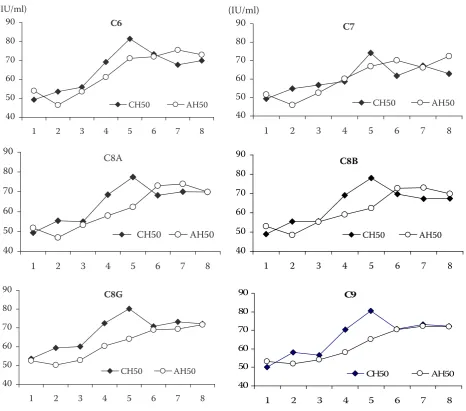
In humans, the genes encoding the proteins of the MAC of the terminal lytic pathway (C5b-9) are required for complement bactericidal activity (Schreiber et al. 1979; Esser 1994). Here only the tendency of expression of C6–9 genotypes on HCA in the classical (CP) and alternative (AP) pathways is described. In the CP, HCA tended to increase on Day 4 after inoculations and then came back close to the innate value before vaccination on Day 10. The highest haemolytic value (from 74.13 ± 5.48 for C7 to 81.50 ± 4.87 for C6) was always reached on day 4 after immunisation with ADV vaccine.
Genetic association of C7, C8A, or C9 geno-types with CH50 was different at 95% significance level. Interaction between genotypes of the C8B and time points of inoculation was also found to be significantly different. There was no significant difference for C6 and C8G. Probably, the C6 and C8G have other roles in formation of the MAC. Actually, it has been suggested that the C8G may not contribute to lysis but rather enhances MAC activity (Schreck et al. 1998, 2000; Figure 2).
not significant. However, in the interaction of geno-types and time points, a significant difference was found for C8A, C8B, and C9 (P < 0.05) (Figure 2).
Initiation of HCA before inoculation with Mh via the CP seemed to be weaker than the AP. But after that it increased faster and became strong-er, especially on Day 4 after ADV vaccination. Perhaps the HCA of the CP must wait for the activation of several factors binding to the C1q, whereas the HCA of the AP can start with the lit-tle available free C3b proteins circulating in blood stream. The linear increasing tendency of the HCA in the AP was similar among the candidate genes, but with many fluctuations in the CP over the experiment, particularly after each inocula-tion. However, a highly significant difference was found between time points of inoculation in both
pathways (P < 0.001). Since the CP is known as the major pathway of the HCA and is supported by lectin and AP, many additional factors, which contribute to complement activation of the CP, have been rec-ognised. For example, the structure of the bacterial membrane, especially protein contents of lipopolysac-charide (LPS)-like lipid A (Morrison and Kline 1977), O-antigen (Merino et al. 1998; Eisenschenk et al. 1999), porin (Loos and Clas 1987; Alberti et al. 1996), kind of vaccine (Bredt et al. 1977), age (Yonemasu et al. 1978; Tyler et al. 1988; Durandy 2003), C-reactive protein (Jiang et al. 1991; Mold et al. 1999), adiponec-tin protein (Peake et al. 2008), and sex (Olaho-Mukani et al. 1995), acute phase response (Wimmers et al. 2003) are strong evidences for this.
The complement system is increasingly activated due to aging as well as accumulation after various
vac-C6
40 50 60 70 80 90
1 2 3 4 5 6 7 8
(IU/ml)
CH50 AH50
C7
40 50 60 70 80 90
1 2 3 4 5 6 7 8
(IU/ml)
CH50 AH50
C8B
40 50 60 70 80 90
1 2 3 4 5 6 7 8
CH50 AH50
C8G
40 50 60 70 80 90
1 2 3 4 5 6 7 8
CH50 AH50
C9
40 50 60 70 80 90
1 2 3 4 5 6 7 8
[image:5.595.67.534.81.492.2]CH50 AH50
Figure 2. Expression tendency of hemolytic complement activity in the classical (CH50) and alternative (AH50) pathway at eight time points of inoculation (Khoa 2010)
C8A
40 50 60 70 80 90
1 2 3 4 5 6 7 8
cinations. The activities of the TCC (C6–9) depend on the activity of other components acting on higher levels of the cascade. Especially the formation of the C3 convertase and subsequently the C5 convertase are keys to the final overall HCA. The release of the C5b from the C5 that binds to the C6–9 to form the MAC is the cause of interaction of different pro-tein sequences in the three pathways of complement activation. The HCA in the AP partly depends on the C3b formed after the complement activation of the CP. Generation of the C3-convertase has strong direct effects on the formation of the MAC. HCA in subsequent time points was higher than in early ones over the course of the experiment due to both antigen-specific and antigen-nonspecific immune responses and responsiveness that accumulated after each vaccination. According to Loos and Brunner (1979), the increase in complement components shortly after infection with Mycoplasma may rep-resent an early unspecific defence mechanism of the host before the specific immune response becomes effective. Of course, complement activation also de-pends on other signals of the immune system like interleukins. Vaccinations are known to affect the acute phase response through cytokines like IL1, IL6 and TGFB1 that are released during the immune response and in particular trigger the expression of C3 (Castell et al. 1989; Mackiewicz et al. 1990; Gonzalez-Ramon et al. 2000).
Unlike other complement components with spe-cific functions, C6–9 assembly has the same func-tion in cell lysis because they are all members of the MAC macromolecule. This means that reciprocal influence among the TCC on HCA is indispensable. Catalytic activity of previous components may af-fect not only the subsequent others but the activity of the whole MAC complex as well. Determining the genetic variation of the TCC C6–9 on HCA in the CP and AP is complicated. It is quite indirect to use CH50 and AH50 for evaluating genetic effects of the terminal complement genes on HCA because direct products at the end of the complement ac-tivation from three pathways (classical, lectin, and alternative) are C5-convertases. However, meas-urement of the CH50 and AH50 has been the best screening test for deficiencies in the complement components of the CP, AP or terminal pathway so far. Besides the genotypes of candidate genes, a number of other factors that affect complement activity were evident in the experiment. These fac-tors have been taken into account when analys-ing the use of adequate statistical models. Some
of these factors may contribute to the fact that the association of the candidate genes was shown for the CH50 but not for the AH50. Therefore, HCA in the CP is stronger than in the AP.
6. Further prospects
Genetic variation had been demonstrated in re-sponse to pathogens or immune system challeng-es (Mallard et al. 1998; Wilkie and Mallard 1999; Henryon et al. 2002) and particularly in the response of pigs to infection with PRRSV (Petry et al. 2005). This study has identified valuable genetic variations between European (German Landrace and Pietrain) and Vietnamese (Muong Khuong) porcine breeds. The genotypes which performed the strong HCA also came from the Muong Khuong. These geno-types, which might have been selected through many generations of the raising of Muong Khuong pigs in bad conditions (no vaccination, insufficient feed and nutrient imbalance, poor hygiene, …), can be considered as candidates for enhancing the natural resistance in pigs in the future. This may represent one of the common good characteristics of local Asian breeds because the Meishan breed also showed variations of complement activities higher than European breeds (Duroc, Landrace and Large White), as a result of natural selection of the host against infectious environmental conditions (Komatsu et al. 1998).
It is recommended that further studies should focus on the genetic association of candidate genes and immune traits to select valuable genotypes, which may then be assembled on multi-SNP-GeneChips and used to select the best individuals for nuclear herds in larger populations of different porcine breeds. The high similarity in molecular structure of the candidate genes among other spe-cies has opened a new way to treat animals and humans with deficiencies of complement compo-nents. Complement proteins can be extracted, puri-fied, produced, and used as commercial medicines/ DNA therapeutic products for disease control.
boosting HCA along the vaccine program. Age is one of the important factors with regard to breed-ing and selection for resistance to diseases.
In summary, the obtained results provide the means for further understanding the role of the TCC in the natural immune response of the host against pathogens. It also highlights C6, C7, C8, and C9 as extremely valuable candidate genes in efforts to genetically improve general animal health, a goal of all breeding programs for food animals.
7. REFERENCES
Alberti S, Marques G, Hernandez-Alles S, Rubires X, Tomas JM, Vivanco F, Benedi VJ (1996): Interaction between complement subcomponent C1q and the Klebsiella pneumoniae porin OmpK36. Infection and Immunity 64, 4719–4725.
Bredt W, Wellek B, Brunner H, Loos M (1977): Interac-tions between mycoplasma pneumoniae and the first components of complement. Infection and Immunity 15, 7–12.
Castell JV, Gomezlechon MJ, David M, Andus T, Geiger T, Trullenque R, Fabra R, Heinrich PC (1989): Interleukin-6 is the major regulator of acute phase protein-synthesis in adult human hepatocytes. FEBS Letters 242, 237–239. Clark LK, Armstrong CH, Freeman MJ, Scheidt AB,
Sandsfreeman L, Knox K (1991): Investigating the transmission of mycoplasma-hyopneumoniae in a swine herd with enzootic pneumonia. Veterinary Medicine (US) 86, 543–550.
Dewald G, Cichon S, Bryant SP, Hemmer S, Nothen MM, Spurr NK (1996): The human complement C8G gene, a member of the lipocalin gene family: Polymorphisms and mapping to chromosome 9q34.3. Annals of Hu-man Genetics 60, 281–291.
DiScipio RG, Linton SM, Rushmere NK (1999): Function of the factor I modules (FIMS) of human complement component C6. Journal of Biological Chemistry 274, 31811–31818.
Durandy A (2003): Ontogeny of the immune system. Transfusion Medicine and Hemotherapy 30, 222–227. Eisenschenk FC, Houle JJ, Hoffmann EM (1999): Mech-anism of serum resistance among Brucella abortus isolates. Veterinary Microbiology 68, 235–244. Eng RHK (1980): Bactericidal screening test for late
com-plement component deficiencies or defects. Journal of Clinical Microbiology 11, 631–634.
Esser AF (1994): The membrane attack complex of com-plement: assembly, structure and cytotoxic activity. Toxicology 87, 229–247.
Flo TH, Smith KD, Sato S, Rodriguez DJ, Holmes MA, Strong RK, Akira S, Aderem A (2004): Lipocalin 2 me-diates an innate immune response to bacterial infec-tion by sequestrating iron. Nature 432, 917–921. Fukumori Y, Horiuchi T (1998): Terminal complement
component deficiencies in Japan. Experimental and Clinical Immunogenetics 15, 244–248.
Gonzalez-Ramon N, Hoebe K, Alava MA, van Leengoed L, Pineiro M, Carmona S, Iturralde M, Lampreave F, Pineiro A (2000): Pig MAP/ITIH4 and haptoglobin are interleukin-6-dependent acute-phase plasma proteins in porcine primary cultured hepatocytes. European Journal of Biochemistry 267, 1878–1885.
Goundis D, Reid KBM (1988): Properdin, the terminal complement components, thrombospondin and the circumsporozoite protein of malaria parasites contain similar sequence motifs. Nature 335, 82–85.
Haeney MR, Thompson RA, Faulkner J, Mackintosh P, Ball AP (1980): Recurrent bacterial-meningitis in pa-tients with genetic-defects of terminal complement components. Clinical and Experimental Immunology 40, 16–24.
Haesebrouck F, Pasmans F, Chiers K, Maes D, Ducatelle R, Decostere A (2004): Efficacy of vaccines against bacterial diseases in swine: what can we expect? Vet-erinary Microbiology 100, 255–268.
Henryon M, Juul-Madsen HR, Berg P (2002): Genetic variation for total and differential numbers of leuko-cytes in growing pigs. In: Proceedings of the 7th World Congress on Genetics Applied to Livestock Produc-tion, INRA, August 19–23, Montpellier, France. Inai S, Akagaki Y, Moriyama T, Fukumori Y, Yoshimura
K, Ohnoki S, Yamaguchi H (1989): Inherited deficien-cies of the late-acting complement components other than c9 found among healthy blood-donors. Interna-tional Archives of Allergy and Applied Immunology 90, 274–279.
Jiang H, Siegel JN, Gewurz H (1991): Binding and com-plement activation by C-reactive protein via the col-lagen-like region of C1q and inhibition of these reactions by monoclonal antibodies to C-reactive pro-tein and C1q. Journal of Immunology 146, 2324–2330. Khoa DVA (2010): Porcine Terminal Complement Genes
C6-9: Molecular Characterization of Terminal Com-plement Genes and their Association With Hemolytic Complement Activity in Pigs. VDM Verlag Dr. Müller Publisher. ISBN-10 3836494019, ISBN-13 978-3-8364-9401-4, ASIN: 3836494019. Berlin, Germany. Komatsu M, Yoshiwara S, Akita T (1998):
Con-gress on Genetics Applied to Livestock Production. Armidale, NSW, Australia, 323–326.
Kumar KG, Ponsuksili S, Schellander K, Wimmers K (2004): Molecular cloning and sequencing of porcine C5 gene and its association with immunological traits. Immunogenetics 55, 811–817.
Loos M, Clas F (1987): Antibody-independent killing of gram-negative bacteria via the classical pathway of complement. Immunological Letters 14, 203–208. Loos M, Brunner H (1979): Complement components
(C1, C2, C3, C4) in bronchial secretions after intrana-sal infection of guinea pigs with Mycoplasma pneu-moniae: dissociation of unspecific and specific defense mechanisms. Infection and Immunity 25, 583–585. Mackiewicz A, Ganapathi MK, Schultz D, Brabenec A,
Weinstein J, Kelley MF, Kushner I (1990): Transform-ing growth factor-beta-1 regulates production of acute-phase proteins. Proceedings of the National Academy of Sciences of the United States of America 87, 1491–1495.
Mallard BA, Wilkie BN, Kennedy BW, Gibson J, Quinton M (1998): Immune responsiveness in swine: eight gen-erations of selection for high and low immune re-sponse in Yorkshire pigs. In: Proceedings of the 6th World Congress on Genetics Applied to Livestock Production. University of New England, Armidale, New South Wales, Australia, 257–264.
McCloskey MA, Dankert JR, Esser AF (1989): Assembly of complement components C5b-8 and C5b-9 on lipid bilayer membranes: visualization by freeze-etch elec-tron microscopy. Biochemistry 28, 534–540.
Merino S, Nogueras MM, Aguilar A (1998): Activation of the complement classical pathway (C1q binding) by mesophilic Aeromonas hydrophila outer membrane protein. Infection and Immunity 66, 3825–3831. Minion FC (2002): Molecular pathogenesis of
myco-plasma animal respiratory pathogens. Frontiers in Bioscience 7, 1410–1422.
Mold C (1998): Cellular responses to the membrane at-tack complex. In: Volanakis JE, Frank MM (eds.): The Human Complement System in Health and Disease. Marcel Dekker, New York. 309–325.
Mold C, Gewurz H, Du Clos TW (1999): Regulation of complement activation by C-reactive protein. Immu-nopharmacology 42, 23–30.
Monahan JB, Sodetz JM (1980): Binding of the eighth component of human complement to the soluble cy-tolytic complex is mediated by its beta subunit. Jour-nal of Biological Chemistry 255, 10579–10582. Morgan BP (1999): Regulation of the complement
mem-brane attack pathway. Critical Reviews in Immunology 19, 173–198.
Morrison DC, Kline LF (1977): Activation of the classi-cal and properdin pathways of complement by bacte-rial lipopolysaccharides (LPS). Journal of Immunology 118, 362–368.
Musingarimi P, Plumb ME, Sodetz JM (2002): Interaction between the C8 alpha-gamma and C8 beta subunits of human complement C8: role of the C8 beta N-ter-minal thrombospondin type 1 module and membrane attack complex/perforin domain. Biochemistry 41, 11255–11260.
O’Leary JM, Bromek K, Black GM, Uhrinova S, Schmitz C, Wang XF, Krych M, Atkinson JP, Uhrin D, Barlow PN (2004): Backbone dynamics of complement control protein (CCP) modules reveals mobility in binding surfaces. Protein Science 13, 1238–1250.
Olaho-Mukani W, Nyang’ao JNM, Kimani JK, Omuse JK (1995): Studies on the haemolytic complement of the dromedary camel (Camelus dromedarius). I. Classical pathway haemolytic activity in serum. Veterinary Im-munology and Immunopathology 46, 337–347. Peake PW, Shen Y, Walther A, Charlesworth JA (2008):
Adiponectin binds C1q and activates the classical pathway of complement. Biochemical and Biophysical Research Communication 367, 560–565.
Parker CL, Sodetz JM (2002): Role of the human C8 subunits in the complement-mediated bacterial killing: evidence that C8 gamma is not essential. Molecular Immunology 39, 453–458.
Petry DB, Holl JW, Weber JS, Doster AR, Osorio FA, Johnson RK (2005): Biological responses to porcine respiratory and reproductive syndrome virus in pigs of two genetic populations. Journal of Animal Science 83, 1494–1502.
Phatsara C, Jennen DGJ, Ponsuksili S, Murani E, Tesfaye D, Schellander K, Wimmers K (2007): Molecular genetic analysis of porcine mannose-binding lectin genes, MBL1 and MBL2, and their association with complement activ-ity. International Journal of Immunogenetics 34, 55–63. Platteborze PL, Hobart MJ, Sodetz JM (1996): Physical
linkage and orientation of the human complement C8a and C8ß genes on chromosome 1p32. Human Genet-ics 98, 443–446.
Rao AG, Sodetz JM (1984): Purification of functional subunits of the eighth component of human comple-ment (C8) under nondenaturing conditions. Comple-ment 1, 182–186.
(2007): A common fold mediates vertebrate defense and bacterial attack. Science 317, 1548–1551. Ross SC, Densen P (1984): Complement deficiency states
and infection: epidemiology, pathogenesis and conse-quences of neisserial and other infections in an im-mune deficiency. Medicine (Baltimore) 63, 243–273. Schreck SF, Plumb ME, Platteborze PL, Kaufman KM,
Michelotti GA, Letson CS, Sodetz JM (1998): Expres-sion and characterization of recombinant subunits of human complement component C8: Further analysis of the function of C8 alpha and C8 gamma. Journal of Immunology 161, 311–318.
Schreck SF, Parker C, Plumb ME, Sodetz JM (2000): Hu-man complement protein C8G. Biochimimica et Bio-physica Acta 1482, 199–208.
Schreiber RD, Morrison DC, Podack ER, Mueller-Eberhard HJ (1979): Bactericidal activity of the alternative comple-ment pathway generated from 11 isolated plasma pro-teins. Journal of Experimental Medicine 149, 870–882. Scolding NJ, Morgan BP, Compston DA (1998): The
ex-pression of complement regulatory proteins by adult human oligodendrocytes. Journal of Neuroimmunol-ogy 84, 69–75.
Slade DJ, Chiswell B, Sodetz JM (2006): Functional studies of the MACPF domain of human complement protein C8alpha reveal sites for simultaneous binding of C8beta, C8gamma, and C9. Biochemistry 45, 5290–5296. Thai CT, Ogata RT (2005): Recombinant C345C and
fac-tor I modules of complement components C5 and C7 inhibit C7 incorporation into the complement mem-brane attack complex. Journal of Immunology 174, 6227–6232.
Tschopp J (1984): Ultrastructure of the membrane attack complex of complement. Heterogeneity of the complex caused by different degree of C9 polymerization. Jour-nal of Biological Chemistry 259, 7857–7863.
Tschopp J, Masson D, Stanley KK (1986): Structural/ functional similarity between proteins involved in complement- and cytotoxic T-lymphocyte-mediated cytolysis. Nature 322, 831–834.
Tyler JW, Cullor JS, Osburn BI, Parker K (1988): Age-related variations in serum concentrations of the third component of complement in swine. Americal Journal of Veterinary Research 49, 1104–1106.
Vazquez-Bermudez MF, Barroso S, Walter K, Alvarez AJ, Alarcon A, Lopez-Trascasa M, Wichmann I, Agu-ilar F, Nunez-Roldan A, Sanchez B (2003): Comple-ment component C7 deficiency in a Spanish family. Clinical and Experimental Immunology 133, 240–246. Vissher AH, Janss LL, Niewold TA, de Greef KH (2002):
Disease incidence and immunological traits for the selection of healthy pigs. A review. Veterinary Quar-terly 24, 29–34.
Wilkie B, Mallard B (1999): Selection for high immune response: an alternative approach to animal health maintenance? Veterinary Immunology and Immuno-pathology 72, 231–235.
Wimmers K, Mekchay S, Schellander K, Ponsuksili S (2003): Molecular characterization of the pig C3 gene and its association with complement activity. Immu-nogenetics 54, 714–724.
Yonemasu K, Kitajima H, Tanabe S, Ochi T, Shinkai H (1978): Effect of age on C1Q and C3 levels in human-serum and their presence in colostrum. Immunology 35, 523–530.
Zhu ZB, Atkinson TP, Hovanky KT, Boppana SB, Dai YL, Densen P, Go RCP, Jablecki JS, Volanakis JE (2000): High prevalence of complement component C6 deficiency among African-Americans in the South-eastern USA. Clinical and Experimental Immunology 119, 305–310.
Received: 2012–01–30 Accepted after corrections: 2013–01–31
Corresponding Author:
Do Vo Anh Khoa, Can Tho University, College of Agriculture and Applied Biology, Department of Animal Sciences, 3/2 street, Xuan Khanh ward, Ninh Kieu district, 92100 Can Tho City, Vietnam