Pre-Computable Multi-Layer Neural Network Language Models
Jacob Devlin Microsoft Research Redmond, WA, USA [email protected]
Chris Quirk Microsoft Research Redmond, WA, USA [email protected]
Arul Menezes Microsoft Research Redmond, WA, USA [email protected]
Abstract
In the last several years, neural network models have significantly improved accu-racy in a number of NLP tasks. How-ever, one serious drawback that has im-peded their adoption in production sys-tems is the slow runtime speed of neu-ral network models compared to alternate models, such as maximum entropy classi-fiers. In Devlin et al. (2014), the authors presented a simple technique for speeding up feed-forward embedding-based neural network models, where the dot product be-tween each word embedding and part of the first hidden layer arepre-computed of-fline. However, this technique cannot be used for hidden layers beyond the first. In this paper, we explore a neural network architecture where the embedding layer feeds into multiple hidden layers that are placed “next to” one another so that each can be pre-computed independently. On a large scale language modeling task, this architecture achieves a 10x speedup at run-time and a significant reduction in perplex-ity when compared to a standard multi-layer network.
1 Introduction
Neural network models have become extremely popular in the last several years for a wide va-riety of NLP tasks, including language model-ing (Schwenk, 2007), sentiment analysis (Socher et al., 2013), translation modeling (Devlin et al., 2014), and many others (Collobert et al., 2011). However, a serious drawback of neural network models is their slow speeds in training and test time (runtime) relative to alternative models such as maximum entropy (Berger et al., 1996) or back-off models (Kneser and Ney, 1995).
One popular application of neural network models in NLP is using neural network language models (NNLMs) as an additional feature in an existing machine translation (MT) or automatic speech recognition (ASR) engines. NNLMs are particularly costly in this scenario, since decoding a single sentence typically requires tens of thou-sands or moren-gram lookups. Although we will focus on this particular scenario in this paper, it is important to note that the techniques presented generalize to any feed-forward embedding-based neural network model.
One popular technique for improving the run-time speed of NNLMs involves training the net-work to be “approximately normalized,” so that the softmax normalizer does not have to be com-puted after training. Two algorithms have been proposed to achieve this: (1) noise-contrastive es-timation (NCE) (Mnih and Teh, 2012; Vaswani et al., 2013) and (2) explicit self-normalization (De-vlin et al., 2014), which is used in this paper.
However, even with self-normalized networks, computing the output of an intermediate hidden layer still requires a costly matrix-vector multipli-cation. To mitigate this, Devlin et al. (2014) made the observation that for 1-layer NNLMs, the dot product between each embedding+position pair and the first hidden layer can bepre-computed af-ter training is complete, which allows the matrix-vector multiplication to be replaced by a hand-ful of vector additions. Using these two tech-niques in combination improves the runtime speed of NNLMs by several orders of magnitude with no degradation to accuracy.
To understand pre-computation, first assume that we are training a NNLM that uses 250-dimensional word embeddings, a four word con-text window, and a 500-dimensional hidden layer. The weight matrix for the first hidden layer is thus 1000×500. For each word in the vocabulary and each of the four positions in the context vector, we
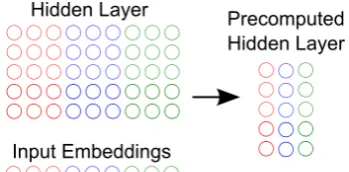
Figure 1: The “pre-computation trick.” The dot product between each word embedding and each section of the hidden layer can be computed of-fline.
Figure 2: Network architectures.
can pre-compute the dot product between the 250-dimensional word embedding and the250×500 section of the hidden layer. This results in four 500-dimensional vectors for each word that can be stored in a lookup table. At test time, we can sim-ply sum four vectors to obtain the output of the first hidden layer. This is shown visually in Fig-ure 1. Note that this isnotan approximation, and the resulting output vector is identical to the orig-inal matrix-vector product. However, the major limitation of the “pre-computation trick” is that it only works with 1-hidden layer architectures, even though more accurate models can nearly always be obtained by training multi-layer networks.
In this paper, we explore a network architecture where multiple hidden layers are placed “next to” one another instead of “on top of” one another, as is usually done. The output of these lateral lay-ers are combined using an inexpensive element-wise function and fed into the output layer. Cru-cially, then, we can apply the pre-computation trick toeachhidden layer independently, allowing for very powerful models that are orders of magni-tude faster at runtime than a standard multi-layer network.
Mathematically, this can be thought of as a gen-eralization of maxout networks (Goodfellow et al., 2013), where different element-wise combination
functions are explored rather than just the max function.
2 Lateral Network
In a standard feed-forward embedding-based neu-ral network, the input tokens are mapped into a continuous vector using an embedding table1, and
this embedding vector is fed into the first hidden layer. The output of each hidden layer is then fed into the next hidden layer. We refer to this as the
stackedarchitecture. For a two layer network, we can represent the output of the final hidden layer as:
H=φ(W2φ(W1E(x)))
wherex is the input vector,E(x) is the output of the embedding layer, Wi is the weight matrix
for layeri, and φis the transfer function such as tanh. Generally,His then multiplied by an output matrix and a softmax is performed to obtain the output probabilities.
In the lateral network architecture, the embed-ding layer is fed into two or more “side-by-side” hidden layers, and the outputs of these hidden lay-ers are combined using an element-wise function such as maximum or multiplication. This is repre-sented as:
H =C(φ(W1E(x)), φ(W2E(x)))
Where C is a combination function that takes two or morek-dimensional vectors as inputs and produces as k-dimensional vector as output. If C(h1, h2) = max(h1, h2) then this is equivalent
to a maxout network (Goodfellow et al., 2013). To generalize this, we explore three different combi-nation functions:2
Cmax(h1, h2) = max(h1, h2)
Cmul(h1, h2) = h1∗(h2+ 1)
Cadd(h1, h2) = h1+h2
The three-or-more hidden layer versions are constructed as expected.3
A visualization is given in Figure 2. Crucially, for the lateral architecture, each hidden layer can be pre-computed independently, allowing for very fastn-gram probability lookups at runtime.
1The embeddings may or may not be trained jointly with the rest of the model.
2Note thatCis an element-wise function, so these repre-sent the operation on a single dimension of the input vectors.
3The + 1 inC
mulis used for all hidden layers after the
[image:2.595.81.282.232.336.2]3 Language Modeling Results
In this section we report results on a large scale language modeling task.
3.1 Data
Our LM training corpus consists of 120M words from the New York Times portion of the English GigaWord data set. This was chosen instead of the commonly used 1M word Penn Tree Bank corpus in order to better represent real world LM training scenarios. We use all data from 2008 and 2009 as training, the first 100k words from June 2010 as validation, and the first 100k words from Decem-ber 2010 as test. The data is segmented and to-kenized using the Stanford Word Segmenter with default settings.
3.2 Neural Network Training
Training was performed with an in-house toolkit using stochastic gradient descent. The vocab-ulary is limited to 16k words so that the out-put layer can be trained using a basic softmax with self-normalization. All experiments use 250-dimensional word embeddings and atanh activa-tion funcactiva-tion. The weights were initialized in the range [-0.05, 0.05], the batch size was 256, and the initial learning rate was 0.25.
3.3 5-gram LM Perplexity
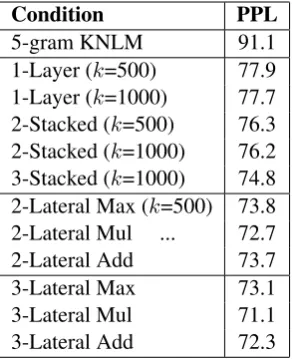
5-gram results are shown in Table 1. The 1-layer NNLM achieves a 13.2 perplexity improvement over the Kneser-Ney smoothed baseline (Kneser and Ney, 1995). Consistent with Schwenk et al. (2014), using additional hidden layers to the stacked (standard) network results in 2.0-3.0 per-plexity improvements on top of the 1-layer model. The lateral architecture significantly outper-forms any of the stacked networks, achieving a 6.5 perplexity reduction over the 1-layer model. The multiplicative combination function performs better than the additive and max functions by a small margin, which suggests that it better allows for modeling complex relationships between input words.
Perhaps most surprisingly, the additive function performs as well as the max function, despite the fact that it provides no additional modeling power compared to a 1-layer network. However, it does allow the model togeneralizebetter than a 1-layer network by explicitly tying together two or three hidden nodes from each node in the output layer.
Condition PPL
[image:3.595.344.491.62.242.2]5-gram KNLM 91.1 1-Layer (k=500) 77.9 1-Layer (k=1000) 77.7 2-Stacked (k=500) 76.3 2-Stacked (k=1000) 76.2 3-Stacked (k=1000) 74.8 2-Lateral Max (k=500) 73.8 2-Lateral Mul ... 72.7 2-Lateral Add 73.7 3-Lateral Max 73.1 3-Lateral Mul 71.1 3-Lateral Add 72.3
Table 1: Perplexity of 5-gram models on the New York Times test set. k is the size of the hidden layer(s).
3.4 Runtime Speed
The runtime speed of the various models is shown in Table 2. These are computed on a single core of a E5-2650 2.6 GHz CPU. Con-sistent with Devlin et al. (2014), we see that the baseline model achieves only 230 n-gram lookups per second (LPS) at test time, while the pre-computed, self-normalized 1-layer network achieves 600,000 LPS. Adding a second stacked layer slows this down to 24,000 LPS due to the 500×500matrix-vector multiplication that must be performed. However, the lateral configura-tion achieves 305,000 LPS while obtaining a bet-ter perplexity than the stacked network. In com-parison, the fastest backoff LM implementation, KenLM (Heafield, 2011), achieves 1-2 million lookups per second.
In terms of memory usage, it is difficult to fairly compare backoff LMs and NNLMs because neural networks scale linearly with the vocabulary size, while backoff LMs scale linearly with the num-ber of unique n-grams. In this case, the non-precomputed neural network model is 25 MB, and the pre-computed 2-lateral network is 136 MB.4
The KenLM models are 1.1 GB for the Probing model and 317 MB for the Trie model. With a vocabulary of 50k, the 2-lateral network would be 425MB. In general, a pre-computed NNLM is comparable to or smaller than an equivalent back-off LM in terms of model size.
Condition Lookups Per Sec.
KenLM Probing 1,923,000 KenLM Trie 950,000 1-Layer (No PC, No SN) 230 1-Layer (No PC) 13,000
1-Layer 600,000
2-Stacked 24,000
[image:4.595.93.273.61.200.2]2-Stacked (Batch=128) 58,000 2-Lateral Mul 305,000
Table 2: Runtime speed of the 5-gram LM on a single CPU core. “PC” = pre-computation, “SN” = self-normalization, which are used in all but the first two experiments. The batch size is 1 except when specified. 500-dimensional hidden layers are used in all cases. “Float Ops.” is the ap-proximate number of floating point operations per lookup.
3.5 High-Order LM Perplexity
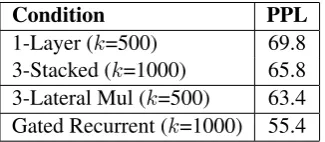
We also report results on a 10-gram LM trained on the same data, to explore whether the lateral network can achieve an even higher relative gain when a large input context window is available. Results are shown in Table 3. Although there is a large absolute improvement over the 5-gram LM, the relative improvement between the 1-layer, 3-stacked, and 3-lateral systems are similar to the 5-gram scenario.
Condition PPL
[image:4.595.310.525.63.173.2]1-Layer (k=500) 69.8 3-Stacked (k=1000) 65.8 3-Lateral Mul (k=500) 63.4 Gated Recurrent (k=1000) 55.4
Table 3: Perplexity of 10-gram models on the New York Times test set. The Gated Recurrent model uses the full word history.
As another point of comparison we report re-sults with an gated recurrent network (Cho et al., 2014). As is consistent with the literature, the recurrent network significantly outperforms any of the feed-forward models (Sundermeyer et al., 2013).
However, recurrent models have two major downsides. First, they cannot easily be integrated into existing MT/ASR engines without signifi-cantly altering the search algorithm and search
Condition Test BLEU Test PPL
Baseline 37.95
-+NNLM 1-Layer 38.89 138.3 +NNLM 2-Stacked 39.13 136.2 +NNLM 2-Lateral 39.15 132.3 +NNJM 1-Layer 40.71 6.33 +NNJM 2-Stacked 40.82 6.25 +NNJM 2-Lateral 40.89 6.13
Table 4: Results on English-German machine translation test set.
space, since they require a fully expanded tar-get context. Second, the matrix-vector product between the previous hidden state and the hid-den weight matrix cannot be pre-computed, which makes the models significantly slower than pre-computable feed-forward networks.
4 Machine Translation Results
Although the lateral networks achieve a significant reduction in LM perplexity over the 1-layer net-work, it is not clear how much this will improved performance in a downstream task. To evaluate this, we trained two neural network models for use as additional features in a machine translation (MT) system.
The first feature is a 5-gram NNLM, which used 1000 dimensions for the stacked network and 500 for the lateral network. The second feature is a neural network joint model (NNJM), which pre-dicts each target word using 5-gram target context
and 7-gram source context. For evaluation, we present both the model perplexity and the BLEU score when using the model as an additional MT feature.
Results are presented on a large scale English-German speech translation task. The parallel train-ing data consists of 600M words from a variety of sources, including OPUS (Tiedemann, 2012) and a large in-house web crawl. The baseline 4-gram Kneser-Ney smoothed LM is trained on 7B words of German data. The NNLM and NNTMs are trained only on the parallel data. Our MT decoder is a proprietary engine similar to Moses (Koehn et al., 2007). The tuning set consists of 4000 utter-ances from conversational and newswire data, and the test set consists of 1500 sentences of collected conversational data.
[image:4.595.101.264.493.564.2]seen in the English NYT data, and that improve-ments in BLEU over a 1-layer model are small but consistent. There is not a significant difference in BLEU between the 2-Stacked and 2-Lateral con-figuration.
5 Conclusion
In this paper, we explored an alternate architec-ture for embedding-based neural network models which allows for a fully pre-computable network with multiple hidden layers. The resulting mod-els achieve better perplexity than a standard multi-layer networkandis at least an order of magnitude faster at runtime.
In future work, we can assess the impact of this model on a wider array of feed-forward embedding-based neural network models, such as the DSSM (Huang et al., 2013).
References
Adam L Berger, Vincent J Della Pietra, and Stephen A Della Pietra. 1996. A maximum entropy ap-proach to natural language processing. Computa-tional linguistics.
Kyunghyun Cho, Bart van Merrienboer, C¸aglar G¨ulc¸ehre, Fethi Bougares, Holger Schwenk, and Yoshua Bengio. 2014. Learning phrase representa-tions using RNN encoder-decoder for statistical ma-chine translation. CoRR.
Ronan Collobert, Jason Weston, L´eon Bottou, Michael Karlen, Koray Kavukcuoglu, and Pavel Kuksa. 2011. Natural language processing (almost) from scratch. The Journal of Machine Learning Re-search.
Jacob Devlin, Rabih Zbib, Zhongqiang Huang, Thomas Lamar, Richard Schwartz, and John Makhoul. 2014. Fast and robust neural network joint models for sta-tistical machine translation. InACL.
Ian J Goodfellow, David Warde-Farley, Mehdi Mirza, Aaron Courville, and Yoshua Bengio. 2013. Max-out networks. arXiv preprint arXiv:1302.4389. Kenneth Heafield. 2011. Kenlm: Faster and smaller
language model queries. InProceedings of the Sixth Workshop on Statistical Machine Translation. Po-Sen Huang, Xiaodong He, Jianfeng Gao, Li Deng,
Alex Acero, and Larry Heck. 2013. Learning deep structured semantic models for web search using clickthrough data. InProceedings of the 22nd ACM international conference on Conference on informa-tion & knowledge management. ACM.
Reinhard Kneser and Hermann Ney. 1995. Im-proved backing-off for m-gram language modeling.
InAcoustics, Speech, and Signal Processing, 1995. ICASSP-95., 1995 International Conference on. Philipp Koehn, Hieu Hoang, Alexandra Birch, Chris
Callison-Burch, Marcello Federico, Nicola Bertoldi, Brooke Cowan, Wade Shen, Christine Moran, Richard Zens, et al. 2007. Moses: Open source toolkit for statistical machine translation. InProc. Assoc. for Computational Linguistics (ACL). Andriy Mnih and Yee Whye Teh. 2012. A fast and
simple algorithm for training neural probabilistic language models. In Proceedings of the Interna-tional Conference on Machine Learning.
Holger Schwenk, Fethi Bougares, and Loıc Barrault. 2014. Efficient training strategies for deep neural network language models. In NIPS Workshop on Deep Learning and Representation Learning. Holger Schwenk. 2007. Continuous space language
models. Computer Speech & Language.
Richard Socher, Alex Perelygin, Jean Y Wu, Jason Chuang, Christopher D Manning, Andrew Y Ng, and Christopher Potts. 2013. Recursive deep mod-els for semantic compositionality over a sentiment treebank. InEMNLP.
Martin Sundermeyer, Ilya Oparin, Jean-Luc Gauvain, Ben Freiberg, Ralf Schluter, and Hermann Ney. 2013. Comparison of feedforward and recurrent neural network language models. In Proc. Conf. Acoustics, Speech and Signal Process. (ICASSP). J¨org Tiedemann. 2012. Parallel data, tools and
inter-faces in opus. InLREC.