Morphological Analysis for Unsegmented Languages
using Recurrent Neural Network Language Model
Hajime Morita1,2 Daisuke Kawahara1 Sadao Kurohashi1,2 1Kyoto University 2 CREST, Japan Science and Technology Agency
{hmorita, dk, kuro}@i.kyoto-u.ac.jp
Abstract
We present a new morphological analy-sis model that considers semantic plausi-bility of word sequences by using a re-current neural network language model (RNNLM). In unsegmented languages, since language models are learned from automatically segmented texts and in-evitably contain errors, it is not apparent that conventional language models con-tribute to morphological analysis. To solve this problem, we do not use language mod-els based on raw word sequences but use a semantically generalized language model, RNNLM, in morphological analysis. In our experiments on two Japanese corpora, our proposed model significantly outper-formed baseline models. This result indi-cates the effectiveness of RNNLM in mor-phological analysis.
1 Introduction
In contrast to space-delimited languages like En-glish, word segmentation is the first and most cru-cial step for natural language processing (NLP) in unsegmented languages like Japanese, Chinese, and Thai (Kudo et al., 2004; Kaji and Kitsure-gawa, 2014; Shen et al., 2014; Kruengkrai et al., 2006). Word segmentation is usually performed jointly with related analysis: POS tagging for Chi-nese, and POS tagging and lemmatization (anal-ysis of inflected words) for Japanese. Morpho-logical analysis including word segmentation has been widely and actively studied, and for exam-ple, Japanese word segmentation accuracy is in the high 90s. However, we often observe that strange outputs of downstream NLP applications such as machine translation and question answering come from incorrect word segmentations.
For example, the state-of-the-art and popu-lar Japanese morphological analyzers, JUMAN
(Kurohashi and Kawahara, 2009) and MeCab (Kudo et al., 2004) both analyze “外国人参政権
(foreigner’s right to vote)” not into the correct seg-mentation of (1a), but into the incorrect and awk-ward segmentation of (1b).
(1) a. 外国 /人
foreigner /right to vote参政 /権
b. 外国
foreign /人参carrot/regime政権
JUMAN is a rule-based morphological analyzer, defining word-to-word (including inflection) con-nectivities and their scores. MeCab is a supervised morphological analyzer, learning the probabilities of word/POS/inflection sequence from an anno-tated corpus of tens of thousands of sentences. Both systems, however, cannot realize semanti-cally appropriate analysis, and often produce to-tally strange outputs like the above.
This paper proposes a semantically appropriate morphological analysis method for unsegmented languages using a language model. For unseg-mented languages, morphological analysis and language modeling form a chicken-and-egg prob-lem. That is, if high-quality morphological analy-sis is available, we can learn a high-quality lan-guage model from a morphologically analyzed large corpus. On the other hand, if a high-quality language model is available, we can achieve high-quality morphological analysis by looking for a segmented word sequence with a large language model score. However, even if we learn a language model from a corpus analyzed by a certain level of morphological analyzer, the language model is affected by the analysis errors of the morphologi-cal analyzer and it is no practimorphologi-cal use for the im-provement of the morphological analyzer. A lan-guage model trained by incorrectly segmented “外 国(foreign)/人参(carrot)/政権(regime)” just
sup-ports that incorrect segmentation.
The point of the paper is that we have tackled the chicken-and-egg problem, not by using a
(foreign) (carrot) (regime)
EOS
国人
(a person name) 参政 (voting)
を (particle)
論
(discuss)
noun noun
verb past form
noun noun noun
外国 人参 政権
論じる
じ た
を
外
国
人
参
政
権
国
外 人 参 政 権
(right) (three)
(person) (country)
(out) (politics)
noun noun noun noun noun noun
BOS
[image:2.595.112.490.63.167.2]Input:
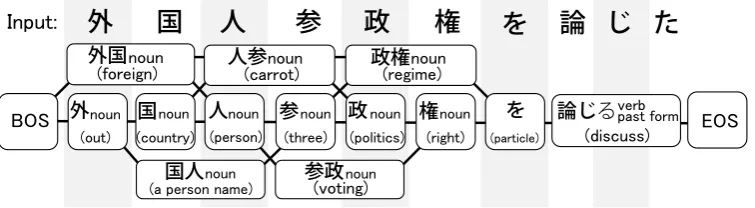
Figure 1: An example of a word lattice.
guage model of raw word sequences, but by using a semantically generalized language model based on word embeddings, RNNLM (Recurrent Neural Network Language Model) (Mikolov et al., 2010; Mikolov et al., 2011). The RNNLM is trained on an automatically analyzed corpus of ten million sentences, which possibly includes incorrect seg-mentations such as “外国(foreign)/人参(carrot)/ 政権(regime).” However, on semantically
gener-alized level, it is an unnatural semantic sequence like nation vegetable politics. Since the state-of-the-art morphological analyzer achieves the high accuracy, it does not often produce incorrect anal-yses which support such a semantically strange se-quence. This would prefer analysis toward seman-tically appropriate word sequences. When a mor-phological analyzer utilizes such a generalized and reasonable language model, it can penalize strange segmentations like “外国(foreign)/人参(carrot)/ 政権(regime),” leading to better accuracy.
We furthermore retrain RNNLM using an an-notated corpus of manually segmented 45k sen-tences, which further improves morphological analysis.
2 Related Work
There have been several studies that have inte-grated language models into morphological anal-ysis. Wang et al. (2011) improved Chinese word segmentation and POS tagging by using N-gram features learned from an automatically segmented corpus. However, since the auto-segmented cor-pus inevitably contains segmentation errors, fre-quent N-grams are not always correct and thus this problem might affect the performance of morphological analysis. They also divided N-gram frequencies into three binned features: high-frequency, middle-frequency and low-frequency. Such coarse features cannot express slight differ-ences in the likelihood of language models.
Kaji and Kitsuregawa (2014) used a bigram lan-guage model feature for Japanese word segmenta-tion and POS tagging. Their objective of using a language model is to normalize informally spelled words in microblogs. Therefore, their objective is different from ours.
Some studies have used character-based lan-guage models for Chinese word segmentation and POS tagging (Zheng et al., 2013; Liu et al., 2014). Although their approaches have no drawbacks of learning incorrect segmentations, they only cap-ture more local information than word-based lan-guage models.
Word embeddings have been also used for mor-phological analysis. Neural network based models have been proposed for Chinese word segmenta-tion and POS tagging (Pei et al., 2014) or word segmentation (Mansur et al., 2013). These meth-ods acquire word embeddings from a corpus, and then use them as the input of the neural networks. Our proposed model learns word embeddings via RNNLM, and these embeddings are used for scor-ing word transitions in morphological analysis. Our usage of word embeddings is different from the previous studies.
3 Proposed Method
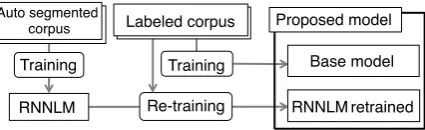
We propose a new morphological analysis model that considers semantic plausibility of word se-quences by using RNNLM. We integrate RNNLM into morphological analysis (Figure 2). We train the RNNLM using both an automatically analyzed corpus and a manually labeled corpus.
3.1 Recurrent Neural Network Language Model
RNNLM Re-training RNNLMretrained
Training Training Base model
Labeled corpus
Auto segmented
corpus Proposed model
Figure 2: Workflow for training RNNLM and base model.
employ the RNNME language model1 proposed
by (Mikolov et al., 2011; Mikolov, 2012) as the implementation of RNNLM. The RNNME lan-guage model has direct connections from the input layer of the recurrent neural network to the output layer, which act as a maximum entropy model and avoid to waste a lot of parameters to describe sim-ple patterns. Hereafter, we refer to the RNNME language model simply as RNNLM.
To train RNNLM, we use a raw corpus of 10 million sentences from the web corpus (Kawa-hara and Kurohashi, 2006). These sentences are automatically segmented by JUMAN (Kurohashi and Kawahara, 2009). The training of RNNLM is based on lemmatized word sequences without POS tags.
The trained model contains errors caused by an automatically analyzed corpus. We retrain RNNLM using a manually labeled corpus after training RNNLM using the automatically ana-lyzed corpus as shown in Figure 2. The retraining aims to cope with errors related to function word sequences.
3.2 Base Model
For our base model, we adopt a model for su-pervised morphological analysis, which performs segmentation, lemmatization and POS tagging jointly. We train this model using a tagged cor-pus of tens of thousands of sentences that contain gold segmentations, lemmas, inflection forms and POS tags. To predict the most probable sequence of words with lemmas and POS tags given an input sentence, we execute the following procedure:
1. Look up the string of the input sentence using a dictionary.
2. Make a word lattice.
3. Search for the path with the highest score from the lattice.
[image:3.595.78.291.63.128.2]1RNNME is the abbreviation of Recurrent Neural Net-work trained jointly with Maximum Entropy model.
Figure 1 illustrates the constructed lattice during the procedure. At the dictionary lookup step, we use the basic dictionary of JUMAN and an ad-ditional dictionary comprising 0.8 million words, both of which have lemma, POS and inflection in-formation. The additional dictionary mainly con-sists of itemizations in articles and article titles in Japanese Wikipedia.
We define the scoring function as follows: scoreB(y) = Φ(y)· ⃗w, (1)
where y is a tagged word sequence, Φ(y) is a feature vector for y, and ⃗w is a weight vector. Each element in ⃗w gives a weight to its corre-sponding feature in Φ(y). We use the unigram and the bigram features composed from word base form, POS and inflection described in Kudo et al. (2004). We also use additional lexical features such as character type, and trigram features used in Zhang and Clark (2008). To learn the weight vector, we adopt exact soft confidence-weighted learning (Wang et al., 2012).
To consider out-of-vocabulary (OOV) words that are not found in the dictionary, we automat-ically generate words at the lookup step by seg-menting the input string by character types2. For
training, we regard words that are not found in the dictionary but found in the training corpus as OOV words to learn their weights.
3.3 RNNLM Integrated Model
Based on retrained RNNLM, we calculate an RNNLM score (scoreR(y)) to be integrated into
the base model. The RNNLM score is defined as the log probability of the next word given its con-text (path). Here, the score for an OOV word is given by the following formula:
−Cp−Lp·length(n), (2)
where Cp is a constant penalty for OOV words, Lpis a factor for the character length penalty, and length(n)returns the character length of the next wordn. This formula is defined to penalize longer words, which are likely to produce segmentation errors.
We then integrate the RNNLM score into the base model using the following equation:
scoreI(y) = (1−α)scoreB(y) +αscoreR(y),
whereαis an interpolation parameter that is tuned on development data.
For decoding, we employ beam search as used in Zhang and Clark (2008). Since the possi-ble context (paths in the word lattice) consid-ered in RNNLM falls into combinatorial explosion in morphological analysis, we keep only prob-able context candidates inside the beam. That is, each node keeps candidates inside the beam width. Each candidate has a vector represent-ing context, and two words of history. The re-current model makes decoding harder than non-recurrent neural network language models. How-ever, we use RNNLM because the model outper-forms other NNLMs (Mikolov, 2012) and the re-sult suggests that the model is more likely to cap-ture semantic plausibility. Since a sentence rarely contains ambiguous and semantically appropriate word sequences, we think that beam search with enough beam size is able to keep the ambiguous candidates of word sequences. In the case of non-recurrent NNLMs and the base model, which uses trigram features, we can conduct exact decoding using the second-order Viterbi algorithm (Thede and Harper, 1999).
4 Experiments
4.1 Experimental Settings
In our experiments, we used the Kyoto University Text Corpus (Kawahara et al., 2002) and Kyoto University Web Document Leads Corpus (Hangyo et al., 2012) as manually tagged corpora. We ran-domly chose 2,000 sentences from each corpus for test data, and 500 sentences for development data. We used the remaining part of the corpora as training data to train our base model and retrain RNNLM. In total, we used 45,000 sentences for training.
For comparative purposes, we used the follow-ing four baselines: the Japanese morphological alyzer JUMAN, the supervised morphological an-alyzer MeCab, the base model, and a model using a conventional language model. For this language model, we built a trigram language model with Kneser-Ney smoothing using SRILM (Stolcke, 2002) from the same automatically segmented cor-pus. The language model is modified to have an interpolation parameter α and length penalty for OOV,Lp.
We set the beam width to 5 by preliminary ex-periments. We also set a constant penalty for OOV
words (Cp) as 5, which is the default value in
the implementation of Mikolov et al. (2011). We tuned the parameters of our proposed model and the baseline model (αandLp) and the parameters
of language models using grid search on the de-velopment data. We setα = 0.3,Lp =1.5 for the
proposed model (“ Base + RNNLMretrain”).3 We measured the performance of the baseline models and the proposed model by F-value of word segmentation and F-value of joint evaluation of word segmentation and POS tagging. We calcu-lated F-value for the two corpora (news and web) and the merged corpus (all).
We used the bootstrapping method (Zhang et al., 2004) to test statistical significance between proposed models and other models. Suppose we have a test set T that includesN sentences. The method repeatedly createsM new test sets by re-samplingN sentences with replacement fromT. We calculate the F-value of each model onM+ 1
test sets including T, and then we have M + 1
score differences. From the scores, we calculate the 95% confidence interval. If the interval does not overlap with zero, the two models are consid-ered as statistically significantly different. In our evaluation, M is set to 2,000.
4.2 Results and Discussions
Table 1 lists the results of our proposed model and the baseline models. Our proposed model (“Base + RNNLMretrain”) significantly outperforms all the
baseline models and “Base + RNNLM,” which does not use retraining. In particular, we achieved a large improvement for segmentation. This can be attributed to the use of RNNLM that was learned based on lemmatized word sequence without POS tags.
“Base + SRILM” segmented the example de-scribed in Section 1 (“外国人参政権”) into the
incorrect segmentation “外国/人参/政権” in the
same way as JUMAN. This segmentation error was caused by errors in the automatically seg-mented corpus that was used to train the language model. Our proposed model can correctly seg-ment this example if a proper context is available by semantically capturing word transitions using RNNLM.
The base model, JUMAN and “Base + SRILM” incorrectly segmented “健康(healthy)/など(etc.)/
Segmentation Seg + POS Segmentation Seg + POS Segmentation Seg + POS (news) (news) (web) (web) (all) (all)
JUMAN 98.92 98.47 98.20 97.64 98.64 98.14
MeCab 99.07 98.58 98.22 97.51 98.74 98.16
Base model 98.94 98.46 97.71 96.90 98.46 97.85
Base + SRILM 98.94 98.40 98.13 97.33 98.62 97.98
Base + RNNLM 99.06 98.59 98.17 97.45 98.71 98.14
Base + RNNLMretrain 99.15∗ 98.70∗ 98.37∗ 97.68∗ 98.84∗ 98.30∗
Table 1: Results for test datasets.∗means the score of “Base + RNNLMretrain” is significantly improved from that of all other models.
の(of)/点(point)/で(in)/……” (in terms of health
and so on) into “健康 な(healthy)/どの(any)/点
(point)/で(in)/…….” Although this segmentation
can be grammatically accepted, it is difficult to semantically interpret this word sequence. Our proposed model can correctly segment this exam-ple because RNNLM learns semantically plausible word sequences.
5 Conclusion
In this paper, we proposed a new model for morphological analysis that is integrated with RNNLM. We trained RNNLM on an automati-cally segmented corpus and tuned on a manually tagged corpus. The proposed model was able to significantly reduce errors in the base model by capturing semantic plausibility of word sequences using RNNLM. In the future, we will design fea-tures derived from RNNLM models, and integrate them into a unified learning framework. We also intend to apply our method to unsegmented lan-guages other than Japanese, such as Chinese and Thai.
References
Masatsugu Hangyo, Daisuke Kawahara, and Sadao Kurohashi. 2012. Building a diverse document leads corpus annotated with semantic relations. In
Proceedings of the 26th Pacific Asia Conference on Language, Information, and Computation, pages 535–544.
Nobuhiro Kaji and Masaru Kitsuregawa. 2014. Ac-curate word segmentation and POS tagging for japanese microblogs: Corpus annotation and joint
modeling with lexical normalization. In
Proceed-ings of the 2014 Conference on Empirical Methods in Natural Language Processing (EMNLP), pages 99–109, Doha, Qatar. Association for Computa-tional Linguistics.
Daisuke Kawahara and Sadao Kurohashi. 2006.
Case frame compilation from the web using
high-performance computing. InProceedings of the 5th
International Conference on Language Resources and Evaluation, pages 1344–1347.
Daisuke Kawahara, Sadao Kurohashi, and Kˆoiti
Hasida. 2002. Construction of a Japanese
relevance-tagged corpus. In Proceedings of the
Third International Conference on Language Re-sources and Evaluation (LREC-2002), Las Palmas, Canary Islands - Spain, May. European Language Resources Association (ELRA). ACL Anthology Identifier: L02-1302.
Canasai Kruengkrai, Virach Sornlertlamvanich, and Hitoshi Isahara. 2006. A conditional random field
framework for Thai morphological analysis. In
Pro-ceedings of LREC, pages 2419–2424.
Taku Kudo, Kaoru Yamamoto, and Yuji Matsumoto.
2004. Applying conditional random fields to
Japanese morphological analysis. In Proceedings
of the Conference on Emprical Methods in Natural Language Processing (EMNLP 2004), volume 2004. Sadao Kurohashi and Daisuke Kawahara, 2009.
Japanese Morphological Analysis System JUMAN
6.0 Users Manual. http://nlp.ist.i.
kyoto-u.ac.jp/EN/index.php?JUMAN.
Xiaodong Liu, Kevin Duh, Yuji Matsumoto, and To-moya Iwakura. 2014. Learning character
repre-sentations for Chinese word segmentation. InNIPS
2014 Workshop on Modern Machine Learning and Natural Language Processing.
Mairgup Mansur, Wenzhe Pei, and Baobao Chang. 2013. Feature-based neural language model and
Chinese word segmentation. In Proceedings of
the Sixth International Joint Conference on Natural Language Processing, pages 1271–1277, Nagoya, Japan, October. Asian Federation of Natural Lan-guage Processing.
Tomas Mikolov, Martin Karafi´at, Lukas Burget, Jan Cernock`y, and Sanjeev Khudanpur. 2010.
Recur-rent neural network based language model. In
IN-TERSPEECH 2010, 11th Annual Conference of the International Speech Communication Association, Makuhari, Chiba, Japan, September 26-30, 2010, pages 1045–1048.
models. InProceedings of ASRU 2011, pages 196– 201. IEEE Automatic Speech Recognition and Un-derstanding Workshop.
Tomas Mikolov. 2012. Statistical language models
based on neural networks. Ph.D. thesis, Brno uni-versity of technology.
Wenzhe Pei, Tao Ge, and Baobao Chang. 2014. Max-margin tensor neural network for Chinese word
seg-mentation. InProceedings of the 52nd Annual
Meet-ing of the Association for Computational LMeet-inguis- Linguis-tics, ACL 2014, June 22-27, 2014, Baltimore, MD, USA, Volume 1: Long Papers, pages 293–303.
Mo Shen, Hongxiao Liu, Daisuke Kawahara, and Sadao Kurohashi. 2014. Chinese Morphological
Analysis with Character-level POS Tagging. In
Pro-ceedings of the 52nd Annual Meeting of the Associa-tion for ComputaAssocia-tional Linguistics (Volume 2: Short Papers), pages 253–258, Baltimore, Maryland. As-sociation for Computational Linguistics.
Andreas Stolcke. 2002. SRILM - an extensible lan-guage modeling toolkit. In John H L Hansen and
Bryan L Pellom, editors,7th International
Confer-ence on Spoken Language Processing, ICSLP2002 - INTERSPEECH 2002, Denver, Colorado, USA, September 16-20, 2002, pages 901–904. ISCA.
Scott M. Thede and Mary P. Harper. 1999. A second-order Hidden Markov Model for part-of-speech
tag-ging. In Proceedings of the 37th annual meeting
of the Association for Computational Linguistics on Computational Linguistics, pages 175–182, Morris-town, NJ, USA, June. Association for Computa-tional Linguistics.
Yiou Wang, Jun’ichi Kazama, Wenliang Chen, Yu-jie Zhang, Kentaro Torisawa, and Yoshimasa Tsu-ruoka. 2011. Improving chinese word segmenta-tion and POS tagging with semi-supervised
meth-ods using large auto-analyzed data. InProceedings
of the Fifth International Joint Conference on Nat-ural Language Processing (IJCNLP-2011), pages 309–317, Chiang Mai, Thailand. Asian Federation of Natural Language Processing.
Jialei Wang, Peilin Zhao, and Steven C.H. Hoi. 2012. Exact soft confidence-weighted learning. In
29th International Conference on Machine Learning (ICML 2012), pages 121–128.
Yue Zhang and Stephen Clark. 2008. Joint word seg-mentation and pos tagging using a single perceptron. In Proceedings of ACL-08: HLT, pages 888–896, Columbus, Ohio, June. Association for Computa-tional Linguistics.
Ying Zhang, Stephan Vogel, and Alex Waibel. 2004. Interpreting bleu/nist scores: How much
improve-ment do we need to have a better system? In
Pro-ceedings of the Fourth International Conference on Language Resources and Evaluation (LREC-2004),
Lisbon, Portugal, May. European Language Re-sources Association (ELRA). ACL Anthology Iden-tifier: L04-1489.
Xiaoqing Zheng, Hanyang Chen, and Tianyu Xu. 2013. Deep learning for Chinese word
segmen-tation and POS tagging. In Proceedings of the