A Model of Individual Differences in Gaze Control During Reading
Niels Landwehr1 and Sebastian Arzt1 and Tobias Scheffer1 and Reinhold Kliegl2 1 Department of Computer Science, Universit¨at Potsdam
August-Bebel-Straße 89, 14482 Potsdam, Germany {landwehr, sarzt, scheffer}@cs.uni-potsdam.de 2Department of Psychology, Universit¨at Potsdam Karl-Liebknecht-Straße 24/25, 14476 Potsdam OT/Golm
Abstract
We develop a statistical model of saccadic eye movements during reading of isolated sentences. The model is focused on rep-resenting individual differences between readers and supports the inference of the most likely reader for a novel set of eye movement patterns. We empirically study the model for biometric reader identifica-tion using eye-tracking data collected from 20 individuals and observe that the model distinguishes between 20 readers with an accuracy of up to 98%.
1 Introduction
During skilled reading, the eyes of a reader do not move smoothly over a text. Instead, read-ing proceeds by alternatread-ing between brief fixations on individual words and short ballistic movements calledsaccadesthat move the point of fixation to a new location. Evidence in psychological research indicates that patterns of fixations and saccades are driven partly by low-level visual cues (e.g., word length), and partly by linguistic and cognitive pro-cessing of the text (Kliegl et al., 2006; Rayner, 1998).
Eye-movement patterns are frequently studied in cognitive psychology as they provide a rich and detailed record of the visual, oculomotor, and linguistic processes involved in reading. Com-putational models of eye-movement control de-veloped in psychology, such as SWIFT (Engbert et al., 2005; Schad and Engbert, 2012) or E-Z Reader (Reichle et al., 1998; Reichle et al., 2012), simulate the generation of eye movements based on physiological and psychological constraints re-lated to attention, visual perception, and the ocu-lomotor system. Recently, the problem of mod-eling eye movements has also been approached
from a machine-learning perspective. Matties and Søgaard (2013) and Hara et al. (2012) study con-ditional random field models to predict which words in a text are fixated by a reader. Nilsson and Nivre (2009) use a transition-based log-linear model to predict a sequence of fixations for a text. A central observation made by these studies, as well as by earlier psychological work (Erdmann and Dodge, 1898; Huey, 1908), is that eye move-ment patterns vary significantly between individ-uals. As one example of the strength of indi-vidual differences in reading eye movements, we cite Dixon (1951) who compared the reading pro-cesses of university professors and graduate stu-dents of physics, education, and history on read-ing material in their own and the two other fields. He did not find strong effects of his experimen-tal variables (i.e., field of research, expertise in re-search) but “if there is one thing that this study has shown, it is that individual differences in read-ing skill existed among the subjects of all depart-ments. Fast and slow readers were found in every department, and the overlapping of distributions from passage to passage was enormous” (p. 173). Even though it is possible to predict across a large base of readers with some accuracy whether spe-cific words will be fixated (Matties and Søgaard, 2013), a strong variation between readers in at-tributes such as the fraction of skipped words and total number of saccades has been observed (Hara et al., 2012).
Some recent work has studied eye movement patterns as a biometric feature. Most studies are based on an artificial visual stimulus, such as a moving (Kasprowski and Ober, 2004; Komogort-sev et al., 2010; Rigas et al., 2012b; Zhang and Juhola, 2012) or fixed (Bednarik et al., 2005) dot on a computer screen, or a specific image stimu-lus (Rigas et al., 2012a). In the most common use
case of biometric user identification, a decision on whether access should be granted has to be made after performing some test that requires the user’s attention and therefore cannot take a long time. By contrast, our work is motivated by a less intrusive scenario in which the user is monitored continu-ously during access to, for instance, a device or document. When the accumulated evidence sup-ports the conclusion that the user is not authorized, access can be terminated or additional credentials requested. In this use case, identification has to be based on saccadic eye movements that occur while a user is reading an arbitrary text—as op-posed to movements that occur in response to a fixed, controlled visual stimulus. Holland and Ko-mogortsev (2012) study reader recognition based on a set of aggregate features derived from eye movements, irrespective of the text being read; their work will serve as reference in our empiri-cal study.
The paper is organized as follows. Section 2 de-tails the problem setting. Section 3 introduces the statistical model and discusses parameter estima-tion and inference. Secestima-tion 5 presents empirical results, Section 6 concludes.
2 Problem Setting and Notation
Let R denote a set of readers, and
X ={X1, ...,Xn} a set of texts. Each r∈ R
generates a set of eye movement patterns
S(r)={S(r)
1 , . . . ,S(nr)}on the set of textsX, by S(ir)∼p(S|Xi, r)
where p(S|X, r) is a reader-specific distribution over eye movement patterns given a textX. A pat-tern is a sequenceS= ((s1, d1), . . . ,(sT, dT))of fixations, consisting of a fixation positionst (posi-tion in text that was fixated) and dura(posi-tiondt ∈ R (length of fixation in milliseconds). In our experi-ments, individual sentences are presented in a sin-gle line on a screen, thus we only model a hori-zontal gaze positionst∈R.
At test time, we observe novel eye move-ment patterns S¯ = {S¯1, . . . ,S¯m} on a novel set of texts X¯ ={X¯1, ...,Xm¯ } generated by an un-known readerr ∈ R. The goal is to infer
r∗ = arg max
r∈Rp(r|S¯,X¯). (1)
−20 −10 0 10 20
0 0.1 0.2 0.3 0.4
Amplitude
Density
Refixation
Empirical Distribution Gamma Fit
−20 −10 0 10 20
0 0.1 0.2
Amplitude
Density
Next Word Move
Empirical Distribution Gamma Fit
−20 −10 0 10 20
0 0.05 0.1 0.15
Amplitude
Density
Forward Skip
Empirical Distribution Gamma Fit
−20 −10 0 10 20
0 0.05 0.1 0.15 0.2
Amplitude
Density
Regression
[image:2.595.305.525.66.265.2]Empirical Distribution Gamma Fit
Figure 1: Empirical distributions over amplitudes and Gamma fits for different saccade types.
3 Statistical Model of Eye Movements
We solve Problem 1 by estimating reader-specific modelsp(S|X;θr)forr∈ R, and solving for
p(r|S¯,X¯;Θ)∝ Ym i=1
p(¯Si|X¯i;θr) !
p(r) (2)
where allθrare aggregated into a global modelΘ. Assuming a uniform priorp(r) over readers, this reduces to predicting the readerr that maximizes the likelihoodp( ¯S|X¯;θr) =Qim=1p(¯Si|Xi¯ ;θr).
We formulate a modelp(S|X;θ)of a sequence Sof fixations given a textX. The model defines a dynamic probabilistic process that successively generates the fixation positionsstand durationsdt inS, reflecting how a reader generates a sequence of saccades in response to a text stimulusX. The joint distribution over all fixation positions and du-rations is assumed to factorize as
p(s1, . . . , sT, d1, . . . , dT|X;θ)
=p(s1, d1|X;θ)
TY−1
t=1
p(st+1, dt+1|st,X;θ).
fixation to a word after the next word (forward skip), or regress to fixate a word occurring ear-lier than the currently fixated word in the text (re-gression) (Heister et al., 2012). We observe em-pirically, that modeling the amplitude as a mixture of four Gamma distributions matches the empiri-cal distribution of amplitudes in our data well— see Figure 1. Modeling the amplitudes as a sin-gle distribution, instead of a mixture of four dis-tributions, results in a substantially lower out-of-sampling likelihood of the model. Therefore, at each time t, the model first draws a saccadic type ut+1∈ {1,2,3,4} from a multinomial
dis-tribution and then generates a saccade amplitude
at+1and fixation durationdt+1from type-specific
Gamma distributions. Formally, the generative process is given by
ut+1 ∼p(u|π) = Mult(u|π) (3) at+1 ∼p(a|ut+1, st,X;η) (4)
dt+1 ∼p(d|ut+1;λ). (5)
Afterwards the model updates the fixation position according tost+1 =st+at+1. The joint
param-eter vectorθ concatenates parameters of the indi-vidual distributions in Equations 3 to 5. Figure 2 shows a slice in the dynamical model.
Given the current fixation position st, the text X, and the chosen saccadic type ut+1, the
am-plitude is constrained to fall within a specific interval—for instance, within the characters of the currently fixated word for refixations. Therefore, we model the distribution over the saccade ampli-tude given the saccadic type (Equation 4) as trun-cated Gamma distributions, given by1
G(x|[l, r];α, β) =
( G(x|α,β) Rr
l G(¯x|α,β)d¯x ifx∈[l, r]
0 otherwise
where G(x|α, β) = βαΓ(α)1 xα−1e−βx
is the Gamma distribution with shape parameter
α and scale parameter β, and Γ is the Gamma
function. For x ∼ G(x|α, β) it holds that
G(x|[l, r];α, β) is the conditional distribution of
xgiven thatx∈[l, r]. The distribution over a
sac-1The definition is straightforwardly generalized to open
truncation intervals.
t
u ut1
t
a dt at1 dt1
t t1
X
t
[image:3.595.342.502.68.196.2]s st1
Figure 2: Graphical model notation of a slice in the dynamic model. Parameters are omitted to avoid notational clutter.
cade amplitude given the saccade type is given by
p(a|ut+1(= 1, st,X;η) =
µG(a|[0, r];α1, β1) ifa >0 (1−µ)G(−a|[0, l]; ¯α1,β¯1) otherwise
(6) where the parameterµreflects the probability for a forward saccade within a refixation, and
p(a|ut+1= 2, st,X;η) =G(a|[l+, r+];α2, β2) p(a|ut+1= 3, st,X;η) =G(a|(r+,∞);α3, β3)
p(a|ut+1= 4, st,X;η) =G(−a|(−l,∞);α4, β4). (7) Here, the truncation intervals reflect the con-straints on the amplitudeat+1 givenut+1, st and X. Let wl (wr) denote the position of the left-most (right-left-most) character of the currently fix-ated word, and letw+l , w+
r denote these positions for the word following the currently fixated word. Then l=wl−st, r = wr −st, l+=wl+−st,
and r+ = w+
r − st. The parameter vector η
contains the parameters µ, α¯1, β¯1 and αi, βi for
i∈ {2,3,4}.
The distribution over fixation durations given saccade type is modeled by a Gamma distribution
p(d|ut+1;λ) =G(d|γut+1, δut+1)
with type-specific parameters γu, δu for
u∈ {1,2,3,4} that are concatenated into a parameter vectorλ.
It remains to specify the distribution over initial fixation positions and durations p(s1, d1|X;θ),
which is given by additional Gamma distributions
0 10 20 30 40 50 60 70 0
0.2 0.4 0.6 0.8 1
number of training sentences n
identification accuracy
Accuracy Over Training Sentences n (m=72)
full model
saccade type + amplitude saccade type only Holland & K. (weighted) Holland & K. (unweighted) random guessing
0 10 20 30 40 50 60 70 0
0.2 0.4 0.6 0.8 1
number of test sentences m
identification accuracy
Accuracy Over Test Sentences m (n=72)
full model
[image:4.595.94.508.59.224.2]saccade type + amplitude saccade type only Holland & K. (weighted) Holland & K. (unweighted) random guessing
Figure 3: Reader identification accuracy as a function of the number of training sentences (left) and test sentences (right) read for different model variants. Error bars indicate the standard error.
where the parametersα0, β0, γ0, δ0are aggregated
into the joint parameter vectorθ.
4 Parameter Estimation and Inference
Given a setS(r)of eye movement observations for
readerr∈ Ron textsX, the MAP estimate of the parameters is
θr= arg maxθ p(θ|S(r),X)
= arg max
θ
n Y
i=1
p(S(ir)|Xi;θ) !
p(θ). (8)
A Dirichlet distribution (add-one smoothing) is a natural, conjugate prior for the multinomial distri-bution; we use uninformative priors for all other distributions. The structure of the model implies that the posterior can be maximized by fitting the parameters π to the observed saccadic types un-der the Dirichlet prior, and independently fitting the distributionsp(at|ut,X, st;η)andp(dt|ut;λ) by maximum likelihood to the saccade amplitudes and durations observed for each saccade type. The resulting maximum likelihood problems are slightly non-standard in that we have to fit Gamma distributions that are truncated differently for each data point, depending on the textual content at the position where the saccade occurs (see Equa-tions 6 and 7). We solve the resulting optimization problems using a Quasi-Newton method. To avoid overfitting, we use a backoff-smoothing technique forp(at|ut,X, st;η)andp(dt|ut;λ): we replace reader-specific parameter estimates by estimates obtained from the corresponding data of all read-ers if the number of data points from which the dis-tributions are estimated falls below a cutoff value.
The cutoff value is tuned by cross-validation on the training data.
At test time, we have to infer likelihoods
p(Si|X;θr)(Equation 2). This is done by evalu-ating the multinomial and (truncated) Gamma dis-tributions in the model for the corresponding ob-servations and model parameters.
5 Empirical Study
We empirically study the proposed model and sev-eral baselines using eye-movement records of 20 individuals (Heister et al., 2012). For each indi-vidual, eye movements are recorded while read-ing each of the 144 sentences in thePotsdam Sen-tence Corpus (Kliegl et al., 2006). The data set contains fixation positions and durations that have been obtained from raw eye movement data by appropriate preprocessing. Eye movements were recorded with an EyeLink II system with a 500-Hz sampling rate (SR Research, Osgoode, On-tario, Canada). All recordings and calibration were binocular. We randomly sample disjoint sets of ntraining sentences andm test sentences from the set of 144 sentences. Models are esti-mated on the eye movement records of individu-als on the training sentences (Equation 8). The eye-movement records of one individual on all test sentences constitute a test example; the model in-fers the most likely individual to have generated these test observations (Equation 2). Identifica-tion accuracyis the fraction of times an individ-ual is correctly inferred; random guessing yields an accuracy of 0.05. Results are averaged over20
training and test sets.
training sentences n
test sentences m
Accuracy Over Training and Test Sentences
0 20 40 60
0 10 20 30 40 50 60 70
accuracy 0 0.2 0.4 0.6 0.8 1
0 5 10 15 20
0.5 0.6 0.7 0.8 0.9 1
number of individuals
identification accuracy
Accuracy Over Number of Individuals
full model
[image:5.595.92.506.59.223.2]saccade type + amplitude saccade type only Holland & K. (weighted) Holland & K. (unweighted)
Figure 4: Identification accuracy as a function of the number of training and test sentences read for full model (left). Identification accuracy as a function of the number of individuals that have to be distinguished for different model variants (right). Error bars indicate the standard error.
(full model), a model variant in which the variable
dt+1 and corresponding distribution is removed
(saccade type + amplitude), and a simple model that only fits a multinomial distribution to saccade types (saccade type only). Additionally, we com-pare against the feature-based reader identification approach by Holland & Komogortsev (2012). Six of the 14 features used by Holland & Komogort-sev depend on saccade velocities and vertical fix-ation positions. As this informfix-ation was not avail-able in the preprocessed data set that we used, we implemented the remaining features. There is ex-tensive empirical evidence that saccade velocity scales with saccade amplitude. Specifically, the relationship between logarithmic peak saccade ve-locity and logarithmic saccade amplitude is lin-ear over a wide range of amplitudes and veloci-ties; this is known as the main sequence relation-ship (Bahill et al., 1975). Therefore, we do not ex-pect that adding saccade velocities would dramat-ically affect performance of this baseline. Holland & Komogortsev employ a weighted combination of features; we report results for the method with and without feature weighting.
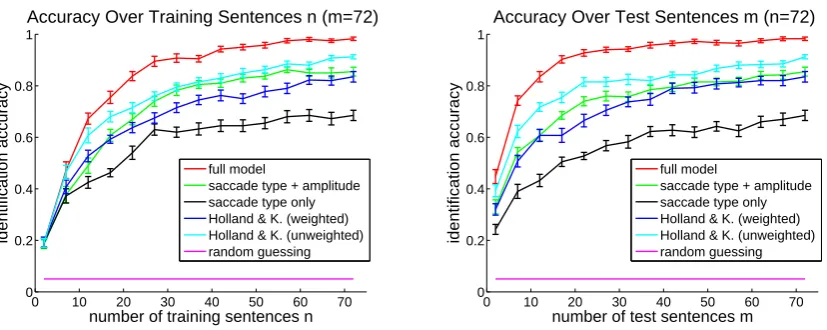
Figure 3 shows identification accuracy as a
function of the number n of training sentences
used to estimate model parameters (left) and as a function of the numberm of test sentences on which inference of the most likely reader is based (right, cf. Equation 2). The full model achieves up to 98.25% accuracy, significantly outperform-ing the Holland & Komogortsev (2012) baseline (91.25%, without feature weighting) and simpler model variants. All methods perform much better
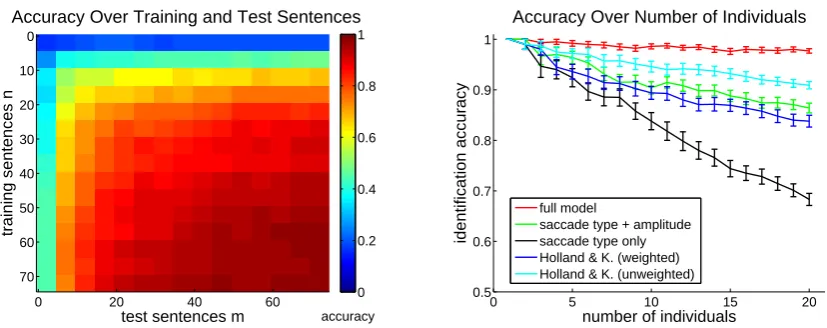
than random guessing. Figure 4 (left) shows iden-tification accuracy as a function of both training sizenand test sizemfor the full model.
We finally study how identification accuracy changes with the number of individuals that have to be distinguished. To this end, we perform the same study as above, but with randomly sampled subsets of the overall set of20individuals. In these experiments, we average over 50 random train-test splits. Figure 4 (right) shows identification ac-curacy as a function of the number of individu-als. We observe that identification accuracy drops with the number of individuals for all methods; our model consistently outperforms the baselines.
6 Conclusions
We have developed a model of individual differ-ences in eye movements during reading, and stud-ied its application in a biometric task. At test time, individuals are identified based on eye movements on novel text. Our approach thus provides poten-tially unobtrusive biometric identification without requiring users to react to a specific stimulus. Em-pirical results show clear advantages over an exist-ing approach for reader identification.
Acknowledgments
References
A. Terry Bahill, Michael R. Clark, and Lawrence Stark. 1975. The main sequence: a tool for studying hu-man eye movements. Mathematical Biosciences, 24:191–204.
Roman Bednarik, Tomi Kinnunen, Andrei Mihaila, and Pasi Fr¨anti. 2005. Eye-movements as a biometric. InProceedings of the 14th Scandinavian Conference on Image Analysis.
W. Robert Dixon. 1951. Studies in the psychology of reading. In W. S. Morse, P. A. Ballantine, and W. R. Dixon, editors, Univ. of Michigan Monographs in Education No. 4. Univ. of Michigan Press.
Ralf Engbert, Antje Nuthmann, Eike M. Richter, and Reinhold Kliegl. 2005. SWIFT: A dynamical model of saccade generation during reading. Psy-chological Review, 112(4):777–813.
Bruno Erdmann and Raymond Dodge. 1898. Psy-chologische Untersuchungen ¨uber das Lesen. Halle: Max Niemeyer.
Tadayoshi Hara, Daichi Mochihashi, Yoshino Kano, and Akiko Aizawa. 2012. Predicting word fixations in text with a CRF model for capturing general read-ing strategies among readers. InProceedings of the First Workshop on Eye-Tracking and Natural Lan-guage Processing.
Julian Heister, Kay-Michael W¨urzner, and Reinhold Kliegl. 2012. Analysing large datasets of eye move-ments during reading. In James S. Adelman, editor, Visual word recognition. Vol. 2: Meaning and con-text, individuals and development, pages 102–130. Corey Holland and Oleg V. Komogortsev. 2012.
Bio-metric identification via eye movement scanpaths in reading. InProceedings of the 2011 International Joint Conference on Biometrics.
Edmund B. Huey. 1908. The psychology and peda-gogy of reading. Cambridge, Mass.: MIT Press. Pawel Kasprowski and Jozef Ober. 2004. Eye
move-ments in biometrics. InProceedings of the 2004 In-ternational Biometric Authentication Workshop. Reinhold Kliegl, Antje Nuthmann, and Ralf Engbert.
2006. Tracking the mind during reading: The in-fluence of past, present, and future words on fix-ation durfix-ations. Journal of Experimental Psychol-ogy: General, 135(1):12–35.
Oleg V. Komogortsev, Sampath Jayarathna, Cecilia R. Aragon, and Mechehoul Mahmoud. 2010. Biomet-ric identification via an oculomotor plant mathemat-ical model. InProceedings of the 2010 Symposium on Eye-Tracking Research & Applications.
Franz Matties and Anders Søgaard. 2013. With blink-ers on: robust prediction of eye movements across readers. InProceedings of the 2013 Conference on Empirical Natural Language Processing.
Mattias Nilsson and Joakim Nivre. 2009. Learning where to look: Modeling eye movements in reading. InProceedings of the 13th Conference on Computa-tional Natural Language Learning.
Keith Rayner. 1998. Eye movements in reading and information processing: 20 years of research. Psy-chological Bulletin, 124(3):372–422.
Erik D. Reichle, Tessa Warren, and Kerry McConnell. 2012. Using e-z reader to model the effects of higher-level language processing on eye movements during reading. Psychonomic Bulletin & Review, 16(1):1–21.
Ioannis Rigas, George Economou, and Spiros Fotopou-los. 2012a. Biometric identification based on the eye movements and graph matching techniques. Pattern Recognition Letters, 33(6).
Ioannis Rigas, George Economou, and Spiros Fotopou-los. 2012b. Human eye movements as a trait for bio-metrical identification. InProceedings of the IEEE 5th International Conference on Biometrics: The-ory, Applications and Systems.
Daniel Schad and Ralf Engbert. 2012. The zoom lens of attention: Simulating shuffled versus normal text reading using the swift model. Visual Cognition, 20(4-5):391–421.