Proceedings of the 2019 Conference on Empirical Methods in Natural Language Processing 1951
Recommendation as a Communication Game:
Self-Supervised Bot-Play for Goal-oriented Dialogue
Dongyeop Kang♥ Anusha Balakrishnan♣ Pararth Shah♣
Paul Crook♣ Y-Lan Boureau♣ Jason Weston♣
♥
Carnegie Mellon University, ♣Facebook AI
[email protected] [email protected]
{pararths,pacrook,ylan,jase}@fb.com
Abstract
Traditional recommendation systems produce static rather than interactive recommendations invariant to a user’s specific requests, clarifi-cations, or current mood, and can suffer from the cold-start problem if their tastes are un-known. These issues can be alleviated by treating recommendation as an interactive di-alogue task instead, where an expert recom-mender can sequentially ask about someone’s preferences, react to their requests, and recom-mend more appropriate items. In this work, we collect a goal-driven recommendation di-alogue dataset (GoRecDial), which consists
of 9,125 dialogue games and 81,260 conver-sation turns between pairs of human workers recommending movies to each other. The task is specifically designed as a cooperative game between two players working towards a quan-tifiable common goal. We leverage the dataset to develop an end-to-end dialogue system that can simultaneously converse and recommend. Models are first trained to imitate the behavior of human players without considering the task goal itself (supervised training). We then fine-tune our models on simulated bot-bot conver-sations between two paired pre-trained mod-els (bot-play), in order to achieve the dialogue goal. Our experiments show that models fine-tuned with bot-play learn improved dialogue strategies, reach the dialogue goal more often when paired with a human, and are rated as more consistent by humans compared to mod-els trained without bot-play. The dataset and code are publicly available through the ParlAI framework1.
1 Introduction
Traditional recommendation systems factorize users’ historical data (i.e., ratings on movies) to extract common preference patterns (Koren et al.,
1https://github.com/facebookresearch/ParlAI
2009;He et al., 2017b). However, besides mak-ing it difficult to accommodate new users because of the cold-start problem, relying on aggregated history makes these systems static, and prevents users from making specific requests, or exploring a temporary interest. For example, a user who usu-ally likes horror movies, but is in the mood for a fantasy movie, has no way to indicate their prefer-ence to the system, and would likely get a recom-mendation that is not useful. Further, they cannot iterate upon initial recommendations with clarifi-cations or modified requests, all of which are best specified in natural language.
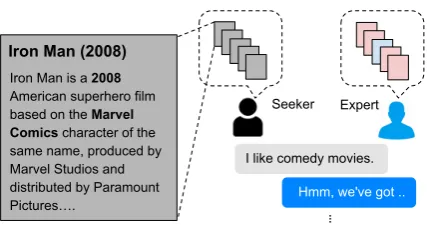
Recommending through dialogue interactions (Reschke et al., 2013; W¨arnestål, 2005) offers a promising solution to these problems, and recent work by Li et al. (2018) explores this approach in detail. However, the dataset introduced in that work does not capture higher-level strategic be-haviors that can impact the quality of the rec-ommendation made (for example, it may be bet-ter to elicit user preferences first, before making a recommendation). This makes it difficult for models trained on this data to learn optimal rec-ommendation strategies. Additionally, the rec-ommendations are not grounded in real observed movie preferences, which may make trained mod-els less consistent with actual users. This paper aims to provide goal-driven recommendation di-alogues grounded in real-world data. We col-lect a corpus of goal-driven dialogues grounded in real user movie preferences through a carefully de-signed gamified setup (see Figure1) and show that models trained with that corpus can learn a suc-cessful recommendation dialogue strategy. The training is conducted in two stages: first, a super-visedphase that trains the model to mimic human behavior on the task; second, abot-playphase that improves the goal-directed strategy of the model.
Hmm, we've got .. I like comedy movies.
...
Iron Man (2008)
Iron Man is a 2008 American superhero film based on the Marvel Comics character of the same name, produced by Marvel Studios and distributed by Paramount Pictures….
[image:2.595.75.289.60.177.2]Seeker Expert
Figure 1: Recommendation as a dialogue game. We collect 81,260 recommendation utterances between pairs of human players (experts and seekers) with a col-laborative goal: the expert must recommend the cor-rect (blue) movie, avoiding incorcor-rect (red) ones, and the seeker must accept it. A chatbot is then trained to play the expert in the game.
(1) We provide the first (to the best of our knowl-edge) large-scale goal-driven recommendation di-alogue dataset with specific goals and reward sig-nals, grounded in a real-world knowledge base. (2) We propose a two-stage recommendation strat-egy learning framework and empirically validate that it leads to better recommendation conversa-tion strategies.
2 Recommendation Dialogue Task
Design
In this section, we first describe the motivation and design of the dialogue-based recommenda-tion game that we created. We then describe the data collection environment and present detailed dataset statistics.
2.1 Dialogue Game: Expert and Seeker
The game is set up as a conversation between a
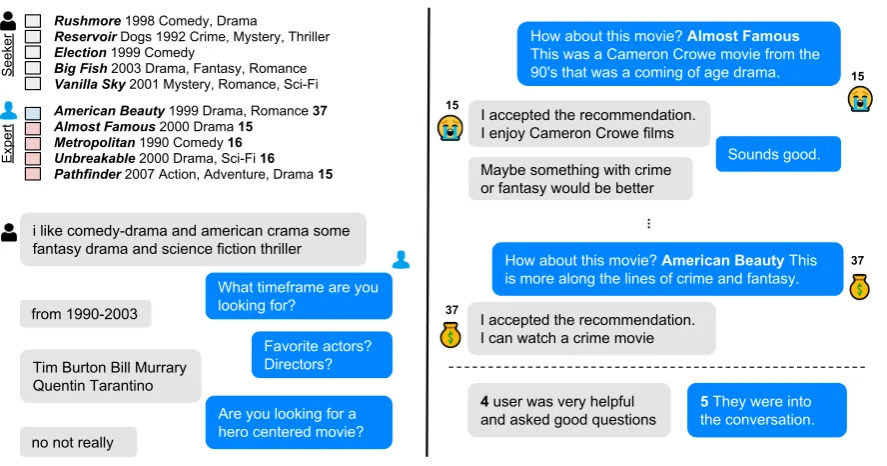
seekerlooking for a movie recommendation, and an expert recommending movies to the seeker. Figure 2shows an example movie recommenda-tion dialogue between two-paired human workers on Amazon Mechanical Turk.
Game Setting. Each worker is given a set of five movies2 with a description (first paragraph from the Wikipedia page for the movie) including im-portant features such as director’s name, year, and
2We deliberately restricted the set of movies to make the task more tractable. One may argue that the expert can sim-ply ask these candidates one by one (at the cost of low en-gagingness). However, this empirically doesn’t happen: ex-perts make on average only 1.16 incorrect movie recommen-dations.
genre. The seeker’s set represents their watching history (movies they are supposed to have liked) for the game’s sake. The expert’s set consists of candidate movies to choose from when making recommendations, among which only one is the
correctmovie to recommend. The correct movie is chosen to be similar to the seeker’s movie set (see Sec.2.2), while the other four movies are dis-similar. The expert is not told by the system which of the five movies is the correct one. The expert’s goal is to find the correct movie by chatting with the seeker and recommend it after a minimal num-ber of dialogue turns. The seeker’s goal is to ac-cept or reject the recommendation from the expert based on whether they judge it to be similar to their set. The game ends when the expert has recom-mended the correct movie. The system then asks each player to rate the other for engagingness.
Justification. Players are asked to provide rea-sons for recommending, accepting, or rejecting a movie, so as to get insight into human recommen-dation strategies3.
Gamification. Rewards and penalties are pro-vided to players according to their decisions, to make the task more engaging and incentivize bet-ter strategies. Bonus money is given if the expert recommends the correct movie, or if the seeker ac-cepts the correct movie or rejects an incorrect one.
2.2 Picking Expert and Seeker movie sets
This section describes how movie sets are selected for experts and seekers.
Pool of movies To reflect movie preferences of real users, our dataset uses the MovieLens dataset4, comprising 27M ratings applied to 58K movies by 280K real users. We obtain descriptive text for each movie from Wikipedia5(i.e., the first paragraph). We also extract entity-level features (e.g., directors, actors, year) using the MovieWiki dataset (Miller et al.,2016) (See Figure1). We fil-ter out less frequent movies and user profiles (see Appendix), resulting in a set of 5,330 movies and 65,181 user profiles with their ratings.
Movie similarity metric In order to simulate a natural setting, the movies in the seeker’s set
3Our model doesn’t utilize this or the engagingness scores for learning, but these are potential future directions.
4 user was very helpful and asked good questions
5 They were into the conversation. Favorite actors?
Directors?
from 1990-2003
Tim Burton Bill Murrary Quentin Tarantino
Are you looking for a hero centered movie?
i like comedy-drama and american crama some fantasy drama and science fiction thriller
What timeframe are you looking for?
no not really
How about this movie? American Beauty This is more along the lines of crime and fantasy.
I accepted the recommendation. I can watch a crime movie I accepted the recommendation. I enjoy Cameron Crowe films
Sounds good.
Maybe something with crime or fantasy would be better 15
Rushmore 1998 Comedy, Drama
Reservoir Dogs 1992 Crime, Mystery, Thriller Election 1999 Comedy
Big Fish 2003 Drama, Fantasy, Romance Vanilla Sky 2001 Mystery, Romance, Sci-Fi
Seeker
Expert
American Beauty 1999 Drama, Romance 37 Almost Famous 2000 Drama 15
Metropolitan 1990 Comedy 16 Unbreakable 2000 Drama, Sci-Fi 16 Pathfinder 2007 Action, Adventure, Drama 15
How about this movie? Almost Famous This was a Cameron Crowe movie from the 90's that was a coming of age drama. 15
...
37
[image:3.595.76.520.63.296.2]37
Figure 2: An example dialogue from our dataset of movie recommendation between two human workers: seeker (grey) and expert (blue). The goal is for the expert to find and recommend the correct movie (light blue) out of incorrect movies (light red) which is similar to the seeker movies. Best viewed in color.
should be similar to each other, and the cor-rect movie should be similar to these, according to a metric that reflects coherent empirical pref-erences. To compute such a metric, we train an embedding-driven recommendation model (Wu et al.,2018).6 Each movie is represented as an em-bedding, which is trained so that embeddings of movies watched by the same user are close to each other. The closeness metric between two movies is the cosine similarity of these trained embeddings. A movie is deemed close to a set of movies if its embedding is similar to the average of the movie embeddings in the set.
Movie Set Selection Using these trained embed-dings, we design seeker and expert sets based on the following criteria (See Figure3):
• Seeker movies (grey) are a set of five movies which are close to each other, chosen from the set of all movies watched by a real user.
• The correct movie (light blue) is close to the av-erage of the five embeddings of the seeker set.
• The expert’s incorrect movies (light red) are far from the seeker set and the correct movie. We filter out movie sets that are too difficult or
[image:3.595.311.515.384.503.2]6We also tried a classical matrix-factorization based rec-ommendation model, which shows comparable performance to the embedding model.
Figure 3: Movie set selection: watched movies for seeker (grey) and correct (light blue)/incorrect (light red) movies for expert.
easy for the recommendation task (see Appendix), and choose 10,000 pairs of seeker-expert movie sets at random.
2.3 Data Collection
For each dialogue game, a movie set is randomly chosen without duplication. We collect dialogues using ParlAI (Miller et al.,2017) to interface with Amazon Mechanical Turk. More details about data collection are included in the Appendix.
Dialogue statistics
Number of dialogues 9,125 Number of utterances 170,904 Number of unique utterances 85,208
Avg length of a dialogue 23.0 Avg duration (minutes) of a dialogue 5.2
Expert’s utterance statistics
Avg utterance length 8.40 Unique tokens 11,757 Unique utterances 40,550
Seeker’s utterance statistics
Avg utterance length 8.47 Unique tokens 10,766 Unique utterances 45,196
Action statistics(all scores are averaged)
# of correct/incorrect recs. by expert 1.0/1.16 # of correct/incorrect decisions by seeker 1.1/1.04
Game statistics(all scores are averaged)
min/max movie scores 12.3/46.0 correct/incorrect movies 39.9/15.0 real game score by expert/seeker 61.3/50.8 random game score by expert/seeker 43.2/38.1
Engagingness statistics(all scores are averaged)
[image:4.595.311.522.59.232.2]engagingness score by expert/seeker 4.3/4.4 engagingness scores & feedback collected 18,308
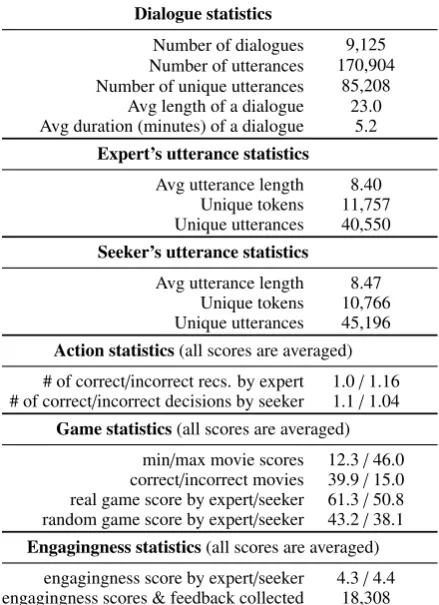
Table 1: Data statistics. “correct/incorrect” in the action stats means that the expert recommends the correct/incorrect movie or the seeker correctly ac-cepts/rejects the movie.
games, and engagingness feedback.
The collected dialogues contain a wide vari-ety of action sequences (recommendations and ac-cept/reject decisions). Experts make an average of 1.16 incorrect recommendations, which indi-cates a reasonable difficulty level. Only 37.6% of dialogue games end at first recommendation, and 19.0% and 10.8% at second and third recommen-dations, respectively.
Figure 4 shows histogram distributions of (a) expert’s decisions between speaking utterance and recommendation utterance and (b) correct and incorrect recommendations over the normalized turns of dialogue. In (a), recommendations in-creasingly occur after a sufficient number of speaking utterances. In (b), incorrect recommen-dations are much more frequent earlier in the dia-logue, while the opposite is true later on.
3 Our Approach
In order to recommend the right movie in the role of the expert, a model needs to combine several perceptual and decision skills. We propose to
con-(a) Decision to speak (-1) or recommend (+1)
(b) Correct (+1) or incorrect (-1) recommendations
Figure 4: Histogram distribution of (a) experts’ deci-sions of whether to speak or recommend and (b) cor-rect/incorrect recommendations over the normalized dialogue turns.
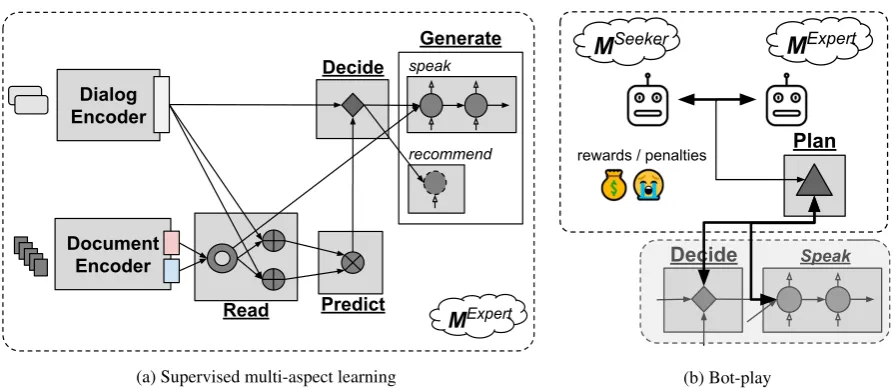
duct learning in two stages (See Figure5): super-vised multi-aspect learningandbot-play.
3.1 Supervised Multi-Aspect Learning
The supervised stage of training the expert model combines three sources of supervision, corre-sponding to the three following subtasks: (1)gen
-eratedialogue utterances to speak with the seeker
in a way that matches the utterances of the human speaker, (2)predictthe correct movie based on the
dialogue history and the movie description repre-sentations, and (3)decidewhether to recommend
or speak in a way that matches the observed deci-sion of the human expert.
Using an LSTM-based model (Hochreiter and Schmidhuber, 1997), we represent the dialogue history contextht of utterancesx1toxt as the
av-erage of LSTM representations of x1,· · ·,xt, and
the description mk of the k-th movie as the
aver-age of the bag-of-word representations7 of its de-scription sentences. Let (xt+1,y,dt+1) denote the
ground truth next utterance, correct movie index, and ground truth decision at timet+1, respectively. We cast the supervised problem as an end-to-end optimization of the following loss:
Lsup=αLgen+βLpredict+(1−α−β)Ldecide, (1)
where α and β are weight hyperparame-ters optimized over the validation set, and
Lpredict,Ldecide,Lgen are negative log-likelihoods
[image:4.595.71.291.64.367.2]Document Encoder
Generate
Dialog Encoder
Predict Decide
Read
speak
recommend
MExpert
(a) Supervised multi-aspect learning
Plan rewards / penalties
Decide Speak
M
ExpertM
Seeker(b) Bot-play
Figure 5: (a) Supervised learning of the expert modelMexpertand (b) bot-play game between the expertMexpert and the seekerMseekermodels. The former imitates multiple aspects of humans’ behaviors in the task, while the later fine-tunes the expert model w.r.t the game goal (i.e., recommending the correct movie).
of probability distributions matching each of the three subtasks:
Lgen =−logpgen(xt+1|ht,m1,· · · ,mK), (2) Lpredict =−logp(y|c1,· · ·,cK), where (3)
cj =ht·mj for j∈1..K, (4) Ldecide= pMLP(dt+1|ht,c1,· · ·,cK), (5)
with pgen the output distribution of an attentive
seq2seq generative model (Bahdanau et al.,2015),
pa softmax distribution over dot productsht·mk
that capture how aligned the dialogue history ht
is with the descriptionmk of thek-th movie, and
pMLP the output distribution of a multi-layer
per-ceptron predictor that takesc1,· · · ,cKas inputs8.
3.2 Bot-Play
Motivated by the recent success of self-play in strategic games (Silver et al.,2017;Vinyals et al.,
2019;OpenAI,2018) and in negotiation dialogues (Lewis et al.,2017), we show in this section how we construct a reward function to perform bot-play between two bots in our setting, with the aim of developing a better expert dialogue agent for recommendation.
Plan optimizes long-term policies of the vari-ous aspects over multiple turns of the dialogue game by maximizing game-specific rewards. We
8We experimented with various other encoding functions, detailed in the Appendix.
first pre-train expert and seeker models individu-ally: the expert model Mexpert(θ) = minθLsup
is pre-trained by minimizing the supervised loss in Eq 1, and the seeker model Mseeker(φ) is a retrieval-based model that retrieves seeker utter-ances from the training set based on cosine sim-ilarity of the preceding dialogue contexts encoded using the BERT pre-trained encoder9. θandφare model parameters of the expert and seeker model, respectively. Then, we make them chat with each other, and fine-tune the expert model by maximiz-ing its reward in the game (See Figure5, Right).
The dialogue game ends if the expert model rec-ommends the correct movie, or a maximum dia-logue length is reached10, yielding T turns of di-alogue; g = (xexpert1 ,x1seeker..xexpertT ,xseekerT ). Let
TREC the set of turns when the expert made a
rec-ommendation. We define the expert’s reward as:
rexpertt = 1
|TREC|
· X
t∈TREC
δt−1·b
t, (6)
where δ is a discount factor11 to encourage ear-lier recommendations, bt is the reward obtained
at each recommendation made, and |TREC| is the
number of recommendations made. bt is 0 unless
the correct movie was recommended.
9See Sec.4.2for details on BERT. We also experimented with sequence-to-sequence models for modeling the seeker but performance was much worse.
[image:5.595.78.526.72.266.2]We define the reward functionRas follows:
R(xt)= X
xt∈Xexpert
γT−t
(rtexpert−µ) (7)
whereµ = 1t P 1..tr
expert
t is the average of the
re-wards received by the expert until time t and γ is a discount factor to diminish the reward of ear-lier actions. We optimize the expected reward for each turn of dialoguext and calculate its gradient
using REINFORCE (Williams, 1992). The final role-playing objectiveLRPis:
∇LRP(θ;z)= X
xt∈Xexpert
Ext[∇logp(xt|x<t)R(xt)]
(8)
We optimize the role-playing objective with the pre-trained expert model’s decision (Ldecide) and
generation (Lgen) objectives at the same time. To
control the variance of the RL loss, we alternate optimizing the RL loss and other two supervised losses for each step. We do not fine-tune the pre-diction loss, in order not to degrade the prepre-diction performance during bot-play.
4 Experiments
We describe our experimental setup in §4.1. We then evaluate our supervised and unsupervised models in §4.2and §4.3, respectively.
4.1 Setup
We select 5% of the training corpus as validation set in our training.
All hyper-parameters are chosen by sweep-ing different combinations and choosing the ones that perform best on the validation set. In the following, the values used for the sweep are given in brackets. Tokens of textual in-puts are lower-cased and tokenized using byte-pair-encoding (BPE) (Sennrich et al., 2016) or the Spacy12 tokenizer. The seq-to-seq model uses 300-dimensional word embeddings initial-ized with GloVe (Pennington et al.,2014) or Fast-text (Joulin et al., 2017) embeddings, [1,2] lay-ers of [256,512]-dimensional Uni/Bi-directional LSTMs (Hochreiter and Schmidhuber,1997) with 0.1 dropout ratio, and soft attention (Bahdanau et al., 2015). At decoding, we use beam search with a beam of size 3, and choose the maxi-mum likelihood output. For each turn, the initial
12https://spacy.io/
movie text and all previous dialogue turns includ-ing seeker’s and expert’s replies are concatenated as input to the models.
Both supervised and bot-play learning use Adam (Kingma and Ba, 2015) optimizer with batch size 32 and learning rates of [0.1,0.01,0.001] with 0.1 gradient clipping. The number of softmax layers (Yang et al.,
2018) is [1,2]. For each turn, the initial movie description and all previous dialogue utterances from the seeker and the expert are concatenated as input text to the other modules. Each movie textual description is truncated at 50 words for efficient memory computation.
We use annealing to balance the different su-pervised objectives: we only optimize the gen
-erate loss for the first 5 epochs, and then
grad-ually increase weights for the predictanddecide
losses. We use the same movie-sets as in the su-pervised phase to fine-tune the expert model. Our models are implemented using PyTorch and Par-lAI (Miller et al.,2017). Code and dataset will be made publicly available through ParlAI13.
4.2 Evaluation of Supervised Models
Metrics. We first evaluate our supervised mod-els on the three supervised tasks: dialogue gener-ation, movie recommendgener-ation, and per-turn deci-sion to speak or recommend. The dialogue gener-ation is evaluated using the F1 score and BLEU (Papineni et al., 2002) comparing the predicted and ground-truth utterances. The F1 score is com-puted at token-level. The recommendation model is evaluated by calculating the percentage of times the correct movie is among the top k recommenda-tions (hit@k). In order to see the usefulness of di-alogue for recommendation, precision is measured per each expert turn of the dialogue (Turn@k) re-gardless of the decision to speak or recommend, and at the end of the dialogue (Chat@k).
Models. We compare our models with In-formation Retrieval (IR) based models and recommendation-only models. The IR models re-trieve the most relevant utterances from the set of candidate responses of the training data and rank them by comparing cosine similarities using TFIDF features or BERT (Devlin et al.,2019) en-coder features. Note that IR models make no rec-ommendation. The recommendation-only models
Generation Recommendation Decision
F1 BLEU Turn@1 Turn@3 Chat@1 Chat@3 Acc
Baseline
TFIDF-Ranker 32.5 27.8 - - - -
-BERT-Ranker 38.3 23.9 - - -
-RandomRecc. 3.6 0.1 21.3 59.2 23.1 62.2
-BERT Recc. 16.5 0.2 25.5 66.3 26.4 68.3
-Ours
Generate 39.5 26.0 - - - -
-+predict 40.2 26.4 76.4 96.9 75.7 97.0
-+Decide 41.0 27.4 77.8 97.1 78.2 97.7 67.6
[image:7.595.99.498.64.220.2]+Plan 40.9 26.8 76.3 95.7 77.5 97.6 53.6
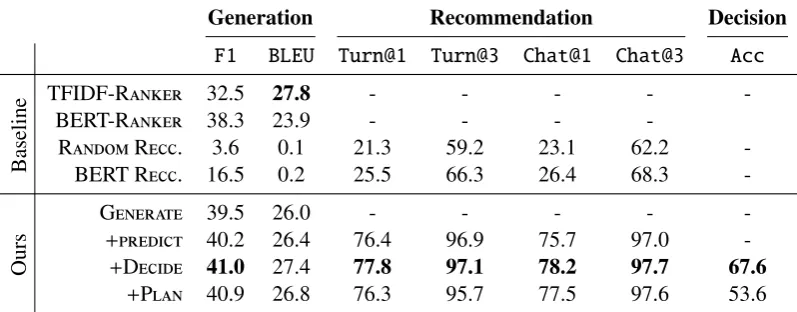
Table 2: Evaluation on supervised models. We incrementally add different aspects of modules: Generate,predict, and Decidefor supervised multi-aspect learning and Planfor bot-play fine-tuning.
always produce recommendation utterances fol-lowing the template (e.g., “how about this movie, [MOVIE]?”) where the [MOVIE] is chosen ran-domly or based on cosine similarities between di-alogue contexts and the text descriptions of can-didate movies. We use the pre-trained BERT en-coder (Devlin et al.,2019) to encode dialogue con-texts and movie text descriptions.
We incrementally add each module to our base
Generate model: Predict and Decide for
super-vised learning and Planfor bot-play fine-tuning.
Each model is chosen from the best model in our hyper-parameter sweeping.
Results. Table 2 shows performance compari-son on the test set. Note that only the full super-vised model (+Decide) and the fine-tuned model
(+Plan) can appropriately operate every function
required of an expert agent such as producing ut-terances, recommending items, and deciding to speak or recommend.
Compared to recommendation-only models, our prediction Predict modules show significant
improvements over the recommendation baselines on both per-turn and per-chat recommendations: 52% onTurn@1and 34% [email protected] are always higher than Turn, indicating that rec-ommendations get better as more dialogue context is provided. The Decidemodule yields additional
improvements over the Predictmodel in both
gen-eration and recommendation, with 67.6% decision accuracy, suggesting that the supervised signal of decisions to speak or recommend can contribute to better overall representations.
In generation, our proposed models show com-parable performance as the IR baseline models
(e.g., BERTRanker). The +Decide model
im-proves on the F1 generation score because it learns when to predict the templated recommendation ut-terance.
As expected, +Plan slightly hurts most
met-rics of supervised evaluation, because it optimizes a different objective (the game objective), which might not systematically align with the supervised metrics. For example, a system optimized to max-imize game objective should try to avoid incor-rect recommendations even if humans made them. Game-related evaluations are shown in §4.3.
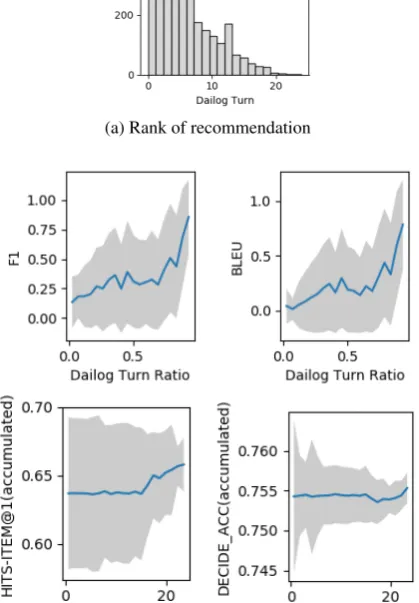
Analysis We analyze how each of the supervised modules acts over the dialogue turns on the test set. Figure 6 (a) shows a histogram of the rank of the ground-truth movie over turns. The rank of the model’s prediction is very high for the first few turns, then steadily decreases as more utter-ances are exchanged with the seeker. This indi-cates that the dialogue context is crucial for find-ing good recommendations.
The evolution of generation metrics (F1,BLEU) for each turn is shown at the top of Fig.6(b), and the (accumulated) recommendation and decision metrics (Turn@1/Accuracy) at the bottom14. The accumulated recommendation and decision per-formance sharply rises at the end of the dialogue and variance decreases. The generation perfor-mance increases, because longer dialogue contexts helps predict the correct utterances.
(a) Rank of recommendation
(b)F1/BLEU(top) &Turn@1/DecisionAcc(bottom)
Figure 6: Analysis of the expert’s model: as the di-alogue continues (x-axis is either fraction of the full dialogue, or index of dialogue turn), y-axis is (a) rank of the correct recommendation (the lower rank, the bet-ter) and (b)F1/BLEU/Turn@1/DecisionAccuracy(the higher the better) with the variance shown in grey.
4.3 Evaluation on Dialogue Games
Metrics. In the bot-play setting, we provide game-specific measures as well as human evalu-ations. We use three automatic game measures: Goal to measure the ratio of dialogue games where the goal is achieved (i.e., recommending the correct movie or not),Scoreto measure the total game score, and Turn2Gto count the number of dialogue turns taken until the goal is achieved.
We conduct human evaluation by making the expert model play with human seekers. We
mea-sure automatic metrics as well as dialogue qual-ity scores provided by the player: fluency, con-sistency, and engagingness (scored between 1 and 5) (Zhang et al., 2018). We use the full test set (i.e., 911 movie sets) for bot-bot games and use 20 random samples from the test set for{bot,human} -human games.
Models. We compare our best supervised model with several variants of our fine-tuned bot-play models. We consider bot-play of an expert model with different seeker models such as BERT-Ranker based seeker and Seq-to-Seq based seeker. Each bot-play model is trained on the same train set that is used for training the original supervised model. The seeker model uses retrieval based on BERT pretrained representations of dialogue con-text (BERT-R)15.
Players Automatic Human
Expert Seeker Goal Sco T2G F C E
Supervised∗ BERT
-R 30.9 38.3 1.4 - - -Bot-play\w S2S BERT-R 42.1 49.6 2.8 - - -Bot-play\wBERT-RBERT-R 48.6 52.4 3.2 - -
-Supervised∗
Human 55.0 51.2 2.1 3.1 2.22.0
Bot-play∗
Human 68.5 54.7 3.1 3.2 2.6 2.0
[image:8.595.77.287.178.480.2]Human Human 95.0 64.3 8.5 4.8 4.7 4.2
Table 3: Evaluation on dialogue recommendation games: bot-bot (top three rows) and {bot,human} -human (bottom three rows). We use automatic game measures (Goal,Score,Turn2Goal) and human qual-ity ratings (Fluency,Consistency,Engagingness).
Results. Compared to the supervised model, the self-supervised model fine-tuned by seeker mod-els shows significant improvements in the game-related measures. In particular, theBERT-R model shows a+27.7% improvement in goal success ra-tio. Interestingly, the number of turns to reach the goal increases from 1.4 to 3.2, indicating that con-ducting longer dialogues seems to be a better strat-egy to achieve the game goal throughout our role-playing game.
In dialogue games with human seeker players, the bot-play model also outperforms the super-vised one, even though it is still far behind human performance. When the expert bot plays with the human seeker, performance increases compared to
[image:8.595.307.527.314.422.2]playing with the bot seeker, because the human seeker produces utterances more relevant to their movie preferences, increasing overall game suc-cess.
5 Related Work
Recommendation systems often rely on matrix factorization (Koren et al.,2009;He et al.,2017b). Content (Mooney and Roy, 2000) and social re-lationship features (Ma et al., 2011) have also been used to help with the cold-starting problem of new users. The idea of eliciting users’ pref-erence for certain content features through dia-logue has led to several works. W¨arnestål(2005) studies requirements for developing a conversa-tional recommender system, e.g., accumulation of knowledge about user preferences and database content. Reschke et al.(2013) automatically pro-duces template-based questions from user reviews. However, no conversational recommender sys-tems have been built based on these works due to the lack of a large publicly available corpus of hu-man recommendation behaviors.
Very recently,Li et al.(2018) collected the Re
-Dial dataset, comprising 10K conversations of
movie recommendations, and used it to train a generative encoder-decoder dialogue system. In this work, crowdsource workers freely talk about movies and are instructed to make a few movie recommendations before accepting one. Com-pared to ReDial, our dataset is grounded in real
movie preferences (movie ratings from Movie-Lens), instead of relying on workers’ hidden movie tastes. This allows us to make our task goal-directed rather than chit-chat; we can optimize prediction and recommendation strategy based on a known ground truth, and train the predict and plan modules of our system. That in turn allows
for novel setups such as bot-play.
To the best of our knowledge, Bordes et al.
(2016) is the only other goal-oriented dialogue benchmark grounded in a database that has been released with a large-scale publicly available dataset. Compared to that work, our database is made of real (not made-up) movies, and the choice of target movies is based on empirical distances between movies and movie features instead of be-ing arbitrary. This, combined with the collabora-tive set-up, makes it possible to train a model for the seeker in the bot-play setting.
Our recommendation dialogue game is
collabo-rative. Other dialogue settings with shared objec-tives have been explored, for example a collabora-tive graph prediction task (He et al.,2017a), and semi-cooperative negotiation tasks (Lewis et al.,
2017;Yarats and Lewis,2018;He et al.,2018).
6 Conclusion and Future Directions
In conclusion, we have posed recommendation as a goal-oriented game between an expert and a seeker, and provided a framework for both training agents in a supervised way by learning to mimic a large set of collected human-human dialogues, as well as by bot-play between trained agents. We have shown that a combination of the two stages leads to learning better expert recommenders.
Our results suggest several promising direc-tions. First, we noted that the recommendation performance linearly increases as more dialogue context is provided. An interesting question is how to learn to produce the best questions that will result in the most informative dialogue context.
Second, as the model becomes better at the game, we observe an increase in the length of di-alogue. However, it remains shorter than the aver-age length of human dialogues, possibly because our reward function is designed to minimize it, which worked better in experiments. A potential direction for future work is to study how different game objectives interact with each other.
Finally, our evaluation on movie recommen-dation is made only within the candidate set of movies given to expert. Future work should eval-uate if our training scheme generalizes to a fully open-ended recommendation system, thus making our task not only useful for research and model development, but a useful end-product in itself.
Acknowledgements
We thank Eduard Hovy, Alan W Black, Dan Ju-rafsky, Alan Ritter, and anonymous reviewers for their helpful comments.
References
Dzmitry Bahdanau, Kyunghyun Cho, and Yoshua Ben-gio. 2015. Neural machine translation by jointly learning to align and translate. InICLR.
Danqi Chen, Adam Fisch, Jason Weston, and Antoine Bordes. 2017. Reading wikipedia to answer open-domain questions. InACL.
Jacob Devlin, Ming-Wei Chang, Kenton Lee, and Kristina Toutanova. 2019. Bert: Pre-training of deep bidirectional transformers for language understand-ing. InNAACL.
He He, Anusha Balakrishnan, Mihail Eric, and Percy Liang. 2017a. Learning symmetric collaborative di-alogue agents with dynamic knowledge graph em-beddings. InACL.
He He, Derek Chen, Anusha Balakrishnan, and Percy Liang. 2018. Decoupling strategy and generation in negotiation dialogues. InProceedings of the 2018 Conference on Empirical Methods in Natural Lan-guage Processing, pages 2333–2343, Brussels, Bel-gium. Association for Computational Linguistics.
Xiangnan He, Lizi Liao, Hanwang Zhang, Liqiang Nie, Xia Hu, and Tat-Seng Chua. 2017b. Neural collab-orative filtering. InWWW.
Sepp Hochreiter and J¨urgen Schmidhuber. 1997. Long short-term memory. Neural computation, 9(8):1735–1780.
Armand Joulin, Edouard Grave, Piotr Bojanowski, and Tomas Mikolov. 2017. Bag of tricks for efficient text classification. InEACL.
Diederik P. Kingma and Jimmy Ba. 2015. Adam: A method for stochastic optimization. InICLR.
Yehuda Koren, Robert M. Bell, and Chris Volinsky. 2009. Matrix factorization techniques for recom-mender systems.Computer, 42.
Mike Lewis, Denis Yarats, Yann Dauphin, Devi Parikh, and Dhruv Batra. 2017. Deal or no deal? end-to-end learning for negotiation dialogues. InEMNLP.
Raymond Li, Samira Ebrahimi Kahou, Hannes Schulz, Vincent Michalski, Laurent Charlin, and Chris Pal. 2018. Towards deep conversational recommenda-tions. InNIPS, pages 9725–9735.
Hao Ma, Dengyong Zhou, Chao Liu, Michael R. Lyu, and Irwin King. 2011. Recommender systems with social regularization. InWSDM.
Kanti V Mardia. 1970. Measures of multivariate skew-ness and kurtosis with applications. Biometrika, 57(3):519–530.
Alexander H. Miller, Will Feng, Dhruv Batra, Antoine Bordes, Adam Fisch, Jiasen Lu, Devi Parikh, and Jason Weston. 2017. Parlai: A dialog research soft-ware platform. InEMNLP.
Alexander H. Miller, Adam Fisch, Jesse Dodge, Amir-Hossein Karimi, Antoine Bordes, and Jason We-ston. 2016. Key-value memory networks for directly reading documents. InEMNLP.
Raymond J Mooney and Loriene Roy. 2000. Content-based book recommending using learning for text categorization. InProceedings of the fifth ACM con-ference on Digital libraries, pages 195–204. ACM.
OpenAI. 2018. Openai five. https://blog. openai.com/openai-five/.
Kishore Papineni, Salim Roukos, Todd Ward, and Wei-Jing Zhu. 2002. Bleu: a method for automatic eval-uation of machine translation. InACL.
Jeffrey Pennington, Richard Socher, and Christopher Manning. 2014. Glove: Global vectors for word representation. InEMNLP.
Kevin Reschke, Adam Vogel, and Daniel Jurafsky. 2013. Generating recommendation dialogs by ex-tracting information from user reviews. InACL.
Rico Sennrich, Barry Haddow, and Alexandra Birch. 2016. Neural machine translation of rare words with subword units. InACL.
David Silver, Julian Schrittwieser, Karen Simonyan, Ioannis Antonoglou, Aja Huang, Arthur Guez, Thomas Hubert, Lucas Baker, Matthew Lai, Adrian Bolton, et al. 2017. Mastering the game of go with-out human knowledge. Nature, 550(7676):354.
Oriol Vinyals, Igor Babuschkin, Junyoung Chung, Michael Mathieu, Max Jaderberg, Wojciech M. Czarnecki, Andrew Dudzik, Aja Huang, Petko Georgiev, Richard Powell, Timo Ewalds, Dan Hor-gan, Manuel Kroiss, Ivo Danihelka, John Agapiou, Junhyuk Oh, Valentin Dalibard, David Choi, Lau-rent Sifre, Yury Sulsky, Sasha Vezhnevets, James Molloy, Trevor Cai, David Budden, Tom Paine, Caglar Gulcehre, Ziyu Wang, Tobias Pfaff, Toby Pohlen, Yuhuai Wu, Dani Yogatama, Julia Cohen, Katrina McKinney, Oliver Smith, Tom Schaul, Tim-othy Lillicrap, Chris Apps, Koray Kavukcuoglu, Demis Hassabis, and David Silver. 2019. AlphaStar: Mastering the Real-Time Strategy Game StarCraft II. https://deepmind.com/blog/ alphastar-mastering-real-time-strategy-game-starcraft-ii/.
Pontus W¨arnestål. 2005. Modeling a dialogue strat-egy for personalized movie recommendations. In Beyond Personalization Workshop, pages 77–82.
Ronald J Williams. 1992. Simple statistical gradient-following algorithms for connectionist reinforce-ment learning. Machine learning, 8(3-4):229–256.
Ledell Yu Wu, Adam Fisch, Sumit Chopra, Keith Adams, Antoine Bordes, and Jason Weston. 2018. Starspace: Embed all the things! InAAAI.
Zhilin Yang, Zihang Dai, Ruslan R. Salakhutdinov, and William W. Cohen. 2018. Breaking the softmax bot-tleneck: A high-rank rnn language model. InICLR.